Floods have been the most common type of disaster globally, responsible for almost one-half of all victims of natural disasters and for economic losses of nearly US $185 billion during the past decade.1 Flood events are expected to increase in frequency and intensity due to rising sea levels and more frequent and extreme precipitation events as climate change continues.Reference Parry, Canziani, Palutikof, van der Linden and Hanson2 Increasing levels of urbanization may expose more people to flooding events,Reference Du, Fitzgerald and Clark3 increasing the global burden of disease, morbidity, mortality, and social and economic disruptions and placing pressure on health services.Reference Ahern, Kovats and Wilkinson4 These health impacts can depend on geographic and socioeconomic factors, as well as population vulnerability.Reference Du, Fitzgerald and Clark3, Reference Ahern, Kovats and Wilkinson4 For instance, it has been observed in previous flooding disasters that direct trauma exposure,Reference Reacher, McKenzie and Lane5-Reference Neria, Nandi and Galea12 female gender,Reference Mason, Andrews and Upton9, Reference Liu, Tan and Zhou10 and older ageReference Liu, Tan and Zhou10, Reference Sharma, Weiss and Young13-Reference Brunkard, Namulanda and Ratard15 can increase the odds of negative health outcomes after floods. Effective policies to reduce and prevent flood-related morbidity and mortality are contingent on comprehensive impact assessments of the affected populations, and policies will be more effective if they are based on location-specific evidence.Reference Du, Fitzgerald and Clark3
In December 2010 and January 2011, the Australian state of Queensland experienced its largest rainfall event since 1974. The resultant flooding claimed the lives of 35 people through drowning in the floodwaters, and caused damage to more than 29 000 homes and businesses; the estimated total economic losses were more than $5 billion.16 The floods severely affected more than 78% of the state, and had an impact on more than 2.5 million people. In particular, the floods had a significant impact on South East Queensland, including the state capital of Brisbane.17 The Brisbane river peaked at 4.46 m, which caused significant flooding throughout the city.
Given the devastation caused by these floods, and the climate projections of an increasing frequency of such events in the future, research of the health impacts of floods is needed to improve disaster management and response planning. We conducted a community-based survey from July to August 2011 to assess the effects of recent floods on both the physical and mental health of residents in Brisbane.
Methods
Study Population
Residents of 12 electorates (Blair, Bonner, Brisbane, Griffith, Groom, Lilley, Moreton, Oxley, Petrie, Rankin, Ryan, and Wright) identified as having been affected by the flooding were sampled. The names and addresses of individuals were obtained from the Australian Electoral Commission database for Queensland. A random representative sample of 3000 residents (18 years and older) from these electorates was drawn from the database. Because each electorate contained neighborhoods that were directly and indirectly (eg, neighbors suffered direct impact of the flood, surrounding roads were cut off) affected by the floods, individuals who did not feel directly affected were treated as a comparison group.
Data Collection
An invitation letter was sent to all selected residents 2 weeks before the survey was sent. The letter explained the purpose of the survey and what was involved in its participation. The main questionnaire, accompanied by a participant letter and prepaid reply envelope (survey package), was mailed to all potential participants (ie, those who did not decline participation or whose mail was not returned to sender) on July 22. A reminder postcard was mailed 1 week later to all participants who received the survey questionnaire but had not responded. Finally, 3 weeks after mailing the reminder, a replacement survey package was sent to all nonrespondents. Ethical approval for this study was obtained from the Human Research Ethics Committee of the Queensland University of Technology.
Exposure Measures
The impact of flooding on households was recorded by the general question, “Has your household been directly impacted by the 2011 floods?” Direct impact was defined as the house or apartment where the resident lived (including any of the following: living area, outside property, and/or vehicles) has been affected by the flood waters. Specific questions were also asked regarding the extent of impact, including damage to outside property, living space, removal of parts of household, damage to vehicles, and friends or relative moving in for at least 48 hours as a result of the floods.
Outcome Measures
Standard epidemiologic instruments for assessing mental health were employed. The Kessler 6 scaleReference Kessler, Barker and Colpe18 and the posttraumatic stress disorder-civilian checklist (PCL-C)Reference Weathers, Litz and Huska19 have been validated and applied in numerous studies conducted in Australia. The Groninger Sleep Quality Scale (GSQS) has been used to assess patients suffering from seasonal depression disorder, shift workers in population-based studies in Finland,Reference Leppämäki, Meesters and Haukka20 and survivors of a firework disaster in the Netherlands.Reference van Kamp, van der Velden and Stellato21 Psychosocial impact was measured through psychological distress (short version of Kessler 10, Kessler 6, scored 8 or above), probable posttraumatic stress disorder (PTSD) (PCL-C scale, scored 44 or above), and sleep quality (GSQS 10-item version, scored 3 or higher on selected postflood items). In addition, both general health and respiratory health were assessed with pre- and postquestions designed by the researchers. Perceived general and respiratory health was assessed with a 5-point Likert scale to the following question: “Compared to before the recent floods, how would you rate your overall health/breathing now?”
Covariates
Sociodemographic variables that have been reported previously to mediate the relationship between flood exposure and psychosocial health outcomes were also measured. These included age and gender,Reference Mason, Andrews and Upton9, Reference Liu, Tan and Zhou10 socioeconomic status (measured through education and employment),Reference Assanangkornchai, Tangboonngam and Edwards6, Reference Norris, Murphy and Baker7, Reference Assanangkornchai, Tangboongam and Sam-angsri22 and existing medical problems.Reference Reacher, McKenzie and Lane5, Reference Heo, Kim and Koh8 The last was assessed with a binary response (Yes/No) to the following question: “Do you suffer from any of the following conditions: cardiovascular disease, high blood pressure, diabetes, alcoholism, chronic kidney disease, liver disease, neurological disease, respiratory disease, cancer, depression, dementia, infectious disease, injury, arthritis and other muscular conditions, or physical disability?” In addition, home ownership status (rent or own) was assessed with the following question “Do you rent or own the house/apartment you live in?”
Statistical Analyses
Descriptive analysis was undertaken for each variable. We compared the prevalence of perceived general (including respiratory health) and mental health symptoms including general psychological distress, PTSD, and sleep quality between flooded and nonflooded populations. The Kruskal–Wallis test, a common nonparametric test used to evaluate associations between multiple categorical variables, was used to detect associations between the outcome and independent variables. Multivariable logistic regression was used to assess the effect of reported flood impact on residents’ perceived physical and mental health after adjusting for the following variables: gender, age, employment status, education, whether the person rented or owned their place of residence, and the presence of 1 or more existing medical problems. To compare the results, analysis was also performed by replacing employment and education with income. Little difference was found in the results, however, so employment and education were used. All analyses were conducted in SAS V9.2.
Results
Response Rate
We mailed invitations to 3000 residents, and received back 960 completed survey questionnaires (32% response rate). Of 2040 individuals who did not complete the survey, the reasons for nonparticipation were known for less than 15% (306 people). Reasons included undeliverable mail (5.9%), active refusal due to lack of interest or feeling that the study was irrelevant (5.8%), and temporary unavailability due to age, sickness, travel, or other reasons, including death (1.5%). A blank survey was returned by 46 (1.5%) people.
Characteristics of Respondents
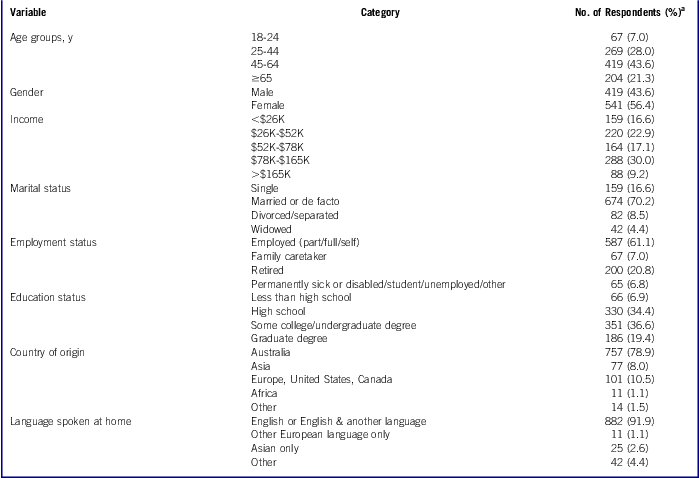
Women constituted 52% of the study sample, and were slightly more likely than men to participate in the survey (38% of all approached women vs 33% of all men participated) (Table 1). The mean age of respondents was 51 years (SD = 16.5 years); those aged 45 years and older were overrepresented (65%) among the respondents.
Characteristics of Survey Respondents (N = 960)

aPercentages in some variables do not total 100% due to missing values.
Impact of Flooding
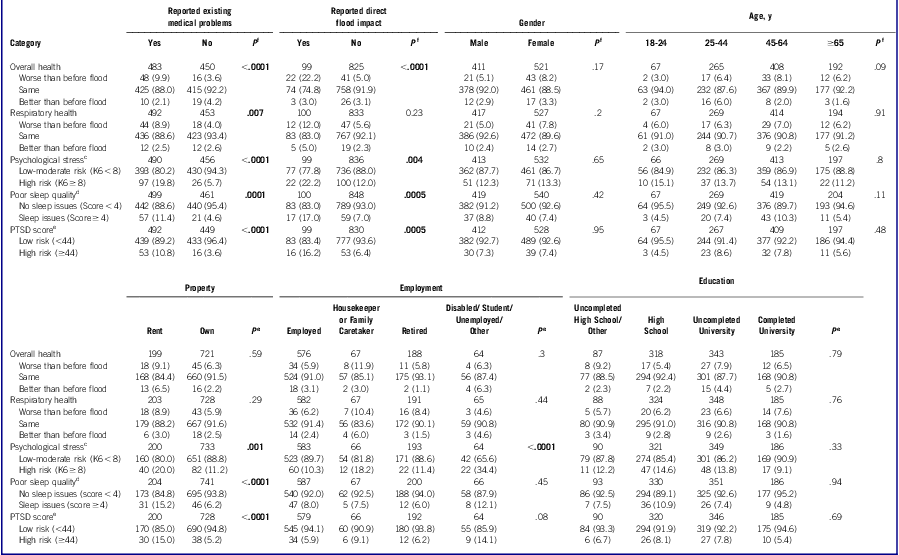
The descriptive results show that adverse perceived physical and mental health outcomes were associated with reported direct flood impact and the presence of existing health problems (Table 2).
Number of Respondents (%, rounded)Footnote a Reporting Physical and Mental Health Outcomes According to Different CovariatesFootnote b
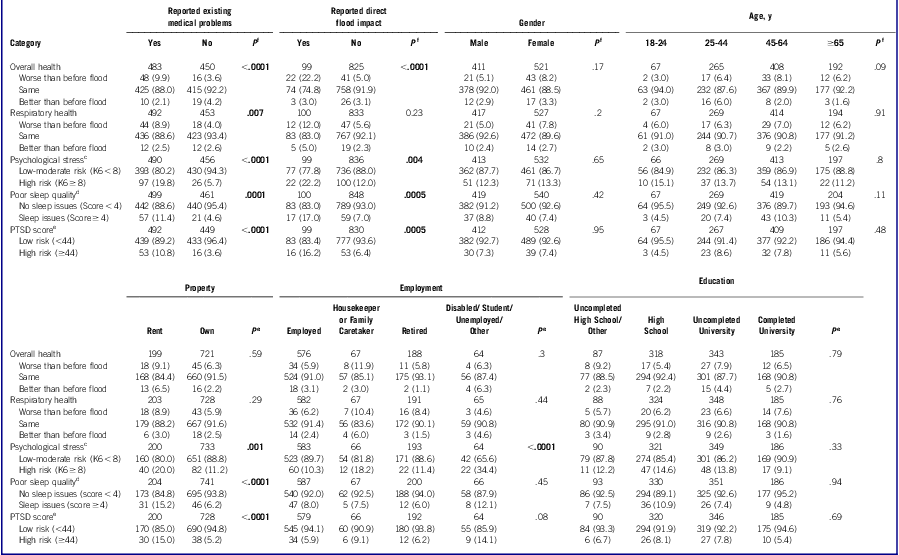
a Missing values excluded.
b P value of Kruskal-Wallis test for significant association between row and column classifications of each variable combination.
c Kessler scale.
d Groninger Sleep Quality Scale.
e Posttraumatic stress disorder-civilian checklist (PTSD; PCL–C) scale.
f Significant at .05 level.
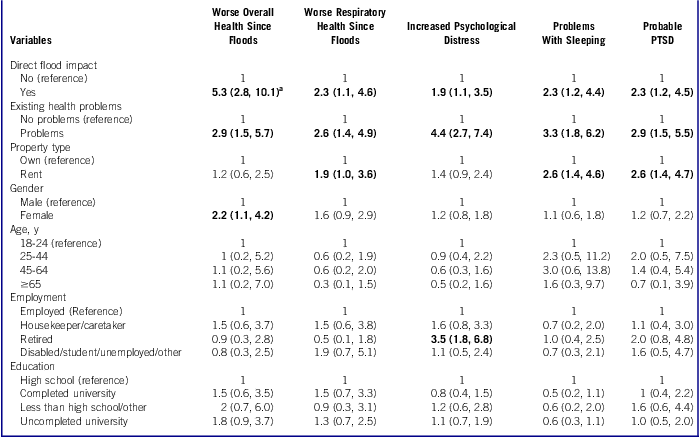
Direct flood impact was a significant risk factor for poor reported general and mental health status, even after adjusting for gender, age, employment, education, and the existence of current health problems (Table 3). People who reported direct flood impact also tended to report worse overall health (Odds Ratio [OR] 5.3; 95% CI, 2.8-10.1) and respiratory health (OR 2.3; 95% CI, 1.1-4.6), higher psychological distress (OR 1.9; 95% CI, 1.1-3.5), more problems with sleeping (OR 2.3; 95% CI, 1.2-4.4), and a higher probability of PTSD (OR 2.3; 95% CI, 1.2-4.5).
Association Between Health Outcomes and Direct Flood Impact, Existing Medical Problems and Sociodemographic Variables
aOdds ratios and 95% CI. Values are adjusted for all variables in table.
In terms of important subgroups of the population, respondents with underlying health problems were more likely to report worse overall (OR 2.9; 95% CI, 1.5-5.7) and respiratory (OR 2.6; 95% CI, 1.4-4.9) health, suffering increased psychological distress (OR 4.4; 95% CI, 2.7-7.4), problems with sleeping (OR 3.3; 95% CI, 1.8-6.2), and probable PTSD (OR 2.9; 95% CI, 1.5-5.5). Female respondents reported worse overall health postflood as compared to male respondents (OR 2.2; 95% CI, 1.1-4.2). Also, renters, as compared to home owners, were more likely to report worse respiratory health, along with sleeping problems (OR 2.6; 95% CI, 1.4-4.6) and probable PTSD (OR 2.6; 95% CI, 1.4-4.7). Age and socioeconomic status (measured via both employment and education level and income) had little effect on health outcomes.
Discussion
To our knowledge, this was the first study to assess the health impacts of the 2011 floods in the greater Brisbane area through a community-based survey. We found that direct flood impact had significant effects on both perceived physical and mental health outcomes among residents in flood-affected areas.
Our results confirmed previous findings that reported elevated physical and mental health problems for those who had experienced direct flood impact. For instance, in agreement with a UK study,Reference Carroll, Balogh and Morbey23 we found that affected residents experienced negative general health symptoms. In other studies of communities in England that were affected by flooding, a 2- to 5-fold increased prevalence of mental health symptoms was found in people whose houses were flooded versus control subjects.Reference Reacher, McKenzie and Lane5, Reference Paranjothy, Gallacher and Amlôt24 Similarly, we found that reporting a direct flood impact was associated with at least a 2-fold increased risk, measured via sleep disturbance, general psychological distress, and symptoms of probable PTSD.
Flood exposure in this study was measured through questions about the level of perceived flood impact on the household. Other authors have noted that perceived health concerns related to floods may be as important a predictor of elevated psychological health outcomes as actual flood damage.Reference Paranjothy, Gallacher and Amlôt24 While it was beyond the scope of this study to conduct an objective assessment of flood-related household damage, future research should measure flood impact through both objective (ie, a physical household damage survey) and subjective (ie, assessment of perceived impact) measures.
Consistent with earlier findings, our study revealed that health outcomes may be exacerbated for various subgroups of the population.Reference Reacher, McKenzie and Lane5-Reference Neria, Nandi and Galea12, Reference Brunkard, Namulanda and Ratard15, Reference Arrieta, Foreman and Crook25, Reference Fewtrell and Kay26 In particular, women and individuals with poor baseline health are at higher risk of worse health outcomes following floods. We found that respondents with underlying health conditions reported worse general and respiratory health, as well as psychological distress, problems with sleeping, and symptoms of PTSD.
In addition, previous studies have revealed that the inability to maintain stable medication intake during flood events may be a contributing factor to flood-related worse health outcomes.Reference Tomio, Sato and Mizumura14, Reference Arrieta, Foreman and Crook25 It was also observed that renters, as opposed to home owners, reported worse respiratory health postflood, and were almost 3 times more likely to suffer from sleep problems and symptoms of probable PTSD. While the focus herein was on the health effects of direct flood impact, these findings indicate that further studies should examine the relationship between health outcomes following floods and factors such as home ownership status, neighborhood, and type of dwelling, as well as preexisting medical conditions.
Limitations
Limitations of the study should be acknowledged. First, the survey was conducted 6 months after the flood, and therefore the results may not reflect longer term (ie, greater than 6 months) health impacts. Second, selection bias may be an issue if only individuals who felt most affected chose to respond to the survey. However, while the questionnaire was sent to flood-affected areas, only about 12% of respondents reported being directly affected by flooding. Those who were affected by the floods may therefore be under-represented. Third, the information used in this study was based solely on self-reported data. Thus information bias was inevitable to some extent. Fourth, the extent of direct trauma, a major risk factor for worse health outcomes after floods, was only partially assessed. Indirect exposures (ie, witnessing the flooding of a neighborhood, media coverage of events, economic loss, impact on a respondent's relationships), other flood-related health outcomes such as earache and gastrointestinal problemsReference Fewtrell and Kay26 and infectionsReference Tapsell, Penning-Rowsell and Tunstall27 were not assessed. Finally, the extent and type of coping strategies employed by the community,Reference Mason, Andrews and Upton9 and the relationship between these and the reported health outcomes were not assessed. Moreover, as data relating to the total flood-impacted population was unavailable, we were unable to make comparisons with the total impacted population.
Conclusions
The results of our study confirm that, in the 6 months after the 2011 Queensland floods, flood-related damage was found to have a significant negative effect on the perceived general, respiratory, and mental health of affected residents. These findings may have important implications for public health policy, suggesting that to mitigate the health impacts of floods, appropriate care and monitoring should be provided to all those who have been or otherwise have felt affected by the floods. The results underscore the importance of targeting public health messages before, during, and after flood events to all members of the general public, particularly those groups (eg, women, individuals with underlying medical conditions, and renters) that are at a higher risk of worse health outcomes.
While most short-term health impacts of floods are well documented in this and other studies, longer-term impacts need to be better understood.Reference Du, Fitzgerald and Clark3, Reference Ahern, Kovats and Wilkinson4, Reference Norris, Murphy and Baker7, Reference Vachiramon, Busaracome and Chongtrakool28 We recommend that repeated assessments be conducted in this study population to understand changes in health outcomes over time.
In the next 20 years, Australia and many other parts of the world are likely to experience an increased frequency of extreme weather events such as floods. Populations located in coastal and lowland areas are particularly vulnerable to extreme weather events. As these areas become more urbanized, more frequent flooding threatens health by affecting access to safe drinking water, secure shelter, and public health infrastructure. These events directly and indirectly contribute to increased morbidity and mortality. Understanding the short- and long-term health impacts of floods and identifying communities most at risk remain imperative. The results of this study may therefore help improve the resilience of populations to cope with the impacts of future flood events, particularly in terms of mental health effects, through the development of appropriate surveillance strategies within existing public health and disaster management programs.Reference Alderman, Turner and Tong29
Acknowledgments
The study was supported partly by funds from the Australian Research Council (DP1095752) (to S.T.); and by NHMRC Research Fellowship (#553043) (to S.T.). Irene van Kamp, PhD, and her colleagues, Center for Environmental Research, National Institute for Public Health and Environment (RIVM), Bilthoven, the Netherlands, advised in the design of the survey instruments used in this study to assess physical and mental health.