Introduction
Urinary problems are important in stroke management. Urinary incontinence (UI) has previously been shown to be strongly associated with mortality, dependency, and need for institutional care (Anderson, Jamrozik, Broadhurst, & Stewart-Wynne, Reference Anderson, Jamrozik, Broadhurst and Stewart-Wynne1994; Kolominsky-Rabas, Hilz, Neundoerfer, & Heuschmann, Reference Kolominsky-Rabas, Hilz, Neundoerfer and Heuschmann2003; Nakayama, Jorgensen, Pedersen, Raaschou, & Olsen, Reference Nakayama, Jorgensen, Pedersen, Raaschou and Olsen1997; Patel, Coshall, Rudd, & Wolfe, Reference Patel, Coshall, Rudd and Wolfe2001). According to a systematic literature review, UI was the only factor that predicted poor function in activities of daily living (ADL) (Meijer et al., Reference Meijer, Ihnenfeldt, De Groot, Van Limbeek, Vermeulen and De Haan2003). Recovery from this common impairment following stroke is therefore important for stroke survivors and their families, as well as all health care personnel involved in stroke care.
Several studies have shown the prevalence of UI after stroke to be high, varying from 32% to 79% (Borrie, Campbell, Caradoc-Davies, & Spears, Reference Borrie, Campbell, Caradoc-Davies and Spears1986; Brocklehurst, Andrews, Richards, & Laycock, Reference Brocklehurst, Andrews, Richards and Laycock1985; Kalra, Smith, & Crome, Reference Kalra, Smith and Crome1993; Kolominsky-Rabas et al., Reference Kolominsky-Rabas, Hilz, Neundoerfer and Heuschmann2003; Nakayama et al., Reference Nakayama, Jorgensen, Pedersen, Raaschou and Olsen1997; Patel et al., Reference Patel, Coshall, Rudd and Wolfe2001; RN, Reference RN2003; Taub, Wolfe, Richardson, & Burney, Reference Taub, Wolfe, Richardson and Burney1994; van Kuijk, Van Der LInde, & Van Limbeek, Reference Van Kuijk, Van Der LInde and Van Limbeek2001; Wade, & Hewer, Reference Wade and Hewer1985). However, little is known about the clinical types of post stroke UI. Although detrusor overactivity seems to be the most frequent mechanism in UI after stroke, recent prospective studies found that new-onset UI after stroke fell into two categories: urge UI and UI with reduced or no awareness of bladder filling before micturition (Pettersen and Wyller, Reference Pettersen, Stien and Wyller2006; Pettersen, Saxby, & Wyller, Reference Pettersen, Saxby and Wyller2007a). Because patients with impaired desire to void (DV) are more difficult to manage than those with detrusor overactivity that can be treated with appropriate medications, attention to the DV in stroke patients is important.
However, few studies have investigated disturbed DV in this population. Pettersen reported that 38 patients had UI with impaired awareness of the need to void in a consecutive sample of 315 hospitalised stroke patients during the acute phase (Pettersen, Stien, & Wyller, Reference Pettersen and Wyller2007b). It has also been reported that new-onset post stroke UI with impaired awareness of bladder needs is a strong and independent risk factor for poor outcome at 3 months (Pettersen, & Wyller, Reference Pettersen, Stien and Wyller2006). Thus, it is important to assess the DV in stroke patients in clinical arenas, but no report has yet examined the time course of the DV after stroke.
In addition, clinically useful evaluation tools for the DV do not exist. The condition of urination is different between daytime and night in general (Tobin, & Brocklehurst, Reference Tobin and Brocklehurst1986), and it is difficult to assess it in an all-or-none manner. To assess the DV after stroke, an evaluation scale needs to have several rating grades. The new Desire to Void Scale (DVS) was developed for this reason.
The aims of the following two studies were to: (1) test the inter-rater and intra-rater reliabilities, concurrent validity, and responsiveness of the DVS; (2) investigate the time course of the DV after stroke during the post-acute phase in a rehabilitation unit; and (3) examine the relationships between the DV after stroke and stroke type, stroke location, and ADL.
Study 1: Development of a Desire to Void Scale and Assessment of its Reliability and Validity
Study 1 was conducted as an internal quality assurance project at the convalescent unit at the Higashi-Saitama National Hospital.
Sample
This study was approved by the Ethics Committee of National Higashisaitama Hospital and in accordance with the Declaration of Helsinki. Informed consent was obtained from all participants or their proxies. Patients were recruited during the post-acute phase from a convalescent rehabilitation unit of the hospital between the period from January 2008 to March 2008. Criteria for inclusion in the study were: (1) patients admitted for rehabilitation of their first ischemic or nonsurgical haemorrhagic stroke, confirmed by either CT or MRI, and (2) patients had not experienced UI before the onset of stroke. Patients were excluded if they: (1) had sustained a subarachnoid haemorrhage; (2) had an episode of infection; (3) were comatose; or (4) had no neurological deficits or experienced a transient ischemic attack.
Measures
Desire to void scale
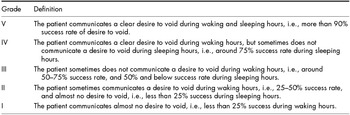
An extensive literature review and interviews with clinical experts in stroke rehabilitation (five board-certified physiatrists with a minimum of 10 years’ experience in rehabilitation medicine and five nurses with minimum of 10 years’ experience in rehabilitation wards) were conducted resulting in the development of an original DVS (Table 1). Consultation with independent experts was then undertaken to evaluate the face validity of the scale. Two physiatrists and two nurses reviewed the difficulty level in interpreting the scale, concluding that there were no difficulties in interpreting the meaning of the scale items or in the administration of the scale. We decided to use the DVS for the subsequent validation study, based on this result.
The Desire to Void Scale (DVS)

The definition of ‘communication’ in this scale, with regard to the patient conveying a desire to void, includes not only verbal but also no-verbal communication through gestures. The following are examples of DV communicated with gestures: (1) the patient pointed at his/her lower abdomen, (2) the patient tried to take off his/her pants, (3) the patient tried to go to the bathroom or to use an urine bottle.
As outlined in Table 1, the DVS comprises five rating levels, from greater than 90% communication during waking and sleeping hours (Level V) to less than 25% during waking hours (Level I). For the development of the scale, this scale was rated based on between 4 and 7 days’ continuous observation. We checked the presence or absence of incontinence and whether patient could communicate DV or not every 2 hours in the daytime and recorded as a medical record. In the same manner, we checked incontinence every 2 hours while he/she was sleeping. Patients do not necessarily have to convey DV verbally and may convey DV with gestures. The following are examples of DV communicated with gestures: (1) the patient pointed at his/her lower abdomen, (2) the patient tried to take off his/her pants, (3) the patient tried to go to the bathroom or to use an urine bottle. Evaluators do not assess whether the patient goes to the bathroom in time or not, but they assess whether the patient can inform somebody of his/her DV before urination. In other words, success rate of DV in this study means successful communication of a DV (regardless of whether they were continent or not).
Functional independence measure
In addition, the bladder management item of the Functional Independence Measure (FIM) was assessed (Data management service of the Uniform Data System for medical rehabilitation and the Center for Functional Assessment Research, 1990). The FIM uses the level of assistance and the individual's needs to grade functional status from total independence (7) to total assistance (1). A score of 1–5 indicates a form of incontinence that requires nursing care and treatment.
Procedures
Two independent raters, a physiatrist and a nurse administered the DVS with the study sample. The weighted kappa (Cohen, Reference Cohen1960; Cohen, Reference Cohen1968) was calculated to assess its inter-rater reliability. Intra-rater reliability was also assessed by having the same rater assess the sample on two occasions with a 1-week interval. To evaluate its concurrent validity, Pearson's correlation coefficients between DVS and the bladder management item of the FIM were calculated.
Results
The participants were 50 patients (27 men and 23 women, mean age 68.0 ± 10.3 years) with post-acute stroke. The DVS grade was rated as 1 in 18 patients, 2 in three patients, 3 in three patients, 4 in four patients, and 5 in 22 patients. Weighted kappa coefficients were .98 for inter-rater and .99 for intra-rater reliabilities. As for concurrent validity, there was a significant correlation between the DVS and the bladder management item of the FIM (Pearson's r = .76, p < .01).
Study 2: Responsiveness of the DVS and Time Course of the DVS in Patients with Stroke and Its Relationships with Other Parameters
The second study employed a longitudinal prospective design to investigate the responsiveness of the DVS and the course of DV. In addition, the study tested the relationship of DV as measured by the DVS with age, sex, stroke type, stroke location, paretic side, and the FIM score. This study was conducted at the convalescent unit at the Higashi-Saitama National Hospital.
Sample
Study 2 had ethics approval from the same Committee and used the same consent procedure as Study 1. A consecutive series of patients were recruited during the post-acute phase from a convalescent rehabilitation unit of the hospital between the period from April 2008 to December 2009. The inclusion/exclusion criteria for Study 1 were also employed in Study 2.
Procedures
To address the time course, DV was assessed at admission and at discharge using the DVS. Standardised response mean was calculated to quantify the instrument's responsiveness to changes in the recovering phase of stroke patients.
The final component of study 2 tested predictors of DV. Stroke location (right or left hemisphere, basal ganglia/thalamus, cerebellum, or brain stem) and stroke type (ischemic or haemorrhagic) were confirmed by either MRI or CT imaging. Patients’ ADL were assessed with the FIM at admission and discharge.
Aphasia and unilateral spatial neglect were evaluated with speech and visuospatial items of the Stroke Impairment Assessment Set (SIAS) (Tsuji, Liu, Sonoda, Domen, & Chino, Reference Tsuji, Liu, Sonoda, Domen and Chino2000).
Statistical Analyses
Descriptive statistics and the Wilcoxon signed-rank test were employed to examine the course of DV from admission to discharge. Next, the sample was divided into two groups, which were compared with regard to sex, age, paretic side, stroke location, stroke type, and ADL. Taking the 50% success rate of DV during waking hours as a cut-off point, we divided the patients into two groups: In group one, DVS grades 1 and 2 at discharge were defined as ‘most impaired DV’ and, in group two, grades 3, 4, and 5 were defined as ‘less impaired DV’. Possible between-group differences were investigated employing various statistical tests (Students t-test, Mann–Whitney U, chi-square) with the significance level set at .05.
Several methods have been proposed to quantify the responsiveness of outcome measures (Guyatt, Walter, & Norman, Reference Guyatt, Walter and Norman1987; Liang, Fossel, & Larson, Reference Liang, Fossel and Larson1990; MacKenzie, Charlson, Digioia, & Kelley, Reference Mackenzie, Charlson, Digioia and Kelley1986). The current study used the standardised response mean, that is, the mean change in score for a scale, divided by the standard deviation of the change in scores, allows us to make statistically meaningful comparisons between instruments. A higher standardised response mean indicates a greater effect or clinically important change, with standardised response mean of .2, .5, and .8 or above representing small, moderate, and large clinical changes, respectively (Liang et al., Reference Liang, Fossel and Larson1990).
After assessing multicollinearity, a multiple regression analysis was conducted to identify predictors for discharge DVS grades. Explanatory variables entered into the regression model were age, sex, stroke type, stroke location, paretic side, motor and cognition FIM scores at admission, the presence of aphasia, the presence of left unilateral spatial neglect, and admission DVS grades. Sex was dummy coded as 0 for women and 1 for men. Stroke type was dummy coded as 0 for haemorrhagic stroke and 1 for ischemic stroke. As for the stroke location, the presence of a lesion at each of the five locations was dummy coded as 0 for ‘no’ and 1 for ‘yes’. The presences of aphasia and left unilateral spatial neglect were dummy coded as 0 for ‘no’ and 1 for ‘yes’. The variables were then selected using the backward method (Thompson, Reference Thompson1995), in which the significance level required for retention in the model was set at .20.
Results
One hundred and thirty two patients with stroke were recruited during the post-acute phase from a convalescent rehabilitation unit of the hospital between the period from April 2008 to December 2009. Patients had been in hospital for at least 1 month. Twenty-nine patients were excluded for the following reasons: (1) one patient had a subarachnoid haemorrhage; (2) 23 patients had an episode of incontinence before the onset of stroke; (3) two patients were comatose; (4) three patients had no neurological deficits or experienced a transient ischemic attack; and (5) 10 patients was discharged from hospital within 1 month. As a result, 103 patients were included in this study.
The 103 participants had a mean age of 67.8 years (SD 11.3 years) and a median number of days from stroke onset to our hospital admission of 47 days (range: 20–90 days). Sixty-four patients had cerebral infarction, and 39 had cerebral haemorrhage. The paretic side was the right side in 47 patients and the left side in 53 patients. Three patients had no signs of paralysis. The median admission motor FIM score was 40 (range: 13–91), and the median cognitive FIM score was 23 (range: 5–35). The mean length of hospital stay was 133 days (SD 54.8 days).
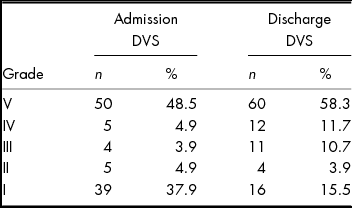
Table 2 shows the result of DVS at admission and discharge. The discharge DVS grade was significantly improved when compared with the admission grade (Wilcoxon signed-rank test, p < .01). Sixteen of the 39 patients graded as 1 at admission showed no improvement during hospitalisation, but all five patients who were graded as 2 at admission demonstrated improvement in DVS.
The Result of The Desire to Void Scale (DVS) at Admission and Discharge
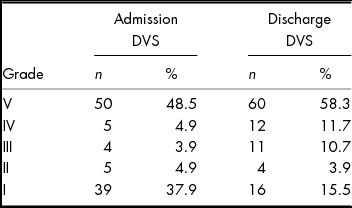
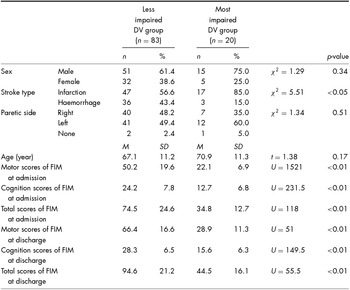
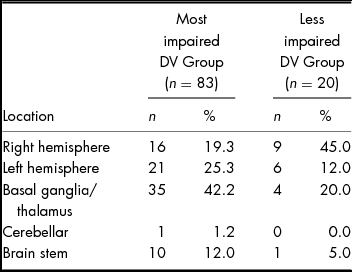
The number of patients with ‘most impaired DV’ decreased from 44 at admission to 20 at discharge. Between the ‘most impaired DV’ group (20 patients) and the ‘less impaired DV’ group at discharge (83 patients), no significant differences were found with regard to age, sex, and paretic side (Table 3). As for the stroke type, the ‘most impaired DV’ group showed a significantly lower rate of cerebral haemorrhage. Furthermore, the ‘most impaired DV’ group had a significantly lower FIM total score at admission and discharge than the ‘less impaired DV’ group. No significant difference was observed between the two groups in relation to stroke location (p = .10) (Table 4).
Comparison Between the Most Impaired DV Group and the Less Impaired DV Group with Regard to Age, Sex, Stroke Type, Paretic Side, and Activities of Daily Living

χ 2 = Chi-square test; t = Student's t-test, U = Mann–Whitney U test.
Comparison Between the Most Impaired DV Group and the Less Impaired DV Group with Regard to Stroke Location
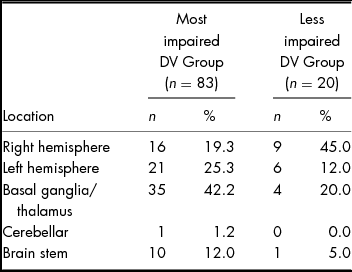
Chi-square test, p = .10.
Next, the responsiveness of the DVS was examined. The standardised response mean was .58. The DVS therefore demonstrated a moderate level of responsiveness.
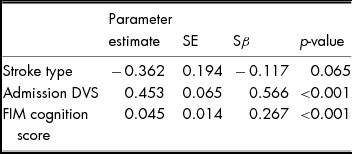
Table 5 shows the results of the multiple regression analysis for discharge DVS, which showed that stroke type (p = .065), admission DVS (p < .001), and FIM cognition scores (p < .001) were independent predictors of the discharge DVS. Overall, the combination of all three independent predictors explained a significant amount of the variance in discharge DVS (Adjusted R 2 = .613, F (3.98) = 54.241, p < .001).
Multiple Regression Analysis of Factors Related to Discharge Desire to Void Scale (DVS) Grade
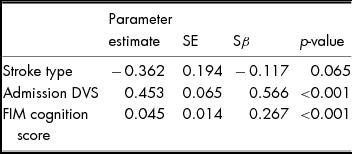
Adjusted R 2 = .613.
SE, standard error; sβ, standard partial regression coefficient; FIM, Functional Independence Measure.
Discussion
This is the first study to report the time course of the DV after stroke. Pettersen et al. noted that 38 of 235 patients developed UI with impaired awareness of the need to void (IA-UI) within the first 10 days after stroke, and IA-UI continued after 1 year in 25 of 208 patients (Pettersen et al., Reference Pettersen, Saxby and Wyller2007a). We indicated that an impaired DV was frequent in stroke patients, but it showed improvement during the rehabilitation phase in this study.
To conduct this investigation about DV, we needed to define DV clearly. In general, the decrease of DV is indicated in three stages, ‘normal’, ‘reduced’, and ‘absent’ (Abrams et al., Reference Abrams, Cardozo, Fall, Griffiths, Rosier, Ulmsten, Van Kerrebroeck, Victor and Wein2002), but staff sometimes teeter between two choices in a clinical situation.
The DVS classifies DV into five grades according to the success of DV during waking and sleeping hours. The DVS had satisfactory inter- and intra-rater reliabilities and was useful to assess the time course of DV and guide urinary management during the post-acute stroke rehabilitation period as a tool for prognostication and determining treatment effects. In a variety of clinical arenas, both physicians and nurses could use the DVS, since little time is required to assess DV. However, it is inconvenient to assess the DVS in patients who have UI at night because evaluators have to check the incontinence while the patient is sleeping. It is necessary for further development to assess the definite incontinence frequency with DVS.
The DVS was highly correlated with the bladder management item of the FIM, which suggested its concurrent validity, but the agreement was not complete. This difference between the DVS and FIM can be interpreted to arise from the fact that the FIM bladder management item does not purely assess DV. It is evaluated based on the requirements for nursing care and treatment.
This study showed that impaired DV was frequent in patients with stroke, and it improved during the rehabilitation phase. Pettersen et al. reported that 38 of the 235 acute stroke patients developed IA-UI, and only two of them with IA-UI regained bladder control within 1 year (Pettersen et al., Reference Pettersen, Saxby and Wyller2007a). As for UI, although the prevalence continued to decrease over time (Borrie et al., Reference Borrie, Campbell, Caradoc-Davies and Spears1986; Brocklehurst et al., Reference Brocklehurst, Andrews, Richards and Laycock1985; Kolominsky-Rabas et al., Reference Kolominsky-Rabas, Hilz, Neundoerfer and Heuschmann2003), as many as one-third of the individuals were still incontinent 1 year post stroke (Kolominsky-Rabas et al., Reference Kolominsky-Rabas, Hilz, Neundoerfer and Heuschmann2003; Patel et al., Reference Patel, Coshall, Rudd and Wolfe2001). Because the aim of the present study was to investigate the time course of the DV after stroke, the present results, although compatible with previous studies, were a little different in the time course and proportion of incontinent patients from previous ones. In this study, no special interventions were provided for the DV. An intervention study is necessary to demonstrate what is useful for the recovery of DV after stroke.
Independent predictors of the discharge DVS during the rehabilitation phase in the present study included stroke type, admission DVS, and FIM cognition scores, but did not include stroke location.
Recent advances in functional brain imaging, especially the widespread accessibility of these techniques during the past decade, have provided a basic understanding of the supraspinal bladder control system(Griffiths, Reference Griffiths2011). The insula, especially on the right, records bladder filling sensation(Craig, Reference Craig2002; Griffiths, Tadic, Schaefer, & Resnick, Reference Griffiths, Tadic, Schaefer and Resnick2007). The dorsal anterior cingulate cortex (ACC) encodes motivation, e.g., urgency to void and concurrent motor output (Critchley et al., Reference Critchley, Mathias, Josephs, O'doherty, Zanini, Dewar, Cipolotti, Shallice and Dolan2003). In addition, Pettersen et al. reported that among the stroke patients, the IA-UI group had right anterior circulation stroke syndromes more frequently (Pettersen, Haig, Nakstad, & Wyller, Reference Pettersen, Haig, Nakstad and Wyller2008).
In the present study, the FIM cognition score, not the stroke location, was an independent predictor of the discharge DVS. This finding should be verified in a larger sample with better representation across the range of stroke sub-types. However, the present result may be considered reasonable. Appropriate voiding needs to be: (1) mechanically appropriate (i.e., the bladder is adequately filled), (2) emotionally safe, and (3) socially appropriate (Griffiths, Reference Griffiths2011). The neural circuit of the network including the insula and dorsal ACC modifies the primary emotion, i.e., fear, to generate secondary social emotions (Damasio, Reference Damasio and Damasio2003). In patients with stroke, the DV can be affected by not only mechanical problems but also by emotional and social problems. A previous report indicates that parietal involvement combined with frontal lobe lesion is important for IA-UI in stroke patients (Pettersen et al., Reference Pettersen, Haig, Nakstad and Wyller2008), which supports the relation between DV and emotional and social problems. We therefore think it reasonable that the FIM cognition score was an independent predictor of the DVS at discharge, because it included emotional and social problems comprehensively (Sasaki et al., Reference Sasaki, Kojima, Kanaya, Yamada, Shibahara, Oikawa and Sugihara2014). The FIM cognition score is composed of communication (comprehension and expression) and social cognition (social interaction, problem solving, and memory).
Stroke type was also an independent predictor of the discharge DVS, and cerebral haemorrhage was related to higher DVS grades. Patients with cerebral hemorrhage tend to show significantly greater recovery than patients with cerebral infarction of similar severity (Paolucci et al., Reference Paolucci, Antonucci, Grasso, Bragoni, Coiro, De Angelis, Fusco, Morelli, Venturiero, Troisi and Pratesi2003). Kelly et al. reported significantly greater cognitive gains during rehabilitation in patients with cerebral haemorrhage compared with the cerebral infarction group (Kelly et al., Reference Kelly, Furie, Shafqat, Rallis, Chang and Stein2003), and this may be related with their greater improvement in DV.
Several study limitations should be noted. First, the present study was conducted at only one rehabilitation ward, so caution in generalising the results is needed. Additional research must be conducted in other establishments including a large number of patients. Second, the unbalanced sample with respect to stroke severity is also a limitation. The study was performed in a population admitted to a rehabilitation hospital, and, therefore, the participants were selected on the basis of the need for physical rehabilitation. Obviously, the present patients represent the middle band of all stroke patients, ranging from patients who die in the acute phase to patients without sequelae. Third, detailed cognitive impairments were not assessed. Although cognitive dysfunction was assessed with the FIM cognitive score in this study, cognitive impairments should be assessed in greater detail in future studies, because some cognitive impairments, especially emotional social problem (Damasio, Reference Damasio and Damasio2003) and anosognosia (Pettersen et al., Reference Pettersen, Haig, Nakstad and Wyller2008) might be related to the DV. Despite these limitations, the present findings provide important information to improve urinary management during the post-acute rehabilitation phase in patients with stroke.
Conclusions
The DVS had satisfactory inter- and intra-rater reliabilities, concurrent validity, and responsiveness, and it was useful to assess the time course of the DV. An impaired DV was frequent in stroke patients, but it showed improvement during the rehabilitation phase. Stroke type, admission DVS grade, and the FIM cognition scores were independent predictors of discharge DVS.
Contributorship Statement
Michiyuki Kawakami, Meigen Liu had substantial contributions to conception and design, acquisition of the data and analysis and interpretation of the data, and drafting the article. Chiaki Nakayama had contributions to the development of DVS and acquisition of the data. All authors reviewed the article critically and approved the final version for publication.
Competing Interests
None declared.
Funding
None.
Ethical Standards
The authors assert that all procedures contributing to this work comply with the ethical standards of the relevant national and institutional committees on human experimentation and with the Helsinki Declaration of 1975, as revised in 2008.