Introduction
Harmonia axyridis (Pallas) (Coleoptera: Coccinellidae), commonly known as the Harlequin ladybird, multicoloured Asian or Asian ladybird as it originates from Asia, has rapidly spread across Western Europe since its introduction in the 1980s as a biological control agent (Brown et al., Reference Brown, Frost, Doberski, Sparks, Harrington and Roy2011; Osawa, Reference Osawa2011). It was first recorded in Britain in 2004 (Majerus et al., Reference Majerus, Strawson and Roy2006), however assessment of the Rothamsted Aphid Trap archive revealed a specimen from 2003 (Roy et al., Reference Roy, Adriaens, Isaac, Kenis, Onkelinx, Martin, Brown, Hautier, Poland, Roy, Comont, Eschen, Frost, Zindel, Van Vlaenderen, Nedvěd, Ravn, Grégoire, de Biseau and Maes2012b). Since its colonization, it has been deemed the ‘most invasive ladybird on earth’ (Roy et al., Reference Roy, Brown and Majerus2006). Much attention has been focused on H. axyridis's rapid ability to successfully disperse across landscapes; however, hypothesized factors to its success remain largely rudimentary (Alhmedi et al., Reference Alhmedi, Haubruge and Francis2010). The success of H. axyridis has been attributed to: (a) its eurytopic nature, thriving in many urban and rural habitats, (b) large climatic tolerance, (c) phenotypic plasticity (d), high dispersal ability, (e) lower susceptibility to pathogens compared to native ladybird species (Roy and Brown, Reference Roy and Brown2015), (f) its generalist feeding behaviour that allows it to exploit a greater range of prey than native coccinellids (Brown et al., Reference Brown, Frost, Doberski, Sparks, Harrington and Roy2011). These are typical characteristics of successful invertebrate invasive species (Parker et al., Reference Parker, Simberloff, Lonsdale, Goodell, Wonham, Kareiva, Williamson, Von Holle, Moyle, Byers and Goldwasser1999; Snyder and Evans, Reference Snyder and Evans2006; Kenis et al., Reference Kenis, Auger-Rozenberg, Roques, Timms, Péré, Cock, Settele, Augustin and Lopez-Vaamonde2008). There is often a strong correlation between the dominance of invasive species and the decline of native species (Roy et al., Reference Roy, Bacon, Beckmann, Harrower, Hill, Isaac, Preston, Rathod and Rorke2012a) and although a number of studies confirm this, there is a lack of observed interactions (Hentley et al., Reference Hentley, Vanbergen, Beckerman, Brien, Hails, Jones and Johnson2016). An in-depth understanding of the severity of invasive species dynamics is necessary in order to predict future invasions and manage current invaded systems. Moreover, assessments of non-lethal interactive behaviour between invasive and native species may lead to a better understanding of their success (Chapple et al., Reference Chapple, Simmonds and Wong2012; Peck et al., Reference Peck, Pringle, Marshall, Owens and Lord2014).
Invasive predators such as H. axyridis frequently compete indirectly with native predators through the consumption of shared prey (Parker et al., Reference Parker, Simberloff, Lonsdale, Goodell, Wonham, Kareiva, Williamson, Von Holle, Moyle, Byers and Goldwasser1999; Pell et al., Reference Pell, Baverstock, Roy, Ware and Majerus2007). This alteration in population regulation by natural enemies, across varying trophic guilds, can be seen with aphid communities; a common prey source among coccinellid guilds (Schellhorn and Andow, Reference Schellhorn and Andow2005; Al-Deghairi et al., Reference Al-Deghairi, Abdel-Baky, Fouly and Ghanim2014). However, aphids represent a limited food resource for coccinellids and therefore competitive behaviour can occur. Conversely, competitive exclusion may occur if one predator has a higher consumption rate. This voracity and large body size allow H. axyridis to achieve a faster development rate and higher fecundity (Vandereycken et al., Reference Vandereycken, Durieux, Joie, Sloggett, Haubruge and Verheggen2013).
Harmonia axyridis is now the most common coccinellid in England; a pattern seen across much of the world (Comont and Roy, Reference Comont and Roy2011). Their invasion has followed dramatic declines in several native coccinellid species (Day et al., Reference Day, Prokrym, Ellis and Chianese1994; Tedders and Schaeffer, Reference Tedders and Schaeffer1994; Elliot et al., Reference Elliot, Kieckhefer and Kauffman1996; Brown and Miller, Reference Brown and Miller1998) and thus, a greater understanding is needed to assess the severity of interactions amongst native coccinellids. The two-spot ladybird, Adalia bipunctata (Linnaeus) (Coleoptera: Coccinellidae) is a small, common, generalist predator of aphids in Europe and inhabits a range of environments including urban landscapes and agro-ecosystems (Jalali et al., Reference Jalali, Tirry and De Clercq2009; Khan et al., Reference Khan, Qureshi, Afzal and Stansly2016). The similarity in both diet and habitat makes the two species likely to interact in the field, and both species can be found together (Harlequin-survey.org, 2018; Ladybird-survey.org, 2018). A 44% decline in the abundance of A. bipunctata occurred 5 years after the arrival of the non-native species (Sloggett, Reference Sloggett2017), with Roy et al. (Reference Roy, Adriaens, Isaac, Kenis, Onkelinx, Martin, Brown, Hautier, Poland, Roy, Comont, Eschen, Frost, Zindel, Van Vlaenderen, Nedvěd, Ravn, Grégoire, de Biseau and Maes2012b) suggesting numbers were previously on the increase.
There is relatively little research on the comparative interactions for prey items among coccinellid species (Leppanen et al., Reference Leppanen, Alyokhin and Gross2012), and especially observational assessments of how aphid prey densities influence the intensity of interactions. The aim of this study was to investigate how H. axyridis and A. bipunctata interact when competing for the same prey resource to help understand why A. bipinctata are declining.
Materials and methods
Plant and insect cultures
Adults of H. axyridis were collected by hand in Fordingbridge, Hampshire and kept in a cold room (5 ± 1°C) to continue diapause from 2 December 2016 until 30 April 2017. Supplementary stock cultures were kindly donated from Professor Simon Leather, Harper Adams University, Shropshire. Adults of A. bipunctata were sourced from biological control suppliers: Green Gardener, Great Yarmouth and Gardening Naturally, Stroud. Both commercial stocks were mixed to reduce any in-breeding. The sex of individuals was not determined as non-destructive certainty is generally difficult (McCornack et al., Reference McCornack, Koch and Ragsdale2007). 120 beetles were used in total (total N A. bipunctata = 90, total N H. axyridis = 30).
Coccinellid species were contained in separate housing microcosms and transferred to a grow room at 25 ± 1°C; 55 ± 5% RH and 16L: 8D. English grain aphids, Sitobion avenae (Hemiptera: Aphididae) were provided ad-libitum. Sitobion avenae used in the experiments were taken from an existing laboratory colony at the Game & Wildlife Conservation Trust, Hampshire.
Experimental set
To assess how H. axyridis affected the feeding behaviour of A. bipunctata, a series of feeding trials were conducted. Five Mulika spring wheat, Triticum aestivum (Poaceae: Triticum) were grown from seed in 12 plastic pots (12.5 cm diameter × 13.5 cm height) containing John Innes II compost. Irrigation occurred on rotation using a distilled water source. Clear acetate was fixed around each pot (12.5 cm diameter × 60 cm height) to confine the wheat plants and a mesh lining was applied at the top to create a microcosm. When the wheat plants had reached ca. 50 cm in height, each of the 12 microcosms was randomly infested with aphids. These were either at low densities (estimated range of 10–60 aphids) or high (estimated range of 70–150 aphids). Aphid abundance in each microcosm was recorded before every feeding trial.
The beetles were kept separately in Petri dishes (9 cm) with a 1 cm2 piece of dampened filter paper, and a folded strip of filter paper was provided to act as a substrate for oviposition. Beetles were chosen at random, and of unknown sex and age, for each trial and starved for 24 h. There were two competition treatments with two beetles per microcosm: (1) two A. bipunctata, and (2) one A. bipunctata and one H. axyridis and these were conducted using both aphid densities with three replicates of each competition/aphid density combination per trial. Each trial was repeated ten times using a total of 90 A. bipunctata and 30 H. axyridis.
For each feeding trial, two of the assigned paired beetles were gently placed on the base of the middle wheat stem within the microcosm using a fine-bristled brush. After the second beetle was placed on the stem, observations were made continuously and terminated after 30 minutes (1800 s). The following activities were recorded: (i) ‘location time’; time taken to discover prey (i.e. the first aphid), (ii) ‘consumption time’; time taken to consume individual prey, (iii) ‘consumption rate’; number of aphids consumed by an individual beetle, and (iv) ‘behaviour’; the direct contacts made and perceived response (aggressive/non-aggressive) were noted. Recognised aggressive behaviours of coccinellids were modified from a similar study by Leppanen et al. (Reference Leppanen, Alyokhin and Gross2012) which assessed competition for aphid prey in laboratory arenas. Behaviours considered as aggressive were categorised as follows: chasing, grasping, biting, climbing upon, and attempting to or successfully stealing prey. Behaviours that were recorded as non-aggressive in the present study included foraging, resting, mandible cleaning and making contact with another individual but not exhibiting an aggressive behaviour as outlined. Feeding trials were conducted in a controlled grow room at 25 ± 1°C; 55 ± 5% RH and 16L: 8D from May 2017 to June 2017.
Statistical analysis
The effect of competition treatment (presence or absence of H. axyridis) and aphid density in relation to prey consumption per microcosm was analysed using a two-way analysis of variance (ANOVA). Linear Mixed Models (REML) were used to test whether the number of aphids consumed per beetle species, time taken to locate them and time to consume them differed when H. axyridis was present. Three beetle categories were compared: A. bipunctata when only beetles of the same species were present, A. bipunctata when H. axyridis was present and H. axyridis alone, and for both aphid densities. Data were transformed (logx + 1) for consumption time and location time before REML was performed. Trial run (1–10) was included as blocking structure in all analyses and tests were run using GenStat (16th edition). An imputed time of 1800 s (30 min) was given to individual beetles that did not locate or consume a prey item, which represented the duration of each feeding trial. Only 31 contacts were observed (aggressive/non-aggressive) which was insufficient for robust statistical analysis into behaviour.
Results
Prey consumption
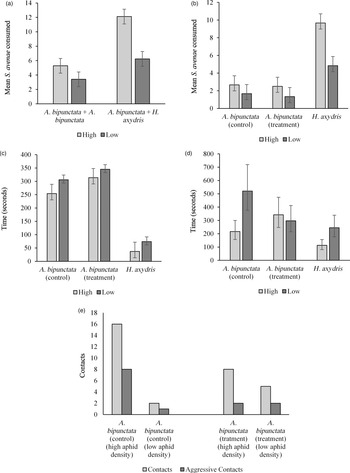
For the total number of aphids consumed, there was a significant interaction effect for competition treatment and aphid density (F = 4.29, P = 0.044). Higher numbers of aphids were consumed when H. axyridis was present in the microcosm for both aphid densities (fig. 1a). However, the difference between the number of aphids consumed for low and high aphid densities was greater when H. axyridis was present. A significant interaction effect was also found for the number of aphids consumed per beetle species category and aphid density (F = 6.03, P = 0.003). Harmonia axyridis consumed almost four times more aphids than A. bipunctata at the high and three times at the low aphid density (fig. 1b). The number of aphids consumed by A. bipunctata was unaffected by the presence of H. axyridis and was fewer at the low aphid density.
(a) mean number of S. avenae consumed per microcosm under high and low aphid densities between i) control: A. bipunctata pairings ii) treatment: A. bipunctata and H. axydris pairings, (b) mean number of S. avenae consumed per beetle species under high and low aphid densities for the three beetle categories (c) mean consumption time per beetle species (±SE) (seconds) of prey items under high and low aphid densities. (d) mean location time per beetle species (±SE) (seconds) of prey items under high and low prey for the three beetle categories, (e) total contacts/aggressive contacts per beetle species between control and treatment pairings under high and low aphid densities.

Prey consumption time
Consumption time differed significantly between the treatment and control beetle pairings (F = 27.68, P ≤ 0.001) and was unaffected by aphid density. However, consumption time was similar for A. bipunctata in the absence (2.44 ± 0.07) and presence of H. axyridis (2.51 ± 0.8) (fig. 1c). Harmonia axyridis had a shorter consumption time (1.58 ± 0.2) under high aphid densities.
Prey location time
There was a significant difference between the treatment and control beetle pairings (F = 6.24, P = 0.003). Harmonia axyridis located prey more quickly (2.51 ± 0.01) compared to A. bipunctata (2.19 ± 0.01) (fig. 1d). Aphids were also located significantly faster (F = 10.27, P = 0.002) when present at the higher density, but there was no significant interaction effect, therefore both species were responding similarly.
Contacts
A total of 31 contacts were observed between control and treatment beetles. More contacts were observed at high than low aphid densities for both beetle species (fig. 1e). The lowest number of aggressive contacts occurred when both beetle species were present at the high aphid density, whereas in all other treatments approximately 50% of contacts were considered aggressive.
A higher proportion of attempts to steal prey was made by conspecifics, and when prey items were not present during a contact, the outcome was often to chase the individual away. There was still chasing behaviour even with the lower frequency of non-aggressive contacts made by heterospecifics, but the majority of initial contacts resulted in avoidance between the treatment pairings. This avoidance strategy could be heightened further if individuals had the ability to fully disperse.
Discussion
The study revealed an asymmetric competitive interaction between H. axyridis and A. bipunctata in relation to feeding behaviour. Harmonia axyridis was able to locate prey items faster than A. bipunctata under high aphid densities, but both species had similar location times with low aphid prey densities. Overall, the number of aphids consumed by H. axyridis was always higher regardless of the aphid density; however, this was because their consumption rate was also much faster. This explains why H. axyridis are able to outcompete A. bipunctata rather than it being through aggressive behaviour, of which there were relatively few incidences. Coccinellids perform an intrinsic array of behaviours to aid in their foraging efficiency (Ferran and Dixon, Reference Ferran and Dixon1993; Dixon, Reference Dixon2000). To achieve this, an encounter with a prey resource must first occur in order to promote the switch from extensive to intensive search behaviour (Hodek et al., Reference Hodek, Van Emden and Honěk2012). Adalia bipunctata, in both treatment and control conditions (67%), were witnessed to intensify their foraging efficiency by making erratic, short turns after consumption of an aphid, or indeed when in close proximity to an aphid. This behavioural change was seen in a higher proportion of A. bipunctata than H. axyridis and could affect their foraging success as they focused on a smaller section of a wheat stem, and thus covered less surface area compared to H. axyridis.
The experimental set-up can greatly affect the scope of perceived behavioural response and therefore any interpretation needs an element of caution, especially using confined arenas (Dixon, Reference Dixon2000). Therefore, the faster location time shown by H. axyridis in this assay could be higher than normal because of the restriction in dispersal. However, the current experimental assay facilitated a higher level of dispersal compared to previous laboratory studies in which coccinellids were confined to Petri-dishes (Rocca et al., Reference Rocca, Rizzo, Greco and Sánchez2017). Furthermore, in natural environments, refuges would exist to prevent competition at plant (Schellhorn and Andow, Reference Schellhorn and Andow2005), field (Hampton, Reference Hampton2004) and landscape levels (Gardiner et al., Reference Gardiner, Landis, Gratton, Schmidt, O'Neal, Mueller, Chacon, Heimpel and DiFonzo2009). This would suggest that when in the presence of heterospecifics, individuals would disperse to avoid competition, and invest energy into profitable activities such as reproduction. This study indicated that coexistence can occur between the two species because there were few aggressive contacts; moreover, the microcosms were sufficiently large to facilitate avoidance and therefore the behavioural responses may reflect natural behaviour.
This study shows that indirect competitive displacement occurs when H. axyridis and A. bipunctata coexist. Harmonia axyirids does not directly exclude A. bipunctata's ability to locate and consume prey items but does show a competitive advantage, and was the more successful aphid predator from the feeding trials. This exploitative competition, which is the most common form of competition amongst arthropod assemblages (Alhmedi et al., Reference Alhmedi, Haubruge and Francis2010), is thought to pose concerns for the population dynamics of the A. bipunctata in its native range. In natural environments, there may also be other factors affecting the relationship between the two species, such as habitat complexity and the availability of alternative food resources that yet need to be investigated.
It is certainly apparent that A. bipunctata has undergone significant declines in its native range, with H. axyridis considered the main cause (Koch et al., Reference Koch, Venette and Hutchison2006; Howe et al., Reference Howe, Ransijn and Ravn2015; Sloggett, Reference Sloggett2017). Yet, there is evidence spanning 39 years that suggests A. bipunctata's decline occurred before the establishment of H. axyridis in Europe (Honek et al., Reference Honek, Dixon, Soares, Skuhrovec and Martinkova2017). There is also evidence that aphids have declined substantially during this period and may be responsible (Ewald et al., Reference Ewald, Wheatley, Aebischer, Moreby, Duffield, Crick and Morecroft2015). Furthermore, A. bipunctata has become established in Japan, where it is a non-native species, and coexists among high populations of native H. axyridis (Toda and Sakuratani, Reference Toda and Sakuratani2006).
A broader context is therefore necessary in order to underpin declines in native coccinellids, and sole responsibility on the non-native H. axyridis should be further revised, along with other driving factors of environmental change.