





Background
An exercise prescription refers to much more than an implicit recommendation for exercise, as it requires sufficient specificity, detail and depth, and therefore very good knowledge of the patient profile (Chen et al., Reference Chen, Gan and How2018; Luan et al., Reference Luan, Tian, Zhang, Huang, Li, Chen and Wang2019). There are many underlying reasons for exercise not going beyond a recommendation. Many studies have been conducted throughout the world to determine these reasons, and according to the results of those studies, the most common reasons are that the physician cannot allocate enough time for the patient and that the physician does not feel sufficiently competent to prescribe exercise, has insufficient resources, and does not show sufficient interest in the patient (Douglas et al., Reference Douglas, Torrance, van Teijlingen, Meloni and Kerr2006; Parker et al., Reference Parker, Steyn, Levitt and Lombard2011; Hébert et al., Reference Hébert, Caughy and Shuval2012; Florindo et al., Reference Florindo, Mielke, Gomes, Ramos, Bracco, Parra, Simoes, Lobelo and Hallal2013).
Although exercise is free of charge and as effective as drugs, for which hundreds of millions of dollars are paid each year, it is still not sufficiently prescribed for the treatment of chronic diseases, and it is not fully followed by patients as prescribed. It has also been seen that the promotion of exercise to patients within lifestyle changes has lagged behind other recommendations such as smoking, diet, and alcohol (Bock et al., Reference Bock, Diehm and Schneider2012; Lindsley Reference Lindsley2014; López-Román et al., Reference López-Román, Tornel-Miñarro, Delsors-Merida-Nicolich, Fernández-López, Martínez-Ros, García Sánchez and López-Santiago2020). Recommendations have been made by the World Health Organization (WHO) and ACSM giving information about the basic components of exercise with the abbreviation FITT (frequency, intensity, time, type) for healthy individuals and patients. This was done with the aim of resolving the problem of a sedentary lifestyle, which is a modifiable risk factor, and to increase the prescription of exercise as a medication, which would contribute to the economy of the country (Alwan, Reference Alwan2011).
In a study in Canada, it was reported that 68% of doctors gave verbal counseling and recommendations for exercise, and only 15.8% used written exercise prescriptions (Petrella et al., Reference Petrella, Lattanzio and Overend2007). In Türkiye there are no guidelines, but there are a few studies showing the difference between the existing and desired situation on the subject of primary care physicians counseling patients and actually writing exercise prescriptions. (Petrella et al., Reference Petrella, Lattanzio and Overend2007; Lobelo et al., Reference Lobelo, Duperly and Frank2009; Windt et al., Reference Windt, Windt, Davis, Petrella and Khan2015). There remains a need for current research to be developed in respect of determining the reasons that exercise prescribing is not at the desired level.
When the population served by a physician is considered in terms of patient profile, primary care physicians are in a unique position to be able to write personalized exercise prescriptions with the advantages of being a continuous point of contact and having all the detailed information about the patient (Solmundson et al., Reference Solmundson, Koehle and McKenzie2016; Luan et al., Reference Luan, Tian, Zhang, Huang, Li, Chen and Wang2019). Therefore, the aim of this study was to determine the frequency of exercise prescribing by primary care physicians, their current practices, and the barriers to prescribing exercise. It was also thought that the cognitive perceptions of physicians could affect motivational approaches and their own lifestyle habits could have an effect on their exercise-prescribing practices.
In this context, it was aimed to first measure the frequency of exercise prescribing of physicians, their cognitive perceptions on the subject of exercise, and their own levels of physical activity. The secondary aim was to determine the relationships between the frequency of exercise prescribing and the cognitive perceptions and daily physical activity levels of the physicians.
Methods
Permission for the research, location, and dates
Approval for this descriptive, cross-sectional study was granted by the Non-Interventional Research Ethics Committee of Hatay Mustafa Kemal University (decision no. 14, session no. 12, dated, 01 November 2021). The necessary permission to conduct the study was obtained from Hatay Province Health Directorate.
The study was conducted between 1 December, 2021, and 30 April, 2022, in all the primary care centers in the cities, towns, and villages of Hatay province.
Research universe and sample size
In a pilot study conducted on 50 subjects to test the comprehensibility of the questionnaire questions and calculate the sample size, the frequency of exercise prescribing was seen to be 42%. According to this rate, from the central population of 505 primary care physicians, it was calculated to be necessary to have a minimum sample of 216 subjects to provide a 95% confidence interval and 5% error margin. Taking potential data losses into consideration, it was decided that the minimum number should be 220. All 505 primary care family doctors in the province of Hatay were contacted, and a total of 240 voluntarily agreed to participate in the study.
The pilot study, conducted with 50 participants to test feasibility and measurement procedures, was included in the main analysis in line with standard methodological practice, as no modifications were made to the study protocol.
The questionnaires of 19 respondents were not completed in full, so were excluded from the analyses. Consequently, the study was completed with the data of 221 primary care physicians.
Study protocol
The study questionnaires were applied to physicians actively working in polyclinic services within working hours at times when there were no patients. All the physicians provided informed consent before completing the study questionnaires. In Hatay Centre and nearby towns, the questionnaires were administered face-to-face. For the physicians in all the villages and in 5 towns far from the center, a link to the questionnaire together with a written explanation was sent online (e-mail, WhatsApp) to the primary care units.
After 2 reminders via e-mail and WhatsApp sent at 2-week intervals, fully completed questionnaires were received from 221 primary care physicians: 133 completed face-to-face and 88 online.
The questionnaire comprised 3 sections: CBPAQ, GPPAQ, and questions prepared according to information in the relevant literature.
The GPPAQ consists of 7 questions under 3 main headings of activity in the workplace, activities performed in the last 7 days and how many hours per week, and the speed of normal walking. The scale measures the overall level of activity in 4 categories as active, moderately active, slightly active, and inactive.
The CBPAQ was designed to determine attitudes and behavior towards participation in exercise. The questionnaire comprises 15 items scored on a 5-point Likert-type scale, in 3 subsections of Outcome Expectation (OE), Self-Regulation (SR), and Personal Barriers (PB). OE shows the benefit expected as a result of participation. For example, ‘I will feel physically better after performing exercise’. SR shows the self-motivational approaches to how exercise can be included in their lifestyle. For example, ‘I schedule the activities in my life according to my exercise habits’. PB indicates the barriers to performing exercise placed by the subject. For example, ‘I cannot find the time for exercise as I have too much work to do all day’. The total score is the total of points obtained from each section and higher values indicate higher cognitive perceptions in the relevant area.
The questionnaire prepared as a result of the literature scan comprised 33 items: 17 questions to elicit sociodemographic information (age, gender, years of professional experience) and knowledge on the subject of prescribing exercise and 16 questions related to the knowledge content prepared according to the ACSM recommendations.
Statistical analysis
Data obtained in the study were analyzed statistically using SPSS version.21 software. Conformity of the numerical data to normal distribution was examined with visual and analytical methods. Descriptive analyses were reported as mean ± standard deviation (SD) values for variables with normal distribution and as median, minimum, and maximum values for data not showing normal distribution. In the inter-group comparisons, the Mann-Whitney U test and Kruskal-Wallis test were used for data not showing normal distribution. Relationships between categorical variables were analyzed using Pearson, likelihood ratio, and chi-square tests. The Cronbach alpha value for the questions measuring the knowledge level according to the ACSM recommendations was calculated as 0.89. A value of P < 0.05 was accepted as the level of statistical significance in all the tests.
Results
The data were evaluated from a total of 221 primary care physicians, comprising 152 (68.8%) males and 69 (31.2%) females with a mean age of 44.8 ± 8.9 years (males: 45.81 ± 9.06, females: 42.65 ± 8.13) and mean duration of professional experience of 19.24 ± 8.98 years (range, 2–38 years).
It was determined that 29.4% of the physicians often provided exercise counseling and 10% often prescribed exercise.
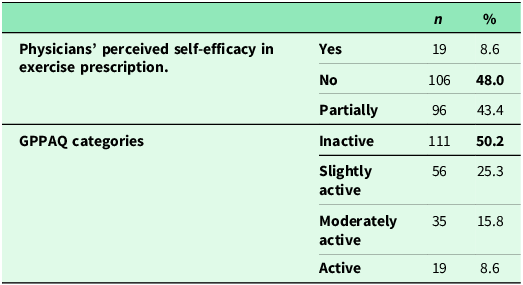
According to the results of the GPPAQ, in the evaluation of the physical activity level groups, the largest group was the inactive group at the rate of 50.2% (n: 111) (Table 1). When the relationship between physicians’ daily physical activity levels and exercise prescription rates was examined, physicians in the slightly active group were more likely not to prescribe exercise than to prescribe it (58.8% vs. 35.9%). In contrast, physicians in the moderately active and active groups prescribed exercise more frequently than they did not prescribe; in the moderately active group, 47.1% prescribed exercise compared with 37.3% who did not, while in the active group the corresponding rates were 17.1% and 3.9%, respectively. These differences were statistically significant (chi-square test, P = 0.005).
Physicians’ physical activity levels according to the BBFAA and their perceived competence in exercise prescription

n: none.
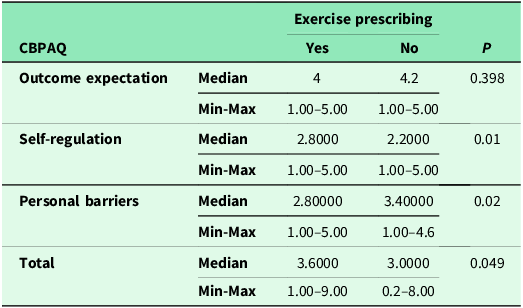
According to the CBPAQ data, the highest points were obtained in the OE section (3.63 ± 1.43) and the lowest points in the SR section (2.62 ± 1.17). The mean CBPAQ total points of the physicians were determined to be 3.53 ± 2.16. When the relationship was examined between the exercise-prescribing behavior of the physicians and the OE, SR, and PB subsections of cognitive perceptions, it was determined that the physicians with higher SR and total cognitive perception points and lower PB points prescribed exercise more (Table 2).
The relationships between exercise prescribing and the CBPAQ points

Min: minimum.
Max: maximum.
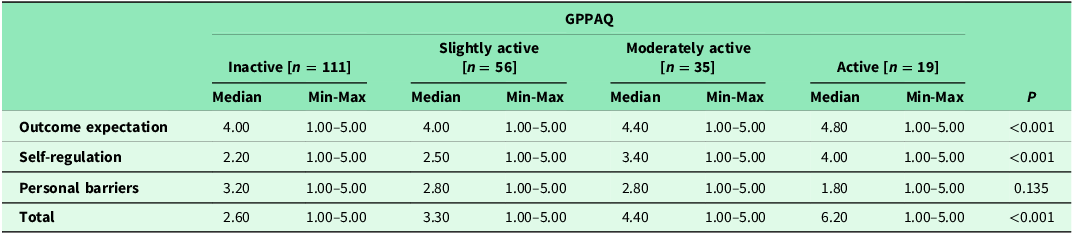
The relationship between the CBPAQ scores and the GPPAQ scores was examined, and it was determined that as the activity level increased, so the OE, SR, and total cognitive behavior points increased (P < 0.001). Thus it was seen that when the benefits to be obtained from exercise, motivational regulation for a life in which exercise can be included, and the total cognitive perception on this subject increased, so the activity level of the physicians also increased. Correspondingly, as the activity level of the physicians increased, there was found to be a decrease in the PB scores (P = 0.135) (Table 3).
The relationships between the CBPAQ and the GPPAQ

n: none.
Min: minimum.
Max: maximum.
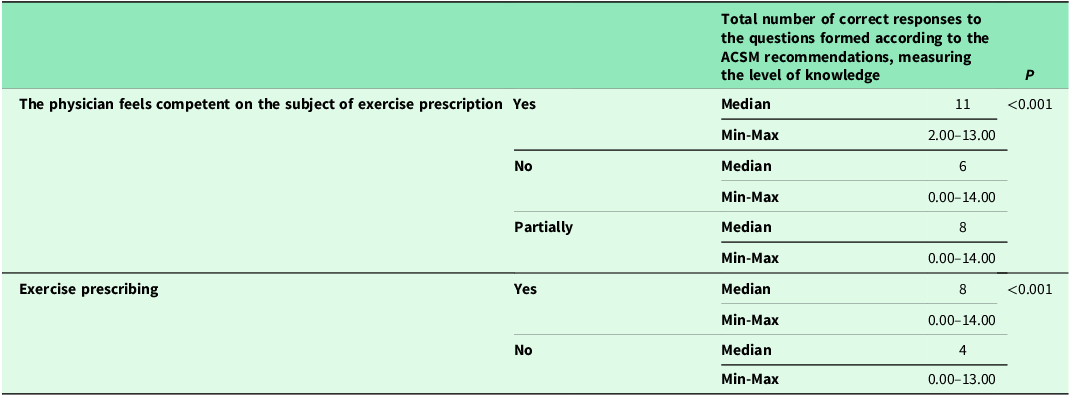
Only 19 (8.6%) of the physicians in this study felt competent on the subject of prescribing exercise. In Table 4, the relationships are shown between exercise prescribing and the number of correct responses given to the questions formed according to the ACSM recommendations to measure the level of knowledge about exercise prescribing (Cronbach alpha value: 0.86). The physicians who gave more correct responses were determined to write more exercise prescriptions and were also seen to feel more competent on this subject (P < 0.001).
The relationship between the total number of correct answers and physicians’ self-efficacy in prescribing exercise

Min: minimum.
Max: maximum.
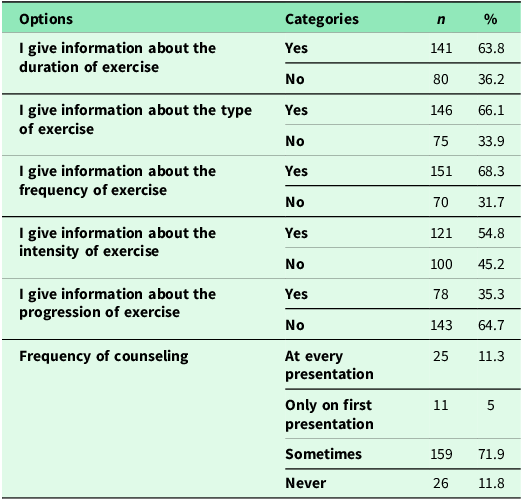
The rates of providing information about the components of exercise were examined. It was seen that 68.3% provided information about the frequency of exercise, and 64.7% of the physicians did not give any information about exercise progression. When the frequency of counseling was examined, 5% of the physicians only counseled patients on first presentation (Table 5).
The frequencies of physicians giving information to patients about the components of exercise and counseling

n: none.
Discussion
Main findings
The results of this study demonstrated that physicians with a high level of self-regulation cognitive perception on the subject of physical activity prescribed exercise more. The physicians with high SR showed a more positive approach. For example, ‘I set my own goals to be able to be physically active’ is one of the statements used to calculate self-regulation. By motivating both the physician and the patient, this positive approach may be one of the reasons increasing the rate of prescribing exercise (Molanorouzi et al., Reference Molanorouzi, Khoo and Morris2015). Physicians with high PB scores were found to prescribe exercise less. The effect of SR and PB perceptions on the exercise prescribing behavior of the physicians shows that exercise prescribing practices can be increased by changing perceptions of this subject. No significant relationship was found between exercise prescribing and outcome expectations, as the other subsection of the CBPAQ. These findings demonstrate the importance of physician behavior to conditions preventing the prescribing of exercise.
The results of this study showed that the frequency of counseling was extremely low, and in respect of the components of exercise, the least information was given on the subject of exercise progression. The low rates of frequency of counseling and providing information about progression by physicians who already had a low rate of prescribing exercise could be a reason for patients not continuing even if they start to exercise.
Although data from the pilot study were included in the main analysis, the decrease in exercise prescription rates from 42% in the pilot study to 10% in the main study may be explained by factors such as the larger sample size, differences in participant characteristics, and more systematic data collection in the main study; to address this potential influence, sensitivity analyses excluding the pilot data were conducted and yielded consistent results.
Study strengths and limitations
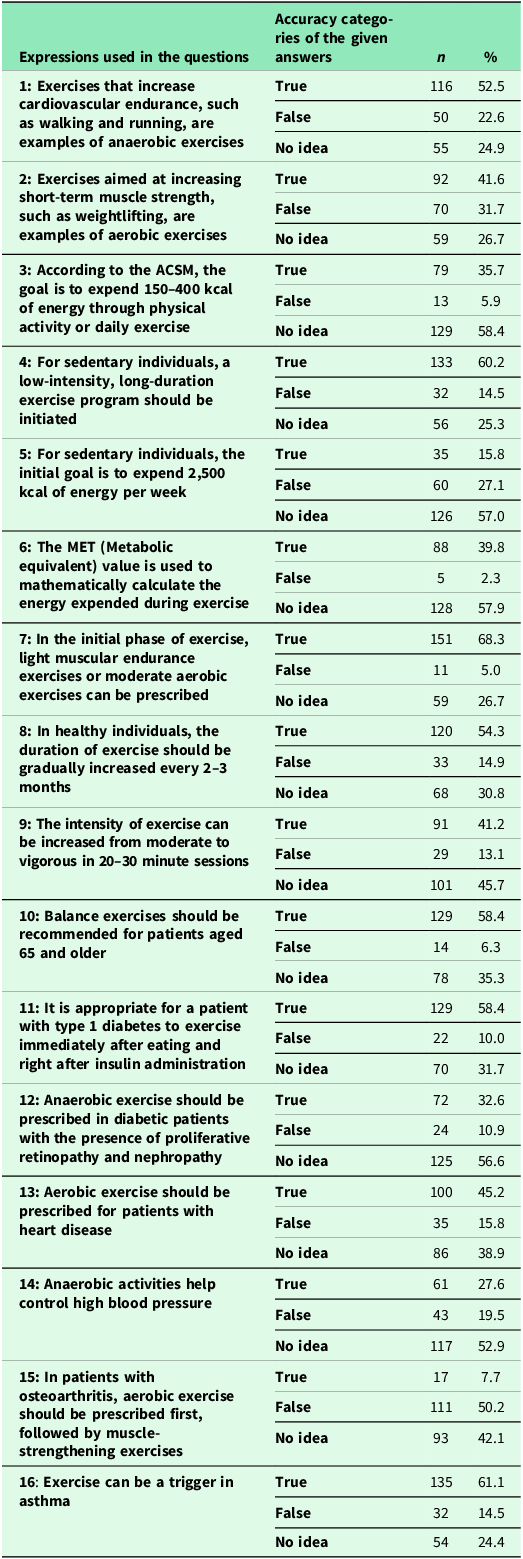
This study can be considered of value as the first study in literature to have evaluated the effect on exercise prescribing of the physical activity levels and cognitive perceptions of physical activity of physicians. The physicians included in the study were primary care family doctors who are the first point of contact and in continuous contact with patients. Unlike other studies, the scales used were the GPPAQ and the CBPAQ. In addition, to measure the level of knowledge, the physicians were asked questions about exercise prescribing, which were prepared according to the ACSM recommendations and for which the Cronbach alpha value was calculated (Table 6). Thus, when answering the questionnaire, both the knowledge levels of the physicians and their daily practices were investigated, and the effect of the physician’s level of knowledge about exercise prescribing on daily practices was evaluated.
However, limitations of the study can be said to be primarily that the research was conducted in the single province of Hatay (south-east Türkiye), and therefore, the results cannot be generalized across the whole country. In addition, some of the questionnaires were completed online, and the reasons for not wishing to participate were unknown.
Comparisons with current literature
Many studies have been conducted throughout the world to determine the underlying reasons that exercise does not go beyond a recommendation. The results of those studies have shown that the most common reasons are that the physician cannot allocate enough time for the patient, does not feel sufficiently competent to prescribe exercise, has insufficient resources, and does not show sufficient interest in the patient(Douglas et al., Reference Douglas, Torrance, van Teijlingen, Meloni and Kerr2006; Parker et al., Reference Parker, Steyn, Levitt and Lombard2011; Hébert et al., Reference Hébert, Caughy and Shuval2012; Florindo et al., Reference Florindo, Mielke, Gomes, Ramos, Bracco, Parra, Simoes, Lobelo and Hallal2013). In the current study, the relationship was evaluated between the exercise-prescribing practices of the physicians and their own physical activity level and cognitive perceptions on this subject. Lawdor D.A. et al. in Canada reported that most doctors (69.8%) used verbal counseling to encourage physical activity, and only 15.8% used written prescriptions for a physical activity introductory program (Petrella et al., Reference Petrella, Lattanzio and Overend2007). In the current study, the rate of verbal counseling was higher than that of written exercise prescribing, and the number of physicians prescribing exercise in written form was extremely low. These findings highlight the need for targeted training programs and supportive resources to strengthen physicians’ exercise prescription practices and increase the use of written prescriptions. Although physicians appear to be aware of the importance of exercise recommendations for patients, the persistently low rates of written exercise prescription underscore the need for qualitative research to explore the underlying barriers; such studies may help to fill this gap by identifying contextual, educational, and systemic factors that hinder effective exercise prescribing and inform strategies to overcome them.
In another questionnaire study in Germany by Christina Bock et al., related to the promotion of physical activity in primary care, it was reported that 26.9% of physicians did not have sufficient knowledge to provide counseling and 36.7% felt that they were unsuccessful in motivating patients to increase physical activity (Bock et al., Reference Bock, Diehm and Schneider2012). F. Lobelo et al. stated that the physical activity habits, training, and motivation of doctors and medical students could be seen as barriers to exercise counseling (Lobelo et al., Reference Lobelo, Duperly and Frank2009). In a study by Johann Windt et al. that aimed to determine the number of physicians prescribing exercise after a 3-hour training session with practical prescribing tools, there was seen to be a significant increase in primary care physicians reporting that they had written physical activity prescriptions (Windt et al., Reference Windt, Windt, Davis, Petrella and Khan2015). In a randomized, controlled study by Sok Ying Liaw et al. and studies by Jesse Clanton et al., there was determined to be a positive correlation between self-confidence and medical knowledge of the subject (Liaw et al. Reference Liaw, Scherpbier, Rethans and Klainin-Yobas2012; Clanton et al., Reference Clanton, Gardner, Cheung, Mellert, Evancho-Chapman and George2014). In support of the findings of those studies, it was seen in the current study that physicians with a high level of knowledge, measured by the questions formed according to the ACSM recommendations, felt more competent prescribing exercise, and those who felt competent prescribed exercise more.
Throughout the world in general, there are very few medical faculties in which the syllabus includes exercise medicine. In the USA, 13% of medical faculties provide education about exercise, 6% have core lessons, and 87% provide no exercise medicine training in the syllabus (Solmundson et al., Reference Solmundson, Koehle and McKenzie2016).
The deficiencies in the current medical faculty syllabuses in respect of exercise as medicine have been exposed. Therefore, this study can be of guidance in the provision and development of evidence-based recommendations and guidelines to facilitate exercise prescribing by primary care physicians.
F. Lobelo et al. reported that the physical activity habits of doctors and medical students affected counseling practices, and Erica Frank et al. similarly showed that the personal health practices of physicians could affect outcomes for patients (Frank Reference Frank2004; Lobelo et al., Reference Lobelo, Duperly and Frank2009). In the current study, it was also determined that the physicians who stated that they were physically active prescribed exercise at a significantly higher level. This can be attributed to the fact that physically active physicians have overcome physical inactivity and are able to practically and more often implement solutions to overcome barriers to physical activity. Moreover, as they have experienced the benefits of physical activity themselves, this may be more effective, convincing, and motivating when explaining to patients.
Implications
The relationship between exercise prescribing rates and the CBPAQ was examined in this study for the first time. The study results showed higher exercise prescribing rates of physicians with high cognitive perceptions of physical activity. This result provides a clue to how exercise prescribing rates can be increased. An increase in the cognitive perceptions of exercise could result in physicians writing more exercise prescriptions.
To increase the level of knowledge of physicians on this subject, the subject of prescribing exercise could be added to the basic medical syllabus and to the family doctor specialism education syllabus. The elimination of deficiencies in knowledge will enable physicians to feel self-confident on this subject and overcome the barrier to prescribing exercise. In addition to providing not only knowledge content but also communication skills for a motivational physician approach to determine and overcome the barriers to exercise, this education could also increase patient compliance and support the applicability of exercise prescribing. This key method could first overcome the resistance of physicians to prescribing exercise and then the resistance of patients to following the exercise prescription.
Finally, as physical inactivity is a modifiable risk factor, clinicians should routinely evaluate the structured exercise and lifestyle activities of all patients, and prescription should be made as necessary. There is a need for further studies to develop programs and guidelines for the practical implementation of exercise prescriptions and which will produce solutions to existing barriers.
Conclusion
The results of this study demonstrated a relationship between the frequency of prescribing exercise and the physical activity level and cognitive perception of physicians. As the physical activity level and cognitive perceptions of physicians increased, so the frequency of prescribing exercise was also seen to increase. The low rates of physicians prescribing exercise was affected by the fact that physicians felt that they did not have sufficient knowledge on the subject of exercise, they had low self-confidence on this subject, and low motivation.
Questions prepared in accordance with ACSM recommendations and the accuracy rates of the given answers

n: none.
Acknowledgements
The authors thank the Provincial Health Directorate and all the physicians who participated in the study.
Funding statement
Only the authors are responsible for the content and writing of this article. No funding was received.
Competing interests
None of the authors declare any conflict of interest.
Ethical standards
Written informed consent was obtained from all participants.

 Open access

