Introduction
Telomeres are simple repetitive sequences (TTAGGG) at the ends of eukaryotic chromosomes. They protect somatic cells from genomic instability during mitotic cell proliferation (Blackburn, Reference Blackburn2001). Telomeres shorten progressively with each mitotic division because of the limiting nature of linear DNA replication mechanisms. After a critical degree of telomere shortening, cells lose the ability to replicate and may cease dividing (senescence) or undergo programmed cell death (Wong & Collins, Reference Wong and Collins2003). Telomere shortening has therefore been proposed as a marker of biological aging (Olovnikov, Reference Olovnikov1996). In support of this notion, shorter leukocyte telomere length has been shown to be associated with age-related morbidity and mortality (Zhu et al. Reference Zhu, Belcher and van der Harst2011).
The question arises regarding which factors influence the shortening of telomeres. Several studies have indicated that psychosocial stress is associated with shorter telomeres, and thereby increased biological age, in apparently healthy persons (Epel et al. Reference Epel, Blackburn, Lin, Dhabhar, Adler, Morrow and Cawthon2004; Damjanovic et al. Reference Damjanovic, Yang, Glaser, Kiecolt-Glaser, Nguyen, Laskowski, Zou, Beversdorf and Weng2007). The presence of depressive and anxiety disorders has been examined in relation to telomere length in only a few cross-sectional, non-population-based studies. Mood disorders seem to be associated with shorter telomere length (Simon et al. Reference Simon, Smoller, McNamara, Maser, Zalta, Pollack, Nierenberg, Fava and Wong2006; Lung et al. Reference Lung, Chen and Shu2007; Hartmann et al. Reference Hartmann, Boehner, Groenen and Kalb2010; Wikgren et al. Reference Wikgren, Maripuu, Karlsson, Nordfjall, Bergdahl, Hultdin, Del-Favero, Roos, Nilsson, Adolfsson and Norrback2012), although mixed findings have been reported (Wolkowitz et al. Reference Wolkowitz, Epel, Reus and Mellon2010). One study that focused on anxiety and telomere shortening did not observe any differences between cases and controls in the entire cohort (Kananen et al. Reference Kananen, Surakka, Pirkola, Suvisaari, Lonnqvist, Peltonen, Ripatti and Hovatta2010). Depression and anxiety are of particular interest in relation to telomere length, not only because these disorders are treatable to a certain degree but also because they are associated with excess morbidity and mortality in the general population (Angst et al. Reference Angst, Stassen, Clayton and Angst2002; Denollet et al. Reference Denollet, Maas, Knottnerus, Keyzer and Pop2009; Schoevers et al. Reference Schoevers, Geerlings, Deeg, Holwerda, Jonker and Beekman2009; Roest et al. Reference Roest, Martens, de Jonge and Denollet2010).
To determine whether depression and/or anxiety are related to accelerated telomere shortening, we studied a large population-based sample with a valid assessment of psychopathology and a telomere length measure after 2 years of follow-up. In addition, we aimed to gain more insight into the mediators involved in the process of telomere shortening by evaluating this prospective effect. Both depression and anxiety are associated with an unhealthy lifestyle (van Gool et al. Reference van Gool, Kempen, Penninx, Deeg, Beekman and van Eijk2003; Bonnet et al. Reference Bonnet, Irving, Terra, Nony, Berthezene and Moulin2005), and telomere length might be affected by several lifestyle factors such as body mass index (BMI), smoking, alcohol consumption and exercise frequency (Valdes et al. Reference Valdes, Andrew, Gardner, Kimura, Oelsner, Cherkas, Aviv and Spector2005; Morla et al. Reference Morla, Busquets, Pons, Sauleda, MacNee and Agusti2006; Cherkas et al. Reference Cherkas, Hunkin, Kato, Richards, Gardner, Surdulescu, Kimura, Lu, Spector and Aviv2008; Kim et al. Reference Kim, Parks, DeRoo, Chen, Taylor, Cawthon and Sandler2009). Other factors related to anxiety and depression, such as medication use, might have an influence on telomere length (Wolkowitz et al. Reference Wolkowitz, Mellon, Epel, Lin, Dhabhar, Su, Reus, Rosser, Burke, Kupferman, Compagnone, Nelson and Blackburn2011). Finally, there are some factors that might increase the risk of anxiety and depression and might have an effect on telomere length, such as educational level (Steptoe et al. Reference Steptoe, Hamer, Butcher, Lin, Brydon, Kivimaki, Marmot, Blackburn and Erusalimsky2011). A better understanding of the relationship between psychopathology and telomere length could help to explain the excess mortality associated with depression and anxiety.
We therefore sought to investigate the prospective association between anxiety and depressive disorders and telomere length after 2 years of follow-up in a population-based sample. In addition, we evaluated whether the association was explained by adverse life events, lifestyle factors, educational level and medication use.
Method
Patients
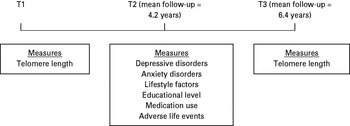
The current study was performed in a cohort derived from the Prevention of Renal and Vascular End-stage Disease (PREVEND) study, which is an ongoing prospective study investigating risk factors for renal and cardiovascular disease. The recruitment of participants for PREVEND has been described extensively elsewhere (Pinto-Sietsma et al. Reference Pinto-Sietsma, Janssen, Hillege, Navis, De Zeeuw and De Jong2000). Three waves were available for this study: the baseline screening was completed in 1998 (T1) and there were two follow-up visits at 4.2 (T2) and 6.4 (T3) years from baseline (Figs. 1 and 2). The PREVEND sample consisted of 8592 subjects selected randomly from the population of the city of Groningen with oversampling for albuminuria (T1). Selection of subjects for the present study was aimed at recruiting a representative sample of the general population of Groningen, while simultaneously rectifying PREVEND's oversampling for albuminuria. Albuminuria-negative participants were combined with a random sample of albuminuria-positive participants until a population-representative ratio was achieved.
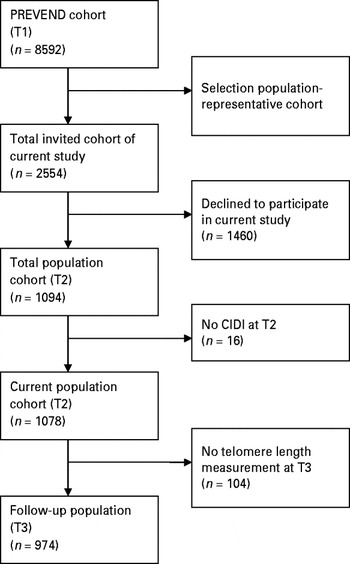
Flow chart showing the number of participants included in the analyses.

Time frame of the study.

Research assistants approached participants (n = 2554) in the PREVEND study during their visit to the out-patient clinic during follow-up. Questionnaires were completed by a total of 1094 participants (43%), forming the population cohort of the present study (T2). There was no significant difference in gender and age between PREVEND participants who were invited to participate in the present study but declined and PREVEND participants who agreed to participate.
Follow-up measurements were completed by a total of 974 participants (89%) at T3 (Fig. 1). The study was approved by the medical ethics committee and written consent was obtained from all participants. We used data from T2 and T3 in our primary analyses. Data from T1 were used for a post-hoc analysis.
Anxiety and depressive disorders
We ascertained the presence of depressive and anxiety disorders in the past 12 months, using the Composite International Diagnostic Interview (CIDI). The CIDI is a comprehensive, fully standardized psychiatric diagnostic interview that is used to assess mental disorders according to the definitions and criteria of DSM-IV. A fully computerized version of CIDI version 2.1 was applied, suitable for self-administration. Trained interviewers were present for questions and for participants who needed computer help. The CIDI is used worldwide and World Health Organization (WHO) field research has found high inter-rater reliability (Wittchen et al. Reference Wittchen, Robins, Cottler, Sartorius, Burke and Regier1991), high test–retest reliability (Andrews & Peters, Reference Andrews and Peters1998), and high validity for depressive and anxiety disorders (Wittchen et al. Reference Wittchen, Burke, Semler, Pfister, Von Cranach and Zaudig1989; Wittchen, Reference Wittchen1994). CIDI 2.1 was administered at T2 (Fig. 2). The depressive disorders that were diagnosed included major depressive disorder and dysthymia. The anxiety disorders that were diagnosed with the CIDI used in this study included panic disorder, generalized anxiety disorder (GAD), social phobia and agoraphobia. Of the 1094 participants enrolled, 1078 completed the CIDI (99%).
Telomere length
Telomere length measurements were performed in a blinded fashion. To avoid any impact of variation in DNA extraction method on telomere length measurement, all samples analyzed in the current study were extracted uniformly using the same DNA extraction kit (QIamp, Qiagen, Venlo, The Netherlands) from frozen full-blood samples anticoagulated with ethylenediamine tetra-acetic acid (EDTA) according to the manufacturer's instructions. DNA samples from different collection time points were mixed and extracted randomly to neutralize potential batch effects. Mean telomere length was measured with the recently modified quantitative polymerase chain reaction (QPCR) protocol using a single-well strategy to measure both the telomere (T) and single reference (S) signal (Cawthon, Reference Cawthon2009). All experimental DNA samples were assayed in triplicate and were measured on different plates but in the same well position. Samples from the three different time points were divided equally over our PCR schedule to prevent potential time or seasonal influences. The ratio of telomere and single copy (reference) gene content (T/S ratio) is a relative measure of telomere length.
Samples were run in triplicate and the intra-assay coefficient of variation (CV) was 2% (T), 1.9% (S) and 4.5% (T/S ratio). Reproducibility data were obtained for 216 subjects from PREVEND and good agreement between T/S ratios was observed (R 2 = 0.99, p < 0.0001, inter-run CV 3.9%). The calibrator sample used was made up of a mixture of DNA samples from young adult individuals (aged around 25 years). There was a highly significant decline in the T/S ratio with age in the PREVEND [a decrease in the T/S ratio of −0.0047 (s.e. = 0.0004) per year increase in age; p = 1.073 × 10⁻²⁸], confirming the internal validity of the assay. Of the 1078 participants, 974 participants provided DNA samples at T3.
Additional variables
Weight and height were measured and BMI (kg/m2) was calculated. Smoking, alcohol consumption and exercise frequency were assessed by written self-report at T2. Smoking was categorized as: non-smoker, 1–5, 6–10, 11–15, 16–20 or >20 cigarettes/day. Alcohol consumption was categorized as: never or almost never, 1–4 units/month, 2–7 units/week, 1–3 units/day and ⩾4 units/day. Exercise frequency was categorized as: never, once/week, twice or more/week. Educational level was retrieved from questionnaires. Low educational level was defined as lower secondary education or less, middle educational level was defined as higher secondary education, and high educational level was defined as tertiary education. Antidepressant medication use (non-selective monoamine reuptake inhibitors, selective serotonin reuptake inhibitors and monoamine oxidase inhibitors) was derived from the InterAction database containing pharmacy-dispensing data (Monster et al. Reference Monster, Janssen, de Jong and de Jong-van den2002).
Adverse life events were assessed using the List of Threatening Experiences (LTE); a sum score of the LTE for each participant was calculated by adding the scores of all different life events of all the age categories (with five age categories and 12 life events, the maximum score was 60) (Brugha et al. Reference Brugha, Bebbington, Tennant and Hurry1985; Rosmalen et al. Reference Rosmalen, Bos and de Jonge2012).
Statistical analyses
Telomere length was not normally distributed and was therefore natural log transformed. For descriptive purposes, participants were grouped based on the presence or absence of past-year depressive or anxiety disorders (by the CIDI) and compared on demographic variables and lifestyle factors, using t tests and χ2 tests. The association between depressive disorders, anxiety disorders and telomere length after 2 years of follow-up was examined using multivariable regression analyses. Covariates that were known to be associated with telomere length, anxiety and/or depression in previous studies were chosen a priori. First, we adjusted for co-morbid depressive or anxiety disorders, because the presence of these disorders showed substantial overlap, and for adverse life events (Kananen et al. Reference Kananen, Surakka, Pirkola, Suvisaari, Lonnqvist, Peltonen, Ripatti and Hovatta2010). Second, we adjusted for level of education (Steptoe et al. Reference Steptoe, Hamer, Butcher, Lin, Brydon, Kivimaki, Marmot, Blackburn and Erusalimsky2011) and lifestyle factors, including BMI, smoking, alcohol consumption and exercise frequency (van Gool et al. Reference van Gool, Kempen, Penninx, Deeg, Beekman and van Eijk2003; Bonnet et al. Reference Bonnet, Irving, Terra, Nony, Berthezene and Moulin2005; Valdes et al. Reference Valdes, Andrew, Gardner, Kimura, Oelsner, Cherkas, Aviv and Spector2005; Morla et al. Reference Morla, Busquets, Pons, Sauleda, MacNee and Agusti2006; Cherkas et al. Reference Cherkas, Hunkin, Kato, Richards, Gardner, Surdulescu, Kimura, Lu, Spector and Aviv2008; Kim et al. Reference Kim, Parks, DeRoo, Chen, Taylor, Cawthon and Sandler2009). Third, we adjusted for antidepressant use (Wolkowitz et al. Reference Wolkowitz, Mellon, Epel, Lin, Dhabhar, Su, Reus, Rosser, Burke, Kupferman, Compagnone, Nelson and Blackburn2011). All multivariable analyses were adjusted for the potential confounders gender and age (Bekaert et al. Reference Bekaert, De Meyer, Rietzschel, De Buyzere, De Bacquer, Langlois, Segers, Cooman, Van Damme, Cassiman, Van Criekinge, Verdonck, De Backer, Gillebert and Van Oostveldt2007). We performed two post-hoc analyses to further examine the association between anxiety disorder and telomere shortening. First, we were interested in the influence of telomere length before the assessment of anxiety disorders. Because we did not have telomere length at T2, we adjusted for telomere length at T1 (4 years before the CIDI assessment). Second, anxiety disorders were divided into GAD versus other anxiety disorders (including panic disorder, social phobia and agoraphobia) and the association with telomere length at follow-up was evaluated. We were particularly interested in this distinction because GAD is characterized by anxious-misery and might therefore be more closely related to depression than to the other anxiety disorders, which are mainly characterized by fear and physiological hyperarousal (Craske et al. Reference Craske, Rauch, Ursano, Prenoveau, Pine and Zinbarg2009). Both post-hoc analyses were adjusted for the potential confounders gender and age. Statistical analyses were performed using PASW version 18.0 (SPSS Inc., USA).
Results
Demographic characteristics
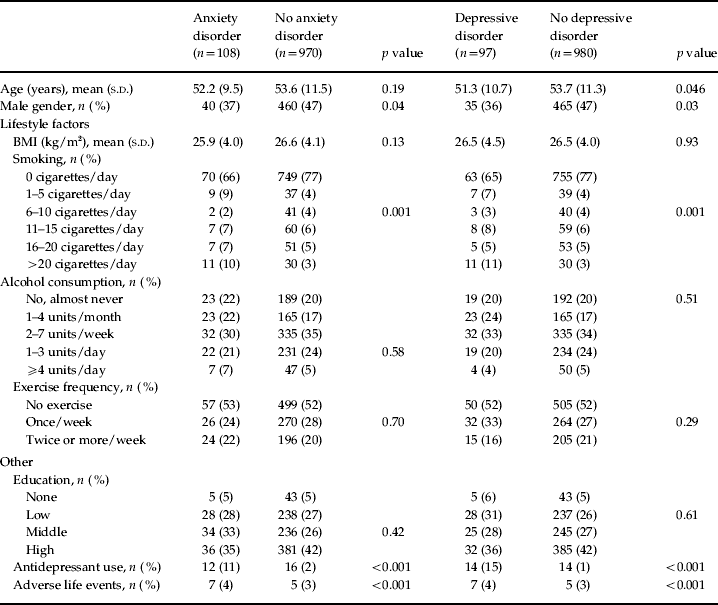
At T2, the mean age of the study population was 53 (s.d. = 11.4, range 33–80) years; 46% were males. Of the 1094 participants, 16 had no CIDI measurement at T2. Table 1 summarizes the characteristics of the 1078 participants. At T2, 108 participants (10%) had an anxiety disorder and 97 (9%) a depressive disorder in the past 12 months. Thirty-six participants had both an anxiety and a depressive disorder in the past 12 months. Compared with participants who did not have an anxiety disorder, those with an anxiety disorder were more often female, more likely to smoke a higher number of cigarettes, more often used antidepressants and had experienced more adverse life events. Compared with participants who did not have a depressive disorder, those with a depressive disorder were younger, more often female, more likely to smoke a higher number of cigarettes, more likely to use antidepressants and had experienced more adverse life events (Table 1). Follow-up data at T3 were available for 974 participants. There were no significant differences in age, gender and telomere length between the 104 participants who were not included in the follow-up and these 974 participants. The mean follow-up duration from T2 to T3 was 2.2 years.
Characteristics of the 1078 participants
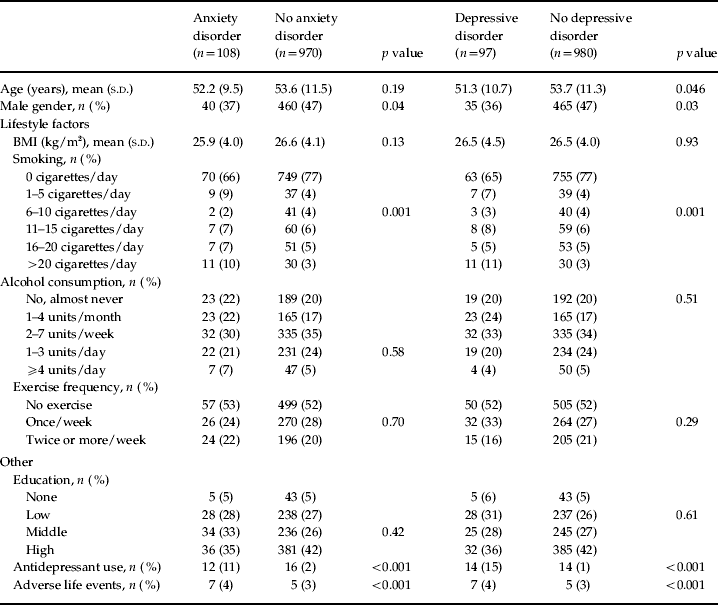
BMI, Body mass index; s.d., standard deviation.
Association between depression, anxiety disorder and telomere length
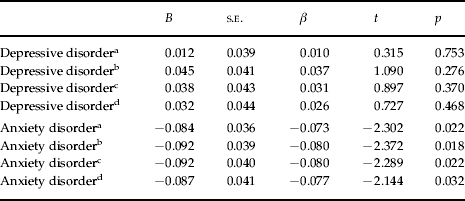
In the regression model adjusted for age and gender, the presence of anxiety disorder predicted shorter telomere length at follow-up (β = –0.073, t = –2.302, p = 0.022). Age was also predictive of shorter telomere length (β = –0.148, t = –4.658, p < 0.001). No association was found between depressive disorders and telomere length at follow-up (β = 0.010, t = 0.315, p = 0.753) (Table 2).
Multivariable associations between depression, anxiety and telomere length at follow-up (n = 974)
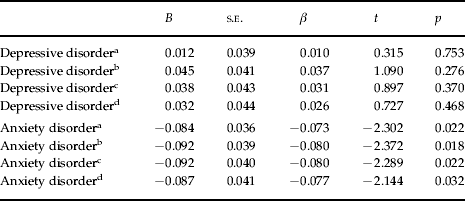
s.e., Standard error.
a Adjusted for age and gender.
b Adjusted for age, gender, co-morbid depressive/anxiety disorders and adverse life events.
c Adjusted for age, gender, co-morbid depressive/anxiety disorders, adverse life events, body mass index (BMI), smoking, alcohol consumption, exercise frequency and education level.
d Adjusted for age, gender, co-morbid depressive/anxiety disorders, adverse life events, BMI, smoking, alcohol consumption, exercise frequency, education level and antidepressant use.
After adjustment for co-morbid depression/anxiety, adverse life events, lifestyle factors, educational level and antidepressant use, the association between any anxiety disorder last year and telomere length at follow-up remained (β = –0.077, t = –2.144, p = 0.032). In addition to the predictive effect of anxiety on telomere length, BMI (β = –0.075, t = –2.136, p = 0.033) and exercise frequency (β = 0.087, t = 2.552, p = 0.011) were also predictive of telomere length at follow-up.
Post-hoc analyses
To further explore the association between anxiety disorder and telomere length, we performed two post-hoc analyses. First, we adjusted for age, gender and telomere length at T1 (4 years before the CIDI assessment). The association between anxiety and telomere at follow-up was similar but no longer significant (β = –0.063, t = –1.947, p = 0.052).
Second, we evaluated whether the presence of GAD or any other anxiety disorder was predictive of telomere shortening at follow-up, while adjusting for age and gender. Sixty-seven (7%) participants had another anxiety disorder and 46 (5%) had GAD. The presence of any other anxiety disorder (including panic disorder, agoraphobia and social phobia) predicted telomere shortening (β = –0.088, t = –2.776, p = 0.006) whereas GAD did not (β = –0.008, t = –0.242, p = 0.809).
Discussion
Our study found that anxiety disorders were prospectively associated with shorter telomere length over time. By contrast, no prospective association was found between depressive disorders and telomere length. The association of anxiety disorder with telomere length could not be explained by adverse life events, lifestyle factors, educational level and antidepressant use.
We are the first to study the direct relationship between anxiety disorder, depressive disorder and telomere length in a population-based sample in a longitudinal setting. Only one previous study has focused on the association between anxiety disorders and telomere length (Kananen et al. Reference Kananen, Surakka, Pirkola, Suvisaari, Lonnqvist, Peltonen, Ripatti and Hovatta2010). This cross-sectional study found that the older half of the anxiety disorder patients exhibited significantly shorter telomeres than the healthy controls. Our study shows that the presence of anxiety in the past year predicts telomere length after 2 years of follow-up in the total sample. It should be noted that this association does not generalize to all types of anxiety disorders.
Although anxiety seems to predict telomere length in our study, we were unable to confirm previously reported associations with depressive disorders and reduced telomere length in leukocytes. The finding that anxiety predicts telomere length over time, while depression does not, might be explained by the phenomenological and etiological differences between anxiety and depressive disorders. Most of the insights about mechanisms associated with telomere erosion originate from research on oxidative stress and inflammation, indicating both as important influences on telomere length (von Zglinicki, Reference von Zglinicki2002; Kurz et al. Reference Kurz, Decary, Hong, Trivier, Akhmedov and Erusalimsky2004; O'Donovan et al. Reference O'Donovan, Pantell, Puterman, Dhabhar, Blackburn, Yaffe, Cawthon, Opresko, Hsueh, Satterfield, Newman, Ayonayon, Rubin, Harris and Epel2011; Shiels et al. Reference Shiels, McGlynn, MacIntyre, Johnson, Batty, Burns, Cavanagh, Deans, Ford, McConnachie, McGinty, McLean, Millar, Sattar, Tannahill, Velupillai and Packard2011). Earlier research suggests that both anxiety and depression are associated with oxidative stress and inflammation (O'Brien et al. Reference O'Brien, Scott and Dinan2004; Forlenza & Miller, Reference Forlenza and Miller2006; Rammal et al. Reference Rammal, Bouayed, Younos and Soulimani2008; Yager et al. Reference Yager, Forlenza and Miller2010). However, the contrasting associations between anxiety and depression with telomere length suggest that a mechanism that is not shared between these disorders is important for telomere shortening. Symptoms of anhedonia and the absence of positive affect are specific to depression whereas symptoms of physiological hyperarousal and thoughts of future threat are more prominent in anxiety (Craske et al. Reference Craske, Rauch, Ursano, Prenoveau, Pine and Zinbarg2009). It is possible that mainly these features related to extreme physiological stress are of importance for telomere damage. In support of this, we found that specifically the presence of panic disorder, agoraphobia and/or social phobia was driving the effects on telomere length at follow-up. These anxiety disorders are mainly characterized by fear whereas GAD and depression are identifiable as anxious-misery disorders (Craske et al. Reference Craske, Rauch, Ursano, Prenoveau, Pine and Zinbarg2009; Dia et al. Reference Dia, Harrington and Silverman2010). This finding suggests that, in patients with anxiety, fear in particular (usually accompanied by extreme physiological hyperarousal) could be an important factor in telomere shortening. Further research is required to yield mechanistic insights into the association between anxiety and telomere shortening.
In our analyses we adjusted for several factors. The association between anxiety disorders and telomere length at follow-up was independent of adverse life events, lifestyle factors, level of education and antidepressant use. Therefore, further research on the association between anxiety and accelerated telomere shortening should look at other potential mediators. The longitudinal setting of our study enabled us to assess anxiety as a predictor of telomere length at the 2-year follow-up. Our study therefore suggests that anxiety might lead to accelerated telomere shortening. However, it is also possible that participants with anxiety already had shorter telomeres to start with. To further explore this possibility we performed a post-hoc analysis. A limitation of this study is that telomere length was assessed 4 years before psychopathology was measured. The association was only marginally reduced after adjusting for telomere length at T1, but lost statistical significance. It remains possible that telomere length before the measurement of anxiety drives the association between anxiety and telomere length at follow-up. An alternative explanation might be that the presence of anxiety and depression at T1 is driving the presence of anxiety and depression at T2 and its subsequent association with T3. With this study design we cannot further disentangle these possibilities. In future studies it would be interesting to further examine whether anxiety has a relatively short effect on telomere length, or also has a longer-lasting effect. To summarize, by using this prospective design we uncovered some potential mutual effects. Further study should include measurements of psychopathology and telomere length at several time points to further illuminate these effects.
Given the importance of anxiety in determining shortened lifespan and more rapid onset of diseases typically associated with aging, such as cardiovascular disease, our findings might have potential clinical relevance (Denollet et al. Reference Denollet, Maas, Knottnerus, Keyzer and Pop2009; Roest et al. Reference Roest, Martens, de Jonge and Denollet2010). Because anxiety seems to be associated with accelerated telomere shortening, this raises the question of whether accelerated cellular aging is a mechanism that contributes to the excess morbidity and mortality associated with anxiety.
The majority of earlier studies observed an association between depression and telomere length (Simon et al. Reference Simon, Smoller, McNamara, Maser, Zalta, Pollack, Nierenberg, Fava and Wong2006; Lung et al. Reference Lung, Chen and Shu2007; Hartmann et al. Reference Hartmann, Boehner, Groenen and Kalb2010; Wikgren et al. Reference Wikgren, Maripuu, Karlsson, Nordfjall, Bergdahl, Hultdin, Del-Favero, Roos, Nilsson, Adolfsson and Norrback2012), in contrast to the present study. However, it should be kept in mind that most sample sizes were relatively small. A reason for the conflicting findings may also be the longitudinal setting of our study whereas the previous studies were cross-sectional. Wolkowitz et al. (Reference Wolkowitz, Mellon, Epel, Lin, Dhabhar, Su, Reus, Rosser, Burke, Kupferman, Compagnone, Nelson and Blackburn2011) found that depressed individuals did not differ from controls in telomere length. However, they did observe that accelerated aging at the level of leukocyte telomeres is proportional to lifetime exposure to major depressive disorder. Therefore, it is possible that telomere length is a reflection of cumulative factors over time. In our study we focused at telomere length and depressive disorder in a relatively short time period. In addition, our null finding could be due to the differences in study population. Earlier studies included in-patients (Hartmann et al. Reference Hartmann, Boehner, Groenen and Kalb2010), chronic severely depressed patients (Simon et al. Reference Simon, Smoller, McNamara, Maser, Zalta, Pollack, Nierenberg, Fava and Wong2006, Reference Simon, Katon, Lin, Rutter, Manning, Von Korff, Ciechanowski, Ludman and Young2007) or patients within psychiatric care (Wikgren et al. Reference Wikgren, Maripuu, Karlsson, Nordfjall, Bergdahl, Hultdin, Del-Favero, Roos, Nilsson, Adolfsson and Norrback2012). Because our study was based on a general population representative cohort, our participants might have had relatively milder depressed than these patients.
There are several strengths of this study. First, we used data from a large population-based cohort, thereby increasing the generalizability of our results to the population at large. In addition, our study had a longitudinal design whereas previous studies assessing the association between depression, anxiety and telomere length were cross-sectional. The longitudinal setting of our study enabled us to assess anxiety disorder as a predictor of telomere length at follow-up. Nevertheless, when interpreting our results, the following limitations should be taken into account. First, although we adjusted for multiple carefully measured potential confounding variables, the possibility of residual confounding cannot be excluded. Second, use of antidepressants was derived from a pharmacy-dispensing database. The prescription of antidepressants does not necessarily translate to actual medication use. Therefore, it is difficult to draw conclusions on the mediating effect of antidepressant use. Third, our measurements were restricted to telomere length in leukocytes and do not necessarily reflect telomere length in other cell compartments or tissues of interest. The fourth limitation of our study is that we assessed psychopathology only at one time (T2); no repeated measures of psychopathology were available. Fifth, telomere length was only measured at T1 and T3 and we did not assess telomere length and psychopathology at the same point in time.
In summary, anxiety disorders were predictive of short telomere length at follow-up in a population-based sample. The association was not explained by adverse life events, lifestyle factors, educational level and antidepressant use. The mechanisms that connect anxiety disorders to accelerated telomere shortening and their relationship with the excess mortality risk associated with anxiety disorders deserve further study.
Acknowledgments
This work was supported by grants from the Innovational Research Incentives Scheme program of The Netherlands Organization for Scientific Research (NWO VENI, grant no. 916.76.170 to P. van der Harst and NWO VIDI, grant no. 016.086.397 to P. de Jonge). The funding organizations had no role in the design and conduct of the study; collection, management, analysis and interpretation of the data; and preparation, review or approval of the manuscript.
Declaration of Interest
None.