Significant outcomes
-
∙ Significant differences were found between patients with, and without, suicidal attempts in dimension harm avoidance (ha) and its subdimension, fatigability and asthenia (ha4). Personality traits, measured by TCI, may be helpful in predicting suicidal behavior.
-
∙ The interactions between temperament and character subdimensions (the interaction of disordiness (ns4) and spiritual acceptance (st3), disordiness (ns4) and integrated conscience (c5), extravagance (ns3) and resourcefulness (sd3)) were significantly contributing for suicidal behaviour risk in investigated group.
-
∙ Associations between 5-HTTLPR and TPH1 polymorphisms and several TCI dimensions and subdimensions were revealed.
Limitations
-
∙ Other psychological, social, and clinical factors that act as protective or risk factors for suicide behaviour were not taken into account in the presented analysis.
-
∙ The genetical study was limited to only three polymorphisms of serotonergic genes and the results need confirmation in more numerous sample.
Objective
Personality is an inner enduring predisposition that affects the pattern of recognising the situation, feeling emotions, decision making and, in consequence, behaviour. It therefore constitutes a part of the diathesis to react to stress with suicidal behaviour. Personality traits fit well to the stress-diathesis model for suicidal behaviour (Reference Mann1). In this model the authors suggest that traits, such as impulsivity and aggression, are important factors underlying a propensity to suicide. The impulsivity/aggression trait is more pronounced in persons at risk of suicide, regardless of the diagnosis of a psychiatric disorder. In this model, a current psychiatric state (depression or psychosis) and life events are elements in the objective state of the patient, whereas the patient’s subjective perception or ideations and individual traits constitute the diathesis to suicidal acts. The stress-diathesis model is complemented by the concept of defeat and entrapment (Reference Gilbert and Allan2). The motivation to suicidal behaviour in predisposed individuals arises under the influence of feeling defeated and entrapped (Reference Panagioti, Gooding, Taylor and Tarrier3,Reference Taylor, Gooding, Wood and Tarrier4). Perceiving oneself as failed in the social struggle, or having no escape route, depends on the individual’s predisposition to social perception.
It has been shown that vulnerability to suicide is partly genetically determined (Reference Brent and Mann5), but also partly depends on non-genetic factors. The heritable factors in the diathesis to suicide account for ~45% of this variance (Reference Statham, Heath and Madden6) and, according to twin studies, about 40% of personality variance is determined by genetic factors (Reference Staner and Mendlewicz7).
As complex psychiatric and behavioural phenomena are difficult to explore in genetic studies, the endophenotype approach is applied (Reference Gottesman and Gould8,Reference Savitz, van der Merwe and Ramesar9). Several main candidate endophenotypes have been described in studies of suicidal behaviour (Reference Chistiakov, Kekelidze and Chekhonin10–Reference Mann, Arango and Avenevoli12).
Personality traits and/or disorders, plus some neurocognitive functions that may underlie an individual’s social recognition are the most important intermediate phenotypes. The linkage between impulsivity/aggression traits and the decision-making process to the serotonergic system, has been well described (Reference Vetulani13,Reference Bortolato, Pivac, Muck Seler, Nikolac Perkovic, Pessia and Di Giovanni14), as well as their genetic background (Reference Greenwood, Badner and Byerley15–Reference Mann, Brent and Arango17).
The serotonergic system is strongly linked to suicidal behaviour (Reference Mann18). The binding of a radiographic marker to the 5-HTT, 5-HT1A and 5-HT2C receptors was shown to be altered in the prefrontal cortex of suicide victims (Reference Arango, Underwood, Gubbi and Mann19–Reference Stanley and Mann21). Lower levels of serotonin and 5-hydroxyindoleacetic acid (5-HIAA) were observed in cerebrospinal fluid of suicide victims (Reference Cooper, Kelly and King22,Reference Asberg, Nordström and Träskman-Bendz23). Moreover, numerous association studies have focussed on genes related to the serotonergic system (Reference Antypa, Serretti and Rujescu24–Reference Buttenschøn, Flint and Foldager26). The authors of two meta-analyses concluded that, although many previous results were inconsistent, robust arguments exist for the role of 5-HTT in a predisposition to suicide (Reference Anguelova, Benkelfat and Turecki27,Reference Malafosse28).
We used Cloninger’s psychobiological model of personality (Reference Cloninger, Svrakic and Przybeck29) to look for inherited intermediate factors that might underlie the vulnerability to suicidal acts. According to this model temperament traits such as novelty seeking (Ns); harm avoidance (Ha); reward dependence (Rd) and persistence (P) have an inherited neurobiological background, whereas the character traits: cooperativeness (C); self-transcendence (St) and self-directedness (Sd) are determined more by environmental influences in the course of ontogenetic development. The traits that are genetically determined underlie an endophenotype. Together with other factors, personality traits can constitute the disposition or diathesis to react suicidally in individual situations.
Aim of the study
The aim was to investigate personality traits associated with suicidal behaviour and selected serotonergic gene polymorphisms. We hypothesised that the suicide attempters and non-attempters differ in terms of personality traits . Moreover, we hoped to confirm a linkage between several personality traits and selected serotonergic gene polymorphisms. We took into account the previously demonstrated differences between bipolar (BP) patients and healthy controls (Reference Pawlak, Dmitrzak-Węglarz and Skibińska30) and between men and women (Reference Miettunen, Veijola, Lauronen, Kantojärvi and Joukamaa31).
Material and methods
The study included 156 unrelated patients with BP affective disorder (86 females – 55.1%, 70 males – 44.9%), aged 18–73 (mean=44.8 years, SD=13.6). The mean age of onset of the BP was 29.53 years (SD=11.53). The data on comorbidity of anxiety disorders, substance abuse/dependence or personality disorder were not included into this study. The patients were recruited in Department of Psychiatry, Poznan University of Medical Sciences. Two psychiatrists, using the Structured Clinical Interview for DSM-IV Axis I Disorders (Reference First, Spitzer and Gibbon32), established a consensual diagnosis. The patients were divided into two groups according to the presence or absence in their history of one or more suicide attempt(s). Suicide attempts were present in the history of 60 patients (38.5%; 38 females, 22 males).
Personality dimensions were assessed by TCI (Reference Cloninger, Svrakic and Przybeck29) in the euthymic state (scores: <8 points in the Beck Depression Inventory (Reference Beck, Ward, Mendelson, Mock and Erbaugh33); <6 points on the Hamilton Depression Rating Scale (Reference Hamilton34) and <6 points on the Young Mania Rating Scale (Reference Young, Biggs, Ziegler and Meyer35). Attempted suicide was defined as self-destructive behaviour with at least some intentions to end one’s life (Reference Mann18). The data relating to those patients (n=2), who committed suicide during the investigation, were excluded from the study to reduce the heterogeneity (Reference Clayden, Zaruk, Meyre, Thabane and Samaan36).
The control group consisted of 93 healthy, unrelated subjects (67 females – 72.0%, 26 males – 28.0%), aged 20–61 (mean=34.95 years, SD=12.6). with no history of a psychiatric disorder or suicide attempt and recruited in the same region.
After a detailed description of the study procedures, informed written consent was obtained from all the subjects and the local Ethics Committee approved the protocol of the study. The gene variants analysed in the study were those previously reported as associated with suicide behaviour (Reference Pawlak, Dmitrzak-Weglarz and Skibinska37). The single nucleotide polymorphisms (SNPs) were selected on the grounds of the HapMap database (Reference Altshuler and Gibbs38). We genotyped selected polymorphisms (rs1800532, rs1799913) of the TPH1 (tryptophan hydroxylase 1) gene by the TaqMan SNP genotyping Assays (ABI 7900HT system). The gene variants of the 5-HTTLPR (serotonin-transporter linked polymorphic region) were genotyped according to Stoltenberg (Reference Stoltenberg, Twitchell and Hanna39). The genotyping success rate was 99%.
Statistical analysis
We applied multiple poisson regression (MPR) to investigate whether genotypes, sex and diagnosis are predictors of TCI dimensions. Logistic regression (LR) was applied to assess risk factors of suicide attempts (diagnosis, gender and personality dimensions/subdimensions were variables included to the model). In addition, we analysed associations between selected genotypes and TCI dimensions/subdimensions, using the Kruskal–Wallis test. For LR and interactions the R environment was used (40). All other analyses were performed using Statistica 8.0 package (STATSOFT, Krakow, Poland).
Results
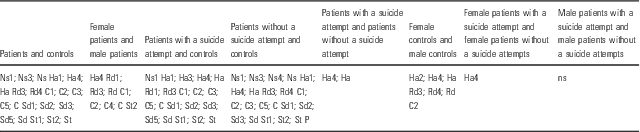
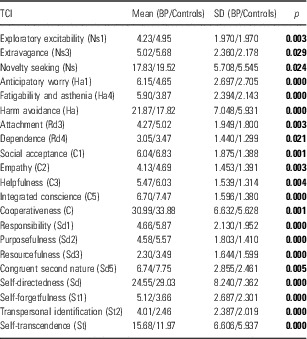
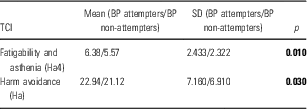
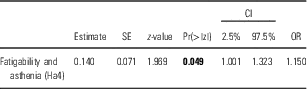
We found numerous differences between the BP patients and the control group in terms of their TCI dimensions/subdimensions (Table 1). The BP patients had higher mean scores than the controls in the following dimensions/subdimensions: anticipatory worry (Ha1), fatigability and asthenia (Ha4), harm avoidance (Ha), self-forgetfullness (St1), transpersonal identification (St2) and self-transference (St) (Table 2). Moreover, differences between BP patients with, and without, suicide attempts were significant with higher scores of fatigability and asthenia (Ha4) as well as harm avoidance (Ha) in suicide attempters (Table 3). Using LR, an association between fatigability and asthenia (Ha4) with suicide attempts in BP patients was confirmed (p=0.049; estimate 0.140; SE 0.071; z-value 1.969; CI 2.5–97.5% 1.001–1.323; OR 1.150) (Table 4). Additional analysis showed differences in terms of personality traits with respect to gender (Table 1).
Significant differences in Temperament and Character Inventory (TCI) dimensions/subdimensions between groups of patients and healthy controls

C, cooperativeness; C1, social acceptance; C2, empathy; C3, helpfulness; C4, compassion; C5, integrated conscience; Ha, harm avoidance; Ha1, anticipatory worry; Ha2, fear of uncertainty; Ha3, shyness with strangers; Ha4, fatigability and asthenia; ns, not statistically significant; Ns, novelty seeking; Ns1, exploratory excitability; Ns2, impulsiveness; Ns3, extravagance; Ns4, disorderliness; P, persistence; Rd, reward dependence; Rd1, sentimentality; Rd3, attachment; Rd4, dependence; St, self-transcendence; Sd1, responsibility; Sd2, purposefulness; Sd3, resourcefulness; Sd4, self-acceptance; Sd5, congruent second nature; Sd, self-directedness; St1, self-forgetfulness; St2, transpersonal identification; St3, spiritual acceptance.
Comparison of Temperament and Character Inventory (TCI) dimensions/subdimensions between bipolar (BP) cases and controls

Bold values significant at p<0.05.Mean, standard deviation and p-value.
Comparison of Temperament and Character Inventory (TCI) dimensions/subdimensions between bipolar (BP) patients with, and without, suicide attempts

Bold values significant at p<0.05.
Logistic regression model for fatigability and asthenia (Ha4) and risk of suicide attempts

Bold values significant at p<0.05.CI, confidence interval; OR, odds ratio.
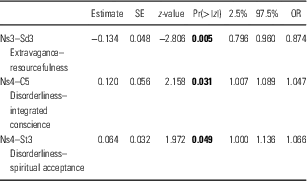
In addition, we investigated whether there are any significant interactions between TCI dimensions/subdimensions and a risk of suicide attempts (Table 5). We found that the interaction of disordiness (Ns4) and spiritual acceptance (St3) may increase suicide risk (OR=1.0658, p=0.063). We noticed a similar trend for disordiness (Ns4) and integrated conscience (C5) (OR=1.0469, p=0.0310). Finally, the combination of extravagance (Ns3) and resourcefulness (Sd3) probably works as a protective factor (OR=0.8744, p=0.0050).
Interactions between temperament and character traits for risk of suicide attempts

Bold values significant at p<0.05.
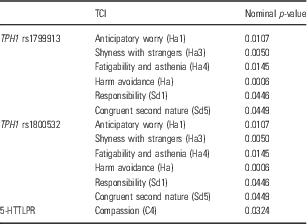
A genetic background of personality traits variability was confirmed in the following findings: an association between rs1800532 and rs1799913 with anticipatory worry (Ha1), shyness with strangers (Ha3), fatigability and asthenia (Ha4), harm avoidance (Ha), responsibility (Sd1), congruent second nature (Sd5) and an association between 5-HTTLPR and compassion (C4) in BP patients (see Table 6). The MPR results suggest that the arrangement of polymorphisms may be helpful in personality traits anticipating (for exploratory excitability Ns1, anticipatory worry Ha1, harm avoidance Ha, cooperativeness C, resourcefulness Sd3, congruent second nature Sd5 and self-directedness Sd) (data not shown in tables).
Associations between 5-HTTLPR, rs1800532 and rs1799913 and Temperament and Character Inventory (TCI) dimensions/subdimensions in the bipolar patients group (Kruskal–Wallis test)

Associations between 5-HTTLPR, rs1800532 and rs1799913 and TCI dimensions/subdimensions in the BP patients group (Kruskal–Wallis test).
Discussion
In our study the patients and controls differed significantly in five main TCI dimensions: novelty seeking, harm avoidance, cooperativeness, self-directedness and self-transcendence. No significant differences were observed between the BP patients and the healthy controls in their scores for reward dependence and persistence. Several personality traits predispose to mood disorders. When investigating personality in the course of BP, we should recognise the fact that personality traits may also be influenced by the disease itself (Reference Calati, Giegling and Rujescu41). Statistically significant differences between BP and healthy individuals in terms of personality traits have been reported previously (Reference Pawlak, Dmitrzak-Węglarz and Skibińska30).
Based on the criteria for endophenotypes formulated by Gottesman and Gould (Reference Gottesman and Gould8), the endophenotype is a marker linked with gene variations. The investigation of the genetic background influencing personality trait variability was limited in our study to the TPH1 and 5-HTTLPR polymorphisms. We found associations between rs1800532 and rs1799913 and anticipatory worry (Ha1), shyness with strangers (Ha3), fatigability and asthenia (Ha4) and harm avoidance (Ha) and responsibility (Sd1), congruent second nature (Sd5) and an association between 5-HTTLPR and compassion (C4) in BP patients.
Impulsiveness and aggressiveness are also related to serotoninergic system polymorphisms (Reference Giegling, Hartmann, Möller and Rujescu42–Reference Zouk, McGirr, Lebel, Benkelfat, Rouleau and Turecki44). A recent linkage analysis produced several linkage peaks for novelty seeking and chromosomes 7 and 10 (Reference Greenwood, Badner and Byerley15). In the same sample, the authors did not confirm the heritability of harm avoidance. However, according to Cloninger’s model, this temperament dimension is highly heritable and linked to the serotonergic system (Reference Pelissolo and Corruble45). Heck et al. (Reference Heck, Lieb and Unschuld46) found associations between 3',5'-cyclic adenosine monophosphate (cAMP)-specific phosphodiesterase four-dimensional SNPs and neuroticism and harm avoidance. These results confirm the fact that personality traits are partially genetically determined. Therefore the criterion that personality traits, as an endophenotype, is heritable is met.
The endophenotype is a marker associated with the investigated illness in the population. Using LR we found an association between the TCI score of fatigability and asthenia (Ha4) and suicide attempts in the BP group. We chose this specific patient population because of its high (33%) risk of suicidal behaviour (Reference López, Mosquera and de León47). Giegling et al. (Reference Giegling, Olgiati and Hartmann48) found that harm avoidance (the TCI dimension that contains the Ha4 subdimension) was associated with self-aggression. Higher scores for harm avoidance and novelty seeking, and lower scores for self-directedness, were associated with suicide attempts in a large study by Perroud et al. (Reference Perroud, Baud and Ardu49). Higher harm avoidance (Ha) and novelty seeking (Ns) scores were associated with a greater severity of suicidal behaviour (Reference Perroud, Baud and Ardu49). Other authors also emphasise the link between suicidal risk, high rates of neuroticism and novelty seeking (Reference Pawlak, Dmitrzak-Węglarz and Skibińska30,Reference Fergusson, Woodward and Horwood50) and the aggression/impulsivity trait (Reference Mann, Arango and Avenevoli12,Reference Maser, Akiskal and Schettler51–Reference Simon, Swann, Powell, Potter, Kresnow and O’Carroll54). However, several studies did not confirm the importance of impulsivity in suicidal behaviour (Reference Pawlak, Dmitrzak-Węglarz and Skibińska30,Reference Oquendo, Waternaux and Brodsky55). This diversity of results may reflect the complex structure of personality and its interactions with other suicide risk factors.
We sought to find whether the interrelations of personality dimensions influence the risk of a suicide attempt. Interactions between the TCI subdimensions: Ns3–Sd3 (extravagance–resourcefulness); Ns4–C5 (disorderliness–integrated conscience); Ns4–St3 (disorderliness–spiritual acceptance) revealed an association with a record of a suicide attempt in the patient’s history. This indicates that assessment of the risk of suicidal behaviour depends not only on the raw subdimension scores, but also on their inter-relationships.
Disorderliness (Ns4) interacts with integrated conscience (C5), and also with spiritual acceptance (St3). Extravagance (Ns3) interacts with resourcefulness (Sd3). These pairs: Ns3–Sd3; Ns4–c5; Ns4–st3 are constituted by traits of temperament that interact with character subdimensions. This may suggest that crucial for the risk of suicide, is the overlapping of congenital traits with those acquired during the processes of development and maturation of the personality. This may be one of the intermediate gene and environment (G×E) interactions. Potentially, the traits: integrated conscience (C5), spiritual acceptance (St3) and resourcefulness (Sd3), as character subdimensions, may be influenced by psychotherapy. The practical use of these results requires further development.
Conclusions
We found associations between 5-HTTLPR, rs1800532 and rs1799913 and the TCI dimensions/subdimensions in the BP patients group. Furthermore, personality traits and their configuration, especially interactions between temperament and character traits, may be helpful in predicting the risk of suicidal behaviour.
Acknowledgements
The authors would like to thank Professor Geoffrey Shaw for his linguistic assistance.
Financial Support
This study was supported by a grant from the National Science Centre, Poland (No 2011/01/B/NZ5/02795).
Conflicts of Interest
The authors declare no conflict of interest.