Introduction
Integrated pest management (IPM) uses biological, chemical, and agronomical techniques to control pest populations (Cocco et al., Reference Cocco, da Silva, Benelli, Botton, Lucchi and Lentini2020; Santoiemma et al., Reference Santoiemma, Tonina, Marini, Duso and Mori2020; Gugliuzzo et al., Reference Gugliuzzo, Biedermann, Carrillo, Castrillo, Egonyu, Gallego, Haddi, Hulcr, Jactel, Kajimura and Kamata2021). Pesticides exhibit efficacy against target pests, but they can also have adverse effects on natural enemies (Desneux et al., Reference Desneux, Decourtye and Delpuech2007; Biondi et al., Reference Biondi, Desneux, Siscaro and Zappalà2012, Reference Biondi, Zappalà, Stark and Desneux2013; Guedes et al., Reference Guedes, Smagghe, Stark and Desneux2016). As biological control is very important for controlling pest populations, insecticide use should not compromise but rather complement biocontrol in reducing pest populations and reducing the risk of pest outbreaks (Fontes et al., Reference Fontes, Roja, Tavares and Oliveira2018). Thus, the potentially adverse effects of pesticides on natural enemies require investigation of their side effects in pest management programs (De Armas et al., Reference De Armas, Grutzmacher, Nava, Pasini, Rakes and de Bastos Pazini2020; Rajaee et al., Reference Rajaee, Maroofpour, Ghane-Jahromi, Sedaratian-Jahromi and Guedes2022).
The cotton aphid Aphis gossypii Glover (Hemiptera: Aphididae) is an important cosmopolitan pest species with vegetables and ornamentals in open fields and greenhouses, and also in crop fields. This aphid species causes direct (e.g., aborted fruit) and indirect (e.g., transmitting viruses) damage to plants (Amini Jam et al., Reference Amini Jam, Kocheili, Mossadegh, Rasekh and Saber2014; Campolo et al., Reference Campolo, Chiera, Malacrinò, Laudani, Fontana, Albanese and Palmeri2014), and insecticide use is a major control method used against this species. As a result, this aphid species has developed resistance to the number of insecticides, and the use of insecticide mixtures is an important tactic to manage the problem (Herron et al., Reference Herron, Powis and Rophail2001; Wang et al., Reference Wang, Liu, Yu, Jiang and Yi2002). The thiacloprid + deltamethrin insecticide mixture controls sucking and chewing pests by systemic and contact exposure (Almasi et al., Reference Almasi, Sabahi and Mardani2016), which, when combined with biocontrol, has a high impact on the targeted pest species (Momanyi et al., Reference Momanyi, Maranga, Sithanantham, Agong, Matoka and Hassan2012; Fontes et al., Reference Fontes, Roja, Tavares and Oliveira2018). However, insecticide use to control a given species has potentially adverse effects on non-targeted organisms, such as parasitoids, predators, and pollinators (Desneux et al., Reference Desneux, Decourtye and Delpuech2007; Souza et al., Reference Souza, Moreira, Lima, Silva, Braga and Carvalho2020). Also, the outbreak of A. gossypii results from the reduction of natural enemy populations and, in some cases, may result from the stimulation of aphid reproduction by pesticides, a phenomenon known as insecticide-induced hormesis (Guedes and Cutler, Reference Guedes and Cutler2014; Wang et al., Reference Wang, Qi, Desneux, Shi, Biondi and Gao2017; Ullah et al., Reference Ullah, Gul, Desneux, Gao and Song2019; Reference Ullah, Gul, Tariq, Desneux, Gao and Song2020).
Insect pest species such as aphids exhibit high reproductive rates, and their control frequently requires the use of selective insecticides along with natural enemies (Aparicio et al., Reference Aparicio, Gabarra and Arnó2020; Hullé et al., Reference Hullé, Chaubet, Turpeau and Simon2020; Maroofpour et al., Reference Maroofpour, Mousavi, Hejazi, Iranipour, Hamishehkar, Desneux, Biondi and Haddi2021). One of the most important approaches for the biological control of plant-feeding insects is the introduction of parasitoid wasps (Japoshvili and Abrantes, Reference Japoshvili and Abrantes2006). Aphidius flaviventris Kurdjumov (Hymenoptera: Aphelinidae) is known to prey on several aphid species in Iran (Abd-Rabou et al., Reference Abd-Rabou, Ghahari, Myartseva and Ruíz-Cancino2013). Aphidius colemani Viereck (Hymenoptera: Braconidae) is a solitary endoparasitoid used to biological control several economically important aphid pests. This parasitoid is one of the most successful biological control agents in greenhouses, and it has a worldwide distribution (Prado et al., Reference Prado, Jandricic and Frank2015; D’Ávila et al., Reference D’Ávila, Barbosa, Guedes and Cutler2018). Compared to aphid parasitoids, A. colemani exhibits significant potential to spread and forage within greenhouses (Heinz, Reference Heinz1998).
Even though this insecticide mixture is a new foliar insecticide formulation with broad-spectrum efficacy for use in a wide range of crops, little information is currently available about the interaction of two natural enemies with insecticides, and particularly insecticide mixtures, including the effects of thiacloprid + deltamethrin on target pests and their natural enemies. This knowledge can help to establish more sustainable IPM programs. Majidpour et al. (Reference Majidpour, Maroofpour, Ghane-Jahromi and Guedes2020) reported the effect of some sublethal concentrations (LC10 and LC30) of thiacloprid + deltamethrin on A. gossypii and A. flaviventris. Based on that study, sublethal concentrations of the insecticide mixture reduced aphid longevity, fecundity, and life-table parameters in the first generation. Furthermore, the parasitoid's population growth and parasitism rate were significantly compromised at both concentrations under sublethal exposure (Majidpour et al., Reference Majidpour, Maroofpour, Ghane-Jahromi and Guedes2020). Besides the short-term influences of insecticides, it is important to take into account the entire life-history as a comprehensive method for evaluating the total effect on insect population, including the impacts on the next generation, which have important implications for the success of an IPM program (Müller, Reference Müller2018). Further and accurate assessments of these effects are important to acquire knowledge on the overall insecticide efficacy for long-term management of pest insect populations and their selectivity toward natural enemy species (Ferdenache et al., Reference Ferdenache, Bezzar-Bendjazia, Marion-Poll and Kilani-Morakchi2019). Hence, this study has attempted to extend the previous research on concentration and insect tested about the sublethal effects of other concentrations on the successive generation. The present study was carried out to assess the effects of thiacloprid + deltamethrin on the life-history and demographic parameters of the cotton aphid A. gossypii and its parasitoids A. flaviventris and A. colemani. The impact of insecticide mixture on parasitism rate was also recorded to assess its effects on natural enemy efficacy under such exposure.
Materials and methods
Insect rearing
The cotton aphid colony was reared on cucumber plants (Cucumis sativus L. var. Emperator) (Cucurbitales: Cucurbitaceae). Cucumber seeds were planted in pots (18 cm in diameter and 19 cm high) without pesticide application at 26 ± 2°C, 60–70% relative humidity, and 16:8 (L:D) photoperiod. The original aphid colony was collected from Yasouj city in the Kohgiluyeh and Boyer-Ahmad Provinces of Iran, and these were transferred to a greenhouse at Yasouj University. Uninfested plants (with 5–7 true leaves) were provided every week to replace the aphid-infested plants in maintaining the insect colonies. In order to synchronize the age of the aphids, apterous female adults were placed on leaf disks and were allowed to lay eggs for 24 h. The nymphs were then transferred to new leaf disks and maintained for 3 days until they reached the 3rd nymphal stage.
A. flaviventris was obtained from mummified aphids of A. gossypii colonies and identified using morphological keys at the Iranian Research Institute of Plant Protection of Tabriz, Iran (Japoshvili and Abrantes, Reference Japoshvili and Abrantes2006). A. colemani was purchased from Gyah Co. (Karaj, Iran). They were maintained on cotton aphids with cotton wicks soaked in sugar water solution (10%), which were kept on cucumber plants. The plants were removed from the cages when most aphids were mummified, and the mummified aphids were transferred into 1-liter plastic jars.
Insecticide concentration-mortality bioassay
The insecticide mixture thiacloprid + deltamethrin (Proteus®) was obtained from Bayer Parsian, Iran. This insecticide mixture contains an oil dispersion with 10 g ai/l deltamethrin and 100 g ai/l thiacloprid.
To determine the toxicity of the thiacloprid + deltamethrin to A. gossypii, bioassays were performed on the 3rd instar nymphs. Stock solution and serial dilutions were prepared with distilled water added with Tween-80 as a surfactant at a concentration of 0.05%. Preliminary tests were conducted to assess the effective concentration range of the insecticide mixture. Five concentrations ranging from 3.3 to 52.25 g ai/l were subsequently established and used. The control treatment consisted of only distilled water and Tween-80. Each concentration was replicated three times. In Petri dishes (6 cm in diameter), leaf disks (5 cm diameter) of cucumber (C. sativus L.) were individually placed on soaked cotton, and 20 3rd instar nymphs (<12 h) were placed on each disk with a soft brush. Three milliliters of each insecticide mixture concentration were subsequently sprayed on the leaf disks containing aphids using a Potter tower (Burkard Scientific, Uxbridge, UK) at 5 bars of pressure. Mortality was recorded after 24 h of exposure. The aphids were recorded as dead when unable to move after being gently prodded with a hair brush.
Sublethal effects on the cotton aphid
Aiming to investigate life-history and demographic effects of the mixture thiacloprid + deltamethrin on A. gossypii, 3rd instar nymphs (<12 h old) were treated with a concentration corresponding to the LC20 (i.e., 4.88 g ai/l) of the insecticide mixture. This concentration is below the 30% mortality threshold usually recommended when focusing on sublethal effects of insecticides used in IPM programs (Desneux et al., Reference Desneux, Wajnberg, Fauvergue, Privet and Kaiser2004). Ninety similar-aged 3rd instar nymphs were transferred to cucumber leaf disks placed on wet cotton in separate Petri dishes before spraying, as described above. In the control group, aphids were sprayed with distilled water and Tween-80. After 24 h of exposure, 50 surviving nymphs were individually transferred to new Petri dishes free from insecticide residues and kept under controlled conditions. Nymph survival was recorded every 24 h until reaching the adult stage. After adult emergence, survival, mortality, and the progeny of each adult female aphid were recorded daily.
Transgenerational sublethal effects in F1 generation of the cotton aphid
The F1-generation nymphs obtained from the insecticide-sprayed 3rd instar nymphs from the previous experiment were used in these experiments. The nymphs were transferred to new Petri dishes without insecticide after 24 h. After adult emergence, 50 similar-aged newborn nymphs (1st instar) were transferred to cucumber leaf disks placed over wet cotton in separate Petri dishes. The subsequent experiments were carried out as described above.
Sublethal effects on aphid parasitoids
In order to estimate the effect of the insecticide mixture thiacloprid + deltamethrin on the aphid parasitoids A. flaviventris and A. colemani, we used the LC20 obtained from the concentration-mortality bioassay with the cotton aphid A. gossypii. For this purpose, 130 similar-aged 3rd instar nymphs of A. gossypii were placed on the Petri dish, as previously described. Then, the aphid nymphs were treated with LC20 of the insecticide mixture using a Potter spray tower, as previously described. The control group consisted of aphids sprayed with distilled water and Tween-80. One-liter plastic jars were used to transfer the surviving nymphs after 24 h. Then, the adult parasitoids (male and female) were released into the jars, and the parasitism on treated and untreated aphids remained for 24 h before removing the adult parasitoids. Each aphid exposed to A. flaviventris and A. colemani parasitism was transferred to a separate Petri dish. The appearance of mummified aphids was monitored daily. After the emergence of adult parasitoids, the females and males were paired (32 and 26 pairs for A. flaviventris and A. colemani, respectively) and daily provided with 20 aphid nymphs (3rd instar) and honey. After 24 h, the parasitoids were removed, and the Petri dishes were kept until mummified aphids emerged. The fecundity and longevity of each wasp couple were recorded daily until the couple died. The treatments were maintained under the same environmental conditions previously described.
Statistical analyses
The concentration-mortality values were subjected by probit analysis using SPSS software (SPSS, 2011). The mortalities were subjected to Abbott's formula to correct the natural mortality observed in control (Abbott, Reference Abbott1925).
The life-table parameters for both aphids and parasitoids, such as development time of different stages, fecundity, longevity, and population parameters, were analyzed by the computer program TWOSEX-MS Chart, based on the age-stage, two-sex life-table theory (Chi, Reference Chi1988; Chi and Su Reference Chi and Su2006; Tuan et al., Reference Tuan, Lee and Chi2014; Chi et al., Reference Chi, You, Atlihan, Smith, Kavousi, Ozgokce, Guncan, Tuan, Fu, Xu and Zheng2020). The bootstrap technique with 100,000 bootstrap replicates was applied to calculate the standard errors of all population parameters (Chi, Reference Chi2020b).
The CONSUME-MS Chart was used to estimate daily parasitism rates (Chi and Yang, Reference Chi and Yang2003; Chi Reference Chi2020a). The parameters calculated were: age-specific net parasitism rate (qx), net parasitism rate (C 0), finite predation rate (ω), stable parasitism rate (ψ), age-specific parasitism rate (kx), and transformation rate (Q p). The bootstrap technique with 100,000 bootstrap replicates was applied to calculate the standard errors of all parameters.
Results
Concentration-mortality bioassays
The probit model was suitable for describing the concentration-mortality trend obtained with the aphids when exposed to the insecticide mixture in the concentration-mortality bioassay. The LC20 and LC50 values for the mixture thiacloprid + deltamethrin against A. gossypii were 4.88 and 14.1 g ai/L, respectively (Supplementary table 1).
Sublethal impacts on the cotton aphid
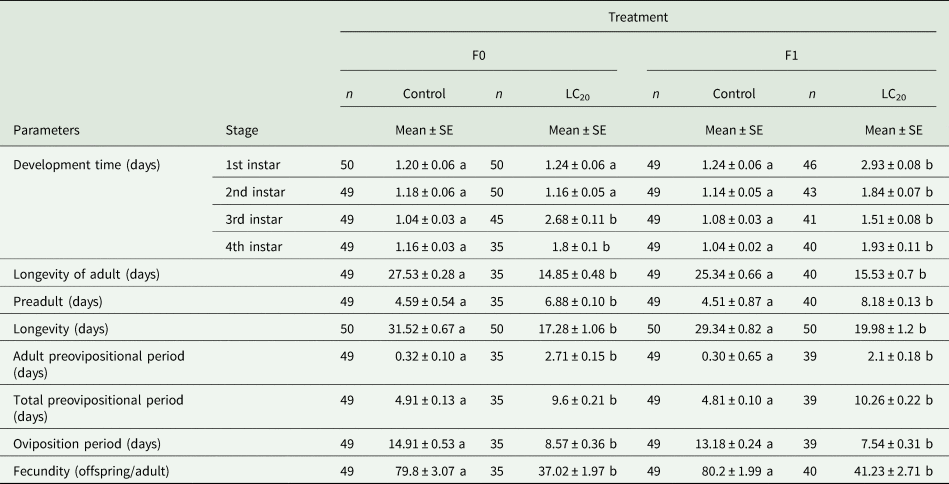
According to the results, the insecticide mixture causes significant impacts on various developmental and biological parameters at different stages of the cotton aphid A. gossypii (table 1). Starting from the 3rd instar, the developmental time extended following exposure to the mixture thiacloprid + deltamethrin compared with the control leading to an increase of the preadult period. Total pre-ovipositional and adult pre-ovipositional periods were also significantly higher. At the same time, a significant decrease was observed in the adult developmental time, fecundity, oviposition period, and longevity of the insecticide-exposed aphids. Furthermore, the insecticide mixture affected the aphid population parameters (table 2), causing significant increase in the mean generation time (T) (F = 4114.29; df = 1; P < 0.001), and decreasing the net reproductive rate (R 0) (F = 7101.66; df = 1; P < 0.001) and intrinsic rate of increase (r) (F = 10,487.69; df = 1; P < 0.001).
Demographic parameters (mean ± SE) of the cotton aphid A. gossypii exposed to thiacloprid + deltamethrin at the LC20 = 4.88 g ai/l

SEs were estimated by using the bootstrap technique with 100,000 resampling. Means were compared with the paired bootstrap test (P < 0.05). Lower case letters indicate significant differences between generations with control.
Population parameters (mean ± SE) of the cotton aphid A. gossypii exposed to thiacloprid + deltamethrin at the LC20 = 4.88 g ai/l

SEs were estimated by using the bootstrap technique with 100,000 resampling. Means were compared with the paired bootstrap test (P < 0.05). Lower case letters indicate significant differences between generations with control.
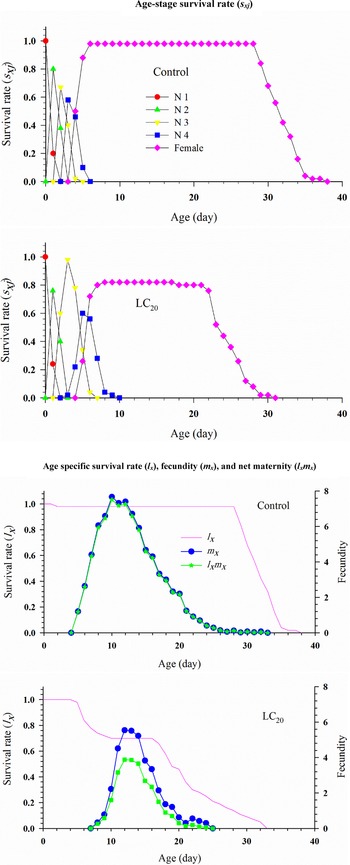
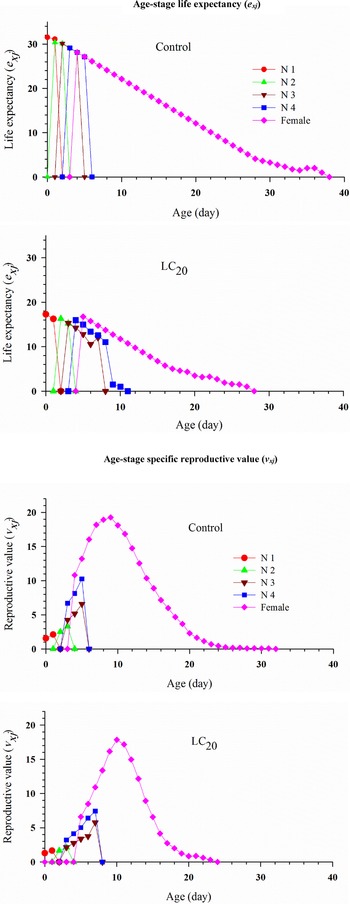
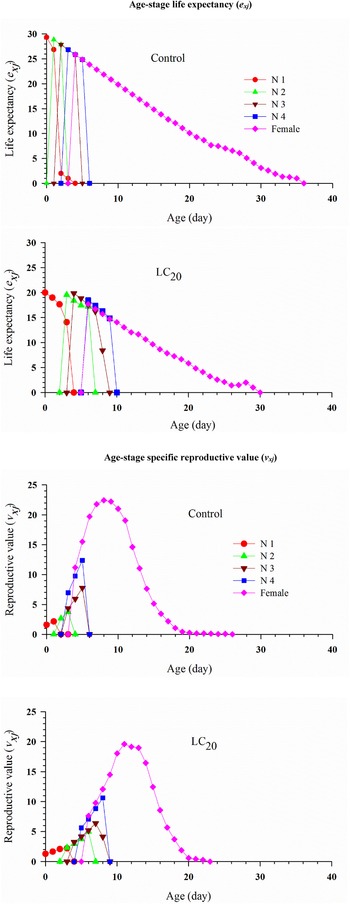
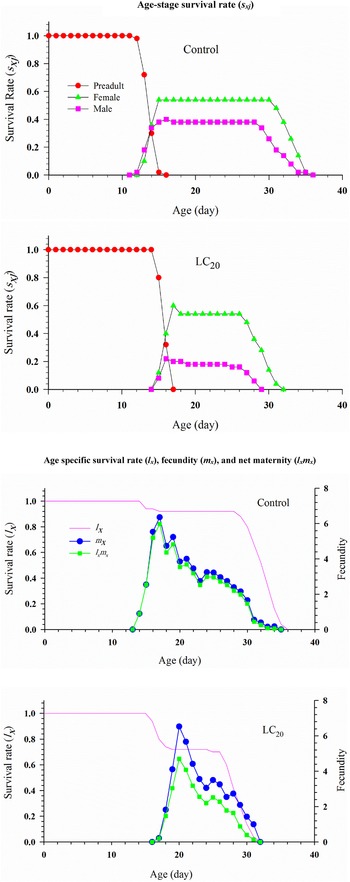
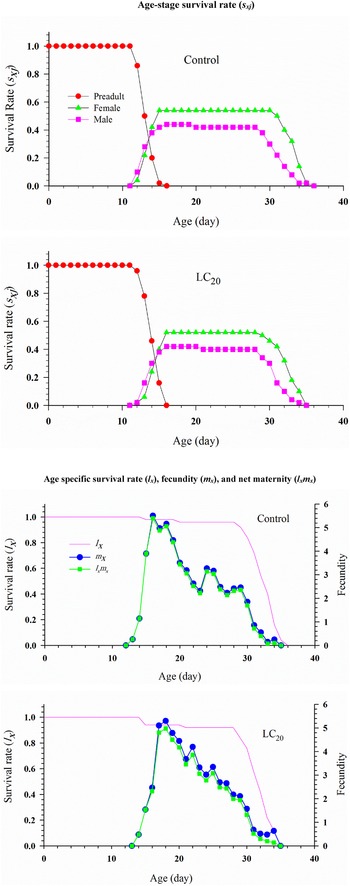
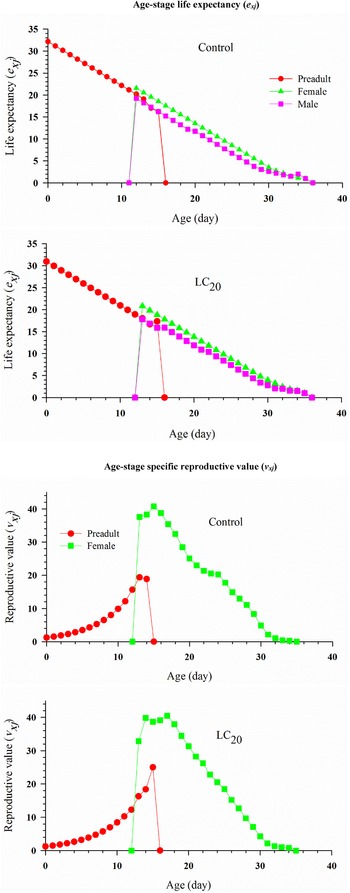
The exposure to thiacloprid + deltamethrin also had detrimental impacts on the age-stage survival rate (sxj) of each age-stage, the age-specific survival rate (lx), the age-specific fecundity (mx) and maternity (lxmx), the life expectancy (exj), and also the age-stage-specific reproductive values (vxj) of the aphid A. gossypii (figs 1 and 2).
Age-stage survival rate (sxj) and age-specific survival rate (lx), fecundity (mx), and net maternity (lxmx) of F0 generation of A. gossypii exposed to thiacloprid + deltamethrin at the LC20 = 4.88 g ai/l.

Age-stage life expectancy (exj) and age-stage specific reproductive value (vxj) of F0 generation of A. gossypii exposed to thiacloprid + deltamethrin at the LC20 = 4.88 g ai/l.

Significant overlap among life stages was observed in untreated aphids due to the variable developmental rate among individuals but was not as evident as in the insecticide-exposed aphids. In these aphids, not only was the probability that a newborn nymph surviving until the adult stage lower (fig. 1), but the start of egg-laying was also delayed (fig. 1), the age-specific fecundity was reduced, and their life expectancy decreased as age increased (fig. 2).
Transgenerational sublethal impacts on the cotton aphid
Thiacloprid + deltamethrin impacted the F1 generation of the cotton aphid (tables 1 and 2). The developmental time significantly increased in all instars and preadult stages of A. gossypii exposed to the insecticide mixture (table 1). Significant increase was observed in the adult preovipositional period (F = 4355.02; df = 1; P < 0.001) and total preovipositional period (F = 2389.81; df = 1; P < 0.001) compared to the control. At the same time, the insecticide significantly reduced oviposition (F = 9201.13; df = 1; P < 0.001) and fecundity (F = 6262.28; df = 1; P < 0.001) compared to the control group. All population parameters were significantly reduced after insecticide exposure (table 2).
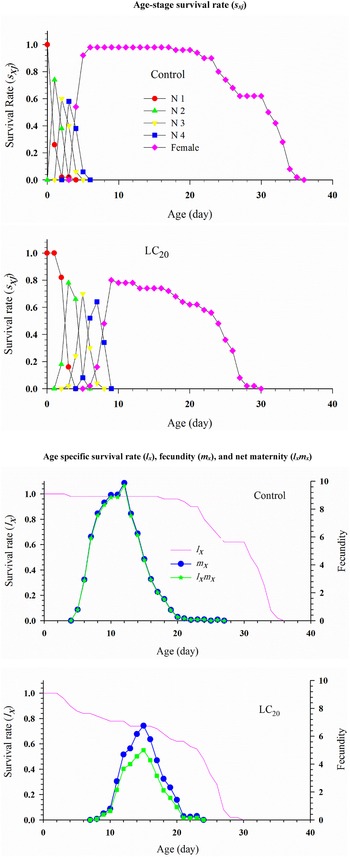
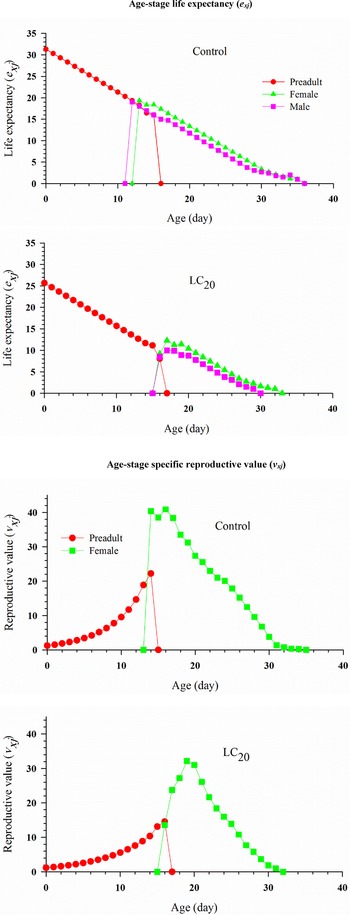
The overlap among life stages in the F1 generation decreased, and the start of egg-laying was delayed by insecticide exposure (fig. 3). Furthermore, the insecticide mixture reduced the life expectancy (exj) of all stages and the age-stage-specific reproductive value (vxj) (fig. 4).
Age-stage survival rate (sxj) and age-specific survival rate (lx), fecundity (mx), and net maternity (lxmx) of F1 generation of A. gossypii exposed to thiacloprid + deltamethrin at the LC20 = 4.88 g ai/l.

Age-stage life expectancy (exj) and age-stage specific reproductive value (vxj) of F1 generation of A. gossypii exposed to thiacloprid + deltamethrin at the LC20 = 4.88 g ai/l.

Sublethal impacts on the parasitoid A. flaviventris
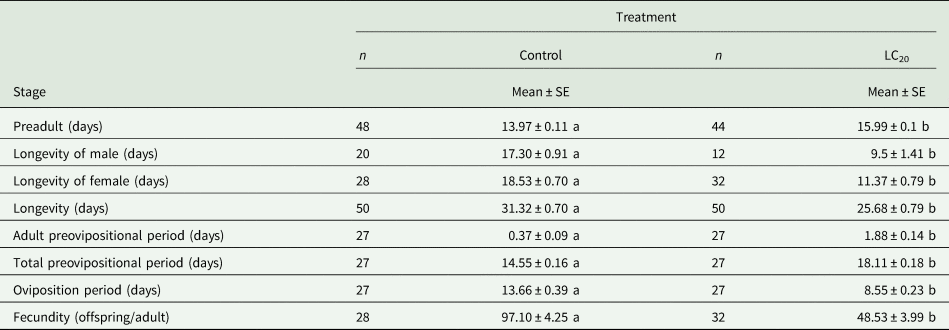
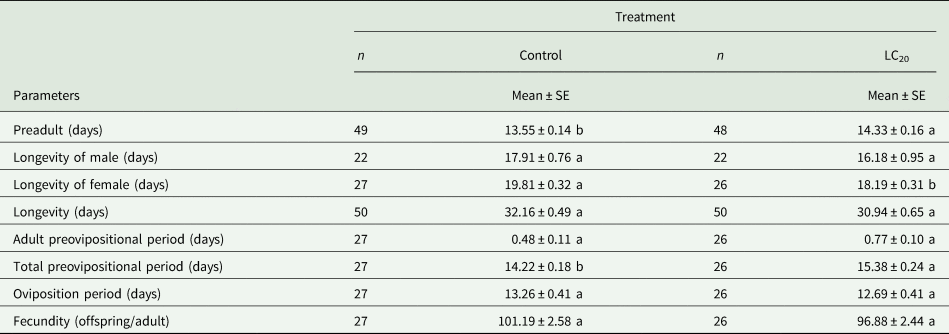
The results of demographic parameters of A. flaviventris indicated that the insecticide mixture had also effects on the different stages and population parameters of this parasitoid when reared on exposed host (tables 3 and 4). In fact, significant decreases were registered in the longevity of male (F = 390.55; df = 1; P < 0.001) and female (F = 1373.22; df = 1; P < 0.001) parasitoids, oviposition period (F = 3877.81; df = 1; P < 0.001) and total fecundity (F = 2113.04; df = 1; P < 0.001), while the adult pre-ovipositional period (F = 2127.47; df = 1; P < 0.001) and total pre-ovipositional period (F = 5635.39; df = 1; P < 0.001) were extended under insecticide exposure. Moreover, the intrinsic rate of increase (rm) (F = 1162.77; df = 1; P < 0.001), and net reproductive rate (R 0) (F = 395.69; df = 1; P < 0.001) of the parasitoid A. flaviventris exhibited a significant decrease compared with unexposed parasitoids, while their mean generation time (T) (F = 4454.46; df = 1; P < 0.001) significantly increased (table 4). Finally, the start of egg-laying was delayed (fig. 5), the life expectancy reduced (fig. 6), and the age-specific fecundity and age-stage-specific reproductive value decreased with the insecticide mixture (fig. 6).
Age-stage survival rate (sxj) and age-specific survival rate (lx), fecundity (mx), and net maternity (lxmx) of A. flaviventris exposed to thiacloprid + deltamethrin at the LC20 = 4.88 g ai/l.

Age-stage life expectancy (exj) and age-stage specific reproductive value (vxj) of A. flaviventris exposed to thiacloprid + deltamethrin at the LC20 = 4.88 g ai/l.

Demographic parameters (mean ± SE) of the parasitoid A. flaviventris exposed to thiacloprid + deltamethrin at the LC20 = 4.88 g ai/l

SEs were estimated by using the bootstrap technique with 100,000 resampling. Means were compared with the paired bootstrap test (P < 0.05). Lower case letters indicate significant differences between the two treatments.
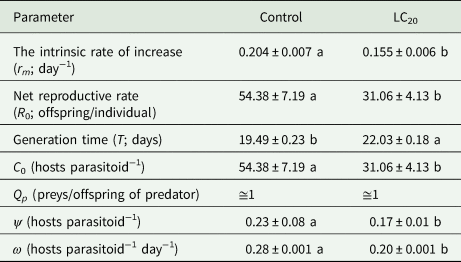
Population parameters and parasitism rate (mean ± SE) of the parasitoid A. flaviventris exposed to thiacloprid + deltamethrin at the LC20 = 4.88 g ai/l

SEs were estimated by using the bootstrap technique with 100,000 resampling. Means were compared with the paired bootstrap test (P < 0.05). Lower case letters indicate significant differences between the two treatments.
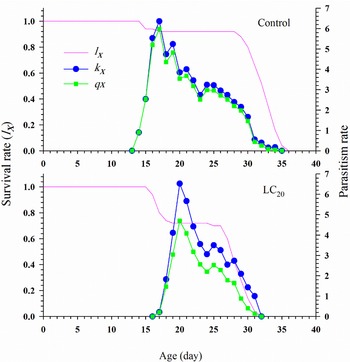
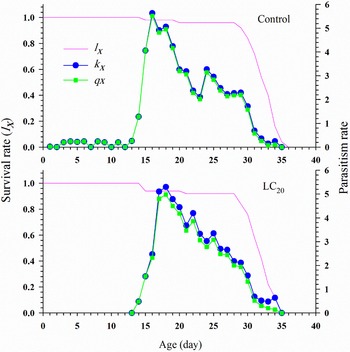
The finite predation rate (ω) and net parasitism rate (C 0) significantly decreased under insecticide exposure (table 4). The transformation rate (Qp) indicates that A. flaviventris required almost one aphid to produce a single parasitoid egg. Also, the age-specific net parasitism rate (qx) increased at first and then decreased as age increased. The start of parasitism was delayed under insecticide exposure (fig. 7). Based on these results, the insecticide mixture reduced the age-specific net parasitism rate (qx) (fig. 7).
Age-specific survival rate (lx), age-specific host feeding rate (kx), and age-specific net host feeding rate (qx) of A. flaviventris exposed to thiacloprid + deltamethrin at the LC20 = 4.88 g ai/l.

Sublethal effects on the parasitoid A. colemani
Thiacloprid + deltamethrin affected A. colemani life-history parameters. The length of the preadult period (F = 670.19; df = 1; P < 0.001), female longevity (F = 357.84; df = 1; P < 0.001), and total preovipositional period (F = 417.05; df = 1; P < 0.001) were affected by the LC20, showing a significant increase when compared to the control, but no significant difference was observed in other life-history traits (table 5). Furthermore, among the life-table parameters of A. colemani, only mean generation time (T) (F = 394.61; df = 1; P = 0.055) was significantly different from the control group (table 6).
Demographic parameters (mean ± SE) of the parasitoid A. colemani exposed to thiacloprid + deltamethrin at the LC20 = 4.88 g ai/l

SEs were estimated by using the bootstrap technique with 100,000 resampling. Means were compared with the paired bootstrap test (P < 0.05). Lower case letters indicate significant differences between the two treatments.
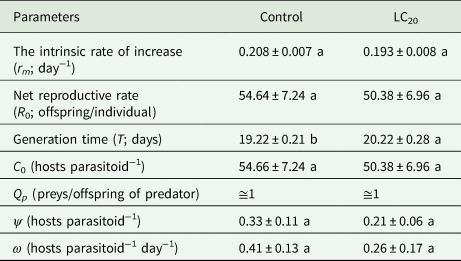
Population parameters and parasitism rate (mean ± SE) of the parasitoid A. colemani exposed to thiacloprid + deltamethrin at the LC20 = 4.88 g ai/l

SEs were estimated by using the bootstrap technique with 100,000 resampling. Means were compared with the paired bootstrap test (P < 0.05). Lower case letters indicate significant differences between the two treatments.
The exposure to thiacloprid + deltamethrin had no detrimental impacts on the age-stage survival rate (sxj) of each age-stage and the age-specific survival rate (lx) of this parasitoid. Furthermore, the age-specific fecundity (mx) and maternity (lxmx), the life expectancy (exj), and age-stage-specific reproductive values (vxj) of this parasitoid were also not affected by exposure to the insecticide mixture (figs 8 and 9).
Age-stage survival rate (sxj) and age-specific survival rate (lx), fecundity (mx), and net maternity (lxmx) of A. colemani exposed to thiacloprid + deltamethrin at the LC20 = 4.88 g ai/l.

Age-stage life expectancy (exj) and age-stage specific reproductive value (vxj) of A. colemani exposed to thiacloprid + deltamethrin at the LC20 = 4.88 g ai/l.

The parasitism rate of A. colemani at different concentrations is shown in table 6. According to the result, the insecticide mixture caused a decrease in the net parasitism rate (C 0) and finite predation rate (ω). The results of age-specific survival rate (lx), the age-specific parasitism rate (kx), and the age-specific net parasitism rate (qx) are presented in fig. 10. Qp shows that A. colemani required almost one aphid to produce a single parasitoid egg. The age-specific net parasitism rate (qx) increases first and then decreases as age increases. Based on these results, the LC20 reduced the age-specific parasitism rate (kx) and age-specific net parasitism rate (qx) of A. colemani. The start of parasitism was also delayed under insecticide exposure.
Age-specific survival rate (lx), age-specific host feeding rate (kx), and age-specific net host feeding rate (qx) of A. colemani exposed to thiacloprid + deltamethrin at the LC20 = 4.88 g ai/l.

Discussion
Thiacloprid + deltamethrin showed different effects on the target pest and its natural enemy. According to the present study results, thiacloprid + deltamethrin exhibits high toxicity to A. gossypii and negatively impacts the demographic parameters of this pest species. Effects of thiacloprid + deltamethrin negatively affected demographic parameters in successive generations of the cotton aphid (Kerns and Stewart, Reference Kerns and Stewart2000).
Shi et al. (Reference Shi, Jiang, Wang, Qiao, Wang and Wang2011) reported that fecundity and longevity of A. gossypii at LC20 were significantly reduced by thiacloprid. Our results are also consistent with Majidpour et al. (Reference Majidpour, Maroofpour, Ghane-Jahromi and Guedes2020), reporting that low concentrations (LC10 and LC30) of thiacloprid + deltamethrin compromise the demographic parameters of A. gossypii and A. flaviventris. Thiacloprid + deltamethrin reduced demographic parameters of several pest species and their parasitoids, such as the age-stage survival rate, age-specific fecundity, age-specific maternity, and life expectancy (Majidpour et al., Reference Majidpour, Maroofpour, Ghane-Jahromi and Guedes2020). Miao et al. (Reference Miao, Du, Wu, Gong, Jiang, Duan, Li and Lei2014) also showed that thiacloprid caused a reduction in net reproductive rate, intrinsic rate of increase, finite rate of increase, and an increase in mean generation time of Sitobion avenae (Fabricius) (Hemiptera: Aphididae). Similar to the present study, other laboratory studies indicated that sublethal concentrations of imidacloprid and thiamethoxam (LC50, LC20, and LC1) had no significant effects on the reproduction of A. colemani (Ricupero et al., Reference Ricupero, Desneux, Zappalà and Biondi2020).
The negative effects of low concentrations of deltamethrin and thiacloprid on natural enemies were previously reported. A study by Kidd et al. (Reference Kidd, Rummel and Thorvilson1996) found that the pyrethroid cyhalothrin increased the population growth of A. gossypii by reducing the predator population. Similarly, Mardani et al. (Reference Mardani, Sabahi, Rasekh and Almasi2016) reported that thiacloprid + deltamethrin had the most negative impact on the life-table parameters of Lysiphlebus fabarum (Marshall) (Hymenoptera: Aphididae). In another study, Abdulhay and Rathi (Reference Abdulhay and Rathi2014) reported that thiacloprid reduced adult emergence and parasitism potency in Trichogramma evanescens (Westwood) (Hymenoptera: Trichogrammatidae).
Mead-Briggs (Reference Mead-Briggs1992) reported that the adult stage was significantly affected by thiacloprid compared to the pre-imaginal stage in Aphidius rhopalosiphi (DeStefani-Perez) (Hymenoptera: Braconidae). Bastos et al. (Reference Bastos, de Almeida and Suinaga2006) investigated Trichogramma pretiosum (Riley) (Hymenoptera: Trichogrammatidae) and reported that thiacloprid did not affect adult emergence of this parasitoid. The difference in the results of these two studies with the present study may be due to differences in the parasitoid species, indicating that A. flaviventris is more susceptible than other parasitoids. Thiacloprid + deltamethrin mixture was recognized as harmful due to its high toxicity to larval and adult stages of Hippodamia variegata (Goeze) (Coleoptera: Coccinellidae) and caused a severe reduction in all parameters of this species demographic (Almasi et al., Reference Almasi, Sabahi and Mardani2016).
Thiacloprid belongs to the neonicotinoid group, and this group of insecticides competitively modulates nicotinic insect acetylcholine receptors in insects, while deltamethrin, as pyrethroid insecticide, is a sodium channel modulator in axons of neurons in the nervous system. The neurotoxic activity of both insecticides may also impair reproduction because the reproductive process in arthropods is mediated by neurohormones (Ullah et al., Reference Ullah, Gul, Desneux, Gao and Song2019). Thus, neurohormonal imbalance due to insecticide poisoning may affect regular reproductive activity. Previous studies attest that adult longevity and fecundity may be due to disturbances in the neurosecretory system due to sublethal insecticide exposure (Ullah et al., Reference Ullah, Gul, Desneux, Gao and Song2019).
Results of the present study indicated that thiacloprid + deltamethrin exhibits high efficiency against A. gossypii. The obtained results also showed transgenerational effects of thiacloprid + deltamethrin on the F1 generation of the cotton aphid, reinforcing its efficacy against this species. The significant reductions in the demographic parameters of A. gossypii indicated the mixture suitability against this pest species. Nonetheless, this species parasitoid, A. flaviventris, was affected even by the low concentration of this insecticide mixture. According to the results obtained, the insecticide compromised all demographic parameters of this parasitoid. In contrast, such effects were only mild on the parasitoid A. colemani, which was more tolerant to this insecticide mixture. Based on our findings, thiacloprid + deltamethrin is effective against the cotton aphid A. gossypii, but it is also harmful to natural enemies such as A. flaviventris, although not as much A. colemani. Therefore, the simultaneous use of this insecticide with A. flaviventris is not recommended in pest management programs.
Given that this research represents a series of preliminary studies to examine the properties of thiacloprid + deltamethrin, further studies exploring the effect of temperature on insecticide performance against target insect pests and natural enemies are warranted. The assessment of the effects of insecticide mixtures on the insect's detoxification metabolism and behaviors such as dispersal and foraging also deserve attention to better understand their impacts on insects exposed to insecticides.
Supplementary material
The supplementary material for this article can be found at https://doi.org/10.1017/S0007485322000281.
Acknowledgements
We are immensely grateful to Professor Raul Narciso C. Guedes (Departamento de Entomologia, Universidade Federal de Viçosa, Viçosa (MG), Brazil) and Professor Gary P. Merkley (Professor of Utah State University, Logan, UT, USA) for their comments on an earlier version of the manuscript.
Conflict of interest
The authors declare that they have no conflict of interest.