Each year, 40,000 children are born in the United States of America with CHD. 2 Medical advances continue to improve morbidity and mortality rates, with significantly more infants living into adulthood.Reference Knowles, Bull, Wren, Wade, Goldstein and Dezateux 3 Given this progress, it is important to focus on children’s psychological, academic, and social functioning throughout the lifespan to best care for this population. Emerging research indicates that children with CHD have lower reported quality of life compared with healthy controls as well as those with other chronic illnesses.Reference Mussatto and Tweddell 4 Although many children do experience relatively normal quality of life, it seems that children born with CHD are at risk for externalising, internalising, and adjustment difficulties, similar to children with other chronic illnesses.Reference Uzark, Jones, Slusher, Limbers, Burwinkle and Varni 5 , Reference Latal, Helfricht, Fischer, Baursfeld and Landoldt 6 A few studies have specifically examined children born with hypoplastic left heart syndrome, a subset of single-ventricle pathology that requires intense surgical intervention early in life, with three palliative heart surgeries typically before age three. 2 , Reference Feinstein, Benson and Dubin 7 , Reference Marino, Tomlinson and Wernovsky 8 Medical advances have dramatically decreased mortality, although it continues to remain at ~40% 5 years after palliative surgeries.Reference Fruitman 9 Continued research is required to better understand the unique course and psychosocial complexity of these medically fragile children.
Understanding the psychosocial experience of the families of children born with hypoplastic left heart syndrome is important, as it is known that those affected by this complex condition endure lengthy, complicated, and stressful admissions.Reference Goldberg, Mussatto, Licht and Wernovsky 10 Early evidence supports that children with more complicated forms of CHD, such as those born with single-ventricle pathology, have more adjustment difficulties and lower quality of life.Reference Mussatto and Tweddell 4 , Reference Uzark, Jones, Slusher, Limbers, Burwinkle and Varni 5 Moreover, children born with single-ventricle pathology are at risk for neurodevelopmental outcomes and comorbid conditions, which likely impact quality of life.Reference Latal, Helfricht, Fischer, Baursfeld and Landoldt 6 , Reference Williams, Gelijns and Moskowitz 11 Additional studies have found that children with hypoplastic left heart syndrome experienced lower self-esteem and peer acceptance, as well as increased psychosomatic symptoms and externalising behaviour concerns.Reference Brosig, Mussatto, Kuhn and Twedell 12 , Reference Mellander, Berntsson and Nilsson 13 Uzark et al recently found that quality of life in adolescents and young adults who had undergone Fontan operation, typically the third stage of palliation for single-ventricle congenital heart conditions, including hypoplastic left heart syndrome, reported lower quality of life on the Pediatric Quality of Life Inventory in terms of physical and emotional functioning compared with healthy controls.Reference Uzark, Zak and Shrader 14 Although there is growing support concerning quality-of-life difficulties in children born with CHD, especially with more severe conditions, a few studies have evaluated more complex conditions such as hypoplastic left heart syndrome with adequate sample sizes and validated quality-of-life measures.Reference Latal, Helfricht, Fischer, Baursfeld and Landoldt 6 , Reference Feinstein, Benson and Dubin 7
This study assessed quality of life in children – school age through adolescence – who were born with hypoplastic left heart syndrome using an empirically validated and standardised measure of quality of life – the Pediatric Quality of Life Inventory.Reference Varni, Seid and Kurtin 1 The aim of this study was to better understand the quality of life of children with hypoplastic left heart syndrome compared with similar populations, using published norms for a comparison group, to determine whether this population showed unique challenges and outcomes.
Method
Data were collected via questionnaires administered through an internet-based link. E-mail requests were sent from registries of caregivers of children with hypoplastic left heart syndrome. Data presented in this study are part of a larger psychosocial study that was approved by Nationwide Children’s Hospital Institutional Review Board. After reading study description and acknowledging consent, caregivers completed a demographic questionnaire and the Pediatric Quality of Life Inventory.Reference Varni, Seid and Kurtin 1
Measure
The Pediatric Quality of Life Inventory (PedsQL) is a standardised and validated tool assessing health-related quality of life. The PedsQL has consistently shown good reliability and validity across paediatric populations, including cancer, diabetes, and asthma. The 23-item measure is made up of four scales assessing physical functioning, for example, ability to complete chores and exercise, emotional functioning, such as feeling sad, angry, or worried, social functioning, such as getting along with peers, and school functioning, such as the ability to attend and be attentive in school. Scores can range from 0 to 100, with higher scores reflecting better functioning.Reference Varni, Seid and Kurtin 1 , Reference Varni, Limbers and Burwinkle 15
Participants
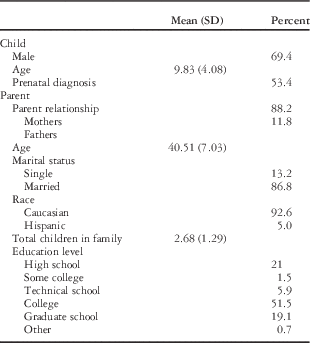
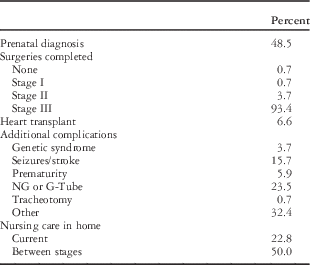
Data were collected for 121 caregivers of children with hypoplastic left heart syndrome. Respondents were generally Caucasian, college educated, and married mothers. Children included in this study were aged 2–18 years (M=9.83 years), with a slightly higher percentage of males (61%). About half of these children (53.4%) were diagnosed prenatally, and the majority of children (>90%) had completed their third-stage palliative surgery, with 6.6% having undergone a heart transplantation. Most common complications during recovery from surgeries included experiencing a seizure/stroke (n=19) and requiring a nasogastric or gastronomy tube for feeding difficulties (n=30). Please see Tables 1 and 2 for additional demographic variables.
Sample demographics (n=121).

Health complications.

The objective of this study was to better understand how the quality of life of children with hypoplastic left heart syndrome compares with other complicated health populations and a normative sample. Independent sample t-tests were used to compare our sample with published norms of healthy children and children with acute or chronic illnesses.Reference Varni, Seid and Kurtin 1 Exploratory analyses included a correlation matrix and independent sample t-tests to evaluate the impact of additional significant health complications – for example, need for feeding tube, experiencing a stroke/seizure – on quality of life.
Results
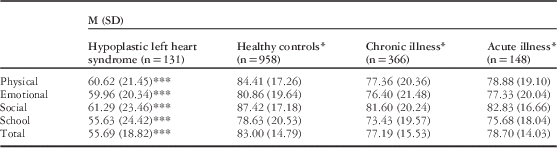
Children with hypoplastic left heart syndrome were rated as having significantly lower overall quality-of-life scores (M=59.69) when compared with published norms of children without medical diagnoses (M=83.00, t(1089)=13.61, p<0.001). The quality of life of children with hypoplastic left heart syndrome was also significantly lower than normalised data for children with acute (M=78.70, t(277)=9.63, p<0.001) and chronic (M=77.19, t(495)=10.44, p<0.001) illnesses.Reference Varni, Seid and Kurtin 1 Caregivers rated their children with hypoplastic left heart syndrome as having significantly lower quality of life for all subscales. For physical functioning, parents reported that their children had lower quality of life (M=60.62) than normative data (M=84.41, t(1088)=10.74, p<0.001), those with acute illnesses (M=78.88, t(277)=7.52, p<0.001), and those with chronic illnesses (M=77.36, t(495)=7.96, p<0.001). Children with hypoplastic left heart syndrome also had significantly lower emotional quality of life (M=59.96) than normative data (M=80.86, t(1087)=9.44, p<0.001), those with acute illnesses (M=77.33, t(277)=7.17, p<0.001), and those with chronic illnesses (M=76.40, t(495)=7.62, p<0.001). Scores for social functioning in children with hypoplastic left heart syndrome (M=61.29) were also significantly lower than normative data (M=87.42, t(1087)=12.77, p<0.001), those with acute illnesses (M=82.83, t(277)=8.92, p<0.001), and those with chronic illnesses (M=81.60, t(495)=9.44, p<0.001). Children with hypoplastic left heart syndrome also reported significantly lower school functioning (M=55.33) across domains compared with normative data (M=78.63, t(1062)=10.66, p<0.001), those with acute illnesses (M=75.68, t(277)=7.86, p<0.001), and those with chronic illnesses (M=73.43, t(495)=8.34, p<0.001); see Table 3.
Means and standard deviations of Pediatric Quality of Life Inventory.

* Norms published inReference Varni, Seid and Kurtin 1
***p<0.001 compared with norms of healthy controls, children with chronic illness, and children with acute illness
A correlation matrix was used to evaluate the effect of demographic variables – for example, age, sex, family density, and caregiver education – on quality-of-life scores. A small correlation was found only between age and school functioning, with older children exhibiting more physical functioning difficulties (r=−0.18, p<0.05).
The impact of additional medical complications on quality of life was explored. Caregivers of children who experienced a neurological complication such as stroke or seizure reported significantly lower overall quality of life (M=47.81) compared with those with no neurological complications (M=61.83, t(117)=3.13, p<0.01). These results upheld across subscales. Children who suffered a neurological complication reported lower physical functioning (M=47.01) than those who had not (M=63.98, t(118)=3.41, p<0.01). Children with neurological complications had significantly lower reported emotional functioning (M=48.75) compared with children without neurological complications (M=62.11, t(119)=2.82, p<0.01). Social functioning was also significantly lower with experienced neurological complication (M=50.52) compared with the absence of seizure or stroke (M=62.75, t(118)=2.18, p<0.05). Finally, those with neurological complications were also more likely to report significantly more school problems (M=40.50) than those who did not experience a seizure or stroke (M=58.01, t(118)=3.08, p<0.01). Medical comorbidities and complications including having an additional genetic syndrome, requiring a feeding tube, tracheostomy, and history of prematurity were not significantly related to parents’ report of quality of life.
Discussion
Data from the present study indicate that children living with hypoplastic left heart syndrome are experiencing significant deficits across quality-of-life domains. Our results indicate that close follow-up is warranted, with even more complications reported in children who had experienced a stroke/seizure during their course. Our findings are consistent with previous studies indicating that children with more complicated congenital heart defects are at increased risk for psychosocial difficulties.Reference Mussatto and Tweddell 4 , Reference Uzark, Jones, Slusher, Limbers, Burwinkle and Varni 5 The results from our study indicate that children have lower functioning across physical, emotional, social, and academic domains. Concern for quality of life in children with hypoplastic left heart syndrome is in line with functional and cognitive limitations as these children have a higher perceived daily burden of disease because of the severity of their disease and the complex, prolonged nature of the palliative process.Reference Feinstein, Benson and Dubin 7 Results are important, as a few studies have evaluated children with severe CHDs, specifically hypoplastic left heart syndrome, with adequate sample size and validated measures.Reference Latal, Helfricht, Fischer, Baursfeld and Landoldt 6 Continued research within this population would be important to target interventions to improve quality of life and overall functioning.
Quality-of-life scores in our study were significantly lower than published norms of healthy children, and those with acute and chronic illnesses. Our data also suggest that children with hypoplastic left heart syndrome have lower quality of life compared with earlier studies of children with general CHD and single-ventricle pathology. Our reported lower scores may be related to focussing on children with hypoplastic left heart syndrome, as many studies have used broader, single-ventricle pathology samples.Reference Uzark, Zak and Shrader 14 , Reference Varni, Limbers and Burwinkle 15 Our results should also be viewed within the context of data collection, as families who completed our surveys were seeking online support. Families spending time with online support communities may be more aware and/or attentive to their child’s concerns, or may be experiencing increased distress related to having children with more medical, cognitive, and adjustment difficulties. The significantly low reported quality-of-life scores may be capturing true concerns with children’s physical, social, and academic functioning, while also may be impacted by the early stress and need for close monitoring throughout the child’s early years.Reference Uzark, Jones, Slusher, Limbers, Burwinkle and Varni 5 Interestingly, we did not find that children’s quality of life was particularly related to age, showing that years out from surgical palliation does not greatly impact parent ratings. Given families’ experience of increased stress and worry during their child’s first few years of life, these memories may continue to impact quality-of-life perceptions when they are in their school years.Reference Uzark, Jones, Slusher, Limbers, Burwinkle and Varni 5 Overall, the data support that children with hypoplastic left heart syndrome and their families may benefit from increased psychosocial support to address concerns with physical limitations and mood difficulties, as well as social and academic problems.
Our results were not significantly related to family variables such as economic status or family density. Some studies have found relationships among children’s adjustment and family demographic variables as well as family stress.Reference Goldberg, Mussatto, Licht and Wernovsky 10 , Reference Brosig, Mussatto, Kuhn and Twedell 12 , Reference Manlhiot, Knezevich, Radojewski, Cullen-Dean, Williams and McCrindle 16 Future studies would benefit from assessing a more comprehensive picture of overall family functioning to better understand the dynamic interplay between the stress families experience and the adjustment of children with hypoplastic left heart syndrome.
School functioning was particularly low in our sample. Children with hypoplastic left heart syndrome are at risk for neurocognitive difficulties, with evidence for lower visual-motor skills, memory, and word structure abilities.Reference Tabbutt, Nord and Jarvik 17 , Reference Brosig, Mussato and Hoffman 18 Our sample also found that children who experienced neurological complications during their early years of life – for example, seizures and stroke – experienced even lower quality of life than those who did not experience this complication, identifying a particularly vulnerable population. The American Heart Association and the American Academy of Pediatrics are calling for more longitudinal developmental screening across the lifespan to focus on early identification of children’s academic weaknesses in this.Reference Marino, Lipkin and Newburger 19 Our study echoes this need to identify and intervene with children’s academic performance. It is hoped that providing increased academic support may also impact children’s emotional and social experiences. Future studies would benefit from better understanding the cognitive trajectories of children with hypoplastic left heart syndrome and the impact of various supports and interventions.
Limitations and future directions
Data collected were from a national sample, and differences in medical intervention as well as psychosocial support may influence children’s functioning and parental support in different settings. The majority of respondents were white, married college, educated females, and therefore these findings should not necessarily be applied to other socio-economic demographics. Although our study used a well-known standardised tool for assessment, the results are limited in that a single measure may not reveal a comprehensive understanding of children’s current functioning. Children’s quality of life is likely better understood within their neurodevelopmental, psychosocial, and physical functioning.Reference Drakouli, Petsios, Giannakoupoulou, Patiraki, Voutoufianaki and Matzious 20 Data would benefit from the inclusion of more objective measures of social skills and peer functioning, as well as school performance – for example, grades, use of education resources, days missed of school. Future studies would benefit from continued assessment using multiple, standardised tools to better understand the quality of life and functioning of children with hypoplastic left heart syndrome, with an emphasis on understanding specific resilience and risk factors. In addition, although our quality of measure is a well-validated parent report, inclusion of children’s perception of their functioning is important in future studies, as parents’ report can be influenced by age and severity of disease.Reference Drakouli, Petsios, Giannakoupoulou, Patiraki, Voutoufianaki and Matzious 20 Future studies may also benefit from timely assessment of family functioning throughout treatment to assess emotional and behavioural functioning over the course of various procedures for this condition. Finally, given that children with hypoplastic left heart syndrome are at risk for multiple medical sequelae, including neurological insults and feeding tubes, future studies may benefit from chart review to better understand the impact of the timing and extent of children’s additional needs on their quality of life – for example, some children experience isolated seizures that may not require long-term medication and follow-up, whereas other children may experience a stroke that requires significant and comprehensive rehabilitation, which may be related to long-term outcomes.
As survival rates for children with hypoplastic left heart syndrome continue to improve with surgical advances, it is important to assess the psychosocial functioning of these families. Children with hypoplastic left heart syndrome appear to be a significantly vulnerable population with difficulties in functioning across academic, social, emotional, and physical domains, especially if they have suffered a neurological insult during the palliative process. Results from this study support the need for continued early detection and implementation of interventions to provide increased psychosocial support to families of children with hypoplastic left heart syndrome.
Acknowledgements
The authors acknowledge the parents who took the time to participate in our study.
Financial Support
This research received no specific grant from any funding agency or from commercial or not-for-profit sectors.
Conflicts of Interest
None.
Ethical Standards
The authors assert that all procedures contributing to this study comply with the ethical standards of the relevant national guidelines on human experimentation (please name) and with the Helsinki Declaration of 1975, as revised in 2008, and has been approved by the institutional committees of Nationwide Children’s Hospital.