1 Introduction
Multi-particle flows have many applications in industrial and environmental problems, such as sedimentation and erosion, chemistry (fluidized beds), combustion, biology and medical science. The behaviour of multi-particle flows depends on many factors, such as the turbulence, particle–particle interaction and own particle dynamics acting on very different scales. This makes numerical multi-particle multi-scale models extremely complex and dependent on the advancement of knowledge of all involved phenomena. The individual particle dynamics can, under some conditions, have a very significant impact on a multi-particle flow behaviour. A recent work by Uhlmann & Doychev (Reference Uhlmann and Doychev2014) demonstrated this fact in the case of sedimentation of a dilute system of spherical particles. It established a clear relation between the onset of path instabilities of freely falling spheres and the formation of sedimentation clusters. Path instabilities have, however, much larger effects on the dynamics of rather flat bodies than spheres. The review paper by Ern et al. (Reference Ern, Risso, Fabre and Magnaudet2011) sums up the knowledge on path instabilities of simple, homogeneous, mostly axisymmetric or two-dimensional (2D), bodies such as disks, flat cylinders, spheroids and 2D plates, based on experimental observations and numerical simulations by the beginning of the present decade.
More recent results brought significant progress in understanding the transition scenario of very flat or even nominally infinitely flat bodies, and also knowledge of the scenario of perfect homogeneous spheres has been improved. As for perfect homogeneous spheres, a finer linear and weakly nonlinear analysis of the first two bifurcations was provided by Fabre, Auguste & Magnaudet (Reference Fabre, Auguste and Magnaudet2008) and Fabre, Tchoufag & Magnaudet (Reference Fabre, Tchoufag and Magnaudet2012). Benchmarking of interface-resolved multi-particle flow simulations at significant particle Reynolds numbers (see Uhlmann & Dušek Reference Uhlmann and Dušek2014) stimulated an interest in more accurate data and for a better understanding of chaotic trajectories (Zhou & Dušek Reference Zhou and Dušek2015). From the mathematical viewpoint, the problem can be parametrized by two non-dimensional external parameters, the Galileo number, defined as
 $G^{\ast }=\sqrt{|\unicode[STIX]{x1D70C}_{s}/\unicode[STIX]{x1D70C}-1|gd^{3}}/\unicode[STIX]{x1D708}$
, and the density ratio
 $\unicode[STIX]{x1D70C}_{s}/\unicode[STIX]{x1D70C}$
, where
 $\unicode[STIX]{x1D70C}$
and
 $\unicode[STIX]{x1D70C}_{s}$
are, respectively, the density of the fluid and of the solid,
 $d$
the diameter of the sphere,
 $g$
the gravitational acceleration and
 $\unicode[STIX]{x1D708}$
the kinematic viscosity of the fluid. (The ‘
 $^{\ast }$
’ in the notation
 $G^{\ast }$
has been introduced here to distinguish the definition used in the context of a perfect sphere, e.g. in papers by Jenny, Dušek & Bouchet (Reference Jenny, Dušek and Bouchet2004), Zhou & Dušek (Reference Zhou and Dušek2015), Uhlmann & Dušek (Reference Uhlmann and Dušek2014), from that introduced to account for more general shapes by Chrust, Bouchet & Dušek (Reference Chrust, Bouchet and Dušek2013) and used in the present paper.) As confirmed by all the cited work, the two primary bifurcating states are characterized by steady oblique and oblique oscillating trajectories. Fabre et al. (Reference Fabre, Tchoufag and Magnaudet2012) showed that the primary instability threshold is independent of the density ratio. There is wide consensus that the critical Galileo number is 156. The linear analysis of Tchoufag, Fabre & Magnaudet (Reference Tchoufag, Fabre and Magnaudet2014) pointed out the theoretical existence of modes with strong and weak solid–fluid interaction called, respectively, solid and fluid modes. Our recent paper (Zhou & Dušek Reference Zhou and Dušek2015) put this theoretical result in relation with the existence of two different frequencies of oblique oscillating trajectories remarked already by Jenny et al. (Reference Jenny, Dušek and Bouchet2004). A similar scenario has been predicted also for flat cylinders by Tchoufag et al. (Reference Tchoufag, Fabre and Magnaudet2014). In what follows, a sequence of a steady oblique and an oblique oscillating state will be called sphere scenario.
Flat bodies are known to present far more spectacular path instabilities than spheres. The, by now already classical, results (Willmarth, Hawk & Harvey Reference Willmarth, Hawk and Harvey1964; Stringham, Simons & Guy Reference Stringham, Simons and Guy1969; Field, Klaus & Moore Reference Field, Klaus and Moore1997) describing experimental observations of the fall of thin disks have been commented upon in the review paper by Ern et al. (Reference Ern, Risso, Fabre and Magnaudet2011). Additional important experimental data is due to Fernandes et al. (Reference Fernandes, Risso, Ern and Magnaudet2007) and Zhong, Chen & Lee (Reference Zhong, Chen and Lee2011). Ern et al. (Reference Ern, Risso, Fabre and Magnaudet2011) sum up the observations into four categories of regimes (of non-vertical trajectories): A – mostly chaotic with small amplitude of oscillation, B and C – period harmonic or anharmonic, oscillating along a mean vertical direction with planar or helical trajectories, and D – highly ‘nonlinear’, i.e. chaotic and strongly oscillating. This list is to be completed by the ‘tumbling’ regime of Field et al. (Reference Field, Klaus and Moore1997). The experimental data are classically parametrized by the Reynolds number based on the mean vertical velocity and by the non-dimensionalized moment of inertia
 $I^{\ast }=I/(\unicode[STIX]{x1D70C}d^{5})$
(
 $I$
being the moment of inertia with respect to an axis lying in the plane of the disk). Each trajectory type is associated with a specific subset of the parameter plane represented in a state diagram.
The experiments of Field et al. (Reference Field, Klaus and Moore1997) stimulated a significant effort to develop an appropriate simulation method capable of reproducing the observations with sufficient accuracy at acceptable costs to allow a parametric study. The challenge of reproducing the experiments was raised by two theses: that by Auguste (Reference Auguste2010) and by Chrust (Reference Chrust2012). Auguste (Reference Auguste2010) (see also Auguste, Magnaudet & Fabre Reference Auguste, Magnaudet and Fabre2013) showed the existence of small-amplitude non-vertical regimes preceding the appearance of large planar oscillations of very flat cylinders. These trajectories, experimentally hard to distinguish from vertical ones, were conjectured to explain the surprising observation of Fernandes et al. (Reference Fernandes, Risso, Ern and Magnaudet2007). A recent paper by Chrust, Bouchet & Dušek (Reference Chrust, Bouchet and Dušek2014) confirmed this conjecture quantitatively. Similarly as for spheres, the weakly oscillating regime represents a fluid mode while all the easily observable regimes are solid modes. Chrust et al. (Reference Chrust, Bouchet and Dušek2013) present a numerical counterpart of the experiments by Field et al. (Reference Field, Klaus and Moore1997) by investigating the transition scenario of thin disks of infinite nominal aspect ratio
 $\unicode[STIX]{x1D712}$
and of variable inertia. Instead of
 $I^{\ast }$
, the disk inertia is characterized by the non-dimensionalized mass
 $m^{\ast }=m/(\unicode[STIX]{x1D70C}d^{3})$
, where
 $\unicode[STIX]{x1D70C}$
is the fluid density,
 $d$
the disk diameter and
 $m$
its mass. Instead of the Reynolds number based on an a priori unknown vertical velocity, the Galileo number is defined as
 $$\begin{eqnarray}G=\sqrt{|m^{\ast }-V^{\ast }|gd^{3}}/\unicode[STIX]{x1D708},\end{eqnarray}$$
where
 $V^{\ast }=V/d^{3}$
is the non-dimensionalized volume (accounting for buoyancy in the definition (1.1)) and
 $\unicode[STIX]{x1D708}$
the kinematic viscosity of the fluid. A good agreement with experiments was obtained and, moreover, many additional facts were revealed. Most notable were the strong subcritical effects leading to coexistence of stable states and a substantially different scenario for light (
 $m^{\ast }<1$
) and massive (
 $m^{\ast }>1$
) disks. It is interesting to note that the above-mentioned fluid modes, observed as weakly oscillating periodic and chaotic states filling a gap between the loss of stability of the vertical fall and the onset of instability of a strong flutter in the same manner as for flat cylinders, were evidenced only for very small non-dimensionalized masses
 $m^{\ast }<0.1$
. At
 $m^{\ast }=0$
, the critical Galileo number for loss of stability of the vertical fall was found to be
 $G=78$
and strong flutter was evidenced starting only from
 $G=130$
. Moreover, again at
 $m^{\ast }=0$
, the chaotic weakly oscillating state was found to coexist with the strong periodic flutter in the wide interval
 $130\leqslant G\leqslant 180$
. The virtually experimentally unobservable, weakly oscillating states were shown to explain the shape of the critical curve of Willmarth et al. (Reference Willmarth, Hawk and Harvey1964) characterized by a strong upward shift of the observed onset of oscillations (flutter) of very light disks. The planar periodically zig-zagging, intermittent and tumbling trajectories were shown to become spiral at higher Galileo numbers. In particular, the spiral trajectories of Zhong et al. (Reference Zhong, Chen and Lee2011) were evidenced for small non-dimensionalized masses.
The comparison of the state diagrams figure 3 of Zhou & Dušek (Reference Zhou and Dušek2015) and figure 22 of Chrust et al. (Reference Chrust, Bouchet and Dušek2013) shows no obvious analogy between the scenario of spheres and disks. Since various flat objects of intermediate aspect ratio occur in many applications of multi-particle flows, the question of the behaviour of particles of intermediate shape may be of interest. Chrust, Bouchet & Dušek (Reference Chrust, Bouchet and Dušek2010) motivated the use of a family of spheroids of variable aspect ratio for establishing the link between the transition scenario of an infinitely flat disk and a sphere by the possibility of parametrizing all intermediate shapes continuously by a single parameter – the aspect ratio defined as
 $\unicode[STIX]{x1D712}=d/a$
, where
 $d$
is the diameter and
 $a$
the length of the axisymmetry axis of the spheroid. In the present paper, we aim to establish this link for freely moving bodies under the action of gravity, buoyancy and hydrodynamic forces. The limit cases are represented by a spheroid of infinite aspect ratio and an imperfect sphere. Neither corresponds exactly to the idealized bodies, for which the path instabilities have been investigated in much detail. While the fact that the limit of infinite aspect ratio of a homogeneous spheroid does not have a uniform mass distribution, and thus its non-dimensional moment of inertia is
 $m^{\ast }/20$
instead of
 $m^{\ast }/16$
, is relatively inessential; the limit towards
 $\unicode[STIX]{x1D712}=1$
does not converge to a perfect sphere since it does not allow a free rotation. This has a significant impact on the behaviour of very light bodies. Seven intermediate aspect ratios ranging from 10 to 1.1 are considered.
2 Mathematical formulation and numerical method
The mathematical formulation is described in the paper by Chrust et al. (Reference Chrust, Bouchet and Dušek2013). Here, we sum up the main features. The fluid is assumed to be incompressible with constant density
 $\unicode[STIX]{x1D70C}$
and Newtonian with constant kinematic viscosity
 $\unicode[STIX]{x1D708}$
. The motion of a homogeneous rigid spheroid, of diameter
 $d$
and the length of the polar axis
 $a$
, is driven by gravity and buoyancy. To keep the link with the thin disc of Chrust et al. (Reference Chrust, Bouchet and Dušek2013), we characterize the inertia by the non-dimensionalized mass whereas the buoyancy effect is given by the non-dimensionalized volume:
 $$\begin{eqnarray}m^{\ast }=\frac{m}{\unicode[STIX]{x1D70C}d^{3}},\quad V^{\ast }=\frac{V}{d^{3}}.\end{eqnarray}$$
The flow and solid-body equations are then non-dimensionalized using the velocity scale
 $$\begin{eqnarray}U_{ref}=\sqrt{|m^{\ast }-V^{\ast }|gd}.\end{eqnarray}$$
The velocity scale
 $U_{ref}$
and length scale
 $d$
are used to non-dimensionalize all other quantities, such as the time, frequency, vorticity etc., appearing throughout this. This non-dimensionalization must be taken into account for conversion to/from physical units.
A very thin spheroid of finite mass
 $m$
can be considered to be made of an infinitely dense material and to have a zero volume. From this viewpoint, the buoyancy effects would be negligible, as is the case for experiments in the air. In water, however, the solid/fluid density ratio (
 $\unicode[STIX]{x1D70C}_{s}/\unicode[STIX]{x1D70C}$
) remains small and buoyancy combined with gravity results in an effective gravitational acceleration
 $g_{eff}=(1-\unicode[STIX]{x1D70C}/\unicode[STIX]{x1D70C}_{s})g$
, where
 $g$
is the gravitational acceleration. The definition of
 $g_{eff}$
covers both falling and ascending spheroids. The present velocity scale differs by the factor
 $\sqrt{V^{\ast }}=\sqrt{\unicode[STIX]{x03C0}/6}$
from that used, in general, for the simulation of freely moving spheres (e.g. in Jenny et al.
Reference Jenny, Dušek and Bouchet2004). The fluid is assumed to adhere perfectly to the solid-body surface. The fluid medium is considered infinite and quiescent far from the moving body.
The fluid and solid-body equations have exactly the same form as in Chrust et al. (Reference Chrust, Bouchet and Dušek2013). The non-dimensionalized viscosity is given by the inverse of the Galileo number defined as:
 $$\begin{eqnarray}G=\frac{U_{ref}d}{\unicode[STIX]{x1D708}}=\frac{\sqrt{|m^{\ast }-V^{\ast }|gd^{3}}}{\unicode[STIX]{x1D708}}=\frac{\sqrt{m^{\ast }g_{eff}d^{3}}}{\unicode[STIX]{x1D708}}.\end{eqnarray}$$
The aspect ratio
 $\unicode[STIX]{x1D712}$
appears in the expressions for the non-dimensionalized volume
 $V^{\ast }$
, mass
 $m^{\ast }$
, moment of inertia
 $I^{\ast }$
and the ratio
 $\unicode[STIX]{x1D6FC}=I_{z}/I$
where
 $I_{z}$
and
 $I$
are the moment of inertia with respect to the axisymmetry axis and to a perpendicular axis, respectively. The corresponding expressions can be written as:
 $$\begin{eqnarray}V^{\ast }=\frac{\unicode[STIX]{x03C0}}{6\unicode[STIX]{x1D712}},\quad m^{\ast }=\frac{\unicode[STIX]{x1D70C}_{s}}{\unicode[STIX]{x1D70C}}V^{\ast },\quad I^{\ast }=m^{\ast }\left(1+\frac{1}{\unicode[STIX]{x1D712}^{2}}\right)\bigg/20,\quad \unicode[STIX]{x1D6FC}\equiv \frac{I_{z}}{I}=\frac{2}{1+{\displaystyle \frac{1}{\unicode[STIX]{x1D712}^{2}}}}.\end{eqnarray}$$
As can be seen,
 $G,m^{\ast }$
and
 $\unicode[STIX]{x1D712}$
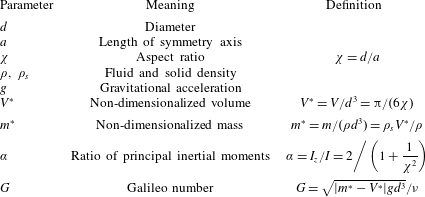
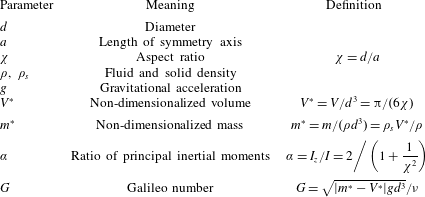
represent three independent parameters fully paramerizing the problem. Alternatively, for example, the density ratio could be used instead of the non-dimensionalized mass provided the infinite aspect ratio were not considered. The essential parameters are summed up in table 1.
Used parameters.
The numerical method consists in a domain decomposition of a cylindrical vertical domain, accompanying the translation motion, into a small spherical subdomain rotating with the solid body and the remaining cylindrical domain keeping a vertical axis. For the schematic of the numerical domain and more details, the reader is invited to refer to the paper by Chrust et al. (Reference Chrust, Bouchet and Dušek2013). The fully implicit fluid–solid coupling described in Jenny & Dušek (Reference Jenny and Dušek2004) allows us to account with the same accuracy and costs for bodies of any, especially of small, inertia. The spatial discretization consists in a spectral azimuthal Fourier expansion combined with a spectral element decomposition in the axial–radial plane in both subdomains. The axis of the spherical subdomain coincides with that of the spheroid. A practically identical spectral element mesh as in Chrust et al. (Reference Chrust, Bouchet and Dušek2013) is used. Since the axes of the two subdomains are not aligned, the connection is provided by a spherical function decomposition on the spherical interface of radius
 $R_{s}=1d$
. The classical rotation matrices yield a highly efficient way how to implement the rotations. The technical details of the numerical method can be found in the PhD thesis by Chrust (Reference Chrust2012). The numerical testing was performed for a light sphere by comparison to the code without domain decomposition, for a disk by comparison to results of Auguste (Reference Auguste2010), as well as for a cylinder of aspect ratio 1 (by testing the sensitivity of critical Galileo numbers to numerical parameters). The retained numerical mesh and a truncation of the azimuthal and spherical function expansions, at
 $M=15$
and
 $\ell _{max}=15$
were shown to assure an excellent accuracy of approximately 0.1 in terms of the critical Galileo number of the primary instability thresholds, as well as the secondary ones, for the sphere and cylinder.
3 Results
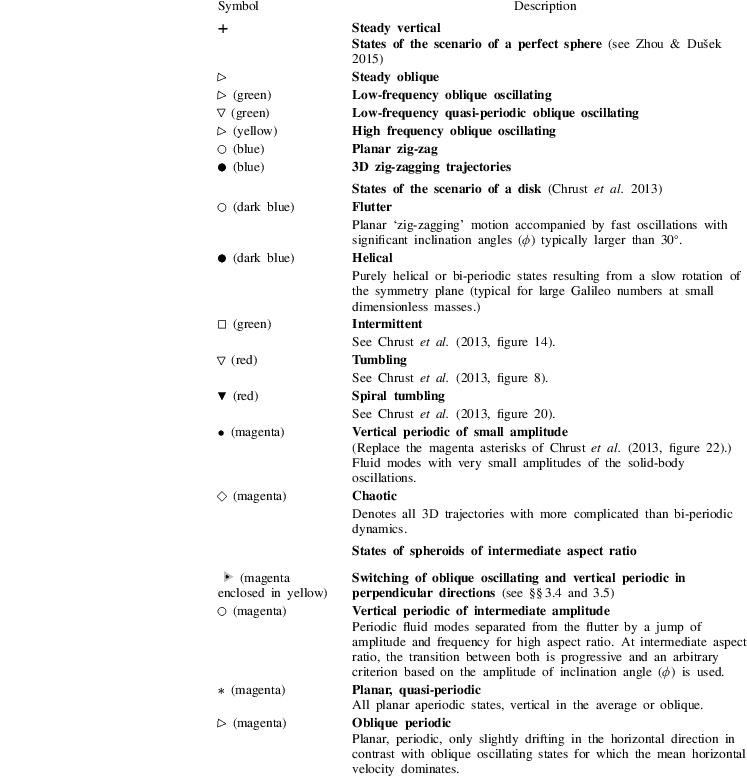
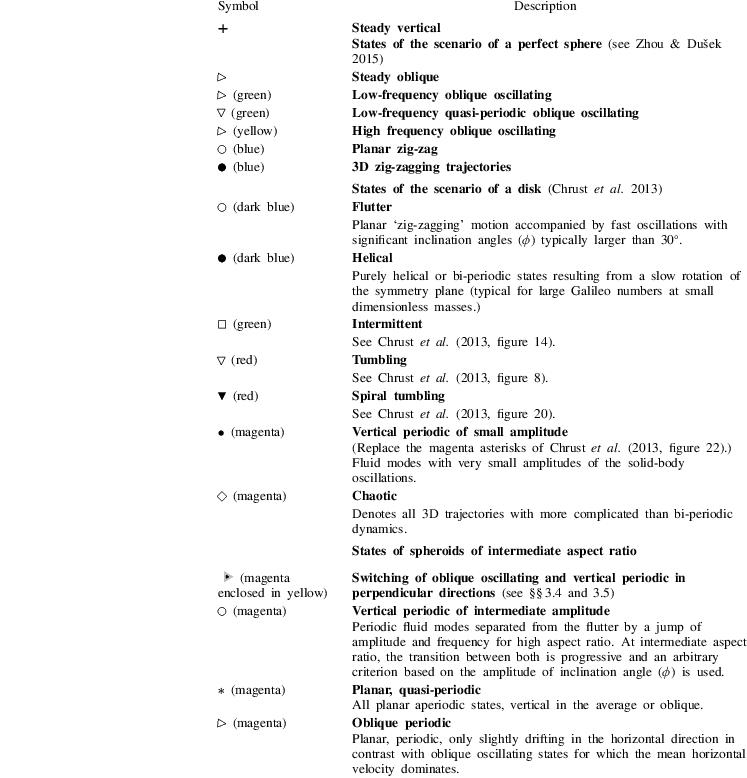
Description of symbols presented in the state diagrams of various aspect ratios.
The transition scenario of freely falling or ascending spheroids is characterized by a set of bifurcating asymptotic states. They correspond to stable asymptotic regimes reached in an infinite time horizon by the solid–fluid system for a fixed set of state parameters. In practical situations, ‘infinite’ means extremely diverse time scales given by the stability of the state. The latter decreases dramatically close to bifurcations and at the onset of chaos. Given the objective to detect asymptotic states, the initial conditions of the simulations are to a great extent arbitrary. They are chosen using already known results. This allows us not only to save CPU time but it is the only practical way how to track branches of coexisting solutions in the many cases of subcritical bifurcations that occur in our study.
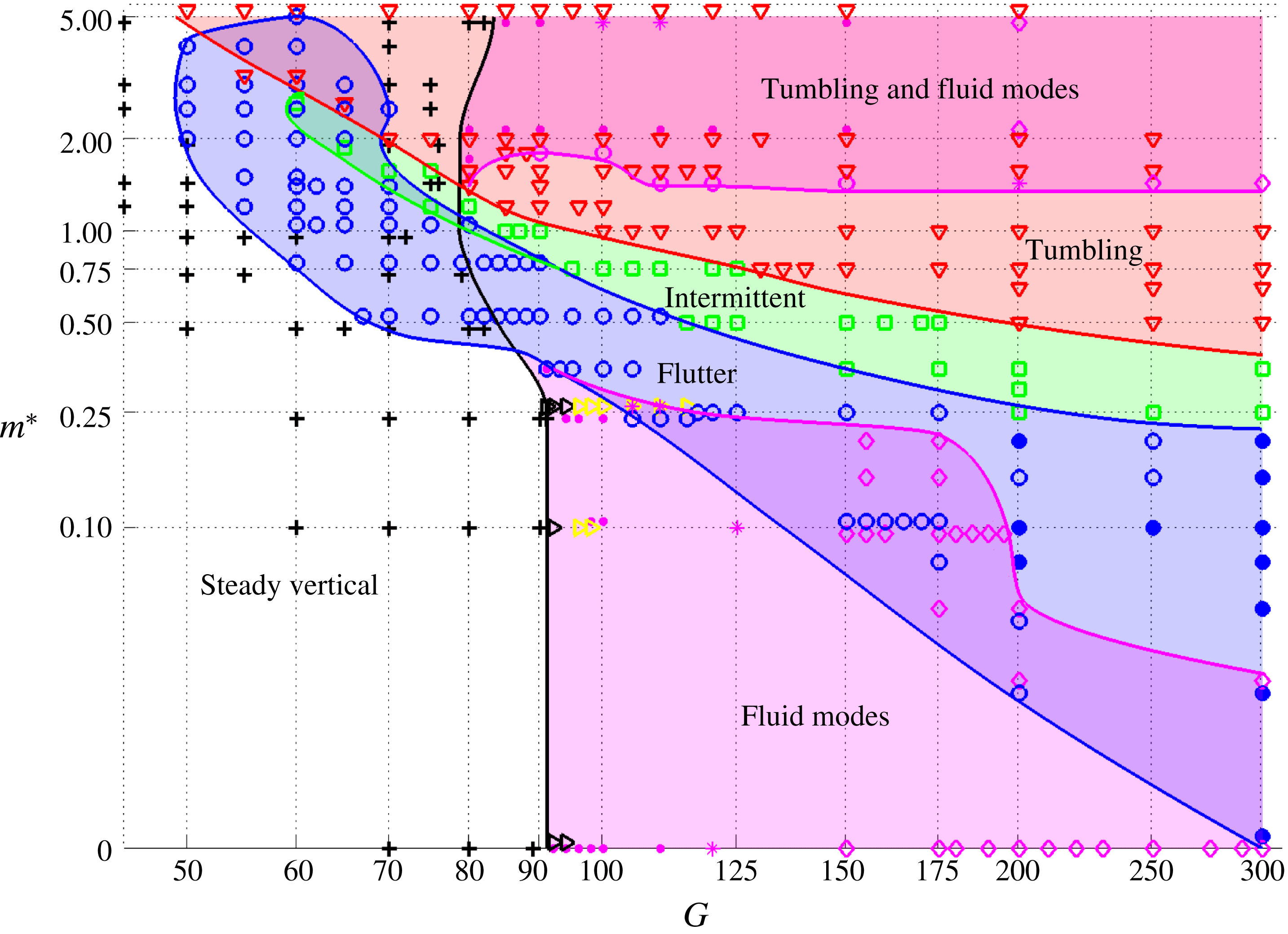
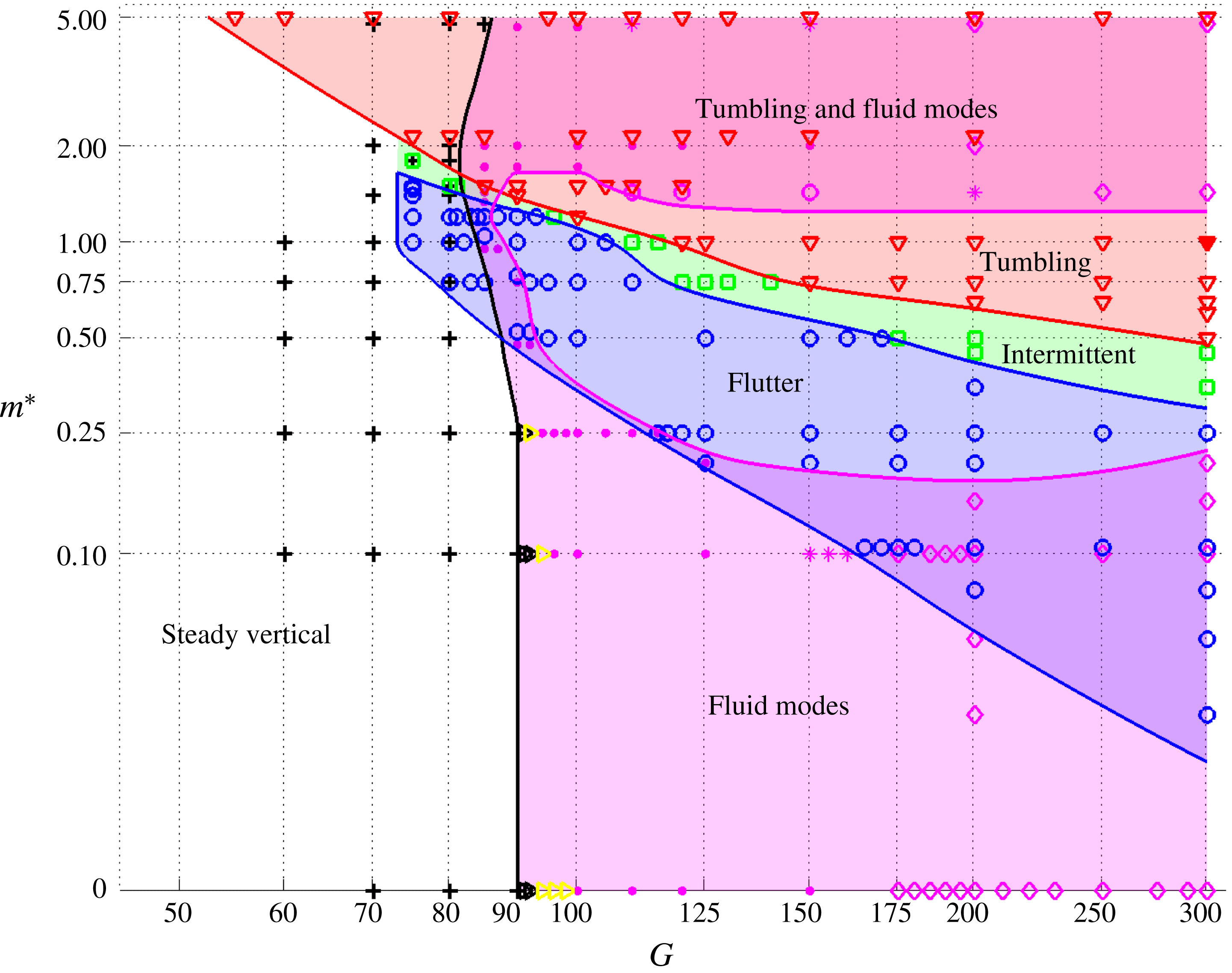
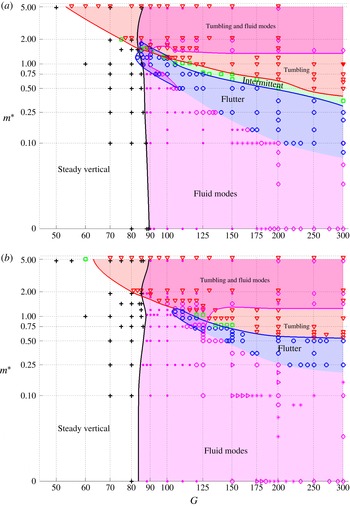
State diagram for spheroids of aspect ratio
 $\unicode[STIX]{x1D712}=10$
. Ticks and labels are not provided for
 $m^{\ast }=1.2$
, 1.4, 1.5 and 1.8 (between 1 and 2) and 2.5, 3 and 4 (between 2 and 5). The three lines between
 $m^{\ast }=0$
and 0.1 correspond to
 $m^{\ast }=0.025$
, 0.05 and 0.075. A flat, but not infinitely flat, spheroid has a particularly large domain of stability of the flutter (with strongly oscillating trajectories). Small-amplitude fluid modes are present both for small and large inertia. The vertical section of the primary instability threshold is due to the regular bifurcation of the sphere-like scenario.

This section is organized into six subsections corresponding to each aspect ratio studied, varying from 10 downwards to 1.1 (except
 $\unicode[STIX]{x1D712}=4$
and 5 treated in a common subsection). For each aspect ratio we provide a state diagram in the two-parameter
 $G{-}m^{\ast }$
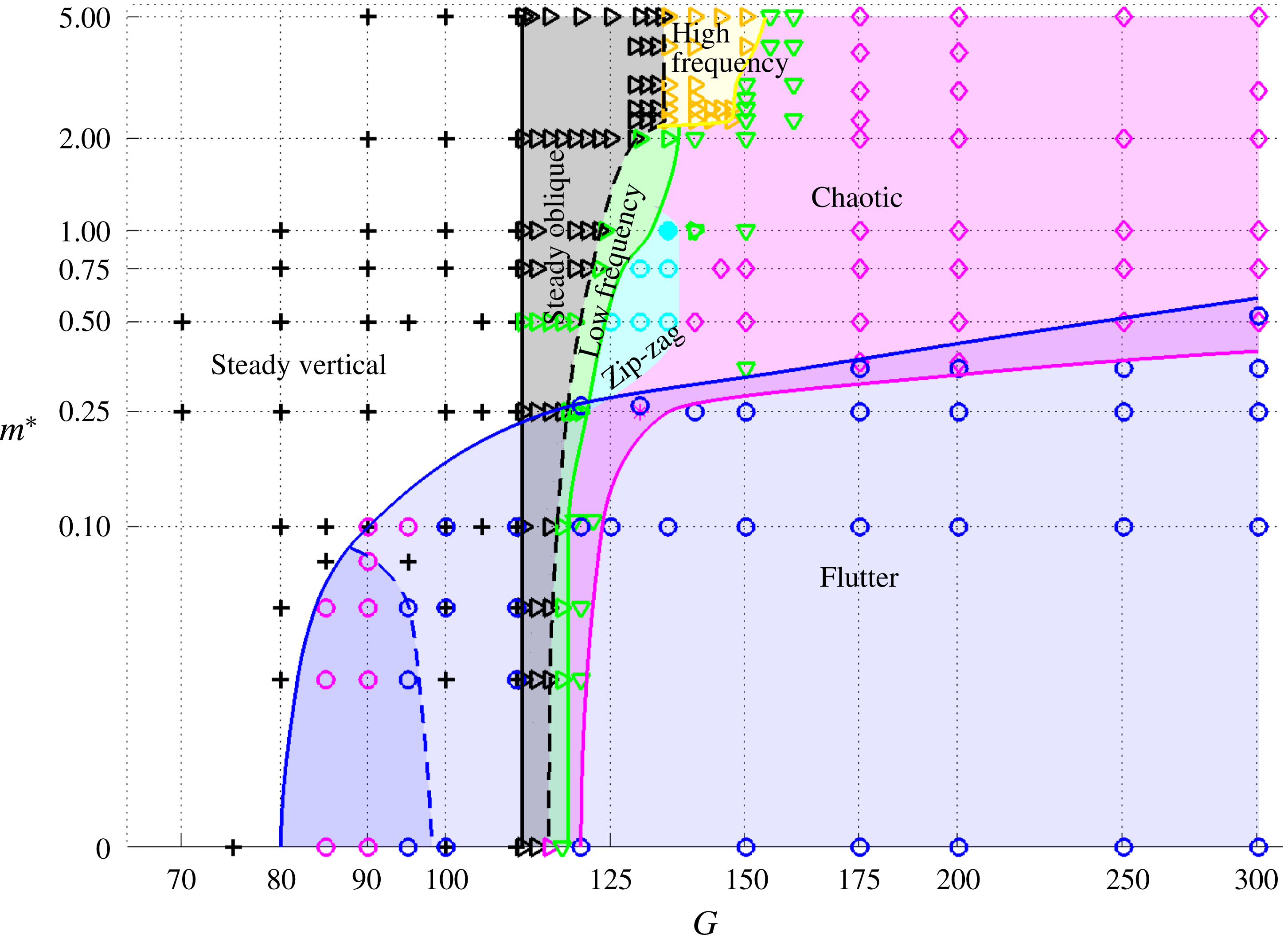
plane (figures 1, 4, 6, 9, 11 and 12). The used symbols are listed in table 2. Their choice respects the symbols used in the IJMF paper by Zhou & Dušek (Reference Zhou and Dušek2015) and in the Physics of Fluids paper by Chrust et al. (Reference Chrust, Bouchet and Dušek2013). Figures illustrating the trajectory styles described already in previous work are not represented. The reader is referred to the papers cited in table 2 for graphic support. For new regimes typical for intermediate aspect ratios, reference to the subsections where they are described is given. The axis scaling had to be adapted to assure an optimal readability. The scaling of the Galileo numbers is logarithmic, i.e. linear in
 $\log (G)$
. The vertical axis is linear in
 $\log (m^{\ast }+0.1)$
. This indication allows anybody to interpolate the position of any point. Moreover, a sufficient number of labelled ticks are provided. The individual two-parameter
 $G{-}m^{\ast }$
planes have been swept linewise (for constant
 $m^{\ast }$
). Where additional data were needed to delimit the stability domains, supplementary points have been added. The intersections of bifurcation thresholds with the
 $m^{\ast }$
-lines are determined by interpolation within at least one tenth of the Galileo number. In the higher Galileo number domain, where the stability limits are weakly dependent on the Galileo number, the interpolation was done in the
 $m^{\ast }$
direction. In general, the intersections with the alignments of points in the state diagrams are accurate.
3.1
 $\unicode[STIX]{x1D712}=10$

Compared to a nominally infinitely flat body, a homogeneous disk or a infinitely flat spheroid (having a very similar scenario as that of a disk), the effect of finite thickness is already significant for as flat a spheroid as that of aspect ratio 10. This observation is not new, as the significant difference between a very flat cylinders of aspect ratio 10 and a disk was already discussed by Auguste et al. (Reference Auguste, Magnaudet and Fabre2013). In many experiments, aspect ratios of approximately 10 are considered as representing ‘flat’ bodies. For this reason
 $\unicode[STIX]{x1D712}=10$
can be considered as acceptable starting point of our analysis. There is, indeed, a qualitative resemblance between the state diagram of Chrust et al. (Reference Chrust, Bouchet and Dušek2013) and that represented in figure 1. Quantitatively, the differences are, however, significant. In the lower part of the figure (
 $m^{\ast }<0.3$
) we observe an upward shift of the threshold of the primary bifurcation (to
 $G_{crit}=91.0$
, as compared to less than 80 for the disk) giving rise to ‘quasi-vertical’ fluid modes. More importantly (unlike for the disk), the primary bifurcation is regular, i.e. the real eigenvalue has become more unstable than the complex eigenpair. This explains why exactly the same critical Galileo number was found for
 $m^{\ast }=0$
, 0.1 and 0.25. The secondary Hopf bifurcation, yielding an oblique oscillating regime, follows at a critical Galileo number slightly above 92. We evidenced oblique oscillating states at
 $m^{\ast }=0.1,0.25$
and at
 $G=96,98$
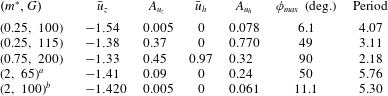
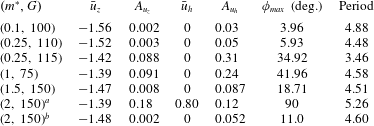
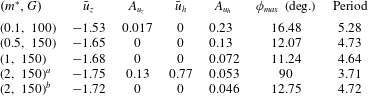
. The sequence of these two regimes represents what we decided to call a sphere-like scenario. As the Galileo number increases to 100, the mean value of the horizontal velocity, responsible for the mean horizontal drift, vanishes and a periodically oscillating regime, vertical in the mean, sets in. It is a typical fluid mode with a very weak response of the solid body to flow oscillation. The maximum inclination of the spheroid axis is only a few degrees (see table 3). By restarting using as initial state that obtained at
 $G=100$
, we verified that at the Galileo number
 $G=96$
the vertical periodic state is not stable. However, at
 $G=98$
we found a coexistence of both a vertical and an oblique oscillating state. The same holds for
 $m^{\ast }=0.25$
. For this higher non-dimensionalized mass, the steady oblique state (at
 $G=94$
) and oblique oscillating states (at
 $G=96,98,100$
and 105) were found to coexist with the vertical periodic one (at
 $G=98,100$
and 105 they are quasi-periodic). This means that there is no progressive evolution from the steady oblique to vertical periodic regime via an oblique oscillating state (with the mean value tending to vanish progressively). Instead a subcritical bifurcation is at the origin of the vertical periodic state.
Quantitative data characterizing selected periodic states for aspect ratio
 $\unicode[STIX]{x1D712}=10$
.
 $\bar{u}_{z}$
,
 $\bar{u}_{h}$
– mean vertical and horizontal velocity,
 $A_{u_{z}}$
and
 $A_{u_{h}}$
– oscillation amplitudes,
 $\unicode[STIX]{x1D719}_{max}$
– maximum inclination angle.
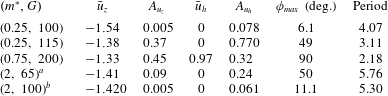
a Flutter.
b Fluid mode.
It may be objected that this degree of detail might lack physical relevance. The steady oblique and oblique oscillating states might be difficult to evidence experimentally due to their restricted stability domain; however, the independence of the threshold of
 $m^{\ast }$
might be detectable as well as the weakly oscillating vertical trajectories. It is to be noted that the typical Strouhal number of oscillations (based on the mean vertical velocity) is approximately 0.11, as can be inferred from table 3 (first line). This value corresponds rather to that of fluid modes (
 $St=0.13$
) than solid–fluid modes (
 $St=0.05$
) of the sphere (see Zhou & Dušek Reference Zhou and Dušek2015). This justifies not only the choice of the symbols (yellow online) but, more generally, the label ‘fluid modes’ for the entire lower subdomain (magenta online) of the diagram.
The sphere-like scenario vanishes for
 $m^{\ast }>0.25$
and at
 $m^{\ast }=0.5$
the primary bifurcation is clearly subcritical and the scenario of a disk is qualitatively recovered. The domain of coexistence of the flutter (planar zig-zagging trajectory) and of the steady vertical state is extremely large. This is due essentially to the very significant shift of the primary bifurcation threshold to higher Galileo numbers. The lowest threshold,
 $G_{crit}=78.0$
, was found at
 $m^{\ast }=1.5$
, whereas for infinitely flat spheroid the lowest critical Galileo number was
 $G_{crit}=35.3$
(at
 $m^{\ast }=2$
). In contrast, the domain of existence of the flutter did not shrink so much, which results in the large bi-stability domain. The stability domain of the flutter overlaps also with the intermittent and tumbling subdomains, which yields up to three coexisting states for some problem parameters.
Also the tumbling (and partly intermittent) domain extends far leftward (towards lower
 $G$
) and overlaps with the domain of vertical states. An interesting feature of the scenario, unobserved for disks, consists in the coexistence of the tumbling with small-amplitude periodic and chaotic fluid modes. The stability of fluid modes was also found for aspect ratio infinity, and is due to a smaller moment of inertia of flat spheroids as compared to disks. Though the zones of their stability are not connected, the fluid modes at high and low inertia present very similar features.
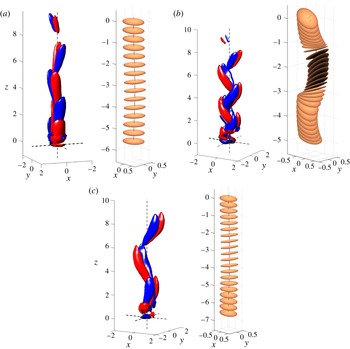
Vorticity structures and trajectory of spheroid of aspect ratio 10. (a) Vertical periodic state at
 $m^{\ast }=0.25,G=100$
(
 $\sin \unicode[STIX]{x1D713}_{max}=0.1$
, vorticity level:
 $\unicode[STIX]{x1D714}_{z}=\pm 0.4$
), (b) flutter at
 $m^{\ast }=0.25,G=115$
(
 $\sin \unicode[STIX]{x1D713}_{max}=0.75$
, vorticity level
 $\unicode[STIX]{x1D714}_{z}=\pm 0.7$
), (c) fluid mode at
 $m^{\ast }=2,G=100$
(
 $\sin \unicode[STIX]{x1D713}_{max}=0.19$
, vorticity level
 $\unicode[STIX]{x1D714}_{z}=\pm 0.7$
).

Three types of vertical periodic (zig-zagging) regimes are distinguished in the state diagram 1. To understand their differences, figure 2 represents three examples in terms of the trajectory and streamwise vorticity. The vorticity is about the same both for fluid modes (a,c) and the flutter (b), while the response of the body to the wake oscillation is very different. In what follows, it will be useful to let quantitative information on the inclination angle appear in the diagrams. Unless otherwise stated, the used criterion for calling the regime ‘with intermediate amplitude’ and for denoting it by a light (magenta) circle will be a sine of maximum inclination larger than 0.1 and less than 0.4.
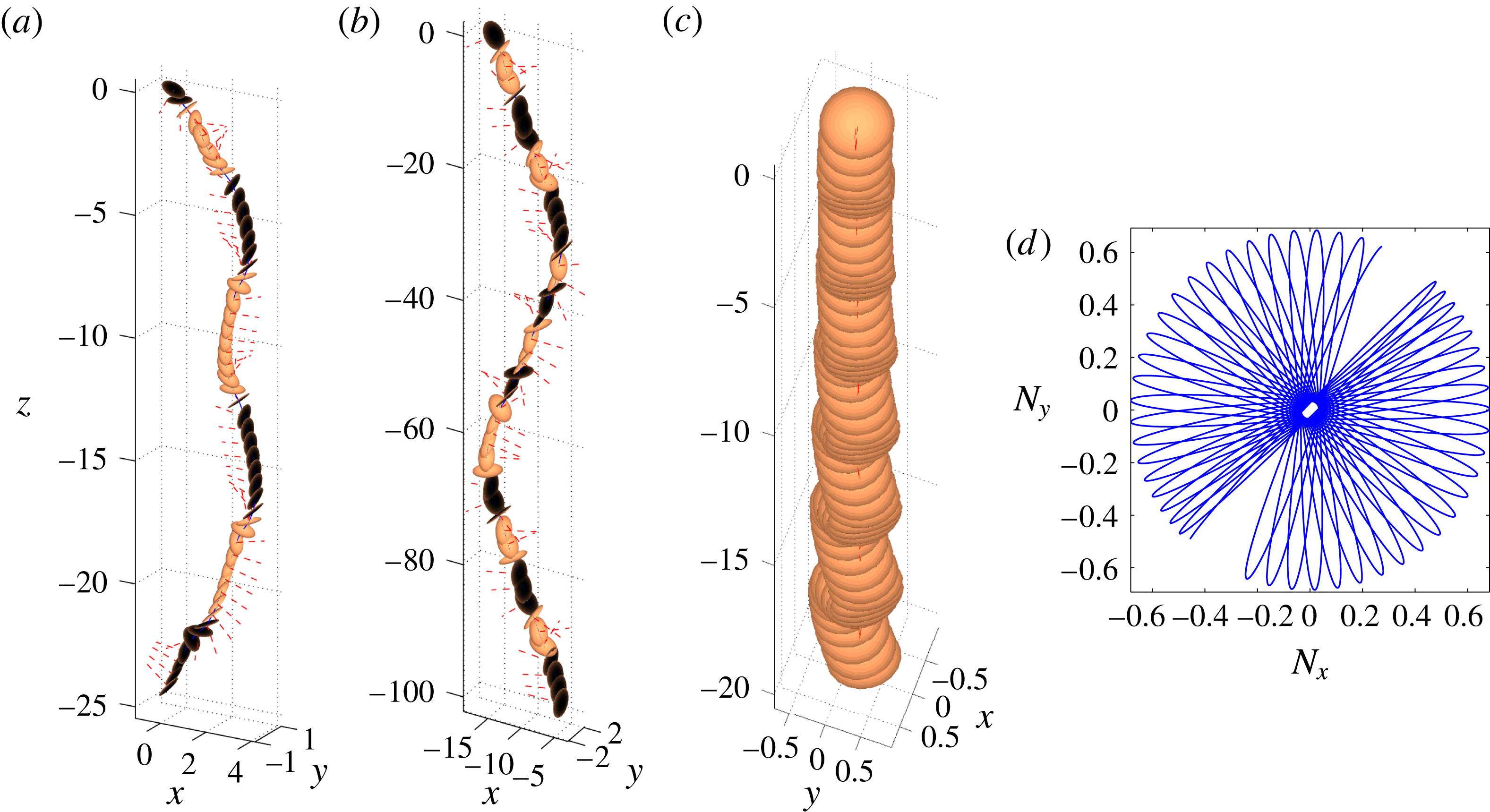
In the domain of flutter, we evidenced, similarly as for disks, in some cases, a destabilization of the planar trajectories for higher Galileo numbers. The states where this destabilization was positively evidenced are marked by filled circles (blue online) in the diagram of figure 1 and represent trajectories with non-zero helicity. The observed trajectories are, however, not mono-periodic and purely helical-like in the papers by Chrust et al. (Reference Chrust, Bouchet and Dušek2013) and Zhong et al. (Reference Zhong, Chen and Lee2011). Their projection onto the horizontal plane is rather represented by a turning flat ellipse. As the result, such dynamics is, strictly speaking, quasi-periodic. An example is represented in figure 3(c). The kinogram of the motion shows that the trajectory remains actually very close to that of a flutter.
At the interface between the domain of flutter and of tumbling, intermittent states typical for their mostly irregular switching between a zig-zagging (fluttering) stage and tumbling were evidenced in the same way as by Field et al. (Reference Field, Klaus and Moore1997) and Chrust et al. (Reference Chrust, Bouchet and Dušek2013), who already noted that, in numerical simulations, the intermittency sometimes becomes periodic with a given number of tumbles alternating in each direction. An example is given in figure 3(b) where the body tumbles five times over edge before changing the rotation direction.
‘Intermittent’ and helical trajectories of spheroid of aspect ratio 10. (a) At
 $m^{\ast }=0.75$
and
 $G=100$
; (b) at
 $m^{\ast }=2$
and
 $G=65$
(the size of the spheroid is magnified by four in this plot). Kinogram (c) and projection of unit vector of the body axis
 $\boldsymbol{N}$
onto the horizontal plane (d) of a trajectory with non-zero helicity at
 $m^{\ast }=0.1,~G=250$
.

3.2
$\unicode[STIX]{x1D712}=6$

At the primary bifurcation, the state diagram in figure 4 evidences the same early sphere-like scenario as for
 $\unicode[STIX]{x1D712}=10$
for small non-dimensionalized masses
 $m^{\ast }\leqslant 0.25$
. The primary bifurcation is regular at
 $m^{\ast }\leqslant 0.25$
and its threshold is thus independent of
 $m^{\ast }$
on this interval. The critical Galileo number is 90.1. For this smaller aspect ratio, the transition from the steady oblique to vertical periodic state is progressive, and there is no bi-stability between the oblique oscillating and vertical periodic fluid mode. In contrast with the
 $\unicode[STIX]{x1D712}=10$
aspect ratio, the stability interval of the sphere-like states decreases with increasing
 $m^{\ast }$
.
The state diagram for spheroids of
 $\unicode[STIX]{x1D712}=6$
. (The three lines between
 $m^{\ast }=0$
and 0.1 correspond, again, to
 $m^{\ast }=0.025$
, 0.05 and 0.075.) The domains of flutter and intermittency are smaller as compared to aspect ratio
 $\unicode[STIX]{x1D712}=10$
.

Unlike for a disk and very flat spheroids of aspect ratios larger or equal than 10, the primary bifurcation is not subcritical at higher non-dimensionalized masses. It continues to be supercritical but of Hopf type, giving rise directly to vertical periodic fluid states. In the interval
 $0.25\leqslant m^{\ast }<1.8$
, the vertical periodic fluid modes undergo a next bifurcation, which is subcritical and yields states with a significant flutter or directly intermittent or tumbling trajectories. As a result, even in the interval
 $0.5\leqslant m^{\ast }\leqslant 1.5$
a narrow ‘channel’ of fluid modes connects the lower area to the upper area, which coexists with tumbling states. This confirms the conjecture formulated in the previous subsection consisting in establishing an analogy between fluid states at small and high inertia. The second bifurcation threshold is marked by the solid light (magenta online) line delimiting the fluid modes from higher Galileo numbers. The stability domain of the flutter extends towards low non-dimensional masses, where it overlaps with fluid modes, and towards small Galileo numbers, where it overlaps, albeit much less than for
 $\unicode[STIX]{x1D712}=10$
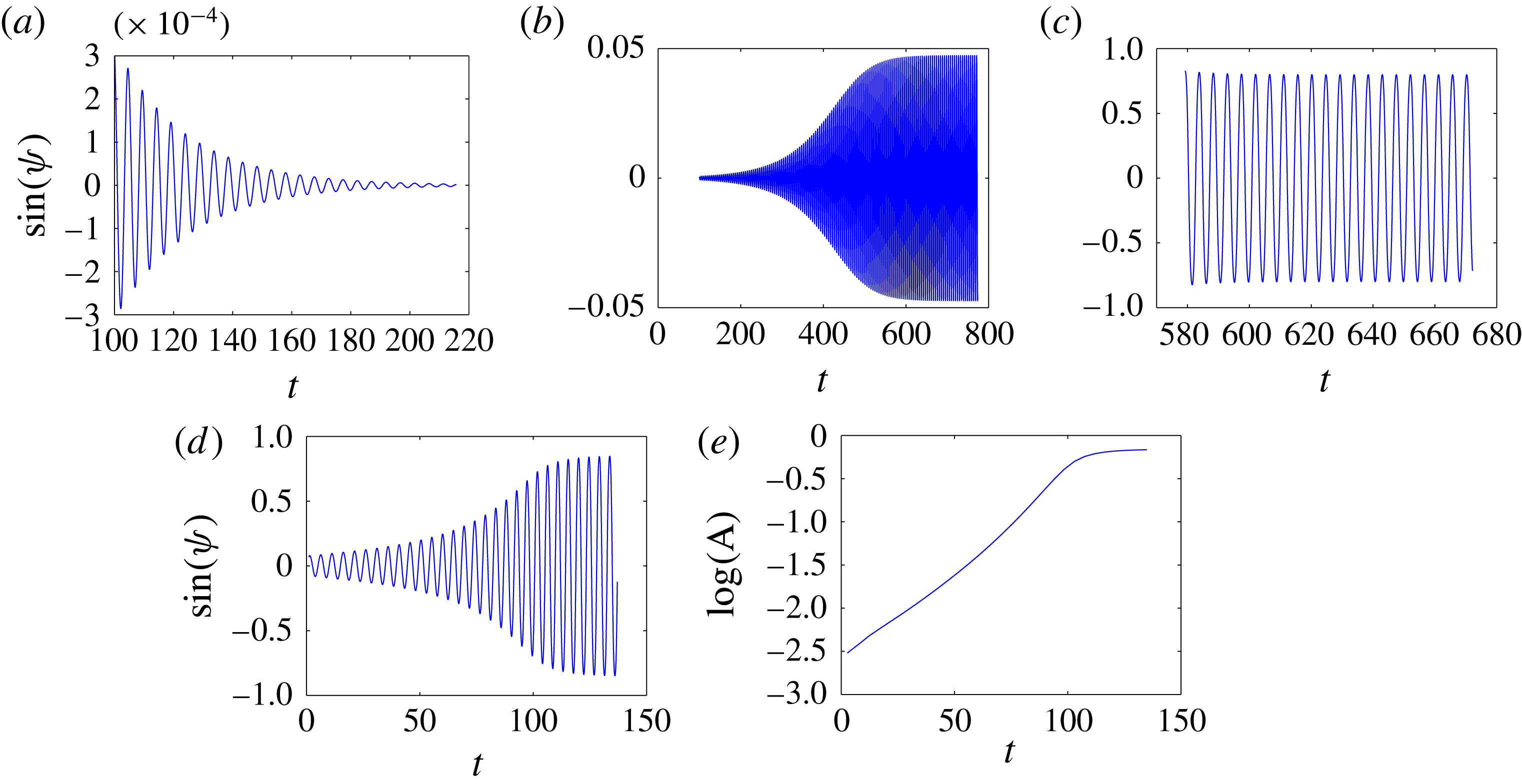
, with the domain of steady vertical trajectories. The progressive transition from a steady vertical regime to flutter with increasing Galileo number is illustrated in figure 5 for
 $m^{\ast }=1$
. The exponential decay of small oscillations of the sine of the inclination angle of body axis at
 $G=80$
proves the linear stability of the steady vertical mode. At
 $G=85$
, the Hopf bifurcation sets in and saturates at an amplitude less than 0.05 typically for the vertical periodic fluid mode. At
 $G=90$
this mode becomes unstable. The new bifurcation is subcritical, as can be seen from the super-exponential growth of the amplitude (figure 5
e, graph of the logarithm of amplitude at
 $G=90$
). Panel (c) shows the stability of the flutter (sine of inclination of 0.8) at the same Galileo number as that of the fluid mode (panel b) at
 $G=85$
.
Evolution of the inclination of the axis of a spheroid of aspect ratio
 $\unicode[STIX]{x1D712}=6$
at
 $m^{\ast }=1$
and at increasing Galileo numbers. (a)
 $G=80$
: stability of the steady vertical state. (b)
 $G=85$
: convergence to the vertical periodic state with small amplitude of oscillation (fluid mode). (c)
 $G=85$
: Flutter coexisting with the fluid mode at
 $G=85$
. (d,e)
 $G=90$
: secondary Hopf bifurcation saturating to the flutter. The log of amplitude plot (e) demonstrates the subcriticality (see the super-exponential (faster than exponential) growth).

State diagrams for spheroids of
 $\unicode[STIX]{x1D712}=5$
(a) and 4 (b). The subcritical bifurcation between the flutter and low-amplitude fluid modes progressively vanishes. At
 $\unicode[STIX]{x1D712}=4$
, only a small domain of bi-stability of both subsists. The regular primary bifurcation has not been evidenced at these aspect ratios.

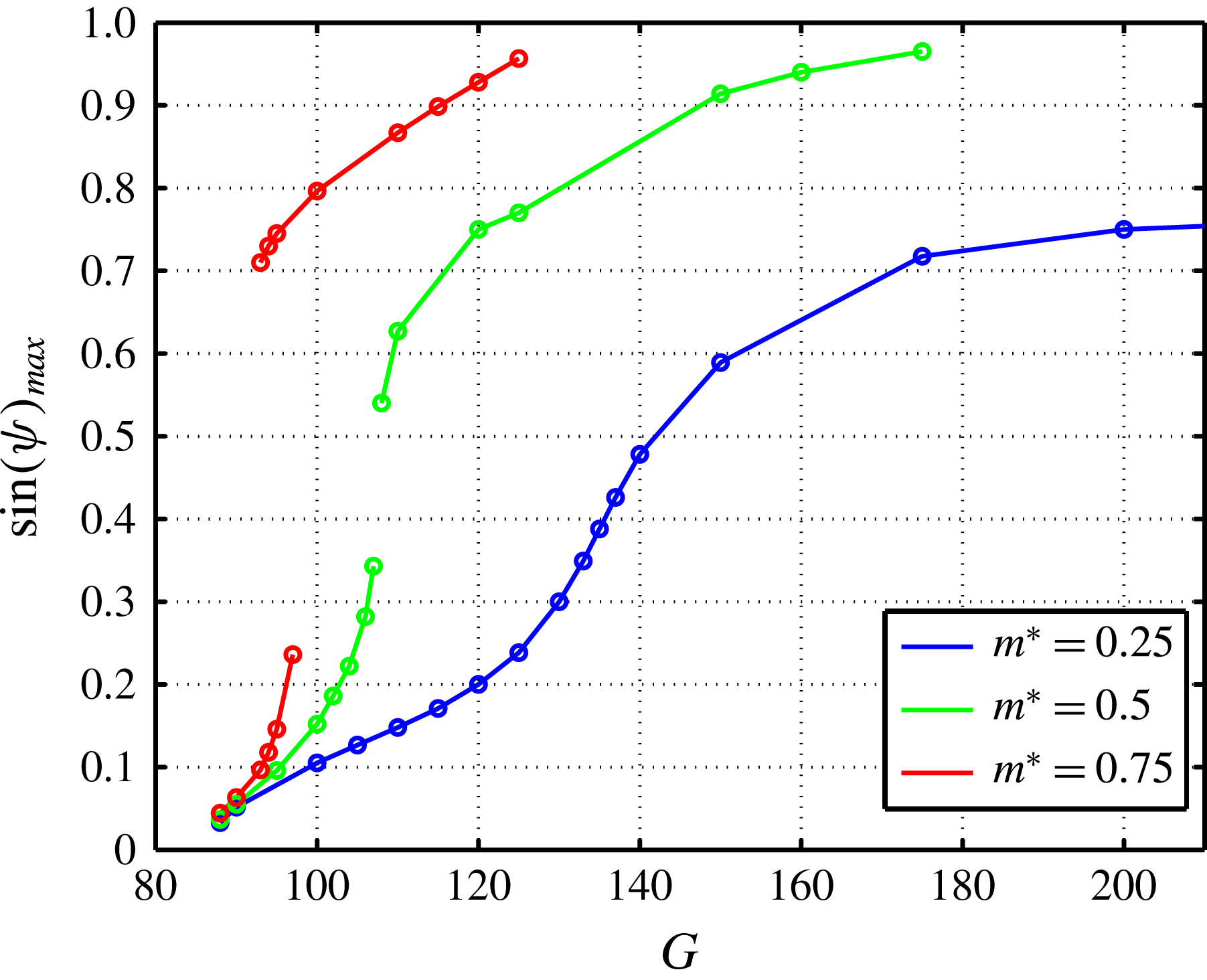
Amplitude of the sine of the inclination angle (
 $\unicode[STIX]{x1D713}$
) as a function of Galileo number for spheroids of aspect ratio
 $\unicode[STIX]{x1D712}=5$
and non-dimensionalized masses
 $m^{\ast }=0.25,~0.5$
and 0.75.

The intermittent domain tends to disappear with decreasing aspect ratio. While the subdomain of stability of the tumbling remains roughly the same as for
 $\unicode[STIX]{x1D712}=10$
, the domain of stability of the flutter gets significantly reduced. It becomes narrower, and the overlapping with vertical regime is much smaller. Obviously, the flutter requires some degree of aerodynamicity while, to sustain the rotating motion in the tumbling regime, the inertia is more important than the shape.
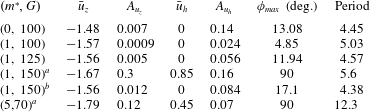
Quantitative data characterizing selected periodic states for aspect ratio
 $\unicode[STIX]{x1D712}=6$
. Same meaning of symbols as in table 3.
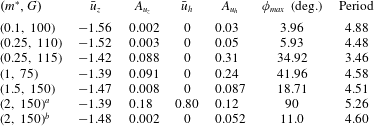
a
Tumbling (period corresponding to a full rotation by
 $2\unicode[STIX]{x03C0}$
).
b Fluid mode.
3.3
$\unicode[STIX]{x1D712}=5$
and
$\unicode[STIX]{x1D712}=4$


The differences of the scenario for
 $\unicode[STIX]{x1D712}=5$
as compared to
 $\unicode[STIX]{x1D712}=6$
can be summed up in the following points (see figure 6).
-
(i) The regular bifurcation for small
$m^{\ast }$
is no longer present, i.e. the sphere-like scenario is no longer observed, at least not for
$m^{\ast }\leqslant 5$
. The primary bifurcation is a Hopf one for all non-dimensionalized masses. The critical Galileo number depends on the inertia, albeit rather weakly. -
(ii) The trend for the flutter to disappear for smaller aspect ratio continues. Moreover, the separation between fluid and solid modes (flutter) defined by the subcritical bifurcation, yielding a wide overlapping of the stability of both, tends to vanish, too. The jump in amplitude of oscillation and the bi-stability of the flutter and fluid modes is limited only to
$m^{\ast }\geqslant 0.5$
and Galileo numbers smaller than 110. This is illustrated by figure 7 showing that, at
$m^{\ast }=0.75$
there is a bi-stability between large amplitude (flutter) and small amplitude (fluid mode), at
$m^{\ast }=0.5$
there is still a jump, while at
$m^{\ast }=0.25$
the amplitude grows continuously with Galileo number. The flutter overlaps only very little with the vertical states. Seen at a constant Galileo number, the evolution from fluid modes to tumbling is progressive, starting from
$G>125$
. The amplitude of the inclination angle progressively approaches
$90^{\circ }$
before tumbling sets in. Since there is no longer any bifurcation between the solid and fluid modes, the distinction between them has been set more or less arbitrarily to
$\sin \unicode[STIX]{x1D713}_{max}=0.4$
in figure 6 (slightly darker grey shade or light blue online for ‘flutter’). The chosen value corresponds roughly to the inflection point of the dependence on
$G$
. -
(iii) The coexistence of the flutter with steady vertical fall vanished between
$\unicode[STIX]{x1D712}=5$
and 4. At
$\unicode[STIX]{x1D712}=4$
, the subcritical bifurcation leading to flutter from fluid modes was evidenced only at
$m=0.75,$
1 and 1.2. -
(iv) The domain of intermittence becomes very narrow and tends to vanish. At aspect ratio
$\unicode[STIX]{x1D712}=4$
(figure 6
b), only a few intermittent states bordering the tumbling domain were evidenced. -
(v) In contrast again, the stability domain of the tumbling remains unaltered.


3.4
$\unicode[STIX]{x1D712}=3$

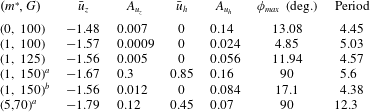
Two remarkable features distinguish the spheroid of aspect ratio 3 from flatter shapes: the total disappearance of the flutter and the reappearance of the sphere-like states on the side of high inertia.
Quantitative data characterizing selected periodic states for aspect ratio
 $\unicode[STIX]{x1D712}=3$
. Same meaning of symbols as in table 3.
a Tumbling.
b Fluid mode.
The flutter, which could be distinguished, at least partially, by a discontinuity from fluid modes at higher aspect ratios, has completely disappeared. Not only is the subcritical bifurcation separating the fluid and solid modes no longer evidenced, but, moreover, as can be seen in table 5, no vertical periodic state has an amplitude of inclination of the body axis exceeding
 $20^{\circ }$
(sine larger than 0.35). All oscillating trajectories are thus fluid modes.
In the absence of a large amplitude of inclination of the zig-zagging states, the tumbling switches directly to a vertical periodic state with only small or intermediate amplitudes of inclination at boundary of the tumbling stability domain. At this aspect ratio, there still subsists a subdomain where the tumbling does not coexist with the fluid mode. At its boundary the fluid mode switches directly to tumbling. For example, the maximum inclination angle of the vertical periodic state at
 $m^{\ast }=1$
and
 $G=195$
is
 $19^{\circ }$
, while at
 $G=200$
this state is no longer stable and evolves to tumbling. Similarly, the state
 $m^{\ast }=1$
,
 $G=125$
situated very close to the lower boundary of the tumbling stability domain has an inclination amplitude of only
 $12^{\circ }$
(see table 5). At this boundary, three cases of intermittent behaviour changing the sense of rotation have also been evidenced.
 $\unicode[STIX]{x1D712}=3,m^{\ast }=5,G=105$
: example of a trajectory switching periodically from a vertical periodic to steady oblique and oblique oscillating state. (a) Horizontal projections
 $N_{x}$
,
 $N_{y}$
of the unit vector of the body axis as a function of time, (b) trajectory.

The primary instability threshold is that of a Hopf bifurcation for
 $m^{\ast }<3$
only. At
 $m^{\ast }=3,4,5$
we evidenced a regular bifurcation and a steady oblique primary bifurcating state, making the threshold inertia independent. The
 $m^{\ast }$
-independent critical Galileo number (
 $G_{crit}=90.6$
) stays remarkably close to that found at
 $\unicode[STIX]{x1D712}=10$
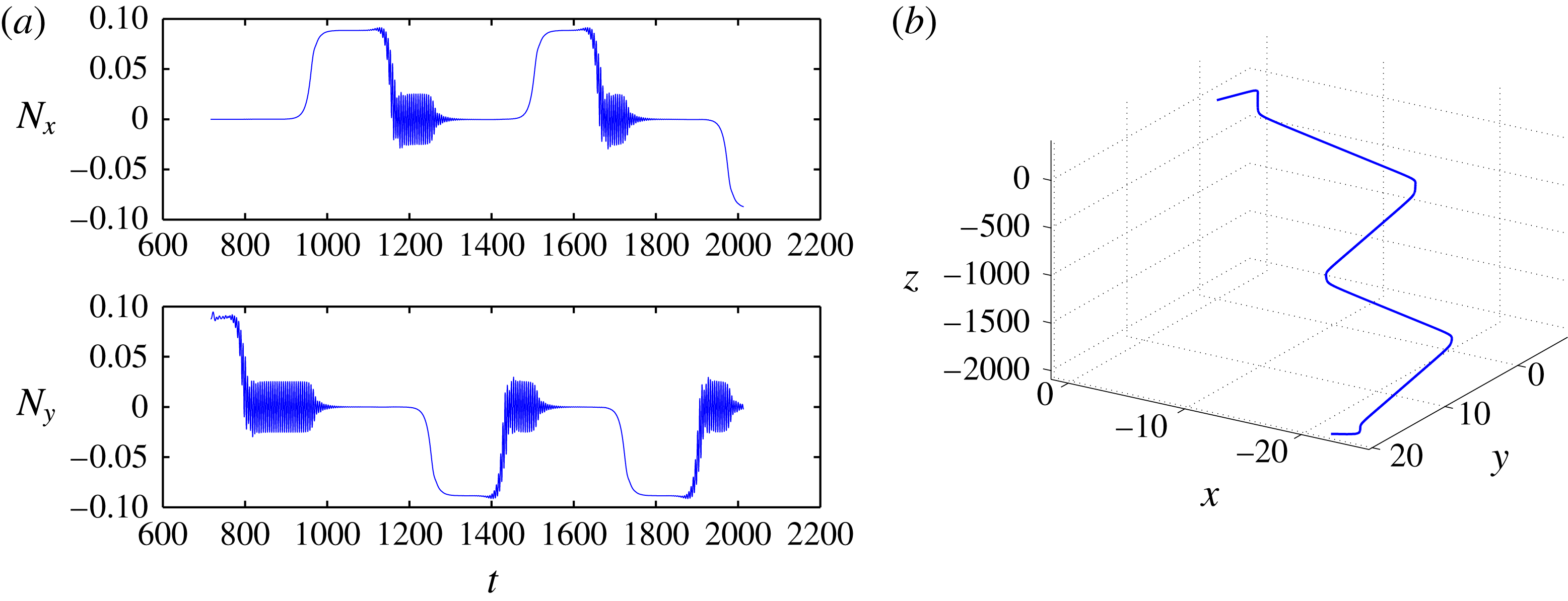
and 6. The secondary bifurcation is of Hopf type, leading to the oblique oscillating states typical for the sphere-like scenario. The specificity of its transition to the vertical periodic state (observed also
 $\unicode[STIX]{x1D712}=2$
) consists in its intermittent character (see figure 8). Instead of saturating to yield a constant non-zero mean, the amplitude grows until the mean value vanishes and a vertical periodic state appears. The latter is not stable either. A steady oblique state in the perpendicular direction arises and the selection of the new symmetry plane of the wake makes the oscillation in the previous direction vanish. The steady oblique state grows until oblique oscillations appear and the cycle repeats regularly. It can be expected that in presence of sufficient random noise the repetition would not be periodic, but rather intermittent. In the example of figure 8, it can also be seen that the direction of the steady oblique growth in the perpendicular plane is selected arbitrarily. The frequency of oscillation varies only slightly (by less than 10 %) over the whole cycle. The typical Strouhal number is 0.11, i.e. the same as for the oblique oscillating state existing for small inertia at aspect ratio
 $\unicode[STIX]{x1D712}\geqslant 6$
.
The state diagram for spheroids of
 $\unicode[STIX]{x1D712}=3$
. No flutter has been evidenced. The inclination angle does not exceed
 $20^{\circ }$
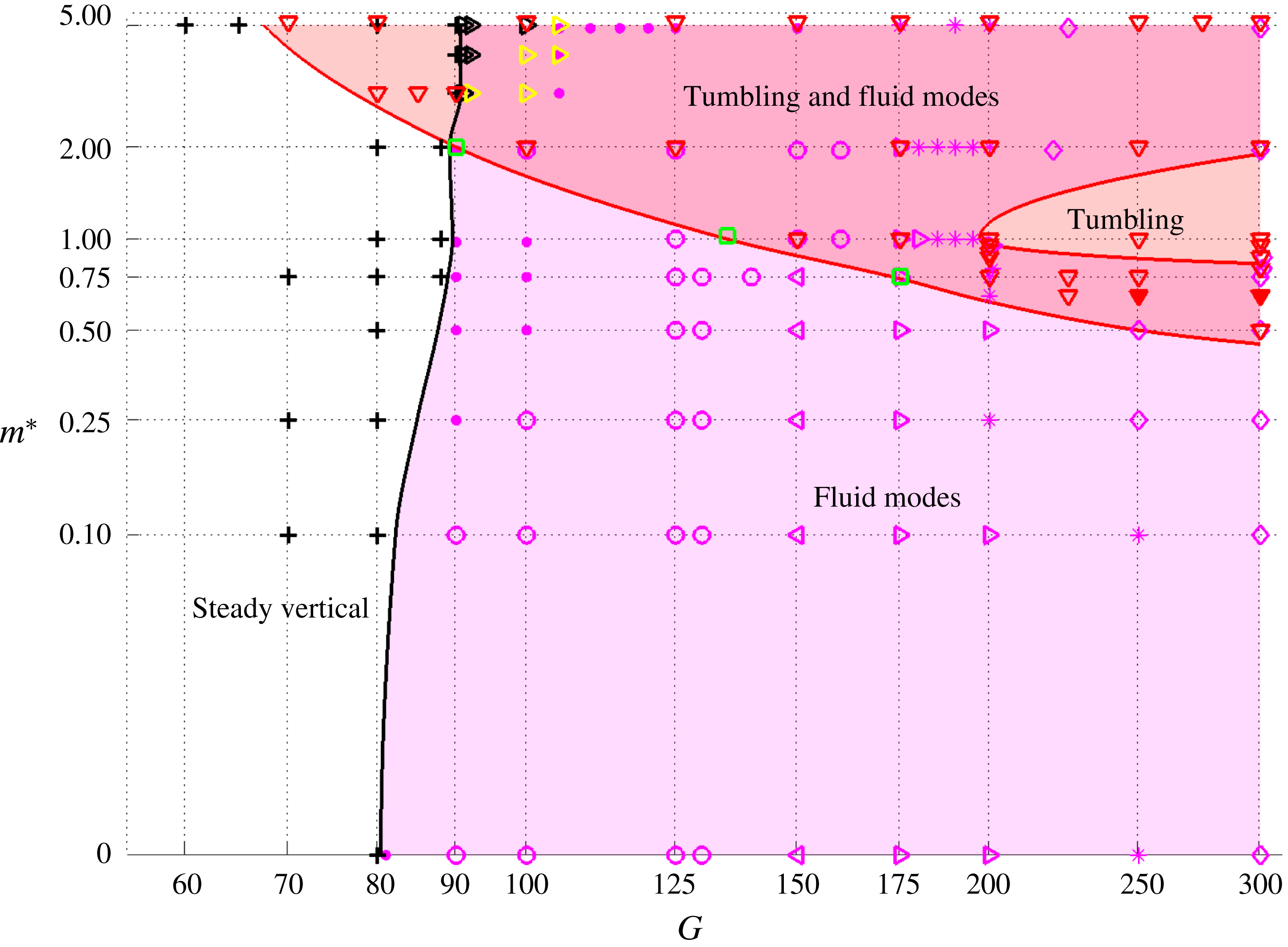
. The shape is neither aerodynamic enough nor close to spherical enough to sustain large oscillations. The sphere-like scenario appears at high inertia. There subsists a small mono-stable tumbling subdomain tending to vanish with decreasing aspect ratio as can be seen at
 $\unicode[STIX]{x1D712}=2$
.

3.5
$\unicode[STIX]{x1D712}=2$

The primary supercritical Hopf bifurcation was evidenced only up to
 $m^{\ast }\leqslant 0.25$
for this aspect ratio. For
 $m^{\ast }\geqslant 0.5$
, the primary bifurcation is already regular and the sphere-like scenario sets in at the first two bifurcations. The
 $m^{\ast }$
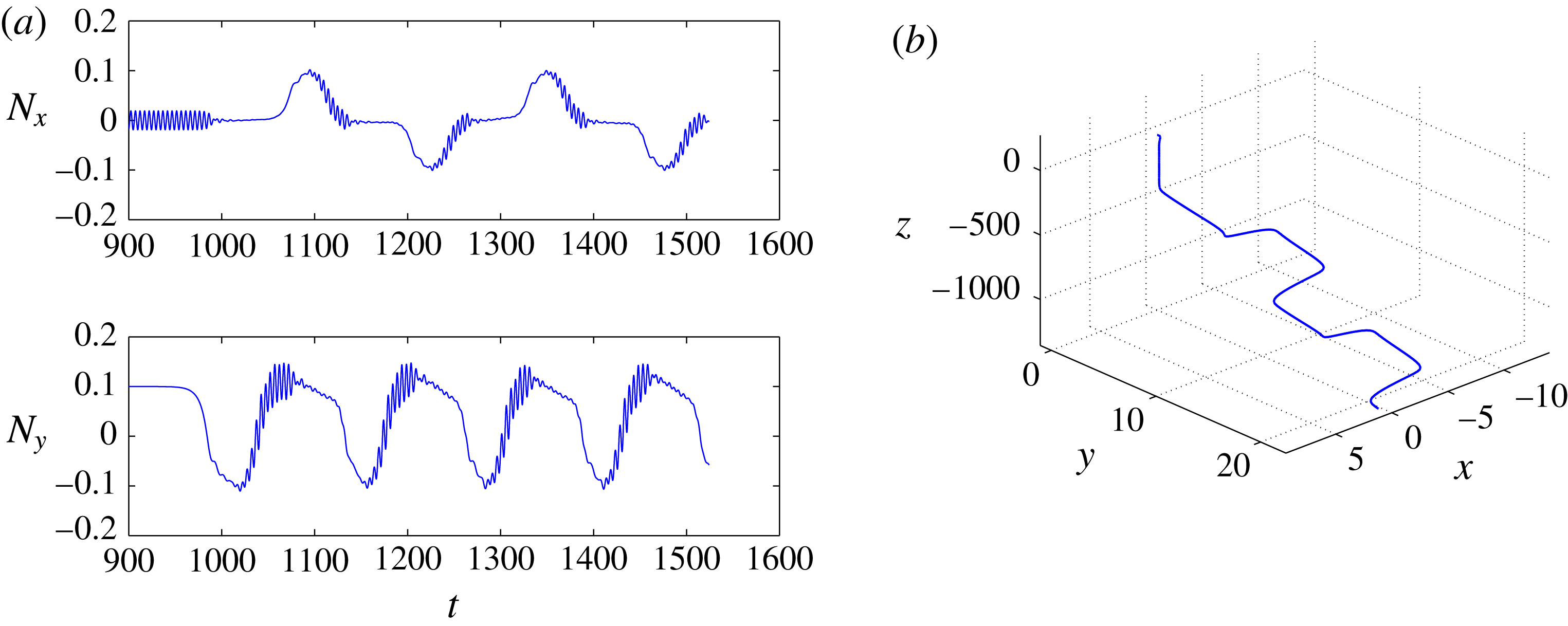
-independent critical Galileo number is 94.3. The secondary, Hopf bifurcation leads systematically to the already described switching between steady oblique, oblique oscillating and vertical periodic states (see figure 10). The fast frequency corresponds to a Strouhal number of 0.12. The period of the switching is very long, and varies significantly with distance from the instability threshold (more than 1000 at
 $m^{\ast }=2,G=120$
, and approximately 130 at
 $G=130$
in figure 10(c)), but stays remarkably constant.
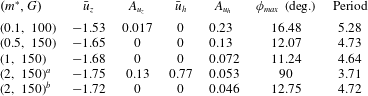
We evidenced no mono-stable tumbling subdomain for the aspect ratio 2. Table 6 shows that, again, no vertical periodic state has an amplitude of inclination of the body axis exceeding
 $20^{\circ }$
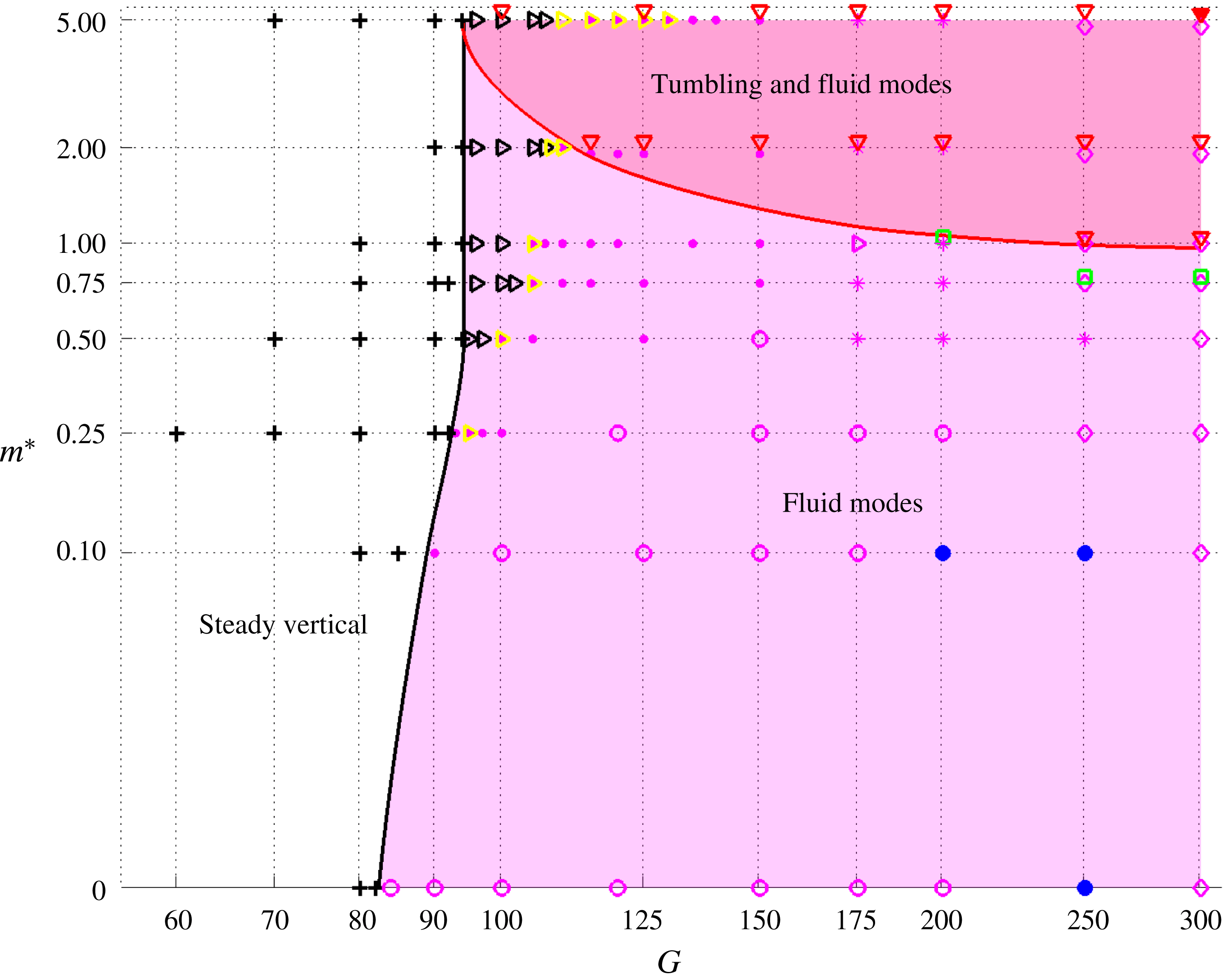
. Given the absence of mono-stable tumbling, there is no continuous transition from a vertical periodic state to tumbling possible by letting the Galileo number and/or the non-dimensionalized mass numerically evolve. This might mean that a simple acceleration from rest will not yield tumbling unless the rotation is externally triggered. Then the rotation will, however, remain self-sustained. At the edge of the domain of stability of the tumbling mode we still evidenced several cases of intermittent behaviour (squares, green online). Table 6 provides additional quantitative data.
To sum up, periodic vertical trajectories with small to moderate inclination dominate the scenario. Only dense bodies can tumble provided the tumbling is externally triggered.
 $\unicode[STIX]{x1D712}=2,m^{\ast }=5,G=120$
: (a) Horizontal projections
 $N_{x}$
,
 $N_{y}$
of the unit vector of the body axis as function of time, (b) trajectory.

The state diagram for spheroids of
 $\unicode[STIX]{x1D712}=2$
. Unlike at
 $\unicode[STIX]{x1D712}=3$
, tumbling always coexists with fluid modes. The sphere-like scenario extends towards smaller inertia (
 $m^{\ast }=0.5$
).

Quantitative data characterizing selected periodic states for aspect ratio
 $\unicode[STIX]{x1D712}=2$
. Same meaning of symbols as in table 3.
a Tumbling.
b Fluid mode.
3.6
$\unicode[STIX]{x1D712}=1.1$

The transition scenario of a spheroid of aspect ratio
 $\unicode[STIX]{x1D712}=1.1$
is close to that of a sphere, but only for sufficiently dense spheroids. The symbols and colours (online) used in figure 12 correspond to those in figure 3 of Zhou & Dušek (Reference Zhou and Dušek2015). The present case of almost spherical body can be quantitatively compared to a perfect sphere by converting the non-dimensionalization. If we neglect the small difference of aspect ratio, the present definition of the non-dimensionalized mass differs by a factor
 $\unicode[STIX]{x03C0}/6$
from the density ratio (
 $m^{\ast }=\unicode[STIX]{x03C0}/6\,\unicode[STIX]{x1D70C}_{s}/\unicode[STIX]{x1D70C}$
), and the reference velocity (2.2) differs from that used for the perfect sphere (see (3) of Zhou & Dušek Reference Zhou and Dušek2015) by a factor
 $\sqrt{\unicode[STIX]{x03C0}/6}$
(i.e.
 $U_{ref}=\sqrt{\unicode[STIX]{x03C0}/6}\,U_{ref,sphere}$
). As the result, the Galileo number defined by (1.1) is smaller by this factor and the velocities and frequencies are larger by its inverse. The primary bifurcation threshold (that of the steady oblique regime) found to be
 $G_{crit}^{\ast }=155.8$
(independently of the density ratio) becomes
 $G_{crit}=112.7$
in terms of the definition (1.1). For an almost spherical spheroid of aspect ratio
 $\unicode[STIX]{x1D712}=1.1$
, this threshold lies at
 $G_{crit}=110.8$
and is represented by the black vertical line separating the domain of steady vertical trajectories (black crosses) from that of steady oblique regimes (rightward pointing black triangles). It is to be noted that, unlike the perfect sphere, the spheroid does not rotate. This fact has a very limited impact on the onset of the primary instability and on the whole scenario for sufficiently dense bodies, i.e. for
 $m^{\ast }>0.25$
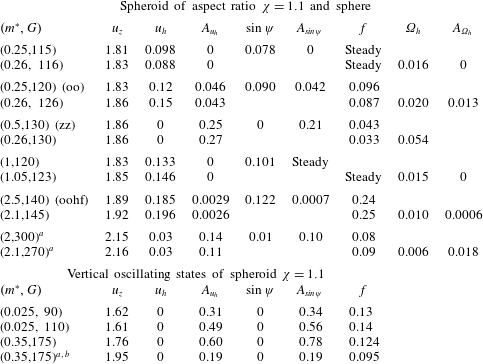
and density ratios larger than 0.5 For the assessment of quantitative agreement and differences see the top part of table 7. It is also interesting to compare figure 12 with the corresponding state diagram in figure 3 of Zhou & Dušek (Reference Zhou and Dušek2015).
The state diagram for spheroids of
 $\unicode[STIX]{x1D712}=1.1$
. For
 $m^{\ast }>0.25$
, i.e. density ratio larger than 0.5, the spheroid behaves qualitatively like a perfect sphere. Trajectories of very light spheroids are zig-zagging with large amplitude of inclination angle allowed by the almost spherical shape.

Top: comparison of some characteristic regimes of a spheroid of aspect ratio
 $\unicode[STIX]{x1D712}=1.1$
(upper lines) and of a sphere (lower lines). oo – oblique oscillating,
 $zz$
– low-frequency periodic zig-zagging, oohf – oblique oscillating, high frequency. (Parameters relevant for the sphere are converted to the non-dimensionalization of the present paper.)
 $u_{h}$
: (average) horizontal velocity,
 $A_{u_{h}}$
: horizontal velocity amplitude,
 $\sin \unicode[STIX]{x1D713}$
: (average) sine of inclination,
 $A_{sin\unicode[STIX]{x1D713}}$
: amplitude of oscillations of the body axis in terms of the sine of inclination,
 $f$
: frequency,
 $\unicode[STIX]{x1D6FA}_{h}$
: (average) horizontal projection of angular velocity,
 $A_{\unicode[STIX]{x1D6FA}_{h}}$
: amplitude of
 $\unicode[STIX]{x1D6FA}_{h}$
. Bottom: characteristics of some vertical oscillating states of spheroid of
 $\unicode[STIX]{x1D712}=1.1$
.
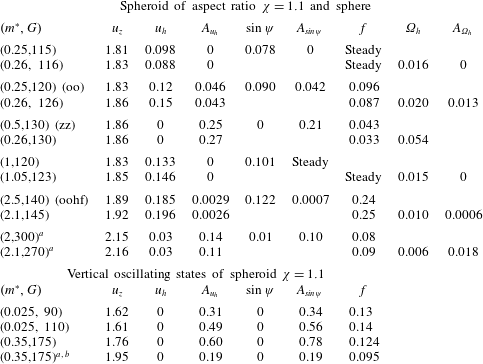
a Non-periodic states – amplitudes replaced by r.m.s. and frequency by the peak of power spectrum corresponding to the most visible oscillations.
b Coexisting chaotic sphere-like state.
In contrast to this close similarity to the scenario of a perfect sphere for higher non-dimensionalized masses, the diagram of figure 12 presents features typical for flat bodies for very small inertia (
 $m^{\ast }$
roughly smaller than 0.25). We evidenced a bounded area of linear instability below the threshold of the steady oblique regime for
 $m^{\ast }<0.1$
and
 $80\leqslant G<10$
. In figure 12, the area is delimited by a solid (blue online) line from lower Galileo numbers and by a dashed (blue) line from higher Galileo numbers, and is filled in a darker colour. The solid and dashed lines correspond, for increasing Galileo numbers at constant
 $m^{\ast }$
, respectively, to a destabilization and re-stabilization of the vertical trajectory. The lines determine the threshold of the Hopf bifurcation yielding a planar oscillating trajectory, vertical in the average (zig-zagging trajectory). The frequency is slightly higher than the low frequency of the oblique oscillating regime for similar inertia: 0.12 to 0.14 as compared to 0.10. At saturation, the oscillations of the body are (unlike the fluid modes discussed elsewhere) significant. Though, in this case, there is no physical reason to distinguish ‘small’ angles of inclination of the axis from larger ones, we keep the notation of table 2 and set the distinction at
 $24^{\circ }$
(sine equal to 0.4). This enables us to show that most vertical oscillating states have a larger inclination amplitude. For this reason we label the subdomain as ‘flutter’ (though the idea of flutter does not really apply to the present thick shape). The amplitude of inclination reaches almost
 $90^{\circ }$
at
 $G=300$
, in agreement with the expectation that for higher Galileo the spheroid will start to rotate (tumble) in the same way as a perfect sphere. The lighter grey (magenta online) symbols indicating smaller amplitudes than
 $24^{\circ }$
are confined to the proximity of the threshold where the bifurcation is supercritical and the amplitude increases theoretically from zero. In spite of that, even these represented states have inclination angles of at least
 $12^{\circ }$
. The bifurcation corresponding to the re-stabilization is subcritical. As a result, the flutter remains stable outside the described small subdomain of linear instability of the vertical ascension. The domain of stability of this regime partially coexists with the states characteristic for a spherical body; however, this overlapping is very limited and the oscillations obviously kill the chaotic regimes found for a perfect sphere. We did not find any coexisting chaotic regimes in the lower right corner of the diagram delimited roughly by
 $m^{\ast }<0.25$
and
 $G>125$
.
Perfect spheres with little inertia have been shown to describe mostly chaotic trajectories for higher Galileo numbers except for an ‘island’ of vertical oscillating trajectories situated around the parameter point (in the present non-dimensionalization)
 $m^{\ast }=0.5$
,
 $G=200$
. The frequency of oscillation at this point was found to be 0.2 (in the present non-dimensionalization). The spatial amplitude of oscillation about the vertical direction is very small for this state – approximately 0.1 of the sphere diameter so that these trajectories may be appropriately called ‘quasi-vertical’. At a close point
 $m^{\ast }=0.25$
,
 $G=200$
, the trajectory of the spheroid of aspect ratio 1.1 presents completely different characteristics. The oscillation frequency is 0.125 (instead of 0.2) and the amplitude of excursions with respect to the vertical direction is equal to
 $1d$
. This shows that the flutter of the spheroid has nothing to do with the periodic quasi-vertical regime of a perfect sphere.
The trajectories of slightly flattened spheres (spheroids of aspect ratio 1.1) are reminiscent of the ‘vibrating regimes’ described by Horowitz & Williamson (Reference Horowitz and Williamson2010). For Reynolds numbers smaller than 1550 these regimes were found to be delimited by a density ratio 0.36 and
 $Re=260$
. This corresponds to
 $m^{\ast }=0.19$
and
 $G\approx 160$
in terms of our parametrization and with account of the mean vertical velocity remaining close to 1.6. The trajectories were found very accurately periodic. At
 $Re=450$
and density ratio 0.11, the amplitude of horizontal excursions was found to be 1
 $d$
and the vertical wavelength of
 $14d$
. At
 $m^{\ast }=0.1$
and
 $G=250$
, we find an amplitude of
 $0.96d$
and wavelength 11.5
 $d$
. The vibrating modes were shown to yield a larger mean drag coefficient (
 $C_{D}\approx 0.8$
) than modes with ‘rectilinear trajectories’ (having a drag coefficient close to that of a fixed sphere). We find
 $C_{D}\approx 0.9$
in our domain of ‘flutter’, while at a similar Reynolds number (400) in the ‘chaotic’ domain of a perfect sphere (at
 $m^{\ast }=0.5$
and
 $G=200$
),
 $C_{D}$
is equal to 0.66. The agreement with the observations of Horowitz & Williamson (Reference Horowitz and Williamson2010) is striking, whereas the simulation of the motion of perfect homogeneous spheres in Zhou & Dušek (Reference Zhou and Dušek2015) failed to yield any resemblance.
4 Conclusion and discussion
In the present paper we investigated the effect of aspect ratio on the transition scenario of oblate spheroids. The intention was to provide a link between the known results, those relative to perfect homogeneous spheres and to homogeneous infinitely flat discs. The investigation of the three-parameter space was conducted in parameter planes of constant aspect ratio. This choice is, of course, arbitrary and the parameter space might have been swept differently depending on the application. E.g. for spheroids manufactured of the same material and investigated in the same fluid, a
 $\unicode[STIX]{x1D70C}_{s}/\unicode[STIX]{x1D70C}=\text{const}.$
parameter plane would be of interest. Due to the fact that the definition of the non-dimensionalized mass mixes both the density and aspect ratios, this plane results in a non-trivial surface in the present parametrization. For some purposes, the number of
 $\unicode[STIX]{x1D712}=\text{const}.$
planes might thus be insufficient. Nevertheless, we hope that not only the investigation of individual
 $\unicode[STIX]{x1D712}=\text{const}.$
planes has been carried out sufficiently in detail but that the spacing between the aspect ratios is not too coarse to prevent a potential user of our results from a reliable interpolation. The generated time series can be provided on demand by the corresponding author.
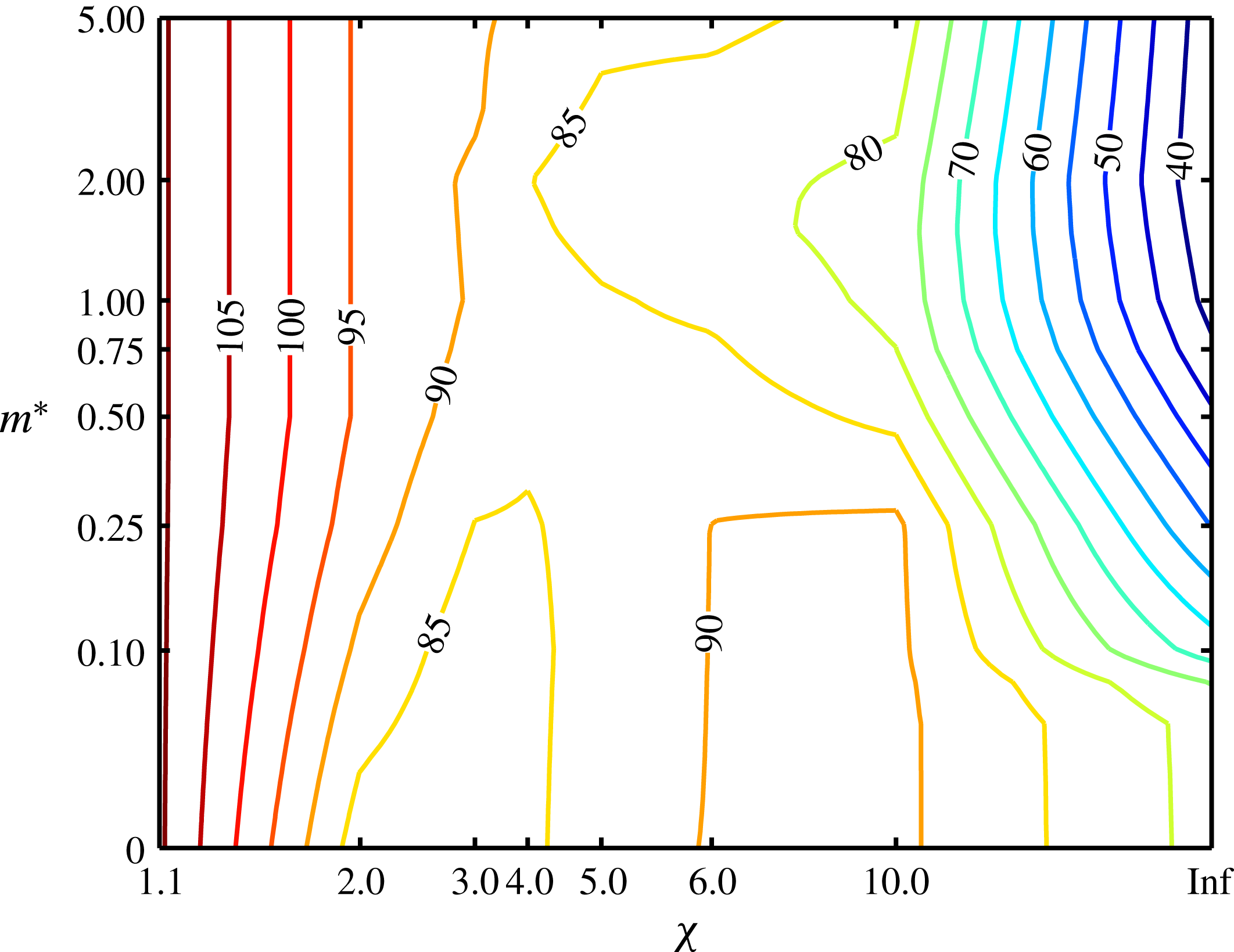
Critical Galileo number of the primary instability as a function of the aspect ratio and non-dimensionalized mass. The horizontal axis is linear as a function of
 $\unicode[STIX]{x1D709}=1/(1+\unicode[STIX]{x1D712})$
and the vertical axis as a function of
 $\unicode[STIX]{x1D707}=\log _{10}(m^{\ast }+0.05)$
.

The critical Galileo number of the primary instability threshold can be represented as a function of two variables in the
 $\unicode[STIX]{x1D712}{-}m^{\ast }$
plane. This comprehensive information is represented in figure 13. The straight vertical isocontours facilitate the localization of the discussed sphere-like scenario, present for flat and thick spheroids.
The scenario is strongly marked by subcritical effects making sometimes several totally different regimes coexist for the same set of parameters. This opens the problem of receptivity in experimental applications where noise is never absent. The numerical reproducibility of results might depend on the choice of initial conditions. The two basic regimes of falling disks – the flutter and the tumbling – remain of importance throughout the whole scenario. Especially the robustness of the tumbling, evidenced down to the aspect ratio of 2, is remarkable. The separation between ‘flat’ and ‘thick’ spheroids lies between
 $\unicode[STIX]{x1D712}=3$
and 4 and can be defined by the disappearance of the flutter, i.e. of vertical periodically oscillating trajectories with large inclination angles of the body. A similar qualitative limit was found for fixed spheroids and cylinders placed in a uniform flow (see Chrust et al.
Reference Chrust, Bouchet and Dušek2010). In contrast, the tumbling regime is stable for all aspect ratios larger or equal than 2 – i.e. for sufficiently aspherical bodies.
The investigation of the spheroid of aspect ratio 1.1 indicates that the dynamics of massive bodies is relatively robust to geometric imperfection of the body shape and the sphere scenario is qualitatively well reproduced in spite of the absence of rotation of the spheroid. In contrast, very significant oscillations of the body axis for ascending almost spherical spheroids of very low solid/fluid density ratio make the dynamics very different from that of perfect spheres. This might be a hint for the explanation of the zig-zagging trajectories observed by Horowitz & Williamson (Reference Horowitz and Williamson2010) that we failed to explain using the results of simulations of freely moving perfect spheres. Obviously, very light spheres are very sensitive to imperfections of all sort (see also Jenny et al. Reference Jenny, Dušek and Bouchet2004). More broadly, an ideal spherical body is perhaps not an ideal prototype representing solid bodies of arbitrary shapes.