Introduction
The use of electric mobility-scooters by older people is an emerging social, health, transport and safety phenomenon. Electric mobility-scooters, which are known by various names including ‘motorised wheelchairs’ and ‘powered mobility devices’, and by brand names such as Gophers, are battery-powered, have a seat over a platform, three or four wheels and controls on a front column (tiller) that enables manual steering. The road rules in Australia classify users of scooters as pedestrians, and specify a maximum speed of 10 kilometres per hour. In Australia, scooters are not required to be registered except in the state of Queensland (Queensland Transport Reference Queensland2008). Mobility-scooters are for people with mobility restrictions and are to help them maintain an independent lifestyle through improved or maintained mobility (Department for Transport, Energy and Infrastructure 2006).
Older adults, like others, value the ability to manage daily tasks independently (Bryant, Corbett, and Kutner Reference Bryant, Corbett and Kutner2001). For them, successful living includes social participation as well as the ability to engage in meaningful activities (Easley and Schaller Reference Easley and Schaller2003; Hinck Reference Hinck2004; Wallin et al. Reference Wallin, Talvitie, Cattan and Karppi2007). Mobility is of great importance in enhancing their ability to live independently in the community (Fried et al. Reference Fried, Ferrucci, Darer, Williamson and Anderson2004). The loss of mobility for the older person is an ominous signifier of helplessness and dependency (Davey Reference Davey2007). If a person is limited by disability or ill health, they risk becoming isolated or housebound, and as autonomy is crucial to quality of life, an older person's outlook can be much influenced by the extent to which they feel dependent on others (Davey Reference Davey2007). Consequently, an older person may have to consider their options for transport, especially those who have lost their driver's licence or who have difficulty walking any distance. Electric mobility-scooters are coming ‘to be viewed by older people as an alternative to the motor vehicle rather than only as an aid for those who are having trouble walking any distance due to physical disability or health condition’ (Cassell and Clapperton Reference Cassell and Clapperton2006: 2).
With advances in technology and the increasing acceptability of electric mobility-scooters as a form of transport, it is not surprising that increasing numbers of older Australians are using them to maintain their contacts and activities in the community (Brownsdon and Marcar Reference Brownsdon and Marcar2002; Department for Transport, Energy and Infrastructure 2006; Muir Reference Muir2004). There is a similar tendency across the developed regions of the world, as in Europe (Marcellini et al. Reference Marcellini, Principi, Ciarrocchi, Mollenkopf, Tacken, Ruoppila and Zsuzsa Szeman2000) and the United States of America, where usage continues to increase (LaPlante Reference LaPlante2003). Nevertheless, little is known about the consequences of this trend in terms of daily activity patterns, impacts on quality of life, or the safety, environmental and other implications for the broader community and transport organisations. Despite the potential that scooters have for enhancing the mobility and quality of life of people with functional limitations, there are many concerns about the unintended consequences of their use.
A review of the research literature revealed that there has been attention to questions of the match between people's needs and the capabilities and demands of the equipment (Daus Reference Daus1999; Smith et al. Reference Smith, Quine, Anderson and Black2002), levels of satisfaction with mobility devices (Kirby and Ackroyd-Stolarz Reference Kirby and Ackroyd-Stolarz1995), adverse events (Charlton Reference Charlton1995; Jedeloo, Witte and Schrijvers Reference Jedeloo, Witte and Schrijvers2002; Jorg, Borgers and Schrijvers Reference Jorg, Borgers and Schrijvers2003), and the rarity and inadequacy of assessment before adoption (Lake Macquarie City Council 2004; RoadSafe 2003). The wider personal, social and environmental implications of scooter use have received less attention. More evidence is needed about purchasing and acquisition decisions, where scooters are used, what they mean for the users, and the environmental enablers and barriers to address safety concerns and inform policy. Significantly, one of the limitations of the research that has been undertaken has been that many studies have grouped together electric wheelchairs and electric mobility-scooters, rather than undertaking in-depth studies of scooter use. The aim of the study reported in this paper was to investigate the meaning that older people attribute to having an electric mobility-scooter as well as the factors that influence and impact on their purchase and use.
Methods
Design
This descriptive and exploratory study used both quantitative and qualitative approaches to explore the meaning that older people attribute to having an electric mobility-scooter, and to examine the issues arising from the purchase and use of scooters by older people. In accordance with promoting older adults' autonomy and community living, we believe that it is essential to take into account the older people's own perspectives (Brown, McWilliam and Mai Reference Brown, McWilliam and Mai1997; Wallin et al. Reference Wallin, Talvitie, Cattan and Karppi2007), which accordingly our data collection approaches and instruments collected.Footnote 1
Sampling and methods of data collection
The study was conducted in South Australia. In 2006, the proportion of the South Australian population aged 65 or more years at 15.1 per cent was the highest among Australia's states and territories, and exceeded the national figure of 13 per cent (Australian Bureau of Statistics 2006). Older people who were using an electric mobility-scooter were the population of interest. The sampling and data collection methods used to capture the perspectives of participants are outlined below.
A survey of the use of mobility-scooters by older people
A large retail supplier of mobility-scooters provided the researchers with access to a database of the purchasers of electric mobility-scooters. The 119 named individuals who lived in South Australia were sent a self-completion questionnaire along with a letter of support for the study from the retailer and a reply-paid envelope. Fourteen members of two scooter support-groups were also invited to complete the survey – at the time of the study, these were the only such groups in the state.
The questionnaire collected the socio-demographic attributes of the scooter users, the reasons for use, trip destinations and distances travelled. It had 12 closed questions and four open-ended questions about why, where and how often scooters were used. The questions were informed by the literature and reflected the aims. A draft was reviewed by a reference group comprised of an employee of a large retailer, researchers and transport officials, prior to it being piloted. Although the majority of the questions were closed or structured, the team wished to capture the personal experiences of mobility-scooter users and so included open-ended questions with a focus on the reasons for use, the benefits of having/using a scooter, and the experienced problems. The questionnaire was piloted with three scooter users, and their reactions and advice led to improvements in the clarity of the questions and a shorter instrument. The anonymity of all the respondents has been preserved.
Focus-group interviews
The purpose of the focus groups was to obtain the scooter users' perspectives on the value and meaning of having an electric mobility-scooter, as well their understanding of the issues surrounding its purchase and use. Focus-group methodology encourages participants to express views and exchange ideas, and is valuable in capturing the participants' shared and consensual views (Parker and Tritter Reference Parker and Trittter2006; Patton Reference Patton2002). Invitations to participate in the focus groups were sent to the older members of the two scooter support groups, and two discussions were conducted. Beforehand, members of the research team met with each support group to inform them about the study, recruit participants and agree on suitable times. Both organisations agreed that the focus-group discussion would be a part of their fortnightly group meeting. Two members of the research team attended each of the focus groups. One with extensive facilitation experience took this role and the other was an observer. There were six participants in one group (all females) and nine participants in the other (eight females and one male). The duration of each focus group was around 75 minutes. Each focus group was digitally recorded and the observer's notes were collated. The initial probes for the focus groups were informed by the literature, the responses to the questionnaire and other information gained through discussions with scooter retailers. The probes reflected the aims of the study and were organised around three themes: why and how the decision to use a mobility-scooter was made; how and where older people use scooters; and the importance of having a scooter and issues surrounding scooter use.
Data analysis
The responses to the open-ended questionnaire items were analysed by organising similar comments into major themes, while the responses to the closed questions were coded and analysed descriptively. The focus groups were taped and transcribed verbatim. Through a process of inductive analysis of the transcripts, as guided by Cheek, Ballantyne and Roder-Allen (Reference Cheek, Ballantyne and Roder-Allen2005), emerging patterns and themes from each focus group were progressively organised and incorporated into classes of similar themes across the focus groups. Two members of the research team reviewed each transcript independently, and then met to discuss any disagreements and next steps in the analysis. The inductive analysis identified a number of major themes relating to the research aims and the broader categories of: obtaining a scooter, the meaning of mobility for the older person, and the factors/issues that arise from and impact upon their use.
Findings
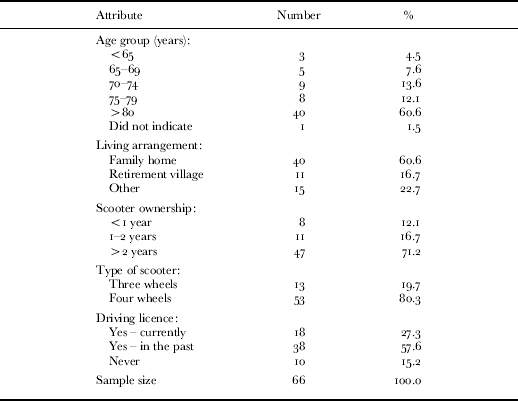
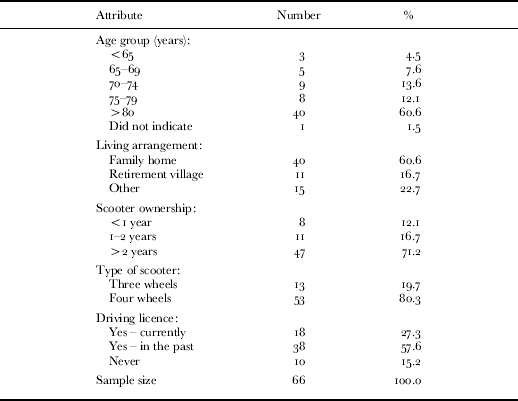
Of the 133 questionnaires that were sent out, 66 were returned (50% response). The principal descriptive characteristics of the sample are shown in Table 1, including the age distribution, living arrangements, past and current driving licence holding, the type of scooter owned and for how long, and usage. Interestingly, 15 per cent of the respondents had never held a driver's licence. The scooters were used for on average three to five trips per week in both summer and (the mild) winter. The weekly distances varied from 0.5 to 80 kilometres. Twenty-six per cent of the respondents took their mobility-scooters on public transport. The questionnaire responses indicated that the most common activities carried out by using the scooters were shopping, visiting friends, keeping appointments and just ‘going for a ride’.
The participants' attributes and scooter ownership
The findings from the analysis of responses to the open-ended questionnaire items and the two focus groups have been grouped into three categories, specifically: obtaining a scooter; the meaning of mobility; and issues around sharing spaces. Within each category, a number of themes emerged but they are interconnected rather than entirely independent. Each theme is discussed in turn and demonstrated by direct quotations from transcripts. In the extracts, the ellipsis (…) indicates omitted text, and glosses are in square brackets.
Obtaining a scooter
A prominent theme among the influences on the decision to acquire a scooter was a decline in health or physical capabilities. For example, problems such as impaired mobility from joint or back pain and difficulties in walking or lung (breathing) problems led to many respondents' interest in scooters as an alternative means of transport. Several also spoke during the focus groups of the despair and isolation that they experienced on being forced to give up their driver's licence because of impairment. One commented that, ‘giving up your driving licence when you are an independent person is pretty hard’. Another reason for deciding to acquire a scooter was a decline in a partner's health and physical capabilities or the death of a partner. As one focus-group participant explained:
I found that once my wife passed away, I had no means of getting around and doing things, and I had a stroke 10 years ago, consequently I was unable to walk very far.
Some participants were reluctant to obtain a scooter because they saw them as signifying old age: they believed that scooters were for ‘older people’ and thought that using one was ‘belittling’. The following comment from a focus-group member typified this feeling as well as strong affirmation of the need for independence:
I didn't want a scooter [because] I thought, that's for old people, but I am an independent person. … If I said to my husband, ‘Can you take me to the library?’ he would say, ‘In an hour’, but I wanted to go at that time, so after a while, I decided, yes, I will buy a scooter.
Other participants indicated that some people leave getting a scooter ‘too late’ and through their reluctance to obtain one, forgo both enjoyment and independence. These feelings are illustrated in the following recommendations about acquiring a scooter from two focus-group members:
Don't leave it until you can't drive anymore, get it now. … I would have been far better off to have got the scooter earlier.
This is where I think a lot of people think, because they get a scooter, they are belittling themselves. I think that they really have to have that confidence to say, right, forget the belittling, forget the other things what people are going to say, [say to yourself] I am going to get one regardless. I think like that a lot of people would get one then earlier. If people look at mine and then say, right, that is a nice one, but I will only get one when I stop driving. I think there should be some way of educating people to be able to get one now instead of later when it is too late.
While all the focus-group participants and survey respondents owned and used a scooter, not all had possessed a driver's licence. Both groups generally felt that the lack of a driver's licence need not be a deterrent to acquiring a scooter and that one did not necessarily need driving skills to be a competent scooter user. As one participant explained:
I got mine because my husband was sick, so I got one to accompany him with his walking. That would be eight years ago. Through his illness I have had to pick him up a lot when he has fallen over, so it didn't do my body any good. … I ended up having operations on my knees, so that messed me up walking, and also unfortunately I got chest and breathing problems. The doctor suggested I get the scooter, and I had never driven a car, incidentally, and I took to the scooter like a duck to water and didn't have any problems with it.
The focus-group participants and survey respondents acquired their scooters in various ways. While some had been able to purchase the scooter, others were provided through organisations such as the Department of Veteran Affairs or Domiciliary Care South Australia (SA).Footnote 2 In these cases, many applicants are placed on waiting lists and then assessed for their ability to use a scooter before it is made available.
In making a decision to acquire a scooter, the individual is confronted with a wide range of models in an expanding competitive retail market. Those participants who decided to purchase a scooter identified retailers through various means and sources, including telephone directories, newspapers, television guides, other printed material, local advertising signs and by simply having driven past a shop that sold scooters. The Independent Living Centre SA, an advisory service staffed by occupational therapists who advise on equipment for people with disabilities, injury and illness, was also cited as a source of information. In selecting a scooter, the focus-group participants identified a number of factors that should be considered, including the choice between three or four wheels, the comfort of the seat, the suspension (to cushion the effect of bumpy surfaces), the look of the scooter, and being ‘able to grip instead of pushing with my thumbs’. They particularly described how supportive some retailers were in providing ‘trial runs’ on many different scooters. Some retail premises had an area where customers could view and try out different scooters, whilst other retailers took various models to people's homes for them to trial. One focus-group member described her purchasing experience in the following way:
He brought three with him that day in the van, three for me to try out, and I wasn't sure which one I liked, so he said, ‘Try this one for a couple of days and we will come back in a couple of days with the other one and you can keep having a go’.
Other participants were less satisfied with the sales procedures and felt vulnerable to over-zealous sales-persons. In the following quote, a focus-group participant describes a negative experience in which the sales-person wanted to sell her a specific scooter that did not meet her needs. Rather than accept the advice of the retailer, she purchased a scooter elsewhere:
I didn't like one [sales person] in particular because he told me that that the scooter was not made for ladies. I said, ‘What is wrong with this?’ [He said] ‘It was going too fast’, and I said, ‘Bad luck’, and I didn't buy the scooter from him. I liked the scooter but I went to another place and got the same scooter. I thought, that serves him right.
Given the relatively high cost of mobility-scooters, several participants commented on what they considered the ‘responsibility’ of retailers to educate the purchaser on both their needs and how to use the scooter. While some participants had ample training and support, for others it had been almost non-existent. Further variation occurred around the availability of ongoing support and maintenance for electric mobility-scooter users. Some focus-group participants had maintenance contracts for their scooters, and others were able to call out the retailer, but some received very little after-sales support. One participant admitted that she was unaware that she needed to have her scooter serviced at all.
The meaning of mobility
Using an electric mobility-scooter has the potential to promote the mobility and independence of older people with mobility limitations. Both the survey respondents and the focus-group participants reported that using scooters allowed them to travel to diverse destinations, accomplish various tasks, promote or maintain their independence, participate in the community, access support groups, and to maintain friendships, and more generally that it promoted their personal health and wellbeing. The participants travelled to their various destinations either using the scooter alone or in combination with public transport, specifically trains and buses. They travelled mainly during daylight hours and the journey purposes included shopping, visiting people, attending meetings, appointments and concerts, and participating in volunteer work and leisure activities. The value of being able to accomplish these tasks and of staying connected with the community was one of the strongest themes in the participants' responses. For one focus-group participant, not to have the scooter would mean: ‘I couldn't go anywhere, I couldn't do my meetings, and I couldn't go to my social functions. I need my scooter, I really do need it’. While mastering the scooter was a challenge for some, most participants were motivated by the desire not to be housebound, as one respondent explained:
I had never driven a car in my life when I first got mine [scooter] and I thought I am not sitting home here, not being able to move around. So I got on mine and just kept going around the block.
The focus-group dialogues highlighted the importance of individual control over personal daily activities as well as the sense of self-sufficiency and autonomy this brings. Self-esteem and confidence are heightened as the individual is able to engage with the wider community. The physical capacity to carry out tasks through the use of a scooter allowed the participants to remain connected with the community. The participants' strong sense of pleasure in their autonomy and ability to do things for themselves is reflected in the following quote:
I bought my scooter and it was marvellous because I could go when I wanted to. That is one of the reasons I love my scooter. I am not stuck at home, I can go out when I want to and I go on the train and go to town and other places. It gives you a second life.
Many stated explicitly that scooters allowed them to go ‘where they want, when they want’. Without scooters they saw themselves as housebound and with limited capacity. Not only did using a scooter impact on the individual but it also reduced dependence on the family for transport. The emotional, personal and physical importance of scooters in the lives of the older people in this study repeatedly emerged from the data, and many credited the scooters with giving them freedom and autonomy:
I tell them ‘you don't know happiness until you have a scooter’, and get a scooter and you can get around like other people. It is freedom.
Scooter, scooter, scooter, we need the independence, we love our scooters, that is the main thing, and they are our life, our way of getting around. We get great enjoyment from them and everybody who needs them. I see people struggling to walk and I say, ‘You need a scooter’.
Negotiating spaces
Knowing the rules
In terms of educating and training scooter users, the participants identified the need to know the road rules as well as to master the controls as important for safe usage (e.g. to negotiate curbs). Many were concerned that this was not the case for all users. It was also suggested that the broader community needs to understand the road rules, particularly that scooter users are legally pedestrians. A number of issues were raised about scooter users' lack of understanding of how to use their scooter safely as well as about current road rules and etiquette. Some were frustrated by scooter users who ‘think they have the right of way’ or ‘don't understand’ the rules, and there was concern that individual transgressions of the road rules damaged the public's perception of scooter users in general. Other concerns communicated during the focus groups related to new users' lack of experience with their scooters and the prevalence of less than safe practices. Some attributed these problems to a lack of necessary training:
They are not getting the training and that is why we are getting a bad name [scooter users], because they are not getting the training that they should. For people to sell these scooters, they should have someone there that knows all about them, the rules of the road and the rules of the footpath as well [for] pedestrians. But if they are not going to show us how to drive them, where do we go?
Most of the participants believed that the provision of education and support in a consistent way for all scooter users needs to be addressed.
Sharing spaces
Several issues arose about the sharing of community spaces with other pedestrians, cyclists and motorists. While some focus-group participants felt that not everyone is ‘scooter friendly’ and that there is a lack of understanding by the wider community of scooter users and their ‘rights’, others commented that scooter users themselves could do more to share spaces with dignity and fairness. One commented:
I know a lady from another group. She [goes] on the footpath and she thinks she has the right of way. She gives us all a bad name. She … toots people to get out of the way.
Not all the users saw themselves in the same way, however, and some clearly considered themselves as pedestrians when using the scooter:
I would say I am a pedestrian like everybody else. If you have that attitude you have no troubles. Yes, I am a pedestrian too, but I don't act like I have more right because of the scooter. So particularly if they [pedestrians] are walking slowly, I stay behind and go at the same pace. A couple of times people have stopped all of a sudden so you have to have your wits about you.
While some participants indicated that they had been insulted by insensitive or prejudiced comments about scooter users, others reported with satisfaction that members of the wider public were generally sensitive. There was, however, concern that there is resentment about the amount of space that scooters require to manoeuvre and park in community settings and on public transport. One participant remarked:
Some people can be very rude. … They make all sorts of remarks about our scooters, and we mustn't make any remarks about the pedestrians. I could write a book! … Kids are the worst when you are out shopping: school holidays, I hate them. They see you coming along and they will deliberately stand in your road.
Accessing buildings
Both the focus-group participants and the survey respondents identified major issues with particular buildings that do not allow disability access. Some said that they often spent large amounts of time searching for ‘safe’ or ‘scooter-friendly’ entrances and exits, and emphasised that the provision of ramps and wide spaces for manoeuvring the scooter were essential. The lack of space in toilets was described as a widespread problem and restriction, and meant that they had to travel with companions who could help them into and out of a toilet. Otherwise they had to risk leaving their scooter outside and unattended whilst visiting the toilet. Such difficulties were vividly described:
Sometimes the ramps go up fine [but are not wide] enough to be able to turn into the door when you get to the top. A few years ago there was an election and [to vote] we had to go around to the school. I was on my scooter and said, ‘How do I get in?’ [A steward] said, ‘There is a ramp. You could go up the ramp.’ But the scooter was too big to go around, so eventually I had to get off to go in.
If they [toilets] are not big enough for the scooters to go into, you have to have somebody with you, because you can't leave them outside. We always go together to a toilet so that if we have to leave the scooters outside, one of us can watch them.
The scooter users in the focus groups were quick to identify which shops and shopping centres were and were not scooter friendly. There were complaints particularly about obstacles in the middle of shopping aisles, which whilst easy to negotiate for shoppers on foot, are problematic for scooter users. One participant pointed out:
Some shops you just cannot get round, (name) is one of them and (another name). They have things parked in the middle of the aisles so you can't get around. … (Name) is the worst, you have to be careful when you are going out, you need to pick an aisle that you can get your scooter through; there is only about two of them. But if you go to (name) all their aisles are nice and wide and you can go in and out easily.
The entries and exits of shops are usually negotiated by scooter users using disability access routes. The participants indicated that this could be time consuming, especially where able-bodied individuals unnecessarily used or congested facilities for people with disabilities. Such lack of consideration particularly upset one participant:
What drives me up the wall is going to the disabled checkout and there are about eight people in front of you and they are all able bodies. What are they doing there; can't they go somewhere else? People push in front of me and I am trying to go through the checkout, and they say, ‘Excuse me’, and I say, ‘No, excuse me, I was here first’. They aren't disabled.
Using footpaths
As pedestrians, scooter users are expected to travel about on footpaths, but the participants gave various reasons as to why they are sometimes not used. They identified many obstacles that were frequent hindrances, including signs, bollards, garbage bins, recycling bins, tree roots, planters and poles. Such obstacles force scooter users to use grassed areas, unstable ground or adjacent roads. One participant commented:
Garbage bins are a damn nuisance, they don't allow enough pavement, they have got all that spare waste bit. … Not everybody takes it [the bin] to the curb edge, some people put it right back in the middle, and then you have grass or someone has put rockery on the bit that is part of council land. You do have big problems like that.
Of particular concern to the scooter users are the concrete curb ramps that provide for passage from a footpath to the road. The participants said that many ramps are too narrow and need to be taken at a ‘square on’ angle so as not to tilt the scooter or even topple it over, so generally the ramps were approached with caution. They were aware that a number of scooter accidents had occurred in this way. The positioning of the ramps was also of concern:
If the instep is on the actual curve of the bend, it is very awkward because you have to go out straight and [if a] car is coming along on, say, your right side, they really panic, screech their brakes thinking you are going to go across the road. … You have to approach right in the middle; you are not to go across [at an angle] because you can tip the scooter.
Additionally, there were concerns about the quality of footpath surfaces and the absence of ramps. In areas where there are no ramps on to the road, long distances are travelled to find them. One participant explained the problem well:
We can't lift the back part of our scooters, they are too heavy. So I somehow wish the design was made where we could get off a pavement where there are no driveways. Because when I am in a bus and I am going on a new route I am always looking out. [I take note that] Oh, yes, I can come down this road, there is a slope to get across there. I look at the roads that haven't got slopes and I think, right, I must remember that, because we can only go down on slopes. So if you are going to a side road somewhere and there is no slope you might have to go a kilometre up or down to find one.
Using roads
The respondents explained that sometimes scooter users are forced to travel on roadways even though most understand that ‘you are not supposed to’. A number of the focus-group participants were surprised, however, to learn that they are not permitted to use scooters on bike paths in South Australia. Some commented that they regularly used bike paths and saw them as efficient and safe. Generally it was the poor or uneven surface of footpaths that underpinned decisions to use roads or bike paths. As older people, scooter users are particularly vulnerable to injury through unnecessary vibration from bumpy or uneven surfaces. The focus-group participants argued forcibly that it is sometimes necessary to travel on the road. One said, ‘If the footpath is up and down and there are driveways you are better off to travel on the road. Your back suffers’. Another concurred with the comment: ‘No, it is not very good for your spine … when there are bumps I go on the road’.
Using public transport
The focus-group participants were probably atypical with regards to their use of public transport. As members of scooter support-groups that meet regularly, organise outings and travel together, they have much experience and unusual confidence in accessing and using public transport systems. Their experiences and comments about using public transport were nonetheless of great interest and have implications for all scooter users. Several focus-group participants indicated that trains were the preferred means, and that buses were much harder to negotiate for reasons such as ‘they only take three wheelers or small four wheelers’ and ‘you have to get off quickly at the stops, but if it is full, sometimes you are stuck in the aisle and can't get through’. Some had found manoeuvring into a space to park once on a bus or tram problematic, particularly on overcrowded vehicles. One participant commented, ‘some scooters are too big to go on trains and they [scooters] are getting bigger and bigger’.
Another participant noted that a significant barrier to using trains is the gap between the platform and the train. Comments included ‘sometimes the gaps are very wide’ and ‘the step is too high’. Knowing and being accustomed to the public transport system was seen to be a significant advantage for a scooter user and contributed to increased confidence in its use. Experienced scooter users in South Australia understand that the front carriage of the train is intended for scooter and wheelchair users, but that not all members of the public are aware of this. In most cases, a conductor puts a ramp in place for the scooter to be wheeled on or off the train. The following focus-group member was concerned with the lack of awareness of the practice by able-bodied passengers:
The first compartment is especially for scooters and bikes and big pushers. … He [the conductor] just puts the ramp out and you wheel in and then he puts the ramp away. So you really have to be in that first carriage [compartment] because there are a few minutes lost putting the ramp out and away, and of course the passengers getting on the train, they have no idea to wait until he has got the ramp out so you can get on. They all want to get their ticket and they all want to be in the first carriage, they don't think to go in the second door. I really feel sorry for our railwaymen because they are as polite as anything but their trains are often late because of the stupidity of passengers.
Interestingly, when asked how they had acquired their knowledge about what to do on public transport, a common response from focus-group participants was, ‘jump on a train, you soon find out’.
Summary and conclusions
Brownsdon and Marcar (Reference Brownsdon and Marcar2002) commented that scooter users are a substantial and growing presence in the community, but the experiences of the users and the wellbeing and health implications have been little researched. This study investigated the meaning of mobility for older people in South Australia who use electric mobility-scooters as a means of transport and to stay active in and connected with the community. The participants appreciated the opportunity to voice their experiences and concerns but were also apprehensive that the findings might be used to support policies that would limit scooter use. A major theme that emerged was the important place of scooters in the lives of the users. For them, the scooters are fundamental tools in enabling their freedom and independence, the ability to maintain friendships, carry out daily tasks and remain connected with wider communities. The respondents firmly believed that scooters make a significant contribution to their health and wellbeing. In light of this, and coupled with the trend for increased scooter use, a number of calls for further investigation and action have arisen from this study. These relate to the processes for acquiring a scooter, educating and preparing older people to use scooters; community support for scooter users; and structural provision for scooters.
The mobility-scooter retail sector comprises many different types of services and providers, and the latter change their policies frequently. The range of products and service options may overwhelm older people and their families. The participants indicated that some older people are not aware of the welfare-aids entitlement to be prescribed a scooter. In describing their purchasing experiences, the participants gave many accounts of the distributors offering different information and purchase options for acquisition and after-sales service. Cassell and Clapperton (Reference Cassell and Clapperton2006) reported that the suppliers of motorised scooters need to do more to match each user's characteristics and abilities with the most appropriate scooter. Older people with mobility difficulties need the right information at the right time to make the best decision. Access to unbiased information and advisory services, such as those of the Independent Living Centre in South Australia, is important and necessary. Encouraging scooter distributors to provide services across the purchase–use continuum and to develop alliances and partnerships with complementary service providers would provide more comprehensive advice for the consumer.
The participants indicated that there is a great deal of misunderstanding about the road rules and what constitutes safe scooter usage. Cassell and Clapperton (Reference Cassell and Clapperton2006) also found that the suppliers' introductory training varied in quality. Education and training courses for older people who intend to use a scooter should refer to a wider range of users' experiences and settings in which scooters are used. If the proficiency of users is raised, the current negative stereotypes of scooter users could become less widespread. This might be achieved by going beyond the customary sources of induction and training. One of the collaborating scooter support groups had developed peer education to provide relevant information to users and to discuss and answer their questions and concerns. Questions of how best to train the peer educators then arise. Particularly with regard to new scooter users, quality educational programmes need to be funded and delivered (Brownsdon and Marcar Reference Brownsdon and Marcar2002).
The findings of this research support the notion that scooters can assist older people with mobility difficulties to maintain control and autonomy over their lives and that, given the growing use of scooters in the community, it is increasingly important to raise the public's awareness of the value of scooters, their place in the community, and the space required for their safe operation. It is important that there is a wider understanding of the road rules as they apply to scooters and that scooter users are classed as pedestrians. The participants identified a number of structural and environmental barriers to safe scooter usage. Scooter users are excluded entirely from or have restricted access to many buildings, footpaths and community places. It is important that building and environmental design take into account the size of scooters and their space needs for safe manoeuvring and apply appropriate standards in disability access planning. Further research is required into the design and upkeep of footpaths and ramps so that they do not limit or compromise scooter use, and in particular allow the safe passage of scooters and wheelchairs on to and off roads.
Limitations of the study
A limitation of this study was the relatively small convenience sample of purchasers and users of electric mobility-scooters from a single retailer's database. Furthermore, the focus-group participants were members of two scooter support groups, self-declared scooter enthusiasts and predominantly Caucasian women. Different views may have been obtained from the customers of other retailers or from those that used different scooter models and customer services. The experiences and voices of men and minority groups were not well represented. Nonetheless the investigation has generated information that will help inform user education, environmental design and future research. We also recognise that the focus-group participants wanted to tell their stories and believed that they had something of value to tell. Some indeed said that they wanted to counteract the negative picture of scooter users shown by the media. Other participants said that they were curious about the project and were interested to take part.
Future directions
Through this preliminary work, the project team hope to develop further research that will explore in greater depth the issues that have been raised in this paper and to evaluate a number of recent initiatives to accommodate scooters and their use. It is near certain that there will continue to be increasing use of electric mobility-scooters by older people as a form of mobility and independence. The importance of scooters in the lives of users cannot be understated. As such, increasing the understanding of the phenomenon and the associated issues is imperative if we are to promote older adults' autonomy and community involvement.
Acknowledgements
We thank the participants who contributed to the study, including the scooter retailers and distributors, especially the retailer who provided access to the customer database, the older people who responded to our survey and to those who attended the focus groups. Some financial support was provided by the Department for Transport, Energy and Infrastructure (South Australia) through the Transport Systems Centre, University of South Australia. The views expressed in this paper are not necessarily those of any of the funding or collaborating organisations.