1. Pregnancy and the Problem of Biological Individuality
What is the problem of biological individuality? Organisms are among the central entities with which the biological sciences are concerned.Footnote 1 They develop, move, eat, fight, copulate, and raise offspring; they have traits that biologists describe; and they are the entities that population biologists count. Even so it is not always clear which entities are organisms. In mammals, birds, and reptiles things appear straightforward enough: here is a horse, there another. But in plants, insects, and many other life forms, complications arise. Is the organism the individual ant or the ant colony? Is every individually rooted strawberry clump a plant, or is the plant the entire patch stemming from one beginning? It is now well described that biology lacks a single concept of or set of criteria for the organism that appears to give the correct or even consistent answers to such questions across all taxa. This is the problem of biological individuality that, so far, has not been resolved (Pradeu Reference Pradeu2016a). No set of criteria have gained widespread support for delivering the right, or trustworthy, results across all of the natural world.
Even so, this problem is generally discussed for life forms that appear very different from us (e.g., slime moulds, fungi, and eusocial insects). The contested case of their microbiome aside,Footnote 2 this is not generally considered a problem in mammals and other higher metazoans, such as birds and reptiles. These organisms remain easily and uncontroversially identifiable, both on the face of it and in theory. Recently, however, I have suggested that pregnancy “presents a genuine and possibly novel set of questions for current debates surrounding biological individuality” in mammals (Kingma Reference Kingma2019, 633).
I arrived at that position, not by considering biological individuality directly, but in the context of investigating the relationship between the fetus and the maternal organism. I drew on four criteria for being an organism “frequently appealed to” (Kingma Reference Kingma2019, 633) in philosophy of biology to argue that the fetus is part of the maternal mammal. Although I ultimately did not state that pregnancy poses a problem of biological individuality—a case in which criteria for individuality give conflicting results—I did suggest very strongly that pregnancy makes the biological individuality of mammals much more complicated than it is generally taken to be.
This article picks up where I left of in Kingma (Reference Kingma2019). It examines (1) whether pregnancy is indeed such a complicating case and (2) whether that results in a problem of individuality for mammals. There are at least two reasons for doing so. One is that these are interesting questions, which I did not quite answer before. But, second, insofar as I did answer these questions, my earlier attempt can be improved on: two of the four criteria I used in Kingma (Reference Kingma2019)—physiological autonomy and functional integration—are among the four rejected by Clarke (Reference Clarke2010) as serious candidates for defining biological individuality (even in the context of Clarke’s otherwise very permissive approach).Footnote 3 We can, and will, do much better than that. In section 2 I test my suggestion by applying eight criteria for biological individuality to the entities involved in mammalian pregnancy. Section 3 concludes and identifies questions for further work.
The problem of biological individuality is already well described. This article makes an important contribution in critically questioning assumptions we tend to make about so-called easy cases: mammals. This is, first, of special relevance to us: we are mammals. If there is no single account of what the mammalian organism is, then this is not just important for (the philosophy of) biology but also for other branches of philosophy, for example, for animalists who defend the claim that we are animals (Olson Reference Olson1997; Snowdon Reference Snowdon2014) or metaphysicians who wish to question when human organisms begin (e.g., Smith and Brogaard Reference Smith and Brogaard2003). Second, pregnant mammals—a life form that is very familiar to us—may help us investigate the problem of biological individuality in new and fruitful ways. Third, the article extends questions about biological individuality to gametes. This suggests that biological reproduction in higher metazoans in general may incur problems of biological individuality. That warrants further research.
2. Testing Pregnancy against Criteria for Biological Individuality
Clarke (Reference Clarke2010) gives an overview of 13 criteria that appear to be—and have been used or defended as—serious contenders for defining biological individuality. She applies some of these criteria to six candidates for being a biological individual, which on intuitive—or, rather, naive or first—appearances range from parts of organisms (a lobster’s claw) to groups of organisms (a bee colony). Clarke uses this exercise to demonstrate that the criteria give different, nonoverlapping verdicts for these different candidates, concluding that the definition of biological individuality is a genuine problem.
I use Clarke’s exercise to a slightly different end: by applying a selection of her criteria to different candidate entities involved in mammalian reproduction, I show that some of these candidates also constitute problem cases, as different criteria generate different results. This is interesting because in her original exercise, Clarke returned the verdict that mammals are wholly unproblematic: “the puppy passed every single test” (Reference Clarke2010, 322).Footnote 4
I will consider the following candidates: first, and for comparison, the male puppy that Clarke considered a prime example of a “paradigmatic higher metazoan. … The[se] share with humans all of the features that have been historically taken to be reliable hallmarks of individuality. Any definition [of biological individuality] that excludes this example will be strongly counterintuitive” (Clarke Reference Clarke2010, 321). Second, a gamete: a (canine) sperm or egg cell. This is included because, in the course of applying this exercise, I came to realize that gametes too seem to be problematic. Since our interest here is in reproduction by pregnancy, and gametes are key entities involved in mammalian reproduction, it is apt to include them.
Third and fourth, a fetal dog and a pregnant dog. These are included because they appear to be the central entities involved in (canine) pregnancy, which I suggested presents problems for biological individuality in mammals (Kingma Reference Kingma2019). But in that paper I also noted an important question about pregnant dogs: Does the pregnant dog include or exclude the fetal dog(s) it gestates? Which answer we take to be true affects how pregnant dogs fare against the different criteria in this exercise. Because I want to remain noncommittal in this article about the correct answer to my (Reference Kingma2019) question, we will consider both possible understandings of pregnant dogs: PDinc, for the pregnant dog inclusive of the fetus, and PDex, for the pregnant dog exclusive of the fetus.Footnote 5
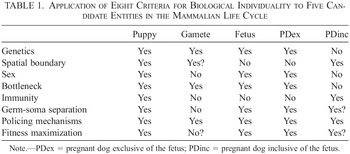
I apply to these candidates only a subset of Clarke’s (Reference Clarke2010) 13 criteria of individuality before summarizing the results in table 1.Footnote 6 For each of these criteria I give no more than a brief introduction; more detail and references can be found in Clarke (Reference Clarke2010). Following Clarke, I do not defend the criteria or my application of them. The merit of the exercise is in raising the question and taking a first stab at answering it, in a way that can form the basis for further discussion.
Application of Eight Criteria for Biological Individuality to Five Candidate Entities in the Mammalian Life Cycle

| Puppy | Gamete | Fetus | PDex | PDinc | |
|---|---|---|---|---|---|
| Genetics | Yes | Yes | Yes | Yes | No |
| Spatial boundary | Yes | Yes? | No | No | Yes |
| Sex | Yes | No | Yes | Yes | No |
| Bottleneck | Yes | Yes | Yes | Yes | No |
| Immunity | Yes | No | No | No | Yes |
| Germ-soma separation | Yes | No | Yes | Yes | Yes? |
| Policing mechanisms | Yes | Yes | Yes | Yes | Yes |
| Fitness maximization | Yes | No? | Yes | Yes | Yes? |
Note. PDex = pregnant dog exclusive of the fetus; PDinc = pregnant dog inclusive of the fetus.
2.1. Genetics
According to this criterion, biological individuals have unique or homogeneous genotypes, so that their parts are maximally related. Of our five candidates, the gamete, the puppy, PDex, and the fetus all have genotypes that are sufficiently homogeneous to meet this criterion.Footnote 7 The clear exception is PDinc, which is not homogeneous; the fetal and maternal portions are genotypically only 50% related.
2.2. Spatial Boundaries
According to this criterion, biological individuals should be “physiologically discrete,” “spatially bounded,” or “spatially localised” (Clarke Reference Clarke2010, 318). The puppy is physiologically discrete and spatially bounded, as is PDinc. But the fetus is not: it is physiologically integrated in the maternal organism and spatially indistinct from it. Granted, the fetus has boundaries such that we can distinguish it from other parts of the PDinc, but so does your kidney. The point is that, like the kidney, it is not completely physiologically or topologically demarcated: through the umbilical cord and placenta there is a direct topological and physiological connection (Kingma Reference Kingma2018, Reference Kingma2020).Footnote 8 Nor, and for the same reason, is the PDex spatially bounded and physiologically discrete: it is with respect to most other mammals but not with respect to the fetus.
The gamete is a bit more difficult to judge. On the one hand, it has a complete, external boundary: its cell membrane. On other hand, the egg remains inside the parental body. On another hand again, the sperm does not remain in the parental body, and the egg could be moved to a petri dish. On yet another hand, we could perhaps say of the individual sperm that it is physiologically integrated in the seminal fluid that also contains other sperm, nutrients, and so on.Footnote 9 All of this motivates me toward a tentative yes only, and a ‘yes’ that it is a bit more confident for the sperm than it is for the egg.
2.3. Sex
According to this criterion, the biological individual is all of the mitotic product of a sexually fertilized zygote.Footnote 10 This applies to the puppy, PDex, and the fetus. PDinc is excluded by this criterion as it is the product of two (or more) different sexual events: one for the mother and one (or more) for the fetus(es).
Gametes are not the mitotic product of a sexual event but the (eventual) meiotic product of one and the ingredient for a new zygote. They are therefore excluded by this criterion. Note the implication of this: gametes are not part of the adult organism (for they are not part of the mitotic product of a sexual recombination event).
2.4. Bottleneck
According to this criterion, the biological individual is the mitotic product of a bottleneck stage in the lifecycle, in which the organism effectively ‘shrinks down’ to just one—or a few—cells. In mammals that bottleneck is the zygote. This criterion thus gives the same result as sex, with one exception: the gamete also appears to be an individual on this view. For meiosis, the process by which diploid cells form haploid gametes produces a bottleneck; the gamete is this bottleneck.
2.5. Histocompatibility or Immunity
According to this criterion, parents are distinguished from other organisms, including their offspring, by immune responses. Or, to follow a recent refinement of this view: biological individuals are characterized by the continuity of ongoing immunogenic interactions between their parts (Pradeu Reference Pradeu2010, Reference Pradeu2012).
The puppy is straightforward: it meets this criterion, as does PDinc. “Mammals are actively set up so that, on the whole, the foster is not attacked by the gravida’s immune system during pregnancy. … And this active immunological non-rejection signals acceptance by the gravida of the foster as one of its parts (Pradeu Reference Pradeu2012; Howes Reference Howes, Kincaid and McKitrick2007)” (Kingma Reference Kingma2019, 629).Footnote 11 It follows that the PDex is not a biological individual; it does not distinguish itself from the fetus. I suspect this means that the fetus does not sufficiently distinguish itself from its mother either, but I do not know whether the fetus should be thought of as having its own immune response at all.
I am not completely confident about the application of this view to gametes; Pradeu (Reference Pradeu2012) has a very broad concept of the immune system that allows for its application to unicellular life. This means we could consider the oocyte and sperm as having something that counts as an immune response; evidence of selection among sperm by the oocyte is an example. But there is also immunogenic interaction between the maternal organism and its oocytes. This appears to suggest the latter are part of the former. Sperm may then become part of the maternal organism, either, and transitively, because of immunogenic interaction with the egg or directly through immunogenic interaction within other parts of the mother’s reproductive tract. The sperm (at least until the point of leaving) were part of the parental organism.Footnote 12
2.6. Germ-Soma Separation
According to this criterion, the biological individual has a reproductive division of labor so that some cells are sterile and carry out only somatic functions, whereas other cells contribute genetic material to the next generation: the germ line. This is true for the puppy, PDex, and the fetus (except, if we wish to be precise, the very early stages of the embryo when there is not yet a germ-soma division). All of these have sterile somatic cells and a germ line. This criterion excludes gametes, which are all germ line.
I am not entirely sure what this criterion says about the PDinc. Strictly speaking this has a division between sterile parts and germ line. It is just that it has two germ lines: one in the ovaries and one in the fetus’s ovaries/testicular buds. One might think this rather undermines the spirit of the view, which—perhaps—was about having one germ line. But another way of thinking about it is that the fetus, including its germ line, is still part of mother’s germ line—after all, it directly grew out of her germ line. On that view we get a nesting of germ lines. On the whole, then, I think the answer is yes, but I am less confident than I am about the other verdicts.
2.7. Policing Devices
According to this criterion, biological individuals possess ‘policing devices’, ‘antisubversion devices’, or ‘conflict modifiers’. There is room for disagreement on how precisely to apply this criterion to our cases, which I cannot fully address here. On the face of it, the gamete has policing mechanisms—it holds itself together so that, for example, the potential intragenomic conflict between its nuclear and mitochondrial DNA is suppressed.Footnote 13 The puppy, PDex, and fetus also have policing mechanisms: some of the mechanism we already discussed, such as germ-soma separation and the immune system, function as such devices. The existence of controlled cell apoptosis is another example; this prevents cells from ‘defecting’ and reproducing uncontrollably (e.g., as cancer).
The PDinc also has several such mechanisms—if only because the PDex and fetus, of which it is composed, possess them. But surely the key question for this entity is whether it is policed in its entirety—which would make it an individual—or whether only its fetal and PDex parts are policed separately, which makes it a (tiny) group. There is certainly some evidence of the former: in many mammals the mother can selectively abort or reabsorb fetuses or control their early development. This controls and suppresses the conflict that she faces from having different genomes within her. For the fetus—or at least the paternal half of its genome—rarely has an interest in being reabsorbed.Footnote 14 Its mother and the maternal part of its genome more often have such an interest: the circumstances under which reabsorption is (statistically) preferred, are different for the maternal and paternal parts of the fetal genome (Haig Reference Haig1993). By retaining some control of the fetus, the PDinc effectively polices these potentially conflicting interests within her. As I wrote elsewhere: “given the genetic heterogeneity involved in the case of the foster and the gravida, the high degree of successful regulation and suppression of competition between them—itself a key indicator of organismic individuality—is what stands out as particularly impressive” (Kingma Reference Kingma2019, 627). That said, this is a first judgment; I suspect a lot more can be written about this criterion than I have space for here.
2.8. Fitness Maximization
According to this criterion, a biological individual is a unit whose parts are all under selection to maximize the unit’s inclusive fitness. With the exception of the puppy, which gets a clear ‘yes’, this criterion is not easy to apply in our cases. Take gametes first. One could argue that all parts of the gametes are under selection to maximize the fitness of the gamete. But one could also argue that gametes are under selection to maximize the fitness of the organism of which they are gametes.Footnote 15 I will go with the latter, but a question mark too.
It is even less clear what this view says about the fetus, the PDinc, and the PDex. There are certainly ways in which the parts of the fetus and PDex are under selection to maximize the fitness of the respective whole. But now take the placenta—and suppose this is at least a part of the fetus. This part is not just under selective pressure to maximize the inclusive fitness of the fetus; it is also under selective pressure to maximize the inclusive fitness of the PDex. The inclusive fitness of the fetus alone demands that the placenta is slightly more invasive, claiming more of the maternal resources than the mother (in fitness-maximizing terms) wants to give. But the inclusive fitness of the mother demands that the placenta is slightly less invasive, leaving more of her resources for other offspring. We know that both these evolutionary pressures play out in the placenta (Haig Reference Haig1993). We also know that depending on life history, these pressures have resulted in different forms of placentation in different mammalian species (Garrat et al. Reference Garrat, Gaillard, Brooks and Letmaître2013). One way of understanding what goes on here is that parts of the PDex and fetus are under selective pressure to promote the inclusive fitness of all of the PDinc. This suggests that the PDinc as a whole—as well as the fetus and the PDex—undergoes selection to maximize the unit’s inclusive fitness.
But another way of viewing this is that the placenta is a part of either the fetus or the PDex that facilitates a particular form of cooperation between fetus and PDex, just as a flower is a part of the plant that promotes cooperation with bees, in a way that promotes its inclusive fitness. I am inclined to give all candidates a yes, but this is an initial judgment only. This is a criterion on which much more can—and hopefully will—be said than I have space for here. It confirms my earlier judgment that considerations such as these “take us straight to the heart of contemporary debates over levels of selection, biological individuality and the nature of organisms” (Kingma Reference Kingma2019, 632).
3. Conclusion and Further Questions
What can we conclude from all this? First, that there is a problem of biological individuality, not just for more ‘exotic’ (from our perspective) life forms but for those that are most familiar: mammals.Footnote 16 As table 1 illustrates, different criteria give different answers: read horizontally, our first seven criteria for biological individuality give six different distributions of yes/no over our five candidate entities. Only ‘genetics’ and ‘bottleneck’ give the same result. Read vertically, this leaves the biological individuality of all but one of our candidates in some doubt; only the puppy appears to stand unassailed, consistent with Clarke’s (Reference Clarke2010) earlier verdict. Until we remember that—of course—puppies were once fetuses, and pregnant dogs were once puppies. Further consideration of that point will have to await future work. Meanwhile considerations of mammalian reproduction should at least be considered alongside other so-called problem cases in the literature on biological individuality and may offer new and fruitful ways of evaluating them.
Second, the application of these criteria was not always straightforward. Clarke wrote: “Higher metazoans are in general relatively easy to individuate, most tests agree on their individuation, and give or take a few worries about parthenogenesis or regenerative abilities, there are not real problems regarding these organisms” (Reference Clarke2010, 323). But whereas all criteria were indeed easy to apply to puppies, considering the entities involved in pregnancy resulted in real difficulties for applying some of these criteria. In particular, policing mechanisms and fitness maximization could in some cases be argued to go either way.Footnote 17 The application of these criteria in mammalian pregnancy is therefore less straightforward than we might have thought and stands in need of further work.
Third, what are the implications for my (Reference Kingma2019) question about the mereological relationship between the fetus and the maternal organism? Some of the current results appear to have a direct bearing on it. In Kingma (Reference Kingma2019) I argued that the fetus is a part of the maternal organism, according to four criteria for biological individuality. Criteria that recognize the PDinc, but not the PDex, as an organism appear to corroborate that view. They effectively decree that the fetus is part of the pregnant organism. (These criteria are ‘spatial boundaries’ and ‘immunity’, both of which were discussed in Kingma [Reference Kingma2019]). But others count against my (Reference Kingma2019) claim: those that recognize PDex but not PDinc as an organism decree that the fetus is not part of the maternal organism (these are genetics, sex, and bottleneck). The remaining criteria appear to underdetermine my (Reference Kingma2019) question; both the PDinc and PDex lay claim to being an organism, which leaves open the question of which is the pregnant dog. Many of these criteria warranted further discussion, however, as their application was itself difficult to judge.
What is also notable is that, if we read table 1 vertically, the fetus and the PDinc get the same result for all criteria: where one is denied individuality, so is the other, and where one is granted individuality, the other is too. This may suggest that the fetus is not an individual on these criteria only when (or because?) it is taken to be part of the PDex. That suggestion needs further defense. It also stands out that the fetus and the gamete do not get the same results, even though both, arguably, are the maternal organism’s effort at starting a next generation. I emphasize once again that this is an initial result. A more detailed treatment of these criteria is needed. Indeed, some of the judgments made about the application of these criteria are not independent of an answer to my (Reference Kingma2019) question about the metaphysics of pregnancy. For it seems that for some criteria, such as spatial boundaries and perhaps fitness maximization, either the PDinc or the PDex—but not both—could be a biological individual.Footnote 18 The resolution of some question marks in table 1 may thus necessitate a judgment on one of the other candidates. The correct application of some criteria may then depend on which is, ultimately, the pregnant dog, and this depends on whether the fetus is or is not part of the pregnant organism. If that in turn is to be determined by the correct application for some criteria of biological individuality, then we may be led into a circle. This means that a resolution of the metaphysics of pregnancy, in the way I approached it in Kingma (Reference Kingma2019), and the problem of biological individuality in mammals may have to be considered jointly.
Finally, gametes lay claim to being an individual/organism on several of the criteria above. The application of some of these criteria also contradicts our ordinary idea that gametes as part of the parental organism (at least until they are ‘expelled’). A further complication, as we saw, is that egg and sperm may not fare exactly the same on all criteria. These matters warrant further research. If gametes are in fact individuals, then this suggests—not wholly implausibly—that reproductive efforts may raise complications about biological individuality in higher metazoans more generally, with or without pregnancy. We are already familiar with some such problems in the context of distinguishing reproduction and growth in asexual reproduction (Janzen Reference Janzen1977). Some of the issues described here, then, are prompted by, but may not be restricted to, mammalian pregnancy.