Introduction
Ernietta is a distinctive Ediacaran megafossil that is typically preserved as three-dimensional impressions within beds of sandstone. It had a gregarious habit, and unlike most Ediacara-type fossils was neither a recliner nor a frond. It is one of the best candidates for a semi-infaunal Ediacaran organism. Thousands of specimens have been collected in Namibia where it is among the most common megascopic Ediacaran taxa, along with the related form Pteridinium Gürich, Reference Gürich1933. In marked contrast to its abundance there, the only other report of Ernietta worldwide is from a single site in the western USA (Horodyski, Reference Horodyski1991), and these specimens have not yet been figured or described.
Ernietta is the type-genus for the Erniettomorpha, a late Ediacaran clade of soft-bodied organisms characterized by modular construction of cm-scale tubular elements (Narbonne, Reference Narbonne2011; Laflamme et al., Reference Laflamme, Darroch, Tweedt, Peterson and Erwin2013). Ernietta has been featured in most Ediacaran dioramas (e.g., Erwin et al., Reference Erwin, Valentine and Jablonski1997; Monastersky, Reference Monastersky1998) and has been discussed and figured in most global overviews of Ediacaran paleobiology (e.g., Glaessner, Reference Glaessner1984; Seilacher, Reference Seilacher1989, Reference Seilacher1992; Jenkins, Reference Jenkins1992; Narbonne, Reference Narbonne2005; Xiao and Laflamme, Reference Xiao and Laflamme2009; Erwin et al., Reference Erwin, Laflamme, Tweedt, Sperling, Pisani and Peterson2011). However, the diagnosis and description of Ernietta remain inadequate. The original diagnosis of the type species, E. plateauensis Pflug, Reference Pflug1966, placed emphasis on the presence of a thick, but flexible, ‘dorsal’ exoskeleton, which was referred to as a shell (Schale)—a feature that has not been observed by any subsequent worker. Pflug (Reference Pflug1966) originally defined Ernietta as a monospecific genus, but later Pflug (Reference Pflug1972) split this single species into 29 species grouped into 13 genera. Glaessner and Walter (Reference Glaessner and Walter1975) and Jenkins et al. (Reference Jenkins, Plummer and Moriarty1981) expressed doubt about the validity of these new taxa, and they were subsequently recognized as synonymous with E. plateauensis by Runnegar (Reference Runnegar1992), Pickford (Reference Pickford1995), and Vickers-Rich (Reference Vickers-Rich2007). All references to Ernietta since 1972 are from authors who accepted that all of the new taxa defined by Pflug (Reference Pflug1972) are junior synonyms of E. plateauensis.
Although the boundaries of the clade Erniettomorpha originally excluded forms such as Pteridinium, the term has come to encompass members of the Ediacaran macrobiota bearing parallel, unbranched tubular elements that meet along a ‘suture’ or ‘mid-line’ with an offset symmetry on either side of this suture (Laflamme et al., Reference Laflamme, Xiao and Kowalewski2009; Hofmann and Mountjoy, Reference Hofmann and Mountjoy2010; Erwin et al., Reference Erwin, Laflamme, Tweedt, Sperling, Pisani and Peterson2011). In practice it refers to those taxa morphologically more similar to Ernietta than to rangeomorphs within the Ediacaran megascopic biota. As well as Pteridinium and Ernietta, this has been taken to include Swartpuntia germsi Narbonne, Saylor, and Grotzinger, Reference Narbonne, Saylor and Grotzinger1997, Miettia salientensis Hofmann and Mountjoy, Reference Hofmann and Mountjoy2010, and Phyllozoon hanseni Jenkins and Gehling, Reference Jenkins and Gehling1978.
Ernietta has been considered in discussions focusing on other fossils or sedimentary features (Jenkins et al., Reference Jenkins, Plummer and Moriarty1981; Jenkins, Reference Jenkins1985, Jenkins, Reference Jenkins1992; Seilacher, Reference Seilacher1992), and as part of broader sedimentologic and stratigraphic studies (Bouougri et al., Reference Bouougri, Porada, Weber and Reitner2011). However, with the exception of Dzik (Reference Dzik1999), Ernietta has not been the focus of published research since 1972.
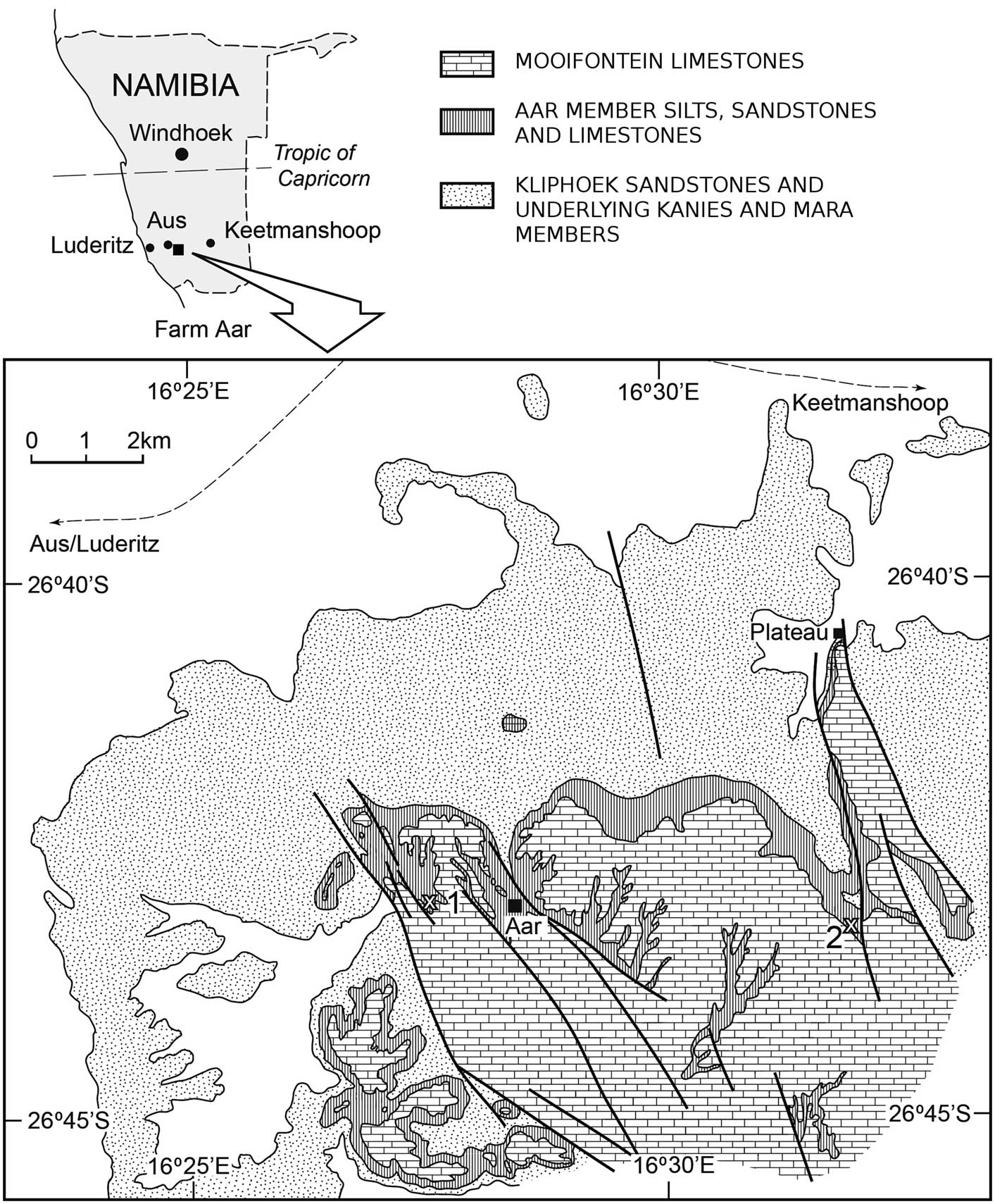
This study is based on examination of hundreds of specimens of Ernietta from Farm Aar in Namibia, including a newly discovered locality (Fig. 1, locality 1). The size, number, and completeness of these specimens, along with their probable occurrence in life position, presents an opportunity to revisit the details of morphology and possible life habits of this organism.
Location of the two newly discovered sites in the Nama Group exposed at Farm Aar. Both are to the west of the Ernietta type locality reported by Pflug (Reference Pflug1966, fig. 1b C). (1) New locality containing Ernietta fossils in likely life position (‘Teapot’ locality of Hall et al., Reference Hall, Kaufman, Vickers-Rich, Ivantsov, Trusler, Linnemann, Hofmann, Elliott, Cui, Fedonkin, Hoffmann, Wilson, Schneider and Smith2013). (2) Location of bag-like structure presented in Fig. 5.1; after Vickers-Rich et al., Reference Vickers-Rich, Ivantsov, Trusler, Narbonne, Hall, Wilson, Greentree, Fedonkin, Elliott, Hoffmann and Schneider2013.

Geological setting
Most specimens of Ernietta have been recovered from the Kuibis Subgroup in southwestern Namibia, which consists of sediments deposited on the edge of the Kalahari Craton in a foreland basin associated with the Damara Orogen to the north (Germs, Reference Germs1974; Saylor et al., Reference Saylor, Grotzinger and Germs1995, Reference Saylor, Kaufman, Grotzinger and Urban1998; Grotzinger and Miller, Reference Grotzinger and Miller2008). The Kuibis Subgroup represents a regional transgression onto the Kalahari Craton, characterized by sandstones giving way to limestones towards the west and up-section (Gresse and Germs, Reference Gresse and Germs1993), deposited in two sub-basins separated by a topographic high in the region of Osis.
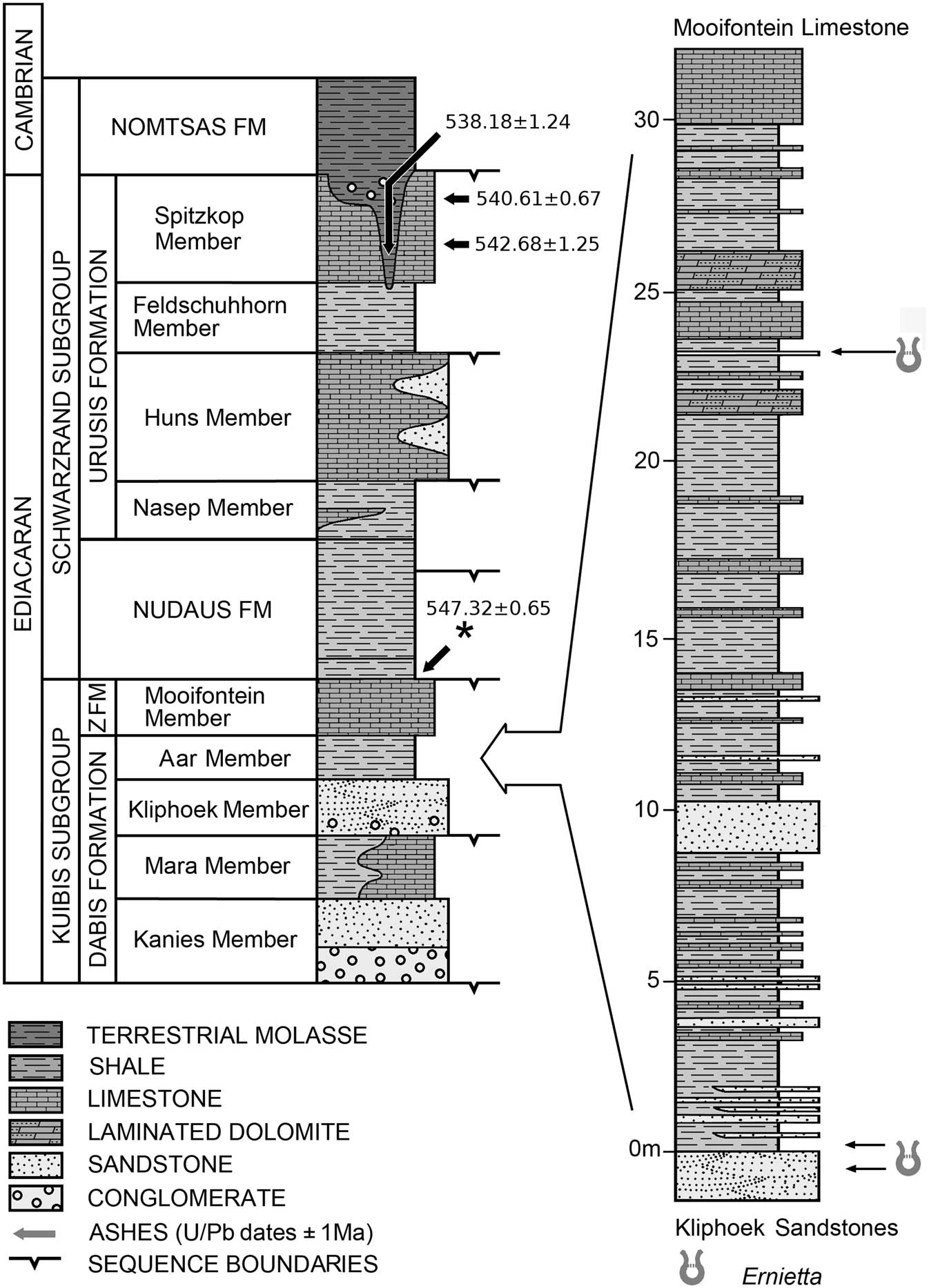
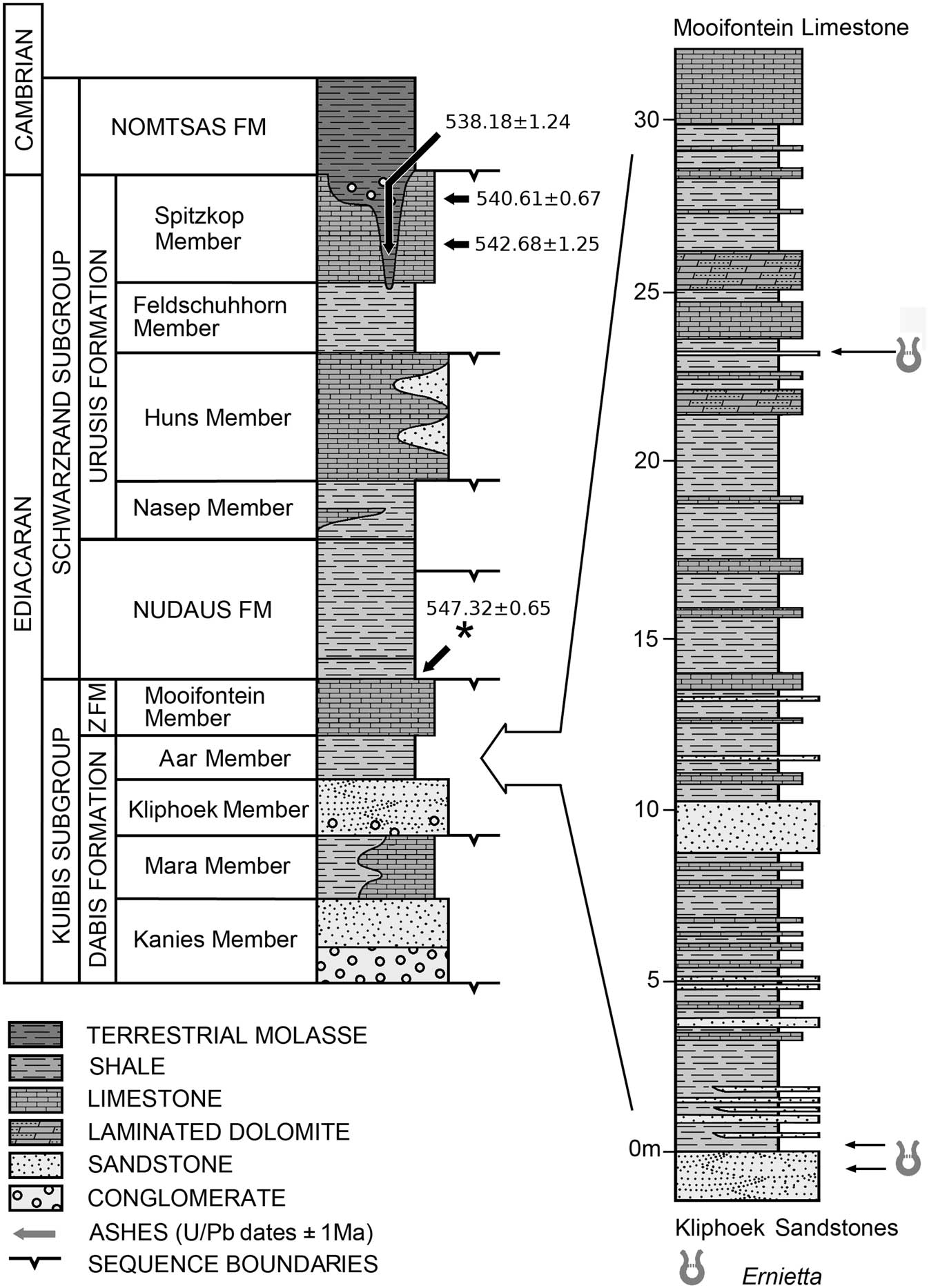
The lowermost, unfossiliferous Kanies Member (Kuibis Subgroup, Dabis Formation) consists of immature, poorly sorted, pebbly to conglomeratic sandstones, interpreted as fluvial plain deposits that overlie crystalline basement (Germs, Reference Germs1983). In the region of Farm Aar (Fig. 1), this member is overlain by a thin sequence of interbedded siltstones and limestones of the Mara Member. Above this, the Kliphoek Member represents the progradation of thick-bedded sandstones. The Kliphoek is characterized by channelization and abundant scour surfaces, implying a deltaic environment, but the absence of unconformities and exposure surfaces suggests continuous submersion (Grotzinger and Miller, Reference Grotzinger and Miller2008). The top meter of this member contains transported beds of Pteridinium associated with scours and overlying dish structures, likely representing material washed into a shallow-marine deltaic setting during storm events (Elliott et al., Reference Elliott, Vickers-Rich, Trusler and Hall2011). Above this lies the Aar Member, a 31- to 38-m sequence of interbedded siltstones and carbonates with sporadic sandstone beds (Hall et al., Reference Hall, Kaufman, Vickers-Rich, Ivantsov, Trusler, Linnemann, Hofmann, Elliott, Cui, Fedonkin, Hoffmann, Wilson, Schneider and Smith2013). The Aar Member contains the new material reported below. It represents a transitional sequence between the siliciclastic shallow-marine Kliphoek, and the overlying subtidal carbonates of the Mooifontein Member of the Zaris Formation (Fig. 2).
Generalized stratigraphic section of the Nama Group south of Osis (left) and the Aar Member (right). The longer arrow on the right hand side indicates the sandstone layer preserving newly recovered Ernietta specimens. The two shorter arrows indicate previously reported Ernietta discoveries (Vickers-Rich et al., Reference Vickers-Rich, Ivantsov, Trusler, Narbonne, Hall, Wilson, Greentree, Fedonkin, Elliott, Hoffmann and Schneider2013). Ages are in Ma and refer to revised U-Pb zircon dates of ash beds after Schmitz in Schmitz et al., Reference Schmitz2012. Asterisk refers to a stratigraphically correlated date from the Hoogland Member of the Zaris Sub-basin, which crops out north of Osis (Grotzinger et al., Reference Grotzinger, Bowring, Saylor and Kaufman1995). ZFM = Zaris Formation; after Vickers-Rich et al., Reference Vickers-Rich, Ivantsov, Trusler, Narbonne, Hall, Wilson, Greentree, Fedonkin, Elliott, Hoffmann and Schneider2013.
Occurrence
More than 100 specimens of E. plateauensis were recovered both as float and in situ within a bedding layer during the 2009 and 2011 field expeditions of IGCP 493/587 on Farm Aar in southwestern Namibia (Fig. 1). The newly discovered Ernietta fossils were recovered from sandstone beds within the Aar Member, which consists primarily of thin interbedded sands, muds and carbonates (Fig. 2).
Depositional Setting
The Aar Member represents subtidal muds with occasional influxes of sand from storm-induced events (Hall et al., Reference Hall, Kaufman, Vickers-Rich, Ivantsov, Trusler, Linnemann, Hofmann, Elliott, Cui, Fedonkin, Hoffmann, Wilson, Schneider and Smith2013). Limestones are increasingly common towards the upper part of the Aar Member, indicative of clearer water. These were interrupted by periods of clastic mud deposition and sandy event beds. At least one of these sandy beds preserves closely packed Ernietta specimens. Mud layers of the overlying bed surround upper parts of some specimens, but the tops of the organisms were not preserved—a feature typical of all known specimens of Ernietta.
New Ernietta fossils
The ‘Teapot’ locality of Hall et al. (Reference Hall, Kaufman, Vickers-Rich, Ivantsov, Trusler, Linnemann, Hofmann, Elliott, Cui, Fedonkin, Hoffmann, Wilson, Schneider and Smith2013; Fig. 1, locality 1 in the present paper) contains specimens ranging from 3 cm up to 10 cm in their maximum dimension preserved in mud and fine-grained sand. Float specimens and float blocks with multiple specimens have been scattered by erosion tens of meters downslope from the layer containing in-situ material. The in-situ section represents only the edge of a fossiliferous deposit, the bulk of which has eroded and is scattered a short distance downslope as float. Despite being removed by erosion from their original layer, these float specimens are well preserved, with evidence of their context. The base of the bed and the fill of the fossils is fine-grained sand with no sedimentary structures. Mica flakes are present, as well as occasional pyrite pseudomorphs. This material characterizes most of the specimens. More complete fragments of the original bed preserve a sharp contact at the top of the sandstone with a layered mudstone containing mica. This mudstone does not fill the fossils, but surrounds the tops of some of them. It breaks away readily from sandstone fossils and beds when the rock is vibrated by sectioning with a rock saw or splitting with a geological hammer.
Materials and methods
Repositories and institutional abbreviations
Specimens (NESM prefix) are housed in the Namibian Geological Survey/Geological Survey of Namibia, Windhoek, which also contains Pflug’s collection (Pf prefix). One specimen (Fig. 4.2) is in private hands.
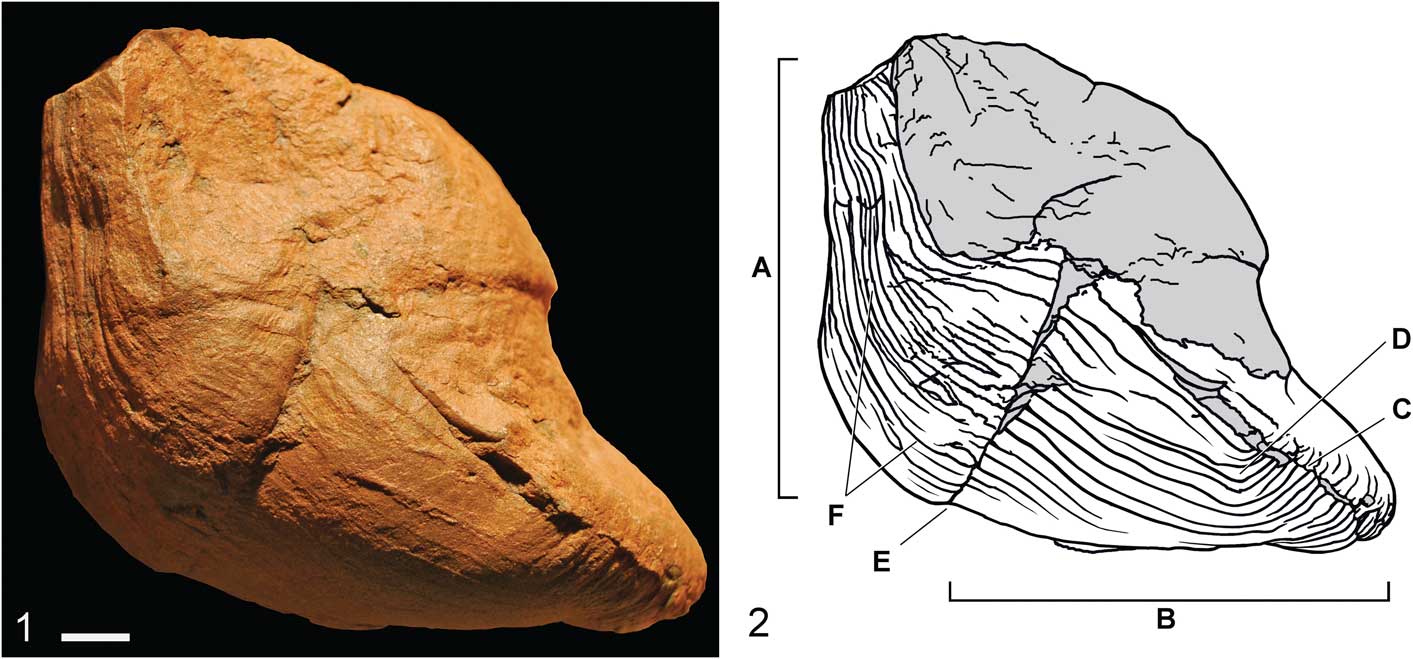
(1) NESM-F-389, the holotype for Erniograndis sandalix Pflug, Reference Pflug1972. This specimen is one of the most complete Ernietta fossils, bearing nearly all of the diagnostic features referred to in the text. Scale bar represents 1cm. (2) Outline of Fig. 3.1 showing diagnostic features. A: ‘upper part’ of the organism, relative to the stratigraphy; B: ‘lower part’ of the organism; C: ‘suture’ located along a surface that is shorter than the perpendicular axis of the fossil, displaying characteristic erniettomorph ‘zigzag’ symmetry; D: zone on the lower (ventral) half of the fossil in which segments can be deflected by an angle of up to 80 degrees (Fig. 4.1); E: ‘equatorial seam’ lying perpendicular to the longitudinal segments, and morphologically distinct from the suture (C); F: ‘constricted’ zone, where segments are less regular than on the lower part of the fossils, are upturned toward the top of the sediment, and often restricted to form a ‘neck’ (Fig. 4.3). Shading delimits unrelated sediment and the negative impressions of adjacent specimens now absent from the specimen block.

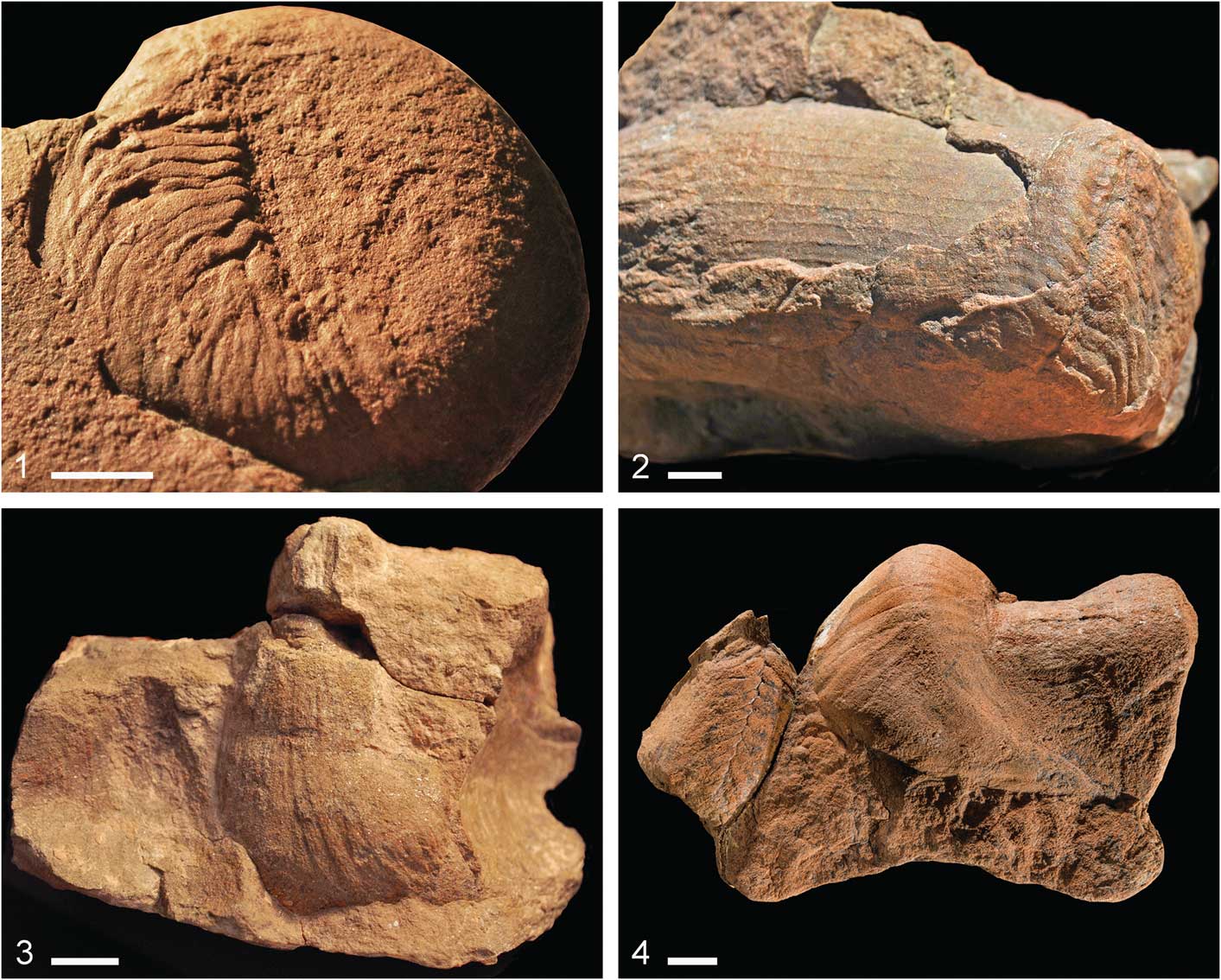
(1) NESM-F-435, holotype for Erniobeta forensis Pflug, Reference Pflug1972, demonstrating segments (left) deflected at an angle of 80°; (2) specimen of Ernietta plateauensis kept at Farm Plateau. The exterior surface of the outer layer of tubular elements (visible in the lower right-hand corner), which includes the zigzag suture. Above, there is a step down to the inner layer of tubular elements. The exterior surface of the inner layer records both the offset impressions made by the outer layer upon the tubular elements of the inner layer and the zigzag suture of the inner layer beneath the outer layer suture. A further step down to the center of the specimen shows that the sediment-filled internal cavity has cast the internal surface of the inner layer of tubular elements in negative relief. (3) NESM-F-1239, E. plateauensis excavated from Pflug’s original stratigraphic level. Specimen is oriented relative to original position within the strata. Segments converge at the restricted upper part of the fossil. (4) NESM-F-1240, showing two specimens of E. plateauensis. On smaller specimen at left, the zigzag suture is visible, displaying the characteristic alternating symmetry. The right-hand side the larger specimen shows the level of deformation observed in some specimens. Scale bars represent 1cm.

Systematic paleontology
Morphological terminology is shown in Figure 3.1–3.2
Group Erniettomorpha Pflug, Reference Pflug1972
Remarks
Many fossils of Ediacaran age are difficult to relate to defined higher-level taxa of modern organisms and all such classification schemes are controversial. Grouping of these fossils into morphological clades (Xiao and Laflamme, Reference Xiao and Laflamme2009; Erwin et al., Reference Erwin, Laflamme, Tweedt, Sperling, Pisani and Peterson2011; Laflamme et al., Reference Laflamme, Darroch, Tweedt, Peterson and Erwin2013; Narbonne et al., Reference Narbonne, Laflamme, Trusler, Dalrymple and Greentree2014) provides a more objective system to group similar Ediacara-type taxa without the assumptions necessary to relate these Ediacaran groupings to living groups of organisms.
Genus Ernietta Pflug, Reference Pflug1966
Type species
Ernietta plateauensis Pflug, Reference Pflug1966, by original monotypy.
Ernietta plateauensis Pflug, Reference Pflug1966
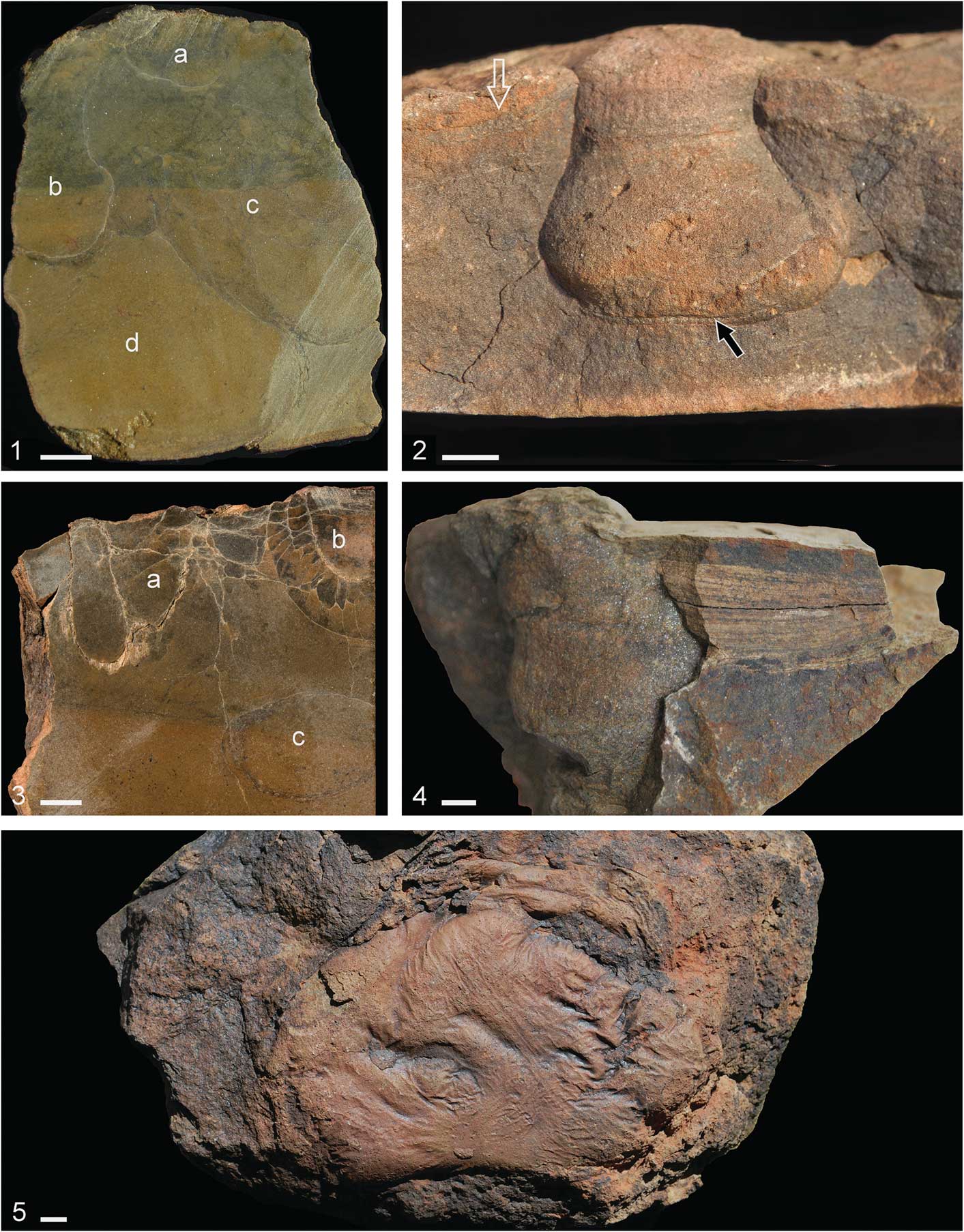
Taphonomic aspects of the new Ernietta localities. (1) NESM-F-1241, float specimen from the Teapot locality on Farm Aar, containing multiple individual E. plateauensis fossils (a–d), sectioned to demonstrate that the entire rock is comprised of fossil specimens such that each boundary is common between two organisms. (2) NESM-F-1242, float block from the Teapot locality on Farm Aar. Compressed mudstone laminae are visible in cross-section on the left (white arrow). The outer layer of tubular elements has been exfoliated except along the zigzag suture on underside of the specimen (black arrow). (3) NESM-F-1243, sectioned E. plateauensis specimens (a–c), from the Teapot locality on Farm Aar. In specimen b, weathering delineates the shapes of the tubes in cross-section, clearly demonstrating a double-layer as in Fig. 4.2. (4) NESM-F-1244, float block from the Teapot locality on Farm Aar, showing mudstone laminae terminating abruptly at the fossil. This indicates that the organism was in place while mudstone was being deposited. (5) NESM-F-1245, bag-like structures found associated with E. plateauensis 8 km west of Teapot locality (Fig. 1). Scale bars represent 1 cm.

1966 Ernietta plateauensis Reference PflugPflug, p. 19, pl. 1, figs. 1–6, pl. 2, figs. 3–6.
1972 Erniodiscus rutilis Reference PflugPflug, p. 158, pl. 27, fig. 3.
1972 Erniodiscus clipeus Reference PflugPflug, p. 158, pl. 27, fig. 1.
1972 Erniaster apertus Reference PflugPflug, p. 159, pl. 28, figs. 1–3, 5–7.
1972 Erniaster patellus Reference PflugPflug, p. 159, pl. 29, figs. 1, 4, 8.
1972 Erniocentris centriformis Reference PflugPflug, p. 159, pl. 28, figs. 4, 8, 9.
1972 Erniofossa prognatha Reference PflugPflug, p. 159, pl. 27, figs. 2, 6, 7.
1972 Ernionorma abyssoides Reference PflugPflug, p. 160, pl. 29, figs. 6, 12.
1972 Ernionorma peltis Reference PflugPflug, p. 160, pl. 29, figs. 2, 5, tab. 30; figs. 1, 7.
1972 Ernionorma clausula Reference PflugPflug, p. 160, pl. 31, figs. 2, 3.
1972 Ernionorma rector Reference PflugPflug, p. 161, pl. 32, figs. 7–9.
1972 Ernionorma corrector Reference PflugPflug, p. 161, pl. 32, figs. 1, 2.
1972 Ernionorma tribunalis Reference PflugPflug, p. 161, pl. 31, figs. 4–8.
1972 Erniobaris baroides Reference PflugPflug, p. 162, pl. 32, fig. 11.
1972 Erniobaris gula Reference PflugPflug, p. 162, pl. 33, figs. 1, 2, 4.
1972 Erniobaris epistula Reference PflugPflug, p. 162, pl. 31, figs. 9, 10.
1972 Erniobaris parietalis Reference PflugPflug, p. 162, pl. 33, fig. 5.
1972 Erniopelta scrupula Reference PflugPflug, p. 163, pl. 33, figs. 7, 10.
1972 Ernietta aarensis Reference PflugPflug, p. 163, pl. 34, figs. 5, 7, 8.
1972 Ernietta tsachanabis Reference PflugPflug, p. 164, pl. 34, fig. 12.
1972 Erniocarpus carpoides Reference PflugPflug, p. 164, pl. 35, figs. 5–9.
1972 Erniograndis sandalix Reference PflugPflug, p. 165, pl. 38, figs. 1, 2, 4.
1972 Erniograndis paraglossa Reference PflugPflug, p. 166, pl. 39, figs. 7, 8.
1972 Erniobeta scapulosa Reference PflugPflug, p. 166, pl. 39, fig. 6.
1972 Erniobeta forensis Reference PflugPflug, p. 166, pl. 39, figs. 2–4, 10.
1972 Ernietta plateauensis Reference PflugPflug; Pflug, pl. 34, figs. 1–4, 6, p. 163.
1979 “Erniograndis sp.” Reference GlaessnerGlaessner, p. A101, fig. 13 1a, b.
1979 “Ernionorma sp.” Reference GlaessnerGlaessner, p. A101, fig. 13 3a, b.
1979 “Erniobeta sp.” Reference GlaessnerGlaessner, p. A101, fig. 13 4a, b.
1979 “Ernietta sp.” Reference GlaessnerGlaessner, p. A101, fig. 13 2a, b.
1981 Ernietta plateauensis; Reference Jenkins, Plummer and MoriartyJenkins et al., p. 74, fig. 5A–E.
1984 Ernietta plateauensis; Reference GlaessnerGlaessner, p. 82, fig. 2.15 A–D.
1985 “Ernietta sp.” Reference JenkinsJenkins, fig. 1.
1992 Ernietta plateauensis; Reference JenkinsJenkins, p. 152, fig. 7.
1994 “Ernietta sp.” Reference Buss and SeilacherBuss and Seilacher, p. 3, fig. 4 (pars).
1999 Ernietta plateauensis; Reference DzikDzik, p. 519, figs. 1, 2, 3.
2003 “Ernietta sp.” Reference SeilacherSeilacher et al., p. 51, fig. 10 (partim), fig. 11 (partim).
2005 “Ernietta sp.” Reference NarbonneNarbonne, p. 429, fig. 4b.
2006 “Ernietta sp.” Reference McCallMcCall, p. 44, figs. 33, 36.
2007 “Ernietta sp.” Reference Vickers-RichVickers-Rich, p. 77, figs. 114 (partim), 117, 123, 125–129.
2007 Ernietta plateauensis; Reference Vickers-Rich, Fedonkin, Gehling, Leonov, Ivantsov, Komarower and FullerVickers-Rich et al., p. 77, fig. 124; p. 271.
2007 Erniaster apertus; Reference Vickers-Rich, Fedonkin, Gehling, Leonov, Ivantsov, Komarower and FullerVickers-Rich et al., p. 270.
2007 Erniaster patellus; Reference Vickers-Rich, Fedonkin, Gehling, Leonov, Ivantsov, Komarower and FullerVickers-Rich et al., p. 270.
2007 Ernietta aarensis; Reference Vickers-Rich, Fedonkin, Gehling, Leonov, Ivantsov, Komarower and FullerVickers-Rich et al., p. 271.
2007 Erniobaris baroides; Reference Vickers-Rich, Fedonkin, Gehling, Leonov, Ivantsov, Komarower and FullerVickers-Rich et al., p. 271.
2007 Erniobaris parietalis; Reference Vickers-Rich, Fedonkin, Gehling, Leonov, Ivantsov, Komarower and FullerVickers-Rich et al., p. 271.
2007 Erniobeta forensis; Reference Vickers-Rich, Fedonkin, Gehling, Leonov, Ivantsov, Komarower and FullerVickers-Rich et al., p. 271.
2007 Erniocarpus carpoides; Reference Vickers-Rich, Fedonkin, Gehling, Leonov, Ivantsov, Komarower and FullerVickers-Rich et al., p. 271.
2007 Erniocentris centriformis; Reference Vickers-Rich, Fedonkin, Gehling, Leonov, Ivantsov, Komarower and FullerVickers-Rich et al., p. 271.
2007 Erniodiscus rutilis; Reference Vickers-Rich, Fedonkin, Gehling, Leonov, Ivantsov, Komarower and FullerVickers-Rich et al., p. 271.
2007 Erniograndis paraglossa; Reference Vickers-Rich, Fedonkin, Gehling, Leonov, Ivantsov, Komarower and FullerVickers-Rich et al., p. 272.
2007 Erniopelta scrupula; Reference Vickers-Rich, Fedonkin, Gehling, Leonov, Ivantsov, Komarower and FullerVickers-Rich et al., p. 272.
2007 Ernionorma corrector; Reference Vickers-Rich, Fedonkin, Gehling, Leonov, Ivantsov, Komarower and FullerVickers-Rich et al., p. 272.
2007 Ernionorma rector; Reference Vickers-Rich, Fedonkin, Gehling, Leonov, Ivantsov, Komarower and FullerVickers-Rich et al., p. 272.
2007 Ernionorma abyssoides; Reference Vickers-Rich, Fedonkin, Gehling, Leonov, Ivantsov, Komarower and FullerVickers-Rich et al., p. 272.
2007 Erniofossa prognatha; Reference Vickers-Rich, Fedonkin, Gehling, Leonov, Ivantsov, Komarower and FullerVickers-Rich et al., p. 272.
2008 Ernietta plateauensis; Reference Grotzinger and MillerGrotzinger and Miller, fig. 13.207G.
2011 “Ernietta sp.” Reference Bouougri, Porada, Weber and ReitnerBouougri et al., p. 475, figs. 5c, d, e, f, g, h, 7b, 10a, b, c, d.
Diagnosis
(Emended from Pflug, Reference Pflug1972) Sac-shaped fossil with body wall consisting of two sheet-like layers of parallel tubular elements. Tubular elements meeting with offset symmetry at a suture located along the short-axis of the fossil. An indented equatorial seam lying perpendicular to the tubular elements commonly divides specimens into two unequal parts.
Description
Sac-shaped body (Figs. 3, 4, 5.2, 5.4), commonly 2–15 centimeters in length. Tubular elements and central body cavity are typically sand-filled. Its surface bears parallel lines formed by the tubular elements that may be expressed as furrows or ridges following the long-axis of the body. The linear relief represents a double-layered, longitudinal array of tubular elements that constitute the body wall (Fig. 4.2). Two sheets of the double array meet along a ‘suture’ with an offset, ‘zigzag’ symmetry on either side of this suture. The zigzag suture lies perpendicular to the tubular elements and is located along the short axis, at one end of the fossil (Figs. 3.2C, 4.2, 4.4). As the zigzag suture curves towards the long axis of the body, the tubular elements bend abruptly to align longitudinally to form the body circumference (Figs. 3.2D, 4.1). An ‘equatorial seam’ lies perpendicular to the tubular elements, encircling the fossil and dividing it in two asymmetrical parts (Fig. 3.2A, B). The equatorial seam does not have a zigzag appearance, differing from the suture, and it forms a sharp indentation of the specimen (Fig. 3.2E). The seam does not replicate the alternating symmetry of the zigzag suture.
The zigzag suture consistently appears on only one side of the equatorial seam, and this is invariably the downward-facing side. On some specimens the tubes near the suture are deflected by an angle of up to 80 degrees (Figs. 3.2D, 4.1, 4.2), which distinguishes Ernietta from fragmentary Pteridinium.
The tubular elements range from 1–6 mm in width and can vary in width within a single specimen (Figs. 4.3, 5.3). Tubular elements making up the body wall on the non-sutured side of the equatorial seam can appear quite different. They become more variable in width, are bound by less regular lines, and in some cases appear to form a ‘constricted zone’ where segments converge toward each other (Figs. 3.2F, 4.3, 5.2). In such cases, the tubular elements continue upward and slightly outward, towards the overlying sediment.
Remarks
As listed by Pickford (Reference Pickford1995), Runnegar (Reference Runnegar1992), and Vickers-Rich (Reference Vickers-Rich2007), most of the multitude of genera and species established by Pflug (Reference Pflug1972) represent junior synonyms of E. plateauensis, following the urging of Glaessner and Walter (Reference Glaessner and Walter1975) and Jenkins et al. (Reference Jenkins, Plummer and Moriarty1981). However, as a result of this study, three of Pflug’s (Reference Pflug1972) species were inappropriately placed within E. plateauensis. These three species are herein excluded from synonymy: Erniotaxis segmentrix appears to be a part of the midline of a fragmentary Pteridinium fossil. Erniocarpus sermo and E. orbiformis are enigmatic features with no visible characteristics in common with Ernietta plateauensis or other erniettomorphs. Namalia villersiensis Germs, Reference Germs1968 may also be a junior synonym of E. plateauensis (Runnegar, Reference Runnegar1992), but this was disputed by Grazhdankin and Seilacher (Reference Grazhdankin and Seilacher2002).
The top of Ernietta is not preserved. Jenkins et al. (Reference Jenkins, Plummer and Moriarty1981, p. 73) suggested that the living Ernietta had an open end that faced upwards in life and bore a “crenellate margin.” Crimes and Fedonkin (Reference Crimes and Fedonkin1996), conversely, suggested that both ends of E. plateauensis were closed. The ‘open end’ is shown in more than one reconstruction of the living organism (Jenkins et al., Reference Jenkins, Plummer and Moriarty1981, fig. 6; Seilacher, Reference Seilacher1992, fig. 1; Monastersky, Reference Monastersky1998; Schneider and Marais, Reference Schneider and Marais2004), and according to Jenkins et al. (Reference Jenkins, Plummer and Moriarty1981, p. 73) the open end is found “collapsed and deformed”, preserved only in “rare instances.” Some specimens show a few expanded, lappet-like segments beyond the restricted zone, but there remains no conclusive termination of their structure.
Jenkins et al. (Reference Jenkins, Plummer and Moriarty1981, p. 76) referred to a “caul-like” outer membrane in E. plateauensis, “only faintly showing underlying longitudinal structure,” which is a feature reminiscent of membranous structures associated with both Rangea Gürich, Reference Gürich1930 and Pteridinium from Namibia (Germs, Reference Germs1973; Elliott et al., Reference Elliott, Vickers-Rich, Trusler and Hall2011). This feature is not visible in any of the E. plateauensis specimens of this study. Rare structures associated with E. plateauensis resemble highly wrinkled large plastic bags filled with sand (Fig. 5.5), but their relationship to Ernietta is uncertain.
Lifestyle and taphonomy
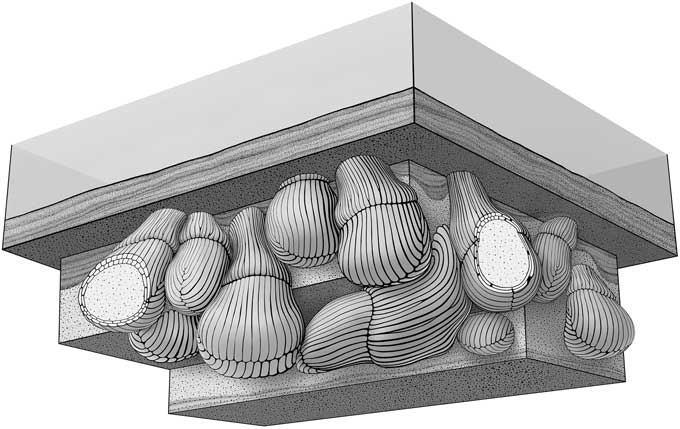
Two interpretations of Ernietta burial have been proposed: Seilacher (Reference Seilacher1992) regarded it as a semi-infaunal organism, while Dzik (Reference Dzik1999) argued that most specimens were emplaced as sand-filled bodies sinking through fluidized sands and muds. Many of the new specimens reported here are from beds containing a high density of fossils and in many cases, the contours of each individual are constrained by adjacent individuals (Fig. 5.1, 5.3), leaving no room for either surrounding sand or mud in the scenario suggested by Dzik (Reference Dzik1999). The surface on which the mudstone layers were deposited changes angle around the fossils (Fig. 5.2, 5.4), suggesting either draping of the mudstone over a surface with some relief, or differential compaction above the sand-filled organism. The fossils themselves do not show signs of compaction. Specimens are invariably oriented with their distal end facing upwards, and many specimens show mudstone laminations that terminate at the body wall of an individual E. plateauensis fossil (Fig. 5.2, 5.4). These features imply that the organisms were living in place before and/or during mudstone deposition, and that these fossils represent an in situ rather than transported community (Fig. 6). This evidence supports the semi-infaunal habit illustrated by Seilacher (Reference Seilacher1992).
Reconstruction of the community at the Teapot site after some burial (artwork by Peter Trusler). Nama-style preservation is distinct from other forms of preservation known for the Ediacaran fauna in that it retains features beneath the sediment-water interface, rather than preserving features of bed soles (Narbonne, Reference Narbonne2005) or tops of beds. Features that cannot be seen in this manner of preservation are excluded from reconstruction. The primary diagnostic features for E. plateauensis are visible, as is the range of forms observed in the fossils.

One specimen of E. plateauensis (Pf 308) figured by both Jenkins et al. (Reference Jenkins, Plummer and Moriarty1981) and Dzik (Reference Dzik1999) contains four different layers of fill and shows that the interface between the layers changes angle along the fossil (Jenkins et al., Reference Jenkins, Plummer and Moriarty1981, fig. 5C). The specimen demonstrates that the orientation of the organism changed between each of the four successive events that filled the interior. The change in orientation may be due to the growth of the organism, implying that E. plateauensis was filled with sediment during life and remained growing, supporting a partly buried life habit, or at the least a basally sediment-filled interior. At the Teapot locality, the sandy fill of specimens is not significantly different from surrounding sand, and is massive without any layering, unlike in Pf 308 (Fig. 5.1, 5.3).
Discussion
Community structure in Ernietta
The discoveries on Farm Aar allow for some limited interpretation of the original community structure of Ernietta. The high density of some Ernietta fossil assemblages, in which the shape of individual organisms is tightly controlled by other individuals surrounding them, implies a great deal of competition for space in life, rather than a closely packed death assemblage to the exclusion of burying sediments (Fig. 6).
Variation in form
Ernietta plateauensis exhibits a wide variation in size and form. Pflug’s (Reference Pflug1972) ‘erniobetines’, which included the largest specimens, represent the more complete specimens. Jenkins et al. (Reference Jenkins, Plummer and Moriarty1981) noted that syndepositional erosional processes truncated the upper parts of many specimens. These were the first E. plateauensis specimens reported (Pflug, Reference Pflug1966, Reference Pflug1972), and this truncation is characteristic of the population of fossils Pflug (Reference Pflug1972) named ernionormines. These are mainly half-dome shaped, showing only the suture along which segments meet, as they are apparently truncated along a plane below the equatorial seam. Numerous such truncated E. plateauensis individuals are present at other sites on Farm Aar. The process leading to their truncation, whether syn- or post-depositional, removed all trace of the equatorial seam and any structure above it.
Based on the more complete forms known before the new site was uncovered, Dzik (Reference Dzik1999) considered that variation in morphology within E. plateauensis was due to the original organism sinking through hydrated mud during transport, producing a range of shapes. Many of the float specimens discussed here were found in dense concentrations, in which there is little-to-no sediment between one fossil and another to permit the settling scenario proposed by Dzik (Reference Dzik1999). Cross-sections show shared boundaries between fossils, and some blocks have been excavated to demonstrate clearly that specimens of E. plateauensis abut one another. The shape of the body wall of any one fossil within the denser concentrations is strongly constrained by the surrounding fossils.
Conclusions
The initial naming of Ernietta came at a time when newly discovered Precambrian organisms were interpreted as precursors to modern clades. This influenced the description of E. plateauensis, which focused on the potential connection between the fragmentary type specimen and modern mollusks (Pflug, Reference Pflug1966), so that a soft dorsal shell became a key part of the diagnosis. Further work on Ediacaran fossils led to a consensus that at least some of the large, soft-bodied biota, including Ernietta, represent organisms with no living descendants, but the particular anatomical characteristics of Ernietta were never systematically codified after the initial interpretations of Pflug (Reference Pflug1966, Reference Pflug1972). Recent work on Ediacaran paleobiology has resulted in a preliminary taxonomy (Erwin et al., Reference Erwin, Laflamme, Tweedt, Sperling, Pisani and Peterson2011), raising the need for a clear diagnosis for many fossil taxa. Based both on re-examination of existing collections and a large number of new specimens, we present a revised diagnosis for Ernietta and show that it contains just the type species, E. plateauensis. Interpretation of its biology and taphonomy is hampered by the fact that no specimens preserve the distal parts of the organism, those parts that were originally highest in the water column. However, it is clear that Ernietta exhibited a wide range in size and shape and lived in dense, semi-infaunal clusters.
Acknowledgments
This work was made possible by grants from UNESCO through the International Geosciences Program (IGCP projects 493 & 587), from the National Geographic Society grants 9208-12 and 8467-08, and assistance from Monash University. GMN acknowledges support from the Natural Sciences and Engineering Council of Canada (NSERC) and a Queen’s Research Chair. PVR appreciates support from the vice-Chancellor’s Emerita Grant for Research. The support of the Geological Survey of Namibia and the landowners B. Boehm-Erni and the late B. Boehm (who have provided both hospitality and material assistance to enable fieldwork to take place at Farm Aar) has been crucial. We thank the owners of Farm Plateau for permission to examine a specimen in their possession. A.Y. Ivanstov provided invaluable expertise in the field and laboratory. Work was carried out under permits from the National Heritage Council of Namibia (Permit 13 of 2009 and Permit 6 of 2011). C. Greentree provided helpful assistance in editing images for publication. We would also like to thank B. Runnegar, B. MacGabhann, and B. Pratt for their constructive comments on the manuscript.