Introduction
Understanding the nature of one’s disease, its treatments, and potential complications promotes good health behaviour and is associated with better disease management and treatment compliance.Reference Whittemore 1 – Reference Gochman 3 For children with heart disease, a better understanding by parents has been shown to promote compliance and reduce parental anxiety.Reference Offord, Cross, Andrews and Aponte 4 , Reference Chan and Molassiotis 5 Studies have indicated that there are important knowledge gaps among parents of children with heart disease, which suggest that the current educational offerings are inadequate;Reference Beeri, Haramati, Rein and Nir 6 – Reference Williams, Shaw and Kleinman 14 however, the questionnaires used in these studies may not adequately assess the most important areas of knowledge, as their content was identified primarily by physicians with little input from nurses and no input from parents.Reference Cheuk, Wong, Choi, Chau and Cheung 8 , Reference Moons, De Volder and Budts 11 , Reference Yang, Chen, Wang, Gau, Chen and Moons 12 Furthermore, these questionnaires did not include questions to assess knowledge that might be uniquely important for parents of children with specific heart conditions including single ventricle congenital heart disease (CHD), biventricular CHD, and orthotopic heart transplantation. Although these groups clearly have some shared educational needs, each of them also likely have additional unique educational needs. Developing a knowledge questionnaire with specific subsections for parents of children with single ventricle CHD, biventricular CHD, and heart transplantation will provide important information to identify current gaps in knowledge and direct the development of educational interventions.
The purpose of this study was to determine what areas of parental knowledge are most important in caring for children with single ventricle CHD, biventricular CHD, and heart transplantation –patient diagnosis groups – from the perspective of parents, nurses, and physicians – participant types. The areas of parental knowledge identified from these focus groups will be used to develop parental knowledge questionnaires for these sets of patients and improve the education we offer their parents.
Materials and methods
Study design
This qualitative study used focus group methodology to elicit participants’ views. A total of 11 focus groups were formed; five focus groups were comprised of parents/guardians including the following: two groups of parents with a single ventricle CHD child, two groups of parents with a biventricular CHD child, and one group of parents with a heart transplantation child. The remaining six groups were comprised of three physician groups and three nurse groups, each having one for each of the three patient conditions. The study was approved by the Cincinnati Children’s Hospital Medical Center Institutional Review Board.
Participants, selection, and recruitment
Potential participants were English-speaking parents/guardians of children with single ventricle CHD, biventricular CHD, and heart transplantation between 0 and 18 years of age, who had at least one cardiac-related admission to Cincinnati Children’s Hospital Medical Center between 1 January, 2010, and 1 January, 2013. The list for each condition was stratified by age (i.e. 0–4, 5–12, and 13–18 years) and re-ordered using a random number generator. The primary investigator (J.D.) proceeded down each list contacting households by telephone until a sufficient number of parent/guardians agreed to participate. The caregiver who provided “the most care for the child” was invited to participate. Although an equal number of parents from each age group (0–4, 5–12, and 13–18 years) was recruited, no additional steps were taken to guarantee equal representation from each group. Physicians and nurses from the Heart Institute at Cincinnati Children’s Hospital Medical Center with at least 3 years of experience caring for children with heart disease were invited to participate. These included attending paediatric cardiologists, advanced practice nurses, and nurses from the cardiac intensive care unit, non-cardiac intensive care unit inpatient, and outpatient areas. Physicians and nurses with expertise and experience in a specific patient diagnosis group were encouraged to participate in that particular focus group – for example, heart transplant physician specialists participated in the heart transplant physician focus group. Advanced practice nurses and bedside nurses were combined within the nurse focus groups. Each focus group session had a targeted recruitment of 6–10 participants.
Focus group structure and content
The sessions were co-facilitated by the primary investigator (J.D.) and a co-investigator (K.D.) who have significant professional experience running healthcare-related focus groups. Each session began with a brief explanation regarding the purpose of the focus group and how the data would be used. A nominal group technique, a structured method for brainstorming designed to elicit contributions from all participants,Reference Tuffrey-Wijne, Bernal, Butler, Hollins and Curfs 15 – Reference Fink, Kosecoff, Chassin and Brook 18 was then used to gather responses to the scripted question “What information is most important for [you/parents] to know in order to care for [your child/their children] with heart disease?”.
Participants began the session by recording their individual responses. Each participant was then asked in turn to share an idea, which was captured electronically in summary format as a single item and projected for all to see. This process continued in rotation until every unique idea had been captured. Each item was then reviewed and discussed to ensure clarity and to combine those with significant overlap. Each participant was then given a printed copy with instructions to use 10 total votes to indicate the items they felt were most important. Using a multi-voting process, participants could place more than one vote on an item but had to place at least one vote on five separate knowledge items. After recording their votes privately, participants were free to leave. Sessions typically lasted between 1.5 and 2 hours, and were audio recorded for review purposes.
Data analysis
Knowledge items and the votes received were combined into a single file, with each identified by its source – that is, focus group. Combining items across groups into unifying themes was straightforward in most cases because many items were the same or very similar. In the few cases, where items varied somewhat across groups, the primary investigator (J.D.) identified a theme, which was independently reviewed for agreement by two of the co-investigators (B.M., M.F.). For each case, the co-investigators were able to reach a consensus regarding the selection of an appropriate theme. In some instances, a single focus group identified and voted on multiple separate items that other groups had identified as one item. Consequently, some themes included multiple items and corresponding votes from a single focus group. Recorded audio dialogue was coded and linked to the appropriate theme by a co-investigator (M.F.) using NVivo, 19 and was reviewed as part of the thematic grouping process to ensure that all concepts and nuances were accurately captured.
The relative importance of each theme was analysed by calculating an endorsement percentage and standardised importance score across all groups, for each participant type and for each patient diagnosis group. The endorsement percentage refers to the percentage of participants within a given group who gave at least one vote to an item under a given theme. The importance score accounts for the fact that individuals could give more than one vote to a particular item and was calculated for each item by taking its vote total, dividing it by six – that is, the maximum number of votes any individual can give an item – multiplying it by the number of people in the group, and multiplying it by 1000. The resulting importance score can range from 0 to 1000. The importance score for a theme is the total importance score for all items under that theme for a given group. A prioritised list of themes based on endorsement percentage was generated based on all groups combined and for each participant type and patient diagnosis group. Statistical analyses to compare endorsement percentages or scores across groups were not conducted because the data were based on qualitative methodology.Reference Haugh and Salyer 20
Results
Study groups
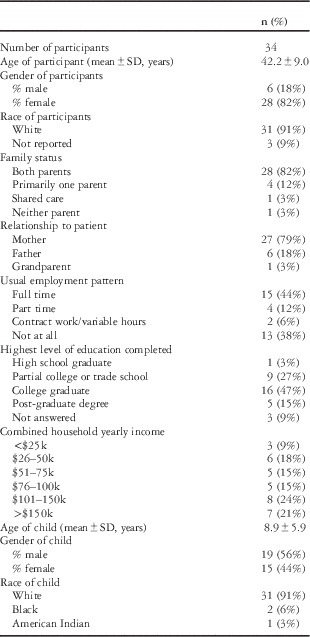
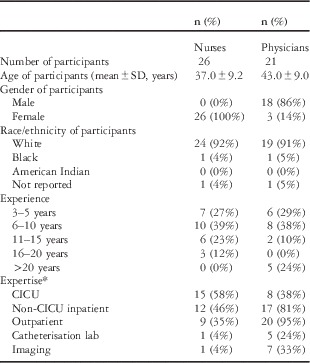
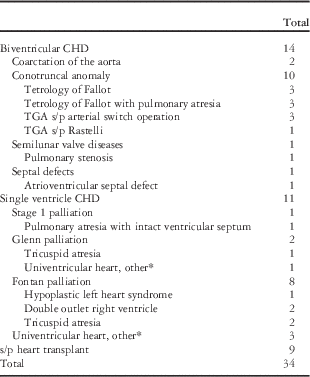
Of the 352 eligible parent/guardians contacted to participate, 144 were successfully reached by phone, 73 (51%) of whom agreed to participate, and 34 (27%) of whom attended a focus group. Over 80% of the physicians and nurses who were contacted participated –26 nurses and 21 physicians. The demographics for all participants are noted in Tables 1a and 1b. Primary cardiac diagnoses of children whose parents participated in the study are shown in Table 2.
Parent demographics.

Nurse and physician demographics.

CICU=cardiac intensive care unit; lab=laboratory
* Participants may have multiple areas of expertise
Primary diagnoses.

s/p=status post; TGA=transposition of the great arteries;
Diagnosis includes one primary diagnosis per unique child
* Includes dextrocardia with ventricular inversion and pulmonary atresia, double inlet single left ventricle, and criss-cross heart
Knowledge content items and themes
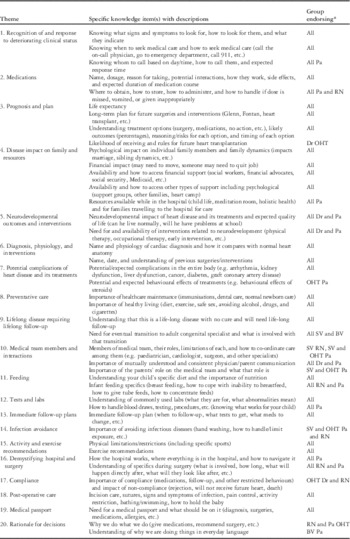
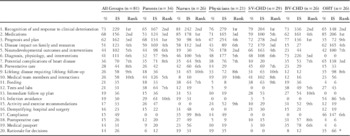
A total of 289 knowledge content items were identified across all groups. These items and associated votes were combined into 45 themes; 41 of those themes received at least one vote with a median (range) endorsement of 12% (1–73%) and a median (range) importance score of 23 (2–229). The 20 most important themes by endorsement percentage and their corresponding knowledge content items are shown in Table 3. Table 4 shows these same themes with endorsement percentage, importance score, and ranking for all groups combined and within each participant type and patient diagnosis group. The three themes that received the highest endorsement percentage across all participants were recognition of and response to clinical deterioration (73%), medications (68%), and prognosis and plan (62%).
Most important themes with associated knowledge content item(s).

Pa=Parent; Dr=physician; RN=nurse; SV=single ventricle CHD; BV=biventricular; OHT=heart transplant
* Indicates which group(s) endorsed the item
Important themes by focus group type.

* 10th for OHT was the theme Rejection, %=endorsement percentage, IS=importance score, OHT=orthotopic heart transplantation, SV-CHD=single ventricle CHD, BV-CHD=biventricular CHD
Analysis of important themes by participant type
There were six common top 10 themes across the parent, nurse, and physician groups as follows: recognition of and response to clinical deterioration; medications; prognosis and plan; disease impact on family and resources; diagnosis, physiology, and interventions; and potential complications of heart disease and its treatments. Other top 10 themes varied across the participant type groups. Parents ranked the themes medical team members and interactions (parents: 44%, nurses: 8%, physicians: 19%) and tests and labs (parents: 38%, nurses: 12%, physicians: 5%) higher than nurses and physicians. Infection avoidance was ranked 10th among parents – mostly from the heart transplantation group – and was not endorsed as a top 10 theme by either nurses or physicians. For nurses, unique top 10 ranked themes included preventative care, feeding, and compliance. Physicians strongly endorsed neurodevelopmental outcomes and interventions (76%) compared with parents (44%) and nurses (19%). Both physicians and nurses ranked the theme lifelong disease requiring lifelong follow-up among their top 10 (parents 18%, nurses, 31%, physicians 33%). Activity and exercise recommendations were ranked in the top 10 by physicians but not by either parents or nurses.
Important themes by patient condition
There were three common top 10 themes across patient diagnosis groups, including medications, recognition of and response to clinical deterioration, and prognosis and plan. The heart transplantation group endorsed potential complications of heart disease and its treatments at a higher percentage (65%) than the single ventricle CHD (10%) or biventricular CHD (35%) groups. Infection avoidance (54%), compliance (46%), and rejection (35%) were also endorsed at higher percentages within the heart transplantation groups. Single ventricle CHD groups uniquely ranked preventative care, medical team members and interactions, and feeding among their top 10 themes. Compared with participants within the biventricular CHD group, those within both the heart transplantation and single ventricle CHD groups endorsed the themes lifelong disease requiring lifelong follow-up, disease impact on family and resources, and neurodevelopmental outcomes and interventions at a higher percentage. The single ventricle CHD and biventricular CHD groups both ranked diagnosis, physiology, and interventions in their top 10 (single ventricle CHD: 48%, biventricular CHD: 73%). Biventricular CHD groups uniquely ranked test and labs, medical passport, activity and exercise recommendations, and postoperative care among their top 10.
Discussion
To our knowledge, this is the first study to use focus group methodology to identify parental knowledge necessary to care for children with heart disease from the perspective of parents, nurses, and physicians. This study reveals that parents, nurses, and physicians identify both common and unique areas of important parental knowledge for children with single ventricle CHD, biventricular CHD, and heart transplantation.
Some themes cut across all participant types and patient diagnosis groups, including recognition of and response to clinical deterioration, medications, and prognosis and plan. These three themes have been at least in part included in existing educational programmesReference Pye and Green 21 and previous parental knowledge questionnaires.Reference Cheuk, Wong, Choi, Chau and Cheung 8 , Reference Chessa, De Rosa and Pardeo 10 Recognition of and response to clinical deterioration is critical to all patients with severe heart disease. Children with hypoplastic left heart syndrome following the Norwood procedure are at risk for clinical deterioration while at home,Reference Ohye, Schonbeck and Eghtesady 22 and educating their parents regarding signs and symptoms of deterioration reduces their mortality.Reference Ghanayem, Hoffman and Mussatto 23 , Reference Hansen, Furck and Petko 24 Data from this investigation indicate that parents of children with other types of severe heart disease also need, and would likely benefit from, this education. The consistent endorsement of medications as a theme is due to the important role of medications in the management of paediatric heart disease, and the fact that medication administration is usually the responsibility of the parent. Many of these patients take multiple medications and the associated burden has been shown to negatively impact patient quality of life.Reference Marino, Tomlinson and Drotar 25 One parent explained that prognosis and plan is important because “parents are the ultimate decision makers”, which is consistent with statements by the American Academy of Pediatrics and the Institute of Medicine, which recommend that healthcare providers actively engage parents in shared decision-making. 26 , 27 An understanding of their child’s prognosis and plan enables parents to make these decisions and provides both meaning and sense to an understanding of their child’s heart disease, which increases the chances that the information will be stored in long-term memory.Reference Sousa 28
The perceived importance of a number of other themes differed by varying degrees among participant types and patient diagnosis groups. The theme disease impact on family and resources was recognised as very important by all participant types and patient diagnosis groups, with the exception of the biventricular CHD group. Parents of children with heart disease have increased stress and financial strain and have the need for medical and spiritual support.Reference Rodrigue, MacNaughton and Hoffmann 29 – Reference Ludlow and Levy 32 In addition, social support has been demonstrated to be a resilience factor between family stress and coping, and the lack of social support is a predictor of poor quality of life.Reference Tak and McCubbin 33 , Reference Lawoko and Soares 34
A number of themes were uniquely identified as important by parents. Parents’ emphasis on medical team members and interactions has been demonstrated for children with special healthcare needs and is consistent with previous findings that parents of children with heart disease prefer to have a single “contact person” to assist with patient care.Reference Wood, McCaskill and Winterbauer 35 – Reference Homer, Klatka and Romm 37 Parents of children with heart disease often co-ordinate care between multiple healthcare providers who have different roles and perspectives and often do not communicate with one another, which can be confusing and frustrating to parents. Tests and labs was another theme identified more frequently by parents. Parents noted that they often do not understand the rationale, interpretation, or implications of these tests, and often feel frustration and anxiety as a result.
Physicians’ and parents’ strong endorsement of neurodevelopmental outcomes and interventions is consistent with previous findings.Reference Marino, Tomlinson and Drotar 25 , Reference Marino, Lipkin and Newburger 38 The exceptionally high endorsement rate by physicians (77%) may be reflective of the growing number of survivors with neurodevelopmental morbidities and the increasing efforts taken towards research in this area.Reference Marino, Lipkin and Newburger 38 The low rate of endorsement by nurses (19%) may be related to the high proportion of the nurses in this study who practice primarily in inpatient settings where neurodevelopmental issues are less relevant and not frequently considered. Physician and nurse endorsement of lifelong disease requiring lifelong follow-up may be driven by gaps in care for adult patients with CHD and the resulting clinical decompensations that often follow.Reference Mackie, Ionescu-Ittu, Therrien, Pilote, Abrahamowicz and Marelli 39 Parents’ relative under emphasis of this as an important theme is consistent with a previous study that demonstrated that only 44% of parents of children with moderate or complex CHD recognised that their child’s cardiology care should be guided by an adult congenital specialist in adulthood.Reference Fernandes, Verstappen and Ackerman 40
Both single ventricle CHD and biventricular CHD groups strongly endorsed diagnosis, physiology, and interventions, which often form the basis of educational programmes and are the topics most heavily tested with parental knowledge questionnaires.Reference Cheuk, Wong, Choi, Chau and Cheung 8 , Reference Chessa, De Rosa and Pardeo 10 , Reference Pye and Green 21 In CHD, as opposed to heart transplantation, these vary significantly from one child to another, which may explain the emphasis in the single ventricle CHD and biventricular CHD groups compared with heart transplantation groups. The two themes that were emphasised by single ventricle CHD and heart transplantation groups but not by biventricular CHD – that is, disease impact on family and resources, and neurodevelopmental outcomes and interventions – likely relate to the relatively greater levels of disease severity in these two groups, which has been shown to impact both of these themes.Reference Lawoko and Soares 34 The heart transplantation groups identified some unique themes as important, including the potential complications of heart disease and its treatments, infection avoidance, rejection, and compliance. All of these themes relate to the transplantation of a foreign organ that is at high risk of rejection and requires treatment with immunosuppressive medications, compliance with these medications, and close surveillance of the resulting negative impacts of immunosuppression.
Our findings demonstrate that important themes are absent in previous parental knowledge questionnaires.Reference Cheuk, Wong, Choi, Chau and Cheung 8 , Reference Chessa, De Rosa and Pardeo 10 – Reference Yang, Chen, Wang, Gau, Chen and Moons 12 The involvement of parents and nurses in questionnaire development results in different content generation compared with development by physicians alone, and our study includes these knowledge themes.Reference Marino, Tomlinson and Drotar 25 In previous questionnaires, the themes disease impact on family and resources, neurodevelopmental outcomes and interventions, and potential complications of heart disease have had very limited assessment, and the themes medical team members and interactions and tests and labs have not been previously included at all.Reference Cheuk, Wong, Choi, Chau and Cheung 8 , Reference Chessa, De Rosa and Pardeo 10 – Reference Yang, Chen, Wang, Gau, Chen and Moons 12
These apparent discrepant perspectives regarding necessary parental knowledge have important educational and clinical implications. To maximise the efficacy of cardiovascular care, physicians and nurses need to ensure that parents possess the knowledge needed to effectively care for their child at home. Parents in this investigation identified important areas of knowledge that are possibly being ignored in current efforts to assess parental knowledge and provide education. The variation among heart conditions in terms of what knowledge is important raises questions as to whether or not current assessment and educational efforts are effectively targeting the knowledge areas for specific patient diagnosis groups.
The primary limitation of this study is the generalisability of the results to other medical centres, regions, and populations. The research was conducted in a single medical centre with disproportionate representation from White, higher income, and very highly educated families, which raises the potential for institutional, cultural, and socio-economic bias. Second, the fact that groups were comprised only of those who agreed to participate in a focus group might have resulted in a self-selection bias. The limited number of slots may have resulted in a sample that is not representative of the population. Third, the grouping of patients by the three patient diagnosis groups may have resulted in parents of children with different educational needs being placed in the same group. Fourth, it is possible that participants might have based their final votes on what they sensed was important to other group members rather than their own views. Fifth, as the themes upon which people voted included various numbers of individual items, it is possible that there was a bias towards selecting themes based on the number of items rather than the individual importance of a particular item within a theme.
This study reveals that parents, nurses, and physicians have both common and unique views regarding what parents should know to effectively care for their children with single ventricle CHD, biventricular CHD, or heart transplantation. Healthcare providers should focus parental educational on the most important areas identified in this investigation. This information will be used to develop parental knowledge questionnaires that will be used to detect knowledge gaps, identify determinants of parental knowledge, and improve educational interventions with the ultimate goal of reducing morbidity and mortality in the high-risk paediatric heart disease population.
Acknowledgements
This work was supported by the Heart Institute Research Core at Cincinnati Children’s Hospital Medical Center. The authors thank all the parents, nurses, and physicians who participated in this study for their valuable input.
Financial Support
All phases of this study were supported by the Cincinnati Children’s Hospital Medical Center Heart Institute Research Core. The authors have no financial relationships relevant to this article to disclose.
Conflicts of Interest
The authors have no conflict of interest to disclose.
Ethical Standards
The authors assert that all procedures contributing to this work comply with the ethical standards of the relevant national guidelines on human experimentation and with the Helsinki Declaration of 1975, as revised in 2008, and has been approved by the Cincinnati Children’s Hospital Medical Center Institutional Review Board.