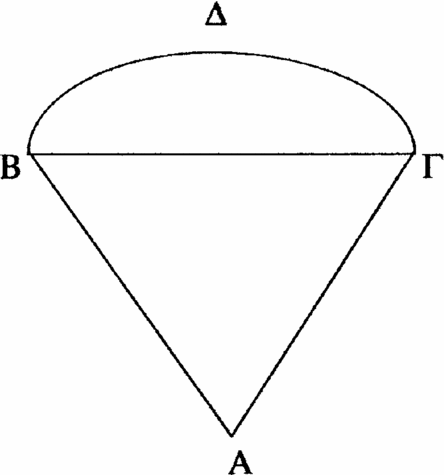
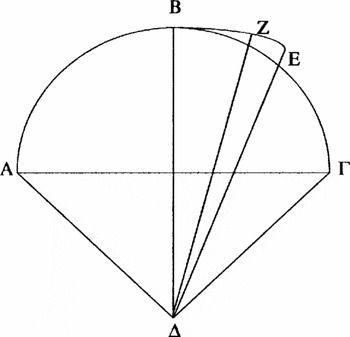
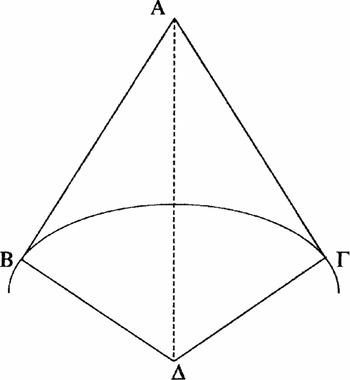
1. Motivations and purpose of the article
A homeomeric line is such that any two equal parts of it can be made to coincide by superposition. Even though mathematical homeomery has far-reaching connections with key issues in the ancient cosmological debate and foundational themes, it has received less than marginal attention in the historiography of Greek mathematics.Footnote 1 However, the subject is important to anyone interested in the development of Greek mathematics. According to ancient sources, homeomeric lines were studied (at least) in Apollonius of Perga's treatise About the Screw and in Geminus’ multi-volume encyclopedia Theory of Mathematics; however, these works are lost. The extant evidence on the subject consists mainly in occasional references scattered in the writings of late commentators on earlier mathematical and philosophical works.
In what follows, I shall pursue an historical and doxographical analysis of these documents. This will be supplemented by a reconstruction, based on the documents themselves, of a definition of homeomeric lines and a proof of the result, stated but left unproved in the extant sources, that there are only three such lines. I am hopeful that the Greek geometrical style that I shall try to mimic in the reconstruction would have been accepted by Apollonius and Geminus. Exercises of this kind have decidedly gone out of fashion in past decades, and their historical value is, a priori, doubtful. I am proposing my reconstruction, at any rate a minimal one, not because I think that it has a chance of being true in any of its details, but rather, in order to support the thesis that there was an ancient mathematical theory of homeomery and also to display some (quite simple) technical tools that would have been needed to solve its main classificatory problem. In addition, I hope to pinpoint how such tools are connected to definitions and proofs found in the writings of some ancient authors (Apollonius, Pappus, Geminus). A point about homeomeric lines that will turn out to be of utmost historiographical interest is that they are the only class of lines defined directly as the extension of a mathematical property, a move that is unparalleled in Greek mathematics. It was exactly for this reason that Greek mathematicians had to investigate which lines are homeomeric.
2. Mathematical homeomery: the plan of this article
The notion of homeomery was originally conceived in a context of natural philosophy and put by Anaxagoras at the basis of his system of the physical world: to him “homeomeric substances such as flesh, bone, and so on are the elements, while air and fire are mixtures of these and all other seeds: for each of them consists of invisible [particles] connected together” (Aristotle, Cael. Γ 3, 302a31–b3; cf. GC A 1, 314a18–20). Without retaining the exclusive seminal connotation of Anaxagoras, homeomeric substances, namely, those whose parts are similar to one another and to the whole,Footnote 2 remained a central notion in Aristotle's system, especially in the biological domain. Aristotle never offered a precise definition of homeomery, even if he qualified homeomeric substances as “those whose part is synonymous to each [of them]” (GC A 1, 314a20). Since “synonymous” is said of those entities “of which both there is a common name and the definition of the essence according to the name is the same” (Cat. 1, 1a6–7), homeomery singles out substances whose parts retain not only the same name but also the same essence as the whole. The main subject of Meteorologica IV is homeomeric substances: they result from a mixture of the basic elements (cf. GC A 10, 328a6–17), and come second in order in a tripartite division of the parts composing living beings (cf. PA B 1–2). Actually, it is not unlikely that the term “homeomery” is an Aristotelian coinage, and that Anaxagoras employed only the word “seed” to denote any homeomeric substance. Galen asserts that they were simply called “primigenial” by Plato, and that they came to be called “homeomeric” by Aristotle (Quod animi mores corporis temperamenta sequantur 3, IV:773.13–7; cf. also Plac. Hipp. Plat. VIII.4.9 and De sanitate tuenda VI.2, 9, VI:384.4 and 420.4). There are, however, sources ascribing the coinage to Anaxagoras (cf. Guthrie Reference Guthrie1962–9, II:325–6).
Homeomery was adapted to serve mathematical purposes at an unknown date. A terminus ante quem is surely Apollonius (late third century B.C.), the author of the Conica, the main extant treatise on conic sections from Greek antiquity. According to the fifth-century Neo-Platonist Proclus, Apollonius proved in About the Screw that the cylindrical helix is homeomeric. At an unknown date again, some Greek mathematician classified homeomeric lines by proving that there are only three of them: the straight line, the circumference, the cylindrical helix. Proclus, our unique direct source on the issue of this classification in his Commentaries on the first book of Euclid's Elements, ascribes the proof to the enlightened rationalist, scholar, and polymath Geminus (first century B.C.). Proclus also provides a crucial piece of information: the enunciation of the lemma(s) on which the proof was based. Partial investigations of the properties of homeomery of a number of geometrical objects were carried out as well. We have a faint echo of them in some definitions reported by Proclus, by the second-century Sceptical philosopher Sextus Empiricus, and in the Definitiones ascribed to the first-century mathematician and scholar Hero of Alexandria. These and other sources are discussed in Section 3, where I reconstruct a complete definition of homeomeric lines. However, the principal aim of Section 3 is doxographical, namely, to study to what extent, for what reasons, and to what purposes the definition got dismembered and modified in the extant sources. I shall argue at the same time that the modifications are strictly connected with the kind of sources presenting the residual information about homeomeric lines.
I shall next discuss two contexts in which the investigations about homeomeric lines turned out to be of crucial importance: these are a mathematical and a philosophical context. I shall deal with the former in Section 4, showing that it consists in subjects that can provisionally be regarded as “foundational,” such as defining and classifying lines. The problem of the mere existence and of the identification in Greek mathematics of issues that can be termed “foundational” deserves a more detailed analysis than the one offered in Section 4. I shall return to it in a companion paper, showing that there actually was a mathematical domain of research of “foundations of mathematics” and that the authors involved in it, most notably Apollonius and Geminus, set out a variety of philosophical, scholarly, and mathematical tools in developing their investigations.
As often happens, we get additional, and crucial, information from philosophical sources, and this will be discussed in more detail in Section 5. Aristotle's classification of simple motions hinged in a decisive way on the existence of simple lines. Since the rather elastic notion of “simple” as applied to lines could be technically qualified by means of homeomery, and since Aristotle admitted of only two simple motions (namely, rectilinear and circular) in face of the three homeomeric lines, criticisms against this founding feature of his cosmological system can easily be raised on these grounds. Xenarchus, a contemporary of Geminus, did precisely that. Partial accounts of the debate that ensued have been transmitted to us by a number of authors who thereby preserve material on homeomeric lines that we cannot get from mathematically oriented sources. These authors are mainly late Neo-Platonic commentators on Aristotle whose interest in simple lines was enhanced by the fact that the issue was expressly taken up in two well-known Platonic passages.
In Section 6 I shall reconstruct the development just sketched, and discuss the limitations and aims of our “philosophical” sources. This issue constitutes a case-study of the extent and the kinds of interactions between ancient Greek mathematics and philosophy. This will shed some light on the process of invention of a mathematical notion and on the routes of transmission of such a notion in non-technical writings. Finally, the Appendix contains the reconstruction of the proof that there are only three homeomeric lines.
3. The definition of homeomeric lines: a reconstruction from the extant sources
The extant sources present one single formulation of the general notion of homeomery for lines, and several applications to the definition or to the (univocal) characterization of specific geometrical objects. From this evidence I shall extract, by pasting together pieces taken from several texts, what a complete definition of homeomeric lines might have been. A work of this kind is necessary, since all extant definitions or characterizations of (particular) homeomeric lines are incomplete, and often flawed. This entails presenting all sources, discussing textual issues, and comparing the various documents in order to clearly distinguish what is firmly attested and what is the result of the historian's work of reconstruction. A few comments, especially those pertaining to textual issues, are immediately added to each single document; a discussion of the texts as a whole will show how and for what reasons the definition got dismembered and modified in the surviving sources.
A general definition of homeomeric lines can be reconstructed from three documents. Only one of these documents explicitly formulates a definition. The other two documents, while they do not contain definitions, show that the attested one is incomplete, and suggest how it might be completed. In addition, they present features that require a detailed discussion; in particular, they might suggest that the term “homeomery” was attached to the property of the definiens only at a later stage.
The first document is in Proclus’ commentary on Elements I. Very likely relying on Geminus, Proclus explains the difference between setting a definition and providing the extension of it (iE, 201.18–202.1). The issue is clarified by means of the example of homeomeric lines. The definition, whose author remains anonymous, is: “a line is homeomeric which has all parts (moria) coinciding with all.” The extension of the definition is correctly stated, but not proved, to consist of the straight line, the circumference, and the cylindrical helix. The context of the citation strongly suggests that a general definition of homeomeric lines must have been formulated, surely before Proclus and almost surely not after Geminus.
To get supplementary information we turn to another passage in Proclus (iE, 104.26–105.18). In his extensive commentary on the definition of a straight line in El. I.def.4, he reports that someone maintained that there is a further simple line besides the straight line and the circular (a notorious Aristotelian claim), namely, “the helix traced about the cylinder, whenever, a straight line moving around the surface of the cylinder, a point moves on it with uniform speed. It comes to be the helix, all parts [merē] of which coincide homeomerically with all, as Apollonius shows in the writing About the Screw.”Footnote 3 Proclus adds that, among the helices, only the cylindrical one enjoys such a property,Footnote 4 and that this helix is homeomeric, “as Apollonius too had shown,” but not simple. In light of the definition of a homeomeric line just read, the rather puzzling adverb “homeomerically” cannot but mean “as homeomeric lines do,” and serves to pinpoint that the clause in which it is inserted is exactly the definition of geometrical homeomery. However, by this we are not entitled to conclude that such a definition was contained in Apollonius’ writing About the Screw. He might have satisfied himself with proving the property for the helix; others after him may have singled it out as a characteristic property of a class of lines. The presence of the adverb might even suggest that Proclus added the qualification exactly because Apollonius did not mention homeomery. Otherwise, one might read the adverb as a reference to a more refined definition of homeomery, of which the reported clause was simply a reminder. That this is a possibility, and in fact the one suggested by other sources, we shall see by discussing our second document.
In his commentary on Aristotle's de Caelo, Simplicius (early sixth century) reports Xenarchus’ (first century B.C.) contention that “also the helix on the cylinder is a simple line, because every part [morion] of it coincides with every [part] equal [to it]” (in Cael., 13.25–26). The (polemical) context of Xenarchus’ claim, to which the last quoted Proclean passage is an indirect reply, will be discussed in Section 5; here I shall address a point relevant to our present aims: whether the property stated by Xenarchus can be taken to refer to a definition of homeomery. To him, in fact, the cylindrical helix is simple because it has the property other sources call homeomery, of which, however, no mention is made in the passage. It might well be that Xenarchus was simply referring to such a property without any connection to homeomery, of which he might have been unaware. What is more, even if the example of the helix is likely to come from a source ultimately depending on Apollonius’ treatise About the Screw, it is not said, as we have just seen, that Apollonius expressly referred to the notion as homeomery, and at any rate Xenarchus (or rather his direct source, which is unlikely to have been Apollonius’ treatise) might have lost the connection to it. Turning a page in Simplicius’ commentary seems to settle the issue. Simplicius quotes Xenarchus’ definition of the cylindrical helix, and the quotation ends this way, followed by the beginning of Simplicius’ counter-objection: “‘the point moving on the straight line makes a helix and this, so he says, is simple, since it is homeomeric.’ But even if it is homeomeric, it is not simple” (in Cael., 14.19–21). One might still question where the quotation from Xenarchus ends: the italicized clause “since it is homeomeric” might well be Simplicius’ addition. However, the strong adversative immediately following it appears to mark the beginning of Simplicius’ refutation. I conclude that, at least to Xenarchus, the property stated in the first passage was called (geometrical) “homeomery.” Again, this suggests that a general definition of homeomeric lines must have been formulated before Xenarchus (that is, before Geminus, since the two are contemporary).
Two further elements can be adduced to support the view that the wording of the property of the first passage was not reworked by Simplicius. First, the use of the term morion (pl. moria) for “part,” whereas we should expect that Simplicius had adopted in a formulation of his the synonym meros (pl. merē) found in the majority of occurrences of the property in our extant documents (see below).Footnote 5Morion appears also in the Proclean definition above, and this in my view authenticates it and Xenarchus’ formulation as relating to a definition dating back to early stages. Second, the crucial word “equal.”Footnote 6 Its presence makes it clear that the Proclean definition has a major drawback: the coinciding parts must be equal, otherwise the definition is trivially empty. All of this seems to me to further corroborate the hypothesis that Xenarchus’ wording is the residual trace of a definition of homeomeric lines that was more precise than the version we read in Proclus.
Yet, the definition is still incomplete. To realize this, one has to read a third document. It comes from the Definitiones ascribed to Hero, a collection of definitions of technical terms, mainly pertaining to geometry. In the present form it is a Byzantine compilation, but it is surely composed by accretion on a nucleus that may well date back to Hero. For this reason, several definitions of the same object are quite often given, collected in a rather casual way under the same heading. For instance, at least six definitions of a straight line feature in Def. 4, variously interlaced with one another and with a version of El. I.cn.9. Def. 7 is the document we need: the generation of a cylindrical helix is first described,Footnote 7 and then its main property is stated: it is a line “every part of which coincides with every [part], whenever it has the concavity on the same side” (HOO IV:20.1–11). The last clause is necessary already in the plane: equal arcs of circumference coincide, once their extremes are made to coincide, only if they have the concavity on the same side.Footnote 8 The qualification is even more effective in the case of the cylindrical helix. In fact, this curve can be roughly said to have two independent “concavities,” and both must be kept on the same side in order to make the line fit with itself. This entails that, for the helix, only translations along the line are allowed in order to make parts coincide; the order of the endpoints of a part of the helix cannot be inverted when this is applied to another part. Therefore, the qualification about the side of the concavity should be more properly regarded as an essential part of a general definition of homeomeric lines accidentally qualifying the main property of the helix, rather than the opposite.
The following definition of a homeomeric line takes into account the results collected so far – including the fact that a definition of this kind must have existed, which will be repeatedly corroborated by the documents we shall read below:
A line is homeomeric which has every part coincident with every [part] equal [to it], whenever the parts have the concavity on the same side.
The preceding discussion raises several problems. First, why Proclus, needing a definition in a very specialized context, chose one that is incomplete and hence flawed. Second, why there are sources that appear to refer to the definiens of a more complete definition, yet, they do not state it as a definiens of the whole class of objects it was intended to single out, but rather as a property of just one of these objects. Third, why each of the two qualifications (obviously or less obviously) missing in Proclus’ definition have dropped out of all but one document in our doxographical dossier. The three questions can be answered by the same argument, which lies in the sources that Proclus and the other authors quoted had access to. These sources consist in compilations of definitions, proofs, counter-examples, selected passages, assembled and transmitted (often within the commentaries themselves) as stock material to assist the work of the commentators of late antiquity (cf. Acerbi Reference Acerbi2008 for the analogous origin of the historical record concerning Euclid's Pseudaria). Such compilations surface in, and possibly originated from, philosophically oriented textbooks that have come to us from the abundant production of the early second century. The following are typical representatives: the Introductio arithmetica of the Neo-Pythagorean Nicomachus of Gerasa, the Expositio rerum ad legendum Platonem utilium of the Middle-Platonist Theon of Smyrna, the Caelestia of the Middle-Stoic Cleomedes, and the Introduction to the Phenomena of Geminus. The Definitiones are paradigmatic in this respect: they are at the same time a resource from which such compilations could draw their technical material and the outcome of the process of accumulation from exactly these sources. The same must be said, in this partial respect, of Proclus’ commentary. This work, in fact, often contains material collected from earlier sources as well as commentaries on principles and proofs alternative to the ones of the Elements, while at the same time it serves as a potential supply of examples for future commentaries. The same holds, as we shall see, of the Aristotelian commentaries of Alexander of Aphrodisias (a late second-century commentator of strictly Peripatetic observance) and of Simplicius, as well as the sources of Sextus Empiricus on geometrical matters.
To complete our discussion, then, we will analyze the compilations of this kind containing definitions of geometrical objects stated in terms of superposition.Footnote 9 Let us start with some definitions collected in the Definitiones.
1) Def. 4. A straight line is a line “all parts [merē] of which naturally coincide in all possible ways with all parts” (HOO IV:18.1–2).
2) Def. 7. The main property of the cylindrical helix read above: “every part [meros] of which coincides with every [part], whenever it has the concavity on the same side” (ibid., 20.1–11).
3) Def. 8. A plane is a surface “all parts [merē] of which naturally coincide” (ibid., 22.7–8); clearly, the definition is strictly analogous to that of straight line.
4) Def. 27. The following definition of a circle seems to have nothing to do with homeomery (ibid., 32.17–19): it is a line “that makes the intervals with respect to all parts equal” (ētis pros panta ta merē isa poiei ta diastēmata). In this formulation,Footnote 10 it appears that the “intervals” (diastēmata) are the radii of the circle. Actually, the text is the result of an emendation: the mss. read “that makes all parts equal with respect to all in the respect of the intervals” (ētis panta ta merē pros panta isa poiei ta diastēmata). My “translation” is tentative, since the syntax is at best perplexing and other versions could be envisaged. Maybe Dasypodius, and Heiberg after him, were right in correcting as they do, but maybe the text might be corrected in another way. The opportunity of a different emendation is suggested by two facts. First, a definition in terms of equal distances from some point is already found in the same Def. 27 (ibid., 32.11–14). Second, it is not immediately clear what we should take as the distance of a part of a circumference from anything.Footnote 11 Suppose we correct instead “all parts of which make the intervals equal with respect to all” (ēstis panta ta merē pros panta isa poiei ta diastēmata) and we give “intervals” the meaning of “chords” (admittedly, quite a weird supposition): the resulting definition would refer to superposition and thereby to a kind of homeomery.
5) The immediate goal of the Sceptical Pyrrhonist Sextus Empiricus in Adversus mathematicos III is to argue that geometry is unfounded, his strategic target being to show that it cannot be used to describe and explain the physical world, thereby undermining its support to the physics of dogmatic philosophy (Dye and Vitrac Reference Dye and Vitrac2009). To this end, he presents several definitions of some basic geometrical entities (point, line, etc.) in order to show that they are inconsistent. As a consequence, Sextus claims, geometry itself is inconsistent, and therefore there is not even a way to begin any endeavor at demonstration. It can be shown, mainly on the grounds of lexical arguments, that the likely sources of Sextus on geometrical terminology were not technical treatises such as the Elements, but elementary compilations redacted to support a philosophically connotated cursus of study or, more likely, polemical writings of Epicurean origin. Sextus discusses, among other things, also a definition of a straight line slightly different from the one at El. I.def.4: it is “A straight line is a line lying on equal [level] with respect to its own parts [meresi]” (Adv. math. III.94 and 96). An analogous property of superposition, this time referring to a whole line, is emphasized by Hero in the prologue to Metrica I: “the straight line is invariant with respect to the other lines: for every straight line coincides with every straight line, whereas the others, concave or convex, do not do that, every [of them] with every” (HOO III:4.14–6).
A further set of documents comes again from Proclus’ commentary to Elements I (a mention at iE, 37.18, has nothing to do with geometrical homeomery):
6) In a list of definitions of a straight line, Proclus includes the following: “all parts [merē] of it coincide in a similar way with all” (ibid., 110.20–21).
7) Commenting on the definition of a plane surface at El. I.def.7, Proclus gives a list of surfaces. At the end of the list he states that, besides the three homeomeric lines,Footnote 12 there are only two homeomeric surfaces: the plane and the spherical. The cylindrical surface, maybe taken to be the putative analogon of the cylindrical helix, is excluded since “it is not the case that all parts [merē] can coincide with all” (ibid., 120.7–12).
8) Commenting on the axioms that Pappus (first half of the fourth century) proposed to add to the Elements, and that can in fact be deduced from the definitions or from their consequences, Proclus mentions also “that all parts [moria] of the plane and of the straight line coincide with one another” (ibid., 198.3–9). The Proclean “proof” of the axiom is the following: “for what is stretched to the utmost has such a nature,” a statement that Proclus himself (ibid., 110.17–18) ranged among the alternative definitions of a straight line just before the one read above in document 6.
Documents 1–8 complete our dossier. They contain definitions or characterizations of linear or plane mathematical objects in terms of superposition of their parts. It is quite obvious that all the definientes have a standard formulation, that they state a predicate that is meaningful even if taken in isolation, and that the predicate may or may not apply to a geometrical object. If the property of exact superposition of all parts belonged in a general definition of geometrical homeomery, as I shall assume henceforth calling the property “homeomery” tout court, in the preceding documents it is applied as a predicate, possibly to identify specific objects (that is, as a definiens of them). The drawback of this procedure is that a proprium of a generic mathematical object (namely, the necessary and sufficient condition in the definiens of homeomeric lines) cannot be consistently used also as a definiens of more specific entities, unless further restrictions are imposed. Even worse, if, as we have seen, the original definiens had lost some of its constraints, then it may simply end in stating a false condition. The following discussion will clarify my point, and will lead to completing the answer to the questions raised above.
a) The definitions of a straight line in documents 1 and 6 take homeomery as a necessary and sufficient condition that univocally identifies it among other geometrical objects. The identification is univocal thanks to the presence of two crucial adverbial clauses (actually, real adverbs in the Greek text), otherwise homeomery could not be said to single out straight lines exclusively: the clauses are “in all possible ways” in document 1 and “in a similar way” in document 6. The first adverb appears to restrict the extension of a general definition of (plane) homeomery by ruling out the circumference: if the endpoints of two equal arcs are made to coincide, then the arcs coincide only if they have the concavity on the same side, and hence they cannot coincide “in all possible ways.” It remains that the adverb in document 1 is not a standard technical term, and its intended meaning amounts to a quick way to exclude an undesired mathematical object by mere stipulation: the resulting definition is rather contrived. Further, it is remarkable that the definition, which states by default a proprium of the definiendum, is strengthened by the adverb “naturally” (actually, a verbal form in Greek, the servile verb pephuke) further stressing the exclusivity of the characterization. The same occurs in document 3 for the plane. In this case, however, the absence of the adverb makes homeomery a characteristic property of the plane, which is of course false. The adverb in document 6, in its turn, cannot even be taken to convey a reasonably precise meaning as that in document 1, and hence the definition is to be regarded as definitely fallacious.Footnote 13 Maybe document 6 is nothing but a corruption of document 1. Two possible origins of such definitions can be envisaged. A first possibility is that definitions 1 and 3 were formulated before some precise definition of homeomery was set out. The elaboration of the latter definition would have revealed the shaky bases on which the defs. 1 and 3 rest. But the tradition of collecting explanations of “technical terms” (technologoumena, cf. the prologue of the Definitiones, HOO IV:14.2) proceeded more by accumulation than by critical assessment and possible replacement of unsatisfactory definitions. What is more, collecting them was apparently pursued mainly for philosophical, scholarly, and scholastic aims rather than for strictly mathematical purposes.Footnote 14 Therefore, it comes as not unexpected that the flawed definition preserved in document 1 found its way into the compilation that produced the Definitiones as we read it. A second possibility is that defs. 1 and 3 were devised on the model of that of homeomeric lines, and hence were later than the latter. The move is not absurd. Almost any definition of a straight line is at bottom useless from the technical point of view, and a number of them were clearly conceived for explanatory purposes only. A slip such as regarding it as essential a property that strictly speaking is not so may well be regarded as a minor drawback. Note also that the notion of a straight line is a pivotal one in geometry and a most debated one, and devising a new definition of a straight line might well entail bypassing the subtleties involved in such an exoteric notion as that of a homeomeric line. A certain redundancy in definition 1 recommends the second possibility. The verbal form pephuke (typical of a certain Aristotelian jargon) conveys the idea that, among the homeomeric lines, the straight line is the one enjoying such a property in the most intrinsic way. Yet it is clearly useless, once the adverb “in all possible ways” was intended to do a better job. If the verb is not a later addition, it is a mark that the one who proposed the definition perceived its artificial character.
b) One might wonder whether there is any relationship between the definitions of a straight line in El. I.def.4 (“A straight line is a line lying on equal [level] with respect to the points on itself”) and in documents 5 and 1 (or 6). The three formulations seem to portray a process of gradual introduction of the notion of “part” of a line in the definition of a straight line, ending with a characterization in terms of homeomery.Footnote 15 Alternatively, one might well see document 5 as a corruption of the definition in the Elements, maybe as a consequence of an interference with the alternative definition 1. Finally, Sextus might well have tendentiously rewritten the definition, in order to make his proof that the definition of straight line is inconsistent more effective. But we might also consider the definition in the received text of the Elements as rewritten, in order to forestall objections of the same kind as those made by Sextus.
c) Document 7 above contains the only serious mention of homeomeric surfaces. The interest in this kind of surface was probably triggered by Ptolemy's rash statement we shall read in Sect. 5 and by the connection between homeomery and isoperimetric properties of figures intimated in Plato's Timaeus. It is likely that no one investigated the subject, and that the extension of the classification of homeomeric lines to surfaces was simply made by analogy.
d) Document 8 tells us that Pappus would have included among the axioms a property of straight lines and of plane surfaces that other authors regarded as pertaining to a definition. The move was surely intended to strengthen the deductive structure of the Elements, laying more firm foundations to proofs by superposition such as, for instance, El. I.4, but it is not to be excluded that Pappus perceived also the problems raised by defining straight lines and plane surfaces in terms of homeomery and solved them by downgrading the logical status of the statement of homeomery from a definiens to an axiom.
We may finally return to the origin of Proclus’ definition of homeomeric lines. One possibility is that he forged his definition by simply upgrading to a definition the received characterization in terms of superposition of, say, the straight line (document 6 above). This would explain why he omits two crucial clauses: all the definitions given in the above documents refer to the straight line or to the plane, namely, to an object where the clause on equality can be considered as satisfied as a matter of course, the emphasis being put on superposition, and the one on concavity is considered redundant. On the other hand, we have seen above that the presence of the form morion for “part” is a feature shared both by Proclus’ definition and by Xenarchus’ condition, and after all one would be surprised to see Proclus forging a definition of homeomeric lines when it is able to give us, as we have seen and we shall see in the next section, such valuable historical information on the subject. Maybe he simply found in his sources the incomplete definition he reports.
It remains that the safest attitude is to give the definition we read in Proclus a limited historical value: our main direct source in this respect should remain Simplicius’ quote from Xenarchus. What is more, if we accept that Simplicius is really quoting Xenarchus, even through the intermediation of Alexander, this permits us to shortcut the passage through the compilations accessible to late antiquity. We may trust Xenarchus: he is far less removed from the original sources than Proclus was; he was interested, since the context of his allusion is polemical, in referring to the notion of homeomery in the most precise way. It remains, though, that the mere existence of the predicate “homeomeric” attached to certain geometrical objects, and the attested theorems concerning homeomeric lines we shall read in the next section, strongly suggest that someone, surely not later than Geminus and probably not earlier than Apollonius, elaborated a mathematical theory of homeomeric lines. We may safely assume that it contained a definition such as the one reconstructed above. Our sources also permit us to see this theory at work, and to identify the mathematical context in which it was elaborated.
4. The mathematical context: classifying lines
Classifying lines was, to ancient eyes, the same as classifying the huge corpus of problems into which these lines enter as necessary mathematical tools. Conversely, this entails classifying and setting limitations on the very techniques for solving the problems. According to the standard scheme we find in ancient sources, problems were classified as “plane” if their solution involved only straight lines and circles, “solid” if their solution involved conic sections, “linear” if any other curve was needed (see Pappus, Coll. III.20–1 and IV.57–9; a similar classification of loci is expounded at Coll. VII.22; cf. Knorr Reference Knorr1986, 341–8, for a discussion). It was obvious to ancient geometers that any plane problem could also be solved by solid methods, etc., and quite clear to them that any single problem falls by its essence into only one of these categories if minimality of mathematical tools employed is required – even if no proof is offered of this (cf. Pappus, Coll. III.21 and IV.59; the normative character of Pappus’ prescription is likely to originate with Apollonius, as we shall see in the companion paper). But classifying lines depends in a crucial way both on providing a good definition of the conceptions serving as classificatory criteria (for instance, the notion of “simple”), and on providing a good definition of the objects to be classified.
It happens that the Greek geometrical corpus does not contain a general, independent characterization of a geometric line as a mathematical genus on which to impose some ordering principle: definitions such as, for instance, “the flowing of a point,” or “a breadthless length,” cannot be transformed into geometrical conditions suitable to enter in a proof as we are used to reading in Greek mathematics.Footnote 16 Classifications of lines could not be made but après coup, after the single curves had been defined or identified as particular mathematical objects on the basis of a variety of techniques. Such techniques included:Footnote 17
1) Generative constructions. These normally amount to cutting a surface with a plane. In this way the conic (Con. I.11–3) and toric sections (iE, 112.4–8) were defined.
2) Pointwise geometrical constructions. A procedure is given to find isolated points that lie on the curve; the latter is then approximated by joining such points by line segments or arcs of other known lines. Pointwise constructions are for instance employed by Diocles to generate the curve (that in modern times came quite improperly to be called “cissoid”) by means of which he solves the problem of duplication of the cube,Footnote 18 and to identify the parabola as the curve enjoying the focus-directrix property.Footnote 19 As only a finite number of points can be generated in this way, one might well wonder which is the ontological status of Diocles’ first curve (he suggests joining the points with rectilinear segments).Footnote 20 Since it is quite easy to set up a “mechanical” construction of the cissoid, Diocles’ choice of resorting to a pointwise construction is presumably linked with the use he makes of it in solving the problem of cube duplication.
3) Intersections of surfaces, in their turn obtained by rotation of plane figures (conic, cylindrical, toric surfaces). This is the case of the curves implicit in Archytas’ method for solving the problem of duplication of the cube (Eutocius, on the authority of Eudemus, in AOO III:84.12–88.2).
4) “Mechanical” constructions, in which some geometrical objects, for instance straight lines, are allowed to move, the curve being generated by the motion of some suitable point on them. Of such a kind are the definitions of most higher curves, such as all kinds of spirals and helices,Footnote 21 Nicomedes’ conchoid,Footnote 22 the quadratrix,Footnote 23 and very likely other special curves of which we only have the name.Footnote 24 Some sources suggest that attempts were made to replace the “mechanical” generations with other methods perceived as more geometrical. Pappus, Coll. IV.51–2, mentions such attempts with approval, showing that the quadratrix can be obtained from the plectoid surface (a screw) generated by the cylindrical helix, after intersection with a suitable plane and subsequent orthogonal projection on the base plane.
5) Setting forward a property that univocally identifies the curve, as in the definition of the circle in El. I.def.15, which is the line such that “all the straight lines falling upon it from one single point among those lying within the figure are equal to one another.”
Such a family of techniques lies at the very heart of Greek geometrical investigations, and suggests that, in fact, a line was quite a complex mathematical entity. For this reason, the ancient attempts at classifying lines are all the more remarkable and significant, insofar as they try to impose some order onto a domain of objects obtained by disparate techniques. The attempts in this direction that are most sustained are reported by Proclus, who ascribes them to Geminus (iE, 111.1–9, 111.9–113.3, commenting on El. I.def.4, and 176.18–177.25, commenting on I.def.23). The first and third passage refer to the same classification, different from the one of the second text, the only one relevant to our present purposes. Both classifications apply a dichotomic progression; the second one starts with the dichotomy “simple” / “mixed.” Of the former lines, the circular makes a figure, whereas the straight line is indefinite. Among mixed lines, some are on a plane, some on a solid. Of the former, some intersect themselves as the cissoid, some can be produced indefinitely. Of the latter, some are conceived by means of sectioning solids, as toric and conic sections, some simply lie around solids, as the helix around a sphere or around a cone. Of the latter, some are homeomeric, as the cylindrical helix, some are not, as all the others.
At this point, Proclus inserts a crucial digression. He first refers to the cylindrical helix as the only homeomeric line traced around solids. He then provides an accidental feature of the classification, that actually sets the three homeomeric lines on fairly different branches of the classificatory tree, with the strength of a mathematical proposition: “From such a classification it may be deduced that there are only three homeomeric lines, . . . the two in a plane being simple, the only one around a solid being mixed.” He finally asserts (the crucial clauses are italicized):
and Geminus proves this clearly, by previously proving that, if from a point two straight lines are produced on a homeomeric line making equal angles on it, they are equal. Ambitious students should take the proofs from his [writings], since he reports also the generation of the spiric lines and of the conchoids and of the cissoids. (iE, 112.22–113.6)Footnote 25
Later in his commentary, Proclus returns rather abruptly to the same subject. At the end of his account of El. I.5, he shows that the isosceles triangle is not the figure to which the enunciation of the proposition applies in the most general way. This is in fact an isosceles trilateral whose base is a portion of a homeomeric line, as Proclus infers from a result that he ascribes among others to Geminus. The passage deserves an extensive quotation:
And even more should one admire the moderns – among whom is also Geminus – when they show even more generally that equal straight lines falling from a single point to a single homeomeric line make equal angles, so that, whether [the triangles] have a straight line as [their] base or a circumference or a cylindrical helix, their angles at the base are equal. For by employing this theorem Geminus shows that only three lines, and no more, are the homeomeric ones, straight line and circumference and cylindrical helix. And this is the genuine general [genus] to which the property applies primarily.Footnote 26 . . . Therefore, it is not in general a proprium of the isosceles, even if having the angles at the base equal applies to any of them, but of the straight lines falling on a homeomeric line. For subtending equal angles applies primarily to those. (iE, 251.2–19)
Hence, if we are not to suppose that Proclus is careless in his formulations, Geminus proved that there are only three homeomeric lines, and there were two conditions connected with his proof. The condition in the former text reads “if from a point two straight lines are produced on a homeomeric line making equal angles on it, they are equal”; the condition in the latter text reads “equal straight lines falling from a single point to a single homeomeric line make equal angles” and they are each the converse of the other. Henceforth, I shall call them Geminus’ first and second lemma. According to Proclus again, the property obtained by conjoining the two conditions singled out such lines as the most general class of objects to which the property itself applies. Therefore, we may accept Proclus’ claim that such a property was used, by Geminus and others, to classify homeomeric lines. Of course, Proclus’ reference to Geminus may well be taken to mean simply that the latter is the source from which Proclus himself draws this information. The reference to “the moderns” might mean that Proclus had access to other accounts, but might also suggest that he had only the account of Geminus, and that from what Geminus wrote it could be reasonably inferred that the whole affair was not his own original elaboration.
The property of homeomery forces the form, and hence the species, of the line. In Geminus’ lemmas, such a property is made mathematically tractable by converting it into a constant relation holding among invariant geometric elements attached to a generic homeomeric line. In ancient technical jargon, this is a “characteristic property” (sumptōma) of a curve. In modern language, and with much approximation, a characteristic property could be likened to the equation of the curve in Cartesian coordinates. An “original” or “principal” characteristic property was usually provided together with the definition of a curve, but the former was carefully differentiated from the latter, that was normally set out in generative or “mechanical” terms.Footnote 27 Nevertheless, as a characteristic property is more easily tractable from the mathematical point of view, and as it establishes a necessary and sufficient condition univocally identifying a curve, lines were in fact usually handled by making reference to it and not to the definition.
A special kind of mathematical proposition, with peculiar stylistic features, was conceived to store characteristic properties of known curves: these are the locus theorems. Their enunciation sets out exactly a univocal relation between a set of geometrical constraints (summarized in the sumptōma) imposed upon a point, and a curve that the point is said “to touch,” that is to lie on. The peculiar demonstrative format of locus theorems, which are solved by analysis and synthesis, guarantees that the characteristic condition set out in their enunciation is in fact a necessary and sufficient one. Therefore, Geminus’ move of setting out a sumptōma of homeomeric lines comes as no surprise.
As said, Geminus’ sumptōma must be carefully distinguished from the defining condition of homeomeric lines, that amounts to assuming that any such line can be generated in its entirety from a portion of it, however small. It happens, however, that the defining condition still is a geometrical property that is necessary and sufficient to the identification of such curves, that is, it still is a sumptōma. The important point from a historical point of view is that such a defining condition does not identify single lines, though dependent on some parameter as in the case of the conic sections, but a whole class of lines that were not defined independently, if not incidentally, in a generative way.Footnote 28 In other words, homeomeric lines were defined directly as the extension of a well-defined mathematical property, independently of the fact that the elements in the extension had been identified as known curves – and independently of the fact that such an extension might possibly be empty. Such a move is unparalleled in Greek mathematics (recall that Apollonius does not define conic sections as a class of lines, not even in a generative way), and amounts to a true conceptual revolution, that however had no impact on the subsequent tradition.
Before turning to the philosophical context, another source deserves mention, introducing homeomery in a context in which a more general restatement of a fairly well-known result is at issue. The source is a compilation of optical results often proposing very fancy “proofs.” The author is the otherwise unknown Damianus, a character almost surely affiliated with the Neo-Platonic circles of pupils of Ammonius active around the sixth century (Todd Reference Todd and Goulet, II1994). Concerning reflection at equal angles Damianus asserts:Footnote 29
for Hero the mechanicus proved in his Catoptrica that the straight lines inflected at equal angles are the shortest of all those in between those inflected at unequal angles from the same homeomeric line towards the same [points]. (Opt. 14, 20.12–6)
Actually, besides straight lines, this is true for convex circular arcs only, as for concave arcs the reflected ray may follow a maximal path, but we may consider Damianus’ undue generalization as a minor slip. An analogous slip of considering the shortest path criterion as universally valid is contained also in the extant De speculis (HOO II:328.25–330.3), almost surely a reworked epitome of Hero's Catoptrica. This text contains also the proofs of statements converse of those by Damianus, namely, that reflection on straight lines or convex circular arcs occurs at equal angles because visual rays travel through the shortest path. What is absent in the De speculis is the generalization to homeomeric lines, but we may safely surmise that this is Damianus’ elucubration. The generalization appears to be grounded on an accidental trait of Hero's proof, namely, the fact that it works exactly for those lines that happen to be the only homeomeric lines in the plane.
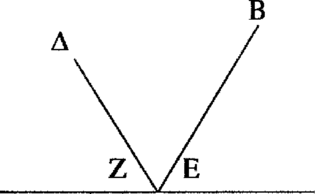
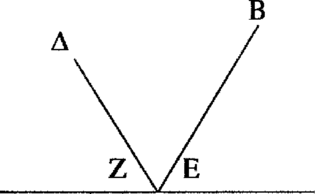
Yet, there is some point to Damianus’ claim, of which he was however very likely unaware. Consider in fact the proof of the equal angles rule reported by a scholium to the Euclidean Catoptrica and there ascribed to Archimedes (see fig. 1):
Archimedes says in this way, that angle Z is either equal to E or smaller or greater. Let first it be Z greater than E: therefore, E is smaller. Let then it be supposed contrarywise that the eye is Δ, and from the eye it has been reflected contrarywise as far as what is seen, B: therefore, angle E will be greater than Z. And it was also smaller; what is absurd. (EOO VI:348.17–22)
Even if the proof were not by Archimedes, we could at least take the ascription as a mark that the argument is quite ancient. The point of the proof is in interchanging the eye and the object seen, a move that can be interpreted as a superposition of the geometrical configuration with its mirror image.Footnote 30 This entails that the line on which reflection occurs can be made to coincide with its mirror image. If we require that the same happens at every point of the line, a condition is obtained that could easily be identified with homeomery. Of course, what is really required is a “local” condition not coinciding with homeomery, and even granting this identification as true the existence of proofs of the equal angles rule not requiring superposition would rule out any connection with homeomery. It remains that the Archimedean proof might have suggested to (a source of) Damianus the extended formulation of the equal angles rule.
The Archimedean proof of the equal angles rule.
5. The philosophical context: the controversy about simple lines
One of the fundamental features of the Aristotelian cosmological system is that there are two simple motions only and five simple bodies only. Aristotle expressly claims that “the cause is that also the simple magnitudes are only these: the straight line and the circular” (Cael. A 2, 268b19–20). As we have seen in Sect. 3, in his commentary on the definition of straight line at El. I.def.4, Proclus mentions Aristotle's contention, and of course also Plato's before him (cf. Prm. 145b and Phlb. 51c), that the only simple lines are the straight line and the circular. However, Proclus adds that “others” objected that there is in fact another simple line, namely, “the helix traced about the cylinder.” The question is then raised whether there are three or only two simple lines. Proclus solves the problem by remarking that the helix is homeomeric, but not simple. The author who raised the objection to the Aristotelian claim that there are only two simple lines is obviously Xenarchus. As we have seen in Sect. 3 again, in his commentary on Aristotle's de Caelo, Simplicius quotes Xenarchus’ first objection, contained among several others in the writing Against the fifth substance:Footnote 31 “also the helix on the cylinder is a simple line, because every part of it coincides with every [part] equal [to it]” (in Cael., 13.25–26).Footnote 32
A surprising fact is that the doctrinal background of such an objection was offered by Aristotle himself. Let us see how. At Phys. E 4 he explains the notions of “uniform” (homalēs) and “non-uniform” (anōmalos) as applied to motion. A passing remark in his text shows that Aristotle appears to use the term “uniform” as a synonym of “homeomeric”:
Again, a single movement is said to be uniform in a different way from those said. For the non-uniform one is not such as to seem a single one, while the uniform is, such as the straight line: for the non-uniform one is divisible. And they appear to differ such as the more and the less. And in any [kind of] movement there is what is uniformly [done] and what is not: for both it can change uniformly, and it can move along an uniform [magnitude] such as, for instance, a circle or a straight line, and in the same way concerning growth and destruction. And non-uniformity is a difference sometimes in that along which it moves (for it is impossible that the movement on a not uniform magnitude is uniform, such as, for instance, the motion of the inflected [straight line] or of the helix or of another magnitude, of which an arbitrary part does not coincide with an arbitrary part); or neither in what [moves] nor in that during which nor in that towards which, but in the way in which. (Phys. E 4, 228b15–26)
Among late commentators, only Simplicius (in Phys., 895.6–900.15) extensively comments on the passage, but without going beyond repeatedly restating Aristotle's words. Yet, this text raises several issues. First, the context of the bracketed explicative clause is indisputably geometrical,Footnote 33 and refers to a property that appears to have been investigated in technical contexts, maybe without being given a name or under the denomination, that left no traces in the extant mathematical literature, of “uniformity” or even of “simplicity.” The italicized clause in the explicative can be straightforwardly transformed into a definition of geometrical homeomery, in fact identical with the one we have read in Proclus. The only difference is the choice of “arbitrary” instead of “every” in order to express the generality, but I am not able to attach any deep meaning to such a variant reading. Second, the passage clearly speaks of the straight line and the circumference as “uniform” and strongly suggests, by conversion of the condition in the bracketed explicative, that they are so because of their property of “uniformity.” It results that also the pivotal identification at Cael. A 2 read above – of straight line and circumference as the only simple lines – hinged upon the same property. It is a fair guess to surmise that this Aristotelian doctrine received support from a contemporary mathematical investigation showing that straight line and circumference are the only “uniform” lines. Third, Xenarchus needed only to compare the passages in Physica and de Caelo, further combining them with Apollonius’ result (unknown to Aristotle) about the cylindrical helix, in order to elaborate his first objection against the fifth substance. Fourth, the passage in the Physica definitely suggests that the adaptation of the term “homeomery” to geometrical purposes is later than Aristotle, but the previous remark might also suggest that it is actually later than Xenarchus too. In this view, Simplicius’ second quote from Xenarchus read and discussed in Sect. 3 would include no mention of homeomery. Fifth, the reference to the “helix” as an example of non-uniform line is rather puzzling. Is a plane spiral at issue here or some kind of solid helix? On the one hand, the “helix” is clearly a plane spiral when, for instance, the structure of certain Testacea is described in the biological treatises (see HA Δ 4, 528–529). On the other hand, the mention at Metaph. B 2, 998a4–6 of “speeds and helices on the heavens as those about which the astronomers shape their arguments” suggests that some kind of spherical spiral could be at issue in the Physica too (recall also the helices described by the planets at Plato, Ti. 39a6). At any rate, it is curious that Aristotle mentions as an example of non-uniform line a kind of helix, whereas exactly a(nother kind of) solid helix will be used to refute a system of his based on simple lines – but this need not be more than sheer coincidence.
Homeomery was made to appear in cosmological contexts to support another thesis. Ptolemy (second century) proposes in Alm. I.3 two theoretical arguments proving the sphericity of the heavens. The first is because the sphere is greater than all other solids isoperimetric to it. The second is stated as follows:Footnote 34
of all bodies aether is the finest and the most homeomeric; and the surfaces of the homeomeric [bodies] are homeomeric; and the only homeomeric surfaces are the circular among planes [sic] and the spherical among solids; and since aether is not plane but solid it remains that it is spherical in shape. (POO I.1:13.22–14.6)
Ptolemy's statement is confused, insofar as the circular surface is asserted to be homeomeric, unless we are to assume that he means the circumference here; maybe we should be charitable with him or assume some textual corruption, but I do not see how the argument could be saved through emendation. Ptolemy sets up also a connection between geometrical and physical homeomery. The two sometimes got identified (or better said conflated), especially in later commentators: within a paraphrasis of this passage of the Almagest, Theon of Alexandria (second half of fourth century) inserts an explanation of why the circle is homeomeric:Footnote 35 it is so “because it is contained by one single line of similar form” (iA, 379.19–20).Footnote 36 Such a “definition” of homeomery intended to support an utterly false statement suggests that Theon did not have at his disposal a technical source from which he could draw an acceptable one. An identical explanation is provided for the sphere, but here Theon takes Ptolemy as referring to the solid, not to the surface, whereas Ptolemy was at least in this case clear in his reference. Ptolemy's argument was eventually perverted to a hopelessly non-mathematical lucubration by Proclus when commenting on Plato, Ti. 33b, where the sphere is termed “most similar”:
Again, among solids some are homoeomeric, some non-homeomeric. . . . And to homeomeric [solids] similar [figures] have been deservedly adapted. And among solids only the sphere is similar, since all the others are dissimilar. . . . If aether is homeomeric, and the figure of the homeomeric is similar, and the similar in solids is the spherical one, therefore aether is spherical. (in Ti., II:75.5–17)
The very same passage triggered comments by Proclus on the isoperimetric properties of circle and sphere (in Ti., II:70.32–71.4 and 76.7–26). Maybe Proclus saw a connection between homeomery and isoperimetric properties as a consequence of Ptolemy's giving them the one after the other.
6. The strategic use of homeomeric lines. Limitations and aims of our sources
Some of our sources establish a definite link between homeomeric and simple lines, and it is worthwhile to outline a possible path of development of the mathematical studies on homeomery on this basis. There is no reason in fact to see inner, technical motivations as the only motive force of mathematical achievements. From the historiographical point of view, a unitary and deeply interconnected mathematical project cannot be regarded as more cogent than an equally wide-ranging and founding philosophical investigation with mathematical import. These observations apply even in case the problematic point is the reconstruction of the evolution of a technical domain. In other words, in this section the perspective is endorsed that a mathematical argument is not necessarily produced by “professional” mathematicians, but might have been entertained for strictly philosophical purposes, possibly by “professional” philosophers with some mathematical penchant. What is more, we know of a number of such philosophers, Geminus of course, but also Posidonius just before him, and possibly Xenarchus. Add to them the small galaxy of mathematicians with Epicurean bent who flourished between the early second and first century B.C.: Zeno of Sidon, Basilides of Tyre, Eudemus, Dionysodorus, Philonides,Footnote 37 Protarchus, and maybe Hypsicles (who sends what became book XIV of the Elements to Protarchus and there mentions Basilides of Tyre), and Apollonius himself (who sends Conica I-III to Eudemus). In our case, thus, the fact that most of our information about homeomeric lines comes from late philosophical sources might not simply be an accident of transmission, as is the case in many other instances, but a sign of uninterrupted interest in the subject.
The crucial issue was of course the one of simple lines. It will remain obscure whether the primary spur to a mathematical investigation of them came from philosophical quarters or not. We can instead safely surmise that Aristotle based his contention that there are two simple lines only, and hence the whole of his cosmology, on a mathematical result, and the passage of Phys. E 4 quoted above tells us that the relevant notion of mathematical simplicity for magnitudes coincided with a property of self-superposition that was later called homeomery. If we accept this hypothesis, it is difficult to resist the temptation to place the classification of plane lines satisfying such a property in pre-Euclidean times, be it assisted by rigorous methods or not. The emphasis on superposition techniques might be taken, in this perspective, as a further mark that this classification was a relatively early achievement. Apollonius later added a third simple line, the cylindrical helix. The consequences for Aristotle's system of the world were pointed out by Xenarchus: in his hands, a mathematical advancement entailed reviewing a cosmological system. Xenarchus’ criticisms were met by means of a standard philosophical tool – linguistic distinctions.
In order to rule out the cylindrical helix as a simple line it was in fact sufficient to disentangle simplicity from homeomery. First, the very term “homeomeric” was adapted from the philosophical lexicon to denote a notion that had earlier been unnamed or received another denomination, maybe “uniform.” Second, homeomery so defined was confined within the domain of strictly technical notions. Simplicity remained a vague philosophical concept, whose extension could be tuned with contingent philosophical aims, grounded on an inconsistent mathematical argument about the movements that generate a line. Proclus singles out Geminus as addressing a direct reply to Xenarchus’ objection by means of such an argument (iE, 105.18–106.19).Footnote 38 Geminus claims that mixed lines are not simply the lines generated by composition of motions along other lines; one must in fact require that the component motions are dissimilar. For the diagonal of a square is obtained by composition of two motions, but the resulting straight line is not thereby mixed, as the two motions are similar. Now, the fact that a cylindrical helix is generated by means of dissimilar motions prevents it from being simple: for only lines generated by similar motions can be simple. Geminus’ argument about the generating motions became the standard reply, as we shall see presently. Such a move licensed mathematical homeomery as a wider notion than simplicity. As a by-product, the newly-born mathematical notion of homeomery came to be used by authors interested in providing fresh definitions of some basic geometrical entities (documents 1–8 in Sect. 3), unless we are to think that, for instance, the definition of a straight line in terms of superposition had been shaped together with the first investigations about homeomery. In either case, it is more likely that such authors came from scholarly and “philosophical” milieux than from mathematical ones.
A further mathematical investigation of the newly introduced technical concept was necessary in order to forestall unpleasant surprises. What was needed was a complete classification of homeomeric lines, showing that the characterization of simplicity on the basis of the compounding movements was not upset by the emergence of other, particularly “simple,” such lines. The need for such classification found a convenient partnership in parallel classificatory elaborations, the known authority being again Geminus. Proclus claims that he systematized the domain of homeomeric lines, proving that there are only three of them. In this way the classification of homeomeric lines was extended to the solid case, maybe by heuristic arguments of the kind outlined in the Appendix. All of this probably took place in Geminus’ Theory of mathematics, which included the material eventually compiled by Proclus: an (incomplete) definition of homeomeric lines, Geminus’ first and second lemma, Geminus’ reply to Xenarchus. Such strategic aims could partly explain both Geminus’ insistence on homeomery in his classification of lines, and his concern for investigating this class of curves.
The polemical context might also explain why the importance of defining a class of lines directly as the extension of a property appears to have passed unnoticed. The fact is simply that homeomeric lines cannot, if Geminus’ argument against Xenarchus aims at having any effectiveness, appear as a coherent whole. Homeomery might feature as a derivate per se property of certain lines (in Aristotelian jargon, something kath’ auto sumbebēkos), but their definitions had to be genetic or mechanical, in order to keep the three homeomeric lines on separate branches of a classification whose main branching criterion (simple vs. mixed) hinged upon the generating motions.
Yet, Geminus’ argument is flawed. First, it obviously makes the Aristotelian argument circular, even if this drawback appears to have passed unnoticed. Second, distinguishing simple and mixed lines on the grounds of the similarity of their generating motions is inconsistent, since “similar” motions on weird lines generate weird, and hence mixed, lines. Therefore, one also has to specify the lines on which the motion takes place, and this makes Geminus’ argument itself circular. As a consequence, it is an arbitrary stipulation to establish that only straight lines and circumferences are simple lines, or better said the stipulation simply fixed the meaning of “simple” for lines. This appears to have been the regulating principle at the basis of Geminus’ second classification, despite his definition of simplicity based on similar and dissimilar motions.Footnote 39
Still later, mainly Neo-Platonic authors (actually, our main sources) resumed the terms of the debate about the simplicity of the cylindrical helix. They sided with the partisans of the mixed character of this curve, either because they commented on Aristotle's treatises for scholastic reasons, or because the issue of simple lines offered a straightforward explanation of major features of the Elements.
As an example of the first attitude, take again the posterity of the Aristotelian theory of simple motions in the de Caelo. Among the commentaries on the treatise we have only the one by Simplicius, but on this occasion he transcribes substantial extracts from the analogous commentary of Alexander of Aphrodisias. In particular, Simplicius reports in detail (and with an unfavorable attitude towards his source as usual) Alexander's counter-objections to Xenarchus’ first argument (in Cael., 13.28–14.29). The first counter-objection accepts the identification of simplicity and homeomery, and retorts that the magnitudes were not regarded by Aristotle as productive causes of the motions, but merely as material causes. Simplicius discards the argument as not to the point, since the problem lies in Aristotle's unambiguous assertion that there are only two simple magnitudes. The second counter-objection is the same as Geminus’ standard reply to Xenarchus (or rather to the anonymous of the objection in Proclus’ account of the question).Footnote 40 As we have seen, the reply as it stands is empty or fallacious, and even more so since the contention that simplicity is more restricted a notion than homeomery is grounded, both in Proclus and in Simplicius, on examples that do not make the point at all. (But it may be that the examples provided were not originally devised as counter-objections to Xenarchus’ arguments. As usual, they might well have been stock examples circulating in the tradition of commentaries, but their origin might be disparate.) The first example in Proclus is that even a simple line such as the straight line may well be generated from rectilinear motions: for a diagonal of a square is generated by uniform rectilinear motions along two sides. But it is not thereby the case that the straight line is mixed, “for another line does not precede it putting it into existence according to a simple motion” (iE, 106.3–9). The second example in Proclus is that a circular line can be generated by means of two suitable rectilinear motions,Footnote 41 but the resulting motion along the circumference is non-uniform, and moreover the same two motions generate also ellipses. Both examples at best show that simplicity and homeomery do not coincide, but the examples do not imply anything about the simplicity of lines other than the straight line and the circular. Rather, they seem devised to tackle an easy counter-counter-objection to a weak form of Geminus’ argument refuting the argument of Xenarchus, namely, the argument stating that the cylindrical helix is generated by two movements, whereas the straight line and the circumference by one only, and taking the latter feature as the mark of simplicity.
The examples in Simplicius/Alexander are even less satisfying. The first argument remarks that the helicoidal motion of the sun is generated by two circular motions, but referred to two different poles, so that the resulting motion is of a mixed nature. To show that this example does not make the point, it is enough to recall that the trajectory of the sun is not a cylindrical helix, not even in the Aristotelian system. The second argument claims that “the simple motions get their being simple according to their relation with respect to the middle of the whole: the one around the middle, those from the middle and towards the middle; and the helix is not of this kind,” which is of course a way of begging the question.
As an example of the second attitude, take the Proclean discussion of the definition of straight line El. I.def.4. Its goal is to justify Euclid's exclusive resorting to straight line and circle as his constructive tools: “in the expositions about simple things [one] should bring in simple species” (iE, 113.20–22). This explains both the high frequency of references to simple/homeomeric lines just in the quite long comments on this definition (in fact containing the nucleus of the technical material accessible to us), and the strategic placement of Geminus’ classification of lines in this part of the commentary and not among the material pertaining to the general definition of line in El. I.def.2, as one might have expected. However, somewhat tangentially with respect to the main issue, other interesting philosophical links were offered by homeomeric lines, and Proclus is rather effective in proposing such residual traces in references filled with Aristotelian terminology. A first link is established by backing the issue of the most general formulation of a proposition, namely, the extension of El. I.5 to the isosceles trilateral with homeomeric base giving him the occasion to enunciate Geminus’ second lemma, with a clear if implicit reference to Aristotle's definition of mathematical generality in APo A 4. A second link is the distinction between giving a definition and providing its extension, a preliminary but crucial issue to be settled before mathematical generality could come into play (as is clear from APo A 5). In the latter respect, homeomeric lines provided an ideal, and singularly uncommon in Greek mathematics, exemplification, as a notion singling out a class of lines without resorting to generative procedures. All such themes strike standard notes in the Aristotelian doctrine of scientific knowledge. It is likely, then, that in this case Proclus’ sources are standard compilations of stock mathematical examples devised to assist the work of the Aristotelian commentators. For instance, the most general formulation of El. I.5 in terms of an isosceles trilateral with a homeomeric base would be a good substitute for the too often repeated Aristotelian example of the interior angles of a triangle. At the same time, without spelling out a definition of homeomeric lines, one would just run the risk of falling short of full generality by making the kind of mistake listed as the second one at the very beginning of APo A 5.
Another clue comes from the choice of the term “homeomery.” It contains a double reference to Aristotelian themes. The term was an Aristotelian coinage, though in another field of research, and was introduced to give an alternative name to the class of lines traditionally identified as simple, another crucial Aristotelian notion. Such a scholarly reference might find its natural milieu in philosophically informed circles, either to mark a filiation or to strike a polemical note, depending on which side of the Xenarchean cleavage the term was invented. It is tempting to call Apollonius into play,Footnote 42 if we surmise that its proof of homeomery of the cylindrical helix was devised to upset the Aristotelian system (thereby giving Xenarchus his first argument), either from the point of view of the professional astronomer who deemed that system as false or of someone proposing mathematically-based and ad hominem criticisms from different philosophical sides. Here a possible Epicurean affiliation of Apollonius would do the job. Of course, Apollonius did not need to endorse the well-known Epicurean criticism against mathematics or a theory of geometric minima, but it appears that this was no standard doctrine among the late Epicureans – and at any rate we know of mathematicians with an Epicurean bent.
Appendix. The three homeomeric lines
I shall tackle in this Appendix the problem of reconstructing a proof that there are only three homeomeric lines. From Proclus we know that the basis of such a proof were Geminus’ lemmas, stating that straight lines drawn to a homeomeric line from a point outside it are equal if and only if they make equal angles to the line. Such a condition does not tell us that homeomeric lines exist, but that the class is non-empty is obvious (the straight line clearly belongs in it).Footnote 43 In order to set up a terminology for what follows, I report here Apollonius, Con. VI.def.1 and 3–5, adapting them to our context (Apollonius Reference Toomer1990, 264; my adaptations are in square brackets, accordingly, item 2 in the list below is omitted).
1) [Homeomeric lines] which are called equal are those which can be made to coincide, one to another, so that the one does not exceed the other.
This definition, which resorts to superposition and applies to any line, must be carefully kept distinct from the general definition of a homeomeric line, since the latter requires that all equal parts can be made to coincide. For this reason, the two definitions do not give rise to any circularity. Note also that no specific definition of equality (an undefined concept in Greek mathematics) will be required in studying homeomeric lines: what is needed in the following proofs (reflexivity of equality) would of course be guaranteed by any definition of equal portions of a line.
3) The [straight line] which subtends a segment of a [homeomeric line] is called the base of that segment.
4) The [straight line] which bisects all the lines drawn in that segment parallel to the base is called the diameter to that segment.Footnote 44
5) And the point of the [line] from which the diameter is drawn is called the vertex of the segment.
In place of the next definition in Conica VI: “Segments are called equal, their base being so,Footnote 45 which can be made to coincide, one with another, so that one does not exceed the other. And unequal are those for which what we stated is not the case,” the definition of homeomeric lines given in Sect. 3 allows us to state the first, quite trivial, result:
Segments determined by equal parts of the same homeomeric line and having equal bases can be made to coincide, one with another, so that one does not exceed the other.
I now pass to state, prove, and comment on a number of theorems, which I propose as a partial reconstruction of a proof that there are only two homeomeric lines in the plane. The extension to solid lines is much more difficult, and trying to reconstruct it is by and large vain labor; I shall discuss the issue at the end. As for the proofs given below, it should be clear that many routes different from and better than mine could be pursued, and that my proposal does not claim to have any particular cogency.
Assumption. The straight line is a homeomeric line.
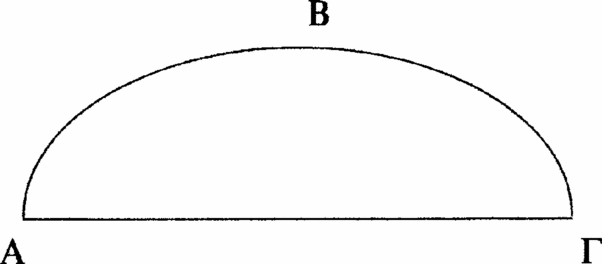
Theorem 1 (fig. 2). The base of a segment of a homeomeric line makes equal angles to the line.
Theorem 1.
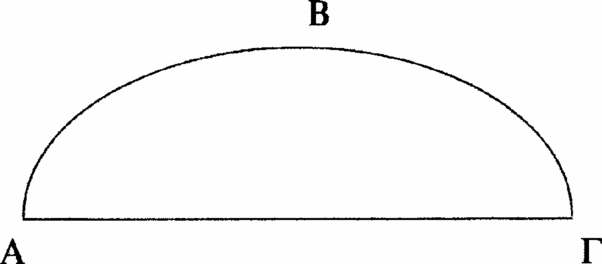
Let it be a segment of a homeomeric line ABΓ, AΓ its base. I say that base AΓ makes equal angles to ABΓ.
For let line ABΓ be conceived as two lines, namely ABΓ and ΓBA. Let A be made to coincide with Γ, and Γ with A. For, since base AΓ is homeomeric, the straight lines AΓ and ΓA coincide. And since lines ABΓ and ΓBA are homeomeric and are equal, therefore segments ABΓ and ΓBA coincide, so that angle A coincides with angle Γ. Therefore angle A is equal to angle Γ.
The proof employs superposition in a decisive way; that lines ABΓ and ΓBA are equal is obvious and any definition of equality will afford this; no reference to rectilinear angles is needed. A few interesting properties of homeomeric lines can be proved at once.
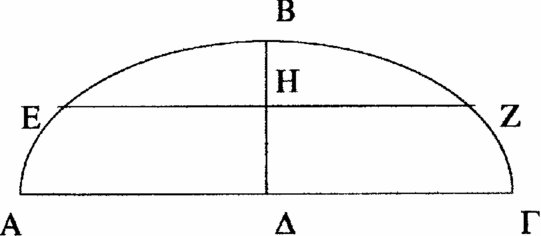
Problem 1 (fig. 3). To find the axis of a given segment of a homeomeric line.
Let it be a given segment of a homeomeric line ABΓ, whose base is AΓ. It is required to find the axis of ABΓ.
For let AΓ be bisected at Δ, and from Δ let a straight line ΔB be drawn at right angles to AΓ. Let it meet line ABΓ at B. I say that ΔB is a diameter of ABΓ, namely, that it bisects all the straight lines drawn in the segment parallel to the base. For let it be a straight line EZ in the segment parallel to the base, and let it meet ΔB at point H. Then since EZ is parallel to the base, it is at right angles to ΔB. Let segment ABΓ be made to coincide with ΓBA. Therefore, AΓ will coincide with ΓA, Δ with Δ, ΔB with ΔB, H with H. But EZ coincides with ZE – for it is parallel to AΓ and line AB coincides with ΓB: therefore, E will coincide with Z and Z with E – so that EH will coincide with ZH and ZH with EH. Therefore, EH is equal to ZH, and H is the midpoint of EZ, so that ΔB bisects EZ too. And similarly it will be shown for all other lines drawn in the segment parallel to the base. And it bisects them at right angles too. Therefore, ΔB is the axis of the segment.
Porism
Homeomeric lines have an axis at every point.
Theorem 2 (fig. 4). The tangent to a segment of homeomeric line through its vertex makes right angles to the axis.
For let straight line ZBE be tangent to a segment of homeomeric line ABΓ, whose base is AΓ, at its vertex B. I say that ZBE makes right angles to BΔ.
For let BΔ be the axis of the segment. Let segment ABΓ be made to coincide with segment ΓBA. Therefore tangent ZBE will coincide with EBZ – for if not, there will be two tangents to line ABΓ from its vertex B, which is absurd. Therefore, angle ZBΔ is equal to ΔBE, so that they are both right angles, so that tangent ZBE will make right angles to BΔ.
Porism 1
The axis of a segment of homeomeric line makes right angles to the line.
Porism 2
The tangent to a segment of homeomeric line through its vertex is parallel to the base of the segment.
Problem 1.
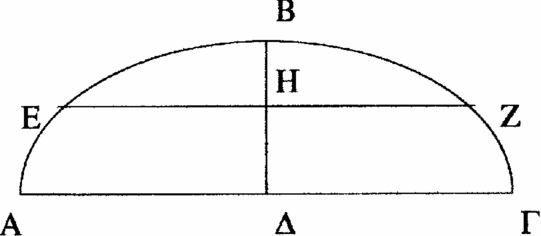
Theorem 2.
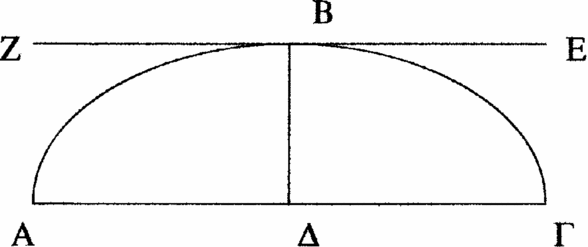
Now Geminus’ lemmas come into play. They state conditions that are necessary for a line to be homeomeric; what is taken for granted in my exposition is that the condition is also sufficient. This amounts to univocally singling out the class of homeomeric lines, on the strength, for instance, of a statement such as “If from any single point two equal straight lines produced on a line make equal angles on it, and straight lines falling from a single point and making equal angles to a line are equal, the line is homeomeric.” It should be clear that assuming this condition as automatically fulfilled is by no means a major drawback. For instance, Apollonius shows in Con. I.52–60 only that, for given values of the parameters, the main sumptōmata of the three conic sections are in fact characteristic of them (namely, that the conditions are also sufficient; their necessity is borne out by their very statement in Con. I.11–3). What is more, he definitely does not state the enunciations in this way, and fills in a subtle lacuna in these proofs later, with the proofs in Con. VI.1–3.Footnote 46 In the case of conic sections, however, the species of the line is a datum of the problems in Con. I.52–60, so that different proofs are set up for parabola, hyperbola, and ellipsis. The same approach is obviously impossible when what is required from Geminus’ conditions is to determine a class of lines. This would make the task of proving that the conditions are also sufficient more difficult. I now prove Geminus’ lemmas:
Theorem 3 (fig. 5). If from a single point two straight lines are produced on a homeomeric line making equal angles on it, they are equal; and if two straight lines falling from a single point to a single homeomeric line are equal, they make equal angles.
For from point A let two straight lines AB, AΓ be produced on a homeomeric line BΔΓ making equal angles ABΔ, AΓΔ on it; I say that AB is equal to AΓ.
Let BΓ be joined. For since angle ABΔ was supposed to be equal to AΓΔ, and angle ΓBΔ was proved to be equal to BΓΔ, angle ABΓ as a remainder is equal to angle AΓB as a remainder. Therefore, AB is equal to AΓ.
Again, from point A let two equal straight lines AB, AΓ fall on a homeomeric line BΔΓ; I say that they make equal angles ABΔ, AΓΔ on it.
Let BΓ be joined. Then, since AB is equal to AΓ, therefore angle ABΓ is equal to AΓB. But angle ΓBΔ was proved to be equal to angle BΓΔ. Therefore, angle ABΔ as a whole is equal to AΓΔ as a whole.
In another way the second proof
From point A let two equal straight lines AB, AΓ fall on a homeomeric line BΔΓ; I say that they make equal angles ABΔ, AΓΔ on it.
For let the single figure ABΔΓ be conceived as two, and join BΓ. Then, since it is both AB equal to AΓ and AΓ to AB, two [straight lines] AB AΓ are equal to two AΓ AB. And [angle] BAΓ is equal to ΓAB – for it is the same – therefore BΓ is equal to ΓB. So that BΔΓ and ΓΔB are equal homeomeric lines, so that they can be made to coincide. But also triangles ABΓ and AΓB can be made to coincide. And they have a common base BΓ. Therefore, figures ABΔΓ and AΓΔB can be made to coincide, and angle B to coincide with angle Γ. Therefore, angle B is equal to angle Γ.
Theorem 3.
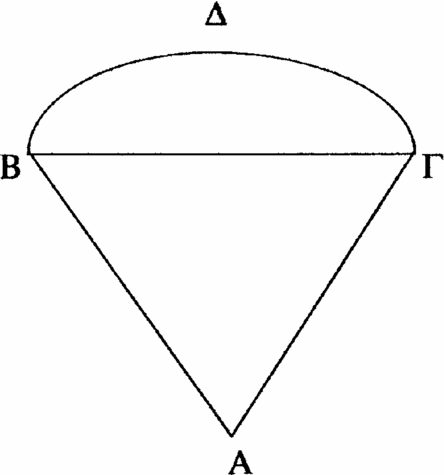
The latter proof is shaped on the alternative proof of El. I.5, that Proclus ascribes to Pappus (iE, 249.20–250.19) and on which I shall comment in the companion paper. We are now in position to prove the main result.
Theorem 4 (fig. 6). The only homeomeric lines in the plane are the straight line and the circumference.
Let it be a segment of homeomeric line ABΓ, whose base is AΓ. I say that ABΓ is either a straight line or a circumference.
For, first, let any axis of a homeomeric line be parallel to any other axis: it is manifest that the line is a straight line – for it is perpendicular to all of them.
Now, let two axes meet.
Let the axes through A and Γ meet at Δ. Let the axis of segment ABΓ be drawn. And since it makes right angles to the base AΓ and bisects it, it will pass through Δ too. But axis BΔ makes right angles to the line, and AΔ, ΔΓ too make right angles to the line, so that both AΔ, ΔΓ are equal to BΔ. Therefore they are equal to each other. But BΔ makes right angles to the base AΓ: therefore the angle between BΔ, ΔΓ is half the angle between AΔ, ΔΓ. Thus, by drawing axes of the two resulting segments, and by doing this continually, we shall leave segments subtending angles at Δ that are less than any pre-assigned angle and whose axes to Δ are equal to one or the other of ΔA, ΔΓ.
Now, let a circumference of center Δ and interval one or the other of ΔA, ΔB, ΔΓ be drawn. Then it will pass through A, B, Γ, and through any of the vertices of the segments obtained by continually drawing axes. I say that the circumference coincides with the line. For let part BE of the line not coincide with the circumference, and let E be a point on it, and let ΔE be joined. Now, let axes be drawn, and let a segment be left subtending an angle BΔZ less than BΔE, and let axis ΔZ meet the line at Z. But Z is also on the circumference through A, B, Γ; which is absurd – for part BE was not supposed to coincide with the circumference. Therefore, it is not the case that the circumference does not coincide with the line. Therefore they coincide.
Theorem 4.

The proof rests on a crucial assumption: if two lines do not coincide, then whole portions of them do not coincide. This assumption must be considered as unproblematic, as looking, for instance, at Apollonius, Con. VI.1–3, or Archimedes, Corp. fluit. A 1 will suffice to show. The modern conception of a line as a set of points admits behaviors decidedly wilder than that, but this is at variance with the notion we can extract from the ancient practice.
The reader might have noticed that the proof only employs the condition in Geminus’ first lemma, not the one in the other. The above proof is so immediate that it is to be excluded that any original proof had needed both conditions. Several explanations can be envisaged (recall that Proclus compiles from Geminus also the incomplete definition of homeomeric lines). a) Proclus, or some copyist, is mistaken in reporting the condition of the second lemma. b) Proclus is accurate in his report from Geminus, but Geminus wrongly compiles his sources. This would of course entail that the proof is not Geminus’. c) More generally, someone in the chain of transmission of Geminus’ lemmas might simply have (just because of lack of information) wrongly assessed the role of the two conditions, conflating them as both necessary to achieve the proof. For instance, the second condition might have been proved together with its converse for reasons of deductive economy, as in Theorem 3 above, but never applied. d) The second condition is of use in the extension of the above proof to the solid case. However, we shall see that such an extension faces serious technical problems. e) Proclus simply wrote the same condition twice, but the syntax of the second formulation is confusing: one should read “make equal angles” not as a predicate of the equal straight lines ruled by the verb “to show,” but as a further determination of the straight lines falling from a point; the predicate would be the first “equal” in the clause. This reading, although not impossible from the syntactical point of view, is ruled out by the context, that undisputably refers to an extension of El. I.5.
Results such as the following one might have been of some use:
Theorem 5 (fig. 7): Any two tangents drawn from a point to a homeomeric line are equal.
For from point A outside a homeomeric line BΓ let two tangents be drawn to the line, touching the line at points B and Γ. I say that AB is equal to AΓ.
For from B and Γ let two straight lines be drawn perpendicular to the tangents. Since the two tangents make an angle, the two perpendiculars too meet. Let them meet at point Δ. And since BΔ and ΔΓ both make right angles with the line, BΔ is equal to ΔΓ. Therefore, the right-angled triangles ABΔ and AΓΔ have AΔ in common and BΔ equal to ΔΓ; so that AB is equal to AΓ.
By contraposition, it is easy to show that several specific lines introduced in Greek mathematics are not homeomeric: it suffices to display two different tangents to them drawn from the same point outside the line. Most notably, Con. V.68–70 show this for the three conic sections. The same conclusion could have been reached after the porism of problem 1, since in Con. II.48 it is shown that no conic section can have more than two axes. The result is used for instance in Con. VI.25, where it is shown that “it is not possible for a part of any of the three conic sections to be an arc of a circle” (Apollonius Reference Toomer1990, 342). That any chord of a homeomeric line makes equal angles to the line (Theorem 1 above) could be used as well to rule out a number of known lines.
Theorem 5.

This remark suggests a few considerations about the proofs I have been presenting until now: could Geminus have simply enunciated the characteristic property and then proved that the only plane homeomeric lines are the straight line and the circle by excluding all other known lines? To this end, a result such as our Theorem 5 might have sufficed, since the list of known lines was finite. Unsurprisingly, Proclus seems to endorse the same attitude: from Geminus’ classification he deduces that there are only three homeomeric lines, and it may well be that the same inference was already drawn by Geminus. There is in fact the remote possibility that the “the proofs ambitious students should take from his [scil. Geminus] [writings]” Proclus alludes to were of such a kind, an elaboration by Geminus with which he replaced more technical and rigorous treatments. As we have seen in Sect. 4, Geminus’ second classifications of lines simply sets up the tree on the basis of a posteriori criteria ordering a repertory of known lines, and introduces no regulating partitions into classes defined in abstracto. The class of homeomeric lines gets remarkably dismembered on very distant branches of the classification.
This leads us to the cylindrical helix. Applying the theory we have been exposing for plane lines to the solid case runs into considerable difficulties. First, as the cylindrical helix does not lie in a plane, it is not obvious how to define an angle between the line and a straight line falling on it. Second, the line cannot have diameters in the Apollonian sense, rather diametral planes. Third, a part of a cylindrical helix is not congruent with itself if its extremes are interchanged. Finally: how to prove that it is the only homeomeric line in space? Knorr (Reference Knorr1986, 296–7) outlined a rather involved argument, that I find utterly un-Greek and it is not my intention to discuss here. Any formal proof would be unsupported by any textual evidence, and I shall refrain from proposing one. As for Apollonius’ proof that the cylindrical helix is homeomeric contained in his About the screw, Knorr observed that this is manifest from its mode of generation, as the definition is independent from the initial positions of both the rotating line and the point on it (this is not the case for the spiral). An alternative argument runs as follows. A cylindrical surface is nothing but a rectangle wrapped around. Unwrapping the rectangle, the cylindrical helix becomes a straight line, let us say a diagonal of the rectangle, whose homeomery was already proven. Since a rectangle can be wrapped around the same cylindrical surface from any point of it, while keeping the orientation of the sides fixed, the property of homeomery of the straight line gets preserved under the process of wrapping. It remains to show that the cylindrical helix is the only solid line with this property. Now the issue of simple and mixed lines might enter in our problem. Since solid lines arise from composition of plane motions along lines that are not straight, and therefore they cannot but be mixed lines, one might for instance assume that a solid homeomeric line could only be generated by composition of motions along plane homeomeric lines. At this point a finite listing of possible such compositions would have produced a “proof.” The range of the list is restricted by the requirement that one should employ different kinds of lines, that is, dissimilar motions, to generate a mixed one. The special status of the helices would be assured by the fact that they are generated by a particularly simple combination of one rectilinear and one circular motion.Footnote 47 Arguments of this kind might well have been elaborated by Geminus and endorsed by Proclus.
Acknowledgments
I am grateful to two anonymous referees and to Bernard Vitrac and Leo Corry for their remarks, which greatly improved the argument and the overall structure of the paper.
Sources and their sigla
The titles of the writings of some classical authors (such as Plato, Aristotle, Galen, Proclus) are abbreviated as in the Liddel-Scott-Jones lexicon; the page(s) are those of the canonical editions there cited. The abbreviations of the titles of the writings of mathematical authors are self-explanatory, as for instance “El.” = Elements, “Con.” = Conica, “Coll.” = Collectio; propositions are referred to by book and number, as for instance “El. III.15.” Pappus’ Collectio is cited by book and chapter. The references to the Aristotelian commentators are to the page(s) of the corresponding volumes in the Commentaria in Aristotelem Graeca series. Other sources are cited according to the following sigla:
AGE: Apollonii Pergaei quae graece exstant, cum commentariis antiquis. 2 vols. Leipzig: Teubner 1891–93.
AOO: Archimedis opera omnia, cum commentariis Eutocii 3 vols. Leipzig: Teubner 1910–15.
CG: Les catoptriciens grecs I. Les miroirs ardents. Paris: Les Belles Lettres 2000.
EE: Euclidis Elementa. 5 vols. Leipzig: Teubner 1969–1977.
EOO: Euclidis opera omnia. Vols. VI-VIII. Leipzig: Teubner 1895–1916.
HOO: Heronis Alexandrini opera quae supersunt omnia. 5 vols. Leipzig: Teubner 1899–1914.
iA: Commentaires de Pappus et de Théon d'Alexandrie sur l'Almageste. Tome II: Théon d'Alexandrie, Commentaire sur les livres 1 et 2 de l'Almageste. Roma: Biblioteca Apostolica Vaticana 1936.
iE: Procli Diadochi in primum Euclidis Elementorum librum commentarii. Leipzig: Teubner 1873. POO: Claudii Ptolemaei opera quae exstant omnia. 3 vols. in 5 parts. Stuttgart und Leipzig: Teubner 1898–1998.