





Modern psychiatry strives to treat patients as equals and to minimise coercion and violence in treatment. This development has been driven by the ratification of the UN CRPD in 190 countries to date and by changes in national legislation. The attitudes of professionals towards coercive measures (i.e. mechanical restraint, seclusion, involuntary medication) influence communication with patients and the effectiveness of interventions to prevent violence and coercion. Reference Czernin, Oster, Jaeger, Junghanss, Baumgartner and Mahler1 These attitudes are complex and depend on various factors, including age, professional experience and personal experiences with mental illness. Reference Steinert2 Different traditions in different countries are also relevant; these are also reflected in differences in legislation. International comparison has revealed clear differences in the use of specific coercive measures: for instance, a comparative study between German and Swiss clinics revealed that seclusion was preferred in Switzerland, whereas mechanical restraint was used more frequently in Germany; Reference Martin, Kuster, Baur, Bohnet, Hermelink and Knopp3 and in the UK, seclusion is preferred over mechanical restraint, and medication is more likely to be administered under coercion and/or physical immobilisation (restraint). Reference Lauber and Rössler4,Reference Savage, Lepping, Newton-Howes, Arnold, Staggs and Kisely5 The legal regulation of involuntary detention and mechanical restraint also differs considerably among countries, even among the German-speaking countries included in this study, with legal provisions varying across the German federal states, the Austrian federal states and the Swiss cantons.
Standardised instruments
Standardised instruments are needed to systematically record the attitudes of mental health professionals (physicians and nursing staff) towards coercive measures and to study the both impact of these attitudes on care and their changeability. Such instruments must be valid in terms of capturing the complexity of their target area and feasible with respect to practical usability. Currently, four instruments are available for recording attitudes towards coercive measures. These include the Attitudes to Containment Measures Questionnaire Reference Bowers, Alexander, Simpson, Ryan and Carr-Walker6 and Management of Aggression and Violence Attitude Scale (MAVAS) Reference Duxbury7 from the UK, the latter of which is also available in German translation (MAVAS-SWISS-German). Reference Duxbury, Hahn, Needham and Pulsford8,Reference Hahn, Needham, Abderhalden, Duxbury and Halfens9 However, for both of these instruments, only some of the items reflect attitudes towards use of coercion by psychiatric staff. The most widely used scale is the Staff Attitude to Coercion Scale (SACS) from Norway, Reference Husum, Finset and Ruud10 which is available in many translations. It captures basic cognitive attitudes towards the use of coercion in treatment of mentally ill patients. The 15 items can be assigned to three dimensions: critical, pragmatic and positive attitudes towards coercive measures. However, the three dimensions could not be replicated in the German-language version. Reference Efkemann, Scholten, Bottlender, Juckel and Gather11 By comparison, the Cologne Questionnaire on Attitudes towards Coercive Measures (KEZ) Reference Baar, Schmitz-Buhl and Gouzoulis-Mayfrank12 from Germany, with its 39 items, captures both cognitive attitudes and emotional components, as well as relevant contexts such as team interaction, patient characteristics and sociolegal conditions. These emotional and behavioural components are missing from the three other instruments. Reference Efkemann, Scholten, Bottlender, Juckel and Gather11,Reference Efkemann, Lickiewicz, Doedens, Lantta, Bali and Husum13 On the other hand, the KEZ is currently available only in the German language, and it is relatively long, which could pose obstacles to its use. In addition, it includes a relatively large number of items related to mechanical restraint and fewer related to seclusion. This reflects the relatively widespread use of mechanical restraint measures in Germany but could be a disadvantage or limitation with respect to use in other countries.
Aim of the present study
The aim of the present study was to revise the KEZ questionnaire with a view to its use in an international context and to develop and validate a short form. For the revised German version (KEZ-R), the items related to mechanical restraint, rather than alternative coercive measures, were weighted more evenly. Like the long form, the short form (KEZ-S) was required to reliably capture attitudes towards use of coercion in various psychiatric settings; however, it was also intended to be more practical to use, especially in non-research settings, so as to gain broader acceptance. This study was conducted using the items from the German-language version. For better understanding, this manuscript includes a translation of the items into English.
Method
The original KEZ questionnaire Reference Baar, Schmitz-Buhl and Gouzoulis-Mayfrank12 covers the following aspects of attitudes towards coercive measures: ‘acceptance of coercive measures without questioning’ (17 items), ‘meaningfulness and legitimacy of coercive measures’ (10 items) and ‘safety and order through coercive measures’ (12 items). In total, the item set of the original KEZ questionnaire Reference Baar, Schmitz-Buhl and Gouzoulis-Mayfrank12 consists of 39 items, which are rated on five-point Likert scales (1 to 5). Higher scores indicate greater acceptance or a less critical attitude towards coercive measures. Consistency on both the overall scale (Cronbach’s α = 0.90) and the three subscales (Cronbach’s α greater than 0.79 in each case) has been rated as very good or good. In addition to general attitudes towards the use of coercion, the KEZ records attitudes towards individual coercive measures including mechanical restraint, seclusion and forced medication. The original KEZ was developed on the basis of a literature review followed by a content analysis by Mayring Reference Mayring14 of guided interviews conducted with experts with clinical experience. The original KEZ can therefore be assumed to have a high degree of content validity. An item pool was then derived, from which the original KEZ item set Reference Baar, Schmitz-Buhl and Gouzoulis-Mayfrank12 was formed via classical test theory verification (i.e. reliability, Cronbach’s alpha, Pearson’s product–moment correlation). Following the analytical approach described by Baar et al Reference Baar, Schmitz-Buhl and Gouzoulis-Mayfrank12 , we performed an exploratory factor analysis using principal axis factoring with orthogonal varimax rotation. To facilitate comparison with the original study, Reference Baar, Schmitz-Buhl and Gouzoulis-Mayfrank12 we limited factor extraction to three factors.
The revised version (KEZ-R) was developed from the original 39-item KEZ. Five items (item numbers 3, 17, 20, 36 and 38) were slightly reworded, and their content was refined. In addition, one item related to mechanical restraint was deleted and replaced by two items related to seclusion (numbers 13 and 31); this resulted in a revised questionnaire comprising 40 items, with an improved balance between items related to mechanical restraint and those related to alternative coercive measures. In addition, the original response scale (from ‘strongly disagree’ to ‘strongly agree’) was changed to ‘no, not at all’, ‘rather no’, ‘neither/partly’, ‘rather yes’ and ‘yes, very much’ to enable better understanding.
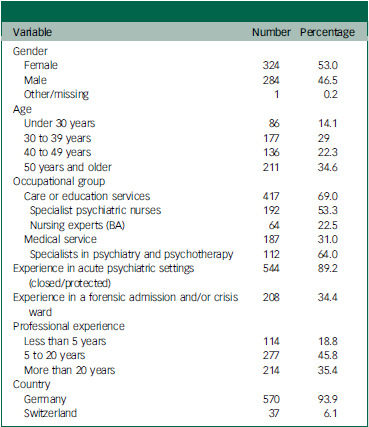
This 40-item German-language KEZ-R was used in an anonymous online survey (using EvaSys survey software). Between 30 March and 16 June 2022, a link to the survey was distributed via established professional networks and associations in Germany, German-speaking Switzerland and Austria to ensure participation by professionals from nursing and educational services and medical services. Unfortunately, despite considerable efforts, our Austrian collaborator was unable to recruit participants during the study period. Consequently, no data from Austria were available for analysis. A total of 611 questionnaires were completed. Cases with missing item responses were excluded from the respective analyses using listwise deletion. As a result, 14.9% of cases were excluded from analyses of the overall scale; the proportions of excluded cases were considerably lower for scale 1 (7.0%), scale 2 (3.8%) and scale 3 (5.6%). A total of 187 doctors, of whom 64% were specialists in psychiatry and psychotherapy, participated in the anonymous survey. Furthermore, 68.0% of the respondents identified themselves as belonging to the nursing and educational services (n = 417). Seven participants did not provide any information about their professional group. The majority of the responses came from Germany (93.9%), with almost all federal states (each with different legal regulations regarding coercive measures) represented. Thirty-seven colleagues from Switzerland participated in the survey (6.1%). Table 1 shows the sample description.
Sample description

Table 1 Long description
The table presents a detailed description of the sample used in the survey. It includes information about gender, age, occupational group, experience in acute psychiatric settings, experience in a forensic admission and/or crisis ward, professional experience, and country of respondents. The table has 10 rows and 3 columns. The columns are labeled ‘Variable’, ‘Number’, and ‘Percentage’. The rows are labeled with different variables such as Gender, Age, Occupational group, Experience in acute psychiatric settings, Experience in a forensic admission and/or crisis ward, Professional experience, and Country. Each row provides the number and percentage of respondents for each category. For example, under Gender, there are 324 females (53.0 percent), 284 males (46.5 percent), and 1 other/missing (0.2 percent). The table provides a comprehensive overview of the demographic and professional background of the survey participants.
BA, Bachelor of Arts.
The results of the survey with the revised version were then tested via classical test theory and used to select items for the short form. This was done by means of the following steps. First, the three-factor structure of the KEZ was tested via factor analysis. The item characteristics were subsequently determined via reliability analysis (IBM SPSS Statistics, version 29 for Windows, Reliability module). Cases with missing item responses were excluded from the respective analyses by listwise deletion. The three authors conducted a comprehensive review of the items on the three subscales and the overall scale on the basis of the following criteria: content relevance; item mean and standard deviation; correlations of the items with the overall scale and the respective scale and between the items; and the extent of change in Cronbach’s alpha when the respective item was removed. Finally, items with less favourable characteristics were identified and removed from the item set in several steps. Using Cronbach’s alpha values from the respective reliability analyses, the items were checked both in terms of content and reliability with respect to the overall scale and the three subscales.
The test theory review of the KEZ, the revised version derived from it, and the short form were based on the German-language version. For this publication, the items were translated into English using back-translation, for purposes of documentation and transparency.
Ethics approval and consent to participate
We analysed exclusively data from an anonymous survey of doctors and nurses working in psychiatric clinics, who, by participating, agreed that this data could be used for revision of the questionnaire. The Medical Association of North Rhine, Germany (Ärztekammer Nordrhein: ÄkNO), takes the position that such studies do not require consultation with an ethics committee (§ 15 (1) Professional Code of Conduct of ÄkNO [Berufsordnung für nordrheinische Ärztinnen und Ärzte; https://www.aekno.de/aerzte/berufsordnung#_15]). Accordingly, the responsible ethics committee of the ÄkNO did not offer consultation for this study (reference number 151/2021). As this was not an interventional study, it was not registered in a clinical trials database.
Results
KEZ-R (40 items)
The principal component factor analysis with varimax rotation was limited to three factors and resulted in a variance explanation of 30.779% (Table 2), similar to that of the original version (30.813%). The factor structure was satisfactorily replicated: 11 of the 17 items (64.7%) on scale 1 (‘acceptance of coercive measures without questioning’) and all nine items on scale 2 (‘meaningfulness and legitimacy of coercive measures’) loaded on the respective identified factor. Only five items loaded on the resulting third factor, four of which were items from scale 1. For content reasons, however, the original assignment of items to the scales was retained. The rotated factor loading matrix is included as Supplementary Table 11 available at https://doi.org/10.1192/bjo.2026.12106. For the overall scale, the reliability of the modified version was slightly lower but comparable with that of the original version Reference Baar, Schmitz-Buhl and Gouzoulis-Mayfrank12 (0.874 v. 0.904). The values of the scales also showed slightly lower but acceptable reliabilities (scale 1: 0.714 v. 0.797; scale 2: 0.786 v. 0.812; and scale 3: 0.763 v. 0.791).
Results of factor analysis, three-factor solution

Table 2 Long description
A table with three rows and seven columns comparing sums of squared factor loadings for extraction and rotated sum of squared loadings. The columns are labeled as Factor, Total, Percentage of variance, Cumulative percentage, Total, Percentage of variance, and Cumulative percentage. Row 1: Factor 1, Total 7.739, Percentage of variance 19.346, Cumulative percentage 19.346, Total 5.465, Percentage of variance 13.662, Cumulative percentage 13.662. Row 2: Factor 2, Total 2.440, Percentage of variance 6.101, Cumulative percentage 25.447, Total 4.236, Percentage of variance 10.589, Cumulative percentage 24.250. Row 3: Factor 3, Total 2.133, Percentage of variance 5.333, Cumulative percentage 30.779, Total 2.612, Percentage of variance 6.529, Cumulative percentage 30.779.
KEZ-S (15 items)
In the first step, seven items were identified for deletion on the basis of unfavourable item characteristics (mean values close to the lower or upper scale value) and/or lower content relevance (high correlation with other items on the scale). Specifically, eight items were removed from the original 17 items on scale 1 (‘acceptance of coercive measures without questioning’) (items 1, 9, 11, 12, 18, 19, 25 and 40; Table 2). Four items (items 7, 17, 20 and 28) were removed from scale 2 (‘meaningfulness and legitimacy of coercive measures’), and three items (items 14, 35 and 37) were removed from scale 3 (‘safety and order through coercive measures’). This resulted in a 25-item set of the KEZ as a first intermediate step; this set showed satisfactory characteristics: the standardised Cronbach’s α was 0.804, and the subscales also showed only a slight decrease in Cronbach’s α compared with the 40-item version (scale 1: 0.521; scale 2: 0.620; scale 3: 0.705).
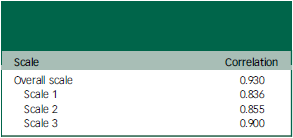
Given these overall satisfactory results, the criteria were tightened to achieve further reductions (item means between 2.5 and 3.5, and dispersion > 1), and an additional ten items with less favourable consistency values were identified. Three items were removed from scale 1 (5, 15 and 39), two items from scale 2 (4 and 29) and five items from scale 3 (items 3, 21, 31, 32 and 33) (Table 2). The resulting 15-item set of the KEZ also showed satisfactory characteristics for the overall scale and thus a high degree of reliability, with a Cronbach’s α coefficient of 0.671 for the overall scale. With the reduced number of items, the reliability of the subscales decreased (scale 1: 0.336; scale 2: 0.444; scale 3: 0.504). Table 3 shows the correlations (overall scale and subscales) between the KEZ-R (40 items) and KEZ-S (15 items).
Correlations (overall scale and scales 1 to 3) between the revised version (long form; 40 items) and the short form (15 items)

Table 3 Long description
A table showing correlations between the overall scale and three subscales. The table has two columns: Scale and Correlation. The Scale column includes the overall scale and three subscales. The Correlation column lists the correlation values. Row 1: Overall scale, 0.930. Row 2: Scale 1, 0.836. Row 3: Scale 2, 0.855. Row 4: Scale 3, 0.900.
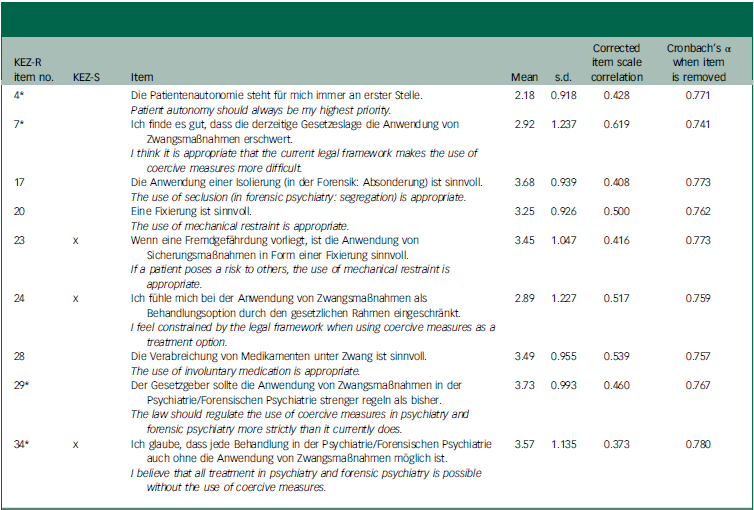
Tables 4–6 contain the items of the KEZ-R with the results of the test theory review (the items of the short form of the KEZ-S are marked with an ‘x’, and an English translation is added in parentheses). Supplementary Tables 7–10 show the KEZ-R and KEZ-S in the German and English languages.
Items of KEZ-R and KEZ-S scale 1: acceptance of coercive measures without questioning (17 items; Cronbach’s α = 0.714) with psychometric characteristics (items included in KEZ-S are marked with an ‘x’)

Table 4 Long description
A table comparing psychometric characteristics of items in KEZ-R and KEZ-S scales. The table has 12 columns and 40 rows. Column headers are: KEZ-R item no., KEZ-S, Item, MW, s.d., Corrected item scale correlation, Cronbach’s α when item was removed, and AQ5. Row 1: KEZ-R item no. 1, KEZ-S, Der professionelle Umgang mit aggressiven Patientinnen/Patienten hängt vom Team ab (Team-Philosophie.), 1.69, 0.888, 0.303, 0.682, AQ5. Row 2: KEZ-R item no. 2, KEZ-S x, Bei ‘schwierigen’ (ungänglichen, angespannten, aggressiven usw.) Patientinnen und Patienten kann nur mit intensivbetreuung (1:1) deeskalierend gearbeitet werden., 2.84, 1.052, 0.142, 0.702. Row 3: KEZ-R item no. 5, KEZ-S, Der Umgang mit Patientinnen und Patienten am Tag der Aufnahme trägt entscheidend dazu bei, ob sich am Aufnahmetag eine Situation eskaliert oder nicht., 1.89, 0.909, 0.356, 0.676. Row 4: KEZ-R item no. 6, KEZ-S x, Ich orientiere mich daran, wie meine Kolleginnen und Kollegen mit einer eskalierten Situation umgehen., 3.14, 0.930, 0.131, 0.701. Row 5: KEZ-R item no. 8, KEZ-S x, Die Dauer der Anwendung von Zwangsmaßnahmen ließe sich noch reduzieren., 2.68, 1.148, 0.353, 0.676. Row 6: KEZ-R item no. 9, KEZ-S, Erfahrung (der Mitarbeitenden) im Umgang mit akut kranken Patientinnen/Patienten ist notwendig, um deeskalierend auf Patientinnen und Patienten einwirken zu können., 1.48, 0.677, 0.137, 0.697. Row 7: KEZ-R item no. 11, KEZ-S, Um deeskalierend arbeiten zu können, ist die Teilnahme an einer Schulungsmaßnahme zur wertschätzenden und empathischen Kommunikation wichtig., 1.63, 0.841, 0.355, 0.677. Row 8: KEZ-R item no. 12, KEZ-S, Die Hemmschwelle, Zwangsmaßnahmen anzuwenden, ist geringer, wenn vor kurzem in der Hemmschwelle Zwangsmaßnahmen anzuwenden., 2.42, 1.023, 0.217, 0.692. Row 9: KEZ-R item no. 15, KEZ-S, Die Haltung und Einstellung zum Umgang mit Zwangsmaßnahmen muss von den Vorgesetzten (ärztlicher/pflegerischer Dienst) vorgelebt werden., 1.73, 0.955, 0.435, 0.666. Row 10: KEZ-R item no. 16, KEZ-S x, Der Einsatz einer Sitzwache am Bett eines/einer fixierten Patienten/Patientin ist sinnvoll., 1.91, 1.097, 0.371, 0.673. Row 11: KEZ-R item no. 18, KEZ-S, Die Anwendung von Zwangsmaßnahmen sollte im Anschluss mit Team nachbesprochen werden., 1.33, 0.590, 0.417, 0.677. Row 12: KEZ-R item no. 19, KEZ-S, Die Anwendung von Zwangsmaßnahmen sollte im Team - sofern die Situation dies zulässt - vorher besprochen werden., 1.37, 0.630, 0.362, 0.680. Row 13: KEZ-R item no. 22, KEZ-S x, Wenn vor kurzem in der Station ein Übergriff auf eine Mitpatientin oder einen Mitpatienten erfolgte, ist die Hemmschwelle Zwangsmaßnahmen anzuwenden geringer., 2.62, 1.052, 0.196, 0.695. Row 14: KEZ-R item no. 25, KEZ-S, Nach der Anwendung von Zwangsmaßnahmen ist die Nachbesprechung mit der Patientin oder dem Patienten wichtig und sollte in jedem Fall erfolgen., 1.40, 0.651, 0.341, 0.681. Row 15: KEZ-R item no. 36, KEZ-S x, Die Überprüfung der Zulässigkeit der Anwendung von Zwangsmaßnahmen durch einen Richter ist unnötig., 1.96, 1.158, 0.314, 0.681. Row 16: KEZ-R item no. 39, KEZ-S, Die Patientensicherheit hat im Behandlungssetting höchste Priorität., 1.91, 0.874, 0.207, 0.692. Row 17: KEZ-R item no. 40, KEZ-S, Ich bin der Meinung, dass ein gutes therapeutisches Stationsmilieu die Notwendigkeit von Zwangsmaßnahmen reduziert., 1.45, 0.742, 0.413, 0.673.
KEZ-R, revised long version of the Cologne Questionnaire on Attitudes towards Coercive Measures; KES-S, short form of the KES-R.
* Inversely formulated item.
Items of KEZ-R and KEZ-S scale 2: meaningfulness and legitimacy of coercive measures (nine items, Cronbach’s α = 0.786) with psychometric characteristics (items included in KEZ-S are marked with an ‘x’)

Table 5 Long description
A table with nine rows and six columns comparing items of KEZ-R and KEZ-S scale 2. The columns are labeled KEZ-R item no., KEZ-S, Item, MW, s.d., Corrected item scale correlation, and Cronbach’s α when item is removed. The table includes items marked with an ‘x’ indicating their inclusion in KEZ-S. Each row provides specific data for each item, including mean (MW), standard deviation (s.d.), corrected item scale correlation, and Cronbach’s α when the item is removed. Notable items include patient autonomy, use of seclusion, mechanical restraint, involuntary medication, and beliefs about the regulation and necessity of coercive measures in psychiatry and forensic psychiatry.
KEZ-R, revised long version of the Cologne Questionnaire on Attitudes towards Coercive Measures; KES-S, short form of the KES-R.
* Inversely formulated item.
Items of KEZ-R and KEZ-S scale 3: safety and order through coercive measures (14 items, Cronbach’s α = 0.736) with psychometric characteristics (items included in KEZ-S are marked with an ‘x’)

Table 6 Long description
A table with 14 rows and 6 columns comparing items of the KEZ-R and KEZ-S scales with psychometric characteristics. The columns are labeled as KEZ-R Item no., KEZ-S, Item, MW, s.d., Corrected item scale correlation, and Cronbach’s α when item is removed. Each row provides details on specific items related to safety and order through coercive measures. The KEZ-S items are marked with an ‘x’. The table includes items in German with English translations in parentheses. Notable items include measures for self-harm, coercive measures, and the appropriateness of de-escalation measures. The table provides mean (MW), standard deviation (s.d.), corrected item scale correlation, and Cronbach’s α when the item is removed for each item.
KEZ-R, revised long version of the Cologne Questionnaire on Attitudes towards Coercive Measures; KES-S, short form of the KES-R.
* Inversely formulated item.
Discussion
Efforts to preserve and promote patient autonomy are highly important in the treatment of people with mental illness. Reference Pollmächer15 In many cases, establishing a trusting relationship between patients and treatment staff and ensuring adherence to treatment are key to successful treatment, especially among patients with severe mental illness. Reference Tetzlaff, Bruins and Castelein16 Coercive measures are very stressful and even traumatic for patients and can undermine their trust in the treatment system and their adherence to treatment in the long term. Reference Akther, Molyneaux, Stuart, Johnson, Simpson and Oram17–Reference Modini, Burton and Abbott19 For this reason, such measures are considered to represent a last resort that should be used as little as possible. To this end, it is important to identify factors influencing the use of coercive measures. Reference Krieger, Moritz, Lincoln, Fischer and Nagel20 These factors include the attitudes of treatment staff towards coercive measures, which can vary significantly.
In a study conducted at three clinics in Switzerland, attitudes of clinic staff were linked to the traditions and guidelines of the respective clinic, and differences in rates of coercive measures were found. Reference Hotzy, Jaeger, Buehler, Moetteli, Klein and Beeri21 According to Lauber & Rössler, Reference Lauber and Rössler4 differences in attitudes can be attributed to cultural, professional and individual backgrounds, whereas Morandi et al Reference Morandi, Silva, Mendez Rubio, Bonsack and Golay22 explain the feelings and attitudes of hospital staff towards the use of coercion via four main dimensions of ‘internal pressure’, ‘emotional impact’, ‘external pressure’ and ‘relationship commitment’. According to Aragonés-Calleja & Sánchez-Martínez, Reference Aragonés-Calleja and Sánchez-Martínez23 background knowledge about coercive measures influences perceptions and attitudes towards coercive measures. In their opinion, training psychiatric nurses in non-coercive practices could help them to consciously recognise and question coercive measures and thus reduce their use more effectively. Finally, Molewijk et al Reference Molewijk, Kok, Husum, Pedersen and Aasland24 showed that attitudes towards coercive measures are related to experiences of moral doubt regarding the use of coercion and suggested that discussion of critical cases could increase professionals’ experiences of ethical and moral doubt, thereby promoting critical thinking and increasing staff curiosity about alternatives to coercion.
For systematic recording of attitudes, instruments for practice and research are needed to verify which interventions to influence attitudes result in reduced use of coercive measures in treatment. Among the available instruments, two specifically and exclusively address the attitudes of medical staff towards coercive measures for patients with psychiatric disorders. The SACS is widely used internationally and is available in several languages, but it is relatively short and covers only selected aspects of attitudes. The KEZ, which is currently available only in the German language, is more comprehensive and takes into account emotional aspects and interactional factors of the treatment team.
In the present study, we revised the KEZ for use in an international context and developed a short form to promote broader application outside research settings. Both were developed and validated using a large sample of employees from various institutions in different regions of Germany and Switzerland, taking into account test theory aspects. This addresses a limitation of the original version of the KEZ, Reference Baar, Schmitz-Buhl and Gouzoulis-Mayfrank12 which was based exclusively on a survey of employees at a single psychiatric institution. As a next step, it will be possible to develop an English-language version for use in an international context. The reliability values of the KEZ-R were only slightly lower than those of the original version. This means that the KEZ-R is comparable with the original version in terms of its test-psychological quality, although the analysis sample used here was larger and more heterogeneous than that used for the original version. The reliability values were slightly better but overall comparable with those of the SACS and its various language versions. Reference Husum, Finset and Ruud10,Reference Efkemann, Scholten, Bottlender, Juckel and Gather11,Reference Polat25 The KEZ-S had a very strong correlation with the long form and a high reliability value for the overall scale. As expected, the reliability values of the subscales decreased owing to the reduced number of items; therefore, this 15-item short form of the KEZ is suitable for use as an instrument to globally assess attitudes towards coercive measures, if subdifferentiation can be dispensed with. The reliability of the KEZ-S was slightly lower than that of the SACS but still satisfactory.
Both the short form and revised version (long form) of the questionnaire included items related to emotional components and the role of interaction with team members. This is a key difference compared with the SACS, which assesses only cognitive attitudes. Emotional aspects in particular can be seen as relevant in this context. Reference Efkemann, Scholten, Bottlender, Juckel and Gather11,Reference Efkemann, Lickiewicz, Doedens, Lantta, Bali and Husum13,Reference Krieger, Moritz, Lincoln, Fischer and Nagel20 The KEZ is therefore suitable for use in psychiatric institutions with acute care wards. It can also be used in research and, especially in its short form, in practice (for example, to support quality development measures). Anonymous surveys provide insight into staff attitudes and enable comparisons between different groups. This allows response behaviour to be analysed in relation to variables such as age, gender, occupation, professional position and professional experience. The results of our survey using the KEZ could therefore be helpful in deriving targeted intervention measures (such as for further training or supervision). Longitudinal surveys can also be used to evaluate training measures such as de-escalation training to assess the influence of the measure on any changes in the attitudes of the participants.
Strengths and limitations
A major strength of this study was the development and validation of both a revised long version and a concise short form of an instrument assessing attitudes towards coercive measures, incorporating cognitive, emotional and interactional aspects. The use of a large and heterogeneous sample of mental health professionals from different institutions and regions enhanced the robustness of the psychometric analyses.
However, several limitations should be noted. Psychometric testing was conducted on the German-language version of the questionnaire, and further validation of an English version in different cultural and legal contexts is required. Moreover, owing to the reduced number of items, the reliability of the subscales in the short form was limited, restricting its use to assessment of overall attitudes rather than differentiated subdimensions. Moreover, the use of listwise deletion resulted in exclusion of up to 14.9% of cases for analyses of the overall scale. Although the proportion of missing data was substantially lower for the individual subscales (3.8–7.0%), listwise deletion may have reduced statistical power, as well as potentially introducing bias if the missing data were not missing completely at random.
Although the sample reflected the professional composition of psychiatric in-patient services reasonably well, it should not be considered to be statistically representative, because participation was voluntary and recruitment was based on convenience (snowball) sampling. The institutions employing participants were intentionally not collected to preserve anonymity. Consequently, it was not possible to account for clustering at hospital level or to apply multilevel analytical approaches. We also recognise that some degree of self-selection bias cannot be excluded.
Future work
Future studies could investigate possible institutional effects using appropriately designed multicentre data-sets. They should also investigate external validity by examining associations between KEZ scores and external criteria, such as actual use of coercive measures, clinical decision-making or other established instruments assessing related constructs.
As the test theory review was carried out only on the German-language version of the questionnaire, future translations should include cultural adaptation of the legal items, followed by appropriate psychometric validation within the respective national context. Questionnaire items referring to legal aspects may require cultural and legal adaptation before the KEZ is applied in other jurisdictions. Translations into other languages would also be desirable, as this may facilitate international research and cross-cultural validation. Finally, a comparison of the results of the KEZ and the SACS on the same samples would be interesting.
Supplementary material
The Supplementary material is available online at https://doi.org/10.1192/bjo.2026.12106
Data availability
The data-set used and analysed during the current study is available from the corresponding author on reasonable request.
Acknowledgements
We thank the colleagues who participated in the survey and the chairpersons of the professional associations who supported this study and forwarded the survey link to their members (BDK: Federal Directors’ Conference (Bundesdirektorenkonferenz), ACKPA: Working Group of Chief Physicians of Clinics for Psychiatry and Psychotherapy at General Hospitals in Germany (Arbeitskreis der Chefärztinnen und Chefärzte der Kliniken für Psychiatrie und Psychotherapie an Allgemeinkrankenhäusern in Deutschland)). We also thank the nursing directors of the LVR for disseminating the survey, and Stefan Rogge, UPK Basel, Switzerland, for his support and forwarding of the survey to his nursing network.
Author contributions
M.S.-B., I.B. and E.G.-M. contributed to the conception and design of the study, analysis and interpretation of the data, and drafting of the article and critical revision for important intellectual content, and approved the version to be published.
Funding
This research received no specific grant from any funding agency in the public, commercial or not-for-profit sectors.
Declaration of interest
None.




 Open access


eLetters
No eLetters have been published for this article.