The December 1936 Gallup poll included the following question: “Is the Republican party dead?” Just over 27 percent of the respondents agreed that the GOP was, in fact, dead following Franklin Roosevelt's landslide defeat of Alf Landon and the Democrats’ sweeping victory in the 1936 congressional elections. The new Senate that convened in January 1937 included just 16 Republicans; the House had only 89, compared to 334 Democrats. Republicans’ dismal electoral fortunes were just one sign of the transformation in the American political landscape. Over the previous four years, Roosevelt's New Deal program had arguably been prodded, shaped, and threatened more by attacks emanating from the left—and from populist insurgencies that defy clear ideological labels—than by conservative Republican resistance.Footnote 1 The most famous such challenge came with the launching of Huey Long's “Share Our Wealth” movement in 1934. Amidst all the ferment of 1933 to 1936 and Roosevelt's decisive reelection victory, the prospects for liberal programmatic innovation seemed particularly favorable. Political observers at the time might well have been surprised to learn that the American welfare state that emerged from the New Deal era would turn out to be a laggard when compared to its more social democratic European counterparts.
Yet it was during the Seventy-Fifth Congress of 1937–38 that a coalition of conservative Southern Democrats and conservative Northern Republicans began to emerge within Congress.Footnote 2 Southerners were by no means the only Democratic dissenters in the first famous example of cross-party conservative cooperation, the 1937 fight against FDR's court-packing plan. But, by 1938, the year of Roosevelt's attempted “purge” of conservative Democrats, it was evident that Southern conservatives constituted the main obstacle to liberal advances within the Democratic Party.Footnote 3 Democrats entered the 1938 midterms weakened by intraparty infighting and the brutal recession of 1937 to 1938. A mere two years after their crushing defeat in the 1936 elections, Republicans began an electoral comeback by gaining eighty-one House seats and seven Senate seats.
Republican victories in 1938 greatly strengthened conservative prospects in the ensuing Seventy-Sixth Congress (1939–40) and set the stage for a long period of rough parity in Congress between conservatives and liberals. The seemingly wide opening for liberal domestic policy innovation of the early-to-mid-1930s gave way to a much more limited agenda in the late 1930s and 1940s. The latter years saw the consolidation and gradual extension of many liberal innovations (Social Security and federal macroeconomic management, for example), but also the frustration of liberal hopes for an expansive “cradle-to-grave” welfare state marked by strong unions, national health insurance, and full employment policies.Footnote 4 The consolidation of the New Deal order in the 1940s established a political regime that structured American politics and policy for the next generation.Footnote 5
The literature on the limits of New Deal liberalism is vast, but it has tended overwhelmingly to focus on the elite maneuvering of politicians, interest groups, and intellectuals. By comparison, the preferences and opinions of the mass public and subgroups within it has received little in the way of comprehensive and detailed analysis, partly because of the challenges of analyzing public opinion polls from this period. Clearly, both elite- and mass-level dynamics are important, and each level influences the other: political elites seek to shape and harness public opinion, and mass preferences establish the basic parameters within which elite conflict plays out.
Taking advantage of a new, comprehensive dataset of public opinion polls from the 1930s and 1940s, we seek in this study to shed light on a neglected aspect of New Deal policy development during this crucial period—the role of public opinion. Consistent with a number of elite-level accounts, we find that the question of organized labor's place in the new regime played a central role in limiting the advance of New Deal liberalism. A perceived growth in the power and radicalism of labor unions was accompanied by a broad-based anti-labor reaction in the mass public. The reaction was particularly consequential in the solidly Democratic South, where the mass-level shift in attitudes toward labor from ambivalence to hostility tracked similar shifts among Southern members of Congress. But Northern voters also evinced a dramatic anti-labor turn, providing Republican leaders with a potent wedge issue among Northern Democrats as a well as a basis for a coalition with conservative Southerners.
At the same time, we find only limited rightward movement within the mass public on New Deal issues unrelated to labor unions. While the public was hardly clamoring for bold domestic policy initiatives in the 1940s and showed increased skepticism, at an abstract level, of government intervention in the economy, it expressed broad support for key pillars of the nascent welfare state. From the start, Social Security enjoyed broad popularity, as did many other New Deal economic programs. These findings underscore how Republicans’ electoral success ultimately depended upon their accepting substantial elements of the New Deal state. The critical exception to the pattern of popular support for New Deal programs, however, was the complex of pro-labor policies represented by the Wagner Act, which were deeply unpopular, even if labor unions in the abstract were not.
We highlight in this article the necessity of bringing public opinion fully into analyses of this crucial period. This study constitutes an initial building block of a broader project addressing the interplay of public opinion and congressional politics in shaping the consolidation and limitations of New Deal liberalism in the late 1930s and 1940s. Congress is, first and foremost, a representative institution mediating the translation of public preferences into policy outcomes.Footnote 6 While this translation is often far from perfect, it is nonetheless worth honing in on the relationship between public opinion and the conservative resurgence. The striking revival of Republican electoral fortunes in the North starting in 1938 and continuing into the 1940s is in part what gave congressional conservatives a majority on the House floor on many issues. Indeed, in each House election from 1938 to 1952, Republicans won a greater share of the popular vote outside the South than did Democrats.Footnote 7 Furthermore, conservative Republicans and Southern Democrats were not just passive observers (and beneficiaries) of popular conservatism. Rather, they repeatedly teamed up to spur investigations intended to turn public opinion against New Deal liberalism. A key feature of Congress as a representative institution is that its members are themselves participants in a “public sphere,” attempting to mold mass opinion.Footnote 8 As such, drawing linkages between the mass public and congressional politics ought to be viewed as a two-way street, rather than just as a bottom-up or top-down process.Footnote 9
In addition to shedding new light on mass opinion in this critical period, our findings also speak to existing accounts of the limits and consolidation of the New Deal. Debates among policy intellectuals,Footnote 10 congressional Southerners’ rightward turn as they forged their alliance with conservative Republicans,Footnote 11 the strategic choices of labor leaders,Footnote 12 progressive liberals’ efforts to build a durable regime,Footnote 13 and business organizations’ drive to shape the postwar orderFootnote 14 all took place on a political terrain defined by mass support for the New Deal, with the glaring exception of its pro-labor policies. In a sense, labor unions and their liberal allies were engaged in a race against time, seeking to construct a durable political-economic place for organized labor before their opponents could capitalize on the growing anti-labor sentiment of the mass public, a race that culminated with the 1947 passage of the Taft–Hartley Act.
In this article, we first situate the project in the literature on the 1930s and 1940s, with a particular focus on organized labor's emerging place in the New Deal order. We then turn to our analysis of public opinion, discussing the unique advantages of the poll data we use, as well as the special challenges they present. Next, we provide a detailed analysis of public opinion on labor issues, with special attention to comparing trends across regional and partisan groups. We then contrast the patterns in public opinion on labor with those on other New Deal issues. Finally, we elucidate the relationship between mass opinion and elite-level dynamics, concluding with a summary of our findings and their implications.
ORGANIZED LABOR AND THE EMERGING NEW DEAL ORDER
Labor unions, somewhat peripheral to the concerns of the Roosevelt Administration in its early years, had by 1936 become a core component of the emerging New Deal order. With lifelong Republican John L. Lewis of the newly formed Congress of Industrial Organizations (CIO) leading the way, organized labor threw its support solidly behind FDR in 1936, replacing business interests as the Democrats’ primary financial base and helping to swing several large industrial states towards the party.Footnote 15 Labor became a central component of the nascent New Deal coalition, forging a political alliance with the Democratic Party that has endured to the present.Footnote 16
The New Deal regime not only benefited from the rise of organized labor, but also played a huge role fostering that rise. The passage of the National Labor Relations Act (the “Wagner Act”) in 1935 signaled a dramatic shift in the relationship between the national government and labor unions. After decades in which the predominant stance of the government toward unions was one of indifference at (occasional) best and hostility at worst, the Wagner Act provided a far more favorable legal and institutional environment for union organization. While some on the left have argued that the Wagner Act tamed a labor movement that otherwise might have used collective action to force a more dramatic restructuring of the economy, at the time the labor regime erected by the act was widely viewed as favoring workers.Footnote 17 The Wagner Act defined a series of unfair labor practices by management and created the National Labor Relations Board (NLRB). The NLRB was staffed largely by liberals and leftists who, at least in the early years, generally sided with workers, particularly the emergent CIO industrial unions. Rather than a tame, voluntary, privatized system of collective bargaining, the labor policy regime that emerged with the Wagner Act and dominated American politics from 1935 to 1947 was a highly politicized process that routinely put unions, business leaders, and government labor experts in the Oval Office and other government venues.Footnote 18
Organized labor played a key role in supporting and sustaining the policy achievements of the New Deal and was at the leading edge of efforts to build on them in the 1940s. Yet the still-tenuous place of labor unions in this period also limited the scope of New Deal liberalism. The institutionalization of social democracy in the United States would have required a labor movement that had broad strength and was widely accepted as a legitimate governing partner.Footnote 19 The labor movement that actually emerged from the 1940s, particularly after the passage of Taft–Hartley in 1947, was much more limited in its ambitions and occupied a more vulnerable place in the postwar political economy.Footnote 20 While some scholars blame the cramping of labor's ambitions on the insufficient militancy of its leaders,Footnote 21 organized labor also faced powerful enemies and an adverse political climate.
One prominent line of research, building on the seminal work of James T. Patterson, identifies the emergence of a “conservative coalition” between Republicans and Southern Democrats in Congress as a crucial block on liberal ambitions. Katznelson and his co-authors place particular emphasis on congressional Southerners’ turn against New Deal liberalism, especially with respect to organized labor.Footnote 22 According to Farhang and Katznelson, the Democratic Party was a hybrid of an “immigrant, labor-oriented, big-city, machine nonsouthern wing that looked very much like a social democratic party” and a native, rural, white supremacist Southern wing that represented no blacks and just a minority of the whole South's white population.Footnote 23 While Southern Democrats in Congress had gingerly backed most New Deal labor legislation in the mid-1930s, focusing primarily on seeking occupational exclusions for agricultural and domestic workers, they shifted ground in the 1940s. Wartime labor shortages and CIO unionization drives, argue Farhang and Katznelson, led Southern elites to see New Deal labor policy as a threat to their system of racial apartheid, low-wage agriculture, and emergent low-wage industrialization. As a result, Southerners joined with Northern Republicans to attack labor unions and the NLRB, authoring a series of initiatives that put labor on the defensive and generated a more cramped American labor movement.Footnote 24 With labor forced into the position of a mere interest group, rather than a broad, class-based movement fusing demands for economic and racial justice, liberal dreams of an expansive social welfare system and vigorous government intervention to limit corporate power had little or no chance of passage.Footnote 25
Another important perspective, articulated by the historian Alan Brinkley, emphasizes the New Deal's evolution as an “idea” during these years, a process that clarified, reoriented, and ultimately narrowed the ambitions of liberal reformers. Focusing on elite debates among policy intellectuals,Footnote 26 Brinkley argues that the New Deal started out as intellectually inchoate, filled with diverse and conflicting strands unified only by their conviction that American capitalism was in deep trouble and in need of government-led reform. In the late 1930s and into the 1940s, New Deal intellectuals struggled to make sense of their accomplishments and prospects in light of changing social, economic, and political conditions. By the end of World War II, he argues, New Dealers had abandoned radical critiques of capitalism, accepted corporate autonomy, and embraced the United States’ transition to a consumer society, now convinced that the government could solve economic problems through macroeconomic management rather than redistribution or fundamental restructuring.Footnote 27
While Brinkley sees the New Deal's boldest aspirations fading away during World War II, some scholars emphasize that the 1940s were a time not only of liberal reversals, but also of consolidation. Certain areas, like veterans’ benefits and housing, actually saw important new advances.Footnote 28 Other scholars insist that real opportunities (and at least latent public support) for major liberal or even radical initiatives persisted through the end of the war, only to be shut down by massive efforts by business to reassert its prerogatives and by the anti-communist hysteria of the early Cold War.Footnote 29
Making sense of and adjudicating among these various perspectives requires careful attention to public opinion. How did popular sentiment toward New Deal liberalism change over these crucial years? How did regional and partisan groups differ with respect to these changes? On what issues could liberals count on public support for consolidation or expansion, and on what issues was the public on the side of conservatives seeking to roll back the New Deal? Notwithstanding the rich literature on this period, our understanding of the relationship between the mass public and the limits of New Deal liberalism has suffered from the dearth of comprehensive analyses of public opinion.
Although scholars such as Brinkley have noted that rising “popular conservatism” put liberals on the defensive in these years, most scholars have either relied on just a few polls or confined themselves to a specific policy domain. Few have compared public opinion trends across time, issues, and social groups to specify the contours of this rightward reaction. Polenberg's study of the New Deal's decline in the late 1930s, for instance, relies on a handful of polls to justify the conclusion that “the New Deal declined after 1937 because most Americans did not want to extend it much further.”Footnote 30 Other works examine aspects of public opinion in isolation—attitudes toward relief, social welfare, health insurance, price controls, and ideological identification, for example—but do not systematically connect their findings to broader questions regarding the New Deal regime.Footnote 31 With regard to labor specifically, the anti-labor popular reaction in this period is often acknowledged, sometimes with references to specific polls, but has not been parsed in detail.Footnote 32
The comparative neglect of public opinion in this period is attributable in large part to problems of data availability and quality. Until recently the early poll data were not available in easily analyzable form. In addition, these polls predate the development of modern survey sampling, and thus the samples must be reweighted to make them representative of the American public as a whole. Recent work by Adam Berinsky and Eric Schickler has made it possible to surmount these difficulties.Footnote 33 The following section provides a detailed discussion of the poll data and the adjustments made to them.
PUBLIC OPINION POLLS, 1936–1945
Systematic public opinion surveys first became a prominent feature of political life in the 1930s. Surveys gained a respected place in national politics beginning with the Democratic National Committee's employment of the pollster Emil Hurja to assist with Roosevelt's presidential campaign and with patronage allocation. Later in his administration, Roosevelt unofficially consulted with Hadley Cantril, who commissioned and interpreted polls on behalf of the administration.Footnote 34 Moreover, starting in the mid-1930s, polling companies surveyed the public about important issues on a regular basis.Footnote 35 Between 1936 and 1945, the four main polling organizations—Cantril's Office of Public Opinion Research (OPOR), George Gallup's American Institute of Public Opinion (AIPO), the National Opinion Research Center (NORC), and Elmo Roper's eponymous firm—conducted roughly 450 national surveys.
The surveys include numerous questions probing respondents’ domestic and foreign policy attitudes. There are many items probing attitudes toward labor unions, government regulation of business, taxation, redistribution, social security, relief policy, civil rights, and a variety of other issues. In addition, most Gallup polls asked about presidential vote intention and/or recent presidential vote choice. The polls attracted considerable attention at the time. George Gallup reported results from his polls in a regular column syndicated in over 100 newspapers by 1940.Footnote 36Fortune magazine sponsored many of Roper's surveys and regularly presented a detailed summary of the results; Roper also popularized the results of his surveys with a syndicated column starting in the early 1940s. News coverage often referred to poll results.
Members of Congress were sufficiently concerned about the implications of polling that there were several resolutions proposed to investigate the industry, and a Senate committee even held hearings to explore the possibility that pollsters were biased against Roosevelt after they underestimated his vote share in the 1944 election.Footnote 37 An early survey of 96 members of Congress found that while most denied relying upon poll results to form their positions, 70 percent believed that other elected officials did so.Footnote 38 The pollsters themselves wrote newspaper articles defending their profession against charges of bias and against the view that polls give rise to self-fulfilling bandwagon effects.Footnote 39 All of this suggests that the burgeoning polling enterprise not only offers us a potential window into what the public was thinking, but that it had also become one of the sources of information that politicians and other elites looked to in crafting their political strategies.Footnote 40
While several studies have made systematic use of some of these data,Footnote 41 in general scholars have been reluctant to draw upon them, for two reasons. First, the data files themselves are generally in poor shape. The data contain numerous miscodings and some codebooks do not include the codes necessary to decipher important questions, such as the respondent's occupation. Second, the data were collected using quota-controlled sampling techniques that have since been largely discredited. In quota sampling, pollsters seek to interview certain predetermined proportions of people from particular segments of the population.Footnote 42 While some pollsters used quotas to ensure that their samples matched the population distributions of the quota variables,Footnote 43 others designed quotas to produce sample proportions that differed systematically from the population. George Gallup was most interested in predicting elections, so he drew samples to represent each population segment in proportion to the votes it usually cast in elections. Because Southerners, African Americans, and women turned out at low rates in this period, these groups were deliberately underrepresented in Gallup's polls. For example, the 1940 Census found that 50 percent of the U.S. population was female, 10 percent was African American, and 31 percent lived in the South. By contrast, a December, 1940 Gallup poll included only 34 percent women, 3 percent African Americans, and 13 percent Southerners.Footnote 44 Thus, the Gallup data that scholars have used to represent the voice of the mass public in fact comes from a skewed sample of that public.
The practice of quota sampling also introduced unintended distortions. Apart from having to fulfill certain demographic quotas, interviewers were given much discretion to select particular citizens to interview. Since interviewers preferred to work in safer areas and tended to survey approachable respondents, the “public” they interviewed often differed markedly from the public writ large. For example, the 1940 Census indicated that about 10 percent of the population had at least some college education, while almost 30 percent of a typical 1940 Gallup sample had attended college. Similarly, polls conducted by Gallup and Roper tended to include more “professionals” than identified by the Census. The skew in these variables is not surprising, given that education and occupation were not quota categories. It is likely that professionals and the highly educated were more willing to be interviewed and, as a result, comprise a disproportionately large share in these samples.
With support from the National Science Foundation, Eric Schickler and Adam Berinsky have led a research team working to make the data suitable for analysis. This team has recoded the datasets, which has involved ferreting out and correcting many errors and inconsistencies in the original datasets. As part of the project, a series of post-stratification weights were developed that allow for better inferences about mass opinion. In aggregate analysis, the data are weighted on education levels, occupation, phone access, and those quota category variables—such as gender and region—that can be matched to census data. If education levels were available, cell weights were created using education, gender, region, and race.Footnote 45 If the survey did not contain a measure of education, cell weights were calculated using a dummy variable for “professional” occupation, gender, region, and race. If neither education nor a reliable occupation variable was available, raking weights were created based on the marginals of gender, region, phone access, and race.Footnote 46 The necessary population counts for the 1940 Census are available from the Integrated Public Use Microdata SeriesFootnote 47; we supplement these data with aggregate Census records of phone access. Even when weighting makes only a modest difference in conclusions, it nonetheless provides more confidence that our estimates are not attributable to problematic sample design.Footnote 48 The recodes and weights will be made publicly available through the Roper Archive at the University of Connecticut by the end of 2011.Footnote 49
As noted above, we aim in this article to provide the first detailed look at this new data source for understanding the development of New Deal liberalism. Before presenting our findings, it is important to note some of the limitations in the data. First, while the weights improve the representativeness of the sampling, they are no substitute for a correctly executed probability sample. Given interviewer discretion to select respondents, one can never be certain that the individuals within a sample cell used in weighting (e.g., female Southern high school graduates) are representative of that broader group.Footnote 50 Second, the sampling frame used by Gallup, in particular, greatly limits what one can say about Southern African Americans. Since Gallup generally excluded Southern blacks from his samples, we can talk of Southern white opinion but not of Southern opinion as a whole. Given that Southern whites dominated the electorate at the time, this means that we can examine the extent to which Southern elites mirrored the policies that the effective electorate favored, but not how different that electorate was from the full Southern population.
A possible third concern is that some of Gallup's practices, such as his effort to predict elections (rather than interview a descriptively representative sample) and his reliance on a large number of part-time interviewers, make his surveys less reliable for estimating white Americans’ opinion, even when one weights the data. Cantril's classic study of survey methods, however, provides evidence that Gallup's interviewers actually performed about as well as other survey houses.Footnote 51 Nonetheless, we replicated the main analyses in this article (e.g., Figures 4a and 4b) dropping all of the Gallup surveys. Fortunately, the findings remained robust when we did so (a supplementary online appendix, posted at http://igs.berkeley.edu/schickler/docs/Schickler_Caughey_online_appendix_2011.pdf, includes these additional figures and a list of the survey questions used). In sum, we believe that systematic analysis of public opinion toward labor unions and other facets of New Deal liberalism offers important insights into the political contestation surrounding the consolidation and expansion of New Deal liberalism, but we readily acknowledge that a degree of circumspection is necessary in making inferences about the broader mass public from each specific survey result.
PUBLIC OPINION ON LABOR ISSUES
Labor policy was the issue on which conservative Southern Democrats and Northern Republicans in Congress united most frequently and aggressively in the late 1930s. Examining Democratic Congresses between 1937 and 1952, Schickler and Pearson identify forty-four conservative initiatives that were reported to the House floor by the Rules Committee over the opposition of the Democratic administration and key party leaders.Footnote 52 Of these, fifteen primarily involved labor–management relations, and several others involved farm labor (e.g., draft deferments for farm labor or incorporating farm labor costs into parity prices). Examples of these initiatives include a 1937 resolution to investigate the sit-down strikes,Footnote 53 Howard Smith's (D-VA) 1939 investigation of the NLRB, and the series of anti-strike bills proposed by Smith and his conservative allies starting in 1941 (which culminated in enactment of the Smith–Connally Act of 1943 and Truman's veto of the Case anti-strike bill of 1946).Footnote 54 Republican and Southern Democratic members of Congress clearly viewed the status quo labor policies adopted in the 1930s as unacceptable, and they joined forces to overcome Northern Democratic and union opposition to reversing those policies.
We argue that the conservative resurgence in Congress was rooted at least in part in a broad-based popular reaction against perceived labor union radicalism that emerged in 1937 and persisted with great consistency through 1945. While this anti-labor turn is evident among Northern Democrats as well as Southerners, it was particularly consequential in the South, where attitudes toward labor shifted from ambivalence to outright hostility. The strength of anti-labor sentiment in the South provided a mass basis for a Republican–Southern Democratic alliance that would define crucial contours of New Deal liberalism. This alliance was helped along by Republicans’ willingness to cooperate with Southerners in blocking civil rights measures in the mid-1940s, which coincided at the mass level with Northern Republicans’ increasing conservatism on civil rights relative to Northern Democrats.Footnote 55 Economic and racial liberalism became increasingly aligned at the mass level by the end of the 1930s,Footnote 56 but liberals of all stripes faced a political landscape shaped in part by broad popular anger at the coalitional player arguably most essential to liberal success: organized labor.Footnote 57
The first opinion polls from 1936 include very few items on labor policy, a telling indication that union power was not yet viewed as a major political issue. For example, a January 1936 Roper poll asked respondents: “Do you believe that any of the following abuse their power?: Bankers, Press, Radio, Pulpit, Veterans.” Labor unions were not even offered as a response option, suggesting that unions were not, in the immediate aftermath of passage of the Wagner Act, viewed as particularly powerful.Footnote 58 Two years later, however, labor unions were listed as a response option when Roper asked “Which of these is most in need of reform?” Indeed, unions were by far the top choice: while 38 percent of respondents claimed that labor unions were “most in need of reform,” just 14 percent listed public utilities, 13 percent listed stock exchanges, and 4 percent cited the Supreme Court.Footnote 59 This theme continued to be prominent over the next few years. For example, in April 1944, Roper offered an open-ended question asking, “Are there any special groups that you feel had too much influence over Congress in the past year or so?” If the respondent answered yes, he or she was asked, “What groups?” Of the respondents identifying a group, 47 percent named labor unions (either in general or the CIO specifically), as compared to 14 percent that named a group associated with Wall Street, business, or finance.Footnote 60 The same year, Gallup asked respondents: “Which would you prefer to have influence the government more strongly—big business or labor unions?” (February 1944). Despite the use of the normally pejorative label “big business,” a plurality of 41 percent preferred big business, as compared to 32.5 percent favoring labor unions.Footnote 61 An overwhelming majority of Southerners favored “big business” power, and the North was split down the middle.
Why did a substantial portion of the public come to view labor unions—even more than business groups—as having too much influence in American politics? As Patterson and others have noted, a key precipitating event was likely the wave of sit-down strikes that began in December 1936.Footnote 62 These strikes resulted in notable successes, such as when the UAW, which was part of the recently formed CIO, won recognition at both General Motors and Chrysler in early 1937.Footnote 63 They also garnered immense national publicity: between December 29, 1936, and February 28, 1937, more than 150 front-page stories in the Chicago Tribune, Washington Post, New York Times, and Los Angeles Times discussed the sit-down strikes.Footnote 64
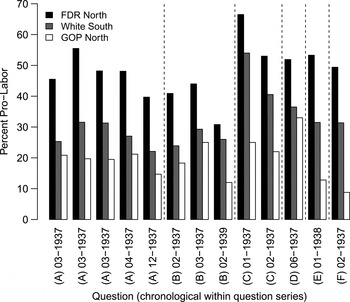
Public ambivalence or hostility toward unions, and toward the CIO in particular, first becomes evident in polls conducted during the sit-down strikes.Footnote 65Figure 1 summarizes the results from a series of Gallup poll items relating to the sit-down strikes. The figure compares the percentage of pro-labor responses among three groups: FDR voters in the North, Landon voters in the North, and all white Southerners.Footnote 66 The juxtaposition of these percentages illustrates the ideologically intermediate position of white Southerners relative to the two Northern partisan groups, who were quite polarized on this issue.Footnote 67
Comparison of percentages of pro-labor responses to sit-down strikes among Northern Democrats, Northern Republicans, and white Southerners. (A) “Do you think that state and local authorities should use force in removing sit-down strikers?” (B) “Do you think this state should pass legislation making sit-down strikes illegal?” (C) “In the current General Motors strike are your sympathies with the John L. Lewis group of striking employees, or with the employers?” (D) “Should the militia be called out whenever strike trouble threatens?” (E) “In the present dispute between Henry Ford and the Automobile Workers union, are your sympathies with Ford or with the Union?” (F) “Would you like to see John L. Lewis succeed in organizing the Ford Motor Company?”

Immediately after the sit-down strikes began, Gallup asked respondents: “In the current General Motors strike are your sympathies with the John L. Lewis group of striking employees, or with the employers?” In that January 1937 poll, the public was nearly evenly divided; the unweighted responses suggest a narrow plurality sympathized with GM, but the weighted numbers suggest that 37 percent favored the union, as compared to 32 percent who favored GM, with the remainder uncertain. The regional breakdown of support is striking in light of later developments: Southern white respondents supported the union at the same rate as Northerners.Footnote 68 As the strife in Michigan wore on, however, opinion shifted decisively against the strikers. An identically worded question in February 1937 suggested that 42 percent of the public now favored GM, as compared to 32 percent favoring the strikers.Footnote 69 Once again, the South was similar to the rest of the country, splitting 42 percent to 29 percent in favor of GM. The data also suggest a sharp class skew in the responses: professionals, businesspeople, and (to a slightly lesser extent) skilled workers opposed the union by a wide margin, while unskilled workers and the unemployed backed the strikers by a fifteen-point margin.
Gallup also began polling respondents about their preferred policy response to the sit-down strikes in late February 1937. Initially, Gallup asked whether the respondent wanted “this state” to pass legislation “making the sit-down strikes illegal.” The breakdown was 60 percent in favor and 28 percent opposed, with the remainder undecided. Southern white respondents were a bit more anti-strike than the rest of the country (65% in favor of banning the strikes, with 22% opposed). When the same item was repeated in March 1937 and again in February 1939, the distribution of responses was similar. The 1939 survey shows the most lopsided margin in favor of banning the strikes (64%–22%). It is worth noting that, in each case, a clear plurality of Northern Roosevelt voters favored making the strikes illegal.
From March to December 1937, Gallup also repeatedly asked about “using force” to remove the sit-down strikers. The March survey revealed a slim majority in favor of using force (51% to 37%, with 12% unsure). By December 1937, 64 percent favored the use of force, as compared to 23 percent opposed. Support for using force was particularly strong in the South, but Southern whites were still less likely to endorse the use of force against strikers than were Northern Republicans. In addition, even Northern FDR voters offered plurality support for the use of force (with the margin quite small in March and April but substantial in December 1937). As one might expect, a clear majority of both AFL and CIO members opposed using force, as did a majority of unskilled workers and the unemployed (including non-union members in the latter two groups). But beyond those groups, hostility to the sit-down strikes appears to have been widespread.
While we lack panel data to trace changes in individual opinion, those questions that were repeated over time suggest at least some deterioration in support for the strikes during 1937 (see Figure 1). Further evidence can be found in a June 1937 Gallup poll, which asked whether respondents’ attitude toward unions had changed during the past six months, and if so, in which direction. Half of the respondents reported that their views had changed; of these, 70 percent claimed to be more negative toward unions than they had been six months earlier.Footnote 70
Given the persistence of anti-union attitudes long after the sit-down strike wave ended, it would be wrong to attribute organized labor's troubles entirely to the strikes. Indeed, popular support for union-friendly policies decreased still further as the United States mobilized for and entered the Second World War. Instead, the reaction to the sit-downs is better viewed as indicative of the structural obstacles confronting the labor movement over the long term. For all of the anger at business in the Depression years, movements that seemed to promise a fundamental reordering of authority relations faced considerable public skepticism.Footnote 71 Social movements in subsequent decades faced a similarly hostile response to their use of socially disruptive tactics.Footnote 72 Furthermore, unions confronted an organized opposition interest, business, which had the resources and motivation to capitalize upon this public reaction. The mass public's ambivalence toward unions provided a favorable backdrop for corporations intent on fighting strikes and unions with threats, coercion, and other aggressive tactics. In this hostile climate, the CIO faced the challenge of harnessing the shop-floor energy and anger that gave rise to such innovations as the sit-down, without at the same time alienating the public as a whole.Footnote 73 The breadth of the CIO's agenda as it took shape in the late 1930s—incorporating civil rights and national health insurance, among other issues—accentuated this challenge. Thus, from the start, the CIO's broad constituency and ambitious political goals made it an inviting target for conservatives. From this perspective, the sit-down strikes are best viewed as the first in a series of sparks for anti-labor drives.
The sit-down strikes are also the first of many examples of congressional conservatives seeking to capitalize upon and exacerbate popular anger against unions. As noted above, congressional conservatives moved immediately to investigate the sit-down strikes. Although the overwhelmingly Democratic House rejected the initial investigative resolution when it was brought to the floor, in 1938 the Dies Special Committee on Un-American Activities, chaired by conservative Texas Democrat Martin Dies, targeted the sit-down strikes in its first round of widely publicized inquiries. Beyond attempting to link the strikes to communist influence, the Dies Committee sought to show that the strikers had received tacit support from Michigan Democratic Governor Frank Murphy, who lost his reelection bid later that fall. Newspaper accounts at the time attributed Murphy's defeat to the Dies Committee investigation, which, along with overwhelmingly negative press coverage, helped fuel public anger over the sit-down strikes.Footnote 74
Ideally, we would seek to determine the direct effect on public opinion of the Dies Committee's activities and other conservative initiatives. Unfortunately, our data are not well suited for such purposes, which would require, at minimum, identical questions asked shortly before and after the event in question.Footnote 75 Instead, polling organizations usually started asking relevant questions after the story had already broken.Footnote 76 The earliest survey questions on union communism, for example, were asked in August 1938, during the Dies Committee's first exposé of communism in the CIO.Footnote 77 In that survey, 60 percent of respondents agreed that “communists have influence in labor unions,” with roughly a quarter of the public claiming further that communists had “very much” influence. Perhaps because the survey was conducted before word of the investigations had time to spread very widely, Southern whites were less likely than other respondents to agree that unions were influenced by communists (47% vs. 60% overall).
Over time, as unions were targeted by repeated congressional investigations, including several Dies Committee hearings and Howard Smith's probe of the NLRB, the view that unions had considerable communist influence seems to have grown. In an October 1941 Gallup poll, 62 percent of respondents replied in the affirmative when asked, “Do you believe that many labor union leaders are communists?,” compared to just 24 percent who answered negatively. By that time, Southern whites were eleven points more likely than Northern whites to agree that many union leaders were communist. While these results do not prove that the investigations influenced public opinion, they are consistent with the idea that Southern Democratic elites, working with their GOP allies, stoked the association between unions and radicalism through investigations and other tools.
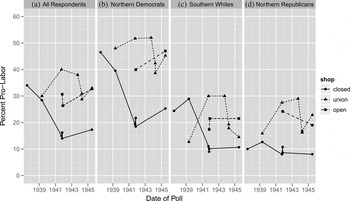
In the late 1930s, pollsters began asking respondents about their views on a different issue: employer policies regarding the “union shop,” the “closed shop,” and their alternative, the “open shop.”Footnote 78 This issue was, of course, a major concern for unions, since the open shop would undermine their ability to gain and maintain a substantial membership base across industries. Figure 2 summarizes the results from a series of survey items on this issue conducted between 1937 and 1945. It plots the percentage of liberal (that is, pro-union) responses to questions about the union, closed, and open shops. The results suggest that in this period a healthy majority of the public opposed both the closed and union shops and instead favored the open shop.Footnote 79 This result holds for both the questions that asked directly about these arrangements (e.g., “Are you in favor of the so-called ‘closed shop’—that is, hiring only persons who are already members of the union to work in a factory or a mine?”) and questions that offered respondents a choice among the open, union, and closed shops. As one might expect, Republican voters were overwhelmingly opposed to the union and closed shops. On this issue, Southerners looked more like Northern Republicans than like Northern Democrats.Footnote 80 Even Northern Democrats were closely divided, however, with a majority generally opposing the closed shop.
Trends in attitudes toward the closed, union, and open shops (question wordings are roughly comparable over time). The exact wording is available in an online appendix posted at: http://igs.berkeley.edu/schickler/docs/Schickler_Caughey_online_appendix_2011.pdf

While changes in question wording require that temporal trends be interpreted with caution, support for the closed shop appears to have dropped substantially, hitting a low point around 1942. This drop occurred among all groups except Northern Republicans, whose support was very low to begin with. Southern whites, whose support for the pro-labor position at the beginning of this period was about the same as that of all Northern whites, ended up at about the level of Northern Republicans. Against this backdrop of minority and declining support for the closed shop, the War Labor Board's (WLB) adoption of “maintenance of membership” clauses as a standard for wartime labor contracts can be seen as a significant boost to unions, providing a stable source of union dues even in the face of popular skepticism toward such programs.Footnote 81 When a 1944 Gallup survey asked about maintenance of membership,Footnote 82 just 24 percent of the respondents favored the plan, with 60 percent opposed and the remainder undecided. Roughly the same percentage of Southern whites and Northern Republicans backed “maintenance of membership” (15% and 14% respectively). Strikingly, Roosevelt voters in the North also opposed the policy by a 50 percent to 31 percent margin, underscoring how Northern Democrats were divided over pro-labor policies. Again, this reinforces the message that while Southern whites had become distinctive in their degree of opposition to pro-union policies, the broader Northern public also tilted against union priorities.
Public concern about union power and tactics continued throughout the war years. For example, across a range of polls from 1941 to 1945, more than 70 percent of respondents supported banning strikes in war industries.Footnote 83 Southern respondents were consistently among the most eager to ban strikes and punish strikers during the war, but even Northern Roosevelt voters favored banning strikes in war industries. Indeed, when asked in July 1945 about banning all strikes during the war, 79 percent of respondents agreed, including 74 percent of Northern Roosevelt voters. These data suggest that the “no strike” pledge made by union leaders following Pearl Harbor, while criticized by some observers for taming shop-floor activism, may well have been a necessary concession to a hostile public and Congress.Footnote 84
While one might argue that poll questions about wartime strikes would have been particularly likely to give rise to anti-union responses, other items that did not reference strikes depicted a similar public mood. For example, in March 1941, Gallup asked respondents: “Do you think labor union leaders are helping the national defense production program as much as they should?” Just 17 percent of respondents answered in the affirmative, as compared to 67 percent who said union leaders had not been helpful. Once again, even Northern Roosevelt voters responded that union leaders had not done as much as they should (59% “no” vs. 23% “yes”), though Republicans and Southerners were even more negative. The same survey asked about “industrial (business) leaders,” with much different results: 49 percent responded that business leaders had done as much as they should, as compared to 32 percent who said that business leaders had not done as much as they should.
It is worth emphasizing that a majority of Americans continued to support the right to strike in peacetime and were in favor of the right to organize unions. Still, the evident widespread anger over (the relatively few) wartime strikes seems to have further eroded unions’ standing with the public. Thus, when Gallup asked in early May 1943 whether respondents’ views of unions had changed over the past year, 38 percent reported being less supportive, as compared to 5 percent who were more supportive than a year earlier. Forty-seven percent of white Southerners claimed to have become less supportive of unions, and only 3 percent claimed to be more so, while 38 percent of Northern whites claimed to be less supportive, 6 percent more supportive. Even 36 percent of Roosevelt voters in the North claimed to have become less in favor of unions, as compared to 7 percent who claimed to have become more in favor.
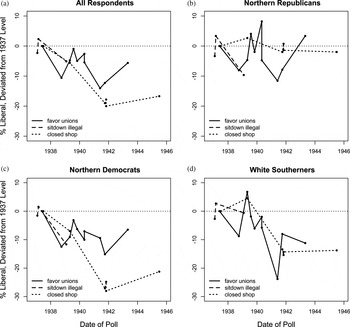
Figure 3, which focuses on the limited number of repeated labor union questions on polls over time, underscores the increasingly difficult political context facing unions. The figure puts the items on a common scale by using the level of pro-union support for each question as of 1937 as a baseline. The evidence points to an overall decline in union support (Figure 3a). Interestingly, this decline hits both Northern Democrats and white Southerners (Figures 3c and 3d). But since white Southerners started with a lower support level than Northern Democrats, the decline drives them all the way down to the same support level as Northern Republicans (see also Figure 4b below). Northern Republicans, who had come to encompass a much larger share of the Northern electorate by the mid-1940s than they had in 1937, began the period much less supportive of unions than Democrats and remained reasonably stable in absolute terms (Figure 3b).Footnote 85
Support for labor among four groups, relative to their level of support in 1937. The three question series plotted—favorability toward unions, making the sit-down strike illegal, and support for the closed shop—are comparable over time.

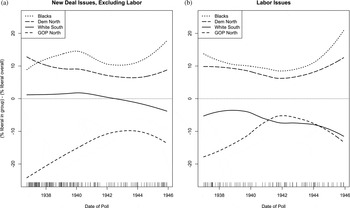
Comparison of ideological trends on labor and non-labor issues among Northern Democrats, Northern Republicans, Southern whites, and African Americans. The difference between the level of support in each group and the overall level of support in the sample is plotted, smoothed with local polynomial regression.

A key question is to what extent the public reaction against the sit-down strikes and war strikes—along with public resistance to the union and closed shops—forced labor unions to temper their ambitions and accept a more limited place in American politics. Brinkley highlights the importance of external pressures in encouraging unions to adopt the no-strike pledge during the war and, more generally, to moderate their demands for far-reaching structural changes. But he also emphasizes the role that internal splits and ideological shifts within the movement played in drawing unions away from a broader, reformist vision. In particular, Brinkley distinguishes those labor leaders, such as John L. Lewis, who promoted an independent labor movement in support of “industrial democracy,” from pragmatists, such as Sidney Hillman, who sought a close alliance with the Democratic Party.Footnote 86 “The postwar political landscape,” he writes:
might have looked very different if leaders more like Lewis than Hillman had managed to shape trade union decisions in those years . . . . But in the conservative climate of the 1940s and 1950s, it is difficult to imagine labor achieving much more . . . with a more radical leadership. The “lost alternative” of the 1940s was probably not labor's emergence as an equal partner within the industrial economy. It was, rather, the survival of an independent social and political force capable of raising challenges to existing ideas and institutions from a position of relative weakness.Footnote 87
There is little doubt that divisions within the labor movement, particularly the AFL–CIO split, were extremely damaging. But it is also worth emphasizing the extent to which Lewis's aggressiveness, magnified by extraordinarily negative press coverage, made him a negative symbol even before World War II. An early example of this is from October 1937, when Roper asked “Can you think of any well-known man in business or industry of whom you approve? If yes, who? Can you think of any such well-known man of whom you disapprove? If yes, who?” In response to this open-ended question, John L. Lewis was easily the top individual selected for “most disapproved”—with over 30 percent selecting Lewis (as compared to 18% for Henry Ford, 7% for J.P. Morgan, and 6% for Andrew Mellon).Footnote 88 In April 1940, before the strike wave in the lead-up to the war, 45 percent of respondents believed that Lewis had been “harmful” to labor, with just 33 percent claiming that he had been “helpful.”Footnote 89 In November 1941, amidst a major coal strike, Gallup asked: “What is your opinion of John L. Lewis?” A full 69 percent of respondents answered negatively about Lewis (with open-ended responses ranging from “he should be hanged” to “he's a radical, communist”), as compared to 12 percent answering positively and 20 percent unsure or neutral.Footnote 90 Finally, a November 1943 Roper poll asked, “Are there any prominent individuals in this country who you feel might be harmful to the future of the country unless they are curbed?” Of the 52 percent of respondents who named someone, Lewis was overwhelmingly the top answer (71% chose Lewis, as compared to 5.5% for second-place finisher Roosevelt and 5% for Henry Wallace).Footnote 91
Even after Lewis withdrew from the CIO, negative views of the organization persisted. A Gallup poll in May 1944 asked, “If the CIO union supported a candidate, would you be more likely to vote for that candidate, or against him?” A majority of respondents said that they would be less likely to vote for the candidate (52%), as compared to 11 percent who said an endorsement would make them more positive toward the candidate.Footnote 92 Even Northern Roosevelt voters said a CIO endorsement would make them less likely to vote for a candidate (41%–15%). The CIO's unpopularity, even among many Northern Democratic voters, forced liberal candidates to engage in a delicate balancing act, seeking to capitalize upon the group's many resources without appearing beholden to it.Footnote 93
As the war was ending in March 1945, Gallup asked respondents whether their attitude toward labor unions was “more favorable or less favorable than it was before the war.” In the sample, 56 percent of respondents reported that their attitude was less favorable, as compared to 24 percent who reported their views to be unchanged, and 20 percent whose attitude was more favorable than prior to the war. By contrast, only 19 percent of respondents reported that their attitudes were less favorable toward “business concerns” than before the war (with 32% more favorable and 49% unchanged). Among Southern whites, 71 percent of respondents reported that they felt less favorable toward unions, as compared to 55 percent of Northern whites.Footnote 94 But even among Roosevelt voters in the North, 43 percent reported becoming more negative in attitude toward unions, as compared to 27.5 percent reporting a favorable shift in views.Footnote 95
All of this suggests that the pragmatic adjustments of individuals such as Hillman and the UAW's Walter Reuther may well have been necessary to avoid a far more draconian governmental response. Greater labor radicalism would have likely either been met by a repressive response from the administration and Congress or by the earlier election of a Republican president and majority in Congress.Footnote 96 As Zieger's definitive history of the CIO makes clear, the organization itself was, even in its heyday, in a precarious position. The considerable shop-floor resentment and militancy that generated the sit-down strikes and other grassroots actions was often not coupled with a willingness of many workers to pay union dues. This weakness made good relations with the national government essential, even if it at times required tamping down on shop-floor demands.Footnote 97
The opinion data thus reveal a conservative, anti-union pulse in the mass public that began in 1937 with the sit-down strikes, continued in 1939 to 1941 during the run-up to the war, and, if anything, became more intense after the war began. The anti-labor pressure was shared across regions, though it was particularly intense in the South. While further analysis is required examining different occupational, ethnic, and urban/rural slices of the electorate, preliminary work suggests that even urban workers were not immune to anti-union appeals.
Two aspects of the governmental response to this public sentiment seem noteworthy. First, despite the wide popular support for governmental action against unions during the war—both within the South and the North—the Roosevelt administration and Northern Democrats in Congress proved largely successful in staving off or watering down the harshest attacks.Footnote 98 The administration and Democratic congressional leaders understood that harsh anti-labor legislation would undermine the central goal of maximum production during the war and thus resisted the popular attacks on unions.Footnote 99 The decisions issued by the War Labor Board were widely viewed at the time as favoring unions. The anti-labor bills passed by the House often found themselves buried in the Senate Education and Labor Committee, which was chaired by pro-labor Senator Elbert Thomas (D-UT) during the war.Footnote 100 The plant seizure provisions of the Smith–Connally Act, though enacted over Roosevelt's veto, were actually turned against management when Roosevelt seized Montgomery Ward in 1944.Footnote 101 In the aftermath of the war, when another strike wave sparked the anti-labor Case bill of 1946, Truman used his veto power to defend the existing policy regime.Footnote 102
Second, even as Democratic presidents and congressional leaders blocked anti-labor policy initiatives, they were much less successful at preventing conservative Southern Democrats from working with Republicans (and allies in the press) to pursue investigations that heightened public anger against unions. These investigations were not subject to presidential vetoes and generally had a relatively easy road to House approval due to support from the conservative coalition–controlled House Rules Committee.Footnote 103 While the opinion data are not well suited to assessing the causal role of specific investigations, it is clear that congressional conservatives pursued these investigations with the goal of influencing the public to strengthen the push for anti-labor legislation. It is also evident that newspapers responded with frequent front-page coverage that often portrayed labor unions in a bad light. An online search revealed 197 front-page stories in the New York Times that referred to congressional investigations relating to labor unions from 1937 to 1945.Footnote 104 Pollsters repeatedly followed investigations with questions that inquired about labor policy, and the public provided answers to those poll questions that were consistent with the conservatives’ policy goals. In that sense, one can view the investigations as part of a broad, long-term strategy to attack labor's place in the emergent New Deal regime. In pursuing investigations that linked unions to communists and other subversives, and by pushing for legislative action to impose drastic restrictions on labor, Southern elites were acting in ways that broadly reflected the polling data in their region. At the same time, these actions likely reinforced this public sentiment, helping shape the public's views of the labor movement.Footnote 105
Still, while congressional conservatives encouraged public anti-labor sentiment, they were unable to enact major policy changes in the 1937 to 1946 period.Footnote 106 Ironically, however, this conservative failure may have contributed to the widespread public sense that labor was too powerful in the 1940s.Footnote 107 Given the structural features of American politics—and the intimate involvement of business leaders in shaping the war mobilization—it is difficult on its face to understand how the public could have identified labor, rather than business, as privileged with too much power during this period.Footnote 108 But when one considers the simultaneous ability of conservatives to fuel popular outrage about unions and their failure to move policy substantially, this public sentiment is easier to understand. From this standpoint, Republicans were able to run against labor “excesses” in the North up until they actually succeeded in passing the anti-union Taft–Hartley Act in 1947.
Truman's reelection in 1948 may thus owe something to the override of his Taft–Hartley veto. The GOP's success in finally striking back against unions arguably cost the party a popular issue and allowed Democrats to charge that the Republicans had gone too far in shifting policy to the right. Still, the new Democratic Congress lacked a clear majority for repeal of Taft–Hartley, suggesting that even in the aftermath of the 1948 election, a return to the Wagner Act labor policy regime was not a winning issue for Democrats. In other words, even if many voters believed the Republicans had gone too far, support for a return to the pre-Taft–Hartley status quo was weak.
These patterns highlight the difficult trade-offs facing labor leaders. On one hand, rank-and-file workers angry about working conditions and limited pay increases often pushed their leaders toward more confrontational strategies. In addition to assuaging shop-floor resentment, aggressive campaigns to organize additional industries and workers could, by enlarging the ranks of organized labor, strengthen its political and economic position. On the other hand, such militancy, especially during wartime, provoked a powerful backlash from both the public and from government officials, even sympathetic ones on whom unions depended for favorable treatment. Thus the same tactics necessary to organize new workers and respond to shop-floor pressures reinforced the backlash that put unions on the political defensive. In that sense, unions were engaged in a race against time: they needed to organize a substantial enough share of the workforce to make their political position invulnerable, before their opponents succeeded in translating the anti-strike backlash into policy changes that would hamper further organizing. With the ultimate passage of Taft–Hartley, unions lost that race. From this standpoint, the reactions against the sit-down strikes and wartime strikes were indicative of the severe barriers that faced the American labor movement. In order to expand their presence into recalcitrant industries (e.g., auto, steel), unions needed to exercise power in ways that were broadly seen as illegitimate; organized labor would remain popular among the broader public only if it did not use the tactics necessary to expand its presence across industries.
For liberals hoping to implement a social democratic policy regime in the aftermath of the war, tenuous public support of unions constituted a key constraint on their aspirations.Footnote 109 Elite debates about Keynesian fiscal policy, antimonopolism, and planning took place in a context of substantial public restiveness toward the main source of organizational muscle behind liberal hopes, labor unions. This public sentiment was reflected most directly in Congress, where members both responded to it and, in the case of conservatives, sought to reinforce it. When congressional Southern Democrats and Northern Republicans joined together in advocating restrictions on labor unions, both groups were reflecting a broadly held perspective among their constituents. At the same time, Northern Democrats faced a more difficult situation in which their own constituents were evidently deeply split on labor issues. Their core supporters included CIO members (and members of other unions) who strongly opposed restrictions on strikes, yet a substantial portion of Northern Democratic voters opposed the sit-down strikes, viewed the closed and union shops with suspicion, supported a crackdown against wartime strikes, and believed unions had become too powerful.
COMPARISON BETWEEN LABOR AND OTHER NEW DEAL ISSUES
Was the public's turn against organized labor part of a broader conservative reaction, or did popular attitudes toward labor unions exhibit distinctive dynamics? To examine this question, we compare public opinion on questions related to labor unions with popular attitudes toward New Deal liberalism generally. In addition to questions related to organized labor, we have identified all items concerning economic policy, government–business relations, domestic spending, social welfare policy, and liberal–conservative self-identification asked in polls between 1936 and 1945.Footnote 110 In aggregate terms, the percentage of respondents supporting the liberal position on non-labor questions remained roughly stable over time. By contrast, on labor issues, pro-liberal sentiment fluctuated dramatically over the period, beginning a precipitous decline in 1939, bottoming out in 1942, and recovering by the end of the war. Because the mix of questions is not stable over this period, however, changes in absolute percentages must be interpreted with great skepticism.Footnote 111
In recognition of this, we focus instead on the liberalism of different demographic groups relative to the population as a whole. Figure 4 presents side-by-side comparisons of attitudes toward labor and non-labor issues among four groups: white Southerners, Northern Democrats, Northern Republicans, and African Americans.Footnote 112 The figure plots each group's deviation from the percent liberal among all respondents. While painting with a somewhat broad brush, these summary figures offer the first systematic, comprehensive analysis of opinion trends among partisan groups in the North, white Southerners, and African Americans for this pivotal period in American politics. As Figure 4a illustrates, on issues unrelated to labor unions, white Southerners occupied an ideological position roughly halfway between Northern Republicans and Northern Democrats (though a bit closer to Northern Democrats), with African Americans the most liberal group. Indeed, throughout this period white Southerners’ liberalism on these questions closely tracks the overall percent liberal in the population. On non-labor questions, white Southerners begin the period slightly more liberal than average and end it slightly more conservative, suggesting a small shift to the right relative to the country as a whole. Thus Southern Democrats’ pivotal position in Congress was also reflected at the mass level by the ideological centrality of their constituents.
On labor issues, the pattern is somewhat different: Southerners begin the period as relative moderates, but by 1941 they are at least as anti-labor as Northern Republicans, if not more so (see Figure 4b).Footnote 113 While it is difficult to draw definitive conclusions from the data, the convergence of white Southerners and Northern Republicans on labor issues appears to be the joint consequence of two phenomena. The first is that between 1937 and 1942, Northern Republicans gradually became less conservative relative to the rest of the public (this holds for both labor and non-labor issues, see Figure 4).Footnote 114 The second phenomenon is the anti-labor trend from 1937 to 1942, which was particularly acute among white Southerners. In absolute value, the drop in Southern whites’ support for labor was only slightly larger than the drop among Northern Democrats, but this decrease was proportionally much greater for Southerners, given their already lower level of support, and thus was indicative of a movement from ambivalence to outright hostility. In contrast to other New Deal issues (toward which white Southerners remained ideologically central throughout this period), on labor questions white Southerners began substantially to the right of Northern Democrats and ended at least as conservative as Northern Republicans.
On average, African Americans were a bit to the left of Northern Roosevelt voters on both labor policy and on most non-labor related issues. Blacks’ favorability toward labor suggests that the tension between these key components of the New Deal coalition emphasized by some authors was not especially evident at the mass level in the 1930s to 1940s.Footnote 115 Since Gallup largely excluded Southern African Americans during this period, the data mainly represent the views of Northern African Americans.Footnote 116 In a separate analysis, we compared Southern and Northern African American opinion across a range of items for those (non-Gallup) surveys that included both groups in reasonable numbers. Not surprisingly, we found that Southern African Americans were more likely to provide “don't know” as a response than their Northern counterparts. But among those expressing an opinion, the percentage liberal was remarkably similar across the two regions.Footnote 117 Therefore, it appears reasonable to infer from our data that African Americans have been distinctive in their liberal policy preferences—across a range of policy issues, including labor unions—at least since the late 1930s.Footnote 118 These views posed a serious obstacle for those Republicans eager to woo African Americans back to the GOP after their defection to Roosevelt in the 1930s.Footnote 119
Closer inspection of the early survey data reveals an American public that favored keeping most of the New Deal in place but that was not clamoring for major liberal innovations beyond that. For example, a March 1940 Roper–Fortune survey asked what respondents wanted the next administration to do about the New Deal. Of those with an opinion, a mere 13 percent wanted to “go farther with it,” while another 18 percent wanted to “keep it as it is.” A plurality of 45 percent wanted to “modify it,” while 23 percent favored “repealing most of it.” Northern whites were actually less supportive of going further with or keeping the New Deal “as it is” than were Southern whites, though the difference disappears when one isolates Roosevelt voters.Footnote 120 Other, similar questions from 1939 to 1940 reveal the same pattern: widespread opposition to repeal of the New Deal, but a preference for incremental modifications rather than broad further advances.
When asked about their ideology explicitly, respondents were nearly evenly split between “liberal” and “conservative” labels in 1938 and 1939, with little evidence of a regional cleavage. Similarly, when asked whether they would join a liberal or conservative party in 1937 and 1938, the public was about evenly split, with Southern whites actually more supportive of a liberal party than their Northern counterparts. A handful of surveys from 1936 to 1938 also asked whether the Roosevelt administration ought to be more conservative or liberal. When offered no middle option, a large majority favored the administration's becoming more conservative. For example, in June 1938, 64 percent of respondents with an opinion favored a more conservative course versus 36 percent who did not. White Southerners were, on average, slightly more in favor of liberalism in the survey than were Northern whites. A clear majority of African Americans, however, preferred a more liberal course for Roosevelt.Footnote 121
As the war was concluding, Gallup began to ask whether respondents preferred for the administration to “go more to the left by following more of the views of labor and other liberal groups,” or “go more to the right by following more of the views of business and conservative groups.” When no middle option was offered, as in a December 1945 survey, 56 percent of respondents favored moving right versus 44 percent who preferred moving to the left. The mention of “labor”—and the possible civil rights connotations of “liberal groups”—may explain why a resounding 74 percent of Southern whites favored moving right. The North was more liberal than the South, but still showed a small margin for the conservative position (54% vs. 46%). In other surveys, when respondents were offered a middle option (“follow a policy halfway in between the two”), most opted for the moderate course, with “rightward” and “leftward” shifts well behind.Footnote 122 Again, however, these results suggest a tilt toward consolidation of existing programs, with perhaps some conservative revisions, rather than bold liberal advances.
In sum, when asked about government policy and ideology in the abstract, the data indicate that, even in the late 1930s, survey respondents both in the North and in the nation as a whole tended to favor a more conservative course than Roosevelt was following while opposing a wholesale rollback of the New Deal. By the end of the war, Southern whites had become particularly suspicious of leftward movement, but even Northern respondents tended to lean slightly in a conservative direction. These results are consistent with Ellis and Stimson's conclusion that even during such liberal high points as the New Deal and the Great Society, self-identified liberals never constituted a plurality of the public, even in the North.Footnote 123
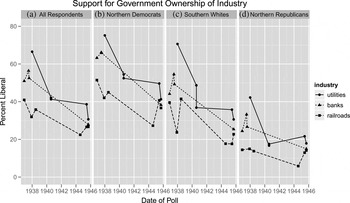
When we turn to more specific policy issues, the general portrait of a public supportive of several key New Deal programs but reluctant to push much further comes into even clearer focus. Figure 5 presents trends with regard to government ownership of key industries: electric utilities, banks, and railroads. These items are useful both because there is a reasonable degree of continuity in question topic and wording over the 1936 to 1945 period and because they speak to general orientations toward the role of government.Footnote 124 Across all three issues, there is a clear downward trend in aggregate support for government ownership from the late 1930s to the mid-1940s. In 1937 to 1938, overall support for government ownership ranged from about 40 percent for railroads to 50 percent for banks and over 60 percent in the case of electric power companies. By the end of the war, however, as Britain prepared to elect a Labour government committed to national ownership of key industries, only 25 to 30 percent of Americans expressed support for government ownership of each of these industries.Footnote 125 Panels B, C, and D of Figure 5 demonstrate that this downward trend in support held across regions and partisan groups. Just as when all non-labor issues were examined (Figure 4a), white Southerners were to the left of Northern Democrats but to the right of Republicans, placing them exactly in the center of national opinion on the question of government ownership.Footnote 126
Trends in support for government ownership of electric utilities, banks, and railroads, among all respondents (a) and among Northern Democrats (b), Southern whites (c), and Northern Republicans (d).

While support for government ownership of industry fell from 1936 to 1945, support for key elements of the New Deal welfare state remained robust or even increased over time. The polling is particularly revealing on the issue of Social Security, whose public popularity seems to have become entrenched even before the first monthly benefit checks were cut.Footnote 127 As early as November 1936, nearly 70 percent of the public expressed support for “the compulsory Old Age Insurance Plan” that had been adopted the previous year and that would be implemented in January 1937. Right after implementation began, 78 percent of respondents expressed support for the plan. In both cases, Southern whites were about 10 points more supportive than Northern whites, but most striking is the overwhelming level of support among all groups. Even Northern Republicans backed Social Security as of January 1937 by 57 percent to 43 percent, though Republicans had leaned against the program when asked in November 1936. Approval of the program continued to climb, reaching 85 percent when a similarly worded item was asked in July 1938 and exceeding 90 percent when a slightly revised question was asked later in 1938.Footnote 128 Support was overwhelming among Southern whites, Northern Democrats, Northern Republicans, and African Americans.Footnote 129
In addition, respondents generally favored expanding the program to cover those groups that had been excluded in the 1935 Act. For example, a December 1944 Gallup poll asked whether Social Security should be expanded to cover farmers, government employees, the self-employed, and domestic servants.Footnote 130 A substantial majority favored incorporating each of these groups (ranging from 68% for the self-employed to 82% for domestic servants). Southern whites were roughly as supportive of each of these proposed expansions as were Northern whites, with the exception of domestic servants. But even in the case of domestic servants, 71 percent of Southern whites took the liberal position (as compared to 85 percent of Northern whites). This level of popular support for expanding Social Security is striking given the role of Southern members of Congress in creating these occupational exclusions in the first place so as to exclude Southern blacks from eligibility.Footnote 131 Northern Republicans too favored each of these expansions of coverage by a substantial margin. These data speak to the impressive level of support achieved by Social Security; from the start, political attacks on government old-age pensions would not resonate with the mass public.Footnote 132
The polling data suggest that other key New Deal programs enjoyed widespread support even if they fell short of the near-universal popularity of Social Security. For example, minimum-wage and maximum-hours legislation was approved by a clear majority of respondents from 1937 to 1938, and there was widespread support for a minimum-wage increase in 1945. In the case of wages and hours legislation, however, the partisan split was more pronounced than on Social Security, with Northern Republicans generally opposed. Still, the balance of opinion—in both North and South—favored the New Deal's wages and hours protections. The same was true of other key regulatory measures, such as Roosevelt's banking and stock exchange legislation, along with such New Deal innovations as farm subsidies, the Civilian Conservation Corps (CCC), and the National Youth Administration (NYA).Footnote 133 Public support for the CCC and NYA, however, could not prevent a conservative coalition of Republicans and Southern Democrats in Congress from eliminating the two programs during World War II.
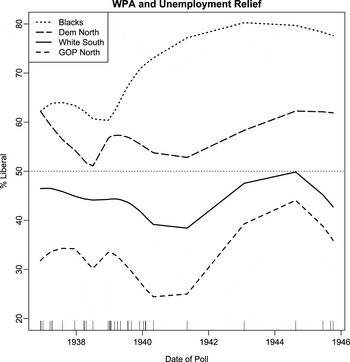
Aside from policies toward labor unions, the one major cluster of New Deal economic programs that stirred considerable public opposition in the polls was the WPA relief program. The WPA was under attack from conservatives in Washington from 1938 on, with Southern Democrat Clifton Woodrum (D-VA) leading a damaging investigation of WPA practices, and Republicans teaming up with Southerners to promote limitations on WPA programs.Footnote 134 Indeed, newspapers provided extensive coverage of hearings targeting alleged WPA misbehavior just as Congress was engaged in a heated battle over WPA funding. While the opinion data do not include survey items that allow us to pinpoint the impact of these investigations, they were no doubt intended to bring the agency into disrepute and produced no shortage of headlines likely to tarnish its image. For example, New York Times stories covering the Woodrum hearings featured such front-page headlines as “House Group told of Red Domination over WPA Writers” (May 2, 1939), “WPA Costs Here Two Times Those of Private Builders, Experts Say” (May 3, 1939), and “WPA Witness Says Soviet Trained Him in Street Fighting” (June 7, 1939).Footnote 135 Again, conservative efforts to force investigations of the WPA were likely facilitated by public skepticism toward relief, while simultaneously stoking that skepticism.
While the general public rejected the idea of doing away with the WPA entirely, the polling suggests that there was considerable support for scaling back its activities. For example, Roper asked in May 1940, “What do you think the next administration should do about the WPA: increase it, keep it as is, cut it down, or do away with it altogether?” A mere 11 percent favored increasing the size of the program; another 31 percent favored keeping it as is. However, 48 percent supported either cutting down or doing away with the program.Footnote 136 By contrast, 86 percent of respondents favored increasing or keeping as is the CCC, and 55 percent favored increasing or keeping as is “major public construction projects like PWA.” As Figure 6 shows, on relief issues, white Southerners begin in 1937 about halfway between Northern Democrats and Republicans but end up somewhat closer to the latter by 1945. The relative liberalism of blacks is especially apparent in this figure.Footnote 137 The general unpopularity of WPA relief relative to other government benefits, such as old age assistance or agricultural subsidies, is a reminder that public support for New Deal welfare programs depended on whether the beneficiaries were considered deserving members of the civic community.Footnote 138 Despite the severe recession of 1937 to 1938, it seems that public sympathy for the unemployed was not great enough to countenance a permanent government “dole.”
Comparison of trends in attitudes toward unemployment relief and the WPA. Because the questions become infrequent starting in 1941, the loess lines after that date should be treated skeptically.

Although few specific programs provoked as much opposition as the WPA, the idea of cutting the overall level of government spending was quite popular, at least when posed in abstract terms. For example, a March 1939 Gallup survey asked half of its respondents the following question: “It has been suggested that the Federal Government cut ALL expenditures by 10 per cent. Do you favor this idea?” Respondents with an opinion favored the cut by 81 percent vs. 19 percent, with 63 percent favoring an even more drastic 20 percent cut. Southern whites mirror the national numbers almost exactly, once again spitting the difference between Northern Democrats and Republicans. The split-sample survey asked the other half of respondents a similar question about spending cuts, but cued the specific programs involved: “It has been suggested that the Federal Government cut ALL expenditures—including relief, farm aid, pensions, national defense and ordinary government running expenses—by 10 per cent. Do you favor this idea?” Faced with this question wording, a majority of 55 percent vs. 45 percent opposed the spending cut. Once again, Southern whites’ response distribution was similar to the national distribution and was about midway between the two Northern partisan groups. These results, which are typical of other surveys in the period, speak to both the abstract opposition to high spending and the greater support for specific spending programs. Just as it has become a commonplace of American politics in recent years that the mass public opposes federal spending in the abstract even as it expresses support for most specific spending programs,Footnote 139 a similar pattern is evident in the late 1930s and 1940s. These results suggest that Republicans had a potential weapon in appealing to abstract opposition to spending, but that they also had a strong incentive to steer clear of targeting many specific spending programs, with the notable exception of relief policy.
In sum, an examination of a broad range of survey items across the 1936 to 1945 period suggests that most New Deal policies were much more popular than its labor union policies. Although the public was skeptical of programs that promised a dramatic further increase in the national government's role, such as public ownership of key industries, there was little mass support for a wholesale rollback of the New Deal. Examination of comparable questions series on issues like government ownership offers signs of a general drift to the right in the late 1930s and 1940s, but this trend did not translate into support for specific, major conservative policy changes outside of the labor relations field. Moreover, a key difference between labor union issues and other New Deal policies is that Southern whites tracked overall Northern public opinion quite closely on most New Deal-related policy issues, but they converged with Northern Republicans in their conservatism on policies concerning unions.Footnote 140
CONCLUSIONS
In this paper, we have drawn on a treasure trove of public opinion data to illuminate a critical era in American political development. Our analyses constitute the first comprehensive analysis of public opinion toward New Deal liberalism in this period, highlighting both commonalities and differences across issue areas and population groups. Equally important, the newly developed survey weights we use adjust for class, gender, and other biases in the samples, making them much more representative of the U.S. population as a whole.Footnote 141 This is an important difference with previous analyses, almost every one of which relies on unweighted results that may be misleading.
The basic contours of mass opinion on New Deal liberalism between 1936 and 1945 are now in focus. The public was solidly in favor of most of the New Deal, with some programs, such as Old Age Assistance, enjoying very high levels of support that if anything increased over this period. At the same time, however, the public was receptive to calls for spending cuts (“economy in government”) and expressed growing skepticism toward such direct microeconomic interventions as government ownership of industry. Along with relief policies, the labor regime instituted during the New Deal and World War II stands out as a glaring exception to the rule of public support for existing New Deal programs. While public views on labor unions in general were consistently favorable, attitudes toward pro-union policies, aggressive labor tactics, and militant labor leaders were highly negative. Democrats in all regions exhibited a marked turn against labor in the years from 1937 to 1942. On non-labor issues, white Southerners retained their ideologically moderate position throughout the period, but by the early 1940s their attitudes toward labor issues were indistinguishable from those of Northern Republicans.
Dynamics at the mass level were closely connected to those at the elite level. Republicans made strong gains in Congress in 1938 and again in 1942, in the latter election winning a majority of ballots cast nationally, though not control of Congress itself. Conservative Southern Democrats moved to the right, joining forces with the newly bolstered Republican forces in Congress to oppose further New Deal initiatives and target vulnerable aspects of the regime, such as relief spending and pro-union policies. Conservatives, however, were not merely passive beneficiaries of rightward shifts in public opinion; rather, they actively sought to shape public opinion in their favor. These efforts were undertaken not only by private actors,Footnote 142 but also by elected officials themselves.
Investigations, hearings, resolutions, and other official activities provided conservative members of Congress with particularly effective means of influencing public opinion.Footnote 143 Indeed, in the period we examine, conservatives were much more successful in organizing highly publicized rhetorical assaults on the New Deal than in advancing conservative legislation past the Democratic congressional leadership and presidential veto. Due to conservative control of the House Rules Committee, Democratic leaders were unable to prevent such high-profile conservative initiatives as the Dies Committee hearings on the 1937 sit-down strikes, Woodrum's WPA investigation, and Smith's probe of the NLRB.Footnote 144 These initiatives received wide and usually favorable media coverage. Public opinion polls then often followed up by asking respondents about the conservative accusations. And as our results show, the public's responses in these polls were often consistent with what congressional conservatives wanted them to believe. Of course, the public may have been reacting to the same events that triggered congressional investigations—sit-down strikes, wartime labor militancy, and the growing power of labor unions generally. Sorting out the independent causal effect of conservative opinion leadership requires data we do not possess. We can at least say, however, that conservative congressional initiatives were intended to move public opinion to the right, and the poll data are consistent with the claim that they were successful.
Our findings have important implications for scholarly understandings of politics during the late New Deal and Second World War. While not absent from existing accounts of this period, public opinion does tend to play a secondary role relative to the activities of politicians, intellectuals, activists, and leaders of labor, business, and other groups. The public opinion data from this period reinforce some elite-level accounts of this period while qualifying or challenging others.
Most directly, our findings reaffirm the central role of organized labor in both the achievements and limitations of the New Deal. Beginning with the 1937 sit-down strikes, the public reacted with increasing negativity to what it perceived to be the growing militancy and power of labor unions. While Americans continued to express broad support for labor unions in principle, labor organizations and leaders, particularly the CIO and John L. Lewis, became extraordinarily unpopular, and were widely perceived to be doing too little to support the war mobilization in the early 1940s. It was also widely believed that communists influenced or controlled many unions, a charge that would become much more explosive in the late 1940s, after the outbreak of the Cold War.
The severity and breadth of anti-labor sentiment, which was expressed by the public in both the North and the South, underscore the difficult strategic position of labor leaders and their liberal allies. Even as full employment and maintenance-of-membership led to swelling union ranks, labor leaders struggled to balance shop-floor militancy against growing popular and congressional pressure for anti-labor legislation. Given the ferocious public response to labor radicalism and aggressive strike tactics, especially during the war, it seems probable that the more militant strategies favored by Lewis, as well as by many labor historians, would only have provoked a harsher popular and electoral reaction. Although control of the White House enabled labor's allies to block most hostile legislation until 1947, it is worth noting that the anti-union reaction at the mass level was largely complete by 1943, casting some doubt on claims that a genuine social-democratic window of opportunity still existed in the war's immediate aftermath.Footnote 145 Seen in this light, the achievements of more accommodative union leaders and their progressive liberal allies in constructing a secure, if limited, place for labor in the New Deal regime seem all the more impressive.Footnote 146
The fact remains, however, that by the late 1930s organized labor, a core element of the liberal Democratic coalition, was viewed with considerable suspicion by many voters, including many Northerners who had cast their ballots for Roosevelt in 1936. The CIO, arguably the single most promising organizational vehicle in society for promoting a broad liberal agenda, became deeply divisive in the North and practically a pariah in the South. Thus, at the same time that it was essential for liberal advances, organized labor also presented conservatives with a powerful issue with which to mobilize opposition to progressive candidates and policies. Indeed, the role of unions and labor-management relations dominated the Republican political program leading up to their successful 1946 drive to retake control of Congress.Footnote 147
Our findings both reinforce and qualify Katznelson and his collaborators’ argument that Southern representatives in Congress constituted the crucial obstacle to the establishment of social democracy in the United States. Echoing the patterns they identify in Congress, we show that white Southerners began this period as relative moderates on labor issues, but by the early 1940s were indistinguishable from Northern Republicans—a pattern not present with regard to other economic issues, about which Southerners remained ideological centrists. At the same time, the data indicate that the anti-labor reaction was hardly unique to the South; Northern Democrats’ labor attitudes turned sharply more negative as well. The key difference is that Southern Democrats began the period substantially less supportive of organized labor than their fellow partisans in the North.Footnote 148 By 1945, even if one ignores the South, there simply was no national liberal majority on labor issues. The parallel movement in North and South is in tension with the otherwise plausible argument that Southern members of Congress turned against pro-labor policies in the 1940s because they began to view them as a threat to “the durability of Jim Crow.”Footnote 149 Unless the simultaneous anti-labor turn in the North was simply coincidental, unions’ potential threat to racial hierarchy in the South would seem to be a better explanation for Southerners’ overall lower level of support rather than for the change in that support.Footnote 150
Our results indicate that while ordinary citizens’ grasp of rarified questions of political economy may have been limited, debates among elites took place on a terrain crucially shaped and constrained by public opinion.Footnote 151 The public's increasing skepticism toward aggressive government efforts at microeconomic management and restructuring presented opportunities for conservative opponents to attack the weak spots of the New Deal regime and encouraged liberalism's ideological evolution. It would be misleading, however, to view the public's conservative turn as merely an exogenous force on elite politics. Rather, politicians and interest-group leaders shaped public opinion even as they responded to it. Aided by a largely cooperative news media, investigations of labor unions and New Deal agencies instigated by Republican members of Congress and their Southern allies were strategically designed to provoke a conservative, anti-labor reaction in the public, improving the electoral prospects of anti–New Deal politicians and policies.
More broadly, our results reinforce insights from Stimson and his collaborators, who have highlighted the equilibrating dynamics in aggregate public opinion, noting that in the post–World War II period, moments of liberal policy innovation tended to lead to conservative shifts in the public mood and vice versa.Footnote 152 Our data reveal a similar pattern in the pre–World War II data, suggesting that the big liberal advances of the early-to-mid-1930s were followed by signs of a more conservative mood. Indeed, many of the liberal hopes raised in the 1930s and early 1940s would be put off until the 1960s, when the next major liberal mood would become prominent—and once again, the liberal policy advances of that era were followed by a conservative reaction. This post–Great Society reaction is usually cited as the time when liberalism came to be associated with unpopular political symbols, especially poor and unemployed minorities. By contrast, liberalism during the New Deal is often characterized as representing
the working people of America: “the common man.” [L]iberalism was conjoined with pictures of workers, often unionized and almost always white, hard-working people, playing by the rules, and trying to get ahead. It is hard to imagine an image better suited to politics than being with and for the common man.Footnote 153
While there is no doubt that the symbolic associations of liberalism changed dramatically in the mid-1960s, it is worth pointing out that the labor unions that formed the backbone of New Deal liberalism were hardly popular symbols themselves, at least at the time.Footnote 154 If organized labor became more popular after the 1940s, it is perhaps largely because the sharp reaction it experienced during this decade caused it to scale back its ambitious goals of transforming the American political economy.
Evidence from the 1930s also highlights how the terms of policy debate have been reshaped by each wave of liberal (or conservative) legislative success. The specific programs created by Roosevelt and the Democratic Congresses of the 1930s were generally far more popular than was liberalism in the abstract. Many of these programs quickly developed their own constituencies and won a mass following that would stand in the way of retrenchment and instead give rise to a politics of gradual expansion. Social Security is the most famous case of this dynamic from the 1930s, but it is not the only one.Footnote 155 Minimum-wage and maximum-hours laws, crop subsidies, financial market regulations, and government housing programs each gained wide approval and had a lasting impact.Footnote 156
The political travails of organized labor, however, fit less comfortably into existing stories about how programs become self-reinforcing. In this case, new governmental programs and agencies helped spur the development of a strong political force, but this new force also gave rise to a counter-reaction that would prove equally important. The strength of this reaction is rooted, at least in part, in the disruptive potential inherent in labor union power. That is, an empowered labor movement held the potential to reorder authority relations within the workplace and to transform the national government's relationship with corporate America.Footnote 157 Just as the environmental and consumer-friendly legislation of the 1960s and early 1970s gave rise to a wave of corporate political organization and activity,Footnote 158 union successes in the mid-1930s fed a reaction that took both legal and extralegal forms. Faced with an electorate that was open to direct challenges to established authority relations, unions might well have been able to withstand this assault and become the backbone of an effective social democratic coalition.Footnote 159 Instead, however, as Northern voters increasingly elected Republicans to Congress and defeated such pro-union stalwarts as Governor Frank Murphy of Michigan, and as Southern whites eagerly joined with Republicans to attack alleged union excesses, a much different political dynamic took shape as America moved from the promise of the second New Deal into the 1940s and beyond.