Introduction
My talk today is in three parts: Vu, Déjà vu and Encore vu? Nous verrons. In the first part, I'll summarise the key findings of research up to the period covered by my Déjà vu review article (Vanderplank Reference Vanderplank2010), then I'll survey the evidence I found of progress in our understanding and use of captions over the last ten years. Lastly, I'll outline some limitations we face in research on captions, introduce an alternative perspective which I consider to be potentially more productive, and speculate about where I think we may or should be going in terms of caption research.
1. Vu
Although many will be very familiar with the history behind captions/same-language subtitles, or what have been called closed captions or teletext subtitles, I think it's worth revisiting some of the milestones, even if only to see whether we have been going around in circles in our empirical research. Have we really been identifying some of the key research questions which we certainly still face? Have we been too narrow in focusing on the high school or higher education student population from which we sample, when captions are used every day by mature post-formal education adults?
It's now almost 30 years since the pioneering work of Karen Price with closed captions at Harvard in 1983, which first showed that captions primarily intended for the deaf and hearing-impaired can provide access to foreign-language films and TV programmes which would otherwise be virtually incomprehensible to non-native-speaker viewers. However, it is important to realise that while programmes may be available, they are not necessarily accessible either to the deaf or to L2 viewers in any meaningful sense.
Unfortunately, Price's MATESOL Newsletter article (1983) was the only article she and her collaborator, Anne Dow, produced on the study, so we have very few details to go on, though she did speak at many conferences and led workshops on using captions.
She begins with the following questions:
• Increasing comprehensibility should facilitate language acquisition, but would learners be helped or hindered by the captions? Would it be possible for foreign viewers to process the audio and visual input and attend to the captions without getting bogged down?
• Does exposure to captioned video significantly improve or impair viewing comprehension, as measured by a carefully constructed video post-test?
The scale and scope of her study was impressive:
• The subject were 500 students from 20 language backgrounds at Harvard.
• They were profiled for educational level and language background.
• Half of the subjects saw English-language videos with captions, the other half without.
• Half of each group had one viewing, the other half two viewings.
• The subjects were randomly assigned to groups after controlling for English language level and length of stay in the US.
Price found that all viewers who saw the captioned film benefited significantly from captioning, even with only one viewing and regardless of their educational level or language background. She argued that there were benefits in terms not only of language acquisition through increased comprehension but also of exposure to the ‘cultural script’ shared by their American peers.
This was a very exciting time to be involved in caption research. Cheap and reliable video recorders had become available in the late 1970s, but initial enthusiasm among language teachers quickly cooled when it became clear that learners were unable to follow the language of most popular programmes and films. Making good use of short clips could mean lengthy preparation for teachers and the verbal was often abandoned in favour of the visual, as the ‘how to’ books of the 1980s and 1990s showed (e.g. Lonergan Reference Lonergan1984; Stempleski & Tomalin Reference Stempleski and Tomalin1990; Cooper, Lavery & Rinvolucri 1991), tending as they did to focus on genres such as game shows. As early as 1983, Frances MacKnight was writing that showing films and programmes on video was becoming a ‘Friday afternoon treat’ with little real pedagogical value.
The first video recorders that could record optional captions produced through the teletext system in the UK and the closed caption system in the USA appeared in the mid-1980s. I was fortunate enough to be given one by Philips for my research. Unlike our present digital black boxes, if you recorded a programme with these subtitles, they were fixed in the recording; you couldn't switch them on and off.
The period from Karen Price's research in 1983 to 1998, the starting-point for my review article, was one in which significant progress was made in our understanding of the principles and good practice of captioned video, especially in the UK and North America, where captions enjoyed official support through legislation. Broadcasters were required to produce a certain percentage of their programming with captions for the deaf and hearing-impaired, while caption decoders or teletext systems became standard in televisions. Research quickly followed, supporting captions which were as complete and verbatim as time and space would allow (given the basic principle of ‘shot-to-shot’, in which captions must not go over from the shot to which they refer to another shot). Summary captions were roundly rejected by the deaf community as patronising.
In contrast to this situation, the situation in mainland Europe remained hopeless. I tried on several occasions to find out how to view French captions on French TV programmes through what I was told was the Antiope system, but no one seemed to know anything about it. It is only now, through Wikipedia, that I have learned how limited the service in France for the deaf and hearing-impaired was at the time.
In English language learning, a body of research grew which generally supported Price's findings (e.g. Vanderplank Reference Vanderplank1988, 1990; Markham Reference Markham1989; Smith Reference Smith1990; Garza Reference Garza1991; Neuman & Koskinen 1992). We began to understand the processes involved in watching captioned video and why our senses were not overwhelmed by the bi-modal input, which in fact appeared to be a support rather than a hindrance, offering multiple representations of the same information (Holobow, Lambert & Sayegh 1984; Lambert & Holobow Reference Lambert and Holobow1984). Paivio's ‘dual coding theory’ also appeared to offer an elegant and insightful explanation (Paivio Reference Paivio1986; Danan Reference Danan and Harley1995), as did Halliday's suggestion that the text might function by supplying a synopsis of dynamic speech (Halliday Reference Halliday1989; Vanderplank Reference Vanderplank1993). Several studies indicated that captioned video might also be useful in improving reading in a second language (Goldman & Goldman Reference Goldman and Goldman1988; Bean & Wilson Reference Bean and Wilson1989; Neuman & Koskinen Reference Neuman and Koskinen1990), while others explored the possible limits of caption use with lower-level learners (Markham Reference Markham1993; Guillory Reference Guillory1998). One of my favourite articles of this period is by Kees de Bot and his colleagues (De Bot et al. 1986), in which viewers are shown news clips with some differences in information between what is spoken and what appears in the captions. They found that learner-viewers obtained information from both sound and text and varied the attention they gave to one or the other.
My own work with teletext subtitles began at Heriot-Watt University in Edinburgh in 1986. Not surprisingly, I called the project the Teletext 888 Project and it ran until 1996. I was fortunate to be in charge of the exchange student English programme at Heriot-Watt; we received about 100 students a year from over 30 exchange partner universities and schools of interpreting and translating in Italy, Spain, France, Germany, Switzerland, Austria, Portugal, Russia, Belgium and Denmark.
My big breakthrough came with the very popular comedy series Yes, Prime Minister. The captions really did make a big difference to watching a comedy which relied on rapid verbal interaction for much of its humour. My students could actually follow what was being said and could laugh in the right places and for the right reasons (well, mostly). What also became clear was that quite a few native speakers also found captions helpful when there were strong dialects or regional accents. For example, the main character (Rab) in the series Rab C. Nesbitt is a Glaswegian with English that was almost incomprehensible to those from outside Glasgow – and I lived in posh-spoken Edinburgh.
Research with a wide variety of genres (e.g. sitcoms, soap operas, documentaries, news and current affairs, and direct address programmes such as DIY and cookery demonstrations) followed as I steadily tried to build up my understanding of strategies used by learners to maximise the benefits of watching with captions, their attitudes and motivation, the cognitive and affective processes at work when watching, and the processes and activities involved for learners seeking long-term benefit and the teachers who were helping them.
I found that there were, inevitably, quite a few issues for both learners and teachers in using captioned TV for language learning. Firstly, there was the problem of learner-viewers’ attention. Thanks to the captions, learners tended to get involved in watching a programme as a normal TV programme, so there was often little obvious benefit in terms of language gained from a programme unless tasks were set which focused on the language in the captions and learners put in an effort to learn from them (Vanderplank Reference Vanderplank1990).
Secondly, the nature of the medium itself. TV is, for the most part, a leisure-orientated medium. Like native-speaker viewers, learners approach viewing with expectations which are not educationally-orientated (Vanderplank Reference Vanderplank, Jung and Vanderplank1994, 1999). I found that my learners had problems similar to those of native-speaker students at the UK Open University (OU) at the time. Research at the OU (Gallagher Reference Gallagher1978; Thompson Reference Thompson, Barrett, Corrigan, Kuhn and Wolff1979) had already shown that students were not picking up the intended and challenging messages from some OU TV programmes; later research by Diana Laurillard (Reference Laurillard1991) confirmed the need to design programmes with great care to ensure educational messages were not lost. Early programmes broadcast by the BBC for the OU were described as a comforting ‘warm bath’, which students found interesting (as they might in the case of non-OU programmes), but which failed in educational terms because students’ behaviour and thinking were not changed by the programmes. Time and again there were instances of Gavriel Salomon's paradox (Salomon Reference Salomon1984; Salomon & Leigh Reference Salomon and Leigh1984): TV is perceived as ‘easy’ and print as ‘tough’, so TV requires viewers to actively overcome their own expectations that little effort is required, if they are to benefit in educational terms. Educational benefits came only to those who put in considerable mental effort.
Then there was the question of intensive versus extensive viewing. Showing short, captioned clips certainly appeared to be the preferred approach by some researchers as it makes for neater and more controlled experiments. I preferred to show whole programmes rather than short clips in order to gain insights into the processes and strategies that my learners were actually using. As I found, gaining benefits in terms of language acquisition appeared to be a lengthy process not well suited to empirical research with HE students, especially in a second-language context (Vanderplank Reference Vanderplank1990).
In terms of theory, the comprehensible input hypothesis (Krashen Reference Krashen1985) was still very influential and captioned TV appeared to offer ideal comprehensible input. However, tracking genuine intake from captioned input presented a real challenge. My learners might gain access and have a great deal of comprehensible input, but was there anything more? Did the constant stream of comprehensible input mean that little could be properly taken in? I shall return to this dilemma later.
I became particularly interested in learners’ cognitive and affective engagement in programmes. Not only did individual learners vary a great deal in their responses to specific programmes, but different programme genres produced a wide variety of responses (Vanderplank Reference Vanderplank, Jung and Vanderplank1994, 1999). In general, I found that captions offered a cognitive counterweight to the affective pull of well-constructed programmes designed for entertainment and easy viewing. However, in some programmes, such as those about the natural world, captions were found to be intrusive, as the emphasis is so much on the visual.
On the link between reading level and use of captions, while my subjects were almost entirely students whose written L1 was in Roman script or whose English reading level was very high (e.g. Russian students), I did have some learners from another course whose L1 was Arabic and who had lower intermediate reading levels (some still sub-vocalised while reading). Their response was negative (Vanderplank Reference Vanderplank1988). This is not surprising, really, as I was showing programmes which were quite fast-paced and which required a reading speed which is only attained by native speaker children when they are about ten. My observations of L1 children is that they are unable to follow captions on general broadcast programmes until they are about ten or more years old.
In general, and rather to my disappointment, there was no ‘free ride’ for learners. Tasks, strategies and focused viewing were required to extract language and content (Vanderplank Reference Vanderplank1990, 1994, 1999). Those who ‘sat back’ and watched programmes retained and recalled little or nothing of the language.
I also found that TV is a very verbal medium. This was a surprise finding, which emerged when I was writing an entry on ‘captioning from silent films to teletext’ for the Encyclopaedia of Language and Linguistics. We think of TV as self-evidently a visual medium, yet when there is an important message to be conveyed, there tends to be text, whether it is advertising, news, a documentary, sports results or new information (Vanderplank Reference Vanderplank1993).
There were also issues with the quality of captions which were, at times, poor and inaccurate. The captioning of feature films, in particular, was often careless about the accuracy of language. Everyone agreed that live, running captions were difficult to read and follow for hearing viewers.
By 1994, I was confident enough to state four axioms with regard to captioned TV in language learning:
• Captions transform general output programmes such as documentaries and situation comedies into a rich language resource for learners.
• Captions redress the balance of visual and verbal elements in a television programme.
• Captions have a liberating effect on both teachers and learners in terms of choice, control and responsibility.
• Captions enable learners to watch programmes in a native-speaker-like way.
2. Déjà vu
Over the last 15 years at Oxford University, I've maintained close contact with the field through personal contact with researchers and by reviewing articles for journals. In 2009, Graeme Porte, the editor of Language Teaching, asked me to write a State-of-the-Art review article on topics which included captions. I found the review exercise immensely rewarding but also rather disconcerting. For example, in language learning at a distance using broadcast TV programmes there was very little new research published and not much appeared to have happened since my predecessor at Oxford, Peter Dyson, and I had surveyed the use of Italia 2000, broadcast on the BBC, and had asked ‘Who is in the BBC Learning Zone?’ (Vanderplank & Dyson Reference Vanderplank, Dyson, Hogan-Brun and Jung1999), though, of course, more work had been done on the use of language courses which included a videotape (e.g. White, Easton & Anderson 2000). In research featuring captions, there was a great deal of well-conducted research, some of it by people attending this conference, but, as I stated in my summary at the end of the article, the research agenda which many of us set in the 1980s and 1990s still remains unfulfilled and many of the questions are unanswered. Over the last ten years or so, have we learned enough about the technology, together with our accumulated knowledge and skills as educators, researchers and language learners, to move forward?
I'll now summarise some of the key points of my Déjà vu article (Vanderplank Reference Vanderplank2010) which are relevant to captions:
• Many articles were still appearing that just compared viewing with and without captions; many had weak research designs and/or a poor selection of materials.
• TV has still not developed as a global resource for language learning and teaching. There appear to be a number of forces working against this, including national policies, commercial policies and, as before, the very nature of TV as a dynamic, verbal medium.
• The leisure-orientated mental set of viewers still dictated the pedagogical approaches that were favoured to exploit TV and films: these often focused on the non-verbal. Teachers were still being encouraged to behave like game-show hosts.
• Hard work was needed to promote captions which were, and remain, an undervalued resource. There is still widespread ignorance about their quality and availability (Danan Reference Danan2004).
• Video with captions needs substantial work from teachers if it is to have a positive effect: factors including the quality of subtitles, careful selection of material according to proficiency level, and the balance between reading and listening skills need to be taken into account (Caimi Reference Caimi2006).
• There was substantial evidence of the value of captions in training in listening skills and aural word recognition (Baltova Reference Baltova1999; Chung Reference Chung1999, 2002; Huang & Eskey 1999–2000; Markham Reference Markham1999, 2001; Markham, Peter & McCarthy 2001; Markham & Peter Reference Markham and Peter2003).
• Bird & Williams (2002) showed that exposure to captions appears to improve listening-based recognition of words that re-occur later without captions as well as implicit learning of words. This well-designed and much-quoted study concludes that captions have a significant facilitating effect on long-term implicit and explicit learning of spoken word forms. But perhaps more important in practical terms is the confirmation of Karen Price's original finding that captions don't create interference with learners’ listening.
• Captions may aid literacy development. My favourite research of the review period is certainly Braj Kothari's studies in India using subtitled TV programmes of songs with ‘early literates’ (Kothari Reference Kothari1999; Kothari et al. Reference Kothari, Takeda, Joshi and Pandey2002; Kothari, Pandey & Chudgar 2004). While his studies may be too informal to provide hard evidence of the benefits of captioning, they do offer rare examples of incremental effects over a long period.
• The extent to which broadcast captioned programmes offer incidental learning remains a big question. I did not find a great deal of evidence for my review but I was able to report Dutch and Belgian research with children and adults which indicated that anecdotal evidence for the incidental learning of vocabulary from TV programmes in one foreign language with subtitles in the L1 or captions in L2 had quite a solid basis, and that adults appeared to benefit more than adolescents and younger children (D'Ydewalle & Pavakanun 1996, 1997; Koolstra & Beentjes Reference Koolstra and Beentjes1999; d'Ydewalle & Van de Poel Reference d'Ydewalle and Van de Poel1999).
Inevitably, it's possible to miss a key article in searching for relevant literature: this was by Holger Mitterer and James McQueen, published in early 2009 in PLOS ONE, a peer-reviewed open-access online journal. Mitterer & McQueen asked whether watching programmes with L1 subtitles or L2 captions can help or hinder the adaptation (i.e. ‘tuning in’) to an unfamiliar regional accent in the foreign language. Six groups of Dutch native speakers, 121 subjects in total, watched a 25-minute programme, either one with strong Scottish accents (the film Trainspotting) or one with strong Australian accents (the sitcom Kath and Kim). Each group watched a different version, one with English captions, one with Dutch captions, or one with no captions/subtitles.
They were then required to repeat back 160 audio excerpts, half of which were ones they had watched and half were new. Mitterer & McQueen found that after only a short exposure, participants who watched with English captions had quickly adapted their ears to regional accents and, strikingly, even new words were spoken better with captions. This is a particularly gratifying finding for me as in my 1988 article, I suggest that in helping learner-viewers to ‘tune in’, there were parallels to be drawn with the rapid adaptation of British filmgoers in the 1930s to American films and unfamiliar American accents. The researchers suggest that when we are exposed to print, phonological knowledge is automatically retrieved and that captions allow for lexically guided re-tuning of perceptual categories. Their second finding was that while the Dutch subtitles may have helped viewers to identify the meanings of unfamiliar words, the subtitles did not permit them to retune their phonetic categories so as to improve their understanding of new utterances by the same speaker. In other words, L1 subtitles actually hindered adaptation. For me, this excellent study is almost as big a breakthrough as Karen Price's article.
3. Encore vu? Nous verrons
3.1 The present paradigm: Effects of captions
Since my review article, I have reviewed, and also seen published, a number of articles with titles beginning ‘The effects of captions/captioning/same-language subtitles. . .’, and so on. One in particular, by Winke, Gass & Sydorenko, ‘The effects of captioning videos used for foreign language listening activities’ (2010), particularly stands out.
In this rigorous study, 150 students at an American university, learning a variety of languages (Arabic, Chinese, Russian and Spanish), watched 3–5-minute clips from a documentary which had been translated from English into each language and had captions added. Groups watched with or without captions and took tests of reading and listening, plus stimulated recall tests and interviews. As far as the overall effects of captioning were concerned, the authors only looked at Spanish second-year learners who watched twice, with or without captions. Not surprisingly, those who watched with captions both times scored significantly higher on tests of vocabulary, listening and comprehension than the no-captions group.
They also looked at the effects of the order of caption presentation in Arabic, Chinese, Russian and Spanish. In general, those who watched with captions first did better on the tests than those who watched first without and then with captions. Again, no surprises here. Indeed, I would argue that watching first without captions was probably a marginal exercise in terms of what we know about viewing with and without captions.
Another area of interest was the effects of orthography. They found some evidence that orthography did make a difference: Spanish and Russian captions first seemed to be better than Arabic and Chinese, for which the captions seemed more beneficial when seen second, though the results were mixed.
The authors also considered the effect of proficiency and but found nothing to report, though they had little data on proficiency level, apart from knowing that the subjects were second- and fourth-year and non-beginners to start with. This seems to me to have been a lost opportunity. There are clearly a number of key variables regarding language proficiency which need to be taken into account: it isn't so much a matter of reading comprehension and listening comprehension but the ability to follow (i.e. decode) what is being said that is the problem for L2 viewing. When you add captions as a supposed support – which assumes the ability to read and understand at reasonable speed – you introduce a reading speed variable. I agree with the authors that the appropriate selection of captioned material for lower-level learners is an important factor. Rapid, complex speech is probably a non-starter, which might rule out a great deal of otherwise engaging material for lower-level learners.
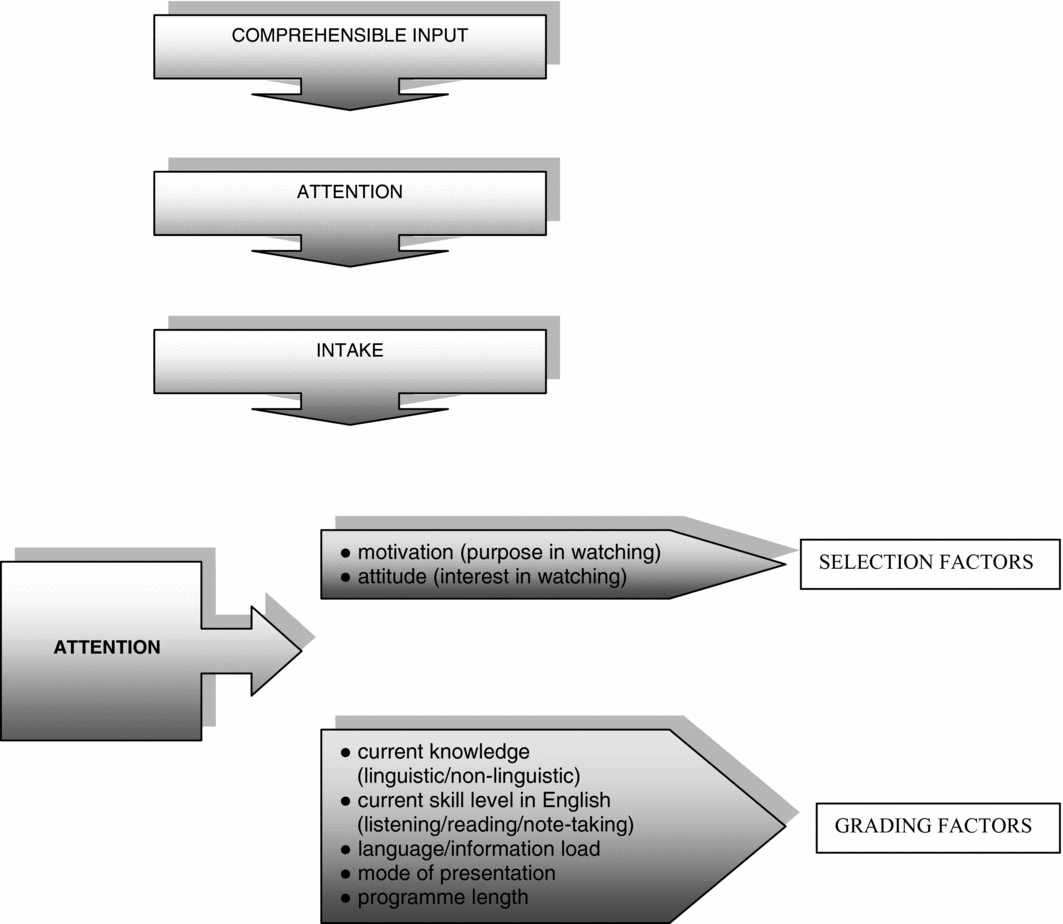
The role of attention in captioned viewing (Vanderplank Reference Vanderplank1990)

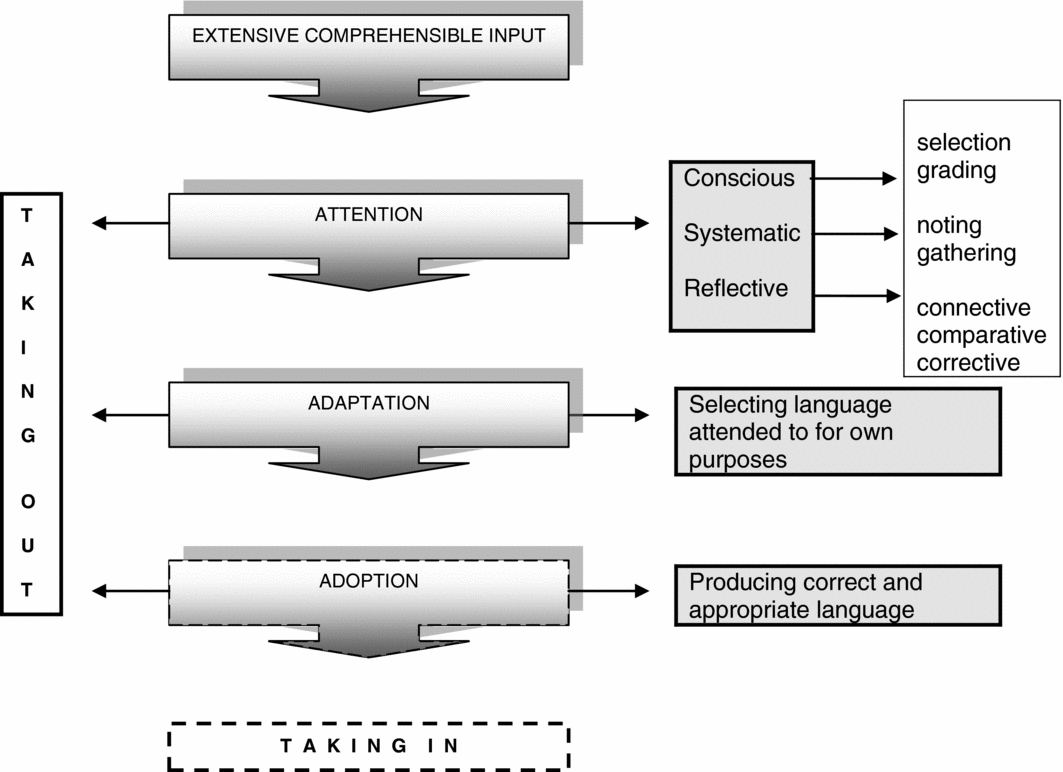
The authors’ theoretical position is to focus on the notions of ‘attention’ and ‘noticing’, linking the use of captions to SLA research, which still focuses so heavily on Schmidt's noticing hypothesis (Schmidt Reference Schmidt and Schmidt1995, 2001). I would argue that this hypothesis is obvious and even trivial in many respects, originally introduced to get round a fundamental problem with the comprehensible input hypothesis (Krashen Reference Krashen1985). However, in learning terms, noticing is not going to get you very far, as I found in my own research and then developed in my 1994 paper. Noticing is fleeting, as is, attention; in cognitive and affective taxonomy terms, it is at the bottom of the affective pyramid, before ‘responding’ and ‘valuing’ and very far from internalising.
In 1990, I proposed a model (Figure 1 and Figure 2) for internalising and using language from captions, which suggests conscious attention, as in the Schmidt hypothesis. In this model, the bar is set almost impossibly high for the ordinary learner-viewer to really gain in terms of genuine language acquisition from watching programmes, even when captions are available.
Factors in attending to captioned language (Vanderplank Reference Vanderplank1990)
In my model, I say nothing about sub-conscious processes which may be at work, allowing, for example, learner viewers to adjust their listening to ‘tune in’ to speech in the foreign language, let's say by ‘hearing’ word boundaries in English, adjusting to the even stress pattern and liaison of French or the pronunciation of double consonants in Italian. As my model suggests, and as I found in my research in Edinburgh, extensive viewing with captions at home will probably not bring the hoped for benefits in terms of language learning and, for most, well-focused tasks will be essential. I stress ‘probably’ – I certainly do not rule it out.
So, in the end, have we been looking in the wrong way and in the wrong places if input has to jump a very high hurdle to become intake and requires support from highly-(self)-directed activities and tasks? Are children and students the most appropriate populations, or are they merely convenient samples?
3.2 A new paradigm: Effects with captions
With these questions in mind, I now want to focus on two themes:
First of all, the conference theme, which is:
to highlight the importance of the use of subtitled audiovisual materials in formal teaching/learning contexts and in informal contexts (individual language learning for adult learners)
What evidence is there in informal contexts and with adult learners? In a sense, this is the promised land we are all still seeking. Before this conference, I went back through my review article and to before that ten-year period, to identify possible evidence for informal learning by adult learners or younger learners using captions. I found some interesting, albeit rather limited, evidence.
Research by Pavakanun & d'Ydewalle (1992) and d'Ydewalle & Pavakanun (1996, 1997), and later by their colleagues (Van Lommel, Laenen & d'Ydewalle 2006), suggested that viewers could indeed pick up language from watching a foreign language film, though this study concerned mainly vocabulary items and the favoured condition appeared to be reversed subtitling, in which the programme was in the L1 and the subtitles were in the L2.
In my review article, I also reported a relevant study by Joan-Tomás Pujolá focusing on the use of ‘Help’ options/strategies in language laboratory and multimedia settings in a self-study programme for developing reading and listening skills (Pujolá Reference Pujolá2002), 22 adult Spanish learners of EFL at fourth and fifth levels (about B2/C1 and C1/C2 levels of the CEFR) at Escola Oficial d'Idiomes in Barcelona. TV, radio and newspaper texts were used as source language input and Help options included optional on-line captions, dictionaries, transcripts, replay/rewind, cultural notes and feedback with explanations. Pujolá found that students at different levels behaved in varied, idiosyncratic ways. In general, the higher levels saw captions as ‘backup’ while lower levels saw them as a necessary tool for understanding. On the whole, though, I found very little relevant research, as, for obvious reasons, it is so difficult to capture informal learning taking place outside educational contexts.
Having talked about the ‘effects of’ captions, at this point I'd like to introduce the ‘effects with’ part of my title. I first used this term in my last paper reporting on research at Heriot-Watt University at the AILA Conference in Jyväskylä, Finland, in 1996. It comes from work by Gavriel Salomon at Haifa University on what is called ‘distributed cognition’ (Salomon Reference Salomon and Salomon1993), or how we offload cognitive tasks onto technology and artefacts.
Comparing the two terms, the thrust of ‘effects of’ research arguments is generally: ‘what does inserting captions or subtitles do in terms of language-learner behaviour and how can we measure this?’ This is analogous to asking: ‘what does literacy do to people?’ (Answer: It enables them to read books, learn new vocabulary and write essays – and text their friends). However, this approach has a strong constraining effect on our research. What matters is what learner-viewers do with captions.
While we may see relatively modest effects of captions in terms of increased comprehension and vocabulary recognition, these effects are small compared to what we might see – if we can capture it – in terms of viewing behaviour once learner-viewers have access to captioned broadcasts. Already, the Mitterer & McQueen research is showing the potential of captions in perceptual terms.
‘Effects with’ technology concern how we may perform a particular task better once we are experienced and skilled users of a tool or piece of technology such as a personal computer, smartphone or DVDs with captions. For captions on films and TV, ‘effects with’ are being able to freeze-frame subtitle text, locating key spoken sequences, elimination of the need for a transcript, ease of identifying unknown and familiar words, ‘hearing’ difficult speech and accents, and so on. In other words, ‘effects with’ captions are linked to learners having choice and taking control – if they wish!
What we need to be doing now as researchers is looking for, and at, other populations of learners who make use of captions, and the new forms of learning that they are developing themselves. This may seem fanciful but, as I shall report, there are grounds for optimism. Self-evidently, learners need time to develop their own conscious, critical faculties, to draw language from programmes and build it into their own competences. Already a number of key factors have been identified in prior research such as autonomy (in the sense of having choice and control of viewing), motivation (intrinsic motivation appears to be the best form), purpose (it helps to have a language-learning rather than solely entertainment-orientated purpose in viewing), maturity (older learners often bring useful learning skills), effective strategies (as I reported in my 1990 article, these varied greatly from individual to individual) and time: there are still very few truly longitudinal studies and the evidence over time is still largely anecdotal.
I should like to point to three pieces of research which offer encouragement for the future, together with some evidence from my own experiences. Firstly, Pemberton, Fallahkhair & Masthoff (2005; also Fallahkhair, Masthoff & Pemberton 2004) at the University of Brighton report on an assessment of the potential for interactive TV (iTV) technologies in language learning (rather than language teaching) using a focus group of 21 subjects to gather information on viewer behaviour in foreign language learning. As they say, where learners are independent and adult, issues of acceptability and ‘fit’ into everyday life become critical. In general, participants were very positive about the potential of iTV for scaffolding incidental language learning as part of entertainment viewing, especially through optional captions or subtitles. The authors present the scenario of a typical mature, motivated, autonomous learner: a well-educated woman named Martha, who is in her 40s, is learning French, and has found a French TV channel that broadcasts its programmes with French captions. She finds it difficult to keep up with the captions as she is usually doing something else while watching (such as preparing food). The authors then go on to describe a future in which viewers can opt for subtitles or captions in the language of their choice and can adjust the speed and quality of subtitles/captions to their level and needs. Having seen the progress made already since digital TV arrived in the UK, I would say that the scenarios are now close to being realised.
My second example is a recent article in ReCALL by Sockett & Toffoli (2012), in which they look at the informal learning of English by non-native speakers with particular reference to the role of virtual communities. Using data collected from diaries, they investigated how a group of five non-specialist language learners at the University of Strasbourg used the Internet in their spare time over two months to read and listen to English and also communicate in English, notably in online communities through social networking websites. The five subjects were also interviewed at the end of the two months. The striking aspect of this study is that it suggests that we need to move away from the current mainstream model of the teacher-driven learner-autonomy paradigm, in which the learner only makes decisions about learning and choices of method, to one in which the learner is a ‘language user’ and ‘social actor’. The only activities which involved all five users were social networking (often with other nationalities in English) and watching video content, usually streamed or downloaded and sometimes with informally contributed French subtitles. One participant watched at least two and a half hours a day!
My third encouraging example is some current research at Oxford on fully autonomous self-instructed learners (FASILs) in Brazil. One of my research students has identified a population of learner/users, similar to those in Strasbourg, who are creating their own online communities and using the wide variety of resources available via the Internet, including English language films and TV. An initial finding is that while his comparison group of class-based learners appears to be equally well motivated, the autonomy of the FASILs (in terms of choice of materials and resources, control, personal identification of purpose and development of effective strategies) is a key factor in leading to better language learning outcomes.
Lastly, the spread of captioning in Europe in flexible forms and formats certainly gives me hope for the future. In the UK, many TV programmes are captioned for deaf and hearing-impaired people, and this has been the case for decades. The same is true in Wales, where the TV channel S4C broadcasts much of its output in Welsh with Welsh captions which are widely used by the hearing community for accessing Welsh language programmes. Now, captions are even provided on online repeat services such as BBC iPlayer. On a recent visit to France, I was able to watch the French version of Masterchef with high quality captions in French. Unfortunately, captioned TV programmes are still not widely available across borders on repeat services and my attempts to watch French repeats of Masterchef on returning home were not successful.
Widespread ignorance and prejudice about captions persists. Teachers of the foreign language (even native speakers) are often unaware of the availability of captions on DVDs. The main distributor for foreign language films in the UK, Artificial Eye, supplies them with translation subtitles and no captions. Yet in France and in Italy, I am able to go into a bookshop which stocks DVDs and buy French or Italian films which have captions for the deaf and hearing-impaired. In future, at Oxford, we shall have to buy all our DVDs from bookshops and suppliers in the country of the language or from the local Amazon online store.
Finally, I'd like to suggest that there are important fundamental differences between the learners who have figured most conspicuously in caption research and those independent learner-viewers I have mentioned in the Brighton, Barcelona, Strasbourg and Brazil studies: a whole population waiting for us to sample and observe in their use of captioned films and TV programmes. Indeed, I have been so inspired by recent research and developments that we hope to be shortly starting a new project at Oxford, the Oxford Project on Captions and Lifelong Language Learning. Adult language learners form the largest formal leisure-activity group in the UK. From this population, we shall take a sample of well-motivated adult learners on evening courses at Oxford in languages for which captioned programmes/films are available. Our participants will be able to borrow captioned resources. We envisage a longitudinal study over six months with a battery of initial and outcomes measures, along with regular feedback from participants. So watch this space!
Postscript
During the conference and afterwards, I was asked why there had not been a meta-analysis of findings on research into captions. As someone who has taken part in a number of systematic reviews in which we had conducted a meta-analysis of findings, I was aware that this remained a weakness in the many claims that had been made over the years about the benefits for language learners of watching captioned films and programmes. With much pleasure, in the time between giving this plenary speech and the final edit for Language Teaching, I reviewed a very good meta-analysis of research into captioned viewing (Montero Perez, Van Den Noortgate & Desmet forthcoming), which will be appearing in System soon. Perhaps unsurprisingly for those of us who have spent much of our research lives researching in this field, the findings are positive about the benefits of captions for vocabulary learning and listening comprehension.
Acknowedgements
I am grateful to Graeme Porte, Editor of Language Teaching, for his constructive suggestions, and to the anonymous reviewers who made a number of helpful comments and suggested additional references.
Robert Vanderplank is Director of Oxford University Language Centre and a Fellow of Kellogg College, Oxford, where he is also Director of the Kellogg College Centre for the Study of Lifelong Language Learning. His research interests and publications include lifelong language learning, language maintenance and attrition (www.lara.ox.ac.uk), television and language learning, listening comprehension, learner autonomy and self-assessment.