Introduction
The languages that a bilingual person speaks influence one another (Albert & Obler, Reference Albert and Obler1978). Cross-linguistic influence, also referred to as the cross-linguistic transfer (CLT) effect, is the influence resulting from similarities and differences between the target language and any other language that has been previously learned (Odlin, Reference Odlin1989, p. 27). It affects second language (L2) processing at the production and comprehension levels (Segalowitz, Reference Segalowitz1976; Smith, Reference Smith1983).
In particular with regard to language production at the lexical level, there is extensive evidence of CLT effects with cognates and clangs (Costa, Santesteban & Caño, Reference Costa, Santesteban and Caño2005; Singleton & Little, Reference Singleton and Little1991). Cognates are formally similar words whose meanings may be identical or similar in the languages analyzed (Ringbom, Reference Ringbom2007, p. 73). Clangs are phonologically similar words with similar or different meanings in one or more languages. The words
 (/telefɔn/; ‘telephone’) in Persian and téléphone (/telefɔn/; ‘telephone’) in French are cognates, whereas
 (/muʃ/; ‘mouse’) in Persian and mouche (/muʃ/; ‘fly’) in French are examples of clangs.
CLT transfer effects with cognates result in faster response times than non-cognates (Costa et al., Reference Costa, Santesteban and Caño2005; De Groot & Nas, Reference De Groot and Nas1991; Edmonds & Kiran, Reference Edmonds and Kiran2006; Kohnert, Reference Kohnert2004; Meinzer, Obleser, Fleisch, Eulitz & Rockstroh, Reference Meinzer, Obleser, Flaisch, Eulitz and Rockstroh2007; Roberts & Deslauriers, Reference Roberts and Deslauriers1999; Van Hell & De Groot, Reference Van Hell and De Groot1998). For example, bilinguals recognize and translate cognates faster than non-cognates (Christoffels, Firk & Schiller, Reference Christoffels, Firk and Schiller2007; Costa, Caramazza & Sebastián-Gallés, Reference Costa, Caramazza and Sebastián-Gallés2000; Gollan, Forster & Frost, Reference Gollan, Forster and Frost1997; Roberts & Deslauriers, Reference Roberts and Deslauriers1999). Furthermore, phonological similarities have a positive impact on lexical decision-making (Humphreys, Boyd & Watter, Reference Humphreys, Boyd and Watter2010; Marian, Blumenfeld & Boukrina, Reference Marian, Blumenfeld and Boukrina2008; Yudes, Macizo & Bajo, Reference Yudes, Macizo and Bajo2010). It has also been argued that cognates in L2 are processed as efficiently as monolinguals process their mother tongue (Antón-Méndez & Gollan, Reference Antón-Méndez and Gollan2010; Duñabeitia, Perea & Carreiras, Reference Duñabeitia, Perea and Carreiras2010), although it has been suggested that the cognate effect in the bilingual population may be restrained by the cognitive context, such as the nature of the task (Yudes et al., Reference Yudes, Macizo and Bajo2010). For example, the cognate effect may be present in translation tasks but not association decision tasks.
Clangs, or homophones, also share phonological similarities with mother tongue words, but unlike cognates, they refer to different concepts. Clangs can be found within and across languages. Within a language, clangs are words that are phonologically similar and thus have a high neighborhood density (e.g., bat, cat, hat, mat, rat, sat). Evidence from monolinguals suggests that not only are clangs retrieved faster than non-clangs, they are also more successfully selected during lexical access (Harley & Brown, Reference Harley and Brown1998; Humphreys et al., Reference Humphreys, Boyd and Watter2010; Vitevitch & Sommers, Reference Vitevitch and Sommers2003). The evidence from bilingual studies is not consistent. Some studies show that both orthographic and semantic similarity can facilitate word recognition (Lemhofer & Dijkstra, Reference Lemhofer and Dijkstra2004). It has also been shown that the phonological similarity facilitates lexical decision tasks by speeding up responses and reducing error rates (Marian et al., Reference Marian, Blumenfeld and Boukrina2008). Other studies have demonstrated that phonological similarity alone is not sufficient to facilitate language tasks in L2 processing (Garcia-Albea, Sanchez-Casas & Valero, Reference Garcia-Albea, Sanchez-Casas and Valero1996; Lalor & Kirsner, Reference Lalor and Kirsner2001). Furthermore, event-related potential (ERP) studies suggest that extra strategic control is required when processing clangs, given that inhibition of the non-target semantic representation is required (Elston-Guttler, Paulmann & Kotz, Reference Elston-Guttler, Paulmann and Kotz2005; Kroll & Stewart, Reference Kroll and Stewart1994).
Most studies of CLT have focused on two closely related languages (Christoffels et al., Reference Christoffels, Firk and Schiller2007; Colomé & Miozzo, Reference Colomé and Miozzo2010, Costa et al., Reference Costa, Caramazza and Sebastián-Gallés2000; Costa et al., Reference Costa, Santesteban and Caño2005; De Groot & Nas, Reference De Groot and Nas1991; Edmonds & Kiran, Reference Edmonds and Kiran2006; Kohnert, Reference Kohnert2004; Lemhofer & Dijkstra, Reference Lemhofer and Dijkstra2004; Meinzer et al., Reference Meinzer, Obleser, Flaisch, Eulitz and Rockstroh2007; Roberts & Deslauriers, Reference Roberts and Deslauriers1999; Titone, Libben, Mercier, Whitford & Pivneva, Reference Titone, Libben, Mercier, Whitford and Pivneva2011; Van Assche, Duyck, Hartsuiker & Diependaele, Reference Van Assche, Duyck, Hartsuiker and Diependaele2009; Van Hell & De Groot, Reference Van Hell and De Groot1998). Linguistically close languages often share vocabulary, phonemes, spelling and pronunciation, syntactic structure, orthography and writing system (Ringbom, Reference Ringbom2007).
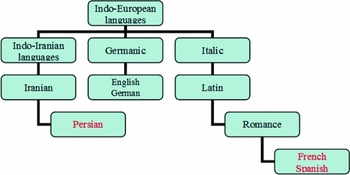
Linguistically distant languages, however, have different orthographic, morphological and phonological systems. Persian and French are distantly related languages. As shown in Figure 1, Persian and French are both members of the Indo-European family. However, the canonical sentence order in French is Subject-Verb-Object (SVO), while in Persian it is Subject-Object-Verb (SOV). In addition, Persian is not marked for gender (Aitchison, Reference Aitchison1999; Finch, Reference Finch2005; Nilipour & Raghibdoust, Reference Nilipour and Raghibdoust2001) and uses the Arabic writing system, whereas French uses the Latin alphabet.
An extract from the Indo-European family tree (Finch, Reference Finch2005; Aitchison, Reference Aitchison1999).

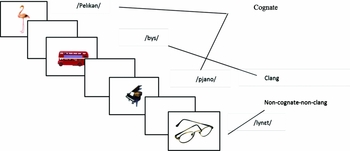
Examples of random presentations of cognates, Clangs and Non-cognate-non-clangs, for the event-related fMRI-naming task.

Studies on CLT with linguistically distant languages have worked with Hebrew–English (Gollan et al., Reference Gollan, Forster and Frost1997; Gollan & Silverberg, Reference Gollan and Silverberg2001; Hacohen & Schaeffer, Reference Hacohen and Schaeffer2007), French–Hebrew (Voga & Grainger, Reference Voga and Grainger2007), Turkish-English (Haznedar, Reference Haznedar and Belikova2007), Japanese–English (Hoshino & Kroll, Reference Hoshino and Kroll2008; Ota, Hartsuiker & Haywood, Reference Ota, Hartsuiker and Haywood2010), Tagalog–English (Gollan & Acenas, Reference Gollan and Acenas2004) and Russian–English bilinguals (Gildersleeve-Neumann & Wright, Reference Gildersleeve-Neumann and Wright2010). The results of these studies show CLT effects across linguistically distant languages. Specifically, it has been argued that in cases where the first language (L1) and L2 do not share orthography, bilinguals rely on L2 phonology (Gollan et al., Reference Gollan, Forster and Frost1997; Marian, Spivey & Hirsch, Reference Marian, Spivey and Hirsch2010). Moreover, it has been suggested that the clang effect can be seen only in linguistically distant languages that do not share an orthographic system, because if L1 and L2 share the same alphabet, the cross-linguistic clang effect will be blocked (Ota et al., Reference Ota, Hartsuiker and Haywood2010). Further evidence of the importance of phonology as a CLT factor in both linguistically close and linguistically distant pairs of languages comes from studies with cognates (Hoshino & Kroll, Reference Hoshino and Kroll2008; Voga & Grainger, Reference Voga and Grainger2007).
It has been argued that, if both cognates and clangs have facilitatory effects, this may mean that the origin of these facilitatory effects is the shared L1-L2 phonological features (Costa et al., Reference Costa, Santesteban and Caño2005). Yet the existing literature in this regard is rather divergent (Gollan et al., Reference Gollan, Forster and Frost1997; Hoshino & Kroll, Reference Hoshino and Kroll2008; Lalor & Kirsner, Reference Lalor and Kirsner2001; Lemhofer & Dijkstra, Reference Lemhofer and Dijkstra2004; Ota et al., Reference Ota, Hartsuiker and Haywood2010; Voga & Grainger, Reference Voga and Grainger2007). Hence, neuropsycholinguistic studies might shed more light on the matter. However, only a few studies have focused on the neurobiological substrates of the phonological similarities (Christoffels et al., Reference Christoffels, Firk and Schiller2007; De Bleser, Dupont, Bormans & Speelman, Reference De Bleser, Dupont, Bormans and Speelman2003; Elston-Guttler et al., Reference Elston-Guttler, Paulmann and Kotz2005; Ghazi-Saidi, Reference Ghazi-Saidi2012; Raboyeau, Marcotte, Adrover-Roig & Ansaldo, Reference Raboyeau, Marcotte, Adrover-Roig and Ansaldo2010; Yudes et al., Reference Yudes, Macizo and Bajo2010), and to our knowledge, only one study has employed fMRI to look at the neural substrates of clangs (Ghazi-Saidi, Reference Ghazi-Saidi2012).
In our recent study (Ghazi-Saidi, Reference Ghazi-Saidi2012), we focused on L2 lexical retrieval in a pair of closely related languages to examine the behavioral and neural correlates of CLT with clangs, cognates and non-cognate non-clangs and study the impact of phonological similarities on vocabulary acquisition.Footnote 1 The evidence showed that the processing of cognates and clangs relies upon a shared L1-L2 language-specific neural network, whereas the processing of non-cognate non-clangs (phonologically distant words) partially activates L1 language-processing structures but also relies upon structures involved in processing working memory and attention. The recruitment of the latter networks suggests that phonological overlap across language equivalents is a facilitating factor and these circuits probably deal with the conflict generated by the lack of such overlap. Spanish (L1) and French (L2) are similar in terms of syntax, orthography, and phonology. CLT may have different effects in language pairs with different systems; however, this has rarely been examined. Therefore, the purpose of this study is to discover the behavioral and neural correlates of CLT in lexical learning effects, as a function of phonological and semantic overlap, in a pair of linguistically distant languages: Persian (L1) and French (L2).
Methodology
Design
The design and methods were based on our previous work on L2 lexical learning (Ghazi-Saidi, Perlbarg, Marrelec, Pélégrini-Issac, Benali & Ansaldo, Reference Ghazi-Saidi, Perlbarg, Marrelec, Pélégrini-Issac, Benali and Ansaldo2013; Marcotte & Ansaldo, Reference Marcotte and Ansaldo2014; Raboyeau et al., Reference Raboyeau, Marcotte, Adrover-Roig and Ansaldo2010). Specifically, this was an event-related fMRI study of L2 learning at the lexical level, using cognates, clangs and non-cognate non-clangs. Twelve Persian native speakers received a computerized program, including three word classes in French and the corresponding pictures. Self-training was completed at a rate of 15 minutes a day, over a period of four weeks. Participants were then interviewed and asked to name the pictures, to make sure that all objects were correctly named. They were then evaluated on an fMRI event-related picture-naming task, with the same items. The data were analyzed for response times (RT), accuracy rates (AR), and BOLD responses to the correctly named items following the data analysis plan of our previous work (Ghazi-Saidi et al., Reference Ghazi-Saidi, Perlbarg, Marrelec, Pélégrini-Issac, Benali and Ansaldo2013; Marcotte & Ansaldo, Reference Marcotte and Ansaldo2014; Raboyeau et al., Reference Raboyeau, Marcotte, Adrover-Roig and Ansaldo2010). The study was approved by the RNQ-CRIUGM Ethics committee. Participants gave their written consent to participate in the study.
Participants
Twelve right-handed (Oldfield, Reference Oldfield1971) Persian native speakers (6 females and 6 males), aged between 26 and 66 years old (M = 40, SD = 21.2), with no history of neurological disorder, depression, or traumatic brain injury, were recruited. The sample was homogeneous in terms of having a similar cultural and educational background, and individuals were matched for their level of French knowledge. Specifically, participants were recruited from the immersion courses for immigrants offered by the Québec government; students are tested on French proficiency prior to being enrolled in the courses. This ensured that they all had a minimal knowledge of French prior to the experiment. Moreover, given that around 28% of Iranians have Azari as their mother tongue, a questionnaire on language history developed in our previous work (Ansaldo, Marcott, Scherer & Raboyeau, Reference Ansaldo, Marcotte, Scherer and Raboyeau2008; Ghazi-Saidi et al., Reference Ghazi-Saidi, Perlbarg, Marrelec, Pélégrini-Issac, Benali and Ansaldo2013; Marcotte & Ansaldo, Reference Marcotte and Ansaldo2014; Raboyeau et al., Reference Raboyeau, Marcotte, Adrover-Roig and Ansaldo2010) and based on three very well-known questionnaires (Flege, Reference Flege and Birdsong1999; Paradis & Libben, Reference Paradis and Libben1987; Silverberg & Samuel, Reference Silverberg and Samuel2004) was administered. Individuals who had a mother tongue other than Persian were excluded from the study, as were those who spoke a third language. Furthermore, in order to exclude neuropsychological conditions that might influence the results, participants were tested for cognitive status with a battery of tests used in our previous work (Ghazi-Saidi et al., Reference Ghazi-Saidi, Perlbarg, Marrelec, Pélégrini-Issac, Benali and Ansaldo2013; Marcotte & Ansaldo, Reference Marcotte and Ansaldo2014; Raboyeau et al., Reference Raboyeau, Marcotte, Adrover-Roig and Ansaldo2010). Specifically the MoCA (Montreal Cognitive Assessment) was used to exclude mild cognitive impairment (Nasreddine, Phillips, Bédirian, Charbonneau, Whitehead, Collin, Cummings & Chertkow, Reference Nasreddine, Phillips, Bedirian, Charbonneau, Whitehead, Collin, Cummings and Chertkow2005); the Memory and Learning Test (Grober, Buschke, Crystal, Bang & Dresner, Reference Grober, Buschke, Crystal, Bang and Dresner1988) and the Working Memory Capacity Test: Buschke Test (Buschke, Reference Buschke1984) were used to exclude memory deficits; and the nonverbal Stroop test (Beauchemin, Arguin & Desmarais, Reference Beauchemin, Arguin and Desmarais1996) was used to rule out attention deficits. Finally, participants in the study were tested on naming the experimental list of stimuli in French; those who were able to name more than 10% of them were excluded.
Stimuli
The experimental list included 130 words, which included 35 cognates (e.g., téléphone /telefɔn/, French; and telefon /telefɔn/, Persian, both meaning ‘telephone’), 35 non-cognate non-clangs (e.g., champignon /ʃ
 piɲ
 /, French; and ghaarch /ʀʌɾt
 , Persian, both meaning ‘mushroom;), and 40Footnote
2
clangs (e.g., table /tabl/, French; and tabl /tabl/, Persian; meaning ‘table’ in French and ‘drum’ in Persian), along with their corresponding pictures. To make sure that the pictures represented the intended words, all stimuli were judged by 20 undergraduate and graduate students (10 native Persian speakers and 10 native French speakers). In addition, 20 Persian–French bilinguals judged the validity of the lists of cognates, clangs and non-cognate non-clangs.
Experimental stimuli were matched for visual complexity, object familiarity, and word familiarity in Persian and French; they were also matched for word length, number of phonemes and syllables within each type of word category, and across languages. Lexical frequency was controlled across categories; moreover, an equal number of animals, fruits, vegetables, clothes and accessories, stationery items, and household objects were included across categories, so as to control for a category effect (Caramazza & Shelton, Reference Caramazza and Shelton1998). As well, similarity with English equivalents was controlled across categories to avoid CLT effects from a third language. A set of 30 distorted images was included for the fMRI subtraction paradigm.
Procedure
Lexical training
For four weeks, participants practiced at home with a 15-minute daily routine involving computerized lexical learning (Raboyeau et al., Reference Raboyeau, Marcotte, Adrover-Roig and Ansaldo2010). They were instructed to review all the words every day, but they were free to choose the amount of time and practice spent on each item. The computerized program included colorful photos corresponding to each stimulus. Participants were instructed to look at the pictures displayed on the screen and name them in French. Two phonological cues followed by the whole target word were presented underneath the picture by means of an icon, and participants could listen to them by clicking on the icon. The sequence of presentation was: (a) the first sound of the word, (b) the first and second sounds of the word, and (c) the whole word corresponding to the target picture. During the first practice sessions, participants were instructed to listen to the first cue, then the second cue, and finally the whole word. They were allowed to repeat this procedure as often as necessary to learn the word. Participants would first try to name the object and, if unsuccessful, they would listen to the first cue and try to recall the word; if they failed to do so, they would listen to the second cue, and finally to the whole word. In all cases, they would click on the icon to get the complete word cue, so as to check their pronunciation. Participants were asked to make an effort to pronounce the word as similarly to the native pronunciation as possible. The aim was to be able to name all pictures fast and accurately. Twice a week, participants were monitored by telephone and email to make sure they were following the schedule. After four weeks of training, they were asked to name the stimuli in a mock fMRI scanner. All participants were able to name all stimuli accurately in this session. The next day, they performed the oral naming task during er-fMRI scanning.
fMRI task and procedures
Participants were first familiarized with the task, and the procedure in the fMRI simulator room. During the scanning session, participants lay on their back with their head immobilized by pieces of foam. Stimuli were presented using Presentation software v.11.2 (www.neurobs.com). Participants were instructed to look at the computer screen and name each picture aloud as accurately and as quickly as possible. For the distorted images, they were asked to say dido. Stimuli were presented for 4 seconds, followed by a blank screen; the duration of blank screen presentation was randomized, between 4600 ms and 8600 ms. Other acquisition parameters were the same as in our previous study (Raboyeau et al., Reference Raboyeau, Marcotte, Adrover-Roig and Ansaldo2010); specifically, TR = 3 s, TE = 40 ms, matrix = 64 × 64 voxels, FOV = 24 cm, slice thickness = 5 mm, acquisition = 28 slides in the axial plane so as to scan the whole brain including the cerebellum. A high-resolution structural scan was obtained during the two functional runs using a 3D T1-weighted pulse sequence MPRAGE (TR = 2.3 ms, TE = 4.92 ms, flip angle = 25º, 76 slices, matrix = 256 × 256 mm, voxel size = 1 × 1 × 1 mm, FOV = 28 cm).
Data analysis
Behavioral data analysis
Oral responses were recorded during fMRI and analyzed with Sound-Forge software (Sonic Foundry, Madison, WI). RTs and ARs were calculated for each word type: cognates, clangs, non-cognate non-clangs, and the pseudo-word used as the baseline condition (i.e., dido). Non-responses, Persian words, and phonological errors (e.g., /pi/ instead of /pje/) were considered wrong answers. The event-related design allowed us to discriminate between correct and incorrect answers and their corresponding BOLD responses. Statistical analyses on ARs and RTs with each word category and the pseudo-word (dido), as well as significant differences in ARs and RTs across word categories, were calculated with SPSS, version 17.0.
Neuroimaging data analysis
Neuroimaging data were analyzed with Statistical Parametric Mapping-8 (SPM-8, Wellcome Trust Centre for Neuroimaging, Department of Cognitive Neurology, London, UK), established in Matlab (Mathworks Inc, Sherborn, MA; www.fil.ion.ucl.ac.uk/spm/). A data analysis was performed individually, before examining the group as a whole. Slice timing, realignment, normalization, and segmentation were performed first. Images were spatially smoothed with an 8-mm Gaussian filter. Only BOLD responses for correctly retrieved words were included in the analysis.
For each participant and for the whole group, task-related BOLD changes were examined by a convolving vector of the onset of the stimuli with a hemodynamic response function and its temporal derivative. Statistical parametric maps were obtained for each individual subject by applying linear contrasts to the parameter estimates for the events of interest (the correct responses); this resulted in a t-statistic map for every voxel.
A one-way ANOVA was performed to explore the interaction between word categories. Also, with a one-sample t-test, group averages were calculated for each word category minus the control condition (i.e., cognates – dido; non-cognates – dido; clangs – dido). Cluster size (k) was superior to 20 voxels and p < .001. Furthermore, direct contrasts were performed to examine the neural substrate that characterized the processing of each word type, with the following contrasts: cognates vs. clangs, cognates vs. non-cognate non-clangs, clangs vs. cognates, clangs vs. non-cognate non-clangs, non-cognate non-clangs vs. cognates, and non-cognate non-clangs vs. clangs. Significant activated clusters were considered only if they were larger than 1 voxel (k > 1) and the p value was set at .005.
Ethical issues
This study was approved by the ethics committee of the Réseau de Neuroimagerie du Québec. The procedure was explained clearly to all participants. All data were recorded in the Unité neuroimagerie fonctionnelle at the Institut de gériatrie de Montréal.
Results
Behavioral results
A repeated measures ANOVA was performed with word category as the within-subject factor with three levels (cognates, clangs, and non-cognate non-clangs), for both ARs and RTs. There was no interaction between word categories. The ANOVA yielded no significant differences between the ARs for the different word categories (F (2,33) = .985, p = .384). Clangs were named most accurately (M = 92.29%, SD = 4.5), followed by cognates (M = 89.52%, SD = 4.5), and then non-cognate non-clangs (M = 87.85%, SD = 7.4) (see figure 3).
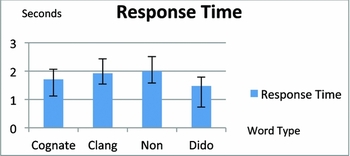
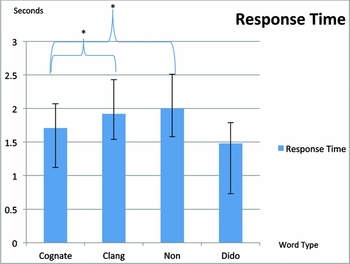
Mean Response Time (in %) in French (L2) word naming, as a function of word type (Pseudo-word: dido, French words: Cognates, Clangs, Non cognates). There was no significant difference in RTs between Cognates and Clangs, between Cognates and Non-cognate-non-clangs or Clangs and Non-cognate-non-clangs.

There was a statistically significant difference between RTs for the different word categories as determined by an ANOVA (F (2,33) = 3.512, p = .041). A Tukey post hoc test revealed that the mean RT for cognates was significantly lower than for non-cognate non-clangs (2.0 ± 0.26, p = .039). There were no statistically significant differences between RTs for cognates and clangs (p = .169), or for clangs and non-cognate non-clangs (p = .769). Cognates were named fastest (M = 1.71 s, SD = 0.25), followed by clangs (M = 1.92 s, SD = 0.24), and then non-cognate non-clangs (M = 2.0 s, SD = 0.27) (refer to figure 4).
Accuracy Rates (in %) in French (L2) word naming, as a function of word type (Pseudo-word: dido, French words: Cognates, Clangs, Non cognates). There was a significant difference in ARs between Cognates and Clangs, and between Cognates and Non-cognate-non-clangs, but there was no significant difference between Clangs and Non-cognate-non-clangs.

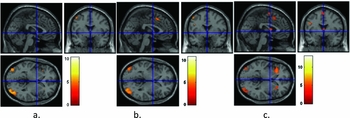
Simple Contrasts; a. (Cognate – dido), b. (Clang – dido), c. (Non-cognate-non-clang – dido). Naming all three categories significantly activates the left inferior frontal gyrus (BA 44, 47 and 9), the left pre-central and the middle frontal gyri (BA 6 and9), the left and the right cingulate gyrus (BA32) and the left insula (BA13), the left and the right fusiform gyri (BA 37, 20 and 19) and the right cerebellum. Also, the left fusiform gyrus (BA 37) and the right and the left cingulate (BA 32), the right and the left insula (BA 13) were activated in all three word- categories. Both Clangs and Non-cognate-non-clangs activated the middle frontal gyrus (BA 46). Only naming Non-cognate-non-clangs activated the right homologues of the left inferior-frontal gyrus (BA 44, 47 and 9), left precentral and the middle frontal gyrus (BA 6 and 9 and 46), as well as the left caudate Body. Statistical parametric maps overlaid onto the average T1-weighted anatomy of all subjects (n = 12). Activation related to only one layer is presented, thus many activations may not be seen on this image.

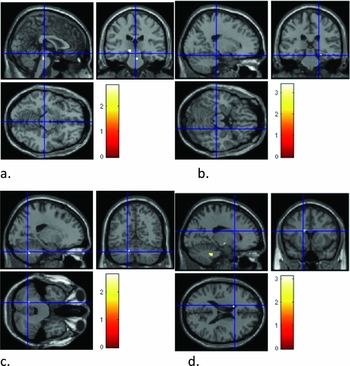
Direct contrasts: a. (Clang- Cognate) and b. (Clang – Non-cognate-non-clang), c. (Non-cognate-non-clang - Cognate) and d. (Non-cognate-non-clang - Clang) the contrasts (Clang – Cognate) resulted in significant activations in the left substania nigra and the right parahippocampal gyrus. The contrast (Clang – Non-cognate-non-clangs) showed a significant activation of the left Amygdala and the right parahippocampal gyrus, whereas the contrast (Non- cognate-non-clangs – Cognate) showed a significant activation of the right and the left cerebellum, the left Caudate and the right inferior temporal gyrus. Finally, the contrast (Non- cognate-non-clangs – Clang) resulted in the significant activation of the left cerebellum. Statistical parametric maps overlaid onto the average T1-weighted anatomy of all subjects (n = 12). Activation related to only one layer is presented, thus many activations may not be seen on this image.

Functional neuroimaging results
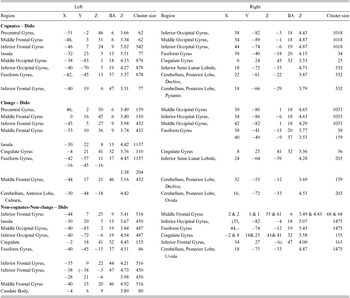
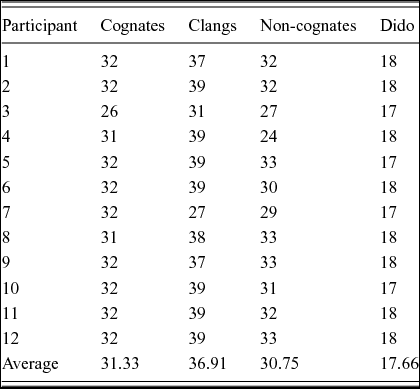
The analyses were done only on the correct items, the number of which was different for each individual and each word category. In all cases, the mean number of correct responses per category was no lower than 30, with clangs being the highest (though not significantly different). This information is shown in Table 3 in Appendix 1. Results with the contrast naming minus the control condition (cognates – dido, clangs – dido, and non-cognate non-clangs – dido) are presented in Table 1. Specifically, naming in all three categories significantly activated the left inferior frontal gyrus (BA 44, 47 and 9), the left precentral and middle frontal gyri (BA 6 and 9), the left and right cingulate gyrus (BA 32), the left insula (BA 13), the left and right fusiform gyri (BA 37, 20 and 19), and the right cerebellum. Both clangs and non-cognate non-clangs activated the middle frontal gyrus (BA 46). Only naming non-cognate non-clangs activated the right homologues of the left inferior frontal gyrus (BA 44, 47 and 9), left precentral and middle frontal gyrus (BA 6 and 9 and 46), and left caudate body. (See table 1 more details.)
fMRI Results with Simple Contrasts: (Cognates – dido), (Clangs – dido) and (Non-cognate-non-clangs – dido).

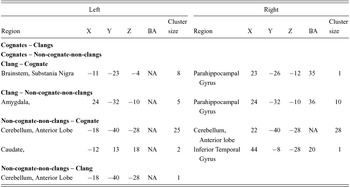
The significant results with the direct contrasts are presented in Table 2. The cognates – clangs and cognates – non-cognate non-clangs contrasts yielded no results. The clangs – cognates contrast resulted in significant activation in the left substantia nigra and the right parahippocampal gyrus. The clangs – non-cognate non-clangs contrast triggered significant activation of the left amygdala and the right parahippocampal gyrus, whereas the non-cognate non-clangs – cognates contrast showed significant activation in the right and left cerebellum, the left caudate and the right inferior temporal gyrus. Finally, the non-cognate non-clangs – clangs contrast resulted in significant activation of the left cerebellum.
fMRI Results with Direct Contrasts between word categories (Cognate/ Clang/ Non-cognate-non-clangs) in Persian Speakers (L1) Naming in French (L2).

Discussion
The purpose of this study was to examine the behavioral and neural correlates of lexical learning in a pair of linguistically distant languages: Persian (mother tongue) and French (L2). We examined these correlates with cognates, clangs and non-cognate non-clangs during an oral naming during fMRI scanning, at a high level of naming performance attained by using a computerized lexical learning program.
From a behavioral perspective, the results show no statistically significant difference in accuracy in naming L2 cognates, clangs, and non-cognate non-clangs. However, significantly faster responses were obtained with cognates than with clangs and non-cognate non-clangs, whereas RTs with the latter two categories were equivalent. In line with the literature (e.g., Costa et al., Reference Costa, Caramazza and Sebastián-Gallés2000; De Bleser et al., Reference De Bleser, Dupont, Bormans and Speelman2003; De Groot & Poot, Reference De Groot and Poot1997; Dijkstra, Grainger & Van Heuven, Reference Dijkstra, Grainger and Van Heuven1999a; Dijkstra & Van Hell, Reference Dijkstra and Van Hell2001; Hoshino & Kroll, Reference Hoshino and Kroll2008; Kroll, Michael, Tokowicz & Dufour, Reference Kroll, Michael, Tokowicz and Dufour2002; Raboyeau et al., Reference Raboyeau, Marcotte, Adrover-Roig and Ansaldo2010), RTs showed a cognate advantage, whereas no facilitatory effect was observed with clangs. Previous evidence showed that facilitatory effects occur only when cross-linguistic similarities concern both the phonological and semantic levels (Garcia-Albea et al., Reference Garcia-Albea, Sanchez-Casas and Valero1996; Lalor & Kirsner, Reference Lalor and Kirsner2001). Because clangs share phonology but refer to different semantic content, word selection requires the inhibition of irrelevant information, and this extra processing is reflected in longer RTs for clangs than cognates (Elston-Guttler et al., Reference Elston-Guttler, Paulmann and Kotz2005; Kroll & Stewart, Reference Kroll and Stewart1994). As for the origin of the cognate advantage, the evidence is controversial: some authors argue that it reflects a task difficulty effect (Chee, Lee, Soon, Westphal & Venkatraman, Reference Chee, Lee, Soon, Westphal and Venkatraman2003a; Chee, Westphal, Goh, Graham & Song, Reference Chee, Westphal, Goh, Graham and Song2003b), whereas others claim that the cognate advantage results from the features of the word such as cross-linguistic phonological and semantic similarities (Costa et al., Reference Costa, Caramazza and Sebastián-Gallés2000; Dijkstra et al., Reference Dijkstra, Grainger and Van Heuven1999a; Francis, Reference Francis1999; Gerard & Scarborough, Reference Gerard and Scarborough1989; Schelletter, Reference Schelletter2002).
Neurofunctional data sheds light on the processes underlying cross-linguistic semantic and/or phonological similarity effects. In our previous studies on CLT effects in linguistically close languages (i.e., Spanish and French; Ghazi-Saidi, Reference Ghazi-Saidi2012; Marcotte & Ansaldo, Reference Marcotte and Ansaldo2014; Raboyeau et al., Reference Raboyeau, Marcotte, Adrover-Roig and Ansaldo2010), we showed that, processing non-cognates and clangs requires the recruitment of the control circuit, an observation that reflect the impact of a partial lexical (i.e., phonological or semantic) overlap on the cognitive load imposed to the system. The present study provides further evidence in this regard, by looking at a pair of distant languages (i.e., Persian and French). As compared to previous work with close language pairs, the present study shows that processing even cognates recruits the cognitive control circuit, and this despite consolidation of cognate learning. This observation suggests that – beyond the degree of overlap between L1-L2 words – language distance is in itself a cognitive control sensitive dimension, which prevails over lexical overlap.
Precisely, the fMRI data shows that the three word-categories significantly activated a set of areas that correspond to what has been described as to the cognitive control circuit (Green & Abutalebi, Reference Green and Abutalebi2013), namely the left inferior frontal gyrus (BA 44, 47 and 9), the left precentral and middle frontal gyri (BA 6 and 9), as well as the insula, the left cingulate cortex and the right cerebellum.
Specifically, with regards to the significant activation of Broca's area, and the left middle frontal gyrus, it has also been related to the processing of newly learnt phonological combinations (Indefrey & Levelt, Reference Indefrey and Levelt2004; Perani, Paulesu, Galles, Dupoux, Dehaene, Bettinardi & Mehler, Reference Perani, Paulesu, Galles, Dupoux, Dehaene, Bettinardi, Cappa, Fazio and Mehler1998; Raboyeau et al., Reference Raboyeau, Marcotte, Adrover-Roig and Ansaldo2010) and word selection (Hirshorn & Thompson-Schill, Reference Hirshorn and Thompson-Schill2006), in the context of competition among incompatible representations in word retrieval (Botvinick, Braver, Barch, Carter & Cohen, Reference Botvinick, Braver, Barch, Carter and Cohen2001; Robinson, Blair & Cipolotti, Reference Robinson, Blair and Cipolotti1998; Thompson-Schill, D'Esposito, Aguirre & Farah, Reference Thompson-Schill, D'Esposito, Aguirre and Farah1997; Thompson-Schill, Jonides, Marshuetz, Smith, D'Esposito, Kan, Knight & Swick, Reference Thompson-Schill, Jonides, Marshuetz, Smith, D'Esposito, Kan, Knight and Swick2002; Thompson-Schill, Kurtz & Gabrieli, Reference Thompson-Schill, Swick, Farah, D'Esposito, Kan and Knight1998; Tippett, Gendall, Farah & Thompson-Schill, Reference Tippett, Gendall, Farah and Thompson-Schill2004). In the present study, the fact that cognates recruited these structures may reflect cognitive control demands and language control processes (Green & Abutalebi, Reference Green and Abutalebi2013; Abutalebi & Green, Reference Abutalebi and Green2016) put into play to inhibit a linguistically distant mother tongue.
Unlike our previous studies on linguistically close languages (Ghazi-Saidi, Reference Ghazi-Saidi2012; Raboyeau et al., Reference Raboyeau, Marcotte, Adrover-Roig and Ansaldo2010), the present study shows that the three word categories significantly activated the cingulate gyrus bilaterally (BA 32), whose role in cognitive control mechanisms (Goghari & MacDonald, Reference Goghari and MacDonald2009; Kuhl & Rivera-Gaxiola, Reference Kuhl and Rivera-Gaxiola2008), and monitoring of semantic and phonological L1-L2 overlap or accent processing (Abutalebi et al., Reference Abutalebi, Della Rosa, Green, Hernandez, Scifo, Keim, Cappa and Costa2011; Abutalebi, Della Rosa, Ding, Weekes, Costa & Green, Reference Abutalebi, Della Rosa, Ding, Weekes, Costa and Green2013; Botvinick et al., Reference Botvinick, Braver, Barch, Carter and Cohen2001; Botvinick et al., Reference Botvinick, Cohen and Carter2004; Ghazi-Saidi, Dash & Ansaldo, Reference Ghazi-Saidi, Dash and Ansaldo2015) has been reported. The fact that cognates activated this structure suggests higher attention and monitoring demands imposed by a distant L1 even with words that share both semantic and phonological features.
Finally, the significant activation of the cerebellum with all word categories differs from our previous work with close language pairs, (Ghazi-Saidi et al., Reference Ghazi-Saidi, Dash and Ansaldo2015; Raboyeau et al., Reference Raboyeau, Marcotte, Adrover-Roig and Ansaldo2010; Marcotte & Ansaldo, Reference Marcotte and Ansaldo2014), showing a role of the cerebellum with non-cognates and clangs only. The cerebellum participates to fine motor tuning and programming, but it also plays a role in language control (Green & Abutalebi, Reference Green and Abutalebi2013; Abutalebi & Green, Reference Abutalebi and Green2016). Its recruitment with cognates in the context of the present study provides further evidence of the cognitive load imposed by distant languages to the processing of cognates.
In addition to common activations among all word types, specific activations were observed with specific word types. With clangs, a significant activation of the right parahippocampal gyrus was observed. Linked to the fusiform gyrus, both anatomically (Insausti, Amaral & Cowan, Reference Insausti, Amaral and Cowan1987; Mufson & Pandya, Reference Mufson and Pandya1984; Suzuki & Amaral, Reference Suzuki and Amaral1994; Van Hoesen, Reference Van Hoesen1982) and functionally, the right paraphippocampaal gyrus plays a role in semantic processing (Binder, Frost, Hammeke, Cox, Rao & Prieto, Reference Binder, Frost, Hammeke, Cox, Rao and Prieto1997; Levy, Bayley & Squire, Reference Levy, Bayley and Squire2004; McCarthy, Reference McCarthy1999), which is a key component to the correct processing of clangs.
With non-cognate non-clangs, the significant activation of the right homologues of the left inferior frontal gyrus (BA 44, 47 and 9), suggests controlled retrieval (Abutalebi & Green, Reference Abutalebi and Green2007; 2013), which probably contributed to accurate behavioral results; also the right inferior frontal gyrus has been reported to sustain effortful motor planning operations (Raboyeau et al., Reference Raboyeau, Marie, Balduyck, Gros, Demonet and Cardebat2004; Raboyeau et al., Reference Raboyeau, Marcotte, Adrover-Roig and Ansaldo2010; Vitali, Abutalebi, Tettamanti, Danna, Ansaldo, Perani, Johanette & Cappa, Reference Vitali, Abutalebi, Tettamanti, Danna, Ansaldo, Perani, Johanette and Cappa2007), required to achieve naming in a distant language.
Naming non-cognate non-clangs recruited the left caudate nucleus, which is as well a component of the cognitive control circuit (Green & Abutalebi, Reference Green and Abutalebi2013; Abutalebi & Green, Reference Abutalebi and Green2016; Crinion et al., Reference Crinion, Turner, Grogan, Hanakawa, Noppeney, Devlin, Aso, Urayama, Fukuyama, Stockton and Usui2006). Its activation has been specifically related to non-automatic processes such as controlled articulation in L2 (Friederici, Reference Friederici2006; Price, Green & Von Studnitz, Reference Price, Green and von Studnitz1999; Rüschemeyer, Fiebach, Kempe & Friederici, Reference Rüschemeyer, Fiebach, Kempe and Friederici2005; Rüschemeyer, Zysset & Friederici, Reference Rüschemeyer, Zysset and Friederici2006; Wartenburger Heekeren, Abutalebi, Cappa, Villringer & Perani, Reference Wartenburger, Heekeren, Abutalebi, Cappa, Villringer and Perani2003), particularly relevant to the naming of non-cognates, which are completely different to mother tongue equivalents in terms of phonological and articulatory patterns. Finally, the significant activation of the left amygdala and right inferior temporal gyrus (BA 20), indicates explicit memory processes (Parkin, Reference Parkin and Rapp2001), probably reflecting memory strategies put into play to recall non-cognate words, as well as the learning method used to teach L2 words in the present study (Schumann, Crowell, Jones & Lee, Reference Schumann, Crowell, Jones and Lee2004).
Beyond cognitive control
In addition to demanding different cognitive control levels, different word categories seem to involve different memory types. Processing of the two phonologically similar word categories (cognates and clangs) recruited the basal ganglia and the parahippocampal gyrus, which has been shown to support the implicit memory (Paradis, Reference Paradis2004; Parkin, Reference Parkin and Rapp2001; Kreitzer, 2009). This may reflect that cognates and clangs can be matched to L1 words through their phonemic and phonetic similarities with L1 items thus may induce an implicit-memory-based mode.
Conversely, given their lack of phonological overlap with L1 items, non-cognate non-clangs cannot induce this implicit learning mode and thus processing of new phonological forms depends on the drills imposed within the context of training, which may have contributed to recruitment of explicit memory-processing areas such as the left amygdala and the right inferior temporal gyrus (Parkin, Reference Parkin and Rapp2001; Paradis, Reference Paradis2004; Schumann, Crowell, Jones & Lee, Reference Schumann, Crowell, Jones and Lee2004).
Conclusion
Distant language pairs impose an extra effort on L2 naming, even when lexical items share both phonological and semantic features. Cognitive control demands are high, as reflected by the recruitment of cognitive-control-related brain areas, with all word categories studied. These results provide an in-depth perspective of the neurofunctional basis of L2 lexical learning. Thus, our previous work with closely related languages (French and Spanish) (Ghazi-Saidi, Reference Ghazi-Saidi2012; Raboyeau et al., Reference Raboyeau, Marcotte, Adrover-Roig and Ansaldo2010) showed that cognitive control regions were activated only with non-cognate non-clangs when lexical learning was consolidated. The present work shows that language distance in itself is a cognitive control modulating factor that prevails over the factor of lexical overlap, as cognitive control resources are recruited even when words overlap both at the phonological and semantic level.
Moreover, the evidence shows that, while phonologically similar words (cognates and clangs) involve implicit memory processing, phonologically dissimilar words (non-cognate non-clangs) rely upon explicit memory resources.
We acknowledge that the results and conclusions of this work refer to the lexical level of L2 learning and thus cannot be extrapolated to the sentence and discourse levels of learning. However, it is quite unlikely that demands at the cognitive control level would be less at more complex language processing levels. Hence, one could predict an addition of cognitive demands at the morphological and syntactic levels of processing with distant language pairs. This would tax the system even more that at the lexical level, consuming resources and probably requiring more time than that required to attain a level of automatic processing with close language pairs.
There is still much work to be done to understand the behavioral and neurobiological bases of L1 and L2 processing, and the impact of L1-L2 distance on word, sentence and discourse processing. This work is necessary, particularly in the context of immigrations, so that we can better understand how L2 learning occurs and which are the cognitive demands imposed on learners who have a distant mother tongue, so that we can adapt learning methods to suit language distance constraints. The importance of this work is also at the level of language therapy in case of language breakdown, and the best therapy choices to serve populations whose mother tongue is distant from the L2 in which therapy is generally provided.
Appendix
Number of correct responses per category of words for each participant.