Introduction
Surgical outcomes of single-ventricle palliation continue to improve while medium- and long-term outcomes are less than optimal. Reference Newburger, Sleeper and Gaynor1,Reference Ghanayem, Allen and Tabbutt2
Amongst the traditional stages of single-ventricle palliation, stage II or the Glenn procedure is associated with low operative mortality. However, a portion of patients who undergo Glenn procedure may fail to sustain the circulation. These patients occasionally need takedown of the palliative circulation and revert to prior stage I.
Previous studies have identified factors associated with mortality between the Glenn procedure and the Fontan, such as younger age (<3 months), diagnosis of Hypoplastic left heart syndrome (HLHS), unbalanced Atrioventricular septal defect (AVSD), atrioventricular valve regurgitation, and high pulmonary vascular resistance amongst others. Reference Lee, Allen and Tabbutt3 However, there is a knowledge gap when it comes to need for surgical interventions immediately after the Glenn procedure. Our understanding of the risk factors of such failure, morbidity associated with the reversal, and eventual outcomes is extremely limited. Broadly, the need for unexpected surgical interventions after the Glenn procedure is also not well described and would add to our understanding of morbidities after Glenn procedure. This study utilising the Society of Thoracic Surgeons database is focused on describing the need for unexpected surgical reinterventions, including takedown to stage I, after the Glenn procedure and analyses the risk factors associated with the same. Our hypothesis being that need for unexpected cardiac reintervention after Glenn procedure is associated with higher morbidity and mortality.
Methods
Data source
This is a retrospective study of the Society of Thoracic Surgeons Congenital Heart Surgery Database (STS-CHSD) from 1 January, 2010, to 31 December, 2019. Details of the database have been previously described. Reference Fernandez, Shahian and Kormos4 The STS-CHSD versions 3.0 through 3.41 were queried via a limited dataset request through the Participant User File (PUF) research programme. Institutional review was waived for this database analysis.
Study population
Demographic information was collected including age, sex, race, and ethnicity. Clinical characteristics and outcomes provided by STS-CHSD including length of stay, mortality, readmission, ventricular morphology, operative procedures, mechanical ventilation, and reintubation.
The index operation was defined as those with the following STS-CHSD procedure codes: bidirectional cavopulmonary anastomosis/bidirectional Glenn (1670), Glenn/unidirectional cavopulmonary anastomosis (1680), bilateral bidirectional cavopulmonary anastomosis/bilateral bidirectional Glenn (1690), Hemi Fontan (1700), superior cavopulmonary anastomosis/Glenn or Hemi Fontan + Atrioventricular valvuloplasty (2330), and superior cavopulmonary anastomosis+ PA reconstruction (2130). For the purpose of the rest of the description, Glenn procedure is used to describe any of these forms of stage II palliation. Unexpected surgical procedures after the Glenn procedure during the same hospitalisations were defined as STS-CHSD complications field 22, “underwent an unexpected operation” or field 901, “other operative/procedural complication” after the index surgery. The subgroup of those patient requiring reversion to stage I procedures were identified by procedure codes 1590 (shunt, systemic to pulmonary, and modified Blalock–Taussig), 1600 (shunt, systemic to pulmonary, and central), 3130 (shunt, systemic to pulmonary, and Mee type), and 3230 (shunt, systemic to pulmonary, and Potts type). Definitions of additional variables are found within the STS-CHSD specifications on the STS website (www.sts.org).
Outcomes of interest was surgical mortality after the procedure as defined by the STS-CHSD (https://publicreporting.sts.org/chsd-exp). Secondary outcomes of interests included hospital length of stay and late mortality after the index procedure defined by STS-CHSD as “mortality status of the patient at the time of the last follow-up. If no follow-up is made after patient is discharged, this value will be the same as the Mortality Status at Hospital Discharge field in the database.”
Statistical analysis
All categorical variables were assessed by chi-square or Fisher’s exact test as appropriate, while all the continuous variables were evaluated using t-test or Kruskal–Wallis test as appropriate. To assess and compare the outcomes such as in-hospital mortality, mixed model multivariable logistic regression analysis was performed. All the other patient surgical characteristics were adjusted as fixed effects for the models. For multivariable analyses, model selection was based on Lemme show and Hosmer technique where all parameters, clinically and statistically significant, were selected and then forward-selection technique was used to identify the best models.
Model selection was based on Akaike information criterion or Bayesian information criterion as appropriate. The accuracy of the model was assessed by C-statistic and area under the curve. We also assessed patients who did not require shunt takedown. We employed 1:5 simple random sampling without replacement to match each patient with five controls based on similar demographic and clinical characteristics minimising selection bias. Any missing data (>5%) were handled by multiple imputation techniques. The significance level for these analyses was set to alpha = 5%. All statistical analyses were performed using SAS 9.4 (SAS Institute., Cary, NC, USA) and R studio.
Results
Characteristics of patients undergoing Glenn procedure
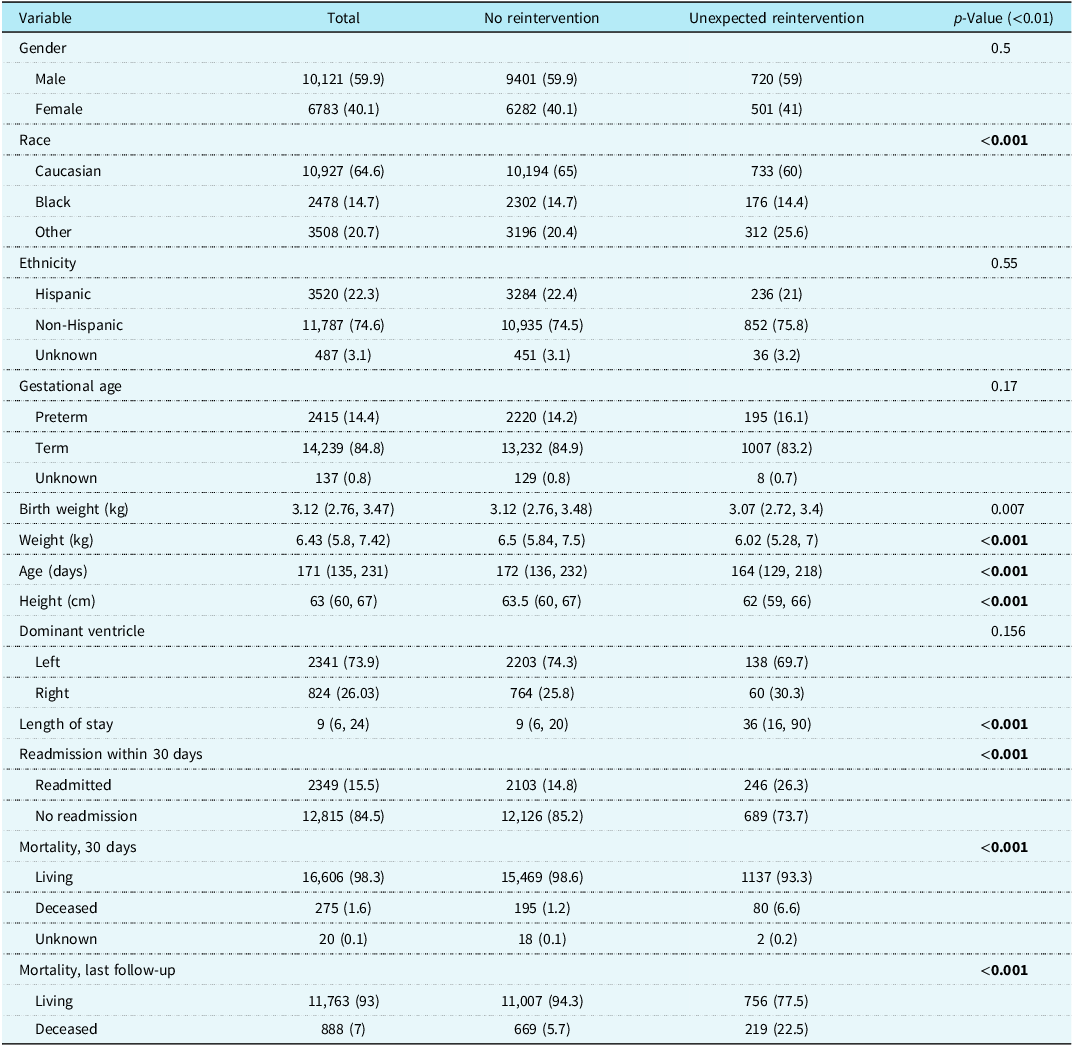
A total of 16,913 patients were identified as undergoing the Glenn procedure between 2010 and 2019, of which 60% were male and 85% were born at full-term gestational age. Majority of these patients were Caucasian race (65%), while 15% were Black race and 21 % were classified as Other race. Overall, 75% (n = 10,935) of the cohort was non-Hispanic ethnicity. The prevalent ventricular dominance was left dominant in 74% of the total cohort (Table 1).
Demographics

*Values are n (%) or median (interquartile range).
The median length of stay post-operatively was 9 days (IQR: 6–24). Readmission within 30 days was noted in 15.5% (2349/16,913) of the patients. Post-operative survival after stage II palliation was excellent with 30-day survival of 98.3% (16,606/16,913) and mortality of 1.6% (275/16,913) (Table 1).
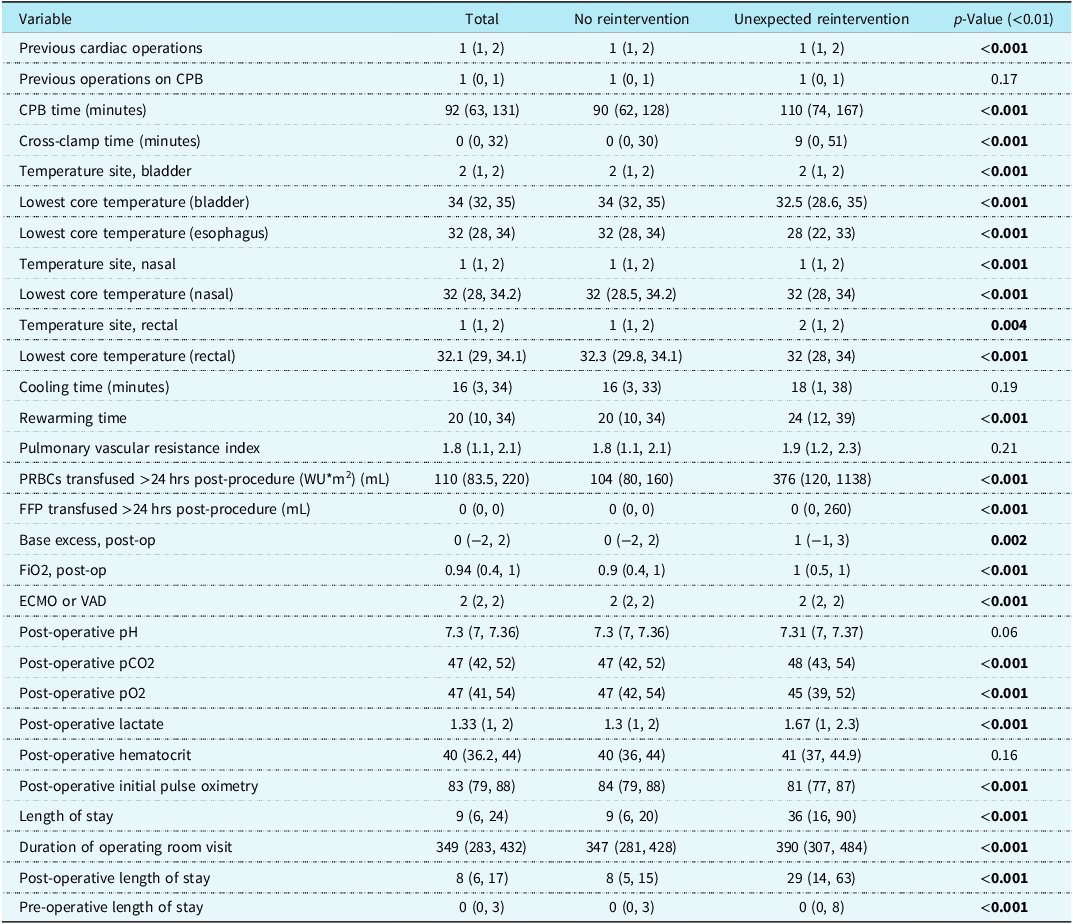
Key operative variables related to the Glenn surgery are summarised in Table 2.
Operative characteristics

CPB = cardiopulmonary bypass; ECMO = extracorporeal membrane oxygenation; FFP = fresh frozen plasma; pRBC = packed red blood cells; VAD = ventricular assist device.
Characteristics of patients requiring unexpected surgical intervention
Of the total cohort of 16,913 patients, 1221 patients (7.2%) required unexpected surgical reintervention after the Glenn procedure. The clinical characteristics of patients with and without unexpected reintervention are shown in Table 1. Those requiring unexpected reinterventions were less likely to be Caucasian more likely to belong to the “other” race. They were significantly likely to be younger and smaller at the time of the Glenn procedure. They were significantly more likely to have a lower birth weight compared to those who did not require such reintervention. There were no differences in gender distribution, gestational age, and pre-maturity, in the anatomic diagnosis of dominant ventricle (Table 1).
There were differences in the operative course for the Glenn procedure between those who eventually required reintervention compared to those who did not. Those requiring an unexpected intervention had a longer cardiopulmonary bypass time (110 versus 90 minutes, p < 0.001), longer cross-clamp time, lower core temperature during the procedure, longer cooling time, and longer rewarming time during the procedure, all p < 0.001. Immediate post-operatively, those requiring reintervention were also noted to have higher PCO2, lower PaO2, higher lactate, and lower initial saturations by pulse oximetry, all p < 0.001 (Table 2).
Impact of unexpected surgical intervention
Those with unexpected reintervention had a significantly longer length of stay, higher rate of readmission within 30 days post-discharge, significantly higher operative mortality (6.6% versus 1.2%, p < 0.001), and higher mortality at last follow-up (22.5% compared to 5.7%, p < 0.001) (Table 1).
Factors predicting mortality
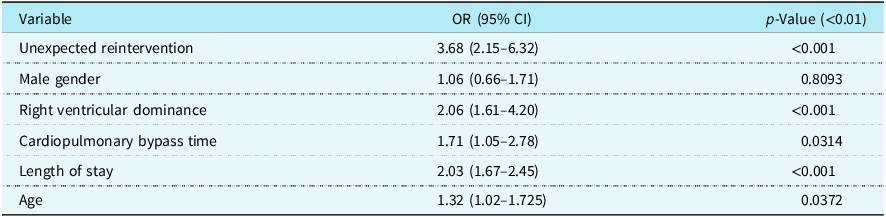
By multivariable regression analysis, patients undergoing an unexpected reoperation had a more than 3.5 times increased likelihood (OR 3.68, CI: 2.15–6.32) of mortality compared to those who did not require reoperation. Right ventricular dominance (OR 2.06, CI: 1.61–4.20), age (OR 1.32, CI: 1.02–1.72), longer cardiopulmonary bypass time (OR 1.71, CI: 1.05–2.78), and length of stay (OR 2.03, CI : 1.67–2.45) were associated with increased risk of mortality after Glenn procedure (Table 3).
Post-operative risk of mortality

Characteristics of patients requiring takedown to stage I palliation
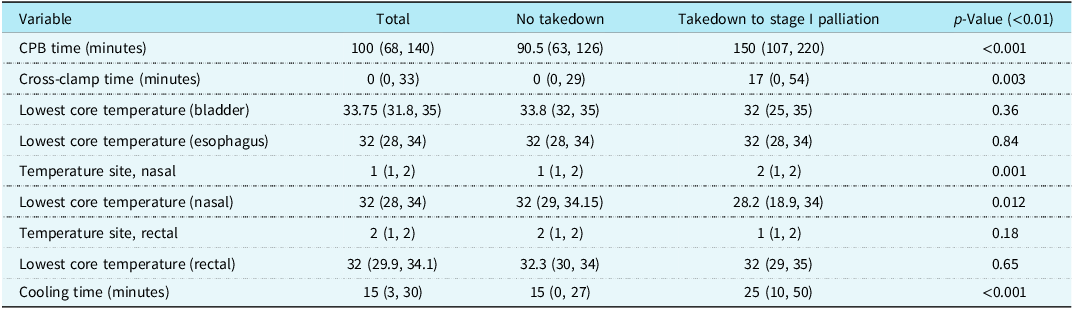
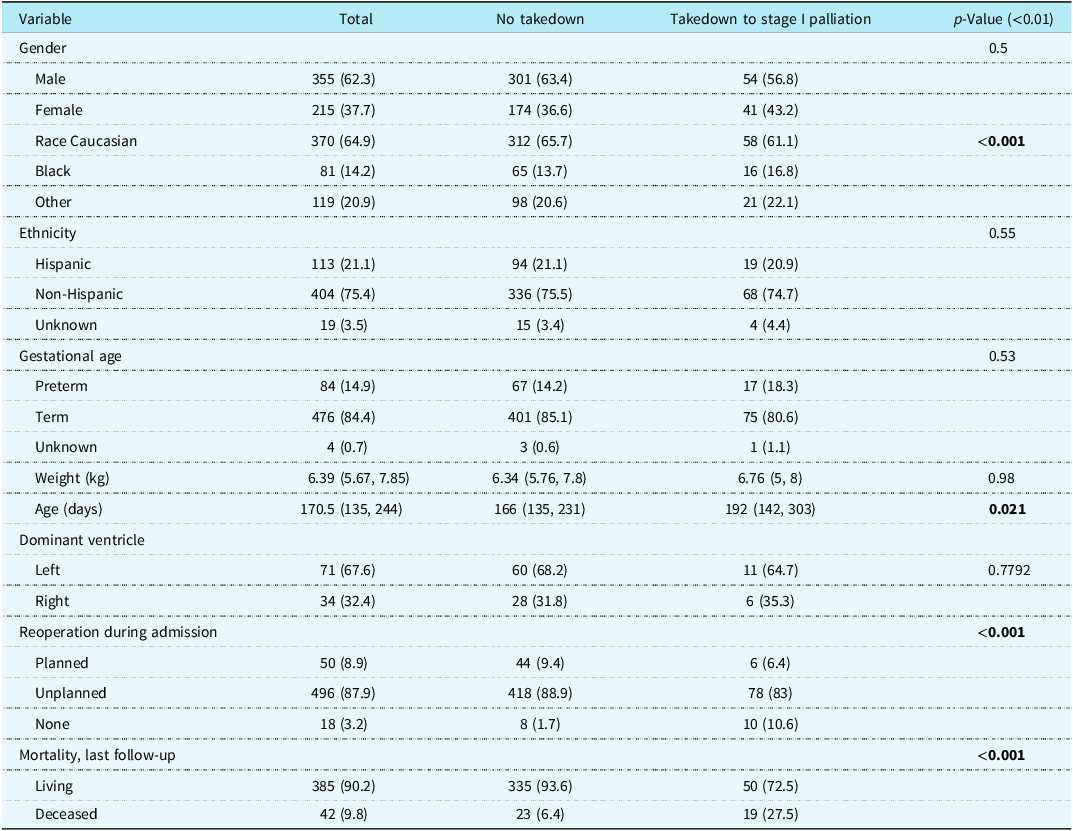
Of the 16,913 patients undergoing Glenn procedure, 95 (0.56%) patients required takedown to a stage I shunt. Those who needed a Glenn takedown were less likely to be Caucasian and more likely to be Black or Other race (p < 0.001). They were likely to be older (192 versus 166 days, p < 0.021) at the time of the Glenn procedure. There was no difference by gender, ethnicity, gestational age, weight at the time of Glenn, or ventricular dominance between the two groups. There were differences in the operative characteristics, with those undergoing a takedown to stage I more likely to have a longer cardiopulmonary bypass time (150 minutes versus 90 minutes, p < 0.001), more likely to need aortic cross-clamp, use lower core temperature (nasal) during the surgery (28.2 degrees versus 32 degrees Celsius, p = 0.012), and have a longer cooling time during the procedure (25 minutes versus 15 minutes, p < 0.001) (Table 4). For outcome, the mortality of the takedown group was significantly increased at last follow-up (27.5% versus 6.4%, p < 0.001) compared to control group (Table 5).
Operative characteristics of control group versus patient’s requiring takedown to stage I palliation

CPB = cardiopulmonary bypass.
Demographics of patients requiring takedown to stage I palliation

*Values are n (%) or median (interquartile range).
Factors predicting mortality
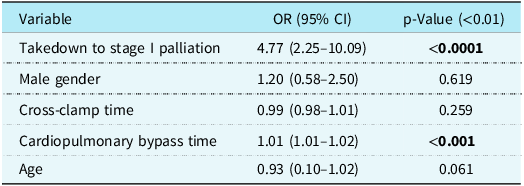
By multivariable analysis, takedown to a stage I shunt (OR 4.77, CI 2.25–10.09) and longer cardiopulmonary bypass time (OR 1.01, CI 1.01–1.02) were significantly associated with mortality in this cohort (Table 6).
Post-operative risk of mortality (control versus takedown cohort)

Discussion
This analysis focusing on the Glenn procedure using the STS-CHSD is the largest analysis to date and presents data on an understudied phase of staged palliation in single-ventricle patients compared to the Norwood or Fontan stages. It may be because the surgical outcomes for Glenn procedure are considered to be excellent with previous studies demonstrating mortality of 0–10% and low perioperative morbidity. Reference Ohye, Schonbeck and Eghtesady5–Reference Keizman, Abarbanel, Salem, Mishaly, Serraf and Pollak8
However, there continues to be a cohort of patients that do not do well after conversion to the Glenn circulation and demonstrate failure related to inadequate pulmonary blood flow, high pulmonary vascular tone, distal pulmonary vascular abnormalities, cardiac dysfunction, or atrioventricular valve dysfunction amongst others. These important factors can be summarised as anatomic or haemodynamic determinants of Glenn circulation. Reference Lee, Allen and Tabbutt3,Reference Viegas, Diaz-Castrillon and Castro-Medina6,Reference Keizman, Abarbanel, Salem, Mishaly, Serraf and Pollak8,Reference Chacon-Portillo, Zea-Vera and Zhu9,Reference Beshish, Brady and Golloshi10 Such Glenn failure may manifest as hypoxia, high respiratory support need or persistent pleural effusions. When unresponsive to medical management, it may necessitate Glenn takedown to an aorto-pulmonary shunt. Other interventions after Glenn procedure may be driven by AV valve regurgitation, cardiac dysfunction, or other anatomic findings such as coarctation of aorta. Lastly, although uncommon, bleeding-related complications may warrant an unanticipated reopening of the chest to address the issue. All of these, although acknowledged, have not been studied in a large population of Glenn patients leading to current study.
Mortality after stage II palliation in our study group was 1.2%, less than reported by other multi-centre series. Reference Ohye, Schonbeck and Eghtesady5,Reference Schwartz, Lu and Ohye11 To our knowledge, there are no studies that have investigated the impact of unexpected reoperation after the Glenn procedure or the impact of reverting back to stage I in the immediate post-operative period. This study showed that any unexpected surgical intervention after Glenn procedure added significant morbidity and mortality. There was a four-fold increase in the length of stay for those needing an unexpected intervention and a greater than five-fold increase in hospital mortality in this cohort (6.6% compared to 1.2%). Even for survivors, the risk for readmission was significantly higher (26% compared to 14%). Thus, although the rate of such need for reintervention was low, the impact was found to be quite high. In attempting to find risk factors for such reinterventions, it appears that both clinical and surgical parameters may set up some Glenn candidates for such failure. Patients were smaller and younger at the time of Glenn procedure, more likely to be non-Caucasian, need significantly longer bypass time and cross-clamp time in the cohort needing such reinterventions. The Glenn procedure itself needed was significantly longer and more involved. Additionally, in the immediate post-operative period, these patients needed more transfusions and had lower saturations. Thus, the profile of these patients appears to suggest higher complexity operatively and carries unto the post-operative period. These are likely a surrogate for more complex baseline pathology and have been identified as a risk factor for post-operative morbidity previously. Reference Kogon, Plattner and Leong7
Some of these risk factors overlap with previously reported risk factors for poor outcomes after Glenn procedure, such as younger age, which was found to be a risk factor for both need for reintervention and Glenn mortality in our study. Reference Hill, Rudd, Ghanayem, Hehir and Bartz12–Reference Shuler, Statile, Heydarian, Lehenbauer and Hill14 The impact of race found only on univariate analysis is in line with previous studies on Glenn outcomes which have identified Black race and Hispanic ethnicity as risk factors. Reference Dean, McHugh, Conaway, Hillman and Gutgesell15,Reference Sooy-Mossey, Matsuura and Ezekian16 Interestingly, Williamson et al surveyed the National Inpatient Sample database and showed that high-volume centres performing single-ventricle palliation disproportionately served White population and had better outcomes compared to lower volume centres that had higher proportion of minority patients. Reference Williamson, Tran and Rudasill17 Thus, the relationship of race with outcomes may be significantly more complex and needs continued and serious attention.
When evaluating the risk factors for mortality, need for unexpected surgical intervention after Glenn came out as the strongest predictor. Additional risk factors identified included age, cardiopulmonary bypass time, and right ventricle as systemic ventricle. The impact of right ventricle as the systemic ventricle on post-Glenn morbidity and mortality was in line with previous reports. Reference Keizman, Abarbanel, Salem, Mishaly, Serraf and Pollak8,Reference Alsoufi, Gillespie and Kim18,Reference Liu, Zielonka, Snarr, Zhang, Gaynor and Rychik19
For the smaller cohort that needed takedown of the Glenn circulation to stage I circulation, the study showed a mortality rate of 27.5% compared to 6.4% in the reintervention control cohort. It does seem, therefore, that such rescue measures come with very high morbidity and mortality and therefore should be considered with caution. The study is not able to clarify the indications and circumstances around such a Glenn takedown. However, given the morbidity and mortality of such a takedown, all alternative management options should be explored. The study has some additional limitations. Presence of significant atrioventricular valvar regurgitation is recognised as an important risk factor for morbidity in single-ventricle palliation, which could not be assessed in this study. Reference Lee, Allen and Tabbutt3,Reference Schwartz, Lu and Ohye11,Reference Stack, Schluger and Roberts20 Details of surgical anatomy pre- and post-Glenn as well as pre- and post-Glenn haemodynamic data are important determinants of success or failure of this circulation. Some of these details are not fully captured by the registry. Similarly, any catheter-based interventions especially during the post-operative or interstage period are not accounted for in this database. Lastly, for the cohort undergoing Glenn takedown, their eventual outcome on the single-ventricle palliation pathway is important and not captured in the data.
Conclusion
Need for unexpected surgical intervention after the Glenn procedure including takedown to stage-I is associated with high morbidity and mortality. Surgical procedural risk factors as well as right ventricular dominance impact outcomes. As we continue to identify characteristics associated with poorer outcomes, we can continue to hone our patient selection and surgical procedures and optimise post-operative management to minimise need for unexpected intervention.
Acknowledgements
The data for this research were provided by The Society of Thoracic Surgeons’ National Database Participant User File Research Program. Data analysis was performed at the investigators’ institution(s). This research was determined to be exempt research with a waiver of informed consent from Advarra Institutional Review Board (Mod01760092, Version 1.1, Approval date July 17, 2023). The views and opinions presented in this article are solely those of the author(s) and do not represent those of The Society of Thoracic Surgeons.
Financial support
No funding source to disclose.
Competing interests
No conflict of interests for any of the authors.