Spray drying is suitable for mango flavoured curd powder due to its very short time of heat association and the high evaporation rate, which gives high quality, stable, functional and low moisture content products (Koc et al. Reference Koc, Koc, Susyal, Sakin-Yılmazer, Kaymak-Ertekin and Bagdatlıoglu2011). Dairy based powder like curd powder can be used to prepare many products like ice cream, instant drinks, thick creams etc. A dried flavoured curd powder also will be highly desirable due to its long shelf life and flavour (mango) and requires comparatively low transportation cost and capacity of storage (Koc et al. Reference Koc, Sakin-Yılmazer, Kaymak-Ertekin and Balkır2014). Mango (Mangifera indica) is an important fruit in Asia and around the world. Nutritional importance of mango is mainly due to carotenes and other bioactive compounds (Wilson et al. Reference Wilson, Kadam, Chadha, Grewel and Sharma2012).
The aim of the present work was to produce self stable mango flavoured curd powder using spray drying technique and to study various parameters such as, reconstitution properties (dispersibility), morphological properties (appearance and particle shape), bulk and tapped density, microbial growth, % lactic acid, moisture content, water activity, Colour and pH of the developed powder. The two spray drying temperatures (150 °C and 170 °C) were selected based on a spray drying system which has been characterised for yogurt at various combinations of inlet air, outlet air temperatures or feed rate, atomisation speed and feed temperature (Kim & Bhowmik, Reference Kim and Bhowmik1990; Koc et al. Reference Koc, Sakin, Balkir and Kaymak-Ertekin2010).
Material & methods
Materials
Mango flavoured curd powder was used in this study which was obtained by spray drying in a tall type spray drier under 2 different temperatures (150 °C and 170 °C) and 3 different curd and mango ratio (1:0·5, 1:1, 0·5:1) with curd sample as control. The curd was prepared from pasteurised, double toned, homogenised milk (fat 1·5%, SNF 9·0%). The spray drying condition for flavoured curd powder production (inlet air temperature of 150 °C and 170 °C, outlet air temperature of 80 ± 10 °C and 105 ± 10 °C, respectively and feed temperature of 15 ± 5 °C) was targeting the maximum survival ratio of lactic acid bacteria, utmost overall sensory attributes, minimum colour change and acceptable moisture content. Besides, all the physical and biochemical properties were measured carefully.
Analytical methods
Moisture content
Moisture contents of flavoured curd powder were determined gravimetrically by oven drying at 105 °C for 3 h.
 $${\rm MC} = \; \displaystyle{{{\rm Intial}\,{\rm Weight} - {\rm Final}\,{\rm Weight}} \over {{\rm Final}\,{\rm Weight}}}\; \times 100\% $$
Water activity (a w)
The water activity was determined using a water activity meter (LabSwift-aw; Novasina, SRM University, India).
Dispersibility
Dispersibility measurements of flavoured curd powder were performed in water by little stirring and the time of dispersion was noted down.
Bulk density and tapped density
The bulk density (ρb) of the flavoured curd powder was determined by taking the weight of the powder and the corresponding volume. For the tapped density (ρt), the cylinder was tapped strenuously by hand until no further change in volume took place (Nijdam & Langrish, Reference Nijdam and Langrish2005).
Porosity
The porosity (ε) of the powder samples was evaluated using the relationship between the tapped (ρt) and bulk (ρb) densities of the powders (Nijdam & Langrish, Reference Nijdam and Langrish2005):
 $${\rm \epsilon} = \; \displaystyle{{{\rm \rho} _{\rm t} - {\rm \rho} _{\rm b}} \over {{\rm \rho} _{\rm t}}}$$
Particle morphology
The morphological properties of flavoured curd powder (the appearance and the particle shape) identified by using images which are taken via a scanning electron microscope (SEM, FESEM–NRC, India).
Colour analysis
The colour of mango flavoured curd powder was measured using a Hunter Lab Colour quest XE-Hunter colour meter based on L* (black to white), a* (red to green), and b* (yellow to blue) values (Behboudi-Jobbehdar et al. Reference Behboudi-Jobbehdar, Soukoulis, Yonekura and Fisk2013).
pH
pH of mango flavoured curd powder was determined after reconstitution using pH meter (Chegini et al. Reference Chegini, HamidiSepehr, Dizaji and Mirnezami2014).
Functional group identification
FTIR is done to identify the functional groups present in the mango flavoured curd powder (Mitali & Baruah, Reference Mitali and Baruah2011).
Identification of the pure culture
Isolated pure culture on MRS agar petri plates was recognised with the help of biochemical tests like endospore test and catalase test.
% Lactic acid
Acidity is indicated as per cent lactic acid. Since 1 ml of 0·1 N lactic acid carries 0·009 g of lactic acid, the number of ml. of 0·1 N NaOH needed to neutralise the lactic acid in the sample, multiplied by 0·009 will produce the quantity of lactic acid (grams) in the sample, when the result is divided by weight of sample and multiplied by 100 the per cent lactic acid will be obtained. Phenolphthalein indicator is used and colour changed to pink which remained constant for 10–15 s. The titration is completed within 20 s.
 $$\eqalign{&{\rm \%} \,{\rm Lacti}\,{\rm acid} \cr & \quad {\rm No}\,{\rm of}\,{\rm ml}\,{\rm of}\,0 \cdot 1 {\rm N}\,{\rm NaOH}\,{\rm solution}\,{\rm required}\,{\rm for} \cr & \quad ={{\rm nutrilization} \times 0 \cdot 009 \over \quad \quad \quad {\rm Weight}\,{\rm of}\,{\rm Sample}} \; \times 100}$$
(Weight of sample = Volume of sample × specific gravity).
Statistical analysis
All measurements were made in triplicate and results are expressed as mean ± standard deviation. The analysis of variance (ANOVA) at a confidence level of 95% was performed. All the results that were obtained were analysed using IBM SPSS Statistics 20·0 software (SRM University, India).
Results and discussion
As reported in Table 1 the moisture content of the fresh curd sample was determined as 8·58% (150 °C) and 3·51% (170 °C) wet basis. The moisture content (%, wet basis) of mango flavoured curd powders obtained at the 2 spray drying conditions with 3 different ratios (1:0·5, 1:1, 0·5:1) are also shown in Table 1, where it is observed that samples with more amount of curd have higher amount of moisture content and water activity. The moisture content as well as water activity decreased with higher inlet temperature. For yogurt powder moisture content varies from 3·98% to 7·17% based on different inlet and outlet temperature (Koc et al. Reference Koc, Sakin-Yılmazer, Kaymak-Ertekin and Balkır2014). From Table 1 it can be obtained the reconstitution property (dispersibility) (P < 0·05) was higher with higher inlet and outlet temperature. The dispersibility of flavoured curd powder is affected by the outlet air temperature, but the trend of this effect cannot be figured out clearly (Koc et al. Reference Koc, Sakin-Yılmazer, Kaymak-Ertekin and Balkır2014). Bulk and tapped density decreased with higher inlet and outlet temperature but porosity increased, hence there was an inverse proportionality between the two characteristics. Spray-dried products are usually non-homogeneous. Milk powder which is dried in low temperature provides relatively high bulk density due to lower porosity, whereas milk powder dried in high temperature gives low bulk density because of porous individual particles (Nijdam & Langrish, Reference Nijdam and Langrish2005).
Physical & Chemical Properties (mean ± sd) of spray dried curd and mango flavoured curd powder

* P < 0·05
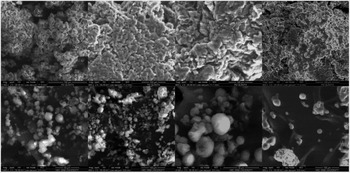
The scanning electron microscopy images of yoghurt powder, produced at 2 different spray drying condition and 4 different ratios, are given in Fig. 1 with a level of magnification of 800× to 4000×. The first four pictures were for 150 °C sample 1:0·5, 1:1, 0·5:1 and control curd sample, respectively. The other four pictures were for 170 °C as the above stated order of ratios.
The scanning electron microscopy images of Mango flavoured curd powder, produced at the optimum spray drying condition (inlet air temperature of 150 °C & 170 °C, outlet air temperature of 80 ± 10 °C & 105 ± 10 °C and feed temperature of 15 ± 5 °C)

The pH was increased with higher inlet and outlet temperature samples. Some circumstances led to an increase in the density of the concentrated liquid samples, which resulted in an increase in the pH values (Chegini et al. Reference Chegini, HamidiSepehr, Dizaji and Mirnezami2014). Sample with equal ratio of curd and mango had higher pH than the rest of the samples. Curd sample had a greater amount of lactic acid than flavoured sample powders. Lactic acid percentage decreased with higher inlet and outlet temperature. In previous experiment on yogurt-ice cream mix the percentage of lactic acid was found to be between 0·60 and 0·63 (Layusa et al. Reference Layusa, Barraquion, Dizon, Elegado and Sevilla2013). The colour analysis showed that the curd sample was white in colour and all the other three ratios were yellow in colour (reported in online Supplementary Tables S1 and S2). All the flavored sample powders had a lower luminosity (L*) and higher yellow colour intensity (b*) compared to the curd-only sample. The luminosity (L*) decreased and intensity of yellow colour (b*) and intensity of red colour (a*) was increased with higher inlet temperature.
The FTIR results showed that with different inlet spray drying temperature and ratios the functional groups present in the sample powder changed (reported in online Supplementary Table S3). In both the cases ratio of mango 0·5: curd 1 had the almost similar functional group against control curd sample (online Supplementary Figs. S1–S8). The number of functional groups decreased with higher inlet temperature. Alkanes were present as same number in flavoured curd powder at both 150 °C and 170 °C inlet temperature. From the result we can see alkenes groups were not present in only curd sample at both 150 °C and 170 °C inlet temperature.
To identify the lactobacillus strain present in the curd powder we obtained an almost-complete 16S rRNA gene amplification with primer combinations 27F and 1492R. The phylogeny tree S9 (reported in Supplementary Fig. S9) shows the strain present in the sample is Lactobacillus_curieae which is a gram-positive, non-motile, facultative anaerobic, non-spore-forming, rod-shaped bacteria which did not exhibit catalase activity (Lei et al. Reference Lei, Sun, Xie and Wei2013).
Conclusion
The newly developed final product mango flavoured curd powder possesses good flavour and colour. A fine particle powder was obtained with higher spray drying temperature. The bulk and tapped densities of sample curd powder are an indication that sample powders have fair porosity. Flavoured curd powders have moderate-poor flowability due to their small particle size. With respect to morphology, the sample powders particles were mostly spherical and showed a crater-like structure. For purposes of understanding the particle formation process, predicting product quality and evaluating the behaviour of spray-dried mango flavoured curd powder during reconstitution, this information will provide a helpful approach. Also the lactobacillus strain (Lactobacillus_curieae) was found, which potentially makes this powder healthy and probiotic.
Supplementary material
The supplementary material for this article can be found at https://doi.org/10.1017/S0022029918000225