Introduction
Salivary duct carcinoma is a rare tumour of the salivary glands and represents 1–3 per cent of all malignant salivary tumours.Reference Jaehne, Roeser, Jaekel, Schepers, Albert and Loning1 Salivary duct carcinoma has significant pathological similarities to ductal carcinoma of the breast. Two-thirds of patients present with advanced disease, and there is a high risk of both local (48 per cent) and distant (48 per cent) recurrence. The five-year overall survival of stage I, II, III and IV disease is 42, 40, 30 and 23 per cent, respectively.Reference Jaehne, Roeser, Jaekel, Schepers, Albert and Loning1 In view of the poor overall survival figures for this disease, a structured therapeutic approach should be developed to improve the outcome of this disease.
The human epidermal growth factor receptor (HER-2/neu) gene is involved in the control of cell growth and development.Reference De Potter2 Amplification of this gene leads to over-expression of the membrane protein, which can be detected using immunocytochemistry (ICC). Over-expressed human epidermal growth factor receptor 2 can be targeted by using a monoclonal antibody, trastuzumab.Reference Pegram, Lipton, Hayes, Weber, Baselga and Tripathy3
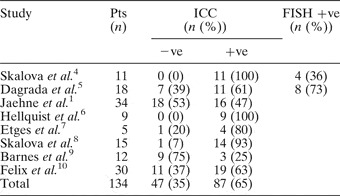
In salivary duct carcinoma, the incidence of human epidermal growth factor receptor 2 over-expression ranges from 25 to 100 per cent (Table I), and is associated with early development of distant metastasis and reduction of the five-year survival rate.Reference Jaehne, Roeser, Jaekel, Schepers, Albert and Loning1–Reference Skalova, Starek, Vanecek, Kucerova, Plank and Szepe4 The wide range of human epidermal growth factor receptor 2 positivity in salivary duct carcinoma may be explained by the use of different staining techniques and antibodies. The discordance between levels of human epidermal growth factor receptor 2 positivity detected by and by fluorescent in situ hybridization (FISH) could in some cases be related to either of two factors. Firstly, an increased sensitivity of the antigen retrieval methods could be interpreted as a false positive ICC. Secondly, a false negative FISH might be encountered as an over-expression of a protein, and could be induced by either an increased transcription of its gene or through an inhibition of protein degradation.Reference Skalova, Starek, Vanecek, Kucerova, Plank and Szepe4 Therefore, a negative human epidermal growth factor receptor 2 status by FISH analysis does not invalidate a strongly positive ICC.
HER-2 status (by ICC and FISH) in salivary duct carcinoma: published case series

HER-2 = human epidermal growth factor receptor 2; ICC = immunocytochemistry; FISH = fluorescent in situ hybridization
Case report
A 49-year-old man presented with a three-month history of a swelling in the right parotid gland, which measured 10 × 15 cm. There was no cervical lymphadenopathy. The rest of the clinical examination was unremarkable.
The full blood count, electrolytes, and kidney and liver functions were all within normal ranges. Fine needle aspiration cytology confirmed the lesion's malignant nature. There was no evidence of metastatic disease on computed tomography scanning.
Therefore, the patient underwent total parotidectomy and a modified neck dissection.
Histopathological examination showed a 40 mm, poorly differentiated salivary duct carcinoma ex-pleomorphic adenoma. Extramural vascular invasion and involvement of the deep resection margin were detected. Fourteen out of 75 nodes were affected at levels two, three and five, with extra-capsular invasion demonstrated in 10 nodes. The cancer was strongly positive for human epidermal growth factor receptor 2 and negative for ICC by estrogen receptor (ER).
In view of the positive deep surgical margin and extracapsular nodal spread, the patient received a course of post-operative adjuvant radiotherapy, with 50 Grays in 20 fractions to the right parotid and neck over 28 days.
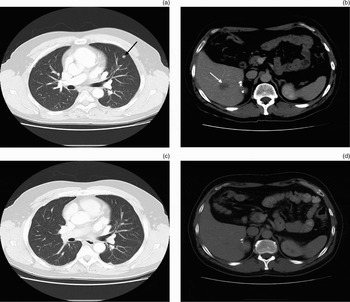
Five months later, the patient developed neck recurrence and lung metastasis (Figure 1a). Therefore, he was treated with five cycles of palliative chemotherapy, with doxorubicin 75 mg/m2 on a three-weekly basis. His disease progressed while receiving this chemotherapy, with development of liver metastasis (Figure 1c). In view of his tumour's human epidermal growth factor receptor 2 positivity, he was then treated with weekly trastuzumab 2 mg/kg, with an initial stabilisation of his disease. Unfortunately, after five months, the disease progressed in his neck, liver and lungs. Thereafter, he was treated with a combination of docetaxel (100 mg/m2) and trastuzumab (6 mg/kg) on a three-weekly basis. After six cycles, complete resolution of the lung and liver metastases was achieved (Figure 1b and d), with minimal residual disease in the neck. There was no significant toxicity and the patient's performance status was maintained throughout the treatment period.
Pre-treatment (a) and (b) and post-treatment (c) and (d) axial computed tomography scans. Arrows point to lung (a) and liver (b) metastases.

At the time of writing, the patient was still alive, 20 months after diagnosis of metastatic disease, and was receiving three-weekly trastuzumab.
Discussion
Docetaxel plus trastuzumab is an established combination for the treatment of advanced breast cancer.Reference Marty, Cognetti, Maraninchi, Snyder, Mauriac and Tubiana-Hulin11 This is based on a synergistic interaction between trastuzumab and taxanes.Reference Pegram, Konecny, O'Callaghan, Beryt, Pietras and Slamon12 Two-thirds of patients positive for human epidermal growth factor receptor 2 respond to a combination of docetaxel and human epidermal growth factor receptor 2 blocker.Reference Sato, Sano, Tabei, Asaga, Ando and Fujii13 Due to the pathological similarities between ductal carcinoma of the breast and salivary duct carcinoma,Reference Jaehne, Roeser, Jaekel, Schepers, Albert and Loning1 the present case was treated with the same combination, achieving complete resolution of the metastatic disease.
• The incidence of human epidermal growth factor receptor 2 positivity in salivary duct carcinoma is 25–100 per cent and is associated with a poor outcome
• Salivary duct carcinoma has significant pathological similarities to ductal carcinoma of the breast
• A 49-year-old man developed lung and liver metastasis a few months after surgery and adjuvant radiotherapy for salivary duct carcinoma of the parotid gland
• A durable, complete response was achieved with a combination of docetaxel and human epidermal growth factor receptor 2 blocker (trastuzumab)
• A rationalised treatment approach targeting the biological characteristics of salivary duct carcinoma proved successful
Alternative and more effective therapeutic modalities should be explored for the treatment of salivary duct carcinoma, through targeting the biological characteristics of this aggressive type of cancer. To our knowledge, this is the first report of the use of human epidermal growth factor receptor 2 blocker in combination with docetaxel for the treatment of salivary duct carcinoma of the parotid gland. Based on the good outcome of the reported case, oncologists should be encouraged to explore such treatment for the management of this aggressive cancer.