IBM's history has been explored many times, for scholarly and popular audiences and from the viewpoints of both business history and the history of computing. One of the first truly multinational firms, IBM remains one of the biggest global businesses. Today, more than 80 percent of IBM's employees work outside the United States. Yet, despite the promise Thomas J. Watson made in 1921 by naming his company the International Business Machines Corporation, its story has usually been told with only intermittent reference to its operations outside the United States. We know relatively little about IBM World Trade Corporation, IBM's international arm from 1949 until the early 1990s.Footnote 1 Attention has focused instead on the personal stories and management philosophies of the senior and junior Thomas Watsons, the firm's early strength in punched card machinery and successful pivot to dominate the mainframe computer industry, its initial triumph and subsequent stumble in the personal computer industry, and Lou Gerstner's turnaround effort to rebuild IBM as an internet-age provider of software and services.Footnote 2
Historians have written about a few national IBM subsidiaries and more recently have started to examine IBM's international operations outside of the United States in detail. Such work has focused particularly on the firm's operations in Germany and France, the hubs of its integrated European production system and research network.Footnote 3 In examining IBM Chile's development, Eden Medina concluded that one needs to study both IBM's corporate strategy and the national history of the host country to fully understand IBM's development and long-lasting success.Footnote 4 Yet even in such accounts, the implication is usually that the story of a particular international subsidiary is a self-contained narrative of primarily local interest, as a footnote or sidebar to IBM's main historical story.
Historians have tended to take the American experience as the default, deploying “international” as a residual category to encompass everything that takes place outside the United States. Their assumption is that other countries will work on their own corresponding, but less important, national narratives. In contrast, we argue for an explicitly transnational understanding of IBM, one that looks not just at national subsidiaries but also at their interactions. The history of IBM is the sum of a set of intertwined narratives taking place on national, regional, and international levels. Historians have studied the European Community's efforts to boost European competitiveness in information technology by encouraging technical exchanges and business partnerships across national boundaries. In the 1970s this yielded Unidata, a disastrous merger of French, Dutch, and German competitors intended to provide the scale needed to compete internationally.Footnote 5 In contrast, IBM's internal cooperation and conflict solving began earlier, worked better, and included more European countries. Our approach has been influenced by Thomas Misa and Johan Schot, who suggest paying attention to the flows of people, knowledge, and goods as important integrating (as well as fragmenting) elements for Europe. Misa and Schot propose linking, circulation, and appropriation as useful concepts for investigating these phenomena. By appropriation, they refer to “the process in which users—including governments, companies, organizations, and citizens—variously explore, signify, reproduce, communicate, and integrate knowledge and artifacts into their daily life and business.”Footnote 6
Our particular focus here is on IBM Finland and on the ways in which this subsidiary and its employees shaped identities and practices that were, for particular audiences and purposes, aligned creatively with IBM's dominant corporate culture, with the national interests of Finland, and with emerging Nordic and pan-European identities. During the early Cold War, Europe's economic environment changed from nationalist protectionism to increasingly free trade within a reintegrating global economy.
Local managers addressed their national needs and political challenges within the constraints of IBM policies and products set globally. Finland was an exceptional country in a number of ways. Yet the apparently narrow story of IBM's success in a single, rather small and undeniably quirky, nation can provide broader insights into its rapid postwar rise to become one of the world's largest and most resilient enterprises. Smaller subsidiaries, particularly when geographically remote, can struggle to gain the attention and understanding of headquarters. Those that expand beyond sales and service into manufacturing or research and development, as IBM Finland attempted to do, have been shown to develop a stronger “voice” with which to attract this attention.Footnote 7
Business scholars exploring the role of national subsidiaries within multinational corporations have increasingly recognized that they are not simply extensions of foreign organizations. Instead, local subsidiaries develop unique capabilities, adding value to their parent organizations by embedding themselves in local business contexts and building unique relationships.Footnote 8 Models varied significantly among companies, with some firms, such as Unilever, granting more autonomy to foreign brands.Footnote 9 Multinational corporations rely heavily on local employees, to build these local connections as well as to save on the high cost of supporting expatriates. Working at the interface of national cultures, these employees develop their own hybrid identities.Footnote 10 In some cases, such as DuPont's operations in Iran or the experiences of Australian firms in postcolonial New Guinea, apparently successful attempts to overcome cultural differences can be swept away by geopolitical instability.Footnote 11
As we will show, IBM relied on several intermediate layers to bridge cultural and organizational divides between its smallest subsidiaries and the parent organization. Its Nordic subsidiaries (Finland, Norway, Sweden, and Denmark) routinely collaborated forming a distinct regional community of practice for managers and salespeople. A European headquarters was the next level up, giving the employees of different subsidiaries a strong pan-European identity long before the formation of the European Economic Community. IBM's European management, along with its other non-U.S. subsidiaries, reported to IBM World Trade, headquartered in New York but separated from the firm's U.S. headquarters. Depending on one's perspective, and the needs of the moment, IBM Finland was Finnish, Nordic, European, or global. Conflicts that occurred between these different levels provide us with windows into the negotiation of national and transnational identity within the firm. Overall, however, the system worked well for most of the Cold War era in giving IBM Finland the ability to present itself domestically as a local company while positioning it within a transnational enterprise with huge technological and economic capabilities.
We based this account on a variety of sources, in alignment with our goal of looking at the interaction of different organizational levels. Much research on the history of IBM World Trade relies on secondary sources because the firm's European archives were never open to academic researchers and reportedly were destroyed by a fire. Fortunately, IBM Finland retained its own archive. We also drew on material from IBM's main archive, in the United States; on oral history interviews and memoirs, to capture the remembered experiences of participants; and on published primary sources, such as company reports and newsletters. These related particularly to IBM's activities in Sweden, which was tightly connected to IBM Finland. In exploring these records, we looked for details that would illuminate the changing position of IBM with respect to Finnish national identity or the flows of people, resources, and ideas between different organizational levels within IBM.
IBM Finland: The Early Years
Companies such as Singer, which expanded to dominate the global sewing machine market early in the twentieth century, provided a template for other U.S. companies—one that involved massive investments in sales and support services.Footnote 12 IBM's Thomas Watson Sr. made international expansion a priority as early as the 1920s, long before his firm joined the top ranks of corporate America. But IBM's task was more challenging and its resources, initially, were more limited: it sold complex products direct to businesses rather than simple machines direct to individuals. Selling tabulating machines demanded a deeper grounding in local language and business culture than selling Coca Cola or sewing machines. IBM always relied heavily on local people to explain its unfamiliar technologies to potential customers and assist with their use.
Those locals were originally agents and distributors for IBM, not its employees. IBM equipment and skills entered Finland through a blend of local, European, and American channels. The very first Hollerith punched card machines had been imported to Helsinki through an earlier Finnish agent, Oy Systema Ab, in 1923.Footnote 13 Neither it nor Amko, its replacement as agent, was hugely successful. The Finnish market for punched card equipment was being met largely by its rival Powers, via a distributor based in nearby Sweden.
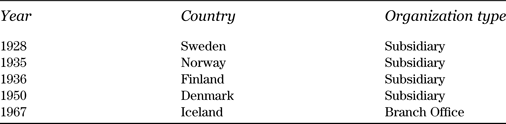
In the summer of 1934, an Amko employee named Einar Dickman became the first Finn to be given IBM sales education, taking a course offered by the Deutsche Hollerith Maschinen Gesellschaft (Dehomag) in Berlin. The ten-week course was attended by forty Germans and fifteen foreigners.Footnote 14 Dehomag was already owned mostly by IBM, but controlled from Berlin (an arrangement that became increasingly strained as war approached).Footnote 15 Oy International Business Machines Ab of Finland (hereafter called IBM Finland) was established in 1936 by two temporary leaders with broader European experience: Jack Holt, IBM's European manager, and Rolf Hurup, a Norway-born returnee from the United States in charge of IBM's Nordic growth (see Table 1). Dickman became its CEO in 1938 and held that job until 1956.Footnote 16
Establishment of Nordic IBM Country Organizations

Source: Petri Paju, “IBM Manufacturing in the Nordic Countries,” in History of Nordic Computing 3, ed. John Impagliazzo, Per Lundin, and Benkt Wangler (Heidelberg, 2011), 217.
The involvement of people and skills from Norway, Sweden, and Germany in building the new subsidiary was pragmatically necessary. Finland in the 1930s had only about three-and-a-half million people and received most of its foreign-trade income from timber and paper products. It was never a huge market for punched card equipment, IBM's core product from its foundation until the 1960s. However, as Riitta Hjerppe has shown, Finland's was a fast-growing economy with a rapidly developing industrial and commercial sector. Despite laws intended to restrict foreign ownership of businesses, many foreign-owned firms and international partnerships, most of them quite small, were set up during the interwar years. Sweden, Norway, Germany, and Britain were the most active countries, but IBM was not unique: Hjerppe was able to identify twenty American-owned firms.Footnote 17
But this international engagement was also politically charged. At this point Finland had a short history as an independent nation and a much longer history as an imperial possession. It had developed within the hinterland of the Swedish Empire, changing hands several times as Sweden vied with Russia for local dominance. Russia emerged victorious from the final struggle during the Napoleonic Wars, ruling from 1809 to 1917. Finland's obedience, and strategic position at the western edge of the Russian Empire, gave its people the freedom to invent and develop a Finnish nation with two national languages, Swedish and Finnish. The Russian Empire's collapse sparked a brief but brutal civil war, in which the more conservative side defeated a radical socialist movement.Footnote 18
Since the late nineteenth century, the Swedish-speaking community had emphasized the importance of international exchange for Finland, whereas Finnish-speaking Finns had—as in other language-driven nationalist movements across Europe—aggressively pushed Finland toward greater independence.Footnote 19 Even after independence, Swedish remained the language of university education and the professions, so the directors of larger businesses were disproportionately drawn from this community.Footnote 20 IBM Finland was run mostly by Swedish-speaking Finns, including Einar Dickman and Carl Enckell. In fact, one supranational IBM manager took notice of the possible ethnic bias (in this case, favoring a minority) at work in IBM Finland and asked if the Swedish-speaking Finns were not overrepresented in the national subsidiary, but his letter seems to have changed nothing.Footnote 21 For the people in IBM Finland, Swedish served also as the language of international exchange in the Nordic countries.
IBM Finland was small, employing fewer than ten people, but from the start its hopes for growth were tied to an internationalist political agenda. In 1938, Rolf Hurup recruited IBM Finland's first chairman of the board: Carl Enckell, a former (and future) foreign minister, industrialist, and diplomat. Thomas J. Watson Sr. was the president of the International Chamber of Commerce (ICC) that year, touring Europe with the slogan “World Peace through World Trade.” This played an important part in boosting European awareness of IBM and its national subsidiaries. Enckell chaired Finland's representation in ICC from 1928 to 1950, working with Watson in Paris, where ICC had its headquarters and IBM a key European office. Both men saw the promotion of IBM's business interests, international trade, and political stability as inextricably intertwined.Footnote 22
To better compete with Powers, IBM invested in Finland in the late 1930s, starting with a service bureau, or a data-processing center. IBM Finland made its own effort to serve customers across national boundaries, selling equipment and services to Estonia, its neighbor to the south. Estonia had a common history with Finland, most recently as part of the Russian Empire, but this promising opportunity was cut short when the Soviet Union annexed Estonia and the other Baltic states in 1940.
IBM Finland in the Postwar World
War and economic upheaval meant that the 1940s were not a happy time for Finnish business. Throughout World War II, Finland's export-driven economy was cut off from international markets by German control of the sea. Things got worse when Finland surrendered territory accounting for almost a third of its economy at the end of the Winter War of 1939–1940, a Soviet invasion secretly sanctioned by the USSR's Molotov-Ribbentrop Pact with Germany. In 1941 Finland exploited Germany's surprise attack on the Soviet Union to recapture its lost territory, only to surrender even more of its land and economy in 1944 after the Red Army swept back through Europe. Even then, the fighting was not over, as a war against the German troops marooned in Finnish Lapland concluded only in 1945. To retain its independence, Finland had to pledge heavy war reparations to the USSR.
IBM Finland weathered these challenges surprisingly well, with some help from IBM Sweden and IBM Norway. The Nordic IBM sister companies supplied spare parts and occasionally sent engineers for service tasks while the Finnish engineers were on military duty.Footnote 23 IBM Finland even managed to establish a punched card production plant during the chaos of the war years, exploiting the local supply of wood pulp and a used press acquired from IBM Sweden. Punched cards were of crucial importance to the data-processing business. For IBM Finland, the sale of cards was a highly profitable and steady source of income. Manufacturing its own cards during the war helped to stabilize its position.Footnote 24 The old card press broke down in 1946 and IBM Finland resumed importing its punched cards.Footnote 25
In 1949, IBM Finland and all of IBM's other national subsidiaries became part of a new global subsidiary: the IBM World Trade Corporation would take care of business everywhere except in the United States, where the parent company IBM Corporation concentrated its operations.Footnote 26 The World Trade Corporation controlled a diverse group of national subsidiaries, which in 1950 ranged from large organizations of thousands to small ones with fewer than a hundred employees. It was headed by Arthur “Dick” Watson, one of the sons of IBM chief Thomas J. Watson, which ensured high visibility for international operations within the firm.
The weight of war reparations to the Soviet Union, satisfied with a flood of industrial products from 1946 to 1952, worked to IBM's advantage as several Finnish companies acquired IBM punched card machines to accurately calculate their production obligations to the USSR. IBM became the major vendor of punched cards in the country, eclipsing Powers.Footnote 27 In 1950, the subsidiary for the first time made a profit to send to the parent company. This reflected considerable ingenuity. In 1952, for instance, a dearth of foreign currency and import permits in Finland made IBM Finland unable to deliver more than three electric typewriters during the whole year despite having more than 130 orders queued. Consequently, the profit of IBM Finland dropped dramatically, falling far below its target.Footnote 28 Difficulties in importing time clocks, another IBM product line, were addressed by manufacturing them locally. When imports were frozen and customers wanted controls for traffic lights and for an apparatus that played church bells, IBM Finland's time equipment department, its repair workshop, and a Finnish machine shop worked together to deliver those.Footnote 29
Because of the growing demand after the war, the Swedish subsidiary had been unable to deliver enough cards for Finland. The Finns applied to the World Trade Division in New York for a new printing machine, over the objection of IBM Sweden.Footnote 30 The national subsidiaries negotiated this question with and through IBM headquarters. Inside the multinational company, this exemplifies international competition over company facilities and functions. After Finland's war reparations to the USSR had been paid, a new IBM punched card plant opened in Helsinki, in 1952. IBM Sweden had sent an expert to install the machinery and soon an inspector visited from IBM Germany.Footnote 31 Paper for the cards was manufactured by and bought from a medium-sized Finnish pulp and paper company, G. A. Serlachius Oy (Kangas Factory near Jyväskylä), integrating the plant into the local economy.Footnote 32 From the mid-1950s onward, several foreign IBM subsidiaries began ordering carton or cardboard for punched cards from the same supplier. IBM's initial postwar push to rebuild its European markets began with a system of local assembly and parts exchange for electric typewriters, intended to overcome tariff barriers on finished goods. IBM Finland was able to barter with punched cards and typewriter ribbons, overcoming an otherwise crippling shortage of hard currency.Footnote 33
This transfer of machinery and expertise opened the door to the emergence of a local competitor. Punched cards were high-margin, low-technology products. Local managers reported to European headquarters rumors that a rival plant was starting; in turn, they were asked to monitor the situation closely.Footnote 34 The real threat turned out to be internal. In 1957 the Finnish manager of the IBM punched card factory resigned. Together with a Finnish engineer, he built an advanced version of the IBM card press. The new Finnish punched card company, Korttipaino Ulf Enbom (Card Press Ulf Enbom), started to compete with IBM Finland.Footnote 35 This was probably the first company to originate in Finland to enter the data-processing industry. In this case, as in later cases, restrictions imposed by IBM on what could be done by its local subsidiary pushed ambitious Finns to start rival firms. The new company attracted some customers, but the rapid development of information technology over the next decade and IBM's own production efficiencies made its success short lived.Footnote 36
One challenge for independent competitors was that while IBM distributed its manufacturing of punched cards and other consumables, such as typewriter ribbons, it centralized its quality control and testing. Tests were done by the Finnish subcontractor and by an IBM print-technology laboratory in Stockholm. Punched card press machines and their special equipment came from an IBM factory in Amsterdam. Another IBM laboratory, in Sindelfingen, West Germany, tested ingredients for color typewriter ribbons, manufactured and tested in Boigny, France. Magnetic tapes were made and tested in the United States.Footnote 37 Access to these international shared resources gave IBM's local plants an advantage that independent competitors could not match.Footnote 38
Growth continued throughout the 1950s. IBM Finland grew from forty-eight employees in 1951 to around two hundred employees in 1961.Footnote 39 In 1950 it had around forty punched-card machine customers. The breakdown of these customers followed the same general pattern established in larger markets beginning with the statistical head office, which in 1923 became an early adopter of IBM equipment, insurance companies, banks, public organizations, and industrial corporations. By 1954, the number of customers with punched card installations had approximately doubled, to seventy-nine.Footnote 40 IBM Finland was, as were subsidiaries in other countries, particularly successful in installing its equipment in government bureaucracies. This set unofficial standards, as IBM was helping to spread expertise and practices between government offices long before an official coordinating body was created in 1964.Footnote 41
The rapid growth of the 1950s took place as the hardening front lines of the Cold War locked Finland into a unique position. Finland retained the independence it had won in 1917, unlike most of the other states created in the aftermath of World War I. The Baltic states were absorbed into the USSR, while Russia dominated central and eastern European nations such as Czechoslovakia, Hungary, and Poland. These countries were forced to accept Communist Party rule and join the Warsaw Pact military alliance and COMECON, a centrally planned trade group. On the other side of the Iron Curtain, democratic countries allied with the United States joined the NATO military alliance, received American assistance via the Marshall Plan to rebuild their shattered economies, and formed a series of free-trade bodies that eventually led to the European Economic Community.
Finland joined neither camp. As a democracy with free markets and an increasingly vibrant corporate sector, its internal arrangements clearly fit with western Europe. Its Communist Party had the support of a significant minority of voters but, as in France and Italy, was shunned as a potential coalition partner by mainstream parties (including the center-left Social Democratic Party). Finland remained highly vulnerable to the Soviet Union, having twice been forced to make peace on Soviet terms. It signed a mutual defense pact with the USSR, avoided public criticism of its foreign or internal policies, and banned books and films showing the Soviet Union in a poor light. Finland declined American aid through the Marshall Plan and shunned NATO. This diplomatic deference to a dominant neighbor in exchange for domestic sovereignty inspired a new piece of Cold War jargon: “Finlandization.”Footnote 42 Finland also remained outside the European Economic Community and its precursors throughout the Cold War. On the other hand, Finland was fully engaged in the postwar trade liberalization movement, joining the Bretton Woods institutions and, in 1961, the European Free Trade Area, which was favored by other nonaligned countries such as Switzerland, Sweden, and Austria.
This economic openness to the West meant that Finland, which prudently remained outside so many international structures, was an active participant in IBM's international order. We provide examples of this international activity later. This made IBM, and other multinationals with local operations, a disproportionately important avenue of mobility for internationally minded Finns.Footnote 43 Finns could not apply for jobs in the European institutions in Brussels, or aspire to postings to NATO headquarters, but they could participate in transnational activities within IBM without antagonizing the USSR.
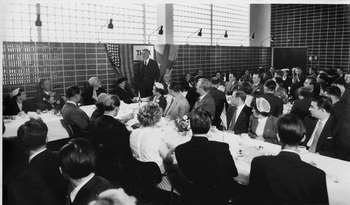
Indeed, the USSR exploited Finland's position as a friendly country with access to IBM technology. In 1954, IBM salespeople were prompted by Paris headquarters to call on oil companies that were not yet IBM customers. All the Western oil companies in Finland already used IBM machines, but one salesperson succeeded in leasing punched card machines to the Helsinki offices of a Soviet-owned oil company, soon to be named Teboil.Footnote 44 None of the international IBM managers visiting Finland intervened, and it is not clear whether they were informed of it in advance (see Figure 1).Footnote 45 In 1956, IBM World Trade forbade IBM subsidiaries from dealing with the Eastern Bloc.Footnote 46 Teboil's connection to IBM Finland let it work around this ban, transferring knowledge from IBM directly to Soviet specialists. The relationship became even more important to Soviet computing after the USSR decided to copy the IBM 360 series rather than design its own mainframe computer architecture and system software.Footnote 47 Finland's government would have been understandably reluctant to jeopardize its perilous relationship with the USSR by discriminating against a Soviet-controlled business, but IBM Finland's willingness to comply points at the challenges of balancing its national obligations with its position within IBM World Trade.
IBM luncheon at Palace Hotel in Helsinki, August 12, 1954. It has the look of an international summit meeting. Arthur K. Watson stands in front the company's “Think” sign, flanked by the flags of the United States and Finland. Manager of IBM Finland Einar Dickman is on Watson's right, and on his left sit Minister Carl Enckell, Chairman of the Board of IBM Finland, and Viggo Troels-Smith, who coordinated IBM's Nordic operations. (Source: IBM Archives, RG 16, World Trade Corporation, box 58, Finland.) Photograph courtesy of IBM Archives.

Another incident tested IBM's ability to prevent its subsidiaries from developing internal cultures that diverged from its American roots. IBM was an exemplar of the American tradition of welfare capitalism, in which employees were dissuaded from unionizing with the promise of generous but paternalistic personnel policies. It was largely successful in avoiding unionization overseas, even in countries where white-collar unions were commonplace. But in 1955, a group of Finnish IBM customer engineers formed a union, the Electrical Accounting Service Engineers. The management of IBM Finland had predicted that the unionization drive would be defeated. When it unexpectedly succeeded, the management was criticized by IBM's European managers in Paris, who consistently fought unionization in IBM World Trade.Footnote 48 This is an example of the way in which the push by multinational firms to create what Glenn Morgan and Peer Hull Kristensen call “boy scout subsidiaries”—which reproduce the national culture of the parent firm—can limit the ability of subsidiaries to integrate fully with local contexts and develop distinctive capabilities.Footnote 49 Once a union existed, IBM managers did their best to keep it national and to prevent contacts with other IBM unions abroad.Footnote 50 Despite its commitment to transnational collaboration, IBM had no qualms about blocking unwanted cross-border communication.
Dickman's quandary captures the delicate position of his country during the early Cold War years. He had, on the one hand, to keep the Soviet Union happy by supplying it with technology and, on the other, to satisfy American managerial ideology by keeping out trade unions. In 1956 Dickman's long reign over IBM Finland was brought to an end, hastened perhaps by the difficulty of balancing these geopolitical pressures.
IBM Finland in the Computer Era
In 1958, IBM caught the nation's attention when it installed the country's first working computer, an imported IBM 650, in a state-owned bank in Helsinki. The installation became a de facto national computer center, which led several Finnish companies to order IBM computers over the next few years.Footnote 51 By 1967, 104 of the country's 136 installed computer systems were IBM models.Footnote 52 This reflected the success of IBM Finland's sales and marketing teams in persuading their existing customer base to transition to the new technology. Such relationships were primarily local, between IBM Finland employees and their fellow Finns. “Marketing at IBM is organized on a national basis,” as journalist Nancy Foy wrote.Footnote 53 But transnational collaborations also played a part in bringing staff and customers into the computer age.
IBM's success in establishing and dominating the Finnish computer market owed a great deal to the groundwork laid by its earlier products and to the thoroughness with which it prepared for the arrival of the new technology. In 1956 it had hired Hans Andersin as its first Finnish “applied science representative,” or computer expert. In Andersin's previous job, part of a Finnish national project to build a computer, one of his tasks had been evaluating possible customer demand. IBM persuaded most potential computer customers to wait for its machines to appear in Finland, rather than to back potential local competitors such as the national committee of scientists. The data-processing journal encouraged this “procrastination” strategy.Footnote 54
IBM Finland supported the strategy by drawing on its transnational resources to train and educate prospective users long before the company was even able to accept orders for electronic computers. IBM Finland had first introduced computers in the summer of 1955 by inviting a Swedish IBM expert to talk about them in Helsinki. At the end of that year, IBM World Trade had informed its subsidiaries, among them IBM Finland, that it could send interested customers to IBM 650 courses in Europe. Such education was organized in Germany, France, Holland, and Sweden.Footnote 55 After he was hired, Andersin could offer interested Finns immediate access to two of the very first IBM computers in Europe. One of them was located in IBM's European Scientific Center in Paris, the other, the first IBM computer in the Nordic countries, at the insurance company Folksam in Stockholm.Footnote 56 Groups of Finnish punched card data-processing supervisors active in the Punched Card Association (Reikäkorttiyhdistys) were taken to see the Swedish machine in operation.Footnote 57 Using computers abroad qualified several Finns as computer experts back in their home country. One of those people going to IBM's center in Paris was a recent physics graduate, Olli Varho, then working for the national Committee for Mathematical Machines (which had also trained Andersin). Varho joined IBM in 1960 and thirteen years later became the executive director of IBM Finland.Footnote 58
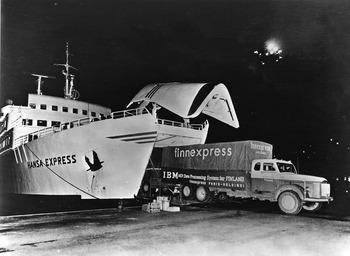
The shift from punched card machines toward computers did nothing to reduce demand for punched cards, which had become a signature product of IBM Finland given the country's thriving timber and paper industries. Throughout the 1960s almost all data processed by computers was first punched onto cards, even if it would eventually be stored on tape or disk (see Figure 2). IBM Finland exported cards to other IBM subsidiaries. By 1966, annual Finnish IBM card production was 403 million cards. In that year, IBM Finland hosted an annual conference for twenty directors of IBM punched card factories from thirteen European countries. Compared with other IBM hardware manufacturing, which was organized continentally and centralized to factory locations usually in larger countries, card production was highly decentralized: in 1967, IBM's fifty-seven punched card plants were spread over thirty-nine different countries.Footnote 59
Truck picking up the first delivery in Finland of a transistorized IBM 1401 computer equipped with interchangeable disk packs, November 18, 1963. The 1401 replaced most of IBM's traditional punched card installations. The truck headed for Oy Vuoksenniska Ab, a steel production company in Imatra, also served as a rolling advertisement for its cargo. (Source: IBM Archives, RG 16, World Trade Corporation, box 58, Finland.) Photograph courtesy of IBM Archives.

Creating a Nordic Identity
IBM provided ambitious Finns with their own opportunities to travel abroad on its behalf spreading modern technology and national pride. Just as Finland had gained its first exposure to computing from Sweden, rather than directly from the United States, so Finland was allowed to initiate Iceland. In 1963, a sales delegation from IBM Finland took a scientific computer manufactured in IBM World Trade's Canadian factory for a short stay in Reykjavík. This aroused great interest from local scientists and engineers, who were trained in programming with the help of visitors from IBM Denmark.Footnote 60 Among the delegation was Andersin, at that time the national manager of data-processing sales of IBM Finland.Footnote 61 Andersin, whose first language was Swedish, was familiar with Norse mythology and able to make sense in Icelandic. He recited an Edda poem, from the Icelandic Viking Age epic.Footnote 62 No American could have done the same job.
As newer generations of computers were introduced, IBM World Trade continued to enlist national IBM staff to carry out transnational marketing. In 1965, IBM flew a computer exhibition around in an airplane, a DC-7B. The “IBM Computour” started from Berlin and circled for two months, touching down in thirty cities in twenty countries—from Tehran to Helsinki, as an IBM customer magazine put it. The display included an IBM System/360 model 20, a small computer produced in Sindelfingen, Germany (as the caption read, not “West Germany”), and several new peripheral devices. In Helsinki, the exhibition stopped for one day only, during which 727 invited guests were ushered through it. A couple of days earlier, Finnish staff had been trained to introduce the exhibition at two airports in Denmark.Footnote 63
By the mid-1960s, IBM was increasingly able to showcase its most advanced computer operations and facilities without having to transport customers all the way to the United States. IBM's World Trade Corporation had a Grumman Gulfstream airplane available for national IBM subsidiaries. IBM Finland used it for the first time in 1968, to fly nine major customer executives and four IBMers to IBM factories in Sindelfingen and in Montpellier, France.Footnote 64 The company's European manufacturing facilities offered powerful venues for transnational marketing for IBM's customers across Europe, symbolizing its commitment to the continent.Footnote 65
IBM was renowned for its investments in education and training, which provided an opportunity to socialize customers and employees into its organizational culture as well as to spread technical knowledge. In 1969 IBM Finland trained 4,308 people at its national education center in Helsinki.Footnote 66 Most were lower-level employees of user organizations—programmers, operators, and other data-processing workers. They experienced IBM's transnationalism indirectly, through imported machines and technologies, and sometimes through meeting foreign IBM specialists in Finland.
The Nordic Education Center (NEC), opened in 1963 just outside Stockholm, helped most rank-and-file Finnish IBM employees, and many customers, experience Nordic travel and collaboration personally. In 1969, for instance, 30 percent of IBM Finland's 556 active employees participated in a course in the NEC, as did 57 customer representatives from Finland. IBM Denmark, IBM Finland, IBM Norway, and IBM Sweden all provided course participants, teachers, and funding for the education center.Footnote 67
Only the more senior staff and customer representatives were likely to travel to western European facilities, suggesting that the firm's pan-European and global identities were experienced less directly by employees. Far fewer Finns traveled to the European Education Center in the Netherlands than to Sweden; in 1969 only nineteen attended seminars there, and sixteen of those were customers.Footnote 68 Likewise, only the top decision makers from large customer organizations were invited to visit IBM's European factories. Long-term foreign assignments, though strategic and considered significant, were also rare—as of 1969, only sixteen Finns were based outside the country (mostly elsewhere in Europe) and four foreign nationals worked for IBM inside Finland.Footnote 69
IBM research and product development likewise functioned increasingly at a middle ground between national subsidiary and the global World Trade empire. Finland, like the other Nordic countries, was too small to be self-sufficient in research or training but too remote and culturally distinct to oversee directly from European headquarters in Paris. In 1960, IBM World Trade established an IBM Nordic Laboratory in Sweden, staffed by employees from across the region. This lab was part of a global IBM division, the Systems Development Division, headquartered in Harrison, New York, but was administered by IBM World Trade. By the middle of the 1960s, the Nordic lab concentrated on researching and developing process-control applications for industry needs as well as process-control-related system development and software. It was, by IBM standards, a small laboratory, with approximately 140 employees from fifteen countries in 1966.Footnote 70
Through this lab, IBM Finland had a connection to IBM's global network of research and development. For instance, Andersin was there on an assignment in the early 1960s. Nordic involvement focused more on the development side than on the research side. One of the tasks allotted to IBM Nordic Laboratory was to develop an IBM System/360 compiler for the Algol programming language.Footnote 71 This is an example of the ways in which local resources helped IBM World Trade to adapt its transnational technologies, such as the standard hardware platform offered by its new mainframe range, to meet international needs, such as the popularity of Algol with its European customers.
IBM's transnational networks also allowed Finns to contribute to the development of technologies used around the world. When, for instance, the national Finnish airline company, Finnair, asked IBM to automate its check-in and weight and balance activities, IBM formed a transnational working group to develop the system, in IBM's British laboratory, “an elegant old Hursley House estate near Winchester in southern England.” This lab employed around fifteen hundred people (almost twice the total number of IBM Finland staff in 1974). In the early 1970s, it was working with a nearby IBM airline competence center at Feltham, close to Heathrow Airport.Footnote 72 The development team included people from Finland, but representatives from the Hursley laboratory had project control. After working in Hursley for over a year, the team came to Helsinki to finalize the project in 1970. The system, “Finnload,” was a major success for IBM, which sold versions to airports in Lisbon and New York. The export of a Finnish software system to the United States was startling news at the time, and it was possible only within IBM's richly developed internal networks of exchange.Footnote 73
In the 1960s, IBM personnel traveled not only because of sales projects or for education but also to strengthen international IBM culture. Each year, IBM Hundred Percent Club (HPC) meetings were organized for those who had fulfilled their sales goals. For instance, in 1969 there was an HPC meeting for the data-processing salespeople in London, attended by six Finnish “Club members” and seven guests (country managers) from Finland.Footnote 74 Participation in the meetings created a transnational and international loyalty toward fellow IBM people and toward the one (imaginary) IBM Company.
For the festivities, some of the salespeople would also bring their native, national traditions over for fun—as when two of the Finns participating in the office-product HPC meeting were presented as the “Kalevan Boys,” dressed in what were supposed to be ancient Finnish costumes “straight from” the national epic Kalevala.Footnote 75 Such rituals created a space for symbolic displays of national tradition within the transnational corporate culture of IBM, presenting the firm as an alliance of salespeople whose diverse roots equipped them to carry out a common project. This is a common feature of transnational organizations; for example, the USSR supplied the citizens of its various republics with traditional dress to wear at Union-wide sporting events. The HPC meetings were then reported globally in the internal IBM journal IBM World Trade News and national IBM publications.
The 1970s
In 1970, the number of active personnel in IBM Finland was 609 and growing.Footnote 76 If in the 1960s state officials accepted IBM's dominance as unavoidable, by the 1970s they were looking for and finding ways to alter the situation. Several foreign computer competitors established Finnish subsidiaries in the 1960s, three decades after IBM. The 1970s brought more competition and political challenges for IBM, though it remained the market leader in terms of revenue. For instance, according to state-supported research, twelve out of every hundred computers in state administration in 1973 were IBM, but as the biggest models they accounted for 55 percent of total cost.Footnote 77
American multinational business faced an increasingly hostile political climate. The debates of the late 1960s and early 1970s included the 1967 book Le Défi Américain, by Jean-Jacques Servan-Schreiber, published in English as The American Challenge and in Finnish as Dollarin maihinnousu (Invasion of the dollar) in 1968. New domestic competitors were eager to criticize IBM as being a mere importer of technology. Other critics argued that Finland's computer industry should cooperate actively with the Soviet Union and the rest of the Eastern Bloc. Together with Soviet partners, the Nokia Company established a joint venture called Elorg Data in 1974 to import computers manufactured in the Eastern Bloc. These machines were marketed as “IBM compatible” and were indeed Soviet copies of IBM's famous 360 series. However, only a few such computers were sold in Finland, where for decades customers had had access to almost all the latest technology from the West.Footnote 78
In Finland as elsewhere in Europe, government committees were set up to map the future use of information technology and recommend ways to boost national production. Across Europe, countries were seeking to bolster the domestic production of computer and microelectronic technologies. These national initiatives were implicit, or sometimes explicit, attempts to challenge IBM's dominant place in European markets. A national struggle unfolded in the mid-1970s over the production of information technology. Key political parties, especially the social democrats (SDP), pushed for a technology policy committed to state ownership, while the Nokia Company, Finland's only homegrown multinational in the information technology sector at that time, and its political allies claimed that the SDP was making a socialist revolution in Finland. After the late-1970s collapse of an SDP-backed technology company, Valco (which made television tubes, intended also for future home computers), the pro-market camp triumphed. By the early 1980s, politicians, including the SDP, chose to support Nokia as a national champion for Finnish information technology.
This put more pressure on IBM Finland to produce goods domestically and to contribute components to systems assembled within other national subsidiaries. IBM Finland appointed its first coordinator for subcontracting in 1970. He reported both to the European Purchasing Competence Center, which coordinated between subcontractors in Europe and IBM's European plants, and to the CEO of IBM Finland.Footnote 79 Production costs in Finland were low by international standards in the late 1960s, which the subcontracting coordinator claimed made the country more attractive for IBM buyers.Footnote 80 During the 1970s, IBM Finland and its Nordic sister companies of similar size were able to gradually increase subcontracting from their countries to IBM's European production system. This included IBM's only major Nordic manufacturing plant, near Stockholm.Footnote 81
Eastern Europe presented a tantalizing sales opportunity. IBM could not open local subsidiaries behind the Iron Curtain, so IBM's Regional Office Europe Central and East (ROECE) used its headquarters in Vienna to conduct operations and deliver computers to Yugoslavia, Bulgaria, Czechoslovakia, East Germany, Hungary, Poland, Romania, and later Albania. From the late 1960s, some Finnish IBM experts were sent to work there. According to an internal IBM magazine, it was one of the most multinational operations in IBM, with an unusually high percentage of foreign assignees. The ROECE reported back to the World Trade headquarters in New York and the European headquarters in Paris.Footnote 82
IBM's official sales to the Soviet Union started in 1971, early in the period of détente, when IBM World Trade took part in a large computer and office products exhibition in Leningrad. IBM Finland executive vice president Olli Varho was there to assist.Footnote 83 Coordination of sales to this new market was an “international operation” that several IBM units competed for. Finland, with its unusually close business relations to the Soviet Union, submitted a serious bid.Footnote 84 In the end, IBM World Trade created a new transnational project organization to take care of business in the Soviet Union.Footnote 85 However, in the mid-1970s IBM exported cards made in Finland to the Soviet Union, as did at least one Finnish competitor.Footnote 86 By this point, though, demand for cards was already in steep decline. The IBM card plant in Helsinki was shut down in 1978.Footnote 87 This hurt IBM Finland's efforts to present itself as a local manufacturer rather than just an importer. In a 1977 survey of Finnish automatic data-processing production, IBM Finland was (by revenue) the tenth-largest manufacturer.Footnote 88 Only two years later, IBM Finland was the seventeenth-largest producer.Footnote 89 IBM Finland's attempt to climb the ladder of subsidiaries, moving from sales and support of foreign-built machines toward local manufacturing and development, was never entirely successful.
Conclusion
We aimed in this article to demonstrate to business historians the usefulness of approaching the stories of large multinational corporations such as IBM from their peripheries. While we grounded the story of IBM Finland within the specifics of Finnish history, our objective was to produce a transnational narrative attuned to the conflicting demands of national context and global corporate imperatives.
IBM's national subsidiaries were both allies and competitors, working together to develop shared resources but also bidding against one another for transnational opportunities such as new sales roles, training centers, and laboratories. Coupled with preexisting national tensions, such as the relationship between Sweden and Denmark, this ran the risk of creating destabilizing resentments or discontent with the narrow areas of focus assigned by IBM to particular countries. IBM World Trade worked hard to overcome these tensions, investing considerable resources in the creation of a transnational company culture through international sales meetings, education sessions, and research projects.
IBM Finland's place within IBM's global networks of exchange offered opportunities to its employees to serve as full participants in an international organization, a kind of participation that Finland's carefully nonaligned foreign policy denied its citizens in many other political and military venues. Within IBM's sales meetings they served as national representatives for Finnish culture, to the extent of performing in traditional dress, but they also brought IBM's international cultures of sales, management, and research back to Finland with them. IBM Finland's customers similarly benefited from its integration within the resources of one of the world's largest and most profitable corporations. IBM Finland was a medium-sized firm in what from the headquarters’ view was a tiny market, but it offered almost the full range of IBM products and services, giving Finnish clients the same information technology resources as their international counterparts.
IBM's trajectory in Finland tended over time toward less national autonomy. IBM Finland provided more control than the previous system of independent distributors, but not long after its founding in 1936 war intervened and the new subsidiary was largely cut off, its managers forced to rely on their own resources and those of surrounding countries. Even after the war, the early years of IBM Finland as a unit within IBM World Trade were distinguished by import restrictions and relatively slow communication. The late 1950s brought trade liberalization, travel conditions, better communication, and IBM reorganizations. The younger Watsons, Thomas Jr. and Dick, gradually enforced greater standardization on IBM's national subsidiaries, leaving less room for national deviations and encouraging international exchanges and interaction.
Our analysis of IBM Finland suggests the value of studying the development of intermediate levels of exchange and identity, between national subsidiary and global corporation. From the viewpoint of operations, training, and customer service, the big change during the 1960s and 1970s was IBM Finland's increasingly tight integration with its Nordic neighbors. This was dominated by IBM Sweden, representing Finland's former ruler and supporter as well as the largest Scandinavian market. Direct contact with the United States remained rare for all but the most senior staff of IBM Finland; IBM World Trade's headquarters in New York and its European management in Paris were almost as remote.
Within this emerging Nordic space, IBM Finland had to settle for printing punched cards and channeling punched card paper as a subcontractor to foreign IBM companies. By the 1970s this led to political concerns that local firms would be unable to thrive given IBM's dominance of the computer industry. The imbalance between growing Finnish technological ambitions and IBM's view of Finland as a small and peripheral market intensified feelings of technological nationalism and shifted political support toward national companies such as Nokia.
Finland's special relationship with the Soviet Union gave the tantalizing, but largely unfulfilled, promise that it might serve as a window for IBM onto the countries of Eastern Europe. In the early 1990s, when these markets finally opened up, IBM Finland was responsible for restarting sales in the Baltic states of Estonia, Latvia, and Lithuania. The end of the Cold War also eliminated the political need to treat Finland as a special case, distinct from its Nordic neighbors. In 1994, less than three years after the dissolution of the Soviet Union, Finland voted to join the European Union. In the same year, IBM Finland lost its status as a national subsidiary and was merged into IBM Nordic Ab, based in Stockholm. This completed the process of Nordic integration, begun in the 1950s.Footnote 90 It was part of a broader reorganization, which began to reunite IBM's domestic and international operations into a single management structure. IBM Finland's autonomy and identity were, in the end, inseparable from Finland's unique position in the Cold War order.