





Introduction
Legislation relating to treating people suffering from mental disorders aims to balance their needs, safety and rights with those of the mentally well public. The Lunacy Act 1890 (LA), specific to England and Wales, was legalistic and rigid, and biased towards public fears, particularly of being detained in a mental institution when mentally well. In historian Kathleen Jones’ opinion, ‘[f]rom a medical point of view, the Lunacy Act of 1890 was out of date before it was passed’.Footnote 1 This medical perspective was largely that of psychiatrists, medically trained and seeking to incorporate into their practice the same principles as recommended for treating physical disorders.Footnote 2 Those included providing treatment at early rather than late stages of an illness to improve clinical outcomes, or at least to prevent deterioration.Footnote 3 Also, long recognised overlaps between mental and physical symptomsFootnote 4 were accompanied by new discoveries about invisible determinants of health and illness, including hormones, microorganisms, and nutrition, contributing to ideas about treatments across medicine generally.Footnote 5 Psychiatrists’ goals were also influenced by more liberal approaches to treating people with mental disorders in Scotland and in university-linked clinics in Germany.Footnote 6 The feasibility of doing similar in England was demonstrated in pioneering work by Dr Helen Boyle at the Lady Chichester Hospital (for women with ‘nervous diseases’), SussexFootnote 7; at the Maudsley Hospital, LondonFootnote 8; and in the treatment of military personnel traumatised in the First World War (WW1).Footnote 9
The LA conceptualised mental disorders primarily as legal, rather than medical, entities, which required deprivation of personal liberty to ensure safety for self and others.Footnote 10 This was achieved through ‘certification’, a legal process requiring a magistrate to ensure that detention was lawful according to habeas corpus. However, magistrate involvement also carried inferences of wrongdoing rather than illness, adding to the stigma of a mental disorder. In addition, inequalities regarding access to treatment enshrined in the 1890 Act were out of keeping with new social and medical values. For example, the LA permitted someone who could pay privately to seek early treatment for mental symptoms, whereas most people had to wait for help until sufficiently disturbed to warrant certification and detention in a public lunatic asylum. Debate on inequalities and personal choice in the early twentieth century was not unique to mental illness. Rather, it aligned with other social changes, such as the rise of the Labour Party and trades unions, campaigns for women’s suffrage, raising the school leaving age, and the introduction of the state Old Age Pension (1908).Footnote 11
Certification automatically designated the mentally sick person a ‘pauper lunatic’. This derogatory term had connotations of undeservingness, rather than illness. The term related to the legal position of Poor Law Unions being responsible for (means-tested) funding of asylum inpatient care. Many patients were self-sufficient until becoming ill, but unless they could pay the fees in full, they fell under that label. They were not paupers in the conventional sense of the word. The Local Government Act (LGA) 1929 abolished the Poor Law Unions and shifted health and welfare responsibilities into new county and county borough local authorities, a welcome step to reduce stigma.
Kathleen Jones and others have pointed out, however, that a change of name ensures neither a change of attitude nor of service delivery.Footnote 12 New terms were understood as having continuity with those established, rather than changing meaning, and as often happens with stigmatising conditions, a plethora of terminology exists to skirt round the subject. Thus, by the 1930s, for mental conditions tending to arise in adolescence or adulthood, the terms illness, disease, disorder, disturbance or ill-health were used interchangeably. The Mental Deficiency Act 1913 had already separated mental illness from ‘mental defect’ (today, learning or intellectual disability), usually present from birth or early childhood. Unless they also became mentally ill, those people had separate institutional and community provision,Footnote 13 a different subject, and outside the scope of this paper.
The Mental Treatment Act 1930 (MTA), like the LA, applied to England and Wales, since Scotland and Ireland had separate legislation. The MTA amended the LA and set a range of objectives for the new local authorities. These were mainly discretionary ‘powers’, allowing, but not compelling, the authorities to spend public funds on the care of uncertified mentally unwell people. These powers included providing outpatient and inpatient hospital facilities for ‘voluntary’ patients who sought help for mild or early mental symptoms in the same way as permitted for physical problems.Footnote 14 Another power was to fund ‘aftercare’ to help prevent readmission.Footnote 15 The concept was well established, albeit in practice only minimally available through charitable bodies. It became more integral to psychiatric treatment in the context of rehabilitating mentally disturbed servicemen and women during WW1.Footnote 16
The MTA was the first legal initiative for the whole population country-wide to move away from the prerequisite of mandatory detention to obtain treatment for mental disorders. This was a radical step. Although an amending Act, and generally enabling rather than mandatory, it created foundations for future legislation. However, the fact that it was tucked between the more momentous Lunacy Act 1890, National Health Service Act 1946, and Mental Health Act 1959, has probably contributed to it being largely overlooked as a subject for dedicated historical investigation. David Pearce’s study of the Devon Mental Hospital is an exception to this.Footnote 17 Pearce’s work contrasted with the present study in several ways, including local archival availability facilitating numerical analysis and a focus on new biological treatments. This paper complements his work and aims to fill the historiographical gap by shedding light particularly on how the MTA affected access to outpatient and inpatient treatment during its first five years (1 January 1931 until 31 December 1935). Five years is an arbitrary period, but one which should have been long enough to observe changes. Insights from this historical episode may also stimulate discussion regarding implementing mental healthcare legislation in the future, as referred to again in the conclusions.
Implementing the MTA was an enormous undertaking, primarily involving the authorities responsible for admissions, care and discharges, across 98 county and borough mental hospitals providing altogether, in 1930, 120,000 beds.Footnote 18 It took place amid competing societal challenges including the Great Depression associated with high rates of unemployment and socio-economic hardship, and growing international tensions. When historian Alice Brumby investigated legal change and stigma in mental healthcare, she remarked on the time taken to bring the MTA into use: ‘after taking so long for the bill to be passed, it took even longer to implement this urgent piece of legislation’.Footnote 19 She also regarded its achievements as ‘limited in its formative years …. Far from being an all-encompassing national scheme, the permissive nature of the act meant that for many patients, very little changed with regards to admission, institutionalisation and discharge’.Footnote 20 Historians of mental nursing, Niall McCrae and Peter Nolan concurred: a ‘harsh regime prevailed: overcrowded wards, antiquated buildings and a stultifying institutional culture’.Footnote 21
In this paper I will argue that implementing the MTA was dependent on local interest and leadership, institutional culture and organisation, and various external factors, including the economy and attitudes in central government, as much as whether the changes were mandated or optional or in line with medical priorities. No one group, individual or organisation dominated, and collaboration and opposition existed within and between them. The new Act, despite its national focus, did not mean large-scale or inevitable change.
To explore implementation from a variety of angles, I have drawn on central government and London County Council (LCC) archives. A single county council, as Mathew Thomson argued, especially that of a large capital city at the centre of economic and political power, cannot be representative of all.Footnote 22 However, exploring archival sources in depth in one locality or institution (in this case, the LCC and Colney Hatch Mental Hospital) may indicate the sorts of challenges faced, even if local circumstances determined different courses of action. A local study may have gaps (e.g. absence of outpatient clinical records), but it may also bring individual patients to the fore. Since patients’ access to healthcare was a central focus of the Act, their experiences also require consideration.
This paper starts by summarising the development of the MTA, as this has implications for understanding how it was implemented. Regarding implementation, I will discuss the national picture during the MTA’s first year. Moving on to focus mainly on the LCC, I will explore: practical aspects around outpatient clinics, mental observation wards, and patients’ routes into the mental healthcare system; then issues specific to voluntary patients, and to ‘temporary’ treatment for someone ‘likely to benefit’ from a short-term admission, but ‘incapable of expressing himself (sic) as willing or unwilling’ to comply.Footnote 23 Terminology may be ambiguous: any patient’s admission could be of short or temporary duration, but that was separate from the MTA category of temporary treatment. The conclusions will include some thoughts on issues arising from implementing the MTA which might have relevance today.
Creating the Mental Treatment Act 1930
Understanding the development of the MTA helps explain its priorities and subsequent implementation. In 1914, the Medico-Psychological Association (MPA), the UK’s professional body of psychiatrists, published a report which included the benefits to patients of allowing treatment without certification.Footnote 24 The same year, the House of Lords debated the subject.Footnote 25 With the outbreak of WW1 in August 1914, any intention of taking matters forward on a national basis ceased abruptly. Nevertheless, a private bill led to the London County Council (Parks, &c.) Act 1915, permitting the newly built, publicly funded, mental healthcare facility – the Maudsley Hospital – to admit civilian patients without certification.Footnote 26 However, with military health needs then having priority over civilian, the Maudsley was requisitioned. It finally opened for civilian use in 1923.
Early in the war, there was public concern about LA nomenclature: it was deemed insulting for ‘shell shocked’ military personnel, mentally traumatised in the service of their country, to be labelled as pauper lunatics and treated alongside them.Footnote 27 The crisis subsided once military patients were officially re-classified as ‘service patients’, giving them private status, and nominally better standards of care than pauper lunatics.Footnote 28 Regarding the pauper lunatic label for civilian patients, nothing changed, and the matter disappeared from the agenda.
Discussion of LA reform re-emerged towards the end of the war when the country was planning for reconstruction. The MPA again advocated for removing mandatory certification, to make outpatient clinics and voluntary admission available to the whole population.Footnote 29 The proposals were incorporated into the Ministry of Health (Miscellaneous Provisions) Bill 1920. Arriving in the House of Lords just before the Christmas recess, Lord Sheffield’s view prevailed: ‘the Bill should be thrown out…it is unreasonable to ask us to meet between Christmas Day and the New Year’.Footnote 30 Public health, including mental health, was clearly not a pressing issue to them.
The MPA and the Board of Control (hereafter, ‘the Board’: part of the Ministry of Health, responsible for regulating mental institutions across England and Wales) were keen to try again. A bill in 1923 proceeded through the Lords but arrived in the Commons immediately before the summer recess. Debate was adjournedFootnote 31 and was not resumed in the autumn, because by then, a related matter was under judicial consideration. This concerned a High Court judgement awarding Mr William Harnett £25,000 compensation for wrongful detention in a mental institution.Footnote 32 The scenario caused public and medical professional alarm. For the public, it provided evidence that wrongful detention was a real threat, while doctors, fearful of facing similar litigation despite acting in good faith, proposed not to certify anyone!Footnote 33 In contrast to allegations of appalling standards of care in mental hospitals which had recently emergedFootnote 34 and received relatively low-key attention from the Ministry of Health, this crisis of public and professional confidence led the government to appoint the Royal Commission on Lunacy and Mental Disorder (hereafter, ‘the Commission’).Footnote 35 The overall message echoed with pauper undeservingness: that inhumane standards of inpatient care were less worthy of attention than public and medical professionals’ fears about themselves.
By the time the House of Lords overturned the original Harnett judgement, the Commission was underway. Patients, doctors, nurses, magistrates, administrators, campaigners, and others gave evidence, including about standards of care. However, the Commission’s recommendations in 1926Footnote 36 were not binding. Regarding the legal reforms, it largely reiterated earlier liberal proposals. Regarding standards of care for pauper lunatics, despite the Commission’s humane recommendations, there was little movement for change: it was not a public or government concern, relative to interest in LA reform.
Implementing the MTA: the national picture and the first year
The MTA became law just months after the Wall Street Crash plunged the world into the Great Depression. The UK suffered rising unemployment, with associated health and welfare disadvantages, particularly in the most deprived areas.Footnote 37 Economic constraints also meant that there would be no additional funding for implementing the MTA.Footnote 38
The LGA 1929 helped prepare the stage for the MTA. The new local authorities established health and social welfare Public Assistance Committees (PACs). To promote healthcare provision based specifically on medical needs, many PACs transferred health-related responsibilities to a separate Public Health Committee.Footnote 39 However, for mental healthcare, this created an administrative split, as the PACs retained some responsibilities, such as for certification.Footnote 40 Lay people rather than healthcare professionals structured the administrative split, which often failed to incorporate medical principles of cross-disciplinary clinical collaboration.Footnote 41 In the LCC, for example, when mental hospital medical superintendents proposed ‘a medical advisory committee representing all branches of medical services to co-ordinate activities and advise on medical matters, administrative and otherwise’, the LCC responded: ‘we appreciate the propriety of the aspirations which underlie the suggestions, and we are … glad to have the medical superintendents’ views and proposals on record’.Footnote 42 As historian Robert Ellis found in his study of the pre-1914 LCC, asylum policy and practice could be far from medically dominated.Footnote 43
Between them, the LGA and the MTA abandoned much stigmatising official terminology: ‘pauper’ became ‘rate-aided’; ‘lunatic’ became ‘patient of unsound mind’; and ‘asylum’ became ‘mental hospital’. ‘Certificate’ now only applied to compulsory admissions, with any other statement authorising admission being called a ‘recommendation’. The term ‘duly authorised officer’ replaced the Poor Law term ‘relieving officer’, the stigma-laden designation of the person whose responsibilities included both overseeing certification and distributing Poor Law relief. When old terms continued to be used, they might indicate a speaker’s bias: ‘lunatic’, ‘inmate’, and ‘patient’ were all used in the 1930s to describe people in mental hospitals, the first two often being used pejoratively.Footnote 44 Despite hopes that less stigmatising terminology would improve public understanding and attitudes, some doctors, such as John Steele of Middlesborough Mental Hospital, had doubts: ‘To the ordinary person it does not matter whether a patient is admitted to a mental hospital as a voluntary boarder or under recommendation for temporary treatment; once they have been in a mental hospital they are labelled as having been “insane”’.Footnote 45 This view resonated with Diana Gittins’ findings at Severalls Mental Hospital.Footnote 46 Nevertheless, the Board, proud of its part in securing the MTA, described new terminology as indicating the ‘more enlightened view now taken in regard to mental illness’,Footnote 47 and that the MTA was ‘an encouraging sign of the growing education of public opinion’.Footnote 48 Precisely who owned the more enlightened public opinion was open to question. The press, for example, perpetuated stereotypes of dangerous lunatics,Footnote 49 and Mr Turton MP informed the House of Commons that his constituents had concerns about mixing voluntary and certified patients on the same ward.Footnote 50
The Board announced that the MTA, ‘will come to be regarded as a great landmark’ in the history of legislation concerning care of people with mental disorders, marking ‘an epoch’ in their treatment. It also warned that ‘some years may elapse before its full possibilities can be realised’.Footnote 51 This caveat, in the context of the broad range of local authority responsibilities and economic pressures, and the optional status of most MTA clauses, meant that local authorities would need encouragement. It therefore proposed to provide these authorities with a ‘full and frank exchange of views with the Board’,Footnote 52 and hosted a two-day conference in July 1930, just two weeks after Royal Assent. Rather one-sidedly, the Board hoped that it would provide them with ‘an opportunity of preaching some very necessary things, such as the importance of out-patient clinics’.Footnote 53 In addition, a conference
would undoubtedly have a soothing effect …. If we let them have a joy-ride to London … we are much more likely to get our proposals carried out than if we merely embody them in a circular. The pill goes down much better with some jam and except for the hire of a hall, the jam is paid for by the ratepayers and not by the Exchequer.
Board member and psychiatrist, Sir (Charles) Hubert Bond, addressed delegates about some of the challenges he envisaged. They included the need for mental hospital doctors to have ‘judicious chats with a voluntary patient’ such as ‘to inform him, without alarming him, of the possibilities inherent in mental illnesses’ and ‘to avoid a feeling afterwards of unfair treatment’. Such chats were new for many public sector psychiatrists who, holding tight to the tradition of medical paternalism, had not prioritised giving explanations to their compulsorily detained patients. As Pearce noted, voluntary status could encourage this new sort of ‘therapeutic alliance’ between doctors and patients.Footnote 54
Sir Hubert also wanted to ‘nip in the bud the pernicious tendency’ to speak of voluntary, temporary and certified patients as being synonymous with prognosis and standards of accommodation and care,Footnote 55 to avoid neglect of patients with chronic disorders. He also spoke about temporary patients whose mental disturbances often appeared suddenly, associated with physical conditions, such as pneumonia or childbirth. Laurence Brock, the Board’s chairman, also took up the mental-physical overlap. He reiterated the benefits of admitting patients with mixed symptomatology to general hospitals, newly permitted under the MTA,Footnote 56 and much needed, given the lack of facilities and expertise in many mental hospitals for managing physical illness. Such arrangements might also facilitate collaboration between mental and general hospital staff, enhancing understanding, research and teaching.Footnote 57 Nevertheless, it would require a change of culture for general hospitals to accept patients with disturbed behaviour deriving from any cause. Some general hospitals were ‘inimical towards the mental hospital’ and unwilling to admit these patients,Footnote 58 as Pearce found in Devon.Footnote 59 Along similar lines, in a letter to the Board, the Brighton local authority acknowledged that its own mental hospital ‘would obviously be unacceptable’ for many voluntary patients, yet it mentioned nothing about making improvements to that facility nor about providing psychiatric beds in its own general hospital.Footnote 60 The Board had no authority over the general hospitals, a major disadvantage regarding these issues.
Although ‘mental health policy still remained defined essentially’ by the LA,Footnote 61 the Board was convinced that the MTA would benefit patients and was determined to ensure its implementation. In February 1931, a month after it came into force, the Board circulated a list of questions on progress to every local authority, expecting prompt written replies.Footnote 62 It tried to understand what hindered change and sought to find remedies. It aimed to take an educational approach, such as through informal discussions with medical superintendents during hospital inspection visits, rather than via its more customary written criticisms.Footnote 63 Its monitoring, however, also allowed identification of outliers, naming and shaming as much as praising, with data open to public scrutiny in its annual reports.
The London County Council and the Mental Treatment Act
The LCC, the largest local authority in the country, was established in 1889, so had forty years’ experience of managing the asylums for its population. Ellis remarked on the LCC’s democratic politics significantly impacting on ‘the finances, management and mismanagement of asylums and their treatment regimes’Footnote 64 and that the direction of services and the obligation to provide them, ‘is framed by wider ideologies and the priorities that stem from them’. In summary, asylum management was a ‘complex web of issues’.Footnote 65 After the LGA, as other councils, the LCC set up various committees. This split responsibility for mental healthcare, adding to organisational complexity. The Mental Hospitals Committee (MHC) managed mental hospitals; the Central Public Health Committee (CPHC) managed services in general hospitalsFootnote 66; and the Public Assistance Committee (PAC) was responsible for the duly authorised officers when certification was under consideration.Footnote 67 In addition, each mental hospital was managed locally by a sub-committee of LCC representatives in conjunction with the institution’s senior professional leadership.
By the mid-1920s, the LCC ran ten asylums with a total of 21,000 beds. It aimed for uniformity across them, at least in part to control expenditure.Footnote 68 Regarding these costs, what was meant by value for money was dependent on political allegiances of lay committee members as well as their perceptions of psychiatric disorders and the people who suffered from them.Footnote 69 Despite diverse views on spending, the LCC sought to negotiate improvements. To this end, it ‘cherry picked from what was considered to be best practice at individual asylums’.Footnote 70
The LCC was also responsible for the Maudsley Hospital. It only admitted voluntary patients into its 144 beds, and its services were in demand before the MTA.Footnote 71 When the MTA came into force, the LCC drew on its unique expertise to inform implementation of the new law. The LCC was cautious, though, to avoid demands of routine MTA work engulfing its flagship institution, so sought to protect it, arguing that altering its research, teaching and other responsibilities would contravene the specifications of Dr Henry Maudsley’s financial gifts which helped create it.Footnote 72
Outpatient clinics
Although not mandated by the MTA, the Board framed outpatient clinics as a ‘moral obligation’.Footnote 73 Based on experiences in Scotland, Edinburgh professor of psychiatry George Robertson added that providing them was an ‘urgent duty’.Footnote 74 Outpatient work, he said, was important, varied and fascinating, and clinics in general hospitals helped avoid patients’ hesitation ‘in seeking advice on a delicate matter, such as mental symptoms, because other forms of disease are also being treated’.Footnote 75 Like psychiatric wards in general hospitals, they would allow cross-specialty collaboration. Indeed, some clinics initially hardly functioned for outpatients but were inundated with requests for clinical advice from doctors of the host hospital.Footnote 76
Always conscious of expenditure, the LCC viewed outpatient clinics as a potential cost-saving approach, since they might avert demand for inpatient facilities. It devised an ingenious scheme to establish them. South of the Thames, there would be one location: the Maudsley.Footnote 77 North of the river, clinics would take place in three general hospitals managed by the CPHC: St. Mary’s, Islington; St. Charles’, North Kensington; and Mile End, Stepney.Footnote 78 The clinics opened in May 1931, each for two half days a week.Footnote 79 Maudsley psychiatrists, such as Dr Aubrey Lewis (later knighted), staffed them, and psychiatrists from other LCC mental hospitals were seconded to them for a few months, to gain experience in managing ‘early cases’.Footnote 80 The Mental After-Care Association and the National Council for Mental Hygiene, both charitably funded organisations, urged the LCC to appoint ‘adequately trained’ social workers to the clinics.Footnote 81 Although such appointments were being piloted in mental healthcare (in the UK, notably by the Child Guidance Council), psychiatric social worker input was still rare.Footnote 82 In 1932, the LCC grasped the nettle, acknowledged the probable benefits and appointed one to each clinic.Footnote 83
Fearing an avalanche of demand for the new outpatient services, the MHC publicised its clinics cautiously:
though we hesitate to suggest an extensive circularisation of local practitioners, such as would be indicated if it were desired at this stage to attract as many patients as possible, we propose that steps shall be taken to secure the issue in the medical journals of a brief notice of the clinics which should suffice to reach medical men likely to be interested.Footnote 84
Becoming a voluntary inpatient: the LCC and beyond
The LCC supported the principle of voluntary admission (on a patient’s written request, or that of a parent/guardian for someone aged under sixteen years), on the grounds that admitting ‘hopeful’ patients would benefit the whole mental hospital. It would also avoid the earlier, distressing and risky situation of patients known to a particular mental hospital going there to seek readmission, but being turned away because they were not yet certified.Footnote 85
For local authorities, the move from compulsory certification to allowing voluntary admission was an anxiety-provoking leap into the unknown. In particular, as for outpatient clinics, they feared being overwhelmed. Might voluntary patients, for example, occupy too many beds, cause overcrowding and delay admission of people more unwell? The dilemmas of overcrowding linked to financial considerations, ‘ever-pervasive and interconnecting factors’ associated with inhibiting new initiatives, wrote Brumby.Footnote 86 Might there also be ‘the undesirable applicant who, we anticipate, may seek admission without the existence of real need’, queried the LCC’s MHC.Footnote 87 The Times quoted similar views from councillor Sir William Lobjoit of the Middlesex MHC, who warned delegates at the Board’s conference in 1930, to be
on guard against the malingerer. Some people who were worried over their wives, or who were tired of standing outside a labour exchange, would, no doubt, like a home as a boarder [voluntary patient] in one of the comfortable mental institutions of the country.Footnote 88
With his authoritative, but probably unrealistic view of mental hospital standards,Footnote 89 Sir William overlooked reality for many. Instead, as Pearce found, working class people with the greatest need, least resources and most precarious employment, were likely to have felt compelled to keep working to support their families for as long as possible, and until they could no longer cope. In contrast, better educated and more financially secure people with close family networks tended to avail themselves of voluntary treatment.Footnote 90
Anticipating a tsunami of demand for voluntary admission, the LCC’s MHC delegated authority to experienced Maudsley staff to decide whether that course of action was appropriate for an individual. The MHC described this process as ‘central medical censorship’, implying that the duty to control admissions was at least as important as attending to clinical need. The term censorship probably mirrored the committee’s lack of trust in, and understanding of, the people whom they were meant to serve. The rapid change, within days, from ‘censorship’ to ‘examination and selection’,Footnote 91 suggests that some objections had been raised to using the term in this way.
In addition to the outpatient route to voluntary admission, some patients arrived in mental hospitals via mental observation wards. These wards existed in general hospitals in the metropolis before the MTA. Located in urban areas close to patients’ homes, they allowed decisions to be made about whether a patient required transfer to a mental hospital which was likely to be significantly further away. Before the MTA, general hospital doctors and nurses without specialist psychiatric training staffed them. After the MTA, with publicly funded mental healthcare now permitted outside mental hospitals, a senior mental hospital psychiatrist was appointed to visit and advise each observation ward regarding patients’ treatment.Footnote 92 However, this specialist psychiatric input, plus the requirement for Maudsley Hospital advice regarding admitting voluntary patients to the mental hospitals, were not available daily. Thus the process caused delays in transferring or discharging patients, meanwhile ‘blocking’ observation ward beds.Footnote 93
Nationally, voluntary patients were admitted unevenly across mental hospitals for an assortment of reasons. Brumby, focussing on Yorkshire mental hospitals, found a gradual increase in voluntary patients at Wakefield (one hundred in 1931; 397 in 1938), while at the similar size Storthes Hall, under the same local authority and at the same time, numbers increased from seven to sixty-three. This probably reflected individual hospital leadership: at Wakefield, medical superintendent Professor Joseph Shaw Bolton led a dynamic and forward-thinking institution. When Wakefield became overcrowded, its chronically ill patients were transferred to Storthes Hall,Footnote 94 suggesting a different leadership approach there regarding pro-active treatment, patient autonomy and discharge. A dynamic medical leadership style elsewhere, such as in Cardiff and Portsmouth, also corresponded with high voluntary admission rates.Footnote 95
Officialdom could affect voluntary admission in other ways. Medically qualified, Sir Francis Fremantle MP, highlighted this in the context of hurdles facing one of his constituents:-
a poor girl, who was an ideal case for voluntary treatment …. She was naturally very hesitant about it, and I wrote to the medical superintendent and to the chairman of the welfare committee. The result was a letter from the medical superintendent saying that the girl had to apply to the relieving officer for a form, get the form filled up and send it to the proper quarter. That kind of thing frightened off the girl, who was the daughter of an agricultural labourer, and nothing more has been heard of the case as yet. I am inclined to think there is too much officialdom. We can get voluntary treatment in incipient mental disease only by making it as easy and as unofficial as possible for people to go into the hospitals.Footnote 96
Also, concerning officials’ understanding of voluntary admission, The Times reported the trial of a young man found guilty of dousing a cat with paraffin and setting fire to it. Instead of a prison sentence, the magistrate advised him to accept voluntary admission ‘and remain there for six months, or so long as the medical authorities desired’ as a condition of his probation.Footnote 97 New concepts could be difficult to grasp, and this advice appeared coercive, hardly compatible with the Act’s goal of voluntarism.
Adapting to voluntary treatment in the mental hospitals
A case study of a mental hospital may provide insights into the lives of individual patients and staff, and of institutional challenges and solutions found.Footnote 98 For Colney Hatch, administrative records reveal much detail, but are selective towards the most pressing issues. Recruitment and training of staff; standards of care; ‘escapes’ and ‘recaptures’; and mandatory data collection were prominent perennial concerns.Footnote 99 Modernising Colney Hatch’s eighty-year-old buildings was underway, including installing electrical wiring throughout, a vast undertaking.Footnote 100 Though fraught, practical tasks such as building works had clear endpoints worth celebrating once achieved, unlike the nebulousness of implementing new legislation. The less tangible challenges worried medical superintendent Dr John Brander, appointed in 1929.Footnote 101 In 1931 he informed the hospital’s sub-committee:
After two years I am able to act upon my own observations …. Practices have arisen which affect both officers and staff, which appear venial to those who have been, as it were, brought up to them, yet which have a most unhealthy effect upon the morale of the hospital …Footnote 102
These comments hardly suggest an optimistic or enthusiastic institutional culture.
Around the early 1930s, Colney Hatch admitted 350–400 patients annually, maintaining a total of about 2,000 inpatients. Of this total, each year about 200 were discharged and 150 died.Footnote 103 The sub-committee minutes reveal admissions of seventy voluntary patients equating to approximately three per cent of total admissions between January 1931 and December 1935. In 1935, the proportion of resident voluntary patients was under ten per cent, among the lowest nationally.Footnote 104 It was also the lowest of all the LCC mental hospitals, suggesting that the Maudsley’s London-wide gate-keeping role and inpatient service did not influence voluntary admissions to all institutions equally. Local factors, such as vacant beds and institutional leadership, probably contributed to the rates,Footnote 105 resembling differences found at Wakefield and Storthes Hall. Colney Hatch was far out of step with The Times’ report that in 1931 seven per cent of public mental hospital admissions were voluntary, and in 1935, twenty-four per cent, concluding that: ‘The picture is full of encouragement as showing that the victims of mental sickness are frequently aware of their disability and eager to obtain treatment’.Footnote 106 ‘Eager’ may have been an exaggeration, but voluntary admission was undoubtedly preferable to certification.
Although Colney Hatch’s sub-committee minutes record the names of people admitted voluntarily, clinical information is unfortunately patchy. Even when available, it typically only gives partial insights into the patients’ symptoms, diagnoses, treatments and outcomes, insufficient to create a comprehensive picture for each.
The first two voluntary patients at Colney Hatch arrived in mid-1931, almost six months after the Act came into force. Reasons for this slow start may have included a mixture of the LCC’s assessment process, local demand and specific Colney Hatch factors. One of the two ‘departed’ within a few days. Initially, some hospitals avoided the word ‘discharge’ regarding voluntary patients, as the term implied an action by the institution. Instead, with freedom to leave being in the patients’ hands (by their written request, giving seventy-two hours’ noticeFootnote 107), the preferred verb was ‘to depart’.Footnote 108
Historians of mental healthcare and patients’ rights, such as Phil Fennell, have asked whether voluntary ever truly meant the freedom to walk out.Footnote 109 In 1930, though, the seventy-two-hour rule was designed to protect, rather than restrict, patients, by providing time for the hospital to contact family or friends to collect the patient and provide support thereafter.Footnote 110 Given that most people had neither telephones nor cars, may not have had money at hand for travel costs, and may have needed to arrange leave from work, seventy-two hours was intended to be a safe compromise. There could also be a degree of flexibility and commonsense based on the spirit of the law: when voluntary patient Ellen G entered her allocated ward, ‘she decided she would not stay and wrote her notice …. As her husband was present she was allowed to depart immediately in his care’.Footnote 111 In contrast, Lilly M stayed for three weeks, improved and sent the hospital a letter of thanks for the treatment she received.Footnote 112 Others had repeated short admissions at their own request, such as Jennie I, a tailoress in her forties suffering from melancholia. She had at least four admissions, returning to her family in between.Footnote 113 Given the relapsing nature of some mental illnesses, the alternative course of action was for the patient to remain in hospital long-term. Thus, despite fears of voluntary patients overcrowding the hospitals, by allowing them more autonomy in decision making about their care, overall bed occupancy might be reduced.
Patients admitted voluntarily had a wide spectrum of symptoms and diagnoses, as Sir Hubert predicted in 1930.Footnote 114 Ethel B, for example, a fifty-eight-year-old housewife, was brought to the hospital by her concerned daughter. Ethel was in emotional turmoil two weeks after being widowed following a stormy marriage. Her assessment was in keeping with medical standards of the day, including a blood test to check for syphilis, which in late stages could affect the brain. She improved over a few weeks, then left with her relatives ‘who live in the country’ and who hired a car so that they could fetch her to their home.Footnote 115
Another voluntary patient was Eleanor C, age sixty-five. Her clinical summary was more informative than usually found and suggests a careful assessment. It reported that:
She is conscious and correctly orientated …. She states her “nerves” were bad. She says she is unable to sleep …. She thought that lodgers tried to kill her, she was in the house alone and found her bed-room full of gas …. She has approached the police about her apprehensions of being murdered. She declares her willingness to remain for treatment. She presents certain psychotic features which may render her … capacity … [to decide on admission] rather suspect. However, she may at present, be considered suitable for voluntary treatment.
Following her initial agreement to stay, a week later she changed her mind, and her relatives collected her.Footnote 116 The notes offer no clues as to her treatment while an inpatient, nor her longer-term outcome.
Voluntary patients made choices which institutions were obliged to consider. This was a challenge for a traditionally paternalistic medical workforce, but some doctors also recognised that patients’ views had the potential to improve institutional practices.Footnote 117 Also, particularly when a voluntary patient wanted to leave, relatives and friends were brought into the realms of decision making about care. The sub-committee minutes suggest that this practice was experienced as helpful, and it seemed also to increase dialogue with families of certified patients.Footnote 118 The Board also encouraged discussion with relatives and friends. This was evident, for example, in their communication with Bracebridge Mental Hospital which had sought advice about whether they were permitted to restrain, forcibly feed or administer medication to a voluntary patient. The Board advised the hospital to ‘take all such steps as may be considered necessary to ensure [the patient’s] safety and that of others’, and to speak to the patient’s friends, informing them of the circumstances.Footnote 119
Another concern for the hospital leadership was whether a more liberal approach to treating mentally unwell people increased the risk of suicide, particularly of voluntary patients who had capacity to decide to leave the institution, including against medical advice. Comparative rates of suicide in the community are difficult to determine before and after introducing the MTA, particularly with confounding factors of unemployment and socio-economic struggles in the context of the Great Depression.Footnote 120 However, psychiatrists did try to address this issue. One study, by Dr Louis Minski at the Maudsley, presented data as a narrative without statistical analysis, a style common at the time but making conclusions difficult to draw.Footnote 121 Nevertheless, not unwisely, Dr Minski interpreted rates as excessive and urged greater caution. By contrast, Pearce commented that even when leaving against medical advice, patients usually continued to recover, or returned to the hospital voluntarily for further treatment, but they ‘had not suffered ill effects because of their decision’.Footnote 122
If a voluntary patient lost capacity during their admission, the psychiatrist could arrange transfer to temporary or certified status. That happened at Colney Hatch with Louis Q. He had late-stage syphilis which affected his mental function – ‘general paralysis of the insane’ – a fatal disease. With his agreement, he was given a new biological treatment for it: inoculations of malarial parasites which would produce fevers and kill the syphilis-causing bacteria. Dramatic and risky, it was then the only known treatment.Footnote 123 Unfortunately for him, it was ineffective and he declined mentally. A year later, when he lost capacity to consent to remain as a patient, he was certified.Footnote 124 Similarly, when Abraham S, a thirty-three-year-old furrier’s assistant who suffered from schizophrenia, wanted to leave in 1934, Dr Brander described him as ‘a definite public menace’. ‘The circumstances were explained to his relatives’, and he too was certified. Abraham S was still at Colney Hatch in 1946, his family maintaining contact with him throughout.Footnote 125
The process of certification for existing voluntary patients was that they were taken to a general hospital mental observation ward for independent assessment, returning back to the original mental hospital afterwards. This process was recommended to avoid the situation of a patient admitted voluntarily being ‘certified later in the institution, [when] he is apt to think that he has been tricked, and his trust in the institution is so shaken that further treatment is a matter of the greatest difficulty’.Footnote 126 At the Maudsley, using observation wards in this way was standard. It made sense there, as the newly certified patient would be transferred to a different mental hospital, but it was cumbersome when the patient was to return to the institution which they had just left.
Temporary treatment and volition
Before the MTA, when someone was severely mentally disturbed, they were likely to be certified under the LA and admitted to a mental hospital, regardless of the need to treat any underlying causative physical disorder. The temporary patient category had the potential to better accommodate the person’s mixed physical and mental healthcare needs, either in a general or a suitably equipped mental hospital. It also avoided the stigma of certification. That the temporary treatment category was generally used for patients with mixed symptoms may help explain the limited attention given to it by historians of psychiatry.
Although providing for temporary treatment was a mandatory duty on local authorities, implementation was peppered with obstacles, conceptually, culturally and practically, across professionals and the public. Temporary treatment, like voluntary, required assessment of a patient’s capacity for decision-making (also referred to as ‘volition’). Formal assessment of volition, while new in the context of public mental hospitals, was central in other realms, such as for managing financial affairs,Footnote 127 determining criminal responsibility,Footnote 128 and for a small number of private patients. However, when a patient was seriously physically and mentally unwell, assessment could be particularly complicated for a doctor – typically a general practitioner – to undertake. Temporary treatment did not feature in the Commission’s recommendations. Instead, it came to public and professional attention at the time of parliamentary debate on the Mental Treatment Bill. This diminished the time available to prepare for it, compared to other sections of the Act. Time was of the essence, however, because the conceptual challenges and the skills to assess the volition of a seriously unwell person would take time to learn. The medical profession was unprepared, and some resorted to certification as they felt more comfortable with a familiar procedure.
There were other hurdles to implementation. To admit a patient on a temporary treatment order, the application ‘must, if possible, be made by the husband or wife, or by a relative’. If that was impossible, the duly authorised officer could fulfil the task. Some doctors were reluctant to ask a family member to make the application,Footnote 129 particularly after encountering relatives who refused to do so because they regarded it as ‘putting the patient away’, preferring others to take such decisions, even if that meant certification.Footnote 130 Another hurdle was that the fees for the medical recommendations fell to the patient’s family, whereas for certification, the local authorities were responsible for them. This may have made temporary treatment less available for poorer people compared to their more affluent peers,Footnote 131 although some local authorities, such as the LCC, promptly rectified the discrepancy.Footnote 132
Yet another difficulty was that once a temporary order was completed, it was ‘often unsafe to leave a non-volitional mental patient in his home for two or three days’. A suitable bed might not be available,Footnote 133 and certified patients were given priority.Footnote 134 A mental observation ward might be able to fill the gap; otherwise, the duly authorised officer might resort to recommending certification, using a seven-day Urgency Order.Footnote 135 That, however, partly defeated the objective of minimising stigma by offering uncertified admissions.
Temporary treatment was initially for six months, but could be extended up to a year if recovery was anticipated. During that time, if a temporary patient became capable of expressing themselves as willing or unwilling to continue to receive treatment, they could only remain under the temporary order for a further twenty-eight days, unless again incapable of expressing themselves. Would that mean, queried one psychiatrist, that a doctor would have to assess temporary patients daily to see if they had recovered volition?Footnote 136 Since public mental hospitals typically employed one doctor to serve around 300 inpatients,Footnote 137 competing duties were unlikely to promote such communication, or interest in new time-consuming clinical possibilities.
According to Board data, nationally, one year after the MTA came into force, the total public mental hospital population comprised 121,000 patients, of whom 830 (0.7 per cent) were voluntary and 159 (0.1 per cent) were temporary.Footnote 138 At the end of 1933, The Times reported that Minister of Health Sir Hilton Young referred to many local authorities as ‘still undoubtedly backward’, and that forty of ninety-eight public mental hospitals had still not admitted a single temporary patient.Footnote 139 As well as hesitancy of doctors and families to propose temporary admission, the fragmentation of mental healthcare administration also proved problematic. Both the Board and the Ministry of Health ignored problems outside their direct lines of responsibility. For example, in 1930 when Derbyshire County Council informed the Board that their duly authorised officers did not understand their new MTA responsibilities, particularly relating to temporary treatment, the Board replied that no specific guidance was required.Footnote 140 Two years later, Miss De Vere Hunt of the National Council for Mental Hygiene raised the issue because other local authorities had approached her about the same problem. She proposed a conference to address it, but the Ministry refused the charity’s support to do so.Footnote 141 The Board eventually circulated a memorandum addressing the deficit in January 1935.Footnote 142
Lack of coordination and passing the buck also affected temporary admissions in the London area. In 1934, the Board informed the LCC MHC that at one of its mental hospitals, around ten per cent of its certified patients could have been admitted as temporary patients. However, with admission procedures largely out of the MHC’s hands – duly authorised officers under the PAC, observation wards under the CPHC, and general practitioners self-employed – the MHC did not see solving the problem as their responsibility and ‘concluded that no action was called for’. Nevertheless, the MHC met with other LCC departments to discuss it.Footnote 143 In November 1935, the MHC minuted ‘a want of familiarity on the part of general practitioners with the provisions of the statute. This will, however, diminish in the course of time as the provisions of the Act become better known’.Footnote 144 Spontaneous change was perhaps wishful thinking, with the MTA having been operational for almost five years. Low rates persisted throughout the 1930s.Footnote 145
Temporary patients at Colney Hatch
The LCC had no specific local expertise to draw on regarding temporary admissions, unlike for voluntary, so the matter was in the hands of individuals, mainly doctors, in the hospitals and in the community who organised the process and made the medical recommendations.
For Colney Hatch, unlike the piecemeal data on voluntary admissions drawn from the sub-committee minutes, the official register of temporary patients (1931–48) is extant.Footnote 146 In contrast to much primary source data being presented inconsistently, sometimes hampering rather than assisting analyses of trends over time,Footnote 147 the register’s data are consistent and appear to be complete. However, as for voluntary patients, administrative documentation does not necessarily cross-reference to surviving clinical records.
The first temporary patient was Rose B, in December 1931, eleven months after the MTA came into force, and six months after admission of the first voluntary patient. The second temporary patient, Martha F, was admitted in August 1932, and in accordance with MTA rules, ‘having been volitional for twenty-eight days, was willing to be retained on a voluntary basis until her friends were able to come to the hospital for her. She departed on 18th December, 1932’.Footnote 148 The youngest temporary patient was Winifred W, a fifteen-year-old tea packer, admitted very unwell physically, with an inflamed throat and high fever. She was discharged after six months.Footnote 149 The oldest was sixty-four-year-old Ellen W, described as being confused, disorientated, and delusional (convinced that her daughter was being tortured), with ‘intellectual powers … grossly impaired’, and requiring help with basic tasks such as dressing. Initially, she was probably delirious, but six months later, the clinical picture suggested irreversible ‘senile’ dementia, leading to her being certified.Footnote 150
Despite limited clinical information, the seventeen people in the register (1931–5, inclusive) clearly had a range of diagnoses and outcomes. Regarding outcome: nine were discharged; three died; and five were certified, because they either wanted to leave or their temporary status expired while still very unwell.Footnote 151 Of those certified, at least one was subsequently discharged into the community. Regarding diagnosis: nine were probably delirious with underlying physical illnesses. This is suggested by their disorientation and hallucinations, plus various physical signs and symptoms, including fever, emaciation and breathing difficulties, with rapid resolution of symptoms or death within weeks. Margaret H, for example, a fifty-year-old milliner, was ‘confused and raving. Talks incoherently all the time. She gets in and out of bed without any reason; and exposes herself. She does not understand what she is saying or doing’. Five days later, she died of pneumonia.Footnote 152 Rose T, a thirty-year-old housewife, was also admitted delirious with a fever, but in the course of recovering, realised where she was and decided to leave, and was discharged into her sister’s care.Footnote 153 Of the other eight: no diagnosis has been identified for four; two had schizophrenia; and two had severe post-natal mental disorders and were discharged when they began to improve. One of them, twenty-three-year-old Edith R, was discharged to her husband’s care with a comprehensive support plan: her sister lived in the house on one side; her mother on the other; and her mother-in-law nearby ‘will keep the baby for the moment’.Footnote 154 Edith’s story provides insights into the impressive network of social support which could emerge. Extensive post-discharge support was also offered to Louise S, fifty-three years old, a hotel housekeeper, single and Swiss, who was unwell for two weeks before her three-week admission. Her employers, Mr and Mrs Schmidt, planned to take her back to her family in Switzerland, and offered to employ her again, her health permitting.Footnote 155
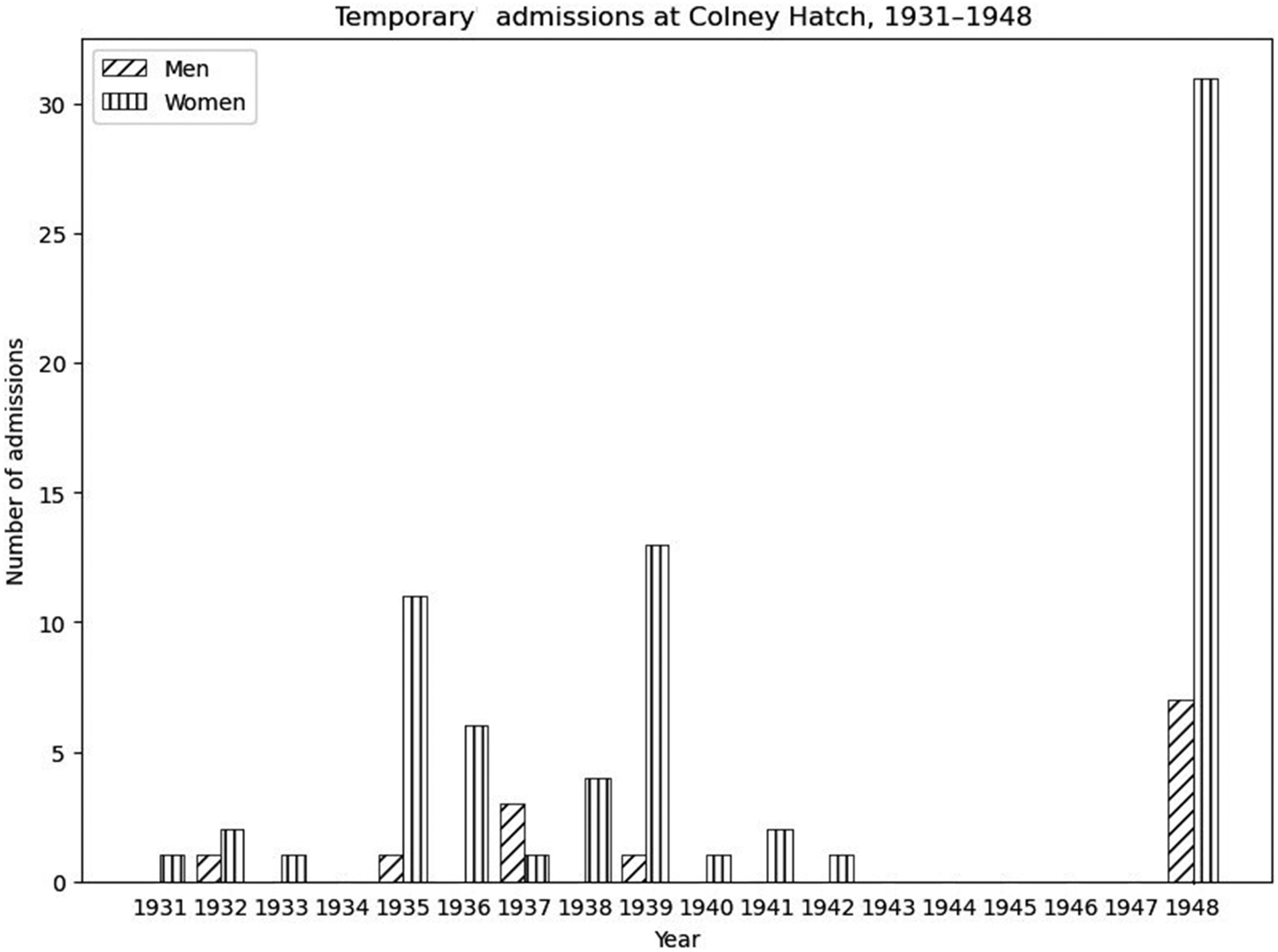
The register raises some broader questions about temporary patients (Figure 1). First, gender: whereas mental hospitals overall admitted more women than men (about 5:4),Footnote 156 the difference was greater for temporary patients. At Colney Hatch before the Second World War, forty-three of forty-nine temporary patients admitted were women, giving a female:male ratio of approximately 9:1.Footnote 157 Colney Hatch was not unique in this regard, leading one 1930s researcher to propose that women were more likely than men to be labelled as non-volitional,Footnote 158 perhaps influenced by gender assumptions. Gender stereotypes may also have influenced perceptions of mentally disturbed men as being opposed or physically resistive to admission and therefore requiring certification.
Patients admitted to Colney Hatch for ‘temporary’ treatment, by gender, 1931–48.
Source: Civil Register, Temporary Patients, 1931–48, The London Archives H12/CH/B/29/001.
Credit: Dr Jacob Hilton.

Figure 1. Long description
The x-axis represents the year from 1931 to 1948, and the y-axis represents the number of admissions from 0 to 30. A legend in the top-left corner identifies men with diagonal hatching and women with vertical hatching.
Data show admissions as follows:
* 1931: 0 men, 1 woman.
* 1932: 1 man, 2 women.
* 1933: 0 men, 1 woman.
* 1934: 0 for both.
* 1935: 1 man, 11 women.
* 1936: 0 men, 6 women.
* 1937: 3 men, 1 woman.
* 1938: 0 men, 4 women.
* 1939: 1 man, 13 women.
* 1940: 0 men, 1 woman.
* 1941: 0 men, 2 women.
* 1942: 0 men, 1 woman.
* 1943 to 1947: 0 for both genders.
* 1948: A spike with 7 men and 31 women.
Overall, women repeatedly outnumber men for ’temporary’ admissions across the period, with a more dramatic difference between them in the final year of the dataset.
Regarding variation in the number of temporary admissions, while correlation does not imply causation, the peak in 1935 followed the Board’s circular on the subject with explanations for duly authorised officers. Another peak occurred in 1939. The reason for this is unclear, but it may have been associated with the repurposing of medical facilities in anticipation of wartime civilian air raid casualties.Footnote 159 During the war, a period of stagnation was unsurprising for a procedure which had hardly become commonplace. One might, though, have expected some rise in 1946–7. Instead, the pattern of temporary admissions changed in 1948, but only after 5 July, the day the National Health Service (NHS) came into being. Thirty-seven of the thirty-eight temporary admissions that year took place after 5 July. There was no specific mental healthcare legislation at that time, but the NHS made healthcare free to those who needed it and brought mental and physical healthcare under the same regional health authorities. The data tentatively suggest that, rather than mental health legislation or post-war optimism, new healthcare organisation may have facilitated change. This requires further historical investigation.
Conclusions and learning from the past
The MTA 1930 had a long gestation, stormy birth and hesitant early development. The Act was a landmark, as the Board proclaimed, but landmarks tend to signpost direction of travel, rather than ensure that destinations are reached. The new Act could not instantly change culture, nor instil new skills or infrastructure, nor remove the legacies and language of stigma and stereotypes of mental illness, certification and Poor Law undeservingness. Nevertheless, by amending the forty-year-old LA, the MTA provided the radical step of introducing population-wide access to mental healthcare according to need rather than wealth, and without the prerequisite of certification. This step towards ‘the majority of psychiatric patients being admitted on a Voluntary basis’, as Pearce concluded, was the MTA’s ‘greatest achievement’.Footnote 160
Although for new patients, admission, treatment and discharge were linked to assessments of an individual’s volition, this did not extend to the majority of mental hospital inpatients still certified. Many were subject to sweeping assumptions that they lacked volition throughout their admission. Concerning reframing of concepts and practices, change was slow to become established, even by the Board. When asked for guidance in 1931 about patients voting, the Board wrote that it ‘did not wish to raise any objection to the view that the fact that a person registered as an elector is a certified lunatic under detention in a Mental Hospital should be regarded as evidence of inability to vote at a Parliamentary Election’. The Board did not recommend individual assessment of a patient’s volition regarding their understanding of what it meant to vote,Footnote 161 which would have aligned with the principles of the MTA.
Another important aspect of the MTA was authorising public expenditure on outpatient and inpatient psychiatric treatment in general hospitals. This sought to place provision for mental healthcare on an equal footing with that for physical, to facilitate early treatment for mental disorder; improve cross-disciplinary healthcare for patients, particularly those with mixed physical and mental disorders; and to reduce the stigma of mental illness and of certification. Despite the potential benefits for patients, medical principles were not necessarily the driving force for change, and seemed to be relatively unimportant in decision making among local authority and general hospital medical leadership. Indeed, providing equitable mental and physical healthcare services, today referred to as achieving ‘parity of esteem’, remains an unfulfilled goal, despite being enshrined in law.Footnote 162 Lack of equality for mentally unwell people on healthcare agendas compared to those with other needs may be particularly detrimental during periods of economic depression.Footnote 163 Although cause cannot be proven in a study such as this, concurring with Brumby’s findings,Footnote 164 the impression is that the desire to control public expenditure was associated with hesitancy towards introducing MTA innovations.
Enthusiasm for implementing the MTA was tempered by multiple voices. The outlook and determination of the local medical and administrative leadership were important, as were the perceptions of patients and their families. Charitable organisations; central government bureaucracies and committees; and others – such as MPs – also gave their views. Challenges to some steps vital to implementation were inadequately envisaged and responded to, particularly when they required multi-agency working, such as training general practitioners and duly authorised officers who needed to understand new concepts and to develop specific skills.
A new law, even if it mandates change, does not make that change inevitable. Attempting to implement the MTA suggested hesitancy associated with tried and tested, well-embedded practices and procedures being threatened by alternatives perceived as awkward or risky, such as giving mentally unwell patients greater autonomy. Resistance to change is double-edged: it may help ensure safe transitions to protect patients (and staff), but in excess, it may inhibit improvements. Temporary treatment, despite its provision being mandatory, took an extraordinarily long time to become established. Overall, implementing the Act took place more rapidly where the local medical leadership was enthusiastic and determined that it should happen, as in Wakefield, and where local authorities agreed to provide necessary financial support.
Despite the challenges, historian Vicky Long commented on the optimism of ‘interwar mental health reformers, whose confidence was fuelled’ by the MTA.Footnote 165 Some psychiatrists hoped that lessons from the MTA would carry forward into the plans for the NHS, even predicting a new ‘Mental Health Act, 194(?)’.Footnote 166 It did not happen. The changes in 1948, as suggested by the admission of temporary patients at Colney Hatch, hinted towards factors other than specific mental health legislation shaping admission procedures.
According to lawyer and historian Peter Bartlett, despite changes in economic and political contexts, and in the nature of family and institutional frameworks, ‘The history of mental health legislation demonstrates the force of legislative inertia …. [T]he study of the nineteenth-century administrative networks has much to say about the roots of the twentieth-century statute’Footnote 167 – and perhaps also that of the twenty-first century. A new Mental Health Act (MHA) received Royal Assent in 2025.Footnote 168 Like the MTA, its development took many years, bearing marks of legislative inertia. The MHA 2025 is also, like the MTA, an amending act. It retains many elements of the MHAs of 1983 and 2007. The changes introduced by the 2007 Act focussed more on reducing risk from patients than on their rights,Footnote 169 a different sort of public priority from Mr Harnett’s case in 1924, but, nevertheless, emphasising public protection. Key principles underpinning the MHA 2025 included: patient choice and autonomy; least restriction on liberty, so far as consistent with patient wellbeing and safety, and public safety; therapeutic benefit; and treating patients with dignity and respect.Footnote 170 In essence, despite the different social contexts, the principles (the last perhaps less so) echo those behind the MTA. In addition, both the MTA and the MHA became law at times of international turbulence, economic difficulties and societal discontents, amid numerous competing interests. Given similar underlying principles and acknowledged repetitions of legislative inertia regarding creating mental health law, might there also be an ‘implementation inertia’ with parallels to the MTA?
Just as central government congratulated itself about the MTA in 1930, Wes Streeting, Secretary of State for Health and Social Care, confidently announced that the MHA 2025 ‘ensures more personalised and compassionate care for people with severe mental illness’.Footnote 171 But is that accurate as a broad statement, or is it wishful thinking? Many MHA clauses appear optional. Phrases such as ‘must seek to ensure’ or ‘must take such steps as are practical to ensure’ are significantly distanced from the obligatory wording of ‘to ensure’. Non-mandatory clauses might not hinder implementation, but neither will they encourage it. In addition, many items are accompanied by the statement: ‘Commencement Information …. [N]ot in force at Royal Assent’. This delaying of implementation may be a genuine attempt to embed the necessary financial, educational and cultural groundwork. On the other hand, competing societal pressures and priorities make the presence of such built-in delays disconcerting. As it stands, implementation is expected to take eight to ten years. Some elements may be outdated by then as societal and medical understanding change, and new treatments may emerge. As with the MTA, unforeseen practical hurdles may take time to come to light, only becoming apparent by trial and error, further delaying effective implementation. They will need openness and constructive responses by the authorities with a view to providing timely guidance and other support.
The 2020s are not the 1930s, the MHA is not the MTA, the sorts of services provided and proposed then and now are not directly comparable, but there are some uncanny similarities between the two Acts. Understanding facilitators and obstacles to implementation in the past may raise our awareness of possibilities which may recur, and help us detect and overcome similar problems today.
Acknowledgements
I am grateful to Dr Jacob Hilton for help with Figure 1, to The London Archives for allowing me access to mental hospital records from the 1930s, and to Dr Michael Robinson and the two anonymous peer-reviewers for their comments.
Competing interests
The author declares none.

 Open access

