Introduction
Nematodes rely upon biogenic amines (BA) and neuropeptides to regulate essentially all aspects of development and physiology (Komuniecki et al., Reference Komuniecki, Hobson, Rex, Hapiak and Komuniecki2004; Perry & Maule, Reference Perry, Maule, Gaugler and Bilgrami2004). Research on the biochemistry, pharmacology and genetics of BAs and their receptors in animal-parasitic nematodes, primarily Ascaris suum, and the free-living nematode Caenorhabditis elegans, is extensive (Horvitz et al., Reference Horvitz, Chalfie, Trent, Sulston and Evans1982; Chaudhuri & Donahue, Reference Chaudhuri and Donahue1989; Williams et al., Reference Williams, Shahkolahi, Abbassi and Donahue1992; Trim et al., Reference Trim, Holden-Dye, Willson, Lockyer and Walker2001; Komuniecki et al., Reference Komuniecki, Hobson, Rex, Hapiak and Komuniecki2004; Perry & Maule, Reference Perry, Maule, Gaugler and Bilgrami2004; Hobson et al., Reference Hobson, Hapiak, Xiao, Buehrer, Komuniecki and Komuniecki2006). Such studies have been driven by veterinary and medical interests, and by the status of C. elegans as a model organism. Somewhat less effort has been devoted to analysis of BAs and their effects in plant-parasitic nematodes that are of particular importance to agriculture. Serotonin and octopamine were found to have varying effects on behaviour in the plant-parasitic nematodes Heterodera schachtii and Meloidogyne incognita (McClure & von Mende, Reference McClure and von Mende1987), and the involvement of serotonin in H. schachtii reproduction has been examined (Jonz et al., Reference Jonz, Riga, Mercier and Potter2001). Octopamine and serotonin have been used to induce uptake of double-stranded RNA (dsRNA) by plant-parasitic nematodes to facilitate gene silencing studies (Urwin et al., Reference Urwin, Lilley and Atkinson2002; Bakhetia et al., Reference Bakhetia, Charlton, Atkinson and McPherson2005; Chen et al., Reference Chen, Rehman, Smant and Jones2005; Rosso et al., Reference Rosso, Dubrana, Cimbolini, Jaubert and Abad2005).
The present work examines effects of the BAs dopamine, octopamine and serotonin on specific behaviours of juveniles (J2) of two different genera of plant-parasitic nematodes, H. glycines and M. incognita. The same amines were also examined for their effects on egg hatch in H. glycines. Finally, the response of M. incognita juveniles to the invertebrate neuropeptide FLRFamide (N-Phe-Leu-Arg-Phe), a member of a neuropeptide family known to be involved with neuromuscular regulation in nematodes (Mousley et al., Reference Mousley, Marks, Halton, Geary, Thompson and Maule2004; Li, Reference Li2005), was also assessed. The purpose of the work was to compare the responses of different plant-parasitic nematodes to the same biogenic amine treatments, and to provide a robust behavioural assay that could be used to examine the effects of other neuroregulators such as neuropeptides. Presented here are the effects of dopamine, octopamine, serotonin and the neuropeptide FLRFamide on behaviours associated with body wall and pharyngeal muscular activities.
Materials and methods
Nematodes
Heterodera glycines was raised on soybean (Glycine max, cv. Kent) grown in sand-filled beakers using a constant moisture system (Sardanelli & Kenworthy, Reference Sardanelli and Kenworthy1997), at 27°C and 16 h light:8 h dark photoperiod. Cultures were inoculated with 2000 H. glycines eggs/plant. Approximately 5 weeks after inoculation, plants were harvested and females and eggs were collected from roots. Eggs were hatched on a modified Baerman funnel, and hatched J2 were collected daily for use in assays. Meloidogyne incognita was raised on pepper (Capsicum annuum, cv. Yolo Wonder) grown in the greenhouse at 24–29°C and a 16 h light:8 h dark photoperiod. Plants were harvested after 3 months and eggs collected. Eggs were hatched in water in glass dishes fitted with nylon mesh (30 μm pore size) that retained eggs but allowed freshly hatched J2 to pass through and into the bottom of the dish. Juveniles were collected fresh daily and used immediately.
Reagents
Dopamine, octopamine, serotonin (5-hydroxytryptamine), and the amidated neuropeptide N-Phe-Leu-Arg-Phe (FLRFamide) were from Sigma (St. Louis, Missouri, USA). Each dissolved readily in water, and stock solutions were prepared fresh daily for each experiment.
Treatments and measurements
Freshly collected J2 were transferred into 1.5 ml polypropylene tubes, containing either tap water (controls) or test solutions prepared in tap water, at a density of ~1 J2/1.5–2 μl of solution. Total volumes were 200–400 μl/tube, and J2 were incubated at room temperature for at least 10 min prior to aliquot collection. To monitor J2 activity and behaviour, aliquots (15 μl drops) containing ~7–10 J2 were placed on a glass microscope slide, and observed at either 40 × or 100 × magnification.
Observations were made separately for body movement and stylet activity. Body movement was monitored for both frequency and amplitude of lateral motion of the anterior portion of the worm. Lateral motion was defined as any change in direction from a previous position, and could occur in any plane. Using the lengthwise axis of the worm as a reference, each movement was scored for degree of motion. Locomotion was not scored. Each complete motion was counted as one movement, and each animal was observed for at least 1 min. Data for each animal were recorded as movements/min (frequency), average degrees/min (amplitude), and total degrees of motion/min. Stylet activity typically was a mild thrusting and retraction (pulsing) of the stylet. Up to ~60 pulses/min could be counted, and this was considered low to moderate activity. More than 60 pulses/min was considered fast. Stylet activity was quantified by using category scoring rather than by absolute stylet movement count, since we found a lack of accuracy in measuring stylet movement rates of more than 60/min. Stylet activity for each J2 was scored as 0 (no movement), 1 (low to moderate movement), and 2 (fast movement), and each J2 was observed for at least 1 min.
For frequency experiments, the length of exposure of individual worms varied from 10 to 30 min or 60–80 min, and were referred to as 10-min and 60-min assays. For amplitude and stylet experiments, exposure times were typically between 10 and 50 min. In addition to the biogenic amine assays in M. incognita, body movement and stylus activity assays were also done using FLRFamide, a member of a large family of invertebrate neuropeptides, the FMRFamide-like peptides (FLPs). FLPs are known to have behavioural effects in nematodes (Li, Reference Li2005), and the C-terminal FLRFamide motif has been identified in a number of predicted FLP homologues in M. incognita (McVeigh et al., Reference McVeigh, Leech, Mair, Marks, Geary and Maule2005).
Egg hatch assays were conducted at 27°C in 24-well polystyrene plates (Corning, Corning, New York, USA). Each well contained 200–250 H. glycines eggs in a total of 400 μl of tap water or biogenic amine treatment solution. Immediately after loading the wells, all eggs and J2 were counted to provide accurate starting (baseline) values. Daily thereafter, J2 in all wells were counted and net J2 calculated by subtracting the baseline J2 value for each well. The ratio of net J2 to starting egg value was used to calculate cumulative percent hatch. All treatments were replicated at least three times.
Data analysis
Data for frequency, amplitude, total degree or stylet scores are expressed as the means ± standard error mean (SEM) and are compared using Student's t-test and one-way analysis of variance (ANOVA). Hatch data are expressed as the means ± standard error mean (SEM) and are compared using one-way ANOVA. All data were analysed statistically using KaleidaGraph (Synergy Software, Reading, Pennsylvania, USA).
Results
Heterodera glycines
Frequency and amplitude of movement
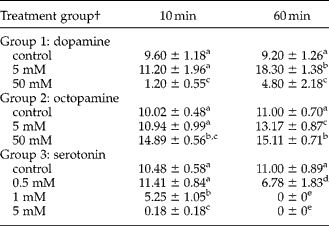
The BAs tested each had significant and differing effects upon H. glycines J2 behaviour, as measured by the frequency of body movements (table 1). At 5 mM, neither dopamine nor octopamine had any effect when assayed at 10 min, but dopamine nearly doubled the frequency of movement over the control at 60 min (P = 0.0001), whereas octopamine had only a marginal stimulatory effect (P = 0.061) compared to the control. In contrast, 5 mM serotonin drastically depressed activity at 10 min (P < 0.0001) and completely eliminated activity at 60 min. Serotonin at 1 mM was also effective at reducing activity at 10 min (50% reduction, P = 0.0037), and 0.5 mM serotonin marginally reduced activity at 60 min (P = 0.060) but had no effect at 10 min. Increasing the dopamine and octopamine doses to 50 mM had opposite effects. Dopamine depressed activity by 88% at 10 min (P < 0.0001), but was less effective over time (48% reduction at 60 min, P = 0.06), while 50 mM octopamine increased activity, by 49% at 10 min (P < 0.0001) and 46% at 60 min (P = 0.0002).
Effect of biogenic amines on Heterodera glycines juvenile behaviour*.
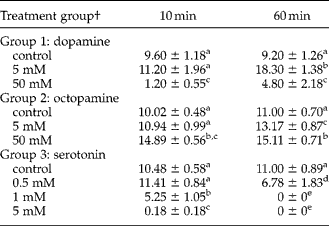
* Data are expressed as the mean ± SEM of head movements/min (frequency) for at least ten different animals within each treatment group (except serotonin 0.5 mM, 60 min, where N = 9). The same treatment groups were used for 10-min and 60-min observations.
† Means are compared within each treatment group using Student's t-test. Means followed by the same letter are not significantly different. In addition, all control means were compared by one-way ANOVA with no differences found (P = 0.70).
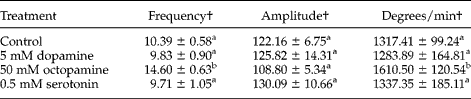
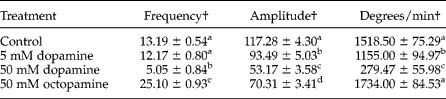
Separate experiments were conducted to examine effects of selected doses of BAs on amplitude of movement. Biogenic amines were selected on the basis of their effects during frequency of movement assays. Dopamine at 5 mM (no effect to stimulatory), 50 mM octopamine (stimulatory), and 0.5 mM serotonin (no effect to inhibitory) were assayed (table 2). Frequencies of movements were as expected for 10-min assays (table 1), with no effects by 5 mM dopamine or 0.5 mM serotonin, and a frequency of movement increase by 50 mM octopamine (40%, P < 0.0001). None of the treatments had any effect upon amplitude of movements (table 2). Thus the 22% increase in mean total degrees/min by the 50 mM octopamine treatment (P = 0.065) was dependent upon frequency of movement, and the mean total degrees/min of the other treatments did not vary from that of the control.
Effect of biogenic amines on amplitude of Heterodera glycines juvenile anterior movement*.
* Data are expressed as the mean ± SEM of number of head movements/min (frequency), degrees covered/head movement (amplitude), and total degrees covered per individual J2/min for at least 17 different animals/treatment.
† Means are compared across treatments using Student's t-test, and values within a column followed by the same letter are not significantly different (P > 0.10).
Stylet behaviour
Stylet activity was examined with the same BAs and concentrations used in the body movement frequency assays (see table 1). Neither dopamine nor octopamine treatments had any effect on stylet activity (data not shown). However, serotonin at 1 mM and 5 mM stimulated stylet pulsing over the control. The mean stylet pulse score/J2 for 1 mM serotonin (0.83 ± 0.22) was a 5.9-fold increase over the control (0.014 ± 0.07; P = 0.007), and 5 mM serotonin caused a 12.7-fold increase (1.78 ± 0.09; P < 0.0001).
Egg hatch
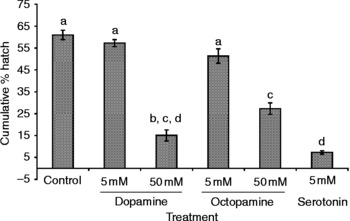
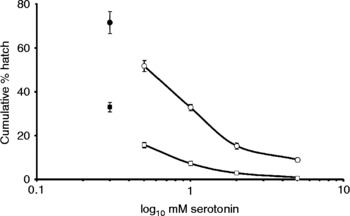
Egg hatch was unaffected by either 5 mM dopamine or 5 mM octopamine (fig. 1), but each depressed hatching at 50 mM. Mean percent egg hatch on day 5 with 50 mM dopamine (15.08 ± 2.06) fell 75% (P < 0.0001) from the control value (60.98 ± 2.08), and mean percent hatch in 50 mM octopamine (27.32 ± 2.15) was reduced by 55% (P < 0.0001) from the control. Serotonin reduced egg hatch by 88% at 5 mM (7.06 ± 0.74; P < 0.0001), and eliminated hatch at 50 mM (fig. 1). The response of H. glycines egg hatch to serotonin exposure was dose-dependent (fig. 2). On day 2 of exposure to 0.5 mM serotonin, the mean cumulative percent hatch (15.78 ± 1.13) was 50% less than controls (33.97 ± 1.80; P = 0.0018), and with a 2 mM exposure the hatch rate was reduced more than 90% (P = 0.001). Depression of egg hatch after 5 days' exposure was somewhat less severe, expressed as a percentage of the control, than at 2 days. Nonetheless, egg hatch was still significantly reduced, with mean cumulative percent hatch down 26% with 0.5 mM (P = 0.0003), 78% at 2 mM (P < 0.0001) and almost 90% at 5 mM (P < 0.0001).
Effect of biogenic amines on egg hatch in Heterodera glycines. Eggs from H. glycines were incubated in wells of 24-well polystyrene plates as described. Wells contained ~200–250 eggs in 400 μl of the indicated solution. Eggs and juveniles were counted in each well, juveniles were counted after 5 days, and net juveniles used to calculate percent hatch. Data are expressed as mean ± SEM of at least six separate observations, except for 50 mM treatments (N = 3). Means were compared using one-way ANOVA and means followed by the same letter are not significantly different (P > 0.01).

Dose effects of serotonin on egg hatch in Heterodera glycines. Eggs from H. glycines were incubated in wells of 24-well polystyrene plates as described. Wells contained ~200–250 eggs in 400 μl of serotonin dilutions. Eggs and juveniles were counted in each well, juveniles were counted after 2 and 5 days, and net juveniles used to calculate percent hatch. Data are expressed as mean ± SEM of at least three separate observations for each data point. Day 2 control, filled square; Day 2 treatments, open squares; Day 5 control, filled circle; Day 5 treatments, open circles.

Meloidogyne incognita
Frequency and amplitude of movement
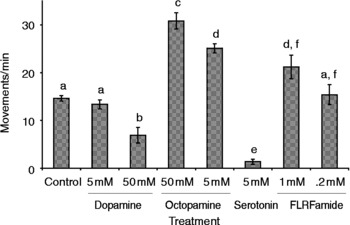
Frequency of motion in M. incognita was affected by BA and neuropeptide treatments (fig. 3). Mean frequencies of movement for 50 mM dopamine (6.93 ± 1.60) and 5 mM serotonin (1.35 ± 0.51) were 53% and 91% lower, respectively, than the control level (14.62 ± 0.58; P < 0.0001). Octopamine caused increases in frequency of movement at 50 mM (25.10 ± 10.93; P < 0.0001) and 5 mM (30.85 ± 1.68; P < 0.0001) to between 70 and 110%. The results with BAs are qualitatively similar to those obtained with H. glycines (table 1). Meloidogyne incognita also responded to the neuropeptide FLRFamide by an increase in movement frequency of 45% (21.20 ± 2.33; P = 0.02) with a 1 mM dose (fig. 3).
Biogenic amine and neuropeptide effects on frequency of movement in juveniles of Meloidogyne incognita. Data are expressed as the mean ± SEM of head movements/min (frequency) for at least 20 different animals (except FLRFamide, where N = 10). Means are compared by one-way ANOVA and those followed by the same letter are not significantly different (P > 0.01).

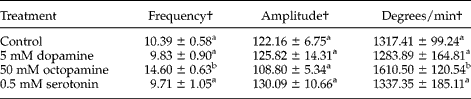
Three treatments (5 mM and 50 mM dopamine and 50 mM octopamine) were examined for their effects on amplitude of movement (table 3), and all three resulted in significantly reduced amplitude. With 5 mM dopamine, amplitude was 20% lower than controls (P = 0.0006). Decreases of 55% (P < 0.0001) and 40% (P < 0.0001) were observed with 50 mM dopamine and octopamine, respectively. The corresponding reductions in total degrees/min for dopamine treatments can be attributed to amplitude loss (table 3), and lack of change in degrees/min for 50 mM octopamine treatments relative to the control is a result of increased frequency and decreased amplitude of movement. These results contrast with those in H. glycines, where amplitude was not affected by any treatment (table 2).
Effect of biogenic amines on amplitude of Meloidogyne incognita juvenile anterior movement*.
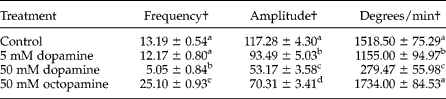
* Data are expressed as the mean ± SEM of number of head movements/min (frequency), degrees covered/head movement (amplitude), and total degrees covered per individual J2/min for at least 17 different animals/treatment.
† Means are compared across treatments using Student's t-test and values within columns followed by the same letter are not significantly different (P > 0.10).
Stylet behaviour
Stylet activity in M. incognita was unaffected by either 5 mM dopamine or 5 mM octopamine (data not shown), but stylet pulsing was increased 14-fold (P < 0.0001) after exposure to 5 mM serotonin, with a mean stylet score of 0.78 ± 0.10 compared to 0.05 ± 0.04 for the control. FLRFamide had no effect on stylet activity in M. incognita at either 1 mM or 0.2 mM (N = 10 each dose).
Discussion
Heterodera glycines and M. incognita J2 responded to serotonin, dopamine and octopamine with a variety of changes in body activity and stylet motion. In addition, H. glycines egg hatch was reduced by serotonin, and M. incognita body movement frequency was increased by a neuropeptide. Dopamine, octopamine and serotonin are known to be involved in the regulation of numerous processes in nematodes essential for reproduction and survival, including egg laying, locomotion, muscular contraction and pharyngeal pumping, and response to the environment (Sawin et al., Reference Sawin, Ranganathan and Horvitz2000; Jonz et al., Reference Jonz, Riga, Mercier and Potter2001; Niacaris & Avery, Reference Niacaris and Avery2003; Komuniecki et al., Reference Komuniecki, Hobson, Rex, Hapiak and Komuniecki2004; Perry & Maule, Reference Perry, Maule, Gaugler and Bilgrami2004).
Biogenic amine modulation of neuronal and muscular activity is biochemically and physiologically complex, making precise descriptions of cause and effect difficult. For example, receptors for some nematode BAs have been detected and characterized, primarily from A. suum and C. elegans (Chaudhuri & Donahue, Reference Chaudhuri and Donahue1989; Williams et al., Reference Williams, Shahkolahi, Abbassi and Donahue1992; Trim et al., Reference Trim, Holden-Dye, Willson, Lockyer and Walker2001; Rex & Komuniecki, Reference Rex and Komuniecki2002; Suo et al., Reference Suo, Ishiura and Van Tol2004; Sugiura et al., Reference Sugiura, Fuke, Suo, Sasagawa, Van Tol and Ishiura2005; Hobson et al., Reference Hobson, Hapiak, Xiao, Buehrer, Komuniecki and Komuniecki2006). Serotonergic receptors are relatively well characterized, but their expression is complex, and numerous variants can be present within an organism (Komuniecki et al., Reference Komuniecki, Hobson, Rex, Hapiak and Komuniecki2004). Multiple isoforms of a dopamine receptor have been characterized in C. elegans (Suo et al., Reference Suo, Sasagawa and Ishiura2003; Sanyal et al., Reference Sanyal, Wintle, Kindt, Nuttley, Arvan, Fitzmaurice, Bigras, Merz, Hebert, van der Kooy, Schafer, Culotti and Van Tol2004), exhibiting variable binding affinities and, like serotonin receptors, are expressed in a variety of muscular and neuronal locations (Tsalik et al., Reference Tsalik, Niacaris, Wenick, Pau, Avery and Hobert2003; Komuniecki et al., Reference Komuniecki, Hobson, Rex, Hapiak and Komuniecki2004). Receptors for octopamine have not been characterized, but this BA does bind to receptors associated with other BAs, including dopamine (Sanyal et al., Reference Sanyal, Wintle, Kindt, Nuttley, Arvan, Fitzmaurice, Bigras, Merz, Hebert, van der Kooy, Schafer, Culotti and Van Tol2004) and tyramine (Rex & Komuniecki, Reference Rex and Komuniecki2002). Despite an incomplete understanding of its mode of action, octopamine is known to function as a neuromodulator, as do other BAs (Horvitz et al., Reference Horvitz, Chalfie, Trent, Sulston and Evans1982; Sawin et al., Reference Sawin, Ranganathan and Horvitz2000), and contributes to the plasticity and complexity of nematode behaviour.
Serotonin (~20 mM) was reported to stimulate body movement and stylet activity in M. incognita, and ~20 mM octopamine stimulated body movement but not stylet activity (McClure & von Mende, Reference McClure and von Mende1987). However, these observations were done after 18 h and the responses were not characterized. We observed rapid responses to BAs in H. glycines and M. incognita, and detected clear qualitative and quantitative differences in the responses of these two nematodes. Decreased body movement in H. glycines exposed to 5 mM serotonin correlated with decreased locomotion reported in C. elegans (Horvitz et al., Reference Horvitz, Chalfie, Trent, Sulston and Evans1982). Octopamine reduced locomotion in C. elegans (Horvitz et al., Reference Horvitz, Chalfie, Trent, Sulston and Evans1982) but increased body movement in both H. glycines and M. incognita in this study.
Until now, dopamine has not been closely examined in plant-parasitic nematodes, but results with H. glycines body movement suggest more functional similarity with serotonin than with octopamine; but in stylet activity assays (see below), dopamine was similar to octopamine. Dopamine is similar to both octopamine and serotonin, as it elicits effects on H. glycines and M. incognita J2 quite rapidly.
Although stylet pulsing and pharyngeal pumping are not equivalent and involve different musculatures, they may be responsive to similar receptors binding the same ligands. The stimulation by serotonin of pharyngeal pumping in C. elegans (Horvitz et al., Reference Horvitz, Chalfie, Trent, Sulston and Evans1982) and the serotonin-stimulated stylet pulsing observed in H. schachtii (Jonz et al., Reference Jonz, Riga, Mercier and Potter2001) are responses similar to the enhanced stylet pulsing in H. glycines and M. incognita. Of note here is the increase in amphidial exudate that accompanies the increased stylet activity in M. incognita exposed to serotonin (McClure & von Mende, Reference McClure and von Mende1987).
Dopamine and octopamine each failed to stimulate stylet pulsing in our experiments with H. glycines and M. incognita. Similarly, octopamine failed to affect stylet activity in M. incognita after long-term exposure to octopamine (McClure & von Mende, Reference McClure and von Mende1987). Also, pharyngeal pumping in C. elegans was depressed by octopamine (Horvitz et al., Reference Horvitz, Chalfie, Trent, Sulston and Evans1982). These results with octopamine are curious since it has been reported to increase the uptake of dsRNA by H. glycines and Globodera pallida, presumably by affecting pharyngeal pumping (Urwin et al., Reference Urwin, Lilley and Atkinson2002), and has been used in G. rostochiensis and M. incognita for the same purpose (Bakhetia et al., Reference Bakhetia, Charlton, Atkinson and McPherson2005; Chen et al., Reference Chen, Rehman, Smant and Jones2005). Also, Rosso et al. (Reference Rosso, Dubrana, Cimbolini, Jaubert and Abad2005) used uptake of the fluorescent dye fluorescein isothiocyanate (FITC) by M. incognita to assess levels of pharyngeal pumping in response to serotonin and octopamine. No uptake was observed after 1 h of exposure to either BA, but after exposure to 50 mM serotonin for 24 h approximately 80% of treated M. incognita had taken up FITC. Less than 10% of the nematodes exposed to 50 mM octopamine showed any signs of uptake. The nature of pharyngeal pumping, stylet pulsing and body wall muscle activity responses in different species must vary not only with regard to the BA used, but to dosage and time as well.
A striking difference existed between H. glycines and M. incognita in the effect of BAs on the amplitude of body movement. While each species exhibited some response to BA treatment in the form of increased or decreased body movement frequency, only M. incognita responded by changing the amplitude of each body movement. Amplitude was reduced, as shorter movements were taken relative to the control, by dopamine, octopamine and serotonin. Further, the effects on amplitude appeared to be independent of frequency, since amplitude was reduced whether frequency increased, decreased or remained unchanged. This implies a high degree of complexity in the regulation of neuromuscular activities in plant-parasitic nematodes.
The rapid response of nematodes to treatment by BAs suggested that these neuromodulators may bind to cellular receptors in tissue very near the body wall, or may diffuse rapidly across the cuticle to access receptors on interior membranes. Knowledge of the biochemistry and pharmacology of BA receptors in nematodes is still developing (Trim et al., 2001; Rex & Komuniecki, Reference Rex and Komuniecki2002; Komuniecki et al., Reference Komuniecki, Hobson, Rex, Hapiak and Komuniecki2001; Rex et al., Reference Rex, Harmych, Puckett and Komuniecki2004; Sanyal et al., Reference Sanyal, Wintle, Kindt, Nuttley, Arvan, Fitzmaurice, Bigras, Merz, Hebert, van der Kooy, Schafer, Culotti and Van Tol2004; Suo et al., Reference Suo, Ishiura and Van Tol2004), but whatever the molecular mechanism, the response to ligands is very rapid.
The differing responses of two behaviours, stylet pulsing and body movement, in both H. glycines and M. incognita exposed to serotonin, are in accordance with observations made in other nematodes. Trim et al. (Reference Trim, Holden-Dye, Willson, Lockyer and Walker2001) reported that serotonin stimulates pharyngeal pumping in A. suum while reducing body wall muscle contractions, and A. suum locomotion is inhibited by serotonin (Reinitz & Stretton, Reference Reinitz and Stretton1996). The modulation by serotonin of pharyngeal pumping and locomotion in C. elegans (Horvitz et al., Reference Horvitz, Chalfie, Trent, Sulston and Evans1982; Avery & Horvitz, Reference Avery and Horvitz1990; Sawin et al., Reference Sawin, Ranganathan and Horvitz2000; Hardaker et al., 2001; Niacaris & Avery, Reference Niacaris and Avery2003) is coupled to nutritional state, and animals encountering food undergo a serotonin-mediated slowing response coupled to increased pharyngeal pumping (Sawin et al., Reference Sawin, Ranganathan and Horvitz2000; Niacaris & Avery, 2003).
In C. elegans, the flp-1 gene encodes a number of FLPs containing the C-terminal FLRFamide motif, some of which are associated with pharyngeal pumping and locomotion, along with other behaviours (Rogers et al., Reference Rogers, Franks, Walker, Burke and Holden-Dye2001; Li, Reference Li2005). Homologues of these peptides are predicted to be expressed in a number of parasitic nematodes including M. incognita (McVeigh et al., Reference McVeigh, Leech, Mair, Marks, Geary and Maule2005). Given the involvement of the FLPs in C. elegans physiological and behavioural regulation (Li, Reference Li2005), and evidence for FLP receptors on A. suum body wall muscle (Mousley et al., Reference Mousley, Marks, Halton, Geary, Thompson and Maule2004; Rex et al., Reference Rex, Harmych, Puckett and Komuniecki2004), it is intriguing that FLRFamide caused a rapid increase in the frequency of M. incognita body movement. It is possible that peptidergic receptors in M. incognita rapidly recognize this FLP. It is also interesting that FLRFamide had no observable effect on M. incognita stylet activity, placing the peptide in the same league as octopamine relative to behavioural effects on M. incognita. Additional analyses, including co-treatment of worms with the two agents, use of dose–response assays and screening of FLRFamide homologues, are needed to reveal the relationship between octopamine and FLPs in affecting behaviour.
The ability of BAs to penetrate the eggshell was confirmed by the serotonin inhibition of egg hatch in H. glycines. How rapidly serotonin enters the egg is not known, but hatching effects were significant within 2 days of treatment. Although still significant at 5 days, the percent hatch inhibition was reduced slightly, suggesting decreased serotonin potency, allowing partial recovery of the affected pre-hatch juveniles. In fact, a preliminary experiment with 5 mM serotonin indicated that H. glycines juveniles return to normal body and stylet activity overnight after transfer to control conditions. Another explanation of apparent recovery of hatching ability over time is stage of juvenile development. Juveniles in earlier and later developmental stages may respond differently to the same chemical, and as development proceeds an increased percentage of juveniles can initiate hatch. How serotonin affects egg hatch is unknown. Increases in frequency of head movement and in stylet pulsing would suggest that rupturing of the eggshell by pre-hatch juvenile activity should increase. However, decreased hatch suggests that the additional activity may not be coordinated normally, and that the energy spent is energy wasted.
Acknowledgements
I wish to thank Paula Crowley and Dr Susan Meyer for M. incognita cultures and advice.