


Introduction
Located on the western flank of Mt. Piramagrun in the Zagros range of the Kurdistan region of Iraq, the Parthian era complex at Rabana-Merquly comprises twin settlements, in the Rabana valley and on the Merquly plateau, joined by an extensive network of perimeter fortifications (Fig. 1). Matching rock-reliefs that most likely depict an anonymous ruler overlook two gated entrances (Amedie and Zamua Reference Amedie and Zamua2011; Brown et al. Reference Brown, Miglus, Rasheed and Ahmad2018; Brown et al. Reference Brown2020: 99–103; Brown et al. Reference Brown, Raheem and Abdullah2022: 930–931; Khounani and Mohammadifar Reference Khounani and Mohammadifar2018; Rasheed Reference Rasheed2001). The iconography of these figurative sculptures suggests an affiliation to the kingdom of Adiabene, a vassal of the Parthian (or Arsacid) empire that controlled much of north-east Mesopotamia in the late first millennium B.C.–early first millennium A.D. (Fig. 2). A further plausible link can be made between Rabana-Merquly and Natounissarokerta/Natounia on the Kapros, a city located close to the Lower Zab river that is otherwise only known from its coinage (Amedie and Zamua Reference Amedie and Zamua2011: 236; Brown et al. Reference Brown, Rasheed, Dörr and Heiler2020: 103–106; Brown et al. Reference Brown, Raheem and Abdullah2022: 931–933).
General plan of Rabana-Merquly (map by M. Brown; © Rabana-Merquly Archaeological Project).

Rabana rock-relief (illustrations by M. Brown; © Rabana-Merquly Archaeological Project).

Rabana-Merquly would have fulfilled a variety of societal functions as a major regional centre. As well as controlling overland communications, in times of crisis Rabana probably served as a refugium for surrounding communities. A citadel with barracks at Merquly supports this defensive characterisation (Brown et al. Reference Brown, Raheem and Abdullah2022: 926, 929; Saber et al. Reference Saber, Rejeb and Altaweel2014). Rabana-Merquly undoubtedly played a military, diplomatic and economic role in relation to neighbouring highland pastoralists (Brown and Amelirad Reference Brown, Amelirad, Bernbeck, Eberhardt and Pollock2023: 218). This article explores the hypothesis that Rabana was also a site of religious veneration, plausibly dedicated to the ancient Persian water goddess Anahita.
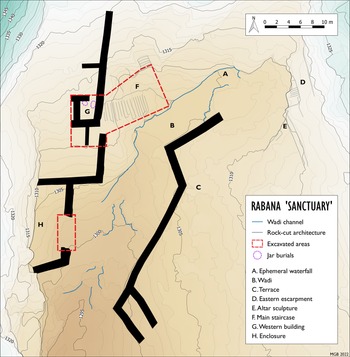
The focus of intramural occupation at Rabana was in its north-east corner, where from higher up the mountain a narrow gorge leads into the valley, before continuing along its length as a wadi (Fig. 3). When heavy rain and snowmelt flow into this channel where it first reaches the valley floor, they create an ephemeral waterfall, around the base of which the upper reaches of the wadi are canalised with large stone structures. Close by, a sculpture resembling an altar is carved into the eastern escarpment. It is proposed in the following discussion that these features should collectively be interpreted as a sanctuary.
Plan of Rabana ‘sanctuary’ (map by M. Brown; © Rabana-Merquly Archaeological Project).

The Rabana ‘sanctuary’ constitutes an augmentation of the natural environment, the built component being restricted to either side of the wadi and its immediately adjacent slopes. Architecture consists of rock-cut and masonry constructions, the latter being further divided into walls built with regular stones, and those comprised of very large boulders. Sheer cliffs surround the ‘sanctuary’ on three sides. Ground level is characterised by thinly developed soils above dolomitic-marly limestone bedrock that protrudes in many places, with the greatest depth of soil being the result of artificial terracing. The main components of the ‘sanctuary’ described below cover an area of approximately 0.25 hectares.
Our current understanding of the Rabana ‘sanctuary’ is based upon fieldwork conducted between 2017 and 2022 as part of a broader program of investigation across the Rabana-Merquly settlement complex (Brown et al. Reference Brown, Miglus, Rasheed and Ahmad2018; Brown Reference Brown2020; Brown et al. Reference Brown, Rasheed, Dörr and Heiler2020; Brown et al. Reference Brown, Raheem and Abdullah2022).Footnote 1 In addition to surveying structures already visible on the surface, targeted excavations have been used to examine key architectural features in more detail.
Ephemeral waterfall
Heavy rains combined with snowmelt in March 2019 provided a rare opportunity to witness the hydrology of Rabana at peak discharge, when water flows over rocks on the northern side of the wadi at its eastern terminus. This ephemeral waterfall is c. 7 m in height from crest (top) to plunge pool (bottom) (Fig. 4). Paleoenvironmental data indicates that the Hellenistic-Parthian periods probably correspond to an aridification phase, shifting the climate close to the current norm (Brown and Amelirad Reference Brown, Amelirad, Bernbeck, Eberhardt and Pollock2023: 214 with references; Sinha et al. Reference Sinha, Kathayat, Weiss, Li, Cheng, Reuter, Schneider, Berkelhammer, Adalı, Stott and Edwards2019: Fig. 3; cf. Flohr et al. Reference Flohr, Fleitmann, Zorita, Sadekov, Cheng, Bosomworth, Edwards, Matthews and Matthews2017: 1531–1532). As is the case today, significant runoff would thus have been a seasonal and primarily springtime phenomena that was always episodic. The waterfall nonetheless appears to have been an important focus of activity within the intramural settlement.
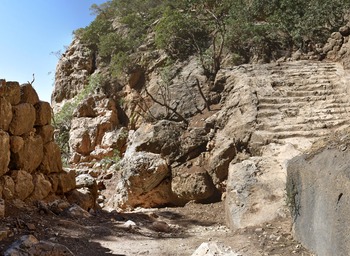
Ephemeral waterwall with main staircase and wadi, April 2019 (© Rabana-Merquly Archaeological Project).

When approaching through Rabana valley, the waterfall is located at the farthest point inside the ‘sanctuary’ and occupies a central position in relation to surrounding architecture. One factor to consider is the current prevalence of tree-cover, which was likely less at the time of the Parthian era occupation, allowing for more direct lines of sight. Falling water impacting upon rocks and echoing off the valley sides is audible for several minutes before becoming visible.
Above the waterfall, the valley becomes steep and narrow with small areas of grass and much exposed bedrock. At the top of the slope, where it rises sharply to form a near cliff, is a natural cave with a sub-triangular entrance, around which are smaller fissures in the escarpment that are the main source of the water flowing down. The difference in elevation between the bottom of the waterfall and the top of the gorge is approximately 120 m.
Wadi and terrace
In front of the waterfall at ground level is the most augmented part of the wadi (Fig. 5). This section of the channel is largely straight and has a uniform width of between five to six meters. In the absence of soil, it could probably retain a shallow depth of water forming a temporary pool. The rock face is chiselled flat along its northern side. At its eastern end the wadi narrows in line with several large boulders.
Wadi with northern terrace retaining wall (left) and main staircase (right), September 2022 (© Rabana-Merquly Archaeological Project).

A terrace (labelled C in Fig. 3) built along the southern side of the wadi is the largest single architectural component within the Rabana ‘sanctuary’. Its shape is that of an irregular polygon, with abrupt rather than curved changes in angle. The main face of the perimeter retaining wall along the north, west and south sides of the terrace has a combined length of 50 meters and is made of massive boulders.Footnote 2 This wall is preserved in places to what appears to be its full height of six meters. The terrace can be easily accessed on its north-east corner closest to the waterfall. Another entrance onto the terrace was presumably located somewhere along its southern flank. Construction of the terrace represents a monumental act of landscaping, designed to frame the wadi and to produce a more level occupational surface than the underlying terrain. An upward incline of c. 8 m is nonetheless apparent from south-west to north-east. Based upon the volume of rubble, the terrace seems to have served in part as a foundation for a stone superstructure, as well as being an open platform.
Eastern escarpment
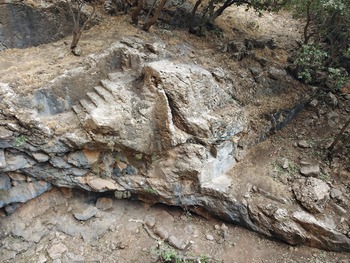
The eastern valley escarpment behind the terrace has been heavily modified with rock-cut architecture split across two principal levels (Fig. 6). The upper level forms a communication from above the terrace, over the end of the wadi, to the top of the waterfall. Where clearly defined this path is c. 2.5 m wide with its back wall hewn flat. A narrow shelf between the upper and lower levels was probably not regularly used, due to its limited dimensions and lack of architectural communication.
Rock-cut architecture of the eastern escarpment, September 2022 (© Rabana-Merquly Archaeological Project).

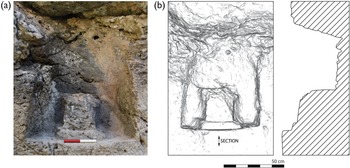
A sub-rectangular niche containing an interior sculpture is cut into the lower level of the eastern escarpment that was carved smooth (Fig. 7a–b) (Brown et al. Reference Brown, Miglus, Rasheed and Ahmad2018: 65, fig. 6). The aperture of the niche measures 66 cm wide at its base, is 90 cm in height, with a depth of 25 cm (left) to 36 cm (right). The bottom and lower sides of the niche are well defined with the upper half being irregular due to fissures in the rock. The interior sculpture is 35 cm tall, 25 cm wide and rectangular in shape. A 5.5 cm thick tier protrudes by 2–6 cm on the bottom of the sculpture, with another tier 5–7 cm thick on top being less well defined. In common with the back wall of the niche, the upper surface of the sculpture is flat and smooth. Lack of fracture marks on the sculpture indicate that it is complete, with the exception of minor damage on its upper right side.
a) Niche with interior altar sculpture, Scale 20 cm; b) Niche front and section diagram (© Rabana-Merquly Archaeological Project).

It is proposed that the Rabana niche sculpture resembles a small pedestal altar.Footnote 3 It is positioned 1.2 m above ground level, at approximately chest height, where it could be easily attended. If this interpretation is correct, a patera (or shallow libation bowl) would likely have been placed on top of the altar containing offerings or oil for burning. Enclosing the altar within a niche may have been a practical consideration, lest the often-inclement weather in the mountains would otherwise extinguish the sacred flame. The close proximity between the fire(?) altar and the ephemeral waterfall is significant, given the conjoined role of these elements in pre-Islamic Persian religion.
A sequence of rock-cut stairs originally provided access between the two main levels of the eastern escarpment. The upper flight survives in situ and consists of six steps leading down to a 90° turn (near D on Fig. 3). Although the continuation of this path has now fallen away, it most probably then went in the opposite direction at a 45° angle, based on the rendered surface of the rock face that appears to have fractured where the stairs fell away. The juncture between this middle flight of steps and the lower level would have been close to the rock-cut niche. A further short flight of stairs leading down to ground is evidenced by one surviving step 1.5 m in front of the niche. It remains to be clarified how the stone floor around the escarpment transitions to the earthen terrace. The volume of rubble beneath the stairs indicates a largely stone construction, although wooden components could also have been incorporated.
Main staircase
On the northern side of the wadi is a large staircase cut into the bedrock (Fig. 3: F). This area was excavated in 2017, with the remaining slopewash removed in 2022. The main staircase is 7.5 m in length and has an incline of c. 30°. It consists of 16 steps, each with a c. 20 cm rise and tread depth between 35–55 cm. The top nine steps have an average width of 2.8 m, while the wider examples lower down measure 3.3 m wide. The best-preserved section on the top right of the staircase displays a polished finish. At the bottom of the main staircase, the steps form an L-shape. A rough edge below the lowest step on the southern side suggests another, now missing, flight of steps continued down into the wadi. In front of the main steps, the sloping bedrock is not obviously carved. Besides providing a communication between the wadi and the building above, the broad shallow steps of the main staircase could have also been used as seating.
Four discrete artefact scatters were found resting on or just above the right side of the main staircase. These include larger spreads of pithoi sherds, their articulation indicating that this material had not moved far from its original point of deposition, which was most likely the structure immediately upslope. The diagnostic components of this pottery assemblage are dated to the Partho-Sasanian period based upon typology (Ahmad in Brown et al. Reference Brown, Miglus, Rasheed and Ahmad2018: 70–71, fig. 11). Amongst the pot-spreads were found two iron arrowheads (Brown et al. Reference Brown, Raheem and Abdullah2022: fig. 6C), the forms of which are compatible with a Partho-Roman date (Sermarini 2022). A solitary Islamic glazed sherd found at the base of the steps indicates some minor reoccupation.
Immediately north-east of the main staircase is another flight of seven steps. In contrast, these steps are too steep at c. 45° to easily ascend, stop abruptly at the top, and seemingly lead to a dead end. Removal of vegetation in spring 2017 resulted in a steady stream of water after rain. Between the base of these steps and the main staircase is an intermediate section of seemingly unmodified escarpment that has been eroded through the action of running water. Based upon these observations, it is proposed that the short flight of narrow steps was designed as an ornamental water cascade, rather than to provide access. Removal of soil to the north-west of the main staircase in 2022 revealed more sloping bedrock. Pottery recovered from this context includes a cooking ware sherd with lug handles (Fig. 12a).
Western building
Above the main staircase on the western side of the ‘sanctuary’ is a large rectangular building. Its exterior east wall is visible on the surface for a length of 21 m. The south-east corner of this structure was excavated in September 2022 (Fig. 8). In the northern part of the trench, investigations revealed a room c. 8 m2 that is surrounded on all sides by substantial masonry walls 1.2 m thick (Fig. 3: G). Access was via a doorway on the north-east side.
Excavated area of the western building and main staircase, September 2022 (© Rabana-Merquly Archaeological Project).

Set into the mud plaster floor of this room are two jar burials that appear to be contemporary with the enclosing structure. Both interments contained cremation deposits that have been disturbed by erosion and root action, their original contents being represented by fine compact, dark grayish brown soil. Carbon-14 (AMS) analysis of organics from charred human bone fragments in the better-preserved western burial [1027] produced a date of 162 cal B.C. – 17 cal A.D. (2111–1933 cal B.P.) with 95.4% probability (Fig. 9a–b). Charcoal fragments from the eastern burial [1026] produced a comparable date of 205–51 cal B.C. (2154–2000 cal B.P.) with 84.6% probability (Fig. 9c–d).
a) Jar burial [1027], Scale 50 cm; b) Carbon-14 dating of interior cremation deposit [1027-A]; c) Jar burial [1026], Scale 20 cm; d) Carbon-14 dating of charcoal fragments [1026-A] (© Rabana-Merquly Archaeological Project).

The interior of the western jar [1027] was coated in bitumen; no such traces were found inside the eastern jar [1026]. Both jars are ovoid in shape and appear to have been of approximately equal size, measuring c. 1.1 m long and 75 cm wide. Surviving sections of rims indicate openings with a diameter of c. 33 cm (Fig. 12b). Bands decorate the exterior of each vessel. Jar 1027 has a rounded base; the bottom of jar 1026 is missing but was most likely the same shape based upon the underlying pit. Due to the eroded condition of the mud plaster floor surface, it is uncertain whether the two jar burials were subterranean or partially exposed at the time of the building's occupation. Sherds from several smaller vessels, presumably deposited at floor level, include an everted jar rim made of coarse fabric with large white mineral inclusions (Fig. 12c). Visible beneath the more eroded lower half of the burial room are very large boulders incorporated into the tiered structure of the building.
The southern part of the trench appears to be exterior to the main building. Its position at the top of the staircase suggests there was an entrance in this area, although the exact orientation is presently unclear. Abutting the more substantial structure at 90° is a small north-south wall 0.75 m wide.
Further west, behind the western building, a wide natural ledge leading up the escarpment provides access around the northern side of Rabana valley, connecting with two upper levels of perimeter fortifications (Brown et al. Reference Brown, Miglus, Rasheed and Ahmad2018: 64, fig. 4; Brown et al. Reference Brown, Raheem and Abdullah2022: 924, fig. 3). Use of this route in antiquity is confirmed by various masonry constructions along its length. These include a small structure overlooking the entrance to the ‘sanctuary’, at an ideal vantage point for intramural surveillance.
Enclosure
On a close parallel orientation to the western building, a wall runs south along the slope and turns at 90° towards the escarpment, with a connecting north-south wall in the middle of the lower segment going down to the wadi. Another right-angled wall abutting the cliff serves, in combination with the south-west corner of the eastern terrace, to narrow the wadi channel at the front of the ‘sanctuary’ to a width of c. 10 m (Fig. 3: H; Fig. 10). The position and substantial construction of this bottom wall raises the possibility that it was designed to be defensive as well as monumental.
Aerial view of Rabana ‘sanctuary’ showing enclosure (left) and terrace (right) with western building and main staircase (top), September 2022 (© Rabana-Merquly Archaeological Project).

The two lower wall segments may have originally joined, forming part of a continuous line framing the western side of the ‘sanctuary’. Excavations in 2022 did not, however, reveal clear traces of a connection. Alternatively, the ‘gap’ in the lower wall could be an entrance into the enclosure formed by surrounding perimeter walls (Fig. 11). A plausible source for the various items recovered from the excavated slopewash context is a small cave above, where they were perhaps originally deposited as votive offerings. These artefacts include a glass finger ring with a translucent yellow hoop and white opaque inclusions in the bezel (Fig. 12d) (see Bagherpour-Kashani Reference Bagherpour-Kashani2022: 141–142), and a leaf-shaped iron arrowhead with long tang (Fig. 12e) of possible Islamic date. Found alongside were various examples of Partho-Sasanian pottery. These include a green-glazed bowl base (Fig. 12f) of a type known from Seleucia on the Tigris (Debevoise Reference Debevoise1934: 82, fig. 194), and a storage jar rim with an over-rolled grooved profile (Fig. 12g) comparable to another example found on the main staircase at Rabana (see Ahmad in Brown et al. Reference Brown, Miglus, Rasheed and Ahmad2018: 70, fig. 11B).
Enclosure with cave at rear, September 2022 (© Rabana-Merquly Archaeological Project).

Artefacts from Rabana ‘sanctuary’ (drawings by Sakar Majid © Rabana-Merquly Archaeological Project).

Discussion
Architectural augmentation of the wadi around the ephemeral waterfall, combined with the construction of a probable fire altar nearby, raises the possibility that the Parthian era ‘sanctuary’ at Rabana could be linked to cultic activities associated with the ancient Persian water goddess Anahita. This deity is first mentioned in the Avesta hymns (principally Yašt 5), and she was especially popular in western Iranic regions under the Seleucids and Parthians (De Jong Reference De Jong1997: 105). Anahita is described in the Avesta as a strong beautiful woman of superhuman size, but she could also take the form of a flowing stream or waterfall (Yt 5.4, 7, 15, 78, 96, 102; Oettinger Reference Oettinger1983: 38–39, 40–41, 48–49, 88–89, 103–104, 107–108; Saadi-nejad Reference Saadi-nejad2021: 44, 66, 73).
Critical interpretation of the Rabana ‘sanctuary’ as a shrine to Anahita is hampered by the lack of clear comparanda. A close association between fire and water is similarly apparent at several Sasanian era sites in Iran associated with Anahita (Azarnoush Reference Azarnoush1987), e.g., the palace hall and fire temple at Bishapur in Fars province (Sarfarāz Reference Sarfarāz and Bagherzadeh1975) and the columned halls (or Steinbauten) and sanctuary at Takht-e Suleiman (Naumann et al. Reference Naumann, Huff and Schnyder1975). The site of Čâr Stên near Duhok in the Kurdistan region of Iraq has again been proposed as an Anahita temple based upon a fire-water relationship (Al-Barwārī Reference Al-Barwārī2008: 60–65). Pairing of water and fire is recorded in several Middle Persian texts, both elements playing a central role in the performance of Zoroastrian ritual (Stausberg Reference Stausberg2004: 258). There is a clear connection between Iranian sanctuaries and natural springs, particularly in caves, e.g., Veshanveh in central Iran (Bagherpour-Kashani Reference Bagherpour-Kashani2022: 253–255).
A link can also be made between the main terrace of the Rabana ‘sanctuary’ and other so-called terrasses sacrées at cultic centers elsewhere in the Zagros region, several of which were in use during the Parthian period, such as Masjed-e Soleyman, Bard-e Neshandeh and Shami (Martinez-Sève Reference Martinez-Sève2014: 258–263; Salaris Reference Salaris2017). These terraces are typically constructed at the highest point of sites, often in especially scenic locations. Further comparisons can be made with the various smaller structures that were also part of these larger monumental shrines. At Bard-e Neshandeh, built into the retaining wall of the upper terrace next to a wide staircase is a niche, interpreted as an atesh gah where the sacred flame was kept (Ghirshman Reference Ghirshman1976: 19–21). Immediately to the left of the niche is a relief sculpture depicting five men engaged in a ceremony, in which the principal subject, who was probably a ruler based upon his attire, is shown pouring a libation over the flames of an altar (Ghirshman Reference Ghirshman1976: 21–23, pl. XIII.1-3; Mathiesen Reference Mathiesen1992: 151). More tentatively, the enclosure surrounding a cave at Rabana potentially had a comparable role to the various semi-closed cultic buildings at Bard-e Neshandeh, including the tetrastyle temple on the lower terrace that was again associated by its excavator with Anahita alongside Mithra (Ghirshman Reference Ghirshman1976: 45–46, 50, 225).
A phenomenological interpretation for the Rabana ‘sanctuary’ can be proposed drawing upon the landscape of Mt. Piramagrun. In topographical and environmental terms, there are major changes in flora-fauna, land use, and weather between the settled confines of the valley and expanse of the high mountain. From a perceptual standpoint, perhaps the most important difference is in terms of precipitation, which can vary significantly due to the abrupt change in elevation. In winter, the current snow line often falls at the top of the valley escarpment, the sheltered confines of which offer some protection against the elements. Those attending the ‘sanctuary’ could have viewed such seasonal and highly localised meteorological phenomena as a portent to the waterfall/Anahita's appearance.
It is also pertinent to consider the relationship between the ‘sanctuary’ and the wider Rabana-Merquly complex. Access from outside the settlement is by way of the Rabana valley, with approaches possible along either side of the wadi running through its centre. Overlooking the fortified entrance to Rabana is one of two matching rock reliefs, depicting a near life-sized figure, who was most likely a ruler credited with the site's foundation. Those approaching the ‘sanctuary’ would undoubtedly have been aware of the strong link between place, royalty, and sacral activities. Based upon the location of Rabana-Merquly within the watershed of the Lower Zab (ancient Kapros) river, combined with iconographic similarities between the anonymous ruler depicted in the rock-reliefs and a statue of a King of Adiabene from Hatra, a plausible–albeit speculative–link can be made with a king called Natounissar and a city named Natounissarokerta/Natounia on the Kapros. This equation was first proposed by Amedie and Zamua (Reference Amedie and Zamua2011: 236) and has been expounded by Brown et al. (Reference Brown, Raheem and Abdullah2022: 931–933; Reference Brown2020: 103–106), relying upon the epigraphical interpretation of Lipiński (Reference Lipiński1982).
Natounissarokerta/Natounia is known from rare examples of its bronze coinage, which feature the image of a city goddess conventionally identified as Tyche on their obverse face (Marciak Reference Marciak2013: 163; Butcher Reference Butcher1991: 4; Seyrig Reference Seyrig1955: 105) (Fig. 13). While the turreted headdress on these coins does not match the Avestan description of Anahita wearing a crown with eight crenellations (Yt 5.128; Oettinger Reference Oettinger1983: 123-124; Saadi-nejad Reference Saadi-nejad2021: 69), the polyvalent nature of local deities during the Parthian period allows for the possibility that this image represents Anahita in the guise of a hybrid goddess, who also incorporates attributes of Tyche. Such a phenomenon is postulated for low-denomination coinage from Ecbatana issued in the name of the Arsacid King Vologeses I (Invernizzi Reference Invernizzi, Gondet and Haerinck2018).
Coin of Natounissarokerta/Natounia, obverse (left) and reverse (right) (photograph © The Trustees of the British Museum. All rights reserved).

While the concept of sacral kingship in the Parthian world is poorly understood, representation of Tyche on coins could alternatively signify the khvarenah (or ‘divine glory’) of the city's ruler (Olbrycht Reference Olbrycht2016: 99). Despite a textual lacuna covering the Hellenistic and Parthian eras, a strong cultic association undoubtedly existed between Ishtar of Arbela and the ruling dynasty of Adiabene (Marciak Reference Marciak2017: 289, 293); the name of its eponymous founder – Natounissar – translates as ‘given by Ishtar’ (Lipiński 2015: 203–205). While a direct equivalency between Anahita and Ishtar of Arbela in the second to first centuries B.C. at Rabana is unlikely, a general association between these deities as members of a shared pantheon is eminently plausible (J. Scurlock, personal communication, February 13, 2022).Footnote 4
If the twin rock-reliefs at Rabana-Merquly do represent Natounissar or another divinized ruler, then it is plausible that their images relate to other cultic practices. The kingly ideology of the Arsacids incorporated the fire cult (Canepa Reference Canepa2020: 235–239; Olbrycht Reference Olbrycht2016), and the existence of ‘dynastic fires’ belonging to vassal rulers of the Parthian empire is recorded in the ‘letter of Tansar’ from the beginning of the Sasanian period (Boyce Reference Boyce1968: 16–17, 47; Dirven Reference Dirven, Hekster and Kaizer2011: 171–172). Geographically the closest comparison for the proposed fire altar at Rabana is the example depicted on the Qizqapan tomb façade, the domed top of which was likely painted with flames (von Gall Reference von Gall1988: 563–568). Though this monument incorporating three interment chambers was probably constructed during the post-Achaemenid/Hellenistic period (Boyce, Grenet and Beck Reference Boyce., Grenet and Beck1991: 105), it could have continued to serve as a place of ancestral veneration concurrent with Parthian era occupation at Rabana-Merquly (Brown et al. Reference Brown, Rasheed, Dörr and Heiler2020: 105 n. 25). The two men shown on either side of the Qizqapan fire altar plausibly represent local rulers, perhaps a king (left) and a prince (right) engaged in the Fravashi cult (Yamamoto Reference Yamamoto1979: 47–48). Other examples of rulers using fire(?) altars shown in Parthian relief sculptures from the Zagros region include those at Masjed-e Soleyman (Ghirshman Reference Ghirshman1976: pl. LXXIX.2; Mathiesen Reference Mathiesen1992: 158–159), and Bisotun (Mathiesen Reference Mathiesen1992: 175–176).
Upkeep of a ‘sanctuary’ with attendants at Rabana would presumably have required the sponsorship of a political elite. It can be surmised that the persons placed in jar burials in the western building were of high social status, based upon the prominent location of these interments. Jar burials are a common form of pre-Islamic burial in the Zagros region dating from the Iron Age through to the late Sasanian period (Farjamirad Reference Farjamirad2015: 17–18; Salimi et al. Reference Salimi, Dehpahlavan and MacGinnis2021). Although intramural burials of this type are relatively rare, Parthian era examples are known from Susa, e.g., in the Ville des Artisans, where ovoid and cylindrical pithoi often lined with bitumen contained predominantly child burials (Boucharlat and Haerinck Reference Boucharlat and Haerinck2011: 37–41). Alongside a common reverence for water and fire, incorporation of prominent natural features and a funerary function into the Rabana ‘sanctuary’ is reminiscent of hierothēsia at Nemrut Dağı and other sites in south-east Anatolia, which were established as part of a dynastic cult by king Antiochus I (r. 69–34 BC) of Commagene (Canepa Reference Canepa2020: 240–250).
Rabana-Merquly overlooks the most direct route from Erbil south towards the Sharizor Plain, and it is conceivable that the ‘sanctuary’ could have been a pilgrimage destination in its own right, located close to the south-east frontier of Adiabene along a major thoroughfare crossing the Zagros Mountains. In western Iran, the Partho-Sasanian site of Qal'eh-i Yazdigird lies just north of the Khorasan Road (Keall Reference Keall1982) and offers the closest comparanda for Rabana-Merquly in terms of architectural conception and geographical aspect. Intramural structures at Qal'eh-i Yazdigird again served a variety of defensive, political, sacred purposes, and include the Sasanian-era fire temple of Gach Dawar, which presents a parallel example for the construction and upkeep of a religious installation in an otherwise remote setting (Moradi and Keall Reference Moradi and Keall2020). Isidorus of Charax in Parthian stations (6) mentions another Anahita temple at Ecbatana (De Jong Reference De Jong1997: 275). It is also possible that Anahita, who is invoked in the Avesta by knights (Yt. 5.86; Oettinger Reference Oettinger1983: 92–93; Saadi-nejad Reference Saadi-nejad2021: 50), was a patron deity for soldiers garrisoned locally at Merquly, the presence of whom is indicated by barracks (Brown et al. Reference Brown, Raheem and Abdullah2022: 926, 929, Fig. 7).
Conclusion
The fieldwork results summarised above provide an overview of settlement in the north-east of the Rabana valley and outline the hypothesis that this was a ‘sanctuary’ dedicated to Anahita. Excavations have produced a small assemblage of artefacts that predominantly date on typological grounds to the Partho-Sasanian period, a conclusion supported by Carbon-14 dating of two intramural jar burials from the second to first centuries B.C. While the steep terrain means several diagnostic artefacts were found in secondary slopewash contexts, the present body of evidence nonetheless indicates that the main phase of monumental architecture was constructed in the decades leading up to or during the early Parthian era.
It is possible that occupation of the ‘sanctuary’, while undoubtedly overlapping, was not exactly synchronous with the wider Rabana-Merquly complex. Beyond the evident desire to control territory and overland communications (Brown et al. Reference Brown, Raheem and Abdullah2022: 924–926, fig. 4), the pre-existing religious significance of a place, subsequently co-opted into a Parthian era cult of Anahita, could have been one justification for the settlement's founding. Religious continuity through the formalization of earlier sanctified high places is a repeating theme in the construction of monuments during antiquity in the Near East (Wilkinson Reference Wilkinson2003: 206). When considering the diachronic development of the complex as a whole, it should also be noted that the Merquly citadel potentially saw Sasanian era reuse (Saber et al. Reference Saber, Rejeb and Altaweel2014: 236–237), and the fortified entrance to Rabana appears to have been partly rebuilt during the Islamic period (Brown et al. Reference Brown, Raheem and Abdullah2022: 930).
Although the centrality of flowing water so closely associated with Anahita appears clear, it should be acknowledged that the proposed interpretation of built and natural features as a ‘sanctuary’ dedicated to her rests upon several assumptions. Use of the niche sculpture as a fire altar is conjectural, and a possible iconographical link between Anahita-Tyche and the coinage of Natounissarokerta/Natounia is likewise a matter of speculation. More generally, relatively little is known about the cult of the ancient Persian water goddess, particularly in relation to its archaeology.
Despite these various caveats, the ‘sanctuary’ is one of the largest built components of the Rabana-Merquly complex, undoubtedly a major regional centre, the establishment of which was likely connected to territorial control by the nascent kingdom of Adiabene south of the Lower Zab river (Marciak Reference Marciak2017: 270–71, 417). Confirmation through radiocarbon dating of the settlement's occupation shortly prior to and/or during the early Parthian era offers circumstantial support to an equation between Rabana-Merquly and the city of Natounissarokerta/Natounia on the Kapros, the undated coinage of which was in circulation during the second or first centuries B.C. (Seyrig Reference Seyrig1955: 86, 100–104). The striking natural setting and monumental construction of the Rabana ‘sanctuary’ lend credence to the notion that it was an important pilgrimage destination, relating to the broader sacral customs and geopolitical landscape of the Zagros highlands.
Acknowledgements
Continuing investigations at Rabana-Merquly are funded by the Deutsche Forschungsgemeinschaft (DFG project number 423891597 ‘Parthian Imperial Control and Local Agency in the Central Zagros Highlands’). We are especially grateful to our friend and colleague Najmaden Ahmad who is the site custodian of Rabana. Particular thanks are also due to fieldwork participants from Qarachatan village, together with Heidelberg University volunteers Jeronimo Trinkle, Roxana Dörr, Jan Heiler, and Leonie Schmidt. The authors likewise gratefully acknowledge the expertise of Sakar Majid (Slemani Museum), JoAnn Scurlock (Elmhurst University) and several anonymous correspondents. We also express our appreciation to Hussein Hama Gharib (Director of Antiquities in Slemani), Kamal Rasheed Raheem (former Director of Antiquities in Slemani) and Kaifi Mustafa Ali (General Director of Antiquities in Iraqi Kurdistan).





 Open access

