Introduction
The black currant-lettuce aphid, Nasonovia ribisnigri (Mosely), is an economically important pest of cultivated lettuce, Lactuca sativa L. High densities of this aphid inflict serious damage to lettuce, causing deformation of the head, change in leaf colour and reduced vigour in seedlings (McCreight, Reference McCreight2008). Although low densities do not affect yield, the presence of living aphids is a cosmetic problem, making lettuce unmarketable (Liu, Reference Liu2004; McCreight, Reference McCreight2008). In addition, N. ribisnigri is capable of transmitting viruses to lettuce, including Cucumber mosaic virus and Lettuce mosaic virus (Davis et al., Reference Davis, Subbarao, Raid and Kurtz1997).
N. ribisnigri prefers to feed on young, inner leaves in the heart of lettuce plants, making it difficult to control the aphids with contact insecticides (Liu, Reference Liu2004). To control this aphid effectively with insecticides, frequent applications are needed, because of a repeated secondary infestation by winged aphids (Dieleman & Eenink, Reference Dieleman, Eenink, Minks and Gruyss1980). Moreover, resistance to several insecticides, including systemic ones, has been reported for this aphid species (Barber et al., Reference Barber, Moores, Tatchell, Vice and Denholm1999; Kift et al., Reference Kift, Mead, Reynolds, Sime, Barber, Denholm and Tatchell2004; Stufkens & Wallace, Reference Stufkens and Wallace2004). Furthermore, application of insecticides causes reduced photosynthesis (Haile et al., Reference Haile, Kerns, Richardson and Higley2000).
The most effective control measure for N. ribisnigri is host plant resistance, for both economic and environmental reasons (McCreight, Reference McCreight2008). Near-complete and partial resistance against N. ribisnigri was found in Lactuca virosa L., a distant wild relative of cultivated lettuce, and transferred to L. sativa by interspecific crosses (Dieleman & Eenink, Reference Dieleman, Eenink, Minks and Gruyss1980). One dominant gene, the Nr gene (Nasonovia resistance gene), appeared to be responsible for near-complete resistance in resistant L. sativa, i.e. only a few aphids survive on lettuce lines containing the Nr gene during bio tests. In addition, partial resistance is conferred by recessive nr genes, located at the same locus as the dominant Nr gene. Partial resistance reduces aphid population growth during biotests (Reinink & Dieleman, Reference Reinink and Dieleman1989).
Increased insecticide resistance and crop damage by aphids have led to the development and cultivation of many aphid-resistant crop varieties. These resistances are often based on dominant resistance genes in the plant, so-called R-genes, and are mostly specific to a certain aphid species (Dogimont et al., Reference Dogimont, Bendahmane, Chovelon and Boissot2010). To identify the tissue(s) where resistance to N. ribisnigri is expressed and investigate how the resistance affects the aphids, the behaviour of N. ribisnigri on both susceptible and resistant lettuce has been studied extensively (Mentink et al., Reference Mentink, Kimmins, Harrewijn, Dieleman, Tjallingii, van Rheenen and Eenink1984; Montllor & Tjallingii, Reference Montllor and Tjallingii1989; van Helden & Tjallingii, Reference van Helden and Tjallingii1993; van Helden et al., Reference van Helden, Tjallingii and Dieleman1993, Reference van Helden, Tjallingii and Van Beek1994). Two of these studies employed the electrical penetration graph (EPG) technique (Montllor & Tjallingii, Reference Montllor and Tjallingii1989; van Helden & Tjallingii, Reference van Helden and Tjallingii1993). Both studies found that aphids spent less time on ingestion of sieve-element contents on resistant lettuce compared with susceptible lettuce. This reduction in feeding indicates a resistance factor in the phloem, encountered during phloem sap ingestion from the sieve elements. Aphids also produced less honeydew on resistant compared with susceptible lettuce (Mentink et al., Reference Mentink, Kimmins, Harrewijn, Dieleman, Tjallingii, van Rheenen and Eenink1984), and nymphs were not able to survive on resistant lettuce (van Helden et al., Reference van Helden, Tjallingii and Dieleman1993).
The formation of virulent biotypes may occur when monogenic resistant plants are cultivated over large areas. Especially in agro-eco-systems, pests are exposed to strong human-imposed selective pressures. Virulent biotypes arise from genotypic variation in insects, expressed as differences in behavioural traits (van der Arend, Reference Van der Arend, Van Hintum, Lebeda, Pink and Schut2003; Lombaert et al., Reference Lombaert, Carletto, Piotte, Fauvergue, Lecoq, Vanlerberghe-Masutti and Lapchin2009). Van der Arend (Reference Van der Arend, Van Hintum, Lebeda, Pink and Schut2003) raised concern about the development of biotypes of N. ribisnigri that are virulent to the resistance conferred by the Nr gene, if the Nr gene would not be protected by combining its use with other means of control. Since 2007, reports have appeared of N. ribisnigri populations infesting resistant lettuce varieties in several locations in Europe, indicating that at least one new biotype (Nr:1) had emerged that is able to colonize resistant lettuce (Thabuis et al., Reference Thabius, Teekens and Van Herwijnen2011). This is a grim prospect, considering the absence of any other form of genetic resistance in cultivated lettuce to this aphid.
The aim of the present study is to locate the resistance to both biotypes of N. ribisnigri in other lettuce material than previously studied (van Helden & Tjallingii, Reference van Helden and Tjallingii1993; van Helden et al., Reference van Helden, Tjallingii and Dieleman1993) and obtain information about the possible resistance mechanism by behavioural studies on the aphids using the EPG technique and other behavioural experiments. This study also investigates a newly emerged N. ribisnigri biotype (Nr:1) that was able in the field to colonize resistant lettuce to test the degree of virulence of this biotype. Seven lettuce lines that were near isogenic for the Nr-locus were tested against an avirulent (Nr:0) and possibly virulent biotype (Nr:1) of N. ribisnigri. To our knowledge this is the first study that uses EPG to describe the feeding behaviour of the Nr:1 biotype of N. ribisnigri.
Material and methods
Plants and aphids
The plants used for the EPG recordings were seven near isogenic lines (NILs) of L. sativa (L. sativa cv Salinas×L. sativa Nr-resistant cross) that are listed in table 1. The lettuce material studied differs from the material reported on by van Helden & Tjallingii (Reference van Helden and Tjallingii1993). The susceptible parent into which the Nr gene was introgressed in the present study was a different iceberg/crisp head cultivar.
The NILs used in this study, provided by Enza Zaden (Enkhuizen, The Netherlands). Susceptibility and resistance relate to aphid Nr:0 biotype. Nr refers to the resistance allele and nr refers to the susceptibility allele.

Plants were grown in a greenhouse at KeyGene N.V. (Wageningen, The Netherlands) at a temperature of 20 °C during the day and 18 °C during the night, 60% RH and L14/D10 photo/scotoperiod.
N. ribisnigri biotype Nr:0, originally collected in the Netherlands in 2001 (Dr K. Posthuma, personal communication) was reared on Nr:0-susceptible L. sativa cultivar Fatima and Nr:1, originally collected in Germany in 2007, on Nr:0-resistant L. sativa cultivar Corbana (Enza Zaden), in a climate chamber at 23 °C during the day and 19 °C during the night, 60% RH and L14/D10 photo/scotoperiod. In the field, N. ribisnigri shows host alternation in which sexual individuals that produce overwintering eggs move to the primary host, Ribes spp. (currants and gooseberries), in autumn (McDougall & Creek Reference McDougall and Creek2007). Newborn aphids multiply on primary hosts for a few generations, and subsequently alatae migrate to secondary hosts, mainly liguliforous Compositae (e.g. lettuce)(Blackman & Eastop Reference Blackman and Eastop2000). In our laboratory colony aphids only reproduce asexually, and produce both winged (alatae) and wingless morphs (apterae). Winged adults mediate for the dispersal of the population. In the rearing they probably develop because of crowding, rather than owing to unsuitability of the rearing plant.
EPG-recording
Studying the behaviour of aphids feeding on resistant and susceptible crops can provide information about the possible tissue location and mechanism of resistance. The feeding behaviour of piercing-sucking insects cannot be observed directly (Walker, Reference Walker, Walker and Backus2000). The EPG technique allows electronic recording of the feeding behaviour of aphids and other piercing-sucking insects. EPG parameters, that correlate with different aphid activities and tissue locations of the stylet tips, can be used to identify and localize tissues containing resistance factors (Tjallingii, Reference Tjallingii1995), and this has been applied in several studies (van Helden & Tjallingii, Reference van Helden and Tjallingii1993; Kaloshian et al., Reference Kaloshian, Kinsey, Williamson and Ullman2000; Alvarez et al., Reference Alvarez, Tjallingii, Garzo, Vleeshouwers, Dicke and Vosman2006).
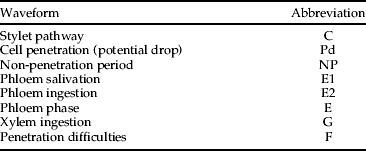
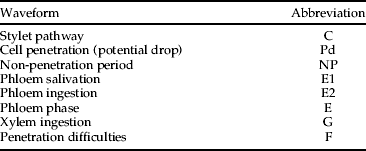
In an EPG set-up, a plant and a piercing insect are made part of an electrical circuit, by inserting an electrode in the soil of the plant and attaching a thin gold wire to the insect (Tjallingii, Reference Tjallingii1985; Reference Tjallingii, Minks and Harrewijn1988). For details on the EPG-methods used, see van Helden & Tjallingii, (Reference van Helden, Tjallingii, Walker and Backus2000). Alate aphids of unknown age were collected from the rearing cage and attached to the electrode. Alate aphids were used because they are the dispersing morph and are, therefore, performing host-plant selection. Pompon & Pelletier (Reference Pompon and Pelletier2012) showed that the age of aphids influences their behaviour in terms of EPG parameters on resistant and susceptible plants. The use of random ages of aphids should therefore give a clear view of the behaviour of adult aphids of all ages within a population, instead of selecting one age of aphids, not knowing how the other aphids might respond. Aphids were placed on the abaxial side of 3-week-old lettuce plants. The DC-EPG device (Giga-8, EPG-Systems, Wageningen, The Netherlands) was used to monitor probing behaviour of aphids during 8 h. All plants were watered before recording, because humid soil provides better electrical contact (Walker, Reference Walker, Walker and Backus2000). Directly after wiring of the aphids recordings were started under constant laboratory conditions at 20±2 °C under continuous artificial illumination (HF fluorescent tubes, 1700 Lux at plant level). Signals of 16 aphids, each on a separate plant, were simultaneously acquired during 8 h in two EPG setups and recorded on a PC hard disc. Data acquisition rate was 100 Hz and waveform analysis was done by PROBE 3.0 software (EPG Systems). Table 2 presents the waveforms that can be distinguished in an EPG recording of aphids.
Different waveforms distinguishable in an EPG recording (van Helden & Tjallingii, Reference van Helden and Tjallingii1993).
Tjallingii (Reference Tjallingii1995) estimated a duration of 10 min of phloem ingestion to be sustained. For every NIL 25 replicates (individual aphids on separate plants) were recorded. Failed recordings were excluded from the dataset.
Performance test
Performance of N. ribisnigri biotypes Nr:0 and Nr:1 was quantified by assessing nymph survival and development time from nymph to the adult stage on one susceptible NIL (S1) and one resistant NIL (R2). About 200 adult alate N. ribisnigri were kept in clip cages (10 per clip cage) on susceptible L. sativa cultivar Fatima, for 24 h. After 24 h, the adult aphids were removed and nymphs were transferred into clip cages on 3-week-old lettuce plants. One clip cage, containing five nymphs, was placed on a single plant. Mortality and development time were recorded daily until aphids reached the adult stage. Experiments were conducted in a greenhouse compartment at a temperature of 18–20 °C, 60% RH and L14/D10 photo/scotoperiod. For every NIL×biotype combination, 20 plants were tested.
Population development
Population development of N. ribisnigri biotypes Nr:0 and Nr:1 was studied on one susceptible and one resistant NIL selected at random, i.e. S1 and R2. Five adults that had moulted within the preceding 24 h were transferred to 4-week-old lettuce plants. A gauze bag was placed over the plant to prevent the aphids from escaping. After 14 days the numbers of nymphs, alate and apterous adults were counted. The experiment was conducted in the same greenhouse compartment where the performance test was carried out, under the same environmental conditions. Six plants per NIL×biotype combination were tested.
Statistics
EPG parameters were calculated individually for every aphid using the EPG analysis worksheet created by Sarria et al., (Reference Sarria, Cid, Garzo and Fereres2009). The Kruskal–Wallis test was used to test for overall differences among aphids on different resistant NILs. For the EPG parameters that differed significantly among the NILs, the Mann–Whitney U test was used for pairwise comparisons. A Bonferroni correction was used to adjust α for multiple-comparisons.
The Mann–Whitney U test was applied to analyse differences in aphid parameters between NIL S1 and NIL R2. Fisher's exact test was performed to analyse differences in the percentage of aphids that showed phloem ingestion.
For the performance test every plant represented one block. Results were first calculated per plant, and means and standard error were calculated over all plants. The Mann–Whitney U test was used to test for significant differences in aphid mortality, time until mortality and development time. This test was also used to test for differences in the population development test for the total number of aphids, nymphs, alate adults and apterous adults.
All statistical tests were performed with IBM SPSS Statistics version 19.
Results
Performance data
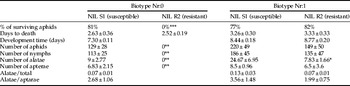
Approximately 80% of the aphids of either biotype survived on NIL S1 (table 3). On NIL R2, a significant difference in survival was observed between the two biotypes. None of the Nr:0 aphids survived, whereas 80% of Nr:1 aphids survived (P<0.0001). Development time of Nr:0 aphids, from 24 h-old nymph to the adult stage, on NIL S1 was 7 days, while Nr:1 developed in 8 days on both NILs.
Performance and reproduction parameters (mean±SEM) for both biotypes (Nr:0 and Nr:1) N. ribisnigri. The Mann–Whitney U test was used to test the differences between resistant and susceptible lettuce, *P<0.05; **P<0.005; ***P<0.001.

Population development
From the initial five adult aphids (all moulted within 24 h) placed on the plant, no Nr:0 aphids were found after 14 days on NIL R2, whereas on NIL S1 129 aphids were counted after 14 days (P = 0.002), of which most (113) were nymphs. Only 16 adults were found: 9 alate and 7 apterous individuals (table 3).
For Nr:1 aphids an average of 220 and 149 aphids were found on NIL S1 and NIL R2, respectively. This difference was not significant (P=0.20). Of the 220 aphids on NIL S1, 186 were nymphs and 34 adults, with 25 alatae and eight apterae. On NIL R2 135 nymphs and 14 adults were counted, of which eight were alatae and six apterae. Significantly more alatae were found on NIL S1 than on NIL R2 (P=0.030).
EPG analysis of biotype Nr:0 on different NILs
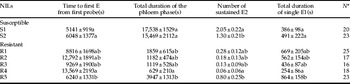
EPG recordings were performed on two susceptible and five resistant NILs. Comparisons were made between the two susceptible NILs and between the five resistant NILs. When comparing aphids on the susceptible NILs, only one significant difference was found. Aphids on NIL S1displayed a larger number of sustained phloem ingestion events (≥10 min), compared with NIL S2 (P=0.022) (table 4). However, the total duration of phloem ingestion over 8 h did not differ (fig. 1).
The total duration of E2 for different NIL×biotype combinations. (A) Shows the total duration (median, first and third quartiles) of E2 for Nr:0 aphids on different NILs. No significant differences were found among the two susceptible NILs or among the five resistant NILs; however, susceptible and resistant NILs differed significantly from each other. (B) Shows the total duration of E2 for Nr:1 aphids on different NILs. No significant differences were found among the two susceptible NILs or among the five resistant NILs and these two groups did not differ from each other either. The outliers are shown.

EPG parameters (mean±SEM) of N. ribisnigri biotype Nr:0 on susceptible and resistant NILs. EPG parameters are presented for which significant differences between lettuce lines were found based on the Kruskal–Wallis test or the Mann–Whitney U test for the two susceptible NILs. All pairwise combinations between the resistant NILs were tested with the Mann–Whitney U test. A Bonferroni correction was applied to account for the ten comparisons made by setting α=0.005. Means within a column having no letters in common are significantly different.

N*, total number of replicates.
When comparing aphids on resistant NILs, there was a trend that aphids on NIL R5 had less problems accepting the phloem compared with aphids on NIL R4 (table 4). Aphids on NIL R5 accepted the phloem quicker compared with aphids on resistant NIL R4 (P=0.005). Total duration of phloem phase was significantly longer for aphids on NIL R5 compared with aphids on resistant NIL R4 (P=0.002). Number of sustained phloem ingestion periods was higher for aphids on NIL R5 compared with aphids on resistant NIL R4 (P=0.003). However, aphids on NIL R4 had a lower number of single phloem salivations (no ingestion before or after) compared with aphids on NIL R5 (P=0.004). There were no significant differences in total duration of phloem ingestion between different resistant NILs (fig. 1).
EPG analysis of biotype Nr:1 on different NILs
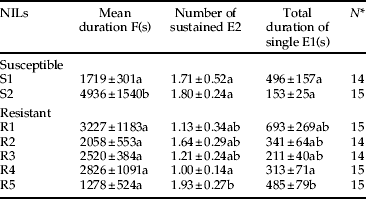
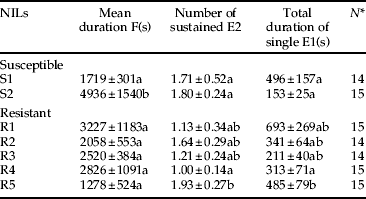
EPG recordings were performed on two susceptible and five resistant NILs. Comparisons were made between the two susceptible NILs and between the five resistant NILs. When comparing aphids on the susceptible NILs, only one EPG parameter significantly differed (table 5). The mean duration of penetration difficulties (F) was more than twice as long for Nr:1 aphids on susceptible NIL S2 (P=0.011) compared with susceptible NIL S1.
EPG parameters (mean±SEM) of N. ribisnigri biotype Nr:1 on susceptible and resistant NILs. EPG parameters are presented for which significant differences between lettuce lines were found based on the Kruskal–Wallis test or the Mann–Whitney U test for the two susceptible NILs. All pair-wise comparisons between the resistant NILs were tested with the Mann–Whitney U test. A Bonferroni correction was applied to account for the ten comparisons made by setting α=0.005. Means within a column having no letters in common are significantly different.
N*, total number of replicates.
When comparing the resistant NILs, aphids on NIL R5 showed a higher number of sustained phloem ingestions compared with aphids on NIL R4 (P=0.004), however, the duration of single phloem salivation (without being followed by ingestion) was longer for aphids on NIL R5 compared with NIL R4 (P<0.0001) (table 5). The total duration of phloem ingestion (E2) did not significantly differ between the resistant lines (fig. 1).
EPG analysis for biotype Nr:0 on NIL S1 and NIL R2
EPG parameters that significantly differed among aphids on the two susceptible NILs and among the aphids on the five resistant NILs were qualified as less discriminative for differences between susceptible and resistant plants. We randomly selected two NILs to test for differences between susceptible and resistant lettuce, susceptible NIL S1 and resistant NIL R2 (table 6).
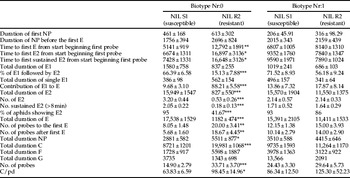
EPG parameters (mean±SEM) for both biotypes (Nr:0 and Nr:1) of N. ribisnigri. Time and duration values are in seconds. The Mann–Whitney U test was used to test for differences between susceptible and resistant lettuce, *P<0.05; **P<0.005; ***P<0.001. Significance of differences in percentage of aphids showing E2 was calculated with Fisher's exact test.

Time until the first stylet probe did not differ significantly between aphids on the resistant and susceptible NIL (P=0.522). Differences between the two NILs were found in the pathway phase and in the phloem phase (table 6). Time until first phloem acceptance was twice as long for aphids on NIL R2 compared with aphids on NIL S1 (P=0.016). In addition, aphids feeding on the resistant NIL spent more time in pathway (P<0.0001) and non-penetration (P=0.012) than aphids on NIL S1. Total number of probes and number of probes before the first phloem event were twice as high for aphids on NIL R2 (P<0.0001 and P=0.003, respectively) compared with aphids on NIL S1. More cell penetrations were made by aphids feeding on NIL R2 (P=0.012).
Although the aphids spent similar amount of time in phloem salivation on both NILs, aphids on NIL R2 often did not proceed to feeding (table 6). The percentage of phloem salivation followed by ingestion was four times lower (P<0.0001), and the contribution of phloem salivation to the phloem phase was much larger for aphids on NIL R2 compared with NIL S1 (P<0.0001). In addition, number of phloem ingestions was six times as low (P<0.0001) and less time was spent on phloem ingestion (P<0.0001) by aphids on NIL R1 compared with aphids on NIL S1 (fig. 1). The overall duration of the phloem phase was shorter on NIL R2 (P<0.0001). No significant differences were found in xylem ingestion and penetration difficulties between aphids on both NILs.
EPG analysis for biotype Nr:1 on NIL S1 and NIL R2
No significant differences were found in EPG parameters for Nr:1 aphids feeding on NIL S1 and R2 (table 6 and fig. 1).
EPG analysis for biotype Nr:0 and biotype Nr:1
Minor differences appeared between the aphid biotypes feeding on NIL S1 (table 6). Biotype Nr:0 had a higher number of phloem ingestions compared with biotype Nr:1 (P=0.042). Biotype Nr:1 had more probes in total (P=0.029), and more probes before the first phloem event compared with biotype Nr:0 (P=0.038).
Nr:0 aphids were less successful in feeding on NIL R2 compared with Nr:1 aphids (Table 6 and fig. 1). It took longer time for Nr:0 aphids to reach the first phloem ingestion (P=0.021), less time was spent in phloem ingestion (P<0.004), the number of phloem ingestions was lower (P<0.0001) and the total duration of the phloem phase was shorter (P=0.001). Phloem salivation of Nr:0 aphids contributed more to the phloem phase (P<0.0001) and a smaller percentage was followed by ingestion (P=0.003) compared with Nr:1 aphids.
Discussion
Differences among NILs
The EPG parameters indicate that the two susceptible NILs are equally susceptible to both biotypes of N. ribisnigri during 8 h of EPG recording, because both biotypes feed equally well on the two lines.
When feeding behaviour of Nr:0 aphids on resistant NILs is compared, the plants seem equally resistant, although for some EPG parameters aphids on NIL R5 differ from the other NILs, in particular NIL R4, indicating NIL R5 is less resistant.
Only minor significant differences appear in EPG parameters for Nr:1 aphids on the resistant NILs, between NIL R5 and NIL R4. The number of sustained phloem ingestions and the total duration of single phloem salivation patterns (not followed by phloem ingestion) are longer on NIL R5, compared with NIL R4. These differences were also found for the Nr:0 aphids feeding on these lines. Total duration of phloem ingestion does not differ among the resistant NILs, indicating that the aphids can feed equally well on the resistant NILs. However, we cannot rule out that a possible resistance against Nr:1 aphids works in a delayed manner, and is therefore not measured during the 8 h EPG recording (Sauge et al., Reference Sauge, Lambert and Pascal2012). To test this performance data need to be collected for Nr:1 aphids on all NILs.
Differences between biotypes
Both biotypes behaved similarly on the susceptible NILs. The ability of Nr:1 and inability of Nr:0 to feed on the resistant lettuce lines, mainly displayed in duration of phloem ingestion, is the major difference in behaviour between these two biotypes. This can also be concluded from the performance and population development of both biotypes on NIL R2. Although Nr:1 aphids survive and reproduce on NIL R2, Nr:0 aphids suffer 100% mortality due to their inability to feed. Differences in behaviour between the two biotypes might have been caused by different rearing history, the Nr:0 aphids were reared on a susceptible cultivar, whereas the Nr:1 aphids were reared on a resistant cultivar.
Plant surface effects
Duration of the first non-penetration period in an EPG provides information on possible resistance factors encountered by aphids on the plant's surface (colour, volatiles, waxes, etc.), although pre-treatment of aphids, like extensive handling of the aphids before an EPG recording, can also influence duration of the first non-penetration period (van Helden & Tjallingii, Reference van Helden and Tjallingii1993). In wild tomato (Solanum pennellii), for example, glandular trichomes have shown to provide resistance against the potato aphid, Macrosiphum euphorbiae (Thomas) (Goffreda et al., Reference Goffreda, Mutschler and Tingey1988). Resistance in Pisum sativum to certain clones of the pea aphid, Acyrthosiphon pisum (Harris) was concluded to be mediated by olfactory cues before the aphid penetrates the plant, because the capacity of aphids to gain access to, or to feed from sieve elements was not altered (Wilkinson & Douglas, Reference Wilkinson and Douglas1998).
In this study, however, there is no difference in duration of the first non-penetration period between aphids feeding on susceptible and resistant NILs, suggesting the absence of a resistance mechanism encountered by the aphid before penetration.
Pathway phase
Nr:0 aphids on resistant NIL R2 take twice as long time before showing the first phloem event compared with Nr:0 aphids on the susceptible NIL S1. This can indicate that Nr:0 aphids on the resistant NIL encounter resistance factors on their way to the phloem, which was not found by van Helden & Tjallingii (Reference van Helden and Tjallingii1993). A possible explanation can be that in this study genetically different lettuce plants have been investigated, compared with the plants used by van Helden & Tjallingii (Reference van Helden and Tjallingii1993). The resistance factors found on the way to the phloem can not only be located in the epidermis or mesophyll but also in the phloem itself. It takes an aphid about 15 min to penetrate a leaf from the epidermis to the phloem and during this pathway phase they penetrate many cells on the way before reaching the phloem. However, after reaching the phloem, salivation or ingestion of phloem sap does not occur directly. Transmission electron microscopy (TEM) combined with EPG showed that a sieve element is not directly accepted by an aphid after reaching it with its stylet (Tjallingii, Reference Tjallingii1994). Montllor & Tjallingii (Reference Montllor and Tjallingii1989) also found indications for resistance factors that acted before accepting the phloem, in their EPG data for N. ribisnigri on a resistant lettuce. The number of probes and total time spent in pathway was higher where phloem ingestion was shorter when feeding on the resistant lettuce compared with a susceptible lettuce variety. An increase in the total number of probes and number of probes before the first phloem event was also found in this study. Chen et al., (Reference Chen, Rahbé, Delobel, Sauvion, Guillaud and Febvay1997) also found that Aphis gossypii (Glover) feeding on resistant melon took longer to reach the first phloem salivation than on susceptible melon. Similar results were found by Crompton & Ode (Reference Crompton and Ode2010) for the soybean aphid (Aphis glycines (Matsamura)) on resistant soybean (Glycine max (L) Merr.).
Phloem phase
Nr:0 aphids have difficulties accepting the phloem of the resistant NIL R2. The phloem phase consists mainly of phloem salivation. Although total time spent on phloem salivation does not differ between aphids feeding on the resistant NIL R2 and susceptible NIL S1, 42% of the aphids on the resistant NIL versus 95% of the aphids on susceptible NIL, show phloem ingestion, however, on the resistant NIL phloem ingestion lasted only for a short time. The number of phloem ingestion events was also low on the resistant NIL. These results indicate that the resistance mechanism encoded by the Nr gene is probably located in the phloem, as has been found previously (Montllor & Tjallingii, Reference Montllor and Tjallingii1989; van Helden & Tjallingii, Reference van Helden and Tjallingii1993). Additional evidence was found by van Helden et al., (Reference van Helden, van Heest, van Beek and Tjallingii1995) by performing artificial diet choice experiments, in which N. ribisnigri could choose between phloem sap from susceptible and resistant lettuce. In these experiments, N. ribisnigri preferred phloem sap of susceptible plants over phloem sap of resistant plants, suggesting that resistance could be based on feeding deterrent activity of the phloem sap of resistant plants.
The Nr:0 aphids did not feed on the phloem of the resistant NIL. They spent more time on other activities like non-penetration and pathway, with a higher number of cell penetrations, as was found also by Montllor & Tjallingii (Reference Montllor and Tjallingii1989) and van Helden & Tjallingii (Reference van Helden and Tjallingii1993) for non-virulent N. ribisnigri on resistant lettuce. In the EPG setup, the aphids were restricted to a certain plant for 8 h. Although the resistant plant is not suitable to feed on, the aphid will try to feed and find a suitable sieve element, to prevent starvation. This can explain why ca. 40% of the Nr:0 aphids do show phloem ingestion, but only for short durations. This can lead to an underestimation of the resistance (Tjallingii, Reference Tjallingii1986).
Several R-gene-related resistances in plants against aphids have been proven to be phloem-based. The mechanism of the Vat-gene in melon (Cucumis melo L.) that provides resistance to the melon aphid (A. gossypii) is probably also located in the phloem. EPG data showed that resistance-caused reduced duration of phloem ingestion on resistant plants, although the frequency of initiation of feeding was not altered (Chen et al., Reference Chen, Rahbé, Delobel, Sauvion, Guillaud and Febvay1997; Klingler et al., Reference Klingler, Powell, Thompson and Isaacs1998). Reduced duration of phloem ingestion was also found by Caillaud et al., (Reference Caillaud, Pierre, Chaubet and Di Pietro1995) on resistant lines of Triticum monococcum L. (Tm44 and Tm46) for the aphid Sitobion avenae F. Similar results were found when the potato aphid was tested on resistant potato expressing the Mi-1.2 gene (Kaloshian et al., Reference Kaloshian, Kinsey, Williamson and Ullman2000). Phloem-based resistance was also found for several other aphid–plant interactions, like in cowpea (Vigna unguiculata L. Walp.) against the cowpea aphid (Aphis craccivora) (Annan et al., Reference Annan, Tingey, Schaefers, Tjallingii, Backus and Saxena2000), lettuce (L. sativa) against the lettuce root aphid (Pemphigus bursarius L.) and soybean (G. max) against the soybean aphid (A. glycines) (Crompton & Ode, Reference Crompton and Ode2010). In a recent study Quantitative trait loci for resistance against Myzus persicae in wild peach were linked to EPG parameters, including the reduction of phloem intake in resistant peach (Sauge et al., Reference Sauge, Lambert and Pascal2012). This is a promising new step in studying host plant resistance against aphids, making it possible to further analyse the underlying resistance mechanisms.
Resistance mechanism
Nr:0 aphids insert their stylets into the sieve element of the resistant NIL, and did show phloem salivation, but did not ingest contents from the sieve elements. This finding might suggest that the stylet canal is blocked, thereby disabling the aphid to feed on the plant. Van Helden et al., (Reference van Helden, Tjallingii and Van Beek1994) and Mentink et al. (Reference Mentink, Kimmins, Harrewijn, Dieleman, Tjallingii, van Rheenen and Eenink1984) also found that Nr:0 reached the phloem on resistant lettuce, because after cutting the stylets of the aphids that were feeding on resistant plants, the cut stylets exude sap.
Mechanical blocking of stylets in the sieve element was suggested as the resistance mechanism in wild Brassica species to the cabbage aphid (Brevicoryne brassicae L.) (Cole, Reference Cole1994). Caillaud & Niemeyer (Reference Caillaud and Niemeyer1996) proposed a blocking mechanism, the phloem sealing system, to be responsible for rejection of resistant lines of T. monococcum (Tm44 and Tm46) by the aphid S. avenae, because amputated stylets on the resistant plants did not or only shortly exude phloem sap. This short exudation of phloem sap out of stylets of aphids was also found by van Helden et al., (Reference van Helden, Tjallingii and Van Beek1994) for N. ribisnigri on resistant lettuce.
In the performance tests, Nr:0 nymphs were not able to survive on the resistant NIL, and no aphids were found back on the plants after 2 weeks in the colony development test. Van Helden & Tjallingii (Reference van Helden and Tjallingii1993) also found a reduced performance of N. ribisnigri on resistant lettuce, compared with susceptible lettuce, observed as higher mortality, lower mean relative growth rate, unsuccessful development from larvae to adulthood and absence of reproduction. Similar results for N. ribisnigri on resistant lettuce were found by Liu & McCreight (Reference Liu and McCreight2006). Kaloshian et al., (Reference Kaloshian, Kinsey, Ullman and Williamson1997) reported a reduced longevity and fecundity of potato aphids tested on resistant potato.
Nr:0 nymphs survived for only 3 days on the resistant NIL, probably because of starvation, because EPG results showed that Nr:0 aphids ingested far less phloem sap on the resistant NIL compared with the susceptible NIL, and about 60% of the aphids did not show phloem ingestion during the 8 h recording period. Total absence of honeydew production and gain of weight after being transferred from a susceptible plant to a resistant plant was found by van Helden et al., (Reference van Helden, Tjallingii and Dieleman1993), suggesting there was neither ingestion of phloem nor xylem sap by N. ribisnigri on resistant lettuce. They also suggested that a hypothetical toxic component in the food as resistance mechanism is probably absent, for there was almost no intake of food by the aphids. In addition, mortality of the aphids on resistant plants was comparable with mortality of aphids in a Petri dish without food, moreover, transfer of aphids after 2 days on resistant plants to susceptible plants showed no sign of intoxication (van Helden et al., Reference van Helden, Tjallingii and Dieleman1993). Therefore, the resistance component seems to be an inhibiting factor blocking the feeding of the aphids on resistant lettuce.
Virulent biotype Nr:1
The resistance mechanism in the resistant NIL that acts against Nr:0 is ineffective against biotype Nr:1, because Nr:1 aphids feed and survive equally well on both the resistant NIL and the susceptible NIL, and suggest that this aphid is highly virulent against the resistance conferred by the Nr gene. No differences were observed for EPG parameters between Nr:1 aphids feeding on the resistant and susceptible NIL. In contrast with Nr:0 aphids, Nr:1 aphids were able to ingest phloem sap from the resistant NIL and survive on this plant. Also the duration from the first probe until the first acceptance of a sieve element did not differ between Nr:1 aphids on resistant and susceptible NILs. More alate aphids were produced on NIL S1 during the population development test, compared with NIL R1. This could be an effect of crowding, as there tended to be more aphids on NIL S1, although the difference was not significant. NIL S1 could also be less preferred by the Nr:1 aphids, and therefore alatae may have been produced to move to other plants. This might also explain the high number of failed EPG recordings we observed for the Nr:1-NIL S1 combination (11 of 25 failed). There might be a negative trade-off for the Nr:1 aphids in performance on resistant versus susceptible lettuce lines.
The occurrence of virulent biotypes is a growing problem in several aphid–plant interactions. For example, Vat-gene virulent populations of A. gossypii (Glover) have been reported (Lombaert et al., Reference Lombaert, Carletto, Piotte, Fauvergue, Lecoq, Vanlerberghe-Masutti and Lapchin2009). For wheat, several biotypes of Diuraphis noxia have emerged, which are virulent to several of the resistance sources and others to all (Tolmay et al., Reference Tolmay, Lindeque and Prinsloo2007). A. glycines (Matsumura) biotypes have emerged, which are able to colonize resistant soybean plants (Kim et al., Reference Kim, Hill, Hartman, Mian and Diers2008). M. euphorbiae aphid biotypes differ in virulence on resistant tomato (Pallipparambil et al., Reference Pallipparambil, Reese, Avila, Louis and Goggin2010).
Genetic basis of plant resistance and aphid virulence
In agro-ecosystems, aphids are exposed to strong human-imposed selection pressures and might therefore evolve virulence to host plant resistance (Mitchell et al., Reference Mitchell, Johnson, Gordon, Birch and Hubbard2009). However, the mechanisms behind this phenomenon remain unknown. The interaction between aphids and their host plants are often hypothesized to function in a gene-for-gene manner. According to Flor (Reference Flor1955) in the gene-for-gene model a single dominant resistance gene (R-gene) in the plant codes for a defence response that is triggered by the product of a single avirulence (Avr) gene in the pest species. Jones & Dangl (Reference Jones and Dangl2006) proposed the Zigzag model, in which a plant responds to an attacker, through a two-branched immune system in the plant, in which the first branch responds to commonly occurring effectors associated with pathogens or insects, and in the second branch the plant reacts to an effector specific for the attacker, via either direct or indirect recognition. The ability of the newly emerged biotypes to overcome R-gene resistances, might be attributed to evading recognition by the plant and/or suppressing these plant defences, by loss or modification of Avr gene products (Parker & Gilbert, Reference Parker and Gilbert2004; Hogenhout & Bos, Reference Hogenhout and Bos2011). Another model to describe the interaction between aphids and their host plants is Ehrlich & Raven's (Reference Ehrlich and Raven1964) model of chemical co-evolution. In this model plants accumulate defence compounds that negatively affect the herbivores, and herbivores might evolve behavioural or biochemical strategies to avoid these plant compounds. Sauge et al., (Reference Sauge, Poëssel, Guillemaud and Lapchin2011) studied whether the tendency of M. persicae aphids to leave RM2 resistant peach (induced resistance), matches one of the above-mentioned models involved in R-gene-mediated resistance. The induced resistance matched the gene-for-gene model, because the level of resistance was independent of the aphid density and time since inoculation used to induce the plants. However, there was a significant quantitative variation for avirulent aphids in the tendency to leave the plant, indicating virulence in these aphids may also match the chemical co-evolution model. R-genes involved in plant–aphid interactions may function in a combination of the gene-for-gene and chemical coevolution model. In a study by Thomas et al., (Reference Thomas, Dogimont and Boissot2012) the relation between the genotype and the phenotype of A. gossypii on 33 melon genotypes was studied by microsatellite markers and testing plant acceptance, colonizing ability and resistance to virus inoculation on several melon accessions. Plant acceptance and resistance to virus inoculation were dependent on the genotype of the aphids, matching the gene-for-gene model. However, for the ability to colonize a plant, phenotypic variability was found for aphids of the same genotype, suggesting polygenic control of this trait.
In the interaction of Meloidogyne javanica with the Mi-gene in tomato, Tzortzakakis et al., (Reference Tzortzakakis, Trudgill and Phillips1998) found a dosage effect of the Mi-gene. More eggs were produced by nematodes on heterozygous compared with homozygous plants. This dosage effect was also studied by (Jacquet et al., Reference Jacquet, Bongiovanni, Martinez, Verschave, Wajnberg and Castagnone-Sereno2005) for several lines of Meloidogyne incognita infecting a number of L ycopersicon esculentum genotypes. Here also the reproduction of the nematodes was often significantly higher on heterozygous than on homozygous tomato genotypes.
Both the Vat-gene in melon and the Mi-1.2 gene in tomato belong to the NBS-LRR family of R-genes (Milligan et al., Reference Milligan, Bodeau, Yaghoobi, Kaloshian, Zabel and Williamson1998; Pauquet et al., Reference Pauquet, Burget, Hagen, Chovelon, Menn, Valot, Desloire, Caboche, Rousselle, Pitrat, Bendahmane and Dogimont2004). Proteins of NBS-LRR genes are involved in the recognition of pathogens by the plant, and might also be involved in the recognition of aphids by plants (McHale et al., Reference McHale, Tan, Koehl and Michelmore2006). Although the Mi-1.2 gene and Vat-gene are both NBS-LRR genes, they differ in species specificity. The Vat-gene was shown to be species-specific as it was effective against A. gossypii, but not against Bemisia tabaci biotype B (Boissot et al., Reference Boissot, Thomas, Marchal and Dogimont2010). In contrast, the Mi-1.2-gene confers resistance against multiple unrelated attacker species: M. euphorbiae, several nematode species, whiteflies and psyllids (Casteel et al., Reference Casteel, Walling and Paine2006). An important difference between the aphid species discussed above and N. ribisnigri, is that the former are generalists, whereas N. ribisnigri is a specialist.
Methodological limitations
Although EPG is a very suitable technique to study the penetration behaviour of piercing-sucking insect herbivores, it has some limitations. A major disadvantage of the EPG technique is that the penetration behaviour cannot be recorded from freely moving aphids. Although the gold wire allows some movement, the insects are still fixed to a limited part of the plant they feed on (Tjallingii, Reference Tjallingii1986). Side effects may occur and can be described as ‘tether-effects’. Tjallingii (Reference Tjallingii1986) studied the tethering effect for the aphid species B. brassicae and A. pisum. Smaller differences in terms of longevity, fecundity, settling ratio, penetration time, and the number of penetrations were found than were normally found between aphids on host and non-host plants. Minor tether-effects were found in several studies (Montllor & Tjallingii, Reference Montllor and Tjallingii1989; van Helden et al., Reference van Helden, Tjallingii and Dieleman1993; Caillaud et al., Reference Caillaud, Pierre, Chaubet and Di Pietro1995), which suggests that the extent of tether-effects differs among species. Therefore, additional experiments with free-moving aphids are necessary, to study the influence of the EPG-recordings technique on differences between host and non-host plants, or between resistant and susceptible cultivars that can differ per plant–aphid species combination (Tjallingii, Reference Tjallingii1986; van Helden & Tjallingii, Reference van Helden, Tjallingii, Walker and Backus2000).
Conclusion
Our studies indicate that the resistance mechanism of the Nr gene against N. ribisnigri is mainly located in the phloem. However, we also found that aphids encounter difficulties on resistant lettuce already during the pathway phase. This was not found in previous research and is probably caused by the use of different lettuce and aphid material. A hypothetical stylet-blocking mechanism could be responsible for the inability to feed on resistant lettuce. The newly emerged Nr:1 biotype of N. ribisnigri is strongly virulent to the resistance mechanism acting on Nr:0 aphids, conferred by the Nr gene. Nr:1 aphids feed and perform the same on both susceptible and resistant lettuce. This aphid biotype is a threat for the lettuce growing industry since currently there is no other source of genetic resistance available to this aphid biotype.
Acknowledgements
The authors thank Freddy Tjallingii for his advice on the EPG technique. We thank Keygene N.V. for growing the plants and rearing the aphids used in the experiments, and Enza Zaden B.V. and Vilmorin & Cie for providing seeds. We also thank Martin de Vos and Raymond Hulzink of Keygene and Bruce Schoelitsz for commenting on earlier versions of the manuscript. Stichting TTI Groene Genetica (TTI-GG project 2CFD022RP) and the companies involved Keygene N.V., Nickerson-Zwaan BV and Enza Zaden Beheer B.V. are acknowledged for financial support.