


This chapter describes the development of legal education and legal theory in Egypt and China during the first decades of the twentieth century. Egypt was under indirect British rule during this period, while China was an independent state (although its sovereignty was compromised due to the intervention of foreign powers in its affairs in various ways). Despite these differing political circumstances, both countries experienced comparable trends in the development of legal education and legal theory. These developments also reflected the patterns that I discussed in the previous chapters when analyzing India and Palestine.
I do not aim to provide an exhaustive analysis of the history of legal education and legal theory during the early twentieth century in Egypt and China. Rather, I seek to demonstrate that the history of legal theory in India and Palestine was not unique. These two territories were part of a broader global jurisprudential wave that emerged more or less simultaneously in many different parts of the world, including Egypt and China.
Egypt
The origins of European-inspired legal education in Egypt can be traced back to the nineteenth century. Early and mid nineteenth-century Egypt was formally a province of the Ottoman Empire but was, de facto, ruled by a local dynasty established by the Ottoman Governor, Muhammad Ali. In 1882, the British occupied Egypt in response to a local revolt; and, between 1914 and 1922, Egypt was a British protectorate. In 1922, Egypt became nominally independent, but British presence (and influence) continued until the Suez Crisis of 1956. Against this backdrop, Egypt developed one of the most advanced systems of modern legal education in the British Empire.
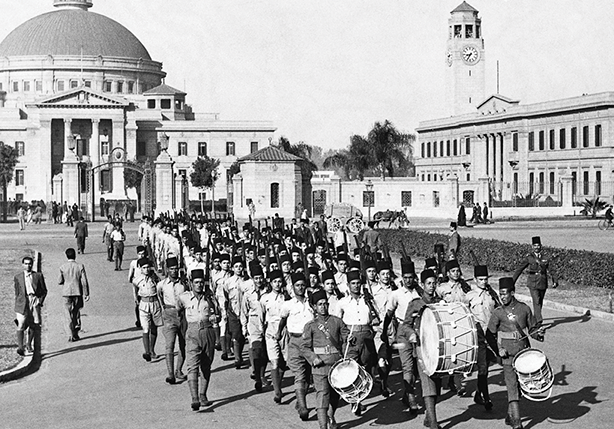
Beginning in 1868, students could enroll in law courses at the Cairo School of Languages and Administration. Later, a fully fledged public institution, the Khedivial Law School, was established. The name of this school and its institutional status changed several times until it became Cairo University Law Faculty. Here, I will call it “The Cairo Faculty.”Footnote 1 French professors and French law dominated the curriculum at the Cairo Faculty due to the strong French influence on modern Egyptian law. In 1907, the British managed to dismiss the French dean of the school, Édouard Lambert. Courses were subsequently taught in English by British professors, although the British could never fully eliminate the French influence. English dominance waned toward the mid-1920s when the school became part of the Egyptian University (later called King Fuad I University and now Cairo University), an institution inspired by Egyptian nationalist ideology (see Figure 7.1). In 1890, another Cairo-based law school, run by French missionaries and supported by the French government, provided Egyptian students with an alternative venue for legal education. There were also institutions teaching Islamic law. These included Al-Azhar University, established in the tenth century, but also new institutions such as Dar al-‘Ulum, a teacher-training school, whose judicial section was established in 1887, and the School for Shari‘a Judges, which operated between 1907 and 1930, when it was integrated into Al-Azhar University.Footnote 2
Cairo University, 1940 (the law school building is visible on the right-hand side).
In Chapter 2, I discussed the jurisprudence textbook that Frederic Goadby wrote while teaching in Cairo. Goadby was just one of several theoretically minded European law professors who taught at the Cairo Faculty, such as Maurice Amos or Léon Duguit. Just as in the case of Palestine, alongside the works of European law teachers, jurisprudence textbooks written by local law scholars began to be published. Two such Egyptian books, both written in Arabic, will be mentioned here. The first was a textbook by Muhammad Kamil Mursi and Sayyid Mustafa, published in 1923.Footnote 3 After studying law in Egypt, Mursi obtained a doctorate in law from the University of Dijon in France in 1914. In 1920, he began teaching at the Cairo Faculty (delivering his lectures in Arabic rather than English). Later, he became the Egyptian Minister of Justice, the Head of Egypt’s Supreme Administrative Court, and the President of Cairo University.Footnote 4 His co-author, Sayyid Mustafa, was an Egyptian judge who eventually became the President of the Egyptian Court of Cassation.Footnote 5
The second textbook was published by ‘Abd al-Razzaq al-Sanhuri and Ahmad Hishmat Abu Sittit in 1941.Footnote 6 Sanhuri was the most important Arab legal scholar of the first part of the twentieth century. He graduated from the Cairo Faculty in 1917 and later studied in France at the University of Lyon. He subsequently taught at the Cairo Faculty and served in various judicial positions, ultimately being appointed the Head of the Egyptian State Council. He was associated with Egyptian nationalist politics and, specifically, with the Sa‘adist party, an offshoot of the nationalist Wafd party, representing middle-class, educated professionals. He also showed an affinity with socialist ideology.Footnote 7
Beginning in the early 1930s, Sanhuri called for replacing the nineteenth-century Egyptian Civil Codes, which were mainly based on French law, with a new code based on Islamic law and inspired by French jurisprudential ideas. The new code, which was ultimately enacted in 1948 and entered into force in 1949, later served as the model for the civil codes of many other Arab countries.Footnote 8 Sanhuri’s works were influenced both by a nationalist desire to see Islamic law used as the basis of modern Egyptian law and also by his socialist commitment to promoting distributive justice in Egyptian society.Footnote 9
The jurisprudential cosmopolitanism that characterized Egypt at the time was related to the fact that the country, including its legal system, was a battleground between French and English influences. The English saw the French – whose culture was espoused by young Egyptian nationalists as an antidote to British rule – as their main rivals. This French–English cultural tension had multiple manifestations, including the aforementioned competition over control of the Cairo Faculty.Footnote 10
Traces of the battle between English and Continental legal influences can be found in Egyptian jurisprudence textbooks. Mursi and Mustafa’s textbook used leading English jurisprudence works (by T. E. Holland, John Salmond, and the aforementioned book by Goadby). However, it also relied on French authors, including anti-formalist thinkers such as François Gény, and German and other Continental writers – for example, the Russian legal scholar Nikolai Korkonuv.Footnote 11 Mursi and Mustafa compared how nineteenth-century English and German scholars defined law, focusing specifically on the difference between the definition offered by the English analytical scholar John Austin (law as the “command of a human sovereign”) and that adopted by the German Historical School (law as a reflection of the “spirit of the people.”) They declared the definition of the Historical School to be superior to Austin’s definition because it allowed one to see Islamic law as a legal system, whereas Austin’s understanding was incompatible with the existence of Islamic law (and other “Eastern” legal systems such as Hindu law) since Islamic law was not created by the commands of a human sovereign.Footnote 12
French legal thinkers such as Léon Duguit (who visited the Cairo Faculty in 1925–26) developed the notion that the law was related to social solidarity.Footnote 13 Such ideas also appeared in Mursi and Mustafa’s book – for example, when discussing the argument that legislators should strive to further distributive justice and social solidarity by “protecting the weak, assisting the poor, spreading education, defending minorities such as workers … [and] seeking to further the welfare of the nation even if this comes at the expense of some individuals.”Footnote 14
The textbook written by Sanhuri and Abu Sittit also included a survey of various European approaches to jurisprudence, providing readers with a broad account of both English and Continental theories. Here, too, one could find discussions of John Austin’s approach to the definition of law, side by side with surveys of the different approaches of nineteenth-century Continental schools, such as the French école de l’exégèse, the German Historical School, or the purpose theory of law developed by German jurist Rudolf von Jhering. References to equivalent Islamic approaches often accompanied such theoretical discussions. For example, the discussion by Sanhuri and Abu Sittit of natural law theories included a note on natural law in the thought of the medieval Mu‘tazilah school, and Austinian positivism was equated to the approach of the medieval Ash‘ari school.Footnote 15 As with Mursi and Mustafa’s book, modern French approaches were dominant in Sanhuri and Abu Sittit’s book. In particular, the authors emphasized figures such as Gény and Duguit, who represented then-fashionable anti-formalist, sociological approaches to law. Sanhuri and Abu Sittit also devoted special attention to favorably describing Duguit’s notion of social solidarity as the foundation of society and law.Footnote 16
Just as Indian and Jewish scholars sought to compare their religious legal systems with Western ones in their jurisprudence textbooks, so did their Egyptian counterparts. Mursi and Mustafa claimed in their book that there were just three fundamental legal systems in the world – Islamic, Roman, and English law – and that these could be considered the source of all modern positive law. They added that Islamic law was, through conquest, the source of the laws of many countries (Egypt, Syria, Persia, Turkey, Central Asia, North Africa, Spain, and India). Surprisingly, they also included China in the list of countries influenced by Islamic law.Footnote 17
Sanhuri and Abu Sittit’s book also contained an argument about the pioneering nature of Islamic law. One of the first topics discussed by these authors was the attitude of various legal systems toward jurisprudence. After mentioning different modern legal systems (English, American, and French), the book moved to Roman law, noting its technical superiority but also remarking on the fact that Roman jurists did not display any great interest in legal philosophy. Sanhuri and Abu Sittit then noted that Islamic jurists, just like their Roman counterparts, excelled in the precision and logic of their technical discussions of law. Islamic jurists, they then added, “surpassed the Romans – and also non-Romans … in creating a science similar to [modern] jurisprudence.” This science (usul al-fiqh) was devoted to “the study of the sources of the shari‘a and the ways in which detailed rulings could be extrapolated from these sources.”Footnote 18 Thus, Islamic scholars, Sanhuri and Abu Sittit claimed – not Roman scholars – were the forerunners of modern jurisprudence.Footnote 19
Western depictions of non-Western religious legal systems described them as outdated and static. Mursi and Mustafa counter-argued that the antiquity of Islamic law did not impede its modern application. Contrary to common Western depictions of Islamic law, this was not a fixed system, unmalleable and inapplicable to modern society. Islamic law, Mursi and Mustafa explained, could be legitimately applied to any time and any place because Islamic rulers could create norms to deal with new conditions and, more generally, because it contained rules dealing with topics that modern legal systems also addressed (such as contract law, family law, property law, criminal law, procedural law, and so on). Thanks to this comprehensiveness, the authors reasoned, Islamic law, unlike other religious legal systems, was “legal” in the modern, positivist, sense.Footnote 20
Given their favorable stance toward Islam, it is not surprising that Sanhuri and Abu Sittit’s book also portrayed it positively when discussing the role of religion as a source of law. Religion, the authors said, adopts customary norms but discards those elements of customs that are “corrupt, upholding what is good, violently shaking what is old, tearing down what cannot hold, and [thus] moving humanity forward.” Religion was, therefore, a progressive force.Footnote 21 Islamic scholars could collaborate with professional jurists, explained Sanhuri and Abu Sittit, and use the consensus of the community (ijma‘) as a fertile source for the revival of Islamic law in a way that would bring its rulings in line with contemporary needs and new circumstances. Such a revival was to be desired because Islamic law contained some of the “most modern and finest” legal principles.Footnote 22
Sanhuri and Abu Sittit lamented the fact that both modern Egyptian legal scholars and, to a lesser degree, Egyptian judges were still heavily influenced by French law and that Egyptian law, therefore, lacked a unique Egyptian character. This, they continued, was true not only of the judges belonging to the civil and mixed courts of Egypt but also the judges of the Islamic courts, who were only “imitators and not independent interpreters.” Given that shar‘i judges were mere imitators, it was not surprising that they could not advance the Shari‘a and assist in its evolution to enable it to meet the requirements of the current age. Similarly, Islamic legal scholars were depicted in Sanhuri and Abu Sittit’s book as imitators, too, unwilling to adapt the Shari‘a to the spirit of the times.Footnote 23
However, Islamic law was not merely seen by these authors as a resource that could be used for practical legal reforms. Sanhuri and Abu Sittit also believed in its global jurisprudential impact. After discussing the contemporary state of Egyptian jurisprudence, they cited, in a footnote, a passage from Sanhuri’s book General Theory of Obligations, in which he said:
We must first “Egyptianize” jurisprudence (fiqh) … see in it our national imprint, and feel in it the impact of our mentality. Our jurisprudence remains occupied today by the French foreign occupation … [and we] still seek guidance in French jurisprudence and barely deviate from its course, as if [we] were its shadow and loyal minion. If we are destined to have our own independent jurisprudence … we must take one final step; we must move beyond the national bounds into the global ones in order to pay some of what is due to humanity … to advance global jurisprudence or what jurists call comparative law … and the most important means to help us reach this goal is to be concerned with Islamic law, the law of the East, God’s revelation, and the product of the minds of its intellectuals grown in its desert, its plains and valleys, for it is a flame of the soul of the East, and a lantern of Islamic light, where the East meets Islam, the former is bathed in the light of the latter, and the soul of the latter is breathed into the former until they fuse to become one. This is Islamic law, and should it spread its wings … we would be able to use this [Islamic] legacy to infuse the spirit of independence into our jurisprudence, and our judiciary, and our legislation, and then we would be able to share this new light with the world to enlighten one facet of the global culture of law.Footnote 24
Moving to works dealing specifically with Islamic public law, one can find an interest in this topic in the works of Sanhuri, who, despite his reputation as primarily a private law scholar, also contributed to the study of Islamic public law. This was evident, for example, in one of his two doctoral theses that he wrote in France. In this work, which dealt with both Islamic international law and constitutional law, Sanhuri examined the past and future of the Islamic caliphate.Footnote 25 The rules of Islamic law regarding the caliph and the caliphate, Sanhuri argued, proved the democratic nature of Islam: Islamic political thought was familiar with the notion of the social contract, separation of powers, and public opinion. The caliph was (ideally) supposed to be elected rather than holding a hereditary position and was a constitutional ruler rather than an absolute despot who enjoyed unlimited power (as some observers mistakenly believed, according to Sanhuri). The caliph was bound by the rules of Islamic law and could not act in any way that might contravene this law.Footnote 26 Furthermore:
The principle [in Islamic law] that the community’s agreement (consensus) constitutes a source of law embodies the essence of the democratic spirit. This agreement becomes, in a way, the expression of divine will … God’s will cannot be expressed by the caliph, who does not have legislative power. It can only be expressed by the entire community, by the Muslim Nation. What could be more democratic than to affirm that the will of the Nation is the expression of God’s will itself? … within the limits of the Quran and the Hadith, constituting in a certain way a constitutional law from which one cannot derogate, the Nation alone, and not the caliph, can legislate. This is the very basis of the modern parliamentary system, with the difference, however, that in the Muslim system, the representatives of the Nation are not elected; they are self-appointed by virtue of their expertise in legal science (ijtihad); the Muslim government is a government of scholars.Footnote 27
Similarly, Sanhuri’s diary contained musings on the nature of Islam as a political religion (unlike Christianity); on the need to create an organization devoted to the study of Islamic international and constitutional law; and on the nature of Islamic democracy, which he viewed as superior to Western democracy.Footnote 28
Liberalism was the dominant ideology of the Egyptian legal profession during the early decades of the twentieth century.Footnote 29 It is, therefore, not surprising to find attempts by Sanhuri to show the compatibility of Islam with liberal values. Several entries in his diary discussed the notion of equality, including statements about Islam as a religion whose essence is equality between people and nations and calls for minimizing gender inequality. Sanhuri also claimed apologetically in his diary that Islam did not seek to permit slavery and polygamy but, on the contrary, sought to restrict their scope in a world in which they were taken for granted and commonplace.Footnote 30
Sanhuri and Abu Sittit’s textbook also included discussions of Islamic law and the notion of equality, focusing specifically on gender relations. Thus, when discussing the Islamic rules regarding marriage, the textbook claimed that husbands were not permitted to “violently strike” their wives. Regarding monetary affairs, wives could freely dispose of their own property and enter into contractual relations without their husbands’ consent. In this sense, the authors contended, Islamic law differed from many Western legal systems where a wife did not enjoy full legal personality and, therefore, her legal acts required her husband’s permission, and where, following the marriage, the wife’s property was combined with that of her husband rather than kept separate.Footnote 31
Along with liberal values, Sanhuri’s thought was influenced by socialist ideology. Like other Egyptian jurists of the time, Sanhuri believed that progressive values identified with the rise of socialism had antecedents in Islamic law.Footnote 32 Thus, his diary contained entries on the compatibility of the socialist and “Oriental” spirits.Footnote 33 Sanhuri and Abu Sittit’s textbook also discussed socialism. It included an examination of the relative merits of individualism and socialism, declaring that the former, despite some advantages, was ultimately based on false premises, and the latter was the dominant approach of the modern era because the role of the state – and law – in regulating everyday life was growing.Footnote 34 While Sanhuri and Abu Sittit’s book did not include explicit doctrinal reform proposals based on Islamic law, Sanhuri’s doctrinal works did. In these writings, Sanhuri thoroughly discussed specific private law doctrines taken from Islamic law that, he argued, should be adopted in contemporary Egyptian law. Many of these doctrines were meant to protect weaker parties, such as debtors or peasants, and thus lessen inequality between Egypt’s rich and poor.Footnote 35
China
Unlike India, Palestine, or Egypt, early twentieth-century China remained a formally independent state. However, beginning in the middle of the nineteenth century, Britain, along with other foreign powers, established a series of quasi-colonial enclaves in China. In these enclaves, foreigners enjoyed sweeping privileges that significantly eroded Chinese sovereignty. The earliest and most important British outpost in China was Hong Kong, which the British ruled from 1841.
Hong Kong was also a center of English culture and law in China. At the University of Hong Kong, established in 1911, a Faculty of Law was only created in 1969, but commercial and international law courses were taught at the Faculty of Arts from 1915. A course on jurisprudence was also taught from 1917 onward. Between 1924 and 1927, this course was taught by George W. Keeton, a graduate of Cambridge University, who later became the Dean of the Faculty of Laws at University College London.Footnote 36
Keeton had an ambitious and theoretically oriented vision of the role of legal education. In the inaugural issue of Hong Kong University Law Journal, a periodical he had helped establish together with some of his students, Keeton published a lecture in which he envisioned the creation of a “true philosophy of law,” which would be based on studying and comparing Western law to Hindu and Chinese law. As the journal’s table of contents attests, the articles published there were mostly theoretical, dealing with legal history, comparative law, and jurisprudence.Footnote 37
Keeton’s lectures on jurisprudence, taught to a class of “Chinese … Hindoos, and Japanese” students, were ultimately published in 1930 as a book entitled The Elementary Principles of Jurisprudence. In the preface to this book, Keeton noted that it was influenced by “informal discussions” with his students about the topics he had taught them and mentioned some differences between Western and non-Western conceptions of law. According to Keeton, his students saw the notion of duty as more important than the notion of right, and custom as more important than the notion of “law as the creature of the State.”Footnote 38 The book was also dotted with examples taken from Chinese law, some of which were used to critique Western jurisprudential concepts. For example, when discussing the Austinian notion of sovereignty, Keeton noted that some scholars rejected the idea that sovereignty was essential for the existence of law, arguing that law could exist even without the backing of a sovereign. In support of this proposition, Keeton mentioned the third-century BC Chinese Book of Lord Shang, which, he claimed, recognized the existence of the notion of the Law of Nature.Footnote 39 In another place in his book, Keeton noted that Henry Maine believed that one of the stages through which every legal system passes is one in which law becomes associated with religion. However, he said, the Chinese never went through such a stage.Footnote 40
Moving from Hong Kong to mainland China, the history of Westernized legal education there began during the last years of the Qing Dynasty.Footnote 41 One of the first institutions in China to offer a comprehensive program of Western-style legal education was Peiyang University, established in 1896 in Tientsin (Tianjin). The first professor of law there, James Bromley Eames, was a graduate of Oxford University, and the curriculum was therefore influenced by English legal education and included a course on “general jurisprudence.” Many additional institutions were established in China in the first decade of the twentieth century, their emergence being a direct result of the legal reforms of the 1890s and 1900s, which sought to introduce a Western-style legal system, mainly inspired by Continental law, to China.Footnote 42 Many of these law schools were called “schools of law and politics” since legal studies were often combined with the study of political science and economics.Footnote 43
The first years of the Republican era, which began in 1912, were characterized by unstable political conditions, leading to the closure of some law schools. One estimate mentions sixty-four Chinese schools, colleges, and universities offering law degrees in 1912, declining to thirty-three in 1924. Another estimate mentions forty-nine law colleges in 1915 declining by half by 1921. In any event, the end of the Warlord era in 1928 saw a rise in the number of institutions and students.Footnote 44
Many of the law schools of the Republican era were staffed by Chinese teachers who studied law in Japan, a country whose own legal system had been Westernized during the second half of the nineteenth century. As a result, the textbooks they used were mainly translated from Japanese. However, there were also law schools where European and American law teachers taught alongside Chinese professors. Two of these schools were established by Christian missionaries in Shanghai. The first was the Faculty of Law of Aurora University, a Catholic institution established by Jesuits. This law school was inaugurated in 1912, and law studies there were based on the French codes.Footnote 45
The second Shanghai law school established by Christian missionaries was Soochow University Law School, also known as the Comparative Law School of China, established in 1915. Founded by American Protestant missionaries, this school sought to provide its students with “a thorough mastery of the fundamental principles of the world’s chief legal systems” and to educate students “who [could] contribute to the making of a new and better jurisprudence for China.”Footnote 46 The model upon which this school was based was the Harvard model of legal education, including the use of casebooks, a requirement for prior undergraduate studies, a large law library (containing over 30,000 books), and the production of student-edited law reviews. The teachers were American lawyer-missionaries such as the first dean, Charles Rankin, French and German lawyers and judges based in Shanghai, and Chinese graduates of Chinese and foreign law schools.Footnote 47
Many of the courses taught at Soochow were devoted to legal theory. The curriculum included courses on both Western and Chinese jurisprudence and legal philosophy, as well as courses on legal history. In addition, various comparative law courses were offered, including modern Continental law (French and German but also Japanese, Soviet, and Italian-Fascist), Roman law, and Anglo-American law. The school also offered an advanced graduate degree in law (LLM) requiring courses on Japanese, Swiss, Anglo-American, Soviet, and French law as well as a thesis. Some of the graduates of Soochow Law School also pursued advanced legal degrees outside China.Footnote 48
The Comparative Law School was a unique institution. The fact that China’s legal system was in flux during the interwar period created a niche for a school focused mainly on comparative law and legal theory rather than on the technical details of local law. The cosmopolitan nature of the legal community in interwar Shanghai and the fact that Soochow University was a place where Western and Chinese scholars interacted also contributed to the unique nature of the school. No other law school in the world at the time was comparative to such an extent.Footnote 49 However, in a certain sense, Soochow was merely a radical version of the law schools of India, Palestine, and Egypt that I previously discussed.
Turning from the history of legal education to the history of legal theory reveals a similar pattern. In the nineteenth century, articles and books by Western and Japanese scholars discussing Western jurisprudential ideas were translated into Chinese. In the first decades of the twentieth century, Chinese legal scholars began to write books and articles on jurisprudence. Indeed, hundreds of such works were written. These included books on jurisprudence, legal history, comparative law, and translations of the works of classical Western legal theorists, such as Montesquieu, and modern ones, such as Roscoe Pound.Footnote 50 Some of these works dealt with ancient Chinese law, arguing that the Chinese should be proud of their ancient law, or used Chinese legal history to critique Western theories about law – for example, by comparing the unitary Western concept of law to the more subtle Chinese distinction between the notions of li and fa.Footnote 51
Focusing specifically on works produced at Soochow, the texts that teachers at this school wrote were, naturally, cosmopolitan and theoretical. Discussions of jurisprudence in the China Law Review, published at Soochow between 1922 and 1940, reflected state-of-the-art developments in Western jurisprudence. In the volumes of this law review, one could encounter articles that outlined cutting-edge Western anti-formalist ideas of thinkers such as Duguit or Pound.Footnote 52 Other late nineteenth- or early twentieth-century American proponents of anti-formalist and sociological jurisprudence, such as Oliver Wendell Holmes, Benjamin Cardozo, Felix Frankfurter, and the American Legal Realists, were also discussed.Footnote 53
The China Law Review also published works on other areas of legal theory, such as comparative law and legal anthropology. A leading author of works on these topics was Charles S. Lobingier, who taught at Soochow. Lobingier had been a classmate of Roscoe Pound at the University of Nebraska in the 1880s and then served as a judge and taught law in Nebraska, the Philippines, and China. He was a prolific author who wrote extensively on legal history, legal anthropology, and comparative law, discussing in his works American law, Continental law (Roman, Spanish, French, and German), and the law of several Far Eastern countries (the Philippines, Japan, and China).Footnote 54 There were other authors, too, whose works showed a similar interest in comparative law and legal history, for example, by comparing ancient Chinese, Hindu, and Jewish law to other legal systems of the ancient world.Footnote 55
China did not have a religious legal system equivalent to Hindu, Jewish, or Islamic law. The dominant Chinese philosophical traditions, Confucianism, Daoism, and Buddhism, did not posit a divine lawgiver or a revealed body of law to govern human affairs. Confucianism emphasized social harmony through moral cultivation rather than law. Classical Daoism, with its focus on the spontaneous natural order, tended to reject rigid legal frameworks, while Buddhism influenced broader Chinese culture primarily through its ethical notions.Footnote 56 However, these ancient philosophical traditions did provide some guidance for individual moral conduct and also for the political ordering of society, and could thus be used (in addition to the very long tradition of Chinese positivist jurisprudence) by local legal scholars seeking jurisprudential inspiration in their own national traditions.
As was the case in other non-Western countries, some late nineteenth- and early twentieth-century Chinese intellectuals sought to meld ancient Chinese traditions with new ideas from the West.Footnote 57 Similarly, some Chinese legal scholars, just like the Indian and Jewish scholars I discussed in the previous chapters, were interested in the legal aspects of these ancient traditions and, indeed, claimed that they were sometimes more “modern” than Western legal approaches. For example, Chinese scholars argued that modern notions about the non-autonomous nature of law echoed ancient Chinese ideas about the harmonious relationship between law and the universe, describing this approach as both “typically Chinese” but also “modernistic.”Footnote 58
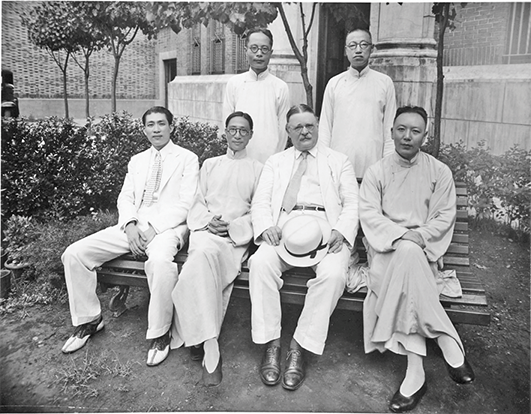
One of the scholars interested in blending Western and Chinese approaches to law was John C. H. Wu (Wu Jingxiong). Born in 1899, Wu began his law studies at Peiyang University, but after only one semester, he moved to the Comparative Law School to complete his law degree. There, influenced by the Bible and the fundamentalist views of the school’s first dean, Charles Rankin, he converted to Christianity, becoming a Methodist and, later, a Catholic. After graduating in 1920, Wu pursued post-graduate studies, first at Michigan Law School, then at the Universities of Paris and Berlin, and finally at Harvard Law School. During his time abroad, he established academic contacts with some of the leading legal thinkers of the period, including Oliver Wendell Holmes, Benjamin Cardozo, Roscoe Pound, and John Wigmore in the United States, François Gény in France, and Rudolf Stammler in Germany. In 1924, Wu returned to China to a position at the Comparative Law School, where he taught several subjects, including jurisprudence, continuing and deepening his engagement with Western legal theory, and with Western legal scholars (see Figure 7.2). Later, he also taught in the United States – first, in 1930, at Northwestern and Harvard, then, after the Communist takeover of China in 1949 and until his retirement in 1967, at the University of Hawaii and Seton Hall Law School in New Jersey. In addition to his academic career, Wu served as a judge, lawyer, Member of the Chinese Parliament, constitutional drafter, and diplomat.Footnote 59
Wu’s legal training and scholarly interests were as cosmopolitan as those of the Indian and Jewish scholars I discussed in the previous chapters. However, unlike most of the Indian and Jewish scholars I have analyzed (with the possible exception of Pal and Sanhuri), Wu was a well-known and internationally recognized legal theorist. One remarkable indication of his international visibility is found in an English translation of a book by the leading German legal theorist Rudolf Stammler (published by the American Modern Legal Philosophy Series in 1925). This book included two appendices discussing and critiquing Stammler’s thought, one of which was written by François Gény – the leading French legal philosopher of the period, and the other by Wu. That Wu would be asked to write the other appendix is extraordinary, considering that, at twenty-six years old, he was only beginning his teaching career at Soochow.Footnote 60
Wu was a prolific author who wrote about Catholicism, Confucianism, Daoism, Zen Buddhism, poetry, and law. His legal works included summaries and discussions of the ideas of Western scholars, which he published both in China and in the United States.Footnote 61 However, he also wrote original works on comparative law and jurisprudence, including a book on the Law of Nature and a jurisprudence textbook, which he published after moving to the United States.Footnote 62
Many of Wu’s works did not refer specifically to Chinese law.Footnote 63 However, as a young law graduate, he was interested in comparing Western and Chinese jurisprudential theories. Thus, in a 1921 article he published while still a student at Michigan Law School, he proudly noted that “China is the oldest nation that flourishes on the globe today. Her civilization had already attained a high stage of development when that of Rome was still in its cradle.” Wu then argued that the jurisprudential ideas of the major Western schools – Natural Law, Positivism, and the Historical School – were all present in ancient Chinese legal thought; that Chinese legal history could provide materials for the study of the evolution of law; and that the “Chinese legal mind” was perfectly receptive to the ideas of modern sociological jurisprudence.Footnote 64
Other works by Wu mentioned Confucianism, employed examples from Chinese legal history to prove general points about the nature of law or its history, criticized inadequate Western surveys of ancient Chinese political philosophy, and discussed Chinese legal and political thought.Footnote 65 It seems that a major driver of Wu’s interest in Chinese law was his acceptance of the cultural nationalist and historicist assumptions of the German Historical School about the unique nature of the law of every nation. Wu observed:
I do not believe, with the German jurists of the historical school, that each nation has a soul of its own called the “Volksseele.” But I do believe that every nation has a way of living and thinking which is more or less peculiar to it, constituting, as it were, its distinctive spirit. This spirit permeates all the main channels of its activities … [including] law …Footnote 66
Discussions of constitutional law in interwar China were often also informed by historicist tendencies and references to the country’s unique constitutional traditions (even when these were combined with calls to Westernize Chinese governmental institutions and Chinese law). One could find them in the work of Western experts sent to China to advise on constitution-making during the Republican period – for example, in the writings of the American scholar Frank Goodnow, who taught constitutional law at Peking University and served between 1913 and 1914 as an advisor to Yuan Shikai, the second provisional President of the Republic of China. Such discussions were also evident in Roscoe Pound’s 1940s works on the constitutional history of China.Footnote 67
Chinese politicians, too, were influenced by the belief that ancient Chinese political philosophy and constitutional traditions were relevant to modern Chinese constitutional reform. A notable example of such an influence can be found in the constitutional thinking of Sun Yat-sen, who led the revolution that ended the rule of the Qing dynasty and established the Republic of China. Sun’s constitutional ideas fused Western and Confucian political thought. One aspect of the mixed nature of Sun’s approach was his rejection of Western liberal individualism in favor of a commitment to collectivism. Another manifestation of the influence of traditional Chinese political theory on his viewpoint was his suggestion that China should create a Five Powers Constitutional Government – that is, a governmental structure based on five, not three, branches of government. This approach followed the traditional Chinese structure of government, which, in addition to the legislative, executive, and judicial branches, also included “control” and “examination” branches.Footnote 68 An article published in 1924 in the China Law Review discussing this idea declared that “law, in order to be effective, must be able to accommodate itself to the traditional mode of life of the country in which it operates” and that, therefore, China, with its “five thousand years of civilization,” should not be expected to simply adopt “a new constitution and new codes without having regard to the customary rules and mode of life of the people.”Footnote 69 Further, in a way reminiscent of the scholars of India, Mandatory Palestine, and also of Egypt, Sun claimed that Western concepts such as democracy were already present in ancient Chinese political theory.Footnote 70
The practical melding of Western and Chinese norms and political traditions was also expressed in the draft constitution produced by Wu in 1933 and in the final version of this text, the 1946 Constitution of the Republic of China (which is the basis of the current Constitution of Taiwan).Footnote 71 The 1946 Constitution adopted the very five-powers structure of government that Sun had suggested at the beginning of the twentieth century. In addition, the fusion between Western and Chinese traditions could be seen in the sections dealing with civil rights. The Constitution did contain a list of individual rights, but these could be easily infringed by the government, thus reflecting a collectivist understanding of the relationship between individuals and the state. This understanding was influenced by Chinese political traditions, which contained both proto-liberal individualist strains and also collectivist ones.Footnote 72
The interest in ancient Chinese political and legal thought was also evident in the academic works of Chinese interwar scholars. These scholars analyzed ancient Chinese political theories.Footnote 73 They argued that liberal notions such as human rights were compatible with classical Chinese philosophy, traditions, and values.Footnote 74 They also claimed that some ancient Chinese philosophers, such as Confucius and Lao Tzu, rejected the notion of absolutism, instead viewing rulers as trustees working on behalf of the people, and subject to the Higher Law of Heaven.Footnote 75
Finally, just as interwar Indian and Jewish scholars claimed that international law was not invented in Europe in the early modern era and sought to prove the ancient pedigree of this field of law, so, too, did Chinese scholars. Following arguments made by the nineteenth-century American missionary W. A. P. Martin, early twentieth-century Chinese scholars wrote works on ancient Chinese international law, claiming that international law already appeared in China during the Spring and Autumn period, or, more generally, that international law originated “in the East” rather than in the West.Footnote 76
Conclusion
The institutional history of legal education in Egypt and China and the history of the texts produced by legal scholars in Egyptian and Chinese law schools shared many common features with the history of institutions and the texts produced in India and Palestine. Egyptian and Chinese institutions and works were cosmopolitan: they were influenced by Western theories, both Anglo-American and Continental, including anti-formalist sociological theories fashionable during the interwar period in the West. Egyptian and Chinese authors depicted their traditional legal and political systems as superior to Western law, and they referred to these traditional systems when discussing public law, specifically constitutional and international law.
There were also some differences. In colonial India, the influence of English jurisprudence was stronger than in Mandatory Palestine, Egypt, or China. The strength of this influence was due to the fact that Britain’s interaction with India was longer and made a deeper impact on local legal culture. The relatively strong French influence on works produced in Egypt was due to the fact that the modern Egyptian legal system had been heavily shaped by French law since the nineteenth century. In the Chinese case, the British influence on Hong Kong was similar in scale to that found in India. There were British law professors in mainland China too, such as James Bromley Eames of Peiyang University, but the British academic influence was weaker than that of American professors. Another distinguishing characteristic of the Chinese case was the involvement of American missionary law professors, such as Charles Rankin, the first dean of the Comparative Law School.
The differences between India, Palestine, Egypt, and China were not limited to the impact of different Western jurisprudential traditions. There were also distinctions in how local legal traditions were imagined and used. I already noted in Interlude 1 that there were almost no calls to replace British colonial laws with Hindu law in colonial India. In China, too, legal reform during the Republican era was based on a desire to Westernize Chinese law. In contrast, in Egypt, just as in Palestine, the legal revival of non-Western law was an ideal espoused by many scholars. While in Palestine, the actual impact of this ideal was ultimately negligible, in Egypt, the calls for the revival of Islamic law were implemented. Here, the study of Islamic law using Western jurisprudential tools ultimately led to the enactment of the 1949 Egyptian Civil Code, which was influenced by Islamic law. This code later served as a model for civil law codification in many other Arab countries.
To what extent can we attribute the similarities in all the places discussed in this book to mutual influence? Anti-colonial nationalist activists often interacted with one another, and anti-colonial ideas were spread through academic and ideological networks in Europe and the colonies.Footnote 77 However, it seems that the anti-colonial interaction did not expand to the realm of legal theory. One possible avenue of interaction would have been law studies in the metropole, but while many Indian law students studied in Britain, there were far fewer Chinese, Egyptian, or Palestinian law students (either Jewish or Arab) studying there.Footnote 78
Another possible avenue of influence was through books. Were Egyptian scholars aware of the books written by Indian and Jewish scholars, and vice versa? The theoretical Indian works I analyzed in previous chapters do not appear to have been available in Egypt. The Egyptian textbooks analyzed here cited many Western works in their footnotes and bibliographies but not Indian works on either Hindu or Islamic law.Footnote 79 As for the influence of Egyptian works on Indian scholars, given that the Egyptian books I discuss were written in Arabic, scholars such as Pal, who did not read Arabic, would have found them inaccessible. Indian scholars of Islamic law were more aware of developments in the Middle East, and many of them could also read Arabic.Footnote 80 However, the early twentieth-century Islamic-Indian works on jurisprudence that I discussed in Chapter 1 – for example, Abdur Rahim’s book – while making use of Egyptian editions of classical Islamic texts, did not cite modern Egyptian works. As I showed in Chapter 2, Palestinian-Arab lawyers were aware of developments in Egypt. However, it does not seem that Egyptian legal scholars were aware of (or interested in) the works of Palestinian-Arab lawyers. As for the relationship between Egyptian and Jewish scholars, the language barrier would have prevented Egyptian legal scholars from reading publications in Hebrew written by the Jewish scholars of Palestine. Some Jewish scholars (Bentwich, who taught at the Cairo Law School, or Grajewsky, who studied there) might have been aware of developments in Egypt, but there is no indication in their works of Egyptian influence.
What about China? China and India have a long history of entanglement. During the first decades of the twentieth century, pan-Asian ideas reinforced the keenness among intellectuals in both countries to interact with one another.Footnote 81 Comparative law works written by Chinese scholars sometimes mentioned Hindu law.Footnote 82 However, there does not seem to have been any mutual interaction between legal scholars in places such as Soochow or Calcutta. As for the Middle East, the founder of the Comparative Law School, Charles Rankin, was a deeply religious man keen to have his students read the Old Testament.Footnote 83 As a result, some Chinese scholars teaching at Soochow became interested in Jewish law.Footnote 84 There were also scholars in interwar China who were interested in Islamic legal traditions, such as Peng Chun Chang (Zhāng Péngchūn), a philosopher, writer, and diplomat who became involved in drafting the Universal Declaration of Human Rights. Chang spent two years in Turkey in the early 1940s and wrote about the similarities and mutual influences between China and the Islamic world.Footnote 85 However, I did not encounter any indications of awareness among Chinese legal scholars of the works of Egyptian scholars such as Sanhuri (and vice versa), and certainly no awareness among Chinese writers of interwar Zionist legal thought.
Given the lack of mutual influence between the four places I have examined, one is left to conclude that the similarities between them were the result not of influence but of similar institutional and intellectual environments. The appearance of Western-style law schools in the late nineteenth and early twentieth centuries as a direct or indirect result of European colonialism exposed local legal scholars to Western jurisprudential theories. The legal reality in European colonies and non-Western states, and also the emergence of anti-European cultural nationalism among Indians, Jews, Egyptians, and Chinese (as well as many other non-Western societies), led local legal scholars to study local ancient legal traditions, producing works that married state-of-the-art Western jurisprudential ideas with local traditions, often in ways that were critical of Western legal theories. Together, the works that I have analyzed in this book were all part of a single interwar non-Western jurisprudential wave that appeared simultaneously in many places across the globe in the first decades of the twentieth century.

 Open access