



It helps from time to time for us to go back to the beginning and to formulate just what we are trying to do.
Paul E. Meehl (Reference Meehl1959)
Ruminations on the validation of clinical procedures.
Introduction
Founded in 1925, the University of Minnesota’s Institute of Child Development has served children for nearly 100 years by training developmental scientists, childhood educators, and clinicians. Although its origins were in child welfare, since the 1970’s a cornerstone of the Institute’s mission has been to better understand the developmental process itself. What is this thing called development? What does it mean for how we proceed as scientists and clinicians, and why does a developmental perspective matter? First published in 1989, Development & Psychopathology reflects its founding editor Dante Cicchetti’s training, collaboration, and friendships with Norman Garmezy and the incomparable Paul Meehl in the University of Minnesota’s Department of Psychology, as well as with Alan Sroufe at the Institute of Child Development.
Today, Development & Psychopathology is the foremost journal integrating developmental theory and clinical research programs. A search of the Journal web site yields nearly 300 articles in which contributors have highlighted the implications of attachment theory and research for understanding developmental processes and pathways, and as a testing ground for intervention strategies. It is unlikely that any other founding editor would have so clearly seen the relevance of attachment for what became, in these pages, the field of developmental psychopathology. Reflecting his Minnesota roots, Development and Psychopathology has always prioritized developmental issues in the study of clinical phenomena. This has enriched every reader’s view of the developmental perspective and how it informs theory, observation, and clinical practice.
Development and developmental change
For as long as humans have observed nature, raised children, cultivated crops and livestock, and shared stories of personal and cultural origins, they have been aware of the concept of development and reflected on how it unfolds. In this paper we will use the term development (more often the descriptor developmental) to describe organic systems becoming increasingly differentiated and organized over time. The idea that development involves more than just increasing what already exists, has a long history in Western thought. As early as the mid-6th century BCE, the earliest Greek philosophers pondered the origins of the material world and the processes of change, suggesting that all things arise from that which potentially is, but is not yet realized (Classen, Reference Classen1977). Aristotle’s 4th century BCE concept of origins or first principles (archê, ἀρχή; see Irwin, Reference Irwin1988) is a further step toward a recognizably developmental perspective. Aristotle argues that any matter is best understood when we have its origins and development clearly in view.Footnote 1 However, his view focused more on the process of instantiation and becoming than on interaction and development. Development, as we conceive it today, is a modern construct (Reeve, Reference Reeve2017, p. 269; Love, Reference Love and Zalta2022), one that extends beyond these processes to consider organizational and transactional processes as well.
Modern developmental perspectives
The view that biology defines a set of potential developmental pathways, and that the course of development is continuously influenced by a wide range of environmental and contextual cues only took shape with the emergence of Darwin’s evolutionary theory, the transition from embryology to developmental biology (Gilbert, Reference Gilbert1991), and the gradual assimilation of the general system’s perspective advanced by Bertalanffy’s (Reference Bertalanffy and Woodger1933, Reference Bertalanffy1968) and embryologist Weiss’s (Reference Weiss1939; Reference Weiss, Koestler and Smythes1969) systems perspective (Drack et al., Reference Drack, Apfalter and Pouvreau2007). As reflected in the pages of Development and Psychopathology, current developmental theorists, researchers, and clinicians favor a multilevel dynamical systems perspective in which developmental history, multiple levels of context, regulatory processes, and even mental representations are interdependent and interact over time (e.g., Sameroff, Reference Sameroff2010).
Developmental change
Developmental change possesses distinct characteristics that distinguish it from historical, cultural, and biographical changes (Baltes, Reference Baltes and Lerner1983/2020, p. 91). Unlike historical and other non-developmental changes, developmental change occurs in organisms, not systems generally.Footnote 2 In addition, developmental pathways can be viewed as a species’ solution to the problem of balancing short-term and long-term adaptation in a manner likely to be favored by natural selection. Thus, development unfolds within a framework of biases and constraints defined by a species evolutionary history, its developmental state, and a wide range of environmental influences. The characteristics that distinguish developmental from non-developmental change are inter-related, inductive generalizations, more qualitative than quantitative. Yet, as summarized in Table 1, they are valuable guides to observing and describing development. They have also provide a useful framework within which to understand atypical development and plan strategies for prevention and intervention.
Characteristics of developmental change

Obtaining developmental data allows you to see components of a skill or behavior pattern before they are interwoven. To best describe them, it is often useful to observe them in this state, as Plato (and Paul Meehl) might have said, in order to carve nature at its joints. Seeing components in isolation can also help evaluate dependence of one skill on other correlated skills. Understanding components prior to integration can also help evaluate the significance and validity of components seen in isolation as a result of a research procedure.
Of course, developmental change is only a subset of the of the changes an individual experiences in a lifetime. Non-developmental changes include most of what you learn, the skills you acquire, the relationships you establish, and changes determined by unique or accidental events. Yet, the subset of changes you experience that fit the developmental mold are interesting and important. Interesting, in part, because they reflect common phylogenetic solutions to the problems of adaptation and reproduction in many different and changing environments. Important because we do not fully understand a behavior simply by measuring it. Behaviors are also defined by how they arose and the possibilities for further development and integration with other behaviors. Understanding developmental change is also important for the information it provides about the possibility and significance of emerging difficulties in early development and about strategies for prevention, intervention, and enrichment.
Some limitations of the traditional developmental perspective
Despite the advantages and historical significance of the traditional developmental perspective, it is valuable to recognize its limitations. Indeed, recognizing its limitations is important for maintaining the developmental perspective in current thinking. Even when not overtly teleological, the traditional perspective tends toward essentialism, the view that developmental phenomena possess an intrinsic “developmental-ness” that drives them forward and explains shared characteristics like orderliness, accumulation, and directionality. It also brings with it a strongly normative orientation, implying that developmental pathways are predetermined, that there is an optimal, and thus preferred, course of development. This assumption neglects the open-ended advantage inherent to human psychological development such that development proceeds irrespective of variation in environments (either historically or withing a single lifespan) and is marked by it such that it produces tremendous variation in outcomes all built from the same underlying systems.
Moreover, the traditional conceptualization of developmental change is very abstract. On one hand, it encourages attention to complexity and detailed observation. This was a useful antidote to the approach of stimulus response psychology and its emphasis on counting discrete acts within constrained options and limited attention to context. On the other hand, this perspective directs attention to aspects that are difficult to measure. Focusing on the distinctive features of developmental change has played an important role in the fields of cognitive, social, and emotional development and on the emergence of developmental psychopathology. Going forward, its influence depends on evidence that focusing on the temporal organization of change continues to provide new insights and more effective therapies.
The organization of developmental change: stages and tasks
Developmental stages
For much of the 20th century, the developmental perspective in psychology was dominated by stage theories which identified (or imposed) themes, goals, and stable sequential organizations and reorganizations on what descriptively seemed to involve overwhelming complexity (e.g., Harris,Reference Harris and Harris1957; Kessen, Reference Kessen1962; Lipsitt, Reference Lipsitt1978; Flavell, Reference Flavell1971a; Kaplan, Reference Kaplan and Arieti1966; Kohlberg, Reference Kohlberg and Goslin1969; Flavell, Reference Flavell1978, Reference Flavell1982, Reference Flavell1992; Brainerd, Reference Brainerd1978; Fischer, Reference Fischer1980; Siegler & Alibali, Reference Siegler and Alibali2005; van Geert, Reference Van Geert1986; and Lourenço, Reference Lourenço2016).Footnote 3 Stage theories made a significant contribution by drawing careful attention to the content and organization of behavior over time and highlighting that developmental change can be qualitative as well quantitative.
Formally, stage theories suggest that developmental change differ from mere temporal sequences or narratives in the following respects:
-
1. Stages. Development is characterized by a progression through a series of “stages.” That is, rather than advancing continuously, it moves through a series of relatively stable configurations.
-
2. Qualitative difference. Each stage represents a distinct mode of organization and inter-relations among components and operations. At a given stage, an individual performs in a stage-appropriate manner across the full range of tasks and skills. According to Piaget & Inhelder (Reference Piaget and Inhelder1969), “Each stage is characterized by an overall structure in terms of which the main behavior patterns can be explained” (p. 153).
-
3. All-at-once transitions. Transitions from one stage to the next are abrupt (saltatory). That is, stage transitions (new modes of operating) are said to occur (relatively) all-at-once rather than piecemeal. Flavell (Reference Flavell1971a) refers to stage changes as “ an abrupt and synchronized metamorphosis” (p. 423).Footnote 4
-
4. Inter-dependence and invariance. Each stage builds (is conditioned) upon the preceding one and serves as the necessary foundations for the next. Consequently, the order of stages is invariant.
-
5. Irreversible. Change from one stage to the next can be accelerated, delayed, or even prevented, but there is no mechanism that allows for retracing paths taken. Previous stages are inaccessible from subsequent ones.Footnote 5
-
6. Universality. The order of stages reflects inherent characteristics of each stage-like configuration. The order of stages is necessary, not a cultural innovation.
Piaget Reference Piaget(1936/1963) is renowned for formalizing the stage concept and integrating each of these characteristics into his theory of cognitive development. The stage concept has also been incorporated into developmental theories across domains as diverse as psychosexual (Freud, Reference Freud1905), psychosocial (e.g., Baldwin, Reference Baldwin1894/1906; Erikson, Reference Erikson1950), ego (e.g., Loevinger, Reference Loevinger1966), language (e.g., Brown, Reference Brown1973), moral (e.g., Kohlberg, Reference Kohlberg and Goslin1969), adulthood (e.g., Baltes et al., Reference Baltes, Lindenberger, Staudinger, Damon and Lerner2007), and faith (e.g., Fowler, Reference Fowler2006) development. Although stage structure has proved its value as a heuristic for describing change across a wide range of ages, critics have questioned the empirical and psychological reality of stages. Indeed, rigorous investigations typically reveal a more complex picture than formal stage theory suggests (e.g., Brainerd, Reference Brainerd1978; Flavell, Reference Flavell1971a; Dawson-Tunik et al., Reference Dawson-Tunik, Fischer and Stein2004; Fischer & Granott, Reference Fischer and Granott1995; Flavell et al., Reference Flavell, Miller and Miller2002; Siegler & Alibali, Reference Siegler and Alibali2005; Smith & Thelen, Reference Smith and Thelen1994).
Some limitations of the stage concept
Developmental stages are highly abstract and often difficult to define. While serving as useful tools for summarizing developmental trends in behavior, cognition, and emotions, stages rarely exhibit the distinct morphology and function that distinguish stages in developmental biology. Furthermore, stage theories tend to over-simplify phenomena, sweeping a great deal of complexity under broad stage labels. By focusing attention on labels rather than behavior and mechanisms, stage theories often emphasize conceptual analysis over observation and description. They also tend to gloss over the complexity of individual developmental trajectories and diversity of developmental trajectories. This approach overlooks the fact that developmental paths are influenced by multifaceted interactions among biological, social, and environmental factors, leading to variability and irregularity that stage theories struggle to accommodate. (Fischer & Granott, Reference Fischer and Granott1995). Yet, such complexity is easily overlooked when we view behavior through the lens of the stage labels (e.g., Lipsitt, Reference Lipsitt1978, p. 194).
Most importantly, detailed observations have repeatedly found behavior to be much more variable across individuals, contexts and problem areas than stage models suggest (e.g., Brainerd, Reference Brainerd1978; Fischer, Reference Fischer1980; Flavell, Reference Flavell1978, Reference Flavell1982).Footnote 6 That is, the uniformity implied by stage theories does not align with the diverse paths individuals actually traverse (Cicchetti & Rogosh, Reference Cicchetti and Rogosh1996). Moreover, stage theories’ focus on normative patterns of development risks pathologizing deviations from expected developmental trajectories.
Development as a series of tasks
Decades before Piaget’s stage concept dominated American developmental psychology, applied psychologist and educator Robert Havighurst (Reference Havighurst1953, Reference Havighurst1956) proposed a lifespan perspective in which development was viewed as a chronological series of “tasks” that arise from (1) physical maturation, (2) personal values and aspirations, and (3) social expectations.Footnote 7 A developmental task is a specific skill or undertaking whose mastery enhances personal satisfaction and comfort in society, and facilitates mastering succeeding tasks, while difficulty with particular tasks slows progress toward future goals and can engender social disapproval (Havighurst, Reference Havighurst1948/1972, Ch. 4; 1953, p. 17). Thus, task structure informs and motivates efforts at mastery and helps consolidate developmental progress.
Importantly, tasks are not predetermined stages of an idealized development program. Rather they are practical challenges essential for effective adaptation and advancement in whatever society or context development is unfolding (Havighurst, Reference Havighurst1948/1972). As indicated in Table 2, many (though not all) developmental tasks find their definition in a specific social class or culture. Although Havighurst’s use of the “developmental task” concept echo’s Erikson’s, Havighurst did not propose a set of canonical tasks for each age. Instead, he suggested sets of 6–10 tasks crafted for the particular educational context and goal.
Representative developmental tasks (Compiled from Havighurst, Reference Havighurst1948/1972; Reference Havighurst1953)

Any of these can be broken down into sub-tasks. In defining each task, he inquired into its biological, psychological, and cultural bases, and in many cases its specific relevance to males or females and its practical educational and curriculum implications. Although Havighurst emphasized a broad range of “tasks” for social and educational development, the task concept can be applied as well in specific domains. For example Goetting (Reference Goetting1986) defines a life spanning sequence of tasks for successful sibling relationships (within Western industrialized cultures).
Havighurst was keenly aware of the constraints developmental level (readiness) place on mastering some tasks. “When the timing is right, the ability to learn a particular task will be possible. This is referred to as a ‘teachable moment’. “It is important to keep in mind that unless the time is right, learning will not occur. Hence, it is important to repeat important points whenever possible so that when a student’s teachable moment occurs, s/he can benefit from the knowledge.” (Havighurst, Reference Havighurst1953, p. 5).
Developmental tasks and developmental change
Havighurst’s theory presents a structured progression that mirrors many of the characteristics of developmental change discussed above. There is a chronological order, aligned with an individual’s age and developmental level. In addition, although contiguous tasks often span different domains and therefore are not necessarily dependent on one another, mastering earlier tasks lays the groundwork for mastering later ones. In addition, mastering a series of tasks fosters greater behavioral organization and social acceptance. In addition, Havighurst emphasized that maturation, continuing socialization pressures, and the motivation and enjoyment associated with task mastery stabilize success with previous tasks and directs efforts toward subsequent ones. Interestingly, Havighurst’s insights into how biological factors and context/socialization shape development are echoed, albeit unacknowledged, in Bronfenbrenner’s major statements on his bioecological theory (Bronfenbrenner, Reference Bronfenbrenner1977, Reference Bronfenbrenner1979; Bronfenbrenner & Morris, Reference Bronfenbrenner, Morris, Damon and Lerner2007).
Unlike stages, Havighurst’s tasks are not seen as reflecting the essence of an abstract developmental process. Rather than expressing some inherent developmental plan, tasks and their sequencing arise from the way the world works. Development is less a process of unfolding than of scheduling and building. Accordingly, the age ranges associated with specific tasks are loosely descriptive rather than defining features.
Havighurst’s tasks are rooted in naturalistic observation and are pragmatic. In addition, they exist (implicitly or explicitly) as goals in the minds of developing individuals, socialization agents, social norms, and ideas about child rearing practices. Although seemingly mundane compared to Piagetian stages of sensori-motor and operational thought, Havighurst’s task concept helps discover and state educational goals that have the greatest advantage for adaptation and further development at particular ages in particular contexts. Havighurst’s developmental tasks can be likened to a core curriculum or an educational/developmental Activities of Daily Living schedule.
Unlike traditional developmental stages, Havighurst’s tasks are mastered over time, not abruptly. Mastery of successively more tasks is conceptualized as increasing competence and potential for further development, not in terms of qualitative change. In addition, tasks are widely shared within a particular culture, but they are not conceptualized as universals.
Havighurst’s work illustrates that one can adopt a detailed developmental perspective without embracing the assumptions of formal stage theories. His emphasis on the role of learning, problem-solving, and socialization practices directs the search for mechanisms of developmental change from inherent characteristics of development outward, toward ordinary mechanisms of learning, problem-solving, socialization, and mentoring working within developmental constraints.
In the following sections, we carry this perspective over into an expanded analysis of attachment development and suggest this as a useful framework for developmental analysis generally. We outline a detailed lifespan chronology of attachment development to illustrate the value of (1) focus on developmental change, (2) more flexible use of stage concepts as seen in Havighurst’s approach, (3) understanding how developmental analysis can focus more on mechanisms, and (4) focus on socialization within constraints as a perspective that can account for some of the temporal organization of attachment development over the lifespan.
Attachment as a framework for studying development
In a major departure from psychoanalytic and learning theories of close relationships, Bowlby (Reference Bowlby1957, Reference Bowlby1958) proposed an alternative rooted in ethology and evolutionary theory. He proposed the term attachment to distinguish this new paradigm from prevailing object-relations and dependency theories, defining attachment relationships as enduring emotional bonds that tie an individual to one or a few primary figures. Attachment relationships are characterized by (a) expectations of attachment figures’ availability and responsiveness, (b) their use as a secure base from which to explore and as a haven of safety and comfort, and (c) grief and mourning in response to loss. In combination, these criteria, and Bowlby’s analysis of the evolutionary function of attachment, distinguish attachment relationships from social relationships in general (Ainsworth, Reference Ainsworth1989, Bowlby, Reference Bowlby1969).
John Bowlby’s Attachment trilogy (Bowlby, Reference Bowlby1969, Reference Bowlby1973, Reference Bowlby1980) has inspired generations of research on attachment behavior and infant-caregiver interactions. Although much of this has been basic research, translational studies have yielded effective strategies for intervention and prevention (Steele & Steele, Reference Steele and Steele2017). Despite the success of this ongoing research, anthropologists and cross-cultural psychologists have questioned the singular emphasis on attachment (Waters & Eagle, Reference Waters and Eagle2024). Committed as these critics are to the methodological principle of holism, they assume that behavior can only be understood in the broadest possible context. Why, they ask, do developmentalists focus on attachment per se, seemingly to the exclusion of other influences such as beliefs, goals, roles, kinship, parenting – broadly construed, ecology, economics, division of labor, power relationships, structure an flow of knowledge, which are cultural anthropologists’ and cross-cultural psychologists’ bread and butter (e.g., Gaskins et al., Reference Gaskins, Beeghly, Bard, Gernhardt, Liu, Teti, Thompson, Weisner, Yovsi, Keller and Bard2017 p. 205–207; Harkness, Reference Harkness2015, p. 192)?
The answer, of course, is that attachment has proven to be an exceptional framework for studying how a lot of things develop. Very often we are not so much studying attachment per se as we are development generally (Waters & Eagle, Reference Waters and Eagle2024). The behavior is accessible, it comes along at a good pace, and by now it is very well described. It is also an excellent example of affect, cognition, and behavior working together across diverse contexts. In addition, the progress of attachment behavior illustrates many of the characteristics of developmental change. Studying it affords an opportunity to observe biases in learning abilities, dependence on affordances in the environment, and many forms of learning, including the co-construction of mental representations, the elaboration of personal narratives, and functional similarities across the lifespan. These are a developmentalists’ bread and butter.
This focus on the developmental process is well illustrated in the work of psychologists such as Alan Sroufe (e.g., Sroufe, Reference Sroufe and Masten2007, Reference Sroufe, Cassidy and Shaver2016). Throughout his career at Minnesota’s Institute of Child Development, he has explicitly asked, and taught students to ask, “Where does the structure in development come from?”, “How do cognition, behavior, and emotion become integrated?”, “How do we recognize the precursors of later developmental outcomes in their early stages?” (e.g., Sroufe & Waters, Reference Sroufe and Waters1976, Reference Sroufe and Waters1977; Cicchetti & Sroufe, Reference Cicchetti, Sroufe, Lewis and Rosenblum1978; Sroufe et al., Reference Sroufe, Egeland and Kreutzer1990; Sroufe, Reference Sroufe1979a, Reference Sroufe and Osofsky1979b; Sroufe, Reference Sroufe1996; Sroufe et al., Reference Sroufe, Carlson, Levy and Egeland1999). As illustrated in the multi-generational Minnesota Longitudinal Study of Risk and Adaptation (Sroufe et al., Reference Sroufe, Egeland, Carlson and Collins2005) and other major developmental studies (e.g., Grossmann et al., Reference Grossmann, Grossmann and Waters2005) this perspective assumes, rather than precludes, that development takes place in an ecological and cultural context.
Attachment as an organizational construct
Sroufe & Waters (Reference Sroufe and Waters1977) concept of attachment as an organizational construct marked a significant departure from methodologies that focused solely on the frequency and quantity of behavior, neglecting its contextual and organizational aspects. This perspective was primarily influenced by Mary Ainsworth’s sensitivity to the dynamics of behavior in both naturalistic and laboratory settings (Waters et al., Reference Waters, Vaughn and Waters2021, pp. 89–96).Footnote 8 Over time, this perspective has expanded beyond behavioral organization to encompass the organization of behavior in time. In the present paper, we extend it further to include the organization of socialization strategies and practices. Where traditional developmental theories often leaned toward abstraction, essentialism, and teleology, contemporary developmental/organizational perspectives emphasize familiarity with behavior in naturalistic contexts, descriptive richness, clarity regarding mechanisms of change, and practical utility as guides for observation, research, and applications.
An expanded view of attachment development
In a special 1971 issue of Human Development, Flavell (Reference Flavell1971b) famously raised the question, What is memory development the development of? This was immediately recognized as the core question for any developmental analysis. Memory development, it turned out, has less to do with increasing memory span than with the development of strategies for efficiently using a very limited memory span. And so it is in every domain of development. Developmental analysis ultimately depends on insights into what the development of X is the development of. Surprisingly, the answer is often not obvious.
What is attachment development the development of?
Bonds vs transactions
Social bonding is a type of learning recognized primarily by proximity seeking, resistance to separation, and strong emotional responses to loss. It is made tangible by the fact that there are marked species differences in the ability to form persistent social bonds and extended parental investment and by research associating neuropeptides such as oxytocin and vasopressin and hormones such as dopamine with mating, monogamy, and parental behavior (e.g., Insel & Young, Reference Insel and Young2001; Young et al., Reference Young, Gobrogge, Liu and Wang2011).
Psychoanalysts and early attachment theorists (including Bowlby) conceptualized attachment in terms of the strength of emotional bonds. However, the concept fell into disuse because it proved difficult to measure the strength of social bonds in humans, and because the complexities, developmental course, and pathologies of attachment behavior (secure base use and support) proved too complex to explain in terms of bond strength. Thus, in current psychological theory and research individuals are presumed socially bonded or not. There are no validated measures of the strength of parent infant or adult-adult bonds. Under ordinary circumstances, parents are assumed to be bonded with their offspring, and infants to their parents. Within the context of bonded relationships, individual differences are usually conceptualized and measured in terms of the organization of secure base use and support, expectations of availability and responsiveness, and mental representations of the relationship (Waters et al., Reference Waters, Vaughn and Waters2021).
In the first decades of modern developmental psychology (1950–1970), learning theorists viewed the infant-mother relationship as one of clingy dependency, which they operationalized in terms of the frequency of discrete behaviors such as crying upon separation, looking at the mother, approaching, clambering, and clinging (e.g., Maccoby & Masters, Reference Maccoby, Masters and Mussen1970). John Bowlby’s ethological attachment theory provided a key descriptive insight, mainly that infants are not at all the clingy, dependent creatures imagined in psychoanalysis and learning theories. Rather than invoking drives or reinforcements, Bowlby proposed that the attachment-exploration balance is organized by a behavioral control system, and eventually informed by internal working models of specific relationships (Bowlby, Reference Bowlby1969, Reference Bowlby1973, Reference Bowlby1980; Ainsworth & Bowlby, Reference Ainsworth and Bowlby1991; Ainsworth, Reference Ainsworth and Gewirtz1972; Sroufe & Waters, Reference Sroufe and Waters1977). Thus, for Bowlby and Ainsworth, attachment development was the development of what they termed secure base relationships (e.g., Ainsworth et al., Reference Ainsworth, Blehar, Waters and Wall1978/2015; Bowlby, Reference Bowlby1988).
Bowlby’s four-phase “sketch” of attachment development: from bonding to a secure base control system
In the first volume of Bowlby’s Attachment trilogy, he introduced what is famously known as his Four-stage Model of attachment development (Bowlby, Reference Bowlby1969, Chapter 11, pp. 266–268). Acknowledging Mary Ainsworth’s recently published work in Infancy in Uganda (Ainsworth, Reference Ainsworth1967), Bowlby allowed that, although attachment behavior in the first year of life is “reasonably well chronicled, the course it takes in subsequent years is not” (Bowlby, Reference Bowlby1969, p. 204). Therefore, he provided a “rough sketch” (p. 266), a practical outline rather than a formal model, explaining, “For purposes of further analysis, it is convenient to divide (attachment) development into four phases, though it must be recognized that there are no sharp boundaries between them” (Bowlby, Reference Bowlby1969, p. 266). The following summarizes Bowlby’s four phases of attachment development (compiled from Ainsworth, Reference Ainsworth1969; Bowlby, Reference Bowlby1969; Marvin, Reference Marvin, Alloway, Pliner and Krames1977; and Marvin & Britner, Reference Marvin, Britner, Cassidy and Shaver2008).
-
Phase I (0–3 mos.): Orientation and Signals without Discrimination of Figure.
-
Phase II (3-∼6 mos.): Orientation and Signals Directed Toward One or More Discriminated Figures.
-
Phase III (6mos. 2–3 yrs.): Maintenance of Proximity to a Discriminated Figure by Locomotion and Signals. Internal image of a set goal.
-
Phase IV (2–3 yrs. +): Goal-corrected Partnership (beginning around third birthday).
Unfortunately, Bowlby never returned to this sketch in earnest. He would certainly have made clear that attachment development continues well beyond toddlerhood and that attachment as a secure base relationship continues to change and remains relevant across the lifespan (Ainsworth, Reference Ainsworth1989; Bowlby, Reference Bowlby1969). As he wrote in his 1978 lecture, Psychoanalysis as art and science, “All of us, from the cradle to the grave, are happiest when life is organized as a series of excursions, long or short, from the secure base provided by our attachment figure(s)” (Bowlby, Reference Bowlby1988, Lecture 3, p. 62). He could also have elaborated on his concept of a goal-corrected partnership. Initially, this concept served primarily as a marker for explanations he expected would arise with advances in cognitive psychology.Footnote 9 Finally, had Bowlby revisited his developmental sketch in the decades after he first proposed it, he could have elaborated on the mechanisms of change that come on (and go off ) line in the course of attachment development.
Attachment development across the lifespan: biases, constraints, and socialization
In the final sections of this paper, we propose a much more detailed sketch of attachment development, which, although not a full theory/model, is much more comprehensive than the four phases described by Bowlby. Readers will notice similarities to Havighurst’s approach, particularly in (a) our focus on description rather than abstract definitions, (b) emphasis on mechanisms of change, and (c) foregoing many of the restrictions that characterize traditional stage models.Footnote 10
A framework, not a calendar
Conventional age ranges imply a normative perspective on maturational benchmarks such as motor and cognitive development. In contrast, our analysis focuses on the order in which changes occur. This varies, sometimes markedly, across individuals, families, and cultures. Therefore, we use descriptive phrases rather than conventional labels and specific age ranges to locate our discussions in the life span.
Mechanisms of change
Unlike stage theorists, we are not attempting to identify qualitative changes in the essence of something called attachment. Instead, our goal is to summarize observable changes in the conduct of secure base behavior and point toward mechanisms – especially in the domains of representation, expectations, experience, and socialization – that move these changes along. As with Bowlby’s four-phase sketch, this is intended to serve as a convenient guide for teaching and for new theory and research.
Accordingly, we conceptualize mechanisms of change as comprising biological development (including neural, motor, and cognitive processes, some attachment-specific and others generic), shifts in personal goals (such as becoming a secure base for one’s children or caring for elderly parents), and changes in circumstances (such as evolving parental socialization goals and life circumstances, like living independently or gaining knowledge about relationships and the world). These factors collectively drive attachment forward. Therefore, we first present mechanisms of change and changing contexts before discussing the changes they engender.
Internal working models and representational processes
To a far greater extent than traditional learning theorists, Bowlby recognized the importance of mental representations in attachment relationships and development. Representational processes are critical to attachment development. They do essential work, allowing for the accumulation of experience, play roles in generating/maintaining expectations and goals, and accounting for continuity across age and diverse contexts. However, at the time he was writing, work on mental representations was in its infancy. Therefore, he proposed the internal working models (IWM) concept, again as a place-holder for anticipated insights from cognitive psychology. In addition, because Bowlby could not be specific about the operating characteristics of IWMs, they are often endowed with the powers needed to meet any requirement (Hinde,Reference Hinde and Rutter1991, p. 379). There are multiple modes of attachment representation (see Waters & Waters, Reference Waters and Waters2006; Waters et al., Reference Waters, Ruiz and Roisman2017), with more than one in play even in a given situation. In addition, representational capacity changes over time. Thus, we will generally avoid the IWM concept and speak of representations generically.
Culture
The extended sketch of changes in attachment behavior and relationships presented below uses Western, middle-class societies as a reference point, in part because our own experience and because most observational attachment research has been conducted in such settings. The tables below can be compared to scripts or grammars that provide a structured (in this case, ordinal) framework with “slots” that can be filled with different content – such as change mechanisms and behavioral/representational changes – to characterize specific phases of attachment development across different cultures or individuals. Social meanings and expectations, even time frames such as middle childhood, adolescence, or adulthood are defined differently, or not recognized at all, in different cultures. Moreover, the life circumstances and socialization practices we emphasize as driving forces behind attachment changes and development clearly differ within and across cultures, among individuals, and over time.
That such differences exist does not diminish the developmental perspective or our description of attachment development. Most of our key points about the nature of attachment relationships and development – such as our emphasis on building rather than unfolding, working within constraints and biases, etc. – can be formulated for a wide range of contexts. Lack of comparable and sufficiently detailed data has been a major obstacle to cross-cultural analysis of attachment (Waters & Eagle, Reference Waters and Eagle2024). Thus, the manner of the present analysis is as important as the particulars. The tables below, can serve as a template for the kinds of information and levels of detail needed to support rich discussions of attachment from cross-cultural perspectives.
In the following sections we present an expanded sketch of attachment development. For clarity, we use the term “secure base” when drawing attention to specific behaviors and behavior patterns, and “attachment” when the focus is on relationships or relationship representations. Note that mechanisms first mentioned in one phase of attachment development are often in play in subsequent phases as well. In addition, the layout is not intended to suggest one-to-one (or line-to-line) correspondence across columns. Mechanisms often act in concert on more than one behavior or representation.
Foundations of secure base behavior in pre-locomotor infancy
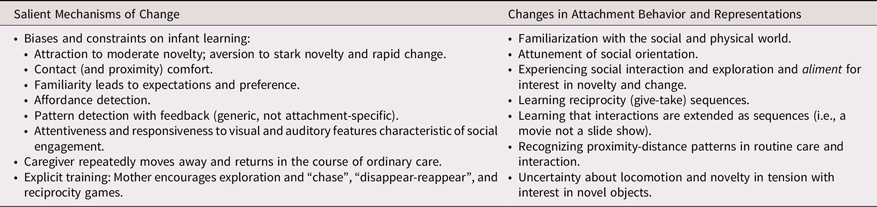
Attachment theory is often described as an instinct theory in which attachment is conceptualized in terms of fixed action patterns – genetically mapped plans that are activated by hormonal and environmental stimuli. There is certainly an element of this classical ethological perspective in Bowlby’s early writings and he is often understood to have viewed attachment development as a process of activation or the unfolding of a genetically programed wiring diagram. However, his increasing interest in control systems theory is evident in the first volume of his Attachment trilogy. This is reflected in the close attention he paid to the process of simple responses becoming integrated into an attachment behavior system (Bowlby, Reference Bowlby1969). This fits well with our own emphasis (beginning in Table 3) on attachment development as a process of construction within a framework provided by biases and constraints on human learning.
Foundations of secure base behavior in pre-locomotor infancy
Unfortunately, Bowlby’s references to attachment as part of our primate evolutionary heritage are often interpreted as supporting the idea that primate learning biases and constraints are sufficient to construct an attachment behavioral system. Concepts such as instinctual drives and preprogrammed behavioral systems tend to explain too much and play a much-diminished role in modern behavioral biology than they did in classical ethology (Hinde, Reference Hinde, Grossmann, Grossmann and Waters2005; Oyama, Reference Oyama, Bateson and Klopfer1982). In addition, as Waters & Eagle (Reference Waters and Eagle2024) illustrate, they are the source of much misunderstanding and unproductive criticism.
Salient mechanisms of change in pre-locomotor infancy
In this first phase of our developmental sketch, we emphasize the operating characteristics of human infants, especially biases in human learning, that make it possible for them to eventually begin using one or a few figures as a secure base from which to explore and as a haven of safety and comfort. Some of these responses, such as interest in moderate novelty and aversion to rapidly changing stimuli are generic rather than attachment-specific. They condition but do not specifically anticipate attachment development. Indeed, they are seen in many species that do not form enduring attachment relationships. Other learning constraints and biases, such as response to maternal reach with reaching, or caregiver facial expression with infant affective response and approach behavior, specifically point toward constructing a proximity-exploration balance. Importantly, the inter-coordination of secure base components is also greatly facilitated by their being brought together in the course of simple social interactions such as routine care, repetitive contingent response interactions, explicit encouragement of exploration, “chase,” “disappear-reappear” and reciprocity games which increase in complexity throughout infancy and toddlerhood. Importantly, the elements of attachment behavior, which human infants acquire so readily, would be difficult if not impossible to establish in species endowed with different learning biases and constraints.
Changes in attachment behavior and representations in pre-locomotor infancy
The processes in play in early infancy establish foundations which, though not attachment bonds or secure base behavior themselves, provide contours that influence subsequent changes. For example, repeated exposure to and even simple interactions with one or a few caregivers likely supports the emergence of persistent ‘priority maps’ in the visual system that bias attention and facilitate early behavioral coordinations (Wolfe & Horowitz, Reference Wolfe and Horowitz2017; Zelinsky & Bisley, Reference Zelinsky and Bisley2015). This happens so early and spontaneously that it might easily be mistaken for an innate preference for social stimuli. In addition, as Piaget Reference Piaget(1936/1963) noted, social stimuli are particularly interesting because they can engage multiple perceptual and motor schemas at once, bringing them into communication and synchrony in ways that inanimate objects rarely can. Social interactions also have a temporal dimension. This is especially salient in give and take sequences and other simple “games.” Through these, an infant detects that it should be alert not only to discrete events and acts but also to the trajectory of experience – that experience is a movie, not a slide show. Such are the foundations for building social expectations and discovering the larger chunks of experience, the building blocks of relationships.
An interesting example of this is learning to anticipate and follow proximity-distance cycles that occur in the course of ordinary care. Consider an infant in a highchair. Its mother engages it en face, steps away to a counter to prepare a bit of food, brings the food, engages, steps away briefly to do something else. The pattern is much the same whether it is the infant or the caregiver who is moving away and returning. An infant’s pattern extraction abilities allow for a sense of this dance to emerge, even prior to locomotion. Thus, we have long expected that even pre-locomotor infants would have a sense of exploratory excursions. Indeed, we found support for this on two occasions (one recorded on video) in which observed infant’s very first crawling movements. In both instances, the infants, attracted by a toy on the floor, moved 18–24 inches off of mother’s lap, and then, grasping the toy scooted back into contact with her before looking at and manipulating the toy.
Our interpretation is that the infant’s attraction to the toy was enough to initiate the departure and capture of the object, but the uncertainty of locomotion and distance had to be overcome by closing the distance from mother before the infant was comfortable enough to exploit its prize. Not that this is a prerequisite for learning secure base patterns. However, combined with mothers’ active encouragement of locomotion, exploration, and affective sharing over a distance, followed by interaction, such observations suggest that the foundations of secure base relationships include a sense of a proximity-distance dance. Although not yet organized secure base behavior (the infants could not, for example monitor much about the context or mother’s behavior during the excursion), this reveals that locomotor exploration-proximity cycles that do become consolidated secure base behavior are written, not on a blank page but on a page on which the pattern is already sketched. Such experiential learning requires little explicit teaching or reinforcement. Healthy infants almost unavoidably acquire such coordinations and integrations in early infancy and in the course of ordinary social interactions.
The changes at this age are not prerequisites for establishing the proximity-exploration balance Mary Ainsworth referred to as the “secure base phenomenon.” The description here reflects a template that can accommodate a degree of individual differences in content and schedule. Establishing the foundations of attachment behavior and relationships is too important for there to be only one way forward.
Establishing secure base relationships in locomotor infancy
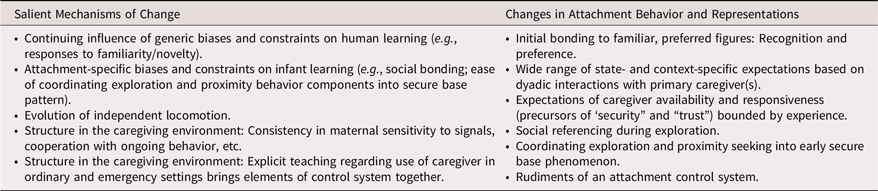
In this phase, we see the emergence of independent locomotion, and with it the first steps toward a balance between proximity seeking and exploratory behavior. Bowlby’s discussion of attachment development at this stage mentions both the unfolding of an “instinctual” behavioral program and the crucial role of an “ordinary expectable caregiving environment” in bringing together the components of such a plan (Bowlby, Reference Bowlby1969, Ch 14). Maturation and readiness of perceptual, locomotor, and cognitive components are prerequisites for the coordination and integration of an-attachment-exploration control system. However, as illustrated in Table 4, we look primarily to the structure of the physical and socialization environment, operating within constraints and biases in infant learning abilities, to account for the trajectory and organization of attachment behavior at this phase.
Establishing secure base relationships in locomotor infancy
Salient mechanisms of change in locomotor infancy
Our formulation differs somewhat from Bowlby’s emphasis on proximity seeking as the hallmark of attachment and exploration as antithetical to attachment. When asked what attachment development is the development of, we focus on building coordinations among the components of these complementary systems. We move away from the idea of “innate behavioral programs,” emphasizing instead that attachment builds on the fact that infants find it far easier to integrate the familiar components of secure base behavior than similarly complex but randomly selected behaviors. For example, infants effortlessly learn, without explicit training, to: (a) associate their mother’s smile with safety, (b) anticipate comfort and contact when their mother enters a room, and (c) hand her a broken object, expecting assistance. In contrast, imagine how difficult it would be, if it were even possible, to teach a one-year-old behaviors such as (d) smiling when mother removes her shoes, (e) going face down onto the carpet when distressed, or (f) stacking toys when a stranger enters the room. This emphasis on facilitated learning seems to us a better gloss on Bowlby’s concept of attachment underpinnings as part of our primate evolutionary endowment than the concept of “innate behavioral programs.”
These attachment-facilitative learning biases and constraints provide a “learning topography” on which caregiving interactions, encouragement of exploratory excursions, and turn-taking/reciprocity games play out. Simultaneously engaging exploratory and proximity-seeking behaviors into patterns of secure base behavior facilitates the inter-coordinations Bowlby referred to as the attachment behavior control system.
This phase of attachment development is widely held to see the foundations of persistent preference for one of a few primary caregivers (“bonding”). As mentioned above, behavioral neurobiologists have, in recent years, conducted elegant studies of neuropeptide and hormonal effects on mating, parental behavior, and monogamy, primarily in rodents (e.g., Insel & Young, Reference Insel and Young2001; Young et al., Reference Young, Gobrogge, Liu and Wang2011; Young [2011]). Such work is technically impressive and sheds light on the nature of biobehavioral processes in social behavior. Nonetheless, the implications of such research for human development and behavior should not be over-drawn. Animal models often involve species that have very different life history strategies than humans. Rodents, in particular have very high reproductive rates and, accordingly, lack key characteristics of human attachment. Parental investment is brief, litters are readily abandoned, the capacity for monogamy and long-term relationships is limited, and there is no analog to grief and mourning in response to loss.
Identifying hormones and neuropeptides that affect attachment behavior analogs in animal models is a significant accomplishment. It is also a significant advance beyond Bowlby’s speculation that bonding ensues as a result of the integration of attachment behaviors into a behavioral system (Bowlby, Reference Bowlby1969, p. 179), it has limited explanatory power. Like a coin “causing” a vending machine to dispense a cup of coffee, a specific hormone or neuropeptide is more the occasion for the output behavior than an explanation. Like the coin, rather than playing any generative role, it simply activates a vastly complex (and largely unknown) mechanism in which the causal process resides.Footnote 11 Thus, we note indications of “bonding” at several points in our sketch but do not depend on this concept to do much of the work accounting for attachment development.
Changes in attachment behavior and representations in locomotor infancy
The processes in this phase build upon previously established foundations, fostering a distinct social orientation and preferences. During this period, we also observe the development of exploratory behaviors and proximity seeking, increasingly well-organized into a recognizable secure base pattern. This goes beyond mere proximity seeking to include:
-
Exploration away from the attachment figure.
-
Monitoring the attachment figure’s location, accessibility, and responsiveness.
-
Monitoring rapid or unexpected changes in the environment (loud sounds, new persons, etc.).
-
Changing location or following to maintain access to the attachment figure.
-
Signaling and interacting from a distance.
-
Seeking proximity when the caregiver’s activity changes.
-
Returning to the attachment figure either when the novelty of toys wanes or assistance is needed.
-
Intermittent, non-distressed returns to the attachment figure.
-
Seeking the attachment figure when uncomfortable or distressed.
-
Resuming exploration after receiving comfort.
As with the acquisition of any skill, coordinating of these behaviors into a reliable secure base pattern requires considerable time and experience. One-year-olds must be closely supervised in open spaces because they are easily distracted and will wander off, often being retrieved before they recognize that they have traveled out of range. In addition, they will occasionally follow the wrong adult, only to be startled when they recognize their mistake.
Increasing secure base competence in toddlerhood
Bowlby (Reference Bowlby1969) emphasized the importance of general cognitive development as a driver of attachment development in toddlerhood. He was particularly influenced by Piaget’s discussions of emerging preoperational thought, which is symbolic but not yet logical, and the decline of egocentrism at this age. These developments afford the child its first sense of attachment figures as independent agents with their own feelings, motives, and goals. Bowlby described this as the first steps from attachment organized around proximity seeking to what he called a “goal-corrected partnership.”
Although Bowlby’s emphasis on cognitive development was a significant insight, it is not clear how cognitive development per se would drive attachment development in any particular direction. Our emphasis on contextual and socialization pressures as mechanisms of change is intended to provide some of the missing information. In addition, Bowlby was working without the benefit of detailed naturalistic observations of attachment behavior in this period as there was little observational data to guide him (Bowlby, Reference Bowlby1969, p. 268). This situation is much improved in recent years with the availability of observational tools such as the Attachment Q-set (Vaughn et al., Reference Vaughn, Waters, Teti, Waters, Vaughn and Waters2021). Theoretical and empirical work on Bowlby’s working models concept and other modes of attachment representation (e.g., autobiographical narratives, scripts) have made clearer what attachment is developing toward.
Salient mechanisms of change in toddlerhood
As indicated in Table 5, increased locomotor competence at this age results in familiarity with a wider range of environments and is an important stimulus to general cognitive development.
Increasing secure base competence in toddlerhood
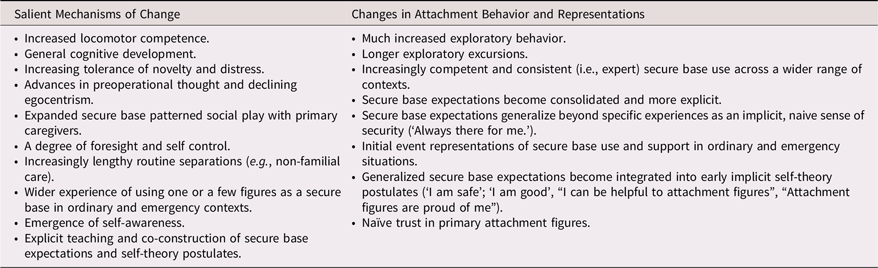
Along with neurological maturation, the resulting increase in experience contributes to increasing tolerance of novelty and distress. In the attachment domain, care is more widely shared, often including more extensive use of supplementary caregivers and adaptation to increasingly extended periods away from the primary caregiver (e.g., in-home or out of home substitute care; early schooling).
At the same time, the expanding range of secure base related experiences is increasingly encoded as temporal-causal event representations (Nelson & Fivush, Reference Nelson and Fivush2004). Although some of this representational change occurs spontaneously, it depends as well on the caregiver’s role as facilitator and interpreter of new experiences and on co-construction interactions that help the child build its own representations and explanatory schemas.
Changes in attachment behavior and representations in toddlerhood
Advances in locomotor and cognitive development, and expectations that cover a wider range of contexts and experiences, increase the toddler’s confidence and competence to extend the range and duration of exploratory behavior. Experience monitoring attachment figures’ availability and responsiveness, and familiarity with the meaning of a wider range of cues in the environment, are reflected in an increasingly reliable and consistent proximity-exploration balance. This is a significant advance over the much less organized and integrated efforts at secure base behavior in infancy. In fact, the skillful attachment-exploration balance often attributed to one-year-olds is more likely to be observed in three-year-olds.
As secure base related expectations become consolidated and applied across a wider range of contexts, they become the foundations for early attachment-related event representations and the first steps toward elaborated representations of the relationship with specific attachment figures. In addition, they become the foundations of what Epstein (Reference Epstein1973, Reference Epstein2014) called higher order self-theory postulates that originate in self-validating statements such as “You are good,” “You are safe/healthy/strong,” “I love you,” “I will always be there for you” (or negative postulates if attachment figures consistently provided less positive signals). Finally, although we can agree with Erikson (Reference Erikson1950) that the conditions for establishing a sense of ‘basic trust’ are rooted in early social experience, we believe that toddlerhood is the earliest age at which caregiver-related expectations and event representations become substantial enough to support a meaningful, though still implicit, belief that can be termed “trust.”
Reflecting on attachment relationships in early childhood
In the preceding phases, locomotor and cognitive development led to increasing familiarity with primary caregivers and the nearby world in general. These changes continue to shape the course of attachment development in early childhood. As outlined in Table 6, they herald the onset of maturity demands and socialization pressures which increasingly inform, constrain, and organize exploratory behavior and the proximity-exploration balance.
Reflecting on attachment relationships in early childhood
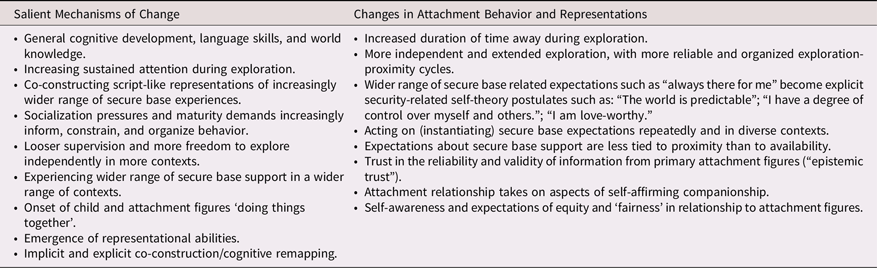
Throughout early childhood, attachment figures continue to play an important role as co-construction partners, helping the child build representations of attachment-related and other experiences. The importance of this co-construction process is often underestimated. Conceptualization, revision, and recoding of experience are often assumed to occur effortlessly, and to be far more spontaneous and extensive than may actually be the case. Even in adulthood, such work often proves difficult and iterative, and often benefits from being externalized in conversations with trusted partners. Attachment figures play particularly important roles throughout childhood as informants, sharing (scaffolding) their understandings with their children, and as co-construction partners, helping their children with the more difficult task of formulating their own understandings and explanatory schemes (Nelson & Fivush, Reference Nelson and Fivush2004).
Salient mechanisms of change in early childhood
Advances in cognitive and language development expand the attachment figure’s opportunities to provide, and refine, information about the social and physical world. They also underpin the child’s ability to ask questions and express his/her understandings, which can then be confirmed, amplified, or corrected. Cognitive, language, and narrative development also underpin co-construction interactions. All of this makes the world more comprehensible and increases confidence to explore. Over time this is associated with loosening the bonds of supervision. Cognitive and language development also cue and enable attachment figures to convey age-appropriate socialization demands (beyond single commands, such as “Don’t do that”) and begin to press maturity demands (e.g., for greater impulse control, and “appropriate” behavior) which inform, constrain, and further organize the child’s social and exploratory behavior.
These changes lead to significant changes in the attachment figure’s orientation toward the child. Although supervision, comforting, and control continue to be available and necessary functions, developmental changes in this period add possibilities for increasingly sustained shared activities, conversation, and reminiscence.
Changes in attachment behavior and representations in early childhood
Early childhood changes in cognitive, language, and representational abilities, and a wider competence and scope for exploring and understanding the social and physical world move basic secure base relationships toward new levels of complexity. Implicit expectations regarding attachment figures’ availability and responsiveness, built in toddlerhood, become increasingly explicit security-related beliefs about caregivers and generalizations about the self (e.g., “The world is predictable,” “My primary attachment figure(s) will always be there for me”). Fonagy and his colleagues saw evidence of this in the child’s preferential confidence in the reliability and validity of information provided by primary attachment figures (e.g., Fonagy et al., Reference Fonagy, Gergely and Target2007; Yong et al., Reference Yong, Wang and Danovitch2020).
This emerging “trust” in one’s self and in caregivers changes how a child explores and experiences the world. In addition, with advancing conversational skills, new possibilities arise for shared interests, open communication and other forms of connectedness, and mutual enjoyment. Thus, a variety of early childhood developments, which are not specifically attachment-related, help advance basic secure base relationships toward including elements of self-affirming companionship, mutuality, and expectations of ‘fairness’ on the part of both partners.
Reflecting on attachment relationships in middle childhood
Advances in cognitive and representational skills, along with evolving socialization practices and pressures, continue to shape and organize development throughout middle childhood. These bring with them (Table 7) advances in self-concept and increasing understanding of attachment figures as individuals. They also contribute to broader social understanding and to strategies for greater emotion regulation. In combination with physical changes, wider experience, evolving socialization pressures, and much wider access to the peer group, these changes significantly alter both the child’s view of the world and the field on which secure base relationships play out (Bosmans, & Kerns, Reference Bosmans and Kerns2015; Kerns & Richardson, Reference Kerns and Richardson2005).
Reflecting on attachment relationships in middle childhood
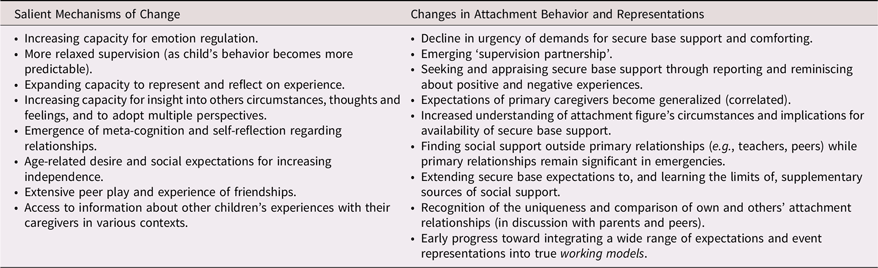
Middle childhood is a period of rapidly expanding horizons. Indeed, as Bowlby noted, the ease with which attachment behavior is activated begins to decline in middle childhood. This reflects in part increasing capacity for emotion regulation. Nonetheless, attachment continues to be a “dominant thread in the child’s life” (Bowlby, Reference Bowlby1969, p. 206). Koehn & Kerns (Reference Koehn and Kerns2022) refer here to an emerging “supervision partnership.” Although children this age enjoy playing independently, being at school, or visiting friends, these activities are predicated on an implicit sense that attachment figures have left them in good hands and are available to provide secure base support if called upon.
Salient mechanisms of change in middle childhood
Advances in representational thought, especially the capacity to reflect on one’s own thoughts (meta-cognition) make it possible to assimilate new information. In addition, expectations and demands for greater independence, along with parents’ loosening supervision in middle childhood, open doors to the peer world. With this comes new opportunities for both play and social friction. The peer group also provides the information necessary for self-informing social comparisons and for comparing one’s own family relationships with those of others.
Changes in attachment behavior and representations in middle childhood
Broader horizons and the ability to reflect on mental representations in middle childhood facilitate incrementally reorganizing and reconceptualizing secure base relationships in ways that were not possible at earlier ages. Integrating and evaluating the consistency of self-theory postulates and understandings of secure base relationships depends on repeated rounds of sharing, reminiscing and co-construction interactions. Such interactions, along with the ability to adopt multiple perspectives, enable the child to understand, somewhat, the complications secure base figures face in being always available and responsive. It also makes it possible to take advantage of and learn the parameters of social support available from peers and supplemental caregivers (e.g., teachers, coaches). Here we also see evidence that attachment representations are increasingly generalized across caregivers which suggests that the child understands their attachment relationships as similar in kind (e.g. similar goals, functions, responsibilities) rather than unique and idiosyncratic relationships (Boldt et al., Reference Boldt, Kochanska, Yoon and Nordling2014). These are important steps in which accumulated expectations and event representations begin coalescing into what Bowlby termed internal working models of attachment (Bowlby, Reference Bowlby1969, pp. 81–82, 351–354).
Exploring attachment relationships and secure base use and support in adolescence
Physical and physiological changes, advances in representational thought, striving to function more autonomously, and increasingly effective emotion regulation are hallmarks of adolescence. At the same time, greatly expanded engagement with peers introduces new relationship experiences and sources of social support (Allen & Manning, Reference Allen and Manning2007; Allen, Reference Allen, Cassidy and Shaver2008). Experiencing age-mate romantic relationships presents the challenge of exploring the relevance of existing secure base schemas for a broadening social world. Individually and in combination, these changes create pressure to further reorganize and renegotiate existing patterns of secure base use and support relationships with attachment figures.
Salient mechanisms of change in adolescence
Although secure base use and support remain relevant throughout adolescence, over time their content and organization change in response to a wide range of physical, cognitive, situational, and cultural norms and images (Table 8). These affect the parameters of caregiver supervision and secure base support, explorations away from the family, and patterns of peer relationships. As at earlier ages, many of these influences on attachment development originate outside the attachment system.
Exploring attachment relationships and secure base use and support in adolescence
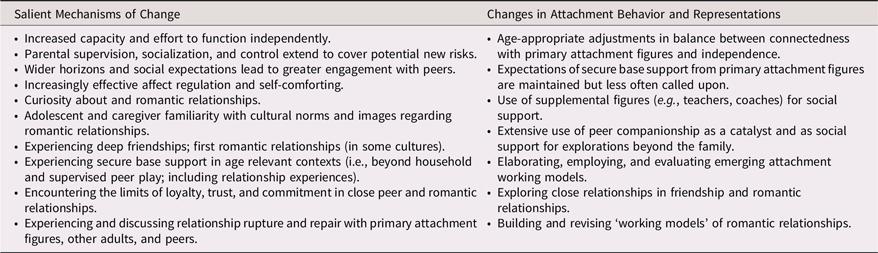
Physical maturation affects adolescent social motivation in important ways. However, rather than acting alone to produce particular social outcomes, these changes serve as triggers, catalysts, and biases that influence rather than determine the course of secure base behavior and relationships in adolescence. In addition, with increasing experience, skills, and self-confidence, the ability to function independently in a wider environment and wider social world increases throughout adolescence. This includes spending more time away from family, wider exposure to peer models, opportunities for deep friendships, and often first romantic relationships. In response to wider exploration and perceived new risks, primary caregivers often extend socialization pressures to cover what they perceive as potential new risks.
Increasing engagement with peers and romantic partners informs and challenges a wide range of self-theory postulates, often engendering deeply felt emotional reactions. This engagement also introduces new sources of social support and, often, disappointment and conflict. Additionally, it brings new experiences of relationship rupture and repair.Footnote 12
These changing circumstances present the paradox that becoming more independent requires more, perhaps different, but not less, support from attachment figures.
Changes in attachment behavior and representations in adolescence
Adjusting the balance between connectedness and independence is a challenging and evolving problem. Social norms and images, peer models, and the organization of existing secure base relationships often conflict. These difficulties are more manageable if the social context and peer culture act as buffers against risky behavior rather than as potentiators. Otherwise, parents may react to an adolescent’s desire for greater autonomy as an emergency, or with resignation.
Sustainable solutions require both behavioral and conceptual/representational change on both sides of the secure-base-use : secure-base-support equation. Even though established attachments remain primary, supplemental sources of secure base support (e.g., extended family, teachers, coaches, trusted peers and their families) are a significant asset at this age. These can sometimes facilitate looser supervision by extending “eyes-on” and serving as co-construction partners for parity when direct communication is difficult. Patterns of partnership and trust can be valuable resources. Typically, though, they are not well consolidated at the onset of adolescence. Consequently, the reciprocity of the partnership is easily disrupted and may not function effectively or survive relationship ruptures or effectively facilitate repair.
Close friendships and romantic relationships are hallmarks of adolescence. Both have interesting secure base components and interesting limitations. These experiences inevitably present challenges to expectations and existing understandings of secure base relationships. New relationships require new relationship-specific representations. They also highlight aspects of secure base relationships with primary caregivers that invite reflections on existing attachment representations. The emergence of autobiographical reasoning abilities allows for adolescents to begin to make explicit links between their early attachment experiences and their emerging sense of self/identity through the construction and sharing of autobiographical narratives (Fivush et al., Reference Fivush, Habermas, Waters and Zaman2011; Habermas, Reference Habermas2011). Peer friendships and romantic relationships may also foster work on generalized (as opposed to relationship specific) attachment representations.
The transition to adulthood
When exploring attachment development in adulthood, it is useful to distinguish between changes in how attachment relationships and secure base behaviors are conducted and the course of individual relationships. A wide range of new experiences, roles, and responsibilities influence the conduct of attachment relationships throughout adulthood. In Western, middle-class contexts, these experiences often include the transition to independent living, employment, committed romantic relationships, and parenthood. Existing attachment representations can influence how an individual perceives and copes with such demands. In addition, although some of these challenges are not specifically attachment-related, secure base skills are often employed in coping with them. The focus here is on how these experiences shape the continuing evolution of secure base use, support, and related representations – specifically, on changes in attachment-related cognitions and skills, rather than on predicting the course of specific relationships.
Becoming a secure base in early adulthood
For many individuals, establishing a committed adult-adult relationship is one of the hallmarks of early adulthood. One of the most marked changes is the added responsibility of serving as a secure base figure for a partner and potentially for children as well. Early phases of commitment provide a degree of information about the kinds of secure base use and support an individual and partner require and can provide. However, most of this information only becomes available over time as secure base use and support are tested by circumstances. Mental representations provide outlines of how secure base relationships work. However, these outlines have to be instantiated in specific situations, evaluated, and adjusted to bring them into alignment with a partner. This requires time and experience, not only to make adjustments but to calibrate representations and expectations in ways that will better meet future demands and coordinate behavior as a partner and a parent. Much of this work is a matter of trial and error and requires experience, reflection, and revision of existing representations.
Salient mechanisms of change in early in adulthood
Attachment in early adulthood is shaped by the interplay of a wide range of stabilizing and destabilizing influences (Table 9). Factors that stabilize attachment relationships in early adulthood include social norms, shared values, commitment and affection, supportive social networks, personal characteristics (such as adaptability), and benefits gained through the partnership (such as material and social advantages, emotional support, comfort, enjoyment, a sense of fulfilling personal values and goals, and parenthood). These inevitably contend with an array of potentially destabilizing influences which range from (a) unrealistic expectations, (b) lack of commitment, and (c) limited communication skills to (d) financial stresses, and (e) life/mental health-related stresses (e.g., depression, substance abuse), to (f) incompatibility, (g) lack of intimacy, (h) infidelity, and (i) abuse.
Becoming a secure base in early adulthood
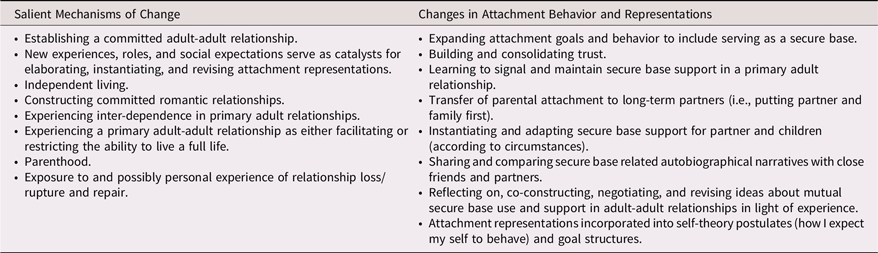
Parenthood is a watershed event in attachment development, not only because of its impact on the parents’ relationship but also because it introduces a range of new and rapidly changing demands in providing secure base support for both the partner and offspring. Social support from parents, siblings, and friends is often useful and reassuring (Gu et al., Reference Gu, Waters, Zhu, Jamieson, Lim, Schmitt and Atkinson2024). Cultural and community norms are also useful. Nonetheless, from infancy to adolescence, much of childcare and rearing involves a great deal of trial-and-error learning and problem-solving as the changing capacities and needs of the child creates a literal and figurative moving target in terms of secure base needs. This consequently creates a great deal of uncertainty. This uncertainty is a significant impetus to continuing change in the parents’ relationship as well as in their ideas about secure base support as parents.
Finally, although rupture, repair, and dissolution are familiar from experience in adolescent relationships, they take on a new significance in committed adult relationships. Not only are they distressing, they also test and inform a wide range of secure base skills, and challenge one’s ability to establish and maintain trust. In doing so, they test a wide range of implicit assumptions about specific relationships and shape expectations about attachment relationships in general. Moreover, they are a catalyst to revising attachment representations through reflection and discussions with each other, friends, and occasionally professionals.
Changes in attachment behavior and representations in early adulthood
Early attachment relationships are organized around using one or a few figures as a secure base from which to explore and as a haven of safety when distressed. Preliminary efforts to serve as a secure base emerge in adolescent romantic relationships, though they are more focused on providing comfort than supervision. Adolescent secure base support is also limited by a degree of egocentrism. As well, existing primary attachments and other personal investments preclude secure base support for a romantic partner from achieving the priority it receives in adult relationships.
Prior to early adulthood, most individuals primarily experience attachment relationships in the role of secure base user. Therefore, the need to serve in the complementary role, providing secure base support, can be problematic. After all, there are many examples of complementary roles (e.g., pilot-air traffic controller; baseball pitcher-batter; student-teacher) in which experience in one role does not provide much advantage toward performing, or even learning the other. Piloting and air traffic control are very different skills, as are pitching and batting, learning and teaching. And yet the need to provide secure base support arises immediately with the initiation of early adult attachments (or the arrival of a child) – and in most cases both partners meet the challenge passably well from the start. To investigate the relationship between secure base use and support early in adult relationships, Crowell et al. (Reference Crowell, Treboux, Gao, Fyffe, Pan and Waters2002) observed 144 engaged couples in a 15-minute videotaped couples problem-solving interaction (Gottman et al., Reference Gottman, Markman and Notarius1977; Gottman, Reference Gottman1979). Scales analogous to Ainsworth et al.’s Reference Ainsworth, Blehar, Waters and Wall(1978/2015) sensitivity, cooperation, and availability scales, were developed to assess each partner’s skill at using their partner as a secure base and serving as a secure base during the discussions.Footnote 13 Both secure base use and support were significantly correlated with existing attachment representations of relationships with primary caregivers (r = .43/.41 for females and .37/.34 for males, p’s < .01; see also Waters et al., Reference Waters, Fraley, Groh, Steele, Vaughn, Bost, Veríssimo, Coppola and Roisman2015). In addition, and contrast to many complementary roles, the ability to use one’s partner effectively as a secure base was highly correlated with providing effective secure base support (r = .78 and .82 for females and males, respectively; p’s < .01controlling for partner’s scores on both variables, IQ, and marital discord). This suggests that, in early adulthood, secure base use and support in committed relationships draw on similar resources (presumably experience with the particular partner, general social problem-solving skills, and to a lesser extent, existing attachment representations).
Across age, attachment relationships depend very much on the belief (expectation) that the partner will “always be there for me.” In early adulthood, this belief buffers rough edges of routine interactions, supports exploration, and bridges time apart. It also provides a sense of security and underpins confidence in the partner’s (untested) commitment in the face of unknown difficulties. Building and consolidating such trust presents a challenging problem of generalizing beyond experience (formally, inductive inference). How do I know that my partner will always be there for me?
Cultural images often suggest that we look to dramatic demonstrations, such as extravagant gifts or gestures as evidence of commitment. However, these are easily contrived. More persuasive evidence is found in the subtleties of everyday life, such as being consistently considerate in small ways. Such gestures suggest that, even in the midst of a busy, complicated, or perhaps very routine life, my partner is actively mindful of my needs and my importance in our relationship. Although not proof positive, such signs instill confidence where there can be no proof, thereby fostering security and supporting exploration.
Learning the when and how, and the value of signaling commitment in a relationship is an important secure base related skill, often precipitated when relationships are taken for granted due to the pressures of adult life. Many of the activities associated with early adult life prompt such adjustments to secure-base-related cognitions and behavior. With such changes, attachment relationships increasingly incorporate subtlety and intentionality not present at earlier ages.
Transfer of attachment from primary caregivers to adult relationship partners is a theoretically and clinically important phenomenon of early adulthood. Unfortunately, it is not well studied, in part due to the lack of satisfactory measures.Footnote 14 Key questions concern (a) whether transfer of attachment might be better viewed as diversification than transfer, (b) whether it is primarily a matter of cognitive remapping, (c) whether it is necessarily stressful, and (d) the extent to which it is related to parent-based and partner-based representations, and experiences within the family of origin and experiences within the emerging current relationship.Footnote 15
Finally, experiences in early adulthood relationships have broad implications for self-concept and goal structures. Self-theory postulates such as “I am trustworthy” and “I and a good secure base for my partner (child)” and script-like representations (e.g., Waters & Waters, Reference Waters and Waters2006) take on motivational significance when they become consolidated as goal structures against which actual and intended behavior is compared. During this period, general advances in autobiographical memory continue to move the construction of an integrative autobiographical narrative, or life story, forward which serves as an explanatory framework of personality and behavior both for oneself and to be shared with one’s partner and peers. Implicit attachment expectations become explicit via the construction of this meaningful and integrative autobiographical narratives of one’s attachment history. In turn, evidence that supports or contradicts these narratives is a significant source of positive (or negative) emotions (Epstein, Reference Epstein1973, Reference Epstein2014; Habermas, Reference Habermas2011; McAdams, Reference McAdams2001).
Providing and using secure base support in middle adulthood
Middle adulthood is often characterized by beginning to make longer term career, financial, and family plans. These tend to bring with them increasing burdens of responsibility and claims on an individual’s time and resources (Table 10). Secure base support in a committed relationship can be a valuable resource. At the same time, increasing responsibilities present relationship challenges – especially how to be an effective secure base for a partner and for increasingly independent children while meeting competing priorities.
Providing and using secure base support in middle adulthood

Salient mechanisms of change in middle adulthood
Changing circumstances in middle adulthood, including adult children establishing committed relationships, place new pressures on self and relationship representations, which are shaped by an ever-widening range of experiences. These experiences expand horizons and bring a mix of successes, disappointments, and failures that can challenge secure base use and support skills as well as representations of self and relationships. Secure base use and support and attachment representations are also affected by the impact of relationship duration (Acevedo & Aron, Reference Acevedo and Aron2009). Children transitioning from adolescence into early adulthood introduce changes that put new pressures on secure base support skills and collaboration between partners. This transition can also create stress in the parents’ relationship.
Additionally, middle adulthood often involves facing a parent’s declining health, which can place significant new demands on both material and emotional resources. This, along with the increasing salience of the impending loss of parental attachment figures, can draw on the strength of a well-functioning secure base relationship or become a significant source of friction. Thus, although middle adulthood is often described as a phase of maturity and “settling-in,” it is also a period in which secure base behavior and representations continue to be challenged and must adapt.
Changes in attachment behavior and representations in middle adulthood
Changing circumstances and challenges in middle adulthood often require a wide range of adjustments to maintain the partner relationship while addressing the pressing needs of adolescent and young adult children, aging parents, career, and community obligations – all while maintaining personal equilibrium. Ideally, parents view children’s transition to committed relationships as exploration to be supported and welcome children’s new partners as an additional source of secure base support for them. Coherent attachment representations help gauge reasonable expectations for a partner’s secure base support. They also aid in the trial-and-error problem-solving needed to meet unfamiliar challenges and in navigating the rupture-and-repair process with a partner or children that such uncertainty and stress often cause.
Maintaining existing secure base relationships through the challenges of middle adulthood can be a significant challenge itself. Middle adulthood is often an individual’s first encounter with a decades-long relationship and, aside from parental relationships and social images, there are few bases upon which to build expectations. How do independence and togetherness work at this age? Does passion necessarily decline? How will an “empty nest” affect our relationship? Is there something I (we) should be doing to enrich our relationship? Even with coherent generalized attachment representations and current relationship representations, finding solutions requires trust and open communication.
Middle adulthood is often a time of increased intimacy, appreciation, and fond reminiscing with aging parents. From the point of view of attachment theory, care for aging parents is not merely custodianship. It is continuous with the kinds of secure base support they provide partners and children. The goal is to help parents continue exploring and being involved, and living as big a life as they are able. Having a partner’s (and children’s) understanding and support can facilitate serving as a secure base for aging parents. Nonetheless, the demands can also create friction between partners and with adult siblings.
Aging parents present a complex array of challenges. Unlike the needs of adolescent and young adult children, aging parents’ needs are often outside their adult children’s own experience. Heightened awareness of parents’ life-style, interests, capabilities, limitations, and concerns can interact with their feelings about needing increasing levels of support, or be perceived as intrusive or controlling. Meeting parents’ needs is particularly challenging when communication is difficult or if they live at a distance. This can be stressful and exhausting, revealing incoherences in self and relationship representations that can lead to emotions such as frustration, anger, guilt, and withdrawal. Nonetheless, it presses attachment representations and secure base behavior forward.
Providing and using secure base support in later adulthood
Later adulthood (Table 11) is often a period of companionship and reflection on life’s meaning and accomplishments. However, it also presents physical and cognitive challenges, such as a decreasing capacity to support a partner whose needs are increasing. These challenges require adjustments in secure base behavior and attachment representations. Representations of the current relationship may influence an individual’s willingness to accept support, even from a devoted partner. In addition, generalized relationship representations and self-theory postulates may affect a person’s openness to help and comforting from other family members and professionals.
Using and providing secure base support in later adulthood

Salient mechanisms of change in later adulthood
Changes in mobility, energy, health, cognition, and perceptual abilities in later adulthood often impact the scope of daily life. Individuals may become less active and less inclined to seek out new experiences. Such changes can negatively impact physical and mental health. They can also contribute to social isolation, increasing the burden and reducing the resources and assistance available to those who would provide secure base support. Often one partner’s health and cognitive and perceptual abilities are maintained longer than the other partner’s. This is advantageous in that it allows the healthier partner, to a degree, to maintain household activities and provide supervision and support. However, it also introduces an asymmetry into what had previously been mutual secure base support. Cultural and personal views of aging influence how this asymmetry is understood. In some cultures, support from younger generations or a partner is seen as a sign of respect and gratitude, affirming one’s sense of self. However, in cultures with a more negative view of the elderly’s role in family and society, even basic support can be experienced differently. Rather than being welcomed as a sign of value, it may be perceived as pity, obligation, or a reminder of declining usefulness, making it much harder to accept.
Changes in attachment behavior and representations in later adulthood
One of the most important contributions to relationship adjustment in later adulthood is recognizing how changes in health, energy, cognition, and perceptual abilities impact established patterns of relating and being active in the world. It can be difficult to recognize the need to adjust secure base support to changes that occur slowly and affect both partners. As in middle adulthood support for aging parents, secure base support for an aging partner is not simply a matter of custodianship. It also involves helping one’s partner continue exploring and being involved, and living as big a life as they are able, and providing comfort in the face of uncertainty and illness. The desire to provide comfort and support may lead more capable partners to focus on fretful supervision and doing things, underestimating the value of their calm presence and assured availability and responsiveness. Trust, communication, awareness, social contacts, and a degree of imagination help discover and maintain suitable modes of relating and secure base support in later adulthood.
Discussion
Bricolage: Building attachment across the lifespan
Anthropologist Levi-Strauss (Reference Levi-Strauss1966) introduced the term bricolage to describe the process of working with available resources within a given set of constraints to create cultural innovations. The development of attachment across the lifespan can also be viewed as a process of bricolage (building, innovating). As we have detailed, attachment does not simply unfold according to a predetermined plan; it is also shaped by the interplay of (a) biological biases and constraints, (b) current developmental status, (c) environmental influences and circumstances, and (d) the resources available in the caregiving environment. Within and across age ranges, secure base use and support behavior and relationship representations discover and navigate available paths forward.
This perspective suggests extending prevention and intervention beyond providing insight and instruction. Where feasible, harnessing and modifying the information and structures within the environment, current circumstances, and cultural context can help initiate, organize, and stabilize progress toward more competent and satisfying relationships.
The secure base concept as a framework for theory and research
Throughout this presentation, we have emphasized the advantage of avoiding an essentialist view that change in secure base relationships reflects inherent properties, the unfolding, if you will, of something called “attachment.” In addition, we have also tried to demonstrate the advantages of viewing proximity-seeking and exploration as a coordinated, integrated system rather than antithetical to one another, and to illustrate the relevance of secure base use and support across the lifespan.
We have focused primarily on the ordinary course of attachment, not addressing vicissitudes of individual relationships, the full range of influences, or pathologies of attachment. Nor have we focused on issues such as individual differences, sex differences and roles, passion, monogamy, fidelity, exceptionally successful or discordant attachments, or relationship attenuation/dissolution, or responses to separation and loss. Attachment theory can be a useful framework for examining such topics. However, Duschinsky (Reference Duschinsky2020) and Verhage et al. (Reference Verhage, Tharner, Duschinsky, Bosmans and Fearon2023) have noted the remarkable diversity of meanings researchers and clinicians attribute to the term “attachment.” Thus, we have tried to illustrate the value of focusing more specifically on secure base use and support and on the cognitive underpinnings of attachment representations as a framework for theory and research in the Bowlby–Ainsworth tradition.
Is our analysis too cognitive?
While defining attachment as an emotional bond, Bowlby refers to “cognition,” “cognitive psychology,” and “appraisal” (not to mention “recognition”) over 200 times in his Attachment trilogy alone. In addition, the move to the level of representation initiated in Mary Main’s work with the Adult Attachment Interview placed narrative and attentional processes in the forefront of attachment theory (Main et al., Reference Main, Kaplan and Cassidy1985; Main, Reference Main, Marris, Stevenson-Hinde and Parkes1991). Following this tradition, we have discussed at length the roles cognitive development and mental representations play in attachment behavior and development.
Admittedly, we have referred to security, emotion, and trust somewhat less often than cognition. This is not to underplay the role of emotion in attachment. It is simply that many – some would say most – emotional experiences are influenced by cognitive appraisal processes and the confirmation or disconfirmation of expectations and self-theory postulates (Epstein (Reference Epstein1973, Reference Epstein2014); the contributors to Scherer et al. (Reference Scherer, Shorr and Johnstone2001). Furthermore, cognitive strategies play a leading role in emotion regulation (Gross & Thompson, Reference Gross, Thompson and Gross2007; Gross, Reference Gross2001). As well, much of our emotional experience is precipitated by cognitions about emotion. Thus, it is simply uninformed to suggest that emphasizing cognitive processes minimizes the place of emotion.
The prototype hypothesis
The belief that early experiences have long-lasting effects is a well-established concept in the history of ideas. Although not specifically psychoanalytic, the term “prototype hypothesis” reflects Freud’s (Reference Freud and Strachey1940) description of the infant-mother relationship as, “unique, without parallel, established unalterably for a whole lifetime as the first and strongest love-object and as the prototype (Vorbild) of all later love relationships” (p. 188). This has led many attachment theorists, researchers, and clinicians to expect that (all things being equal) attachment security with one’s primary caregiver will be stable from infancy to adulthood, and concordant with attachment patterns in one’s adult-adult relationships. Yet, meta-analytic studies consistently report modest effects (e.g., Fraley, Reference Fraley2002; Pinquart et al., Reference Pinquart, Feussner and Ahnert2013). For many who expected more substantial effects, this is problematic, at best. This is the subject of continuing research and analysis and may resolve into issues of the reliability and validity of attachment measures, the limitations of brief and single assessment research designs, and underestimating the impact of small effects projected through countless interactions over time.
Meanwhile, there is a complementary formulation of the prototype hypothesis that should be of considerable interest to developmentalists and clinicians, regardless of the outcome of individual differences studies. Simply put, even if infant-mother attachment security is not highly stable, and not highly predictive of later primary adult-adult relationships, such relationships are, in important respects, similar in kind. Specifically, infant attachment and committed adult-adult relationships are both secure base relationships.
From a developmental perspective, this suggestion seems improbable. Yet it remains intriguing, despite the fact that looking across domains of human development as disparate as gait and locomotion, reaching and grasping, language, learning and memory, representation and problem-solving, qualitative change is arguably more the rule than the exception. Moreover, the idea that early and later attachment relationships are similar in kind remains intriguing because it suggests that exploring qualitative/organizational similarities in attachment relationships across the life span will reveal something about the nature of attachment relationships – and that research and clinical insights gleaned at one age can be more than mere analogies in relation to attachment at other ages.
Developmental versus non-developmental change
It is interesting to consider which components of observed change meet (or do not meet) the traditional criteria for developmental change outlined above. Reflecting on this can help us better understand the nature of evolutionary biases and constraints and how they interact with the environment and experience to shape attachment behavior and relationships. In addition, students will find that puzzling over developmental versus non-developmental change provides a unique perspective on attachment that will pay dividends in research, measurement, and clinical practice over a career.
Most of the influences enumerated in Tables 4–11, though contingent on cultural and family circumstances, impose orderly rather than random change. In addition, even environmentally induced changes can be cumulative in the sense of requiring a degree of readiness and building on what preceded them. Whether the changes so induced are directional depends, perhaps on the level of analysis. Although it is difficult to predict the particulars of individual relationships, there are, within cultures at least, noticeable trends across age ranges. Moreover, many of the changes are stabilized and buffered by the very environmental influences that induced them, as well as by being incorporated into attachment and representations of self and identity. Of course, mental representations can change but they are not reversible. There is no mechanism for returning the representational system to the status quo ante.
Finally, there is the issue of whether there are meaningful commonalities (universals) in the course of secure base use and support, and relationship representations, within and across cultures. As Brown (Reference Brown1991) and Chapais, Reference Chapais, Workman, Reader and Barkow2020) point out there are very few absolute universals (i.e., present in detail and without exception) in human behavior. Instead, universals are best sought at the level of motivation and organization. At present, relevant data at the appropriate levels of analysis are largely lacking. We hope the present developmental sketch will help organize the search for relevant data across cultures and contexts.
Overall, our impression is that attachment changes across ages are a combination of developmental and non-developmental change. Insofar as attachment is a productive domain in which to study development, this may be a fair conclusion about behavior in general. In the behavioral domain, and perhaps in cognition and emotion as well, there will always be developmental and non-developmental change. That is, nothing only develops.
Conclusion
Familiarity with the underpinnings and clinical course of illness is a cornerstone of medical training and problem-solving. Knowing in detail the mechanisms of change and the developmental course from infant-caregiver to adult-adult relationships has similar implications for developmental analysis and for clinical training, diagnosis, and the design and implementation of prevention and intervention programs. We hope we have illustrated, as so many others have, the wisdom of Development & Psychopathology’s founding editor, Dante Cicchetti, in making the Journal a venue for developmental theory as well as empirical studies, and in recognizing the value of attachment as a domain in which to study the interplay of affect, cognition, and behavior – benefitting generations of students, researchers, and practitioners.
Acknowledgments
The authors wish to thank Prof. Brian E. Vaughn (Auburn University) and Prof. Cory Chen (Long Island University), and Prof. H. S. Waters (Stony Brook University) for feedback and suggestions on multiple drafts of this manuscript. In addition, we join friends and colleagues of Prof. Dante Cicchetti, founding editor of Development & Psychopathology, in thanking him for his foundational contributions to the study of human development and to the field of developmental psychopathology.
Funding statement
None.
Competing interests
None.



