Introduction
Probing behaviour depends on the combined effect of informational and physiological variations (Mangel, Reference Mangel, Papaj and Lewis1993). For aphids, probing behaviour is influenced by the host plant (Powell et al., Reference Powell, Tosh and Hardie2006) but also by previous plant feeding experiences and starvation (Ramírez & Niemeyer, Reference Ramírez and Niemeyer2000).
Aphids exhibit several probing behaviours which have been studied in the context of host-plant selection (Powell et al., Reference Powell, Tosh and Hardie2006). These behaviours generally occur in the following order: (i) pre-alighting behaviour, which appears to have little effect on host-plant selection since aphids have little control over the direction of their flight (Dixon, Reference Dixon1998); (ii) initial plant contact and assessment of surface cues before probing (insertion of stylets); (iii) probing the epidermis; (iv) stylet pathway activity in the mesophyll; (v) sieve element puncture and phloem salivation; and, lastly, (vi) phloem acceptance and sustained ingestion. Xylem sap consumption is also occasionally observed (Spiller et al., Reference Spiller, Koenders and Tjallingii1990; Ramírez & Niemeyer, Reference Ramírez and Niemeyer2000) and is related to osmoregulation (Pompon et al., Reference Pompon, Quiring, Giordanengo and Pelletier2010b, Reference Pompon, Quiring, Goyer, Giordanengo and Pelletier2011b). The selection of the plant is considered to be completed when a phloem sap feeding period longer than ten minutes has been observed (Prado & Tjallingii, Reference Prado and Tjallingii1997).
Plant resistance mechanism can be inferred from aphid behaviour (Alvarez et al., Reference Alvarez, Tjallingii, Garzo, Vleeshouwers, Dicke and Vosman2006; Le Roux et al., Reference Le Roux, Dugravot, Campan, Dubois, Vincent and Giordanengo2008; Pompon et al., Reference Pompon, Quiring, Giordanengo and Pelletier2010a). For instance, a reduction in the duration of phloem sap ingestion is caused by toxic phloem sap (Givovich & Niemeyer, Reference Givovich and Niemeyer1995). Studies assessing aphid behaviour on resistant crop, however, usually evaluate the behaviour of young individuals, most of the time naive to the tested plant, and for a punctual short period of time.
Electrical penetration graph (EPG) is commonly used to study the probing behaviour of aphids (Tjallingii, Reference Tjallingii1995). Numerous variables related to particular behavioural activities are calculated from EPG and can most efficiently be analysed through multivariate analysis approaches (Pompon et al., Reference Pompon, Quiring, Giordanengo and Pelletier2010a). The EPG experimental set up can interfere with behaviour (Prado & Tjallingii, Reference Prado and Tjallingii1999; Pelletier & Giguere, Reference Pelletier and Giguere2009), is a destructive method (Tjallingii, Reference Tjallingii1995) and affects life history parameters (Tjallingii, Reference Tjallingii1986). For these reasons, it cannot be conducted for long periods without the risk of significantly affecting the results obtained (Tjallingii, Reference Tjallingii1986).
The aim of the present study was to document the probing behaviour of aphids over an extended period of time with the insects in continuous contact with hosts of different suitability. We assessed the influence of plant genotype (with different resistance levels) and aphid age on probing behaviour of a major aphid potato pest, the potato aphid Macrosiphum euphorbiae (Thomas) (Hemiptera: Aphididae) (Radcliffe, Reference Radcliffe1982). Behaviour was monitored every day for seven days on potato, Solanum tuberosum L., and on one susceptible and one resistant genotype of a wild Solanum species, S. chomatophilum (Pompon et al., Reference Pompon, Li and Pelletier2011a).
Material and methods
Plants and insects
Two genotypes of S. chomatophilum (Bitter) accession PI243340, previously identified as resistant (chmR, previously named RES6) and susceptible (chmS, previously named RES10) to M. euphorbiae, were propagated by cuttings (Pompon et al., Reference Pompon, Li and Pelletier2011a). Potato plants (Solanum tuberosum L.) var. Shepody (tbr) were grown from Elite II seed tubers (McCain Produce Inc., Florenceville, NB, Canada). Both plant species were used when they reached 5–7 weeks-old. The M. euphorbiae colony was initiated from one asexual individual collected in a potato field in Fredericton, NB, Canada (45°55′32.92″N; 66°36′22.23″W) during the summer of 2000. Ever since, aphids have been reared on potted tbr plants in wood frame cages (1 m high, 50 cm deep and wide, all sides and ceiling screened), which allow alate individuals to take off. Alate aphid production was induced by crowding (Muller et al., Reference Muller, Williams and Hardie2001). Alates were age-standardized by collecting them from the ceiling of the rearing cage (described above) 14 h after removing all alate aphids that were flying or walking on the walls and ceiling of the same cage. As alate aphids engage in flight less than 24 h after adult moulting and once settled on a suitable plant do not take off (Robert, Reference Robert, Minks and Harrewijn1988), collected aphids were assumed to have moulted less than 24 h before collecting them. The collection day is referred to as day 0. Collected aphids were either used the same day (day 0) for experiments, or caged (cage: 15 cm diameter, 30 cm long piece of Plexiglas™ tubing closed at one end with fine white screening) on the same plant genotype as used for later experiments (day 1–6) in groups of 30 to 50 individuals until they were assessed. Plant production and aphid rearing were performed in growth chambers set to 16:8 h (light:dark), 24:20°C (day:night) and 50% relative humidity. Manipulations of aphids were realized with a soft-bristled paint brush. All behavioural experiments started around 9:00 am.
Fecundity assessment
Aphid fecundity was assessed in order to confirm the resistance status of the plant genotypes. Four plants of each plant genotype (chmR, chmS and tbr) were used. On each plant, five clip-cages (MacGillivray & Anderson, Reference MacGillivray and Anderson1957), each containing one newly moulted (day 0) adult alate aphid, were attached to five different young leaves (2nd or 3rd fully expanded leaf from the apex) (20 replicates per aphid age×plant genotype combination). Fecundity was recorded every day from the same aphids until day 6. All plants were studied at the same time, and their positions were randomized within the same growth chamber where aphids were reared.
Probing behaviour
EPG analysis was used to monitor probing behaviour of alate adult aphids every day from day 0 to day 6 on the three plant genotypes. Prior to the experiment, young aphids were reared on the same plant genotype on which they were assessed. Plants and aphids were used once. Using water-based silver conductive paint, a fine gold wire (2–3 cm long and 12 μm in diameter) was glued on the dorsum of each aphid while immobilized with a vacuum device. Inside a Faraday cage, one tethered aphid was rapidly (<30 min after collecting it from the rearing plant) placed on a young leaf of one potted plant, which had a copper electrode inserted in the soil. Wires and electrodes were connected to a 109 Ω input resistance Giga 8™ amplifier (EPG-systems, Wageningen, The Netherlands). Probing behaviour was recorded for 5 h using a USB data acquisition board (DT9806, Data Translation, Marlboro, MA, USA) and Scope software, version 2.2.0.30 (Data Translation). A previous study showed that aphids do not take off from the same plant species studied here within 5 h after placing them on plants (Pompon et al., Reference Pompon, Quiring, Giordanengo and Pelletier2010a). Twelve to 22 continuous records per aphid age×plant genotype combination were conducted in laboratory conditions under constant light and at 20°C. EPG records were interpreted with respect to the waveforms identified by Tjallingii (Reference Tjallingii1995) and were used to calculate 50 different variables (table 1).
Description and abbreviation of EPG behavioural variables, categorized with respect to five probing activities.

1 variable selected by the stepwise discriminant analysis.
Statistical analysis
One-way repeated measures ANOVA was carried out to determine the effect of plant genotype on aphid fecundity. Normal distribution of data was verified using the Kolmogorov-Smirnov's test.
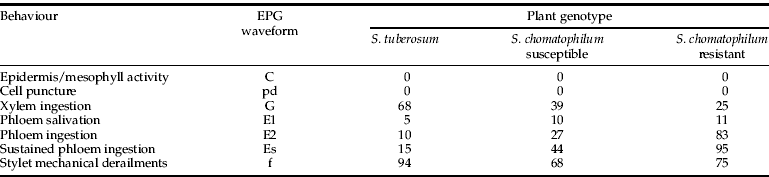
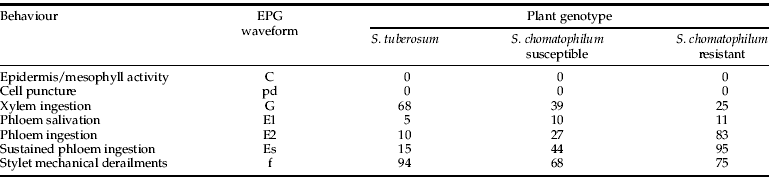
For the few EPG variables that could not be calculated because the behaviour associated to it did not occur, we took the following conservative approach to modify their values: for variables describing time to a behaviour (t_1Pr, t_1G, t_1E1rec, t_1E1, t_1E2rec, t_1E2, t_1Esrec, and t_1Es; see table 1), we ascribed the maximum possible value (5 h); for variables describing the average duration of a behaviour (a_Pr, a_C, a_G, G prop, a_E1, a_E1-E2, a_E2, a_Es, and a_F; see table 1), we ascribed the value of zero; for variables counting the number of bouts of a behaviour before the first occurrence of another behaviour (n_Pr>E1, n_Pr>E2, n_Pr>Es, n_E1>E2 and n_E2>Es; see table 1) that was not observed, we ascribed the total number of bouts of the behaviour that was counted; and for variables measuring the duration of a behaviour before the occurrence of another behaviour (a_E1>E2, and a_E2>Es; see table 1) that was not observed, we ascribed the total duration of the behaviour that was timed. Percentage of aphids that did not exhibit one of the behaviours is detailed in table 2, but cannot be used in the analysis as there is no variance associated with each value. Such a modification of variables was applied to limit any bias caused by the elimination of samples that did not exhibit one of the behaviours, as multivariate analysis deals with missing values by eliminating the entire sample.
Percentage of aphids that did not exhibit one of the behaviour recorded on one of the plant genotypes.
The influence of plant genotype and aphid age on the EPG variables was determined by applying multivariate analyses (Pompon et al., Reference Pompon, Quiring, Giordanengo and Pelletier2010a). EPG variables were then submitted to backward stepwise discriminant analysis (classic) at a tolerance of 0.001, and F-to-enter and F-to-remove equal to 0.02, to select a subset of variables relevant to group each combination of plant genotype×aphid age (Sokal & Rohlf, Reference Sokal and Rohlf1995). Factorial analyses based on a correlation matrix with varimax rotation option (orthogonal rotation minimizing the number of variables with high loadings), and a minimum eigenvalue of 1 (factors with eigenvalues lower than 1 were not retained) were applied to the EPG variables selected through the discriminant analysis. The biological interpretation of each factor was derived using the variables contributing the most to the factors. Factors are orthogonal to each other, allowing the use of factor scores as explanatory variables in general linear models and eliminating the problem of co-linearity (Quinn & Keough, Reference Quinn and Keough2002) inherent to behavioural variables. To assess the effect of plant genotype and aphid age on the behavioural factors, two-way ANOVA was applied to the factor scores. Statistical analyses were performed with Systat 12.0 (Systat Software, San José, CA, USA).
Results
Plant resistance level measured by fecundity
Fecundity was influenced by plant genotype (between subjects: df=2, 57; F=12.20; P<0.001), aphid age (within subjects: df=6, 342; F=40.95; P<0.001), and the interaction between plant genotype and aphid age (within subjects: df=12, 342; F=4.48; P<0.001). Fecundity was similar on tbr and chmS, and was the lowest on chmR, although these patterns were most apparent on days 3–6 (fig. 1).
Mean (±SEM) fecundity of adult alate Macrosiphum euphorbiae maintained on S. tuberosum (tbr) and two S. chomatophilum genotypes (chmS and chmR). Fecundity was measured from day of adult emergence (day 0) until aphids were six days old (day 6) ( , tbr;
 , chmS;
 , chmR).

Probing behaviour
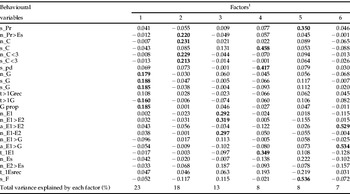
Of the 50 EPG variables calculated (table 1), 24 were retained by discriminant analysis (table 3). Factorial analysis using the 24 variables produced six factors explaining 77% of the total variance (table 3). According to factor loadings, factor 1 was related to ‘xylem sap ingestion’, factor 2 to ‘brief probe’, factor 3 to ‘phloem salivation bout’, factor 4 to ‘pathway activity’, factor 5 to ‘probing activity’ and factor 6 was related to ‘phloem salivation duration preceding sap ingestion’.
Factors defined through factorial analysis of behavioural variables measured daily for alate Macrosiphum euphorbiae on different plant genotypes for the first six days following the adult moult. The biological meaning of each factor was estimated by the loading value of the variables contributing the most to the factors. Loading values contributing the most to each factor are indicated in bold.

1 Factor 1 was related to ‘xylem sap ingestion’, factor 2 to ‘brief probe’, factor 3 to ‘phloem salivation bout’, factor 4 to ‘pathway activity’, factor 5 to ‘probing activity’ and factor 6 to ‘phloem salivation duration preceding sap ingestion’.
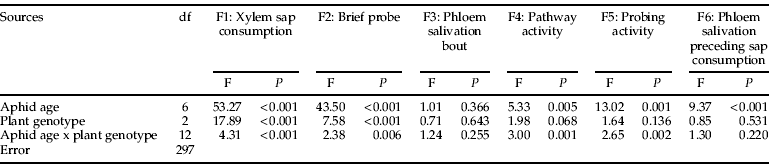
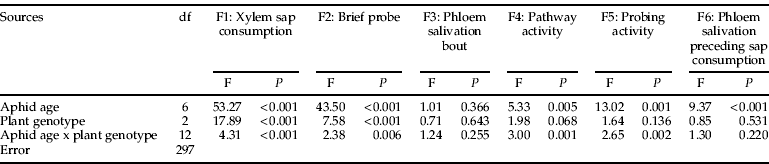
‘Xylem sap ingestion’ factor (F1) scores were affected by aphid age, plant genotype, and their interaction (table 4). It was lower for tbr than for the other plants, decreased with aphid age for tbr and chmS, and increased for chmR after four days (fig. 2). ‘Brief probe’ factor (F2) was affected by aphid age, plant genotype and their interaction. It was generally the lowest for tbr and the highest for chmR, was constant on tbr and increased for one and two days for chmS and chmR, respectively, before decreasing. ‘Phloem salivation bout’ factor (F3) was independent of the effect tested. ‘Pathway activity’ factor (F4) was influenced by aphid age and the interaction between aphid age and plant genotype. It was very variable for tbr and followed a similar variable pattern for both chmS and chmR. ‘Probing activity’ factor (F5) was influenced by aphid age and the interaction between aphid age and plant genotype. It was generally the lowest for chmR, on which it particularly varied as a function of age. ‘Phloem salivation duration preceding sap ingestion’ factor (F6) was only influenced by aphid age. Overall, scores of every factor were similar for chmS and chmR on day 0.
Effect of alate aphid age and plant genotype on probing behaviour factor scores. Factors are described in table 3.
Mean (±SEM) scores at different ages after adult moult of six factors (detailed in table 3) describing the probing behaviour of alate Macrosiphum euphorbiae maintained on S. tuberosum (tbr) and two Solanum chomatophilum genotypes (chmS and chmR) (—, tbr; -■-, chmS; - - ▲- -, chmR).

Discussion
Our study demonstrates the combined and independent effects of aphid age and plant resistance level on aphid behaviour. The fecundity results confirmed the resistant and susceptible status of chmR and chmS, respectively (Pompon et al., Reference Pompon, Li and Pelletier2011a). Using EPG and a multivariate statistical approach, we identified six behavioural factors on three distinct plant genotypes with different resistance levels.
During brief probes (<3 min), aphid stylets can only reach the epidermal layers (Powell et al., Reference Powell, Tosh and Hardie2006), from which they gain sufficient information to reject and leave the plant (Caillaud, Reference Caillaud1999; Powell & Hardie, Reference Powell and Hardie2000). This decision can be based on primary and secondary metabolites acting as token signs (Bernays, Reference Bernays2001), nutritional cues and/or chemical signals involved in plant defence (Li et al., 2002), although these cues are different in epidermis from the ones in phloem (Tosh et al., Reference Tosh, Powell, Holmes and Hardie2003). Phloem sap nitrogen quality has no impact at this stage (Nowak & Komor, Reference Nowak and Komor2010), as aphids have not reached phloem bundles. Brief probe factor (F2) scores were low and constant for S. tuberosum during the six days following the adult moult, likely because the brief probe stage quickly leads to the next behavioural stage of host-plant selection (pathway activity) on suitable plants (Tosh et al., Reference Tosh, Powell, Holmes and Hardie2003). Conversely, the increase of the brief probe factor scores for chmR and chmS after day 0 suggests that previous experience on these plants influenced the probing of superficial cues. Aphids may have associated superficial cues with the toxicity of deeper tissues, such as phloem sap, which is ingested during day 0 on S. chomatophilum (Pompon et al., Reference Pompon, Quiring, Giordanengo and Pelletier2010a). Probing behaviour can be modified through associative learning in insects (Mangel, Reference Mangel, Papaj and Lewis1993) and was suspected for the blackberry-grain aphid, Sitobion fragariae (Walker), which modifies its probing behaviour to avoid hydroxamic acids after previous exposure to plants containing high levels of hydroxamic acid (Ramírez et al., Reference Ramírez, Caballero and Niemeyer1999).
Pathway activity towards phloem bundles consists of inserting stylets into intercellular spaces in epidermal and mesophyll tissues. This stage usually includes the puncture of cells, which provides gustatory information (Powell et al., Reference Powell, Tosh and Hardie2006). Cell puncture frequency can be influenced by symplastic compounds (Chen et al., Reference Chen, Rahbé, Delobel, Sauvion, Guillaud and Febvay1997) and is suspected to trigger parturition (Powell et al., Reference Powell, Tosh, Hardie, Simon, Dedryer, Rispe and Hull2004). Early reproductive decisions, based on peripheral cues, provide a fitness advantage (Powell et al., Reference Powell, Tosh and Hardie2006). The variation of the pathway activity with cell puncture factor score (F4) is difficult to interpret on S. tuberosum, whereas the factor score increase on chmS and chmR may be interpreted as changes in the sensitivity to cues of deeper plant tissues, similar to those observed for brief probes. Alternatively, the factor could be related to the ability to penetrate the mesophyll tissue (Mutti et al., Reference Mutti, Louis, Pappan, Pappan, Begum, Chen, Park, Dittmer, Marshall, Reese and Reeck2008).
Derailed stylet mechanics is visualized as the waveform F (Tjallingii, Reference Tjallingii, Minks and Harrewijn1988). Little is known about the reasons for such activities, except that it is related to the gelling saliva (Tjallingii, Reference Tjallingii, Minks and Harrewijn1988), depends on plant age and virus infection (Alvarez et al., Reference Alvarez, Garzo, Verbeek, Vosman, Dicke and Tjallingii2007) and can last from several minutes to hours (data not shown; Tjallingii, Reference Tjallingii, Labeyrie, Fabres and Lachaise1987). The gelling saliva is continuously excreted during the intercellular stylet penetration of the mesophyll (pathway activity) and forms a salivary sheath enveloping the stylets (Tjallingii, Reference Tjallingii2006), potentially protecting stylets from plant contacts. Stylet derailment is suspected to reflect adverse conditions (Caillaud et al., Reference Caillaud, Pierre, Chaubet and Di Pietro1995), as exemplified by its increase on S. stoloniferum resistant plants for the peach-potato aphid, Myzus persicae (Sulzer) (Alvarez et al., Reference Alvarez, Tjallingii, Garzo, Vleeshouwers, Dicke and Vosman2006). We found that probing activity factor (F5), mainly made of the stylet derailment variable, was more prominent on the resistant genotype but varied with aphid age.
Phloem salivation is the first behaviour performed after reaching phloem bundles and always occurs before phloem ingestion. It may provide information about phloem sap quality (Tjallingii, Reference Tjallingii2006), but especially it is supposed to prevent phloem protein clogging, which is part of the plant wound response (Will et al., Reference Will, Tjallingii, Thonnessen and van-Bel2007). Phloem salivation duration increases when aphids face nutritionally unbalanced (Ponder et al., Reference Ponder, Pritchard, Harrington and Bale2000) or toxic phloem sap (Ramírez & Niemeyer, Reference Ramírez and Niemeyer1999), while the saliva composition may adjust to (Tjallingii, Reference Tjallingii2006) and modify phloem sap quality (Girousse et al., Reference Girousse, Moulia, Silk and Bonnemain2005; Nowak & Komor, Reference Nowak and Komor2010). The number of phloem salivation bouts (F3) is related to the difficulty to detect suitable phloem vessels, whereas phloem salivation duration (F6) indicates either difficulties in preventing plant sap clogging or a reaction to phloem sap quality (Tjallingii, Reference Tjallingii2006). Our results showed that aphids did not experience difficulty in finding phloem bundles on the genotype tested, but that their general reaction to phloem sap quality (illustrated by F6) varied with adult age and did not follow a regular pattern.
Xylem sap ingestion is a general response to osmotic stress (Pompon et al., Reference Pompon, Quiring, Goyer, Giordanengo and Pelletier2011b). The xylem sap ingestion factor (F1) was the most clearly divergent between the plant genotypes, and strikingly increased in old aphids on the resistant genotype (chmR), while it steadily decreased with age on chmS as on S. tuberosum. Xylem sap ingestion might have succeeded in limiting the negative impact of the resistance mechanism on chmS. We speculate that toxins in phloem sap, which have been suggested to trigger xylem sap ingestion (Givovich & Niemeyer, Reference Givovich and Niemeyer1995), could have been diluted below their deleterious concentration in chmS by ingesting xylem sap. For chmR, higher toxin concentrations may have restricted the beneficial impact of xylem sap ingestion, resulting in shorter survival (Pompon et al., Reference Pompon, Li and Pelletier2011a) and lower fecundity. Further analyses of phloem sap constituents are required to test that hypothesis.
Our study showed that behaviour differences between resistant and susceptible genotypes can develop days after host-plant selection. This questions conclusions on resistance mechanisms drawn from punctual behavioural studies. Previous studies that assessed behaviour during the first hours an aphid encountered a plant revealed that xylem sap ingestion increased on resistant S. chomatophilum accessions (Le Roux et al., Reference Le Roux, Dugravot, Campan, Dubois, Vincent and Giordanengo2008; Pelletier et al., Reference Pelletier, Pompon, Dexter and Quiring2010; Pompon et al., Reference Pompon, Quiring, Giordanengo and Pelletier2010a). In our study, we only observed a difference in the duration of xylem sap ingestion between a susceptible and a resistance genotype of S. chomatophilum after six days, confirming that S. chomatophilum resistance influences xylem sap ingestion. Performance evaluation is conducted over several days and is better accounted for by behaviour observation over the same time-period. Our results support the hypothesis that aphids modify their behaviour to react and/or adapt to plant characteristics after host selection, pointing to complex dynamic interactions between insects and plants.
Acknowledgement
The authors thank Dan Quiring for comments. This work was supported by the Comité Nord des Producteurs de Plants de Pomme de Terre and the MII program of Agriculture and Agri-Food Canada. Additional support was provided by a NSERC Discovery grant and the University of New Brunswick.