1. Introduction
European Union countries are diverse in terms of the level of socio-economic development (Fura and Wang Reference Fura and Wang2017; Stec et al. Reference Stec, Filip, Grzebyk and Pierścieniak2014; Timmer et al. Reference Timmer, Inklaar, O’Mahony and Ark2010; Wesseling Reference Wesseling1998). In order to reduce economic, social and territorial disparities between the individual Member States, the European Union has a cohesion policy. Financial assistance under the cohesion policy is primarily aimed at supporting areas with lower development level, with a geographical or natural disadvantage, low population density and with mountain areas. Proper distribution of financial resources requires constant monitoring of changes in the level of socio-economic development of Member States.
Tourism is now considered to be a very important element of international relations. Interdisciplinarity and the high dynamics of development of this field result from the fact that individual countries or regions perceive tourism as an instrument to solve many economic and socio-cultural problems. Policymakers should therefore implement relevant economic decisions to sustain efforts to spur growth in the tourism sector (Cannonier and Burke Reference Cannonier and Burke2017; Ohlan Reference Ohlan2017; Shahbaz et al. Reference Shahbaz, Kumar and Ivanov2017).
As confirmed by research, Europe is the world’s number one tourist destination (European Commission 2010; UNWTO 2018; Juul Reference Juul2015). Europe’s main strengths include its infrastructure, its cultural diversity in a comparatively small area, and its borderless travel area within the Schengen zone. In the European Union, tourism is the third largest socio-economic activity and makes an important contribution to the EU’s gross national product and to employment (tourism generates 10% of GDP and represents 9% of total employment in the European Union). Maintaining Europe’s leading market position has been set as the objective of EU tourism policy. Tourism can become a strong point especially for those EU countries with rich tourist values, but with a lower level of socio-economic development. Therefore, it is extremely important to examine EU countries in terms of the level of tourist function development.
The aim of this article is to compare and statistically assess the level of socio-economic development and level of tourist function development of EU countries. With the use of diagnostic variables defining both these complex phenomena for 2016, EU countries were organized and classified according to the TOPSIS (Technique for Order Preference by Similarity to an Ideal Solution) method. Moreover, variables having the greatest impact on the classification of EU countries in terms of the level of development of both the studied complex phenomena were indicated with the use of discriminant analysis. The influence of particular complex phenomena on the value of the overall synthetic measure was also assessed.
In order to implement research assumptions, we tried to answer the following questions:
Which EU countries can be considered as leaders in terms of the level of socio-economic development, and which have an average or low level?
Which countries have a leading tourist function, and in which countries does it play a marginal role?
Which diagnostic variables have the greatest impact on the classification of EU countries in terms of the level of socio-economic development and level of tourist function development?
Which of the complex phenomena under study are relatively more important for the overall socio-economic situation?
What is the practical significance of the obtained results?
2. Socio-economic Development and Tourist Function of an Area – a Literature Review
Socio-economic development is a concept that is difficult to define, it includes many elements at once, and depends on the context of its use. The concept of development is based on the concept of change, which constitutes a transition from one state of affairs to another. Determining socio-economic development as a sequence of changes consists of indicating what characterizes these changes and what determines them. The nature of socio-economic development is determined by development processes and/or development goals. Generally, these processes are internally ordered sequences of changes in states of things or phases in which the determination of some states by subsequent states takes place (Takamori and Yamashita Reference Takamori and Yamashita1973).
Some authors (Bellu Reference Bellu2011; Khan Reference Khan1991) define socio-economic development more broadly, treating it as a process of positive quantitative–qualitative changes (involving increasing and improvement of existing phenomena and emergence and development of new phenomena) in the sphere of all economic, cultural and social activities as well as social-production and political-constitutional relations. Other authors (Chojnicki Reference Chojnicki2010; Fritz Reference Fritz2004) even point out that this development process also includes, apart from economic changes, changes of a social nature. Social development determines economic development and viceversa. Without one, the other will not exist, but both components contribute to the mechanism that drives the ‘circle of development’ in the long run.
Hence, the attributes of thus defined changes are (Litwiński Reference Litwiński2017; Rodriguez et al. Reference Rodríguez Martin, Holgado Molina and Salinas Fernández2012) irreversibility and the positive assessment of on-going changes from the perspective of a given value system or the principles recognized by interest groups in a regional or local perspective. The processes of change in a socio-economic system, on the other hand, are dictated by human activity and behaviour (controlling and monitoring). They are focused on achieving the particular states of the final processes that serve as the realization of certain objectives of the activity.
Taking into account different approaches to the definition of socio-economic development, the authors of this article understand socio-economic development as all qualitative and quantitative changes directed at gaining certain aims. These are irreversible changes in the sphere of any economic, cultural and social activity as well as social and production and political and systemic relations.
It is worth emphasizing that socio-economic development as a complex process is conditioned by many factors, which most often include (Cracolici et al. Reference Cracolici, Cuffaro and Nijkamp2010):
geographical – shaped by nature (natural environment) and human (artificial environment), related to the place of business;
scientific and technical – related to the level of knowledge, development of work tools and ability to use them;
demographic – related to the number and structure of population living in the area where the activity is or will be conducted;
socio-economic – resulting from the nature of economic and social relations and determined by the level of economic development that has been achieved;
resulting from the external environment.
Similar conditions are pointed out by Szirmai (Reference Szirmai2015), listing the following factors:
external (exogenous) and internal (endogenous);
various factors or barriers for development,
presented according to the SWOT analysis, i.e. strengths, weaknesses, opportunities and threats;
specified according to another classification criterion.
According to this author (Szirmai Reference Szirmai2015), traditional development factors are: natural, human resources and capital. Natural conditions consist of all components of the geographical environment, related to space occupied by specific nations and local communities. They are natural and at the same time internal conditions for the development of each society. The role of people in the development process is determined by the size of the population and its spatial distribution, population structure, and method of use in production and service processes. Capital, on the other hand, is included in the total value of fixed assets and non-durable items (equipment). In a spatial aspect, this is everything that is called existing spatial planning together with technical equipment (machines and devices). The sum of these resources is the so-called standard of technical and economic equipment of a given country, region, commune, city or village.
Tourism is one of the areas of economic activity that is considered to be a stimulator of social and economic development.
Tourism, as one of the fastest growing economic areas and as a social phenomenon, is a driving force for many national economies, especially those with a lower level of socio-economic development (Flecha et al. Reference Flecha, Fusco, Damiani and Amaral2010; Lee and Chang Reference Lee and Chang2008; Marzuki Reference Marzuki2009; Sharpley and Telfer Reference Sharpley and Telfer2014). It gives an opportunity to improve the competitiveness of a region (country) by increasing employment, increasing GDP, increasing revenues from tourism coming from, among other things, tourist expenses and emergence of new tourist infrastructure (Dritsakis Reference Dritsakis2004; Ekanayake and Long Reference Ekanayake and Long2012).
Tourism, as a multidimensional and complex phenomenon, in conditions of globalization, has become a distinctive feature of modern lifestyles and a significant element of socio-economic development both on a regional and global scale and a factor of international integration. Together with the growing importance of tourism in the European Union, it has become a priority branch of the economy in many countries. Currently, tourism activity is considered to be one of the indicators of residents’ standard of living and one of the indicators of developing societies.
Tourism is currently one of the most dynamically developing fields of economic activity in the world. The essence of tourism lies in the fact that it has multiple aspects (heterogeneity), because on one hand this activity is a result of socio-economic changes, and on the other, it becomes an indispensable element of the development of contemporary societies (Gnanapala and Sandaruwani Reference Gnanapala and Sandaruwani2016; Matarrita-Cascante Reference Matarrita-Cascante2010; Nassani et al. Reference Nassani, Aldakhi and Abro2018). This field of the economy benefits the countries or regions that invest in it. An example of such a country is Switzerland. It should be emphasized that 100 years ago Switzerland was a poor agricultural country in which about two-thirds of the territory was considered non-productive, i.e. unfit for agricultural purposes or other industrial activity (in Switzerland over 60% of the territory is covered by the Alps). However, it is elements of Switzerland’s natural landscape, i.e. the very interesting shaping of the area, mountain ranges and lakes, that became a basis for the birth of tourism in this country (Klimek Reference Klimek2010).
It should be noted that even the European Commission conducts a so-called guide on tourism development. It contains many guidelines that will shape the development of tourism in an appropriate way. According to this guide, development of a tourist function of a given country or region depends, among other things, on appropriate natural values, features that distinguish this area from the rest of the environment, creating clusters of tourist attractions, creating a brand of tourist destinations, strategic planning or others (see https://ec.europa.eu/regional_policy/pl/policy/themes/tourism/).
‘Tourist function’ is most often understood as a socio-economic activity carried out by a specific area and its inhabitants, and directed at services related to tourist traffic. Therefore, this activity located in a given area and its environment consists of activities of its permanent and temporary residents, various institutions and organizations, as well as geographical environment resources enabling the performance of such activities. The overriding goal of undertaking such activities is to help arriving tourists their restore normal psychophysical abilities, which may have been lost as a result of fatigue (Stoffelen and Vanneste Reference Stoffelen and Vanneste2017).
Specialization of tourist function is extremely rare on its own, and usually it is one of many service functions. Large-scale provision of tourist goods and services requires a very strongly developed service sector (Nayomi and Gnanapala Reference Nayomi and Gnanapala2015). Hence, the occurrence of tourist function is conducive to the creation of many complementary, e.g. commercial, communication functions, which, as the area develops, may dominate it (Alipour et al. Reference Alipour, Eshliki and Kaboudi2012). For example, in small towns, the tourist function, due to a poorly diversified functional structure, has a chance to obtain a dominant position, which is not the case in large cities. It is, therefore, necessary to better understand the nature of the tourist function itself, its relation to other functions, and its role in the socio-economic development of a given territory. The relevance of this issue is due to the current recognition that tourist function aspires to be a factor of great importance for the development of individual regions or countries through generating jobs and income, stimulating investments, ecological and cultural knowledge, and taking care of broadly understood social health.
A tourist function is universal in its endogenous dimension. It occurs without exception, although to a different extent, because we organize our leisure everywhere, including in the place of our permanent residence. However, in its exogenous dimension, it is a highly specialized function. Geographical location, which determines the size and nature of tourism resources, largely determines this. The presence of the appropriate size and quality of tourism resources and demand for tourism goods and services have an impact on meeting the needs in the sphere of tourism, and this has an impact on the level of development of a given area. Both demand and tourism resources are internally quite strongly diversified, which, in turn, causes specialization within the tourist function itself, and thus specialization within the scope of tourist goods and services provided by a specific territorial unit.
Full satisfaction of demand reported by tourists requires the coexistence and cooperation of many individual goods and services produced by different producers. Tourists visiting a given region report demand for specific goods and services, they import and spend money. These funds are the revenues of entities operating in a given region, but they are also allocated, among others, to employees’ remuneration and purchases of the goods and services necessary for conducting further operations. At the same time, this results in an increase in budget revenues of local government units in the form of tax revenues (Lacher et al. Reference Lacher, Sanjay and Nepal2010).26
Some authors even emphasize that the tourist function does not develop spontaneously, it is part of local and regional development processes and is an important impulse that makes socio-economic development of the whole country more dynamic (Lee Reference Lee2013). Development of tourism leads to investment revival (including the development of technical infrastructure), a consequence of which is an inflow of capital from outside the region, in many cases from abroad. This is clearly visible in the example of the development of business tourism and the presence of global hotel chains in a region (Kulendran and Wilson Reference Kulendran and Wilson2000; Sugiyarto et al. Reference Sugiyarto, Blake and Sinclair2003).
It should also be emphasized that development of tourist function in a region has an impact on the region’s overall image (Gierczak-Korzeniowska Reference Gierczak-Korzeniowska2019), which refers to all aspects of its functioning, and thus the tourist function is addressed to a wider range of people than just tourists and vacationers (Haralambopoulos and Pizam Reference Haralambopoulos and Pizam1996).
The significance of tourist function manifests itself in a greater ability to generate new jobs, improve the quality of life of the local communities (Andereck and Vogt Reference Andereck and Vogt2000), or increase the competitiveness of individual regions, which has a huge impact on raising the level of socio-economic development.
Development of the tourist function is associated with economic and social development. Less developed countries gain importance and, thanks to the development of the tourist function, they have a chance of economic development, thus raising the standard of living for their residents.
3. Methods Applied
The level of socio-economic development and the level of tourist function development of EU countries are complex phenomena that are difficult to assess with a single indicator.
Therefore, in this article, we have used one of the so-called Multidimensional Comparative Analyses – the TOPSIS method to analyse these multi-dimensional phenomena. This method makes it possible to determine the value of synthetic measure (aggregate measure), thus replacing the description of objects using a set of diagnostic features with one aggregate. Thanks to such a procedure, the obtained results are considered to be more objective and easier to interpret compared to results obtained on the basis of individual indicators.
The TOPSIS method belongs to the so-called pattern methods; it consists of determining Euclidean distance from both the pattern and development anti-pattern (Hwang and Yoon Reference Hwang and Yoon1981).
In pursuing the goals of their work, we have identified the following stages in the research procedure.
(1) Proposing a preliminary set of variables defining the complex phenomenon under study and the presentation of values of variables X j (j = 1, 2, …, m) describing the examined objects O i (i = 1, 2, …, n) in the form of an observation matrix:
 $${\bf{X}} = \;\left[ {\matrix{
{{x_{11}}} & {{x_{12}}} & \cdots & {{x_{1m}}} \cr
{{x_{21}}} & {{x_{22}}} & \cdots & {{x_{2m}}} \cr
\vdots & \vdots & \vdots & \vdots \cr
{{x_{n1}}} & {{x_{n2}}} & \cdots & {{x_{nm}}} \cr
} } \right]\;$$
(2) Conducting the selection of diagnostic variables.
A condition for correct implementation of the linear arrangement of objects is to check the pre-proposed variables defining a complex phenomenon due to the discriminating ability and duplication of information. Diagnostic variables should be characterized by an appropriate level of variability, therefore variables for which coefficients of variation are calculated from the below formula are subject to elimination (their value does not exceed the threshold of 10%):
 $${v_j} ={{{{s_j}}}\over{{{{\overline x}_j}}}} \times 100{\rm{ }}$$
where:
 ${\overline x_j}$
= arithmetic mean for feature X
j
,
 ${s_j}{\rm{ }}$
= standard deviation for feature X
j
.
Diagnostic variables should also not be excessively correlated, which may cause them to be carriers of similar information. An interesting procedure for evaluating the level of correlation of variables is the method of the inverse matrix of Pearson linear correlation coefficients (Malina and Zeliaś Reference Malina and Zeliaś1997). It means that in the case of strong correlation between variables, diagonal elements of a matrix inverse to the correlation matrix (R -1) significantly exceed the value of 10, which is a symptom of poor numerical conditioning of the Pearson linear correlation coefficient matrix (R).
(3) Bringing variables to comparability by normalizing values of variables by means of zero unitarization, according to the following formulas (Kukuła Reference Kukuła2000).
For stimulants:
 $${z_{ij}} = \;{{{x_{ij}} - \mathop {\min }\limits_i \{ {x_{ij}}\} } \over {{R_j}}}$$
For destimulants:
 $${z_{ij}} = {\rm{ }}{{\mathop {\max }\limits_i \{ {x_{ij}}\} - {x_{ij}}} \over {{R_j}}}$$
It should also be added that the method of zero unitarization used for normalization is a recommended way of bringing variables to comparability, widely accepted, among others, within the methodology of counting the Human Development Index.
(4) Determination of coordinates for model units – pattern (A +) and development anti-pattern (A –) (see Hwang and Yoon Reference Hwang and Yoon1981):
 $${A^ + } = (\mathop {\max \;}\limits_i {\kern 1pt} ({z_{i1}}),\;\mathop {\max \;}\limits_i ({z_{i2}}),\; \cdots ,\mathop {\max {\kern 1pt} \;}\limits_i ({z_{im}}) = (z_1^ + ,z_2^ + ,...,\;z_m^ + )$$
 $${A^ - } = (\mathop {\min \;{\kern 1pt} }\limits_i ({z_{i1}}),\mathop {\min \;}\limits_i {\kern 1pt} ({z_{i2}}),\; \cdots \;,{\kern 1pt} \,\mathop {\min }\limits_i \;{\kern 1pt} ({z_{im}}) = (z_1^ - ,z_2^ - ,...,\;z_m^ - )$$
(5) Calculation of Euclidean distance of each object from the pattern z + and anti-pattern z - with the use of formulas:
 $$d_i^ + = {\rm{ }}\sqrt {\sum\limits_{j = 1}^m {{{\left( {{z_{ij}} - z_m^ + } \right)}^2}} } ,{\mkern 1mu} \;d_i^ - = {\rm{ }}\sqrt {\sum\limits_{j = 1}^m {{{\left( {{z_{ij}} - z_m^ - } \right)}^2}} } $$
(6) Determination of synthetic measure value:
 $${S_i} = {\rm{ }}{{d_i^ - } \over {d_i^ + + d_i^ - }}$$
where the S i measure takes values from the range [0;1]. The smaller the distance of a given object from the development pattern, and thus greater than the development anti-pattern, the closer to unity is the value of the synthetic measure. This means that an object (country) is more developed when it comes to a studied complex phenomenon when it acquires a synthetic measure value that is closer to unity.
(7) Classification of objects into groups which are similar in terms of the studied complex phenomenon. According to the scheme (Nowak Reference Nowak1990):
 $$\begin{array}{l@{\quad}l}
\textrm{group I:}\ S_i \geq \bar{S}_i + S_{S_{i}} & \text{high evel}\\
\textrm{group II:}\ \bar{S}_i + S_{S_{i}} > S_i \geq \bar{S}_{i} & \textrm{medium-high level}\\
\textrm{group III:}\ \bar{S}_{i} > S_{i} \geq \bar{S}_{i} - S_{S_{i}} & \textrm{medium-low level}\\
\textrm{group IV:}\ S_i < \bar{S}_i - S_{S_{i}} & \text{low level}
\end{array}
$$
where:
 ${\overline S_i}$
= mean value of synthetic measure,
 ${S_{{S_i}}}$
= standard deviation of synthetic measure.
(8) Application of discriminant analysis in order to identify variables that have the greatest impact on the classification of EU countries in terms of the level of development of complex phenomena under study.
Discriminant analysis is a statistical technique that makes it possible to study differences between groups by analysing several variables simultaneously. It decides if groups differ due to an average of the highlighted variable, and then uses it to predict belonging to a group. This method also allows us to check which variables are the best to discriminate against groups. Assumptions of the discriminant method can be found, among others, in the works of Fisher (Reference Fisher1936), Huberty and Olejnik (Reference Huberty and Olejnik2006) and Klecka (Reference Klecka1981).
(9) Construction of a linear econometric model, in which the role of explanatory variable would be the value of general synthetic S iO measure, determined by the TOPSIS method including all 17 diagnostic variables (11 variables defining the level of socio-economic development of EU countries and six variables characterizing the level of tourist function development), while explanatory variables are values of synthetic measures determined separately for both complex phenomena (S iD , S iT ). Thanks to such proceedings, it is possible to assess whether explanatory variables exert a significant influence on the explained variable.
 $${\hat S_{iO}} = {a_0} + {a_1}{S_{iD}} + {a_2}{S_{iT}}$$
where:
a 0, a 1, a 2 = structural parameters of a model,
S iO , S iD , S iT = synthetic measures.
In order to determine the relative importance of explanatory variables in explaining changes in the explained variable, the so-called ‘validity’ coefficients can be determined according to the formulas:
 $${b_1} = {{{{{\overline S}_{iD}}}}\over{{{{\overline S}_{iO}}}}} \,{a_1}$$
 $${b_2} = {{{{{\overline S}_{iT}}}}\over{{{{\overline S}_{iO}}}}} \,{a_2}$$
where:
 ${\overline S_{iO}}$
,
 ${\overline S_{iD}}$
,
 ${\overline S_{iT}}$
= mean value of synthetic measures.
Greater absolute values of the b i coefficient indicate a relatively greater impact of a given explanatory variable on the explained variable of a model.
4. Variables Defining the Studied Complex Phenomena and their Statistical Verification
In order to assess the level of socio-economic development of EU countries, we initially proposed the following variables:
X1D – GDP per capita in euro (current prices) in thousands (S).
X2D – Gross value added by kinds of activity-services in % (S).
X3D – Gross domestic expenditure on research and development activity (R&D) in % of GDP (S).
X4D – Investment rate in % (S).
X5D – Share of high-tech exports in total exports in % (S).
X6D – Infant deaths rate per 1000 population (D).
X7D – Activity rate in % (S).
X8D – Employment rate in % (D).
X9D – At-risk-of-poverty rate in % (D).
X10D – Students of higher education institutions per 10 thousand of population (S).
X11D – Mobile telephone subscribers per 1000 population (S).
X12D – CO2 emissions from fuel combustion in tonnes per square kilometre of area (D).
Symbols (S) and (D) indicate the character of a variable, respectively treating it as a stimulant or destimulant.Footnote 1 Variables proposed to assess the level of socio-economic development of EU countries represent the most important aspects of socio-economic development of individual countries (Rao Reference Rao1976). Basic descriptive parameters of these variables for EU countries are presented in Table 1.
Descriptive statistics of variables based on socio-economic development in countries in 2016.

Source: Own elaborations based on Eurostat data (http://ec.europa.eu/eurostat/data/database).
When analysing the statistical data presented in Table 1, it can be seen that EU countries are the most diversified in terms of variable X12D – CO2 from fuel combustion in tonnes per square kilometre of area. The coefficient of variation amounted to 116.80%.
The lowest value of the coefficient of variation (5.10%) was obtained for variable X7D – Activity rate in %. This variable, in accordance with criteria for selection of diagnostic variables, is eliminated from the initial set of variables defining the level of socio-economic development of EU countries. The remaining variables have been checked in terms of the level of correlation. Pearson linear correlation coefficients between variables did not take high values and the correlation test procedure with the use of inverse correlation matrix method did not eliminate any of the variables. All diagonal elements of the matrix inverse to the R –1 correlation matrix did not exceed 10 (Table 2).
Matrix inverse to correlation matrix (level of socio-economic development).

Source: Own calculations.
Ultimately, in subsequent studies, the following diagnostic variables remained to assess the level of socio-economic development of EU countries: X1D, X2D, X3D, X4D, X5D, X6D, X8D, X9D, X10D, X11D, X12D.
The next step in the research was the selection of diagnostic variables for the assessment of the second complex phenomenon under study, i.e. the level of tourist function development of EU countries. Here, the following variables have been pre-proposed:
X1T – Number of bed places per 1000 population (Beretje and Defert index) (S).
X2T – Number of accommodated tourists per square kilometre of area (Defert index) (S).
X3T – Number of accommodated tourists per 1000 population (Schneider index) (S).
X4T – Number of nights spent per 100 population (Charvat index) (S).
X5T – Density of accommodation (number of tourist bed places per square kilometre of area) (S).
X6T – The accommodation capacity index (number of provided bed places in group accommodation facilities) (S).
X7T – The relation between the income and expenses regarding foreign tourism (S).
X8T – The percentage of employees in tourism development and gastronomy in the general number of employees (S).
All of the proposed variables for assessment of the tourist function development level are stimulants. Descriptive statistics for these variables are included in Table 3.
Descriptive statistics of variables based on tourist function in countries in 2016.

Source: Own calculations based on Eurostat data (http://ec.europa.eu/eurostat/data/database).
Based on the data contained in Table 3, it can be seen that all variables (X1T – X8T) meet the criterion of the appropriate level of variation (coefficients of variation for all variables are greater than 10%). A study of the correlation level between individual variables showed, in some cases, a strong correlation relationship. Therefore, from the initial set of variables determining the level of tourist function development, the following variables were eliminated: X2T and X4T. the definitive matrix inverse to the correlation matrix is presented in Table 4.
Matrix inverse to correlation matrix (level of tourist function).

Source: Own calculations.
Diagnostic variables that were used to assess the level of tourist function development of EU countries were: X1T, X3T, X5T, X6T, X7T, X8T.
5. Empirical Results
After selecting diagnostic variables to assess the level of socio-economic development and level of tourist function development of EU countries, in the subsequent stages of the research procedure (separately for each complex phenomenon) normalization of variables according to equations (3) and (4) was carried out, and values of synthetic measures SiD and SiT were determined using the TOPSIS method. In a similar way, only taking into account all diagnostic variables (17 variables), values of the synthetic SiO measure were also calculated. The received rankings of EU countries are presented in Table 5.
Rating of EU countries based on value of synthetic measure of level of socio-economic development (SiD), tourist function (SiT) and general synthetic variable (SiO) in 2016.

BE – Belgium, BG – Bulgaria, CZ – Czech Republic, DK – Denmark, DE – Germany, EE – Estonia, IE – Ireland, EL – Greece, ES – Spain, FR – France, HR – Croatia, IT – Italy, CY – Cyprus, LV – Latvia, LT – Lithuania, LU – Luxembourg, HU – Hungary, MT – Malta, NL – the Netherlands, AT – Austria, PL – Poland, PT – Portugal, RO – Romania, SI – Slovenia, SK – Slovakia, FI – Finland, SE – Sweden, UK – United Kingdom.
Source: Own calculations based on Eurostat data (http://ec.europa.eu/eurostat/data/database).
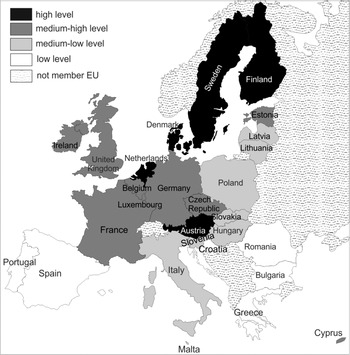
In 2016, the leaders of EU countries in terms of socio-economic development level are (Table 5, Figure 1): Austria, Sweden, Denmark, Finland and the Netherlands included in a group with high level of development. These countries have achieved the most favourable average values of eight output variables, i.e. X1D – GDP per capita in euros (current prices) in thousands; X3D – Gross domestic expenditure on research and development activity (R&D) in % of GDP; X4D – Investment rate in %; X6D – Infant deaths rate per 1000 population; X8D – Employment rate in %; X9D – At-risk-of poverty rate in %; X10D – Students of higher education institutions per 10,000 population; X11D – Mobile telephone subscribers per 1000 population.
Classification of EU countries in terms of level of socio-economic development in 2016.

Nine EU countries (France, Cyprus, Estonia, Luxembourg, Germany, Czech Republic, Ireland, Belgium and the United Kingdom) qualified to group II, with a medium-high level of socio-economic development. These countries dominate in terms of two variables: X2D – Gross value added by kinds of activity-services in %, and X5D – Share of high-tech exports in total exports in %.
Group III, with a medium-low development level, comprising eight countries (Slovenia, Hungary, Poland, Latvia, Malta, Italy, Lithuania and Slovakia), is not distinguished in terms of any output variable defining the level of socio-economic development.
The last countries in the ranking in terms of socio-economic development level were: Romania, Bulgaria, Greece, Croatia, Portugal and Spain. This group is characterized by the most favourable variable value X12D – CO2 emissions from fuel combustion in tonnes per square kilometre of area.
In order to decide which variables distinguish (discriminate) the created groups of EU countries due to the level of development of studied complex phenomena, discriminant analysis was used. The calculated value of the Wilks lambda test (0.0097), as well as value of the F statistic (4.85) and corresponding test probability value p < 0.001 indicate that discrimination of EU countries in terms of the level of socio-economic development, determined with the use of the analysed variables, is statistically significant. Variables that discriminate against this division into groups the most are: X1D – GDP per capita in euro (current prices) in thousands (p = 0.024); X8D – Employment rate in % (p = 0.044); X10D – Students of higher education institutions per 10,000 population (p = 0.0037); X11D – Mobile telephone subscribers per 1000 population (p = 0.018).
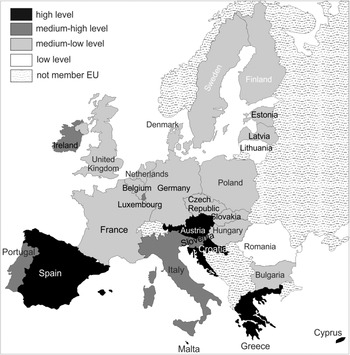
However, when analysing the ranking of EU countries in terms of the level of tourist function development, it can be noted that Malta, Croatia, Cyprus, Greece, Austria and Spain are countries with a high level of tourist function development. This group has achieved the most favourable average values of all output variables defining the level of tourist function development. It can therefore be concluded that in these countries tourism has a dominant meaning and may constitute their smart specialization. Portugal, Italy, Ireland, Slovenia and Luxembourg also have a fairly good situation in the studied area. The majority of EU countries (15 countries) are included in group III, with the average-low level of tourist function development. Only two countries (Lithuania and Romania) have achieved a low level of tourist function development (Figure 2).
Classification of EU countries in terms of level of development of tourist function in 2016.

When verifying the division of EU countries into groups due to the level of tourist function development, discriminant analysis was also used. The calculated Wilks lambda value (0.075), as well as F statistic (18.5) and corresponding test probability p < 0.0001 indicates statistically significant discrimination of groups of countries created with the TOPSIS method. The most discriminating variable turned out to be SiO – The percentage of employees in tourism development and gastronomy in the general number of employees (p = 0.0015).
In the last stage of the research procedure, a linear econometric model with synthetic variables was constructed in accordance with equation (10).
The results of model estimation with the use of Least Squares Method are presented in Table 6.
Estimation results of a linear econometric model with synthetic variables.

Source: Own calculations.
Based on the data contained in Table 6, it can be seen that synthetic variables S iD and S iT have a significant impact on general synthetic variable S iO (in all cases, p test probability is 0). In contrast, the obtained significance coefficient values indicate that relatively greater importance in the description of the formation of the general synthetic measure is played by the aggregate measure defining the level of socio-economic development (b 1 = 0.716). This conclusion is also confirmed by values of the Pearson linear correlation coefficient:
 $${r_{{S_{iO}}\;{S_{iD}}}} = 0,726,\,{r_{{S_{iO}}\;{S_{iT}}}} = 0,551$$
The relationship between the general synthetic measure and a synthetic measure of socio-economic development of EU countries can be considered quite strong in a positive direction. On the other hand, there is a moderate positive correlation dependence between the general synthetic measure and a synthetic measure of the development of the tourist function of EU countries.
6. Conclusion
Socio-economic development and level of tourist function development are complex phenomena of a multidimensional nature. The complexity of these phenomena makes it necessary to apply both statistical and econometric methods, as well as multidimensional comparative analysis in comparative studies of objects (e.g. EU countries).
Statistical evaluation of two complex phenomena, i.e. level of socio-economic development and level of tourist function development in 28 European Union countries, included nine subsequent stages of proceedings. In the initial stage, initial variables describing both phenomena submitted in 2016 and selection of diagnostic variables were proposed. Then, the ordering of EU countries was carried out with the use of the TOPSIS method. Values of the general synthetic measure were also determined to take into account all diagnostic variables. Rankings of EU countries were built and four typological groups of countries with high, medium-high, medium-low and low level of development were created.
Obtained results confirm the fact of diversifying EU countries in terms of the level of socio-economic development and level of tourist function development.
Austria, Sweden, Denmark, Finland and the Netherlands are leaders in the ranking in terms of the level of socio-economic development. Most EU countries (17 countries) have an average level and six countries (Spain, Portugal, Croatia, Greece, Bulgaria and Romania) low level.
However, Malta, Croatia, Cyprus, Greece, Austria and Spain have a high level of tourist function development. It can therefore be concluded that tourism has a dominant meaning in these countries and may constitute their smart specialization. The largest number of EU countries (20 countries) were included in the group with an average level of development of the studied phenomenon. Ranking of EU countries in terms of the level of development of tourist function is closed by Lithuania and Romania.
Econometric analysis has confirmed a significant impact of synthetic measures on a level of socio-economic development and level of development of tourist function on a general synthetic measure, at the same time allocating a relatively larger impact to the first studied phenomenon. Correlation analysis has also confirmed the positive direction of the dependence of both complex phenomena on the overall synthetic measure.
The obtained results may be helpful in conducting an appropriate regional policy, which should lead to increased territorial efficiency, that is, to the use of resources held by a given area. At present, it is assumed that there will be a departure from the current support of all sectors or industries in order to support strategic sectors (including the development of tourist function) that may become engines of the economy of a given country. Supporting the development of smart specializations, including tourism, using unique potentials of a given area may contribute to building its competitive advantage. In addition, the obtained results may also apply to the creation of joint development strategies with the use of the strengths of each territory to best contribute to the integrated and sustainable development of the EU as a whole.
About the Authors
Małgorzata Stec has been an academic teacher for 30 years. She received the title of PhD in economics areas, in the year 1999, from Maria Curie-Skłodowska University in Lublin, Poland. In July 2019 she received the title associate professor, also in economics and finance, from Szczecin University, Poland. She is the author of 68 publications. Her research interests include the economy, socio-economic development and regional development, statistics, econometrics.
Mariola Grzebyk has been an academic teacher for 29 years. She received the title of PhD in economics areas, in the year 2000, from Cracow University of Economics, Poland. Then, in January 2018, she received the title associate professor, also in economics, from the same university. She has published more than 150 articles, including several books about management (also for students) and economics. Her fields of specialization include the economy, economic development and local and regional development, and management – including human resources management, strategic management, strategies of company development and public management.