Who was Jean de Savoie, the clerk with whom the composers Jean Campion and Philippe de Vitry penned the jeu-parti Ulixea fulgens in 1350? The sole source of the jeu-parti (F-Pn, MS Lat. 3343) identifies Jean as a secretary and notary in the Requêtes du Palais and a canon of the collegiate church of Saint-Benoît-le-Bestourné in Paris.Footnote 1 His activity as a royal notaire from the mid-1330s to the early 1350s is well represented in the registers of the Trésor des Chartes, where his notarial subscription ‘J. de Sabaudia’ appears in the extra sigillum clauses of numerous royal letters. What has not hitherto attracted attention is his activity as a canon of Saint-Benoît, and in particular the significance of a substantial bequest made at his death that endowed two chaplaincies there at the altar of Sainte-Croix.Footnote 2 The endowment documents preserve parts of Jean de Savoie's will, made in his house in the rue Saint-Jacques on 30 September 1353. Jean's will gives his full name and style as ‘magister Johannes Ruffi de Cruce alias de Sabaudia Lausannensis dyocesis clericus domini regis francie notarius sanctorumque Benedicti Beneversus Parisiensis’, thus establishing that Jean de Savoie, canon of Saint-Benoît, and Johannes Rufi de Cruce, already known to scholarship as a prolific notary and illustrator of charters, are one and the same person.Footnote 3
Taken in combination, the two administrative identities deployed by Jean demonstrate clearly the extent to which he worked in a royal, Parisian milieu intertwined with that occupied by Vitry. As royal notary he consistently signs ‘J de Sabaudia’, or ‘Sabaudia’; as a public apostolic notary he appears, with occasional variants, as ‘magister Johannes Ruffi de Cruce alias de Sabaudia Lausannensis dyocesis’. A notary who entered royal service under Charles IV, as did Vitry, he emerges first in 1320 as a public and apostolic notary formalising an agreement between Charles de Valois and the Republic of Venice relating to Charles de Valois's crusade plans against Byzantium.Footnote 4 In 1322, and again in 1325, he was paid by the royal Trésor for making copies of papal bulls granting Charles IV a clerical tenth in France and Navarre.Footnote 5 He was paid as a public notary by both Charles and Philip VI, and from the mid-1320s notarised the formal instruments relating to several high-profile judicial cases and diplomatic negotiations, including: the pardon issued by Charles IV to the Flemish in 1326; the settlement by Philippe VI of debts owed by the city of Ghent to its Italian bankers in 1331; the dowry of Jeanne de Bourgogne in 1336; the first treaty between Philippe VI and Alphonse XI of Castille in 1337; a copy in 1340 of the homage made by Edward III at the end of March 1331; and Philip VI's agreement with Louis of Bavaria in 1342.Footnote 6 He features in the anonymous Parisian Chronicle as one of two ‘tabellions de Romme’ (apostolic notaries) named among those who gave evidence against Robert d'Artois in 1334.Footnote 7 He acted frequently for the chapter of Notre-Dame in Paris, where he attended to witness documents, and first appears as a canon of Saint-Benoît-le-Bestourné in 1330; he may have been a graduate of the university, since he is included in the compotus of 1329–30 recording the receipt of dues from its masters and students.Footnote 8 He notarised the absolution granted by the Bishop of Paris to members of the confraternity of the church of the Holy Sepulchre, Paris, in December 1328, and the foundation there of a chaplaincy in 1346 by a fellow royal clerk, Guillaume le Page, dit de Dol.Footnote 9 He also dealt with a significant number of ecclesiastical matters, including an arbitration by Guy Baudet, chancellor of France, between the bishop of Paris and the chapter of Notre-Dame in 1335; royal disputes with the bishop of Langres in 1337 and the bishop of Mende in 1338, and the foundation of a new parish by the bishop of Beauvais in 1341.Footnote 10
Through the 1320s and 1330s Jean de Savoie thus had a ringside seat at numerous events of state, underpinned by a regular presence in and around the court and Parlement. To a significant degree Jean's exposure at court parallels the access enjoyed by Vitry, who was a notary in the circle of Louis I, duke of Bourbon; who was also a royal notaire, from the late 1320s; who had experience of transacting business at Avignon; and who enjoyed high-level political access at court through the Crusade project, and doubtless others, during the 1330s. It is possible that the two knew one another as early as 1321, when Jean de Savoie notarised an agreement at the Paris hotel of Louis I de Bourbon and when Vitry may already have been in Louis's employ.Footnote 11 It appears that these parallels continued into the 1340s. Jean de Savoie first appears notarising royal letters in the registers of the Trésor des Chartes in 1335 and did so in most years between then and 1353, often as the scribe and/or collator, and was listed among the royal notaries examined in Latin in 1342.Footnote 12 In the 1340s he seems to have been increasingly connected with the business of the Parlement, where until 1345 Vitry was one of the judges in the Requêtes du Palais; by the early 1350s much of the business he transacted was connected with the Requêtes de l'Hôtel, where Vitry served as a senior judge from the mid-1340s until he became bishop of Meaux in 1351.Footnote 13
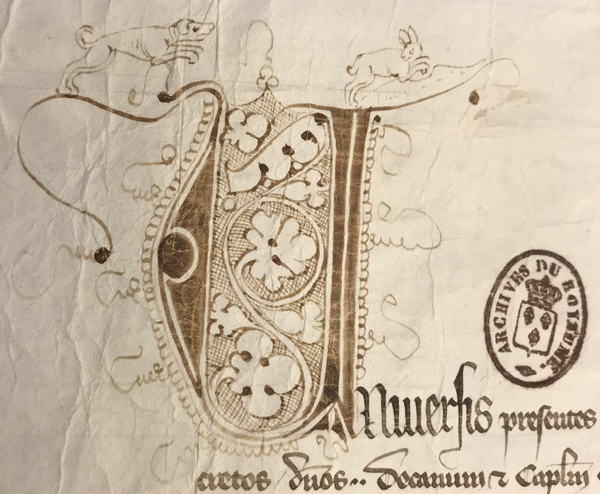
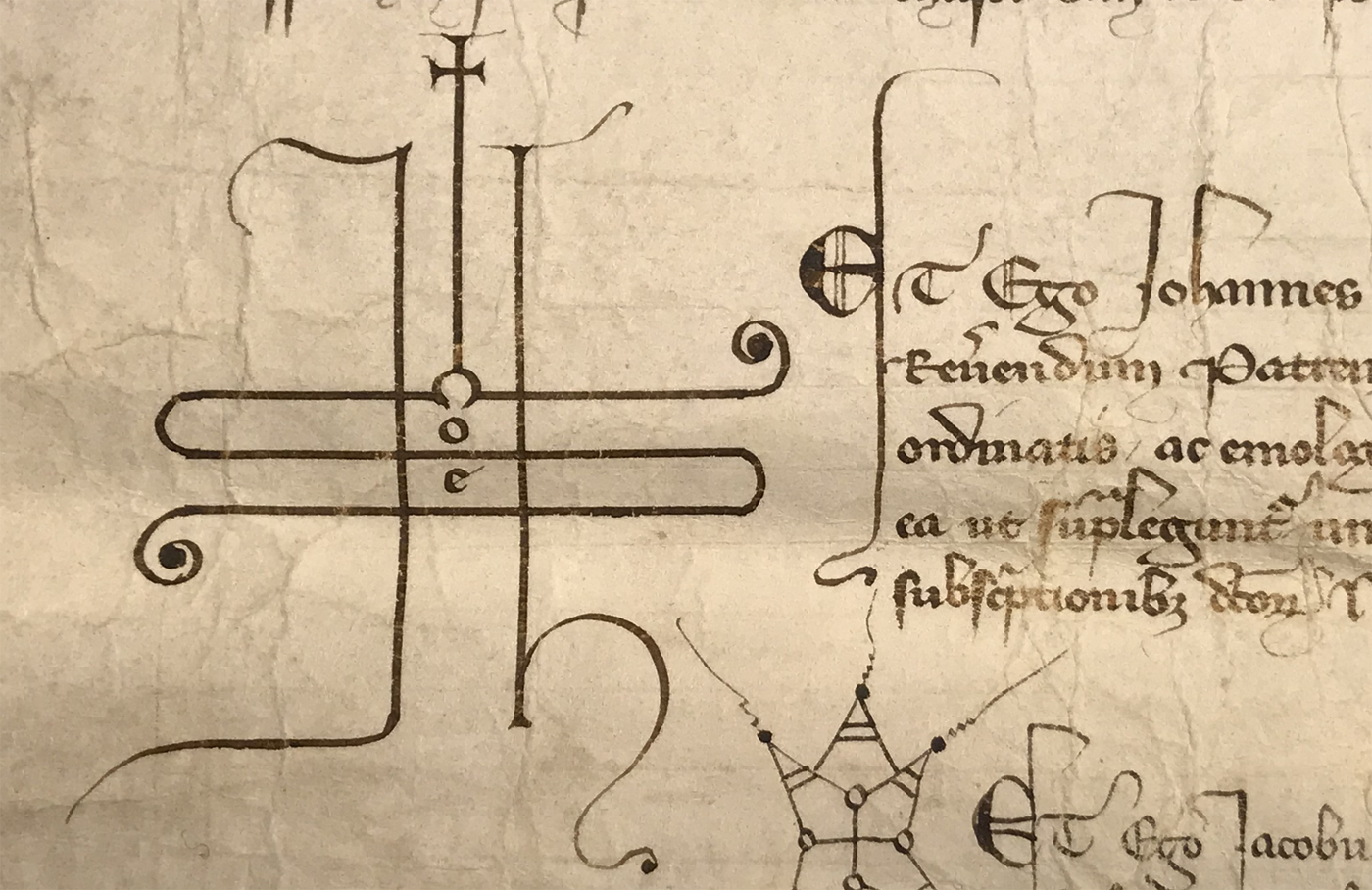
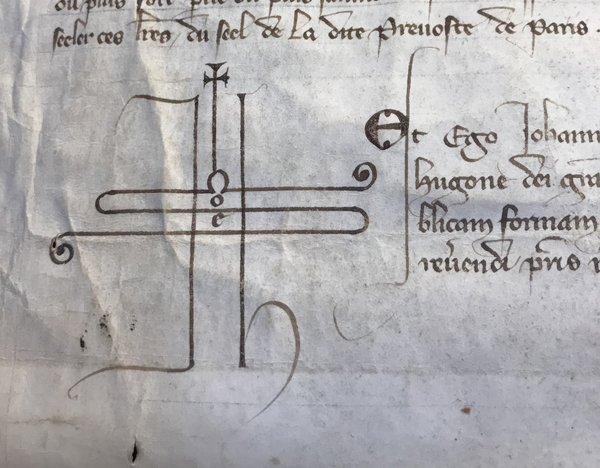
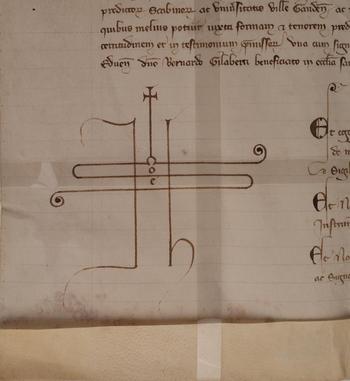
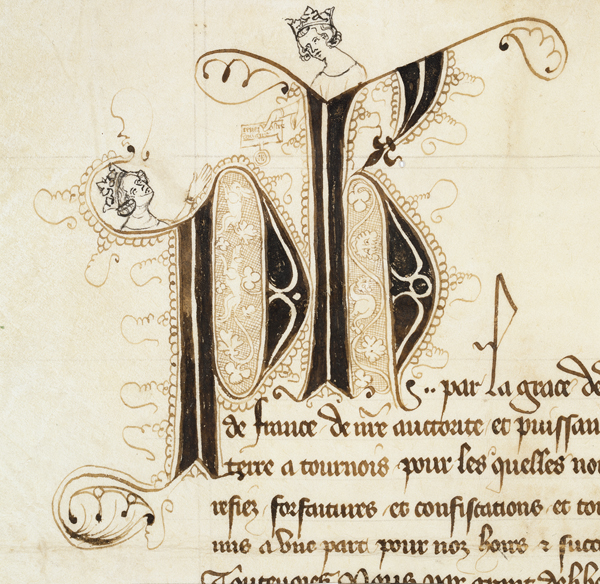
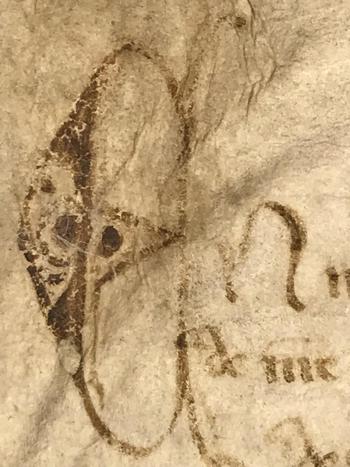
Yet, well before the 1340s it would appear that Jean de Savoie was established as an artist and illustrator. Ghislain Brunel shows that he not only notarised the 1335 arbitration by Guy Baudet but was also its scribe and decorator – implying that secretaries and notaires in the royal chancery also took a role in the physical production of its charters.Footnote 14 Elements of Jean's distinctive notarial sign – using the letters J, O, H, E and S, in a cross-shaped design punning on his name – are shared with his decorative work (Figures 1–4), which is found in several examples, between 1326 and 1347, created over a long career as one of Philippe VI's more prominent cartoonists. He may also be the one of the artists responsible for the introduction of royal portraiture into the king's charters: portraits attributed to him appear in a charter of Philippe VI modifying the dowry of Queen Jeanne de Bourgogne in March 1332 (Figure 5), and in four others from the years between 1332 and 1347.Footnote 15 This was one of the most significant developments in charter illustration during Philippe VI's reign, lifting the decoration of these documents and its use of royal symbolism to a new level. Given the simultaneous presence of Jean de Savoie and Philippe de Vitry in the chancery of Philippe VI, the chief originator of illustrated charters at a key period in their development, it would be surprising if the two had not collaborated at some level in their production, or at least shared an involvement in the events that these documents were created to mark. Vitry was also well placed to witness at first hand the adoption by Louis I de Bourbon, in the products of his own chancery, of the hitherto largely royal practice of charter illustration.Footnote 16 The initial E of the charter recording Louis I's ennoblement of two brothers in 1334, whose use of a fish motif echoes that of several contemporary royal letters and which was witnessed by Philippe de Vitry, provides a potential case in point (Figure 6).Footnote 17
Charter of Guy Baudet, chancellor of France, 5 November 1335. Paris, Archives Nationales, K 42C, no. 38/1.

Notarial sign of Jean Rufi de Cruce. Paris, Archives Nationales, K 42C, no. 38/1. (colour online)

Absolution granted by Hugh Bishop of Paris to the confraternity of the church of Saint Sepulcre, December 1328. Paris, Archives Nationales, L 611, no. 12. (colour online)

Certified copy of papal documents relating to Philippe VI's debts to Ghent's Italian bankers, 21 May 1331. Ghent, Stadarchief, reeks 94, no. 367. (colour online)

Charter of Philippe VI, March 1332, modifying the dowry of Queen Jeanne de Bourgogne. Paris, Archives Nationales, J 357A, no. 4 bis. (colour online)

Charter of Louis I de Bourbon, 22 February 1334, ennobling Jean and Guy de Bourbon. Paris, Archives Nationales, P 4632, no. 3178 (AE/II/343). (colour online)

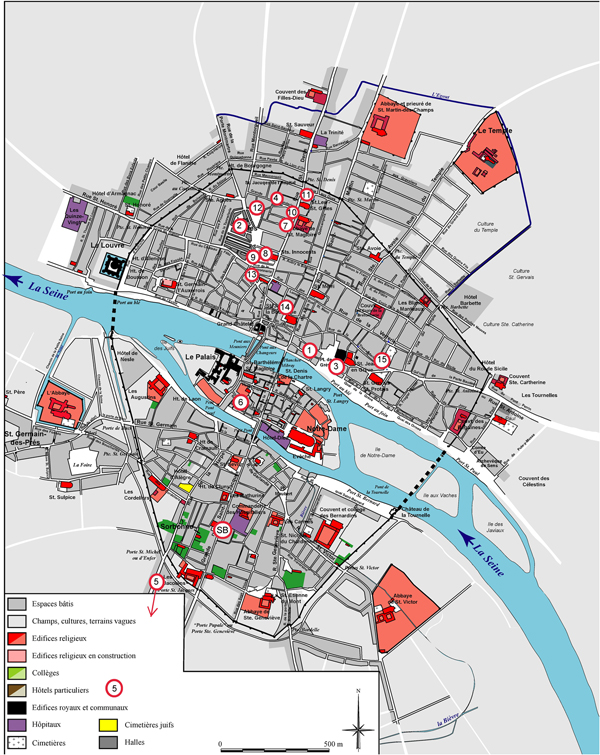
Jean de Savoie last appears in the registers of the French royal chancery in July 1353; he made his will on 30 September, appointing as executors Aubert Martin, canon of Saint-Benoît and maître Étienne Belin, conseiller du roy and canon of Saint-Martin-des-Champs.Footnote 18 The obituary of the priory of Sainte-Cathérine du Val-des-Écoliers records the obit of ‘magistri Ruffi de Cruce, alias dicti de Sabaudia’ on 21 February, in all probability the date of his death in 1354.Footnote 19 His will probably also included one or more bequests to the priory of Sainte-Cathérine (his executors remitted thirty gold scuti to the priory), whose links with the court grew significantly in the mid-century, and which was close to the Paris residence of the bishops of Meaux, including Philippe de Vitry between 1351 and 1361.Footnote 20 Royal licences to alienate property for Jean's foundation at the altar of the Sainte-Croix (perhaps in reference to his own name) at Saint-Benoît were granted to his executors on 7 November 1354 and 5 June 1355,Footnote 21 who then set to work buying property whose rents would provide a perpetual income for his endowment. Between March 1356, a month after receiving a letter of approbation from the royal Trésor, and September 1358, when they secured approval for the foundation from the chapter of Notre-Dame, Paris, the executors bought fifteen separate properties at a total cost of over 500 l. p. (Table 1; Fig. 7). A scattered first group was acquired by August 1356, near Les Halles, in the Place de Grève near the Hôtel de Ville, and at Notre-Dame des Champs to the south-west of the city. Subsequently these purchases were consolidated by further acquisitions to form a cluster between the rue Saint-Denis and Les Halles, and a string of properties forming an almost straight line from there to the Place de Grève. Acquisitions in 1357 and 1358 reinforced this pattern, also adding a house in front of the Palais du Roy on the Île de la Cité, and an outlier at the Porte Saint-Denis. The whole ensemble yielded a total annual rent of over 43 l. p, significantly above the 24 l. p. stipulated in the royal grant.
Map of Paris c.1300–30. By Caroline Bourlet (IRHT), Nicolas Thomas (INRAP-LAMOP), Cédric Roms (INRAP): http://alpage.huma-num.fr/documents/ressources/cartes/CarteParis1300-1330.ai. Numbers show the locations of properties in Table 1; SB indicates the location of the church of Saint-Bénoit. (colour online)

Property acquired for Jean de Savoie's foundation at Saint-Benoît, 1356–8.

It is unclear in most cases whether Jean de Savoie was directly linked with the vendors of these properties, but in two he clearly was. Dimenche de Châtillon, from whom his executors bought a hotel in the Place aux Chats in 1357, was a royal counsellor, active as a member of the judiciary and in the Parlement since the 1330s. And the executors of Pierre Binel, a perpetual chaplain at the altar of Notre-Dame at Saint-Benoît, sold to those of Jean de Savoie the rent on a house in front of the Palais du Roy.Footnote 22 Jean de Savoie must have known Binel well. They shared an executor in Aubert Martin and both held positions at Saint-Benoît for several years. Pierre Binel finalised his will from his sickbed in a room at Sainte-Cathérine du Val-des-Écoliers on 19 August 1356 and named the prior there, Mag. Jean de Cambron, as another executor. What emerges is a network of royal councillors working in and around the Parlement in the 1330–50s, linked to the priory of Sainte-Cathérine and reinforced through shared interests in the Paris Collegiate Churches where they were beneficed. This network and its links with church and state also forms the backdrop against which the relationship between Vitry and Jean de Savoie, and perhaps also Jean Campion, was played out. The same milieu, some decades earlier, was satirised by the Roman de Fauvel, which criticized the canons of Saint-Benoît at length and called them the ‘sons or nephews of Fauvel’.Footnote 23 The royal chancery itself, as is well known, was closely linked with the creation of the Roman de Fauvel and of its subsequent musical, visual and textual elaboration in F-Pn, MS fr. 146. In 1324, some years after Fauvel’s completion, Gervès du Bus's engagement with the church of Saint-Benoît and its milieu acquired a further dimension when he bought a house next to its cemetery from the executors of Thomas de Viri, one of the church's benefactors.Footnote 24
The parallel careers and shared experiences of Jean de Savoie and Philippe de Vitry may partly explain how two ageing royal clerics came to collaborate in penning Ulixea fulgens with Jean Campion. By 1350 Vitry was nearly sixty; Jean de Savoie's career suggests that his age must have been similar. Campion, a canon of Saint Donatian at Bruges from 1356 to his death in 1383, was certainly younger, and at the time a chaplain of Notre-Dame at Tournai though his fame had clearly spread to Paris.Footnote 25 It may also be in Paris in the 1350s, around Vitry and Savoie, that Jean Campion found an introduction to the patronage of Cardinal Guy de Boulogne, whose support was reflected in his promotion to the position of scholasticus at Saint Donatian in Bruges in 1361, and perhaps already in his preferment to a canonry there in 1354.Footnote 26 Ulixea fulgens – an allegory of innocence and experience in love – was, as Pognon suggested, an exceptional ‘divertissement’.Footnote 27 In view of the backgrounds of Savoie and Vitry, it may perhaps have had some additional significance as political allegory, as Jean II contemplated the formation of a new administration following his father's death in August that year. In any case, however, the long royal career of Jean de Savoie locates the origins of Ulixea fulgens yet more strongly in a milieu of royal notaries working around the court and Parlement, a setting still strongly reflected in its later transmission in F-Pn, MS Lat. 3343 and the addition to the poem made in that manuscript in the early fifteenth century by two royal notaires. More broadly, Jean's biography tends to confirm the picture that has emerged in the last twenty years of the centrality of an interlinked group of musicians and poets in Paris who were occupied primarily in the French court and state bureaucracies; for Philippe de Vitry as well as for Jean de Savoie, and perhaps others, this network provided a career-long source of association and engagement.
Appendix: Jean de Savoie's will – F-Pan, S 895B [S 893 No. 8], opening
A touz ceulz qui ces presentes lettres verront ~ Guillaume Staise garde le la prevoste de Paris salut. Savoir faisons que pardevant nous vint en jugement honnorable et discrete personne messire Aubert Martin prestre chapellain perpetuel en leglise Saint Benoit le Bien Tourne a Paris executeur avec honnorable et discrete personne maistre Estienne Belin conseillierFootnote 28 du Roy nostreseigneur et un autre du testament ou dernier voulente de feu maistre Jehan de Savoie clerc notaire du Roy nostredit seigneur et chanoine en la dicte eglise Saint Benoit jadis sicomme nous le veismes plus plainement estre contenu ou testament ou dernier volunte dudit feu maistre Jehan de Savoie signe du seing de maistre Estienne Burgaut tabellion publique sicomme il apparoit par la teneur dicellui testament, qui ainsi se commence:
In nomine sancte et individue trinitatis patris et filii et spiritus sancti amen. Per presens publicum instrumentum cunctis pateat evidenter quod anno domini millesimo cccmo quinquagesimo tercio indictione septima secundum morem Francie mensis Septembris die ultima pontificatus sanctissimi in Cristo patris et domini nostri domini Innocentii divina providencia pape .vjti. anno primo. In mei notarii publici et testium infrascriptorum ad hoc vocatorum et rogatorum presencia proper hoc personaliter constitutus venerabilis et discretus vir magister Johannes Ruffi de Cruce alius de Sabaudia Lausannensis dyocesis clericus domini regis Francie notarius sanctorumque Benedicti Beneversi Parisiensis et Mathei Fulliacensis Ambianensis dyocesis ecclesiarum canonicus prebendatus in lecto egritudinis iacens et licet infirmus corpore tam per dei gratiam sanus mente et sui compos ut prima facie apparebat et cetera. Testamentum suum seu suam ultimam voluntatem Christi nomine invocato preposito quod venerabilis signo crucis fecit condidit et ordinavit ac de bonis suis a summo largitore sibi collatis disposuit et cetera.
Et ainsi se fenist:
Acta fuerunt hec in domo habitationis dicti testatoris in vico sancti Jacobi Parisius predicte presentibus discretis viris domino Jacobo de Lingonis presbitero matriculario predicte ecclesie sancti Benedicti Parisiensis, magistro Johanne Petri de CaloreFootnote 29 magistro in artibus, et Johanne Cambellani de Belna scolari Parisiensis Eduencis dyocesis clericis testibus ad premissa vocatis specialiter et rogatis.
Ou quel testament entre les autres choses estoit contenue ceste clause:
Si vero completo hoc suo testamento seu ultima voluntate aliquod residuum fuerit voluit et ordinavit dictus testator quod executores sui de toto residuo prout secundum deum pro salute anime ipsius testatoris melius sibi videbitur possint plene et libere ordinare huius autem testamenti per quod omnia alia et singula testamenta quecumque et quamcumque ac eciam codicillos per ipsum facta et factos expresse ac specialiter revocavit et haberi voluit pro infectis quod eciam iure testamenti seu iure codicillorum aut iure cuiuslibet alterius voluntatis extreme et alium prout melius de consuetudine vel de iure poterit vel debebit valere voluit et vigere. Et ad omnia et singula supradicta facienda exequenda complenda et sine debito terminenda dictus testator elegit nominavit et eciam ordinavit executores suos venerabiles et discretos viros Magistrum Stephanum Bellini clericum in utroque iure licenciatum predicti domini Regis consiliarium ac canonicum ecclesie sancti Martini de Campellis Parisiensis dyocesis, dominum Aubertum Martini presbiterum suum se in prefata sancti Benedicti ecclesia capellanum et dominum Rigaudum de ProvisieuxFootnote 30 presbiterum Laudunensis dyocesis capellanum quondam magistri Johannis de Montibus et quemlibet eorum insolidum ita quod non sit melior condicio occupentis sed quod per unum ipsorum inceptum fuerit per alium eciam altero non impedito prosequi mediari et terminari valeat cum effectu. Et ita eciam quod si ipsi tres executores prenominati vel duo ipsorum dicte executionis ipsius testatoris onus in se susceperint. Nichilomenus quilibet eorum per se et insolidum prout conscientia propria sibi dictaverit omnia et singula supradicta possint complere et proficere ac executioni in omnibus et per omnia demandare ac si per se et in se dicte executionis onus solus et insolidum suscepisset. Ipsisque executoribus et eorum cuilibet insolidum dedit et concessit plenam et liberam potestatem addendi diminuendi corrigendi mutandi declarendi et interpretandi in premissis et quolibet premissorum aliasque faciendi et in quascumque personas prout secundum deum per anime ipsius testatoris remedio et salute eis aut eorum alteri insolidum placuerit et videbitur expedire et cetera.
[…]