Healthcare personnel often contaminate their skin and clothing during removal of personal protective equipment (PPE).Reference Tomas, Kundrapu and Thota1 , Reference Kwon, Burnham and Reske2 Such contamination may contribute to transmission of pathogens and can place personnel at risk for infection. Educational interventions can reduce contamination by improving the donning and doffing technique.Reference Tomas, Kundrapu and Thota1 Modified methods of doffing could also potentially reduce the risk for contamination.Reference Osei-Bonsu, Masroor and Cooper3 , Reference Alhmidi, Gonzalez-Orta and Cadnum4 For example, contamination with a fluorescing Staphylococcus epidermidis was reduced when a 1-step removal method was used during simulations of contaminated PPE removal.Reference Osei-Bonsu, Masroor and Cooper3
Improvements in PPE design are needed to reduce the risk for contamination.Reference Tomas, Kundrapu and Thota1 , Reference Mana, Tomas, Cadnum, Jencson, Piedrahita and Donskey5 The hands and wrists present a particularly high risk for contamination with current PPE design due to factors such as exposed skin at the gown–glove interface and a high potential for inadvertent contact between contaminated gloves and skin.Reference Tomas, Kundrapu and Thota1 , Reference Alhmidi, Gonzalez-Orta and Cadnum4 , Reference Mana, Tomas, Cadnum, Jencson, Piedrahita and Donskey5 We previously demonstrated that a commercial gown designed to allow easy removal at the neck and with increased skin coverage and snugness of fit at the wrist significantly reduced contamination of personnel during simulations of contaminated PPE removal.Reference Mana, Tomas, Cadnum, Jencson, Piedrahita and Donskey5 Here, we have expanded upon those findings by testing the hypothesis that a modified cover gown with further improvements in hand and wrist skin coverage would reduce contamination during PPE removal.
Methods
Cover gowns studied
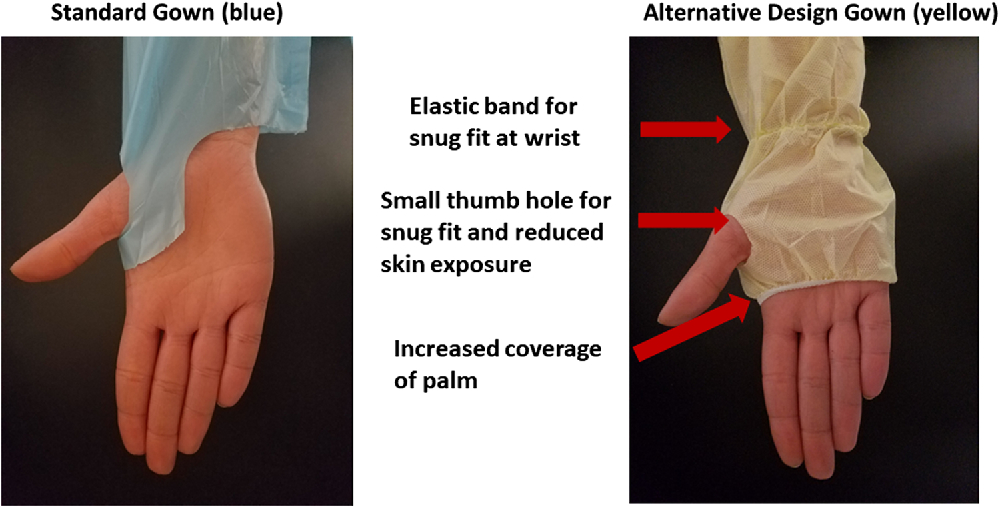
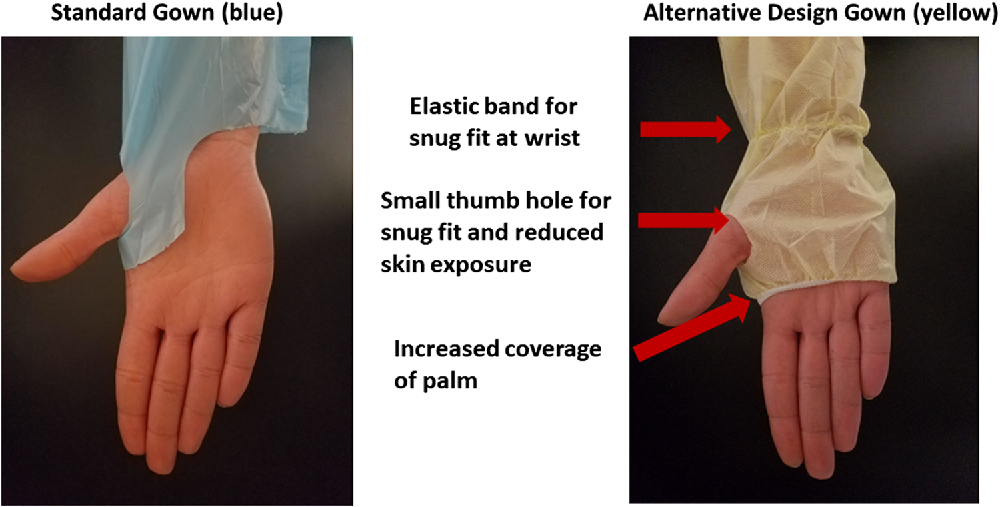
The standard gown, the Safety Plus polyethylene gown (TIDI Products, Neenah, WI), was the gown used routinely in our facility. The alternative design gown was a modified version of the Assure Wear VersaGown with Flexneck technology (AMD Ritmed, Tonawanda, NY); the gown includes an elastic band at the wrist for snug fit and was modified to provide a substantial increase in skin coverage including the entire wrist and the palms and dorsum of the hands to just above the fingers. Figure 1 provides illustrations of the differences in the designs of the 2 gowns.
Comparison of the design of the standard and alternative design gowns. The standard gown was a Safety Plus polyethylene gown used routinely in the study facility. The alternative design gown was a modified version of the Assure Wear VersaGown with Flexneck technology (AMD Ritmed, Tonawanda, NY). The gown was modified to provide increased coverage of the skin of the hands and wrists.
Setting and study design
The study was conducted at the Louis Stokes Cleveland Veterans Affairs Medical Center. The facility’s institutional review board approved the study protocol. We conducted 2 nonblinded crossover trials to compare contamination of personnel during simulations of contaminated PPE removal with the standard versus the alternative design cover gown. The trials were conducted on hospital or long-term care facility wards during routine work hours.
In the first trial, 64 healthcare personnel were randomized to perform initial simulations using the standard or alternative design gown. Participants donned the gowns and nitrile gloves (Denville Scientific, Holliston, MA) in their usual manner. The gloved hands were inoculated with 0.5 mL of fluorescent solution (Super Blue Invisible Ink, Black Light World) that was rubbed over the gloved hands until dry (~15 seconds). The participants removed their PPE in their usual manner; no education was provided. Each simulation was observed, and any breaks in technique based on the recommended Centers for Disease Control and Prevention (CDC) donning and/or doffing protocol were recorded using a standardized checklist.6 Contamination of the hands and wrists was assessed using a black light, and the sites of contamination were recorded. After a washout period of at least 5 minutes, an additional simulation was conducted with crossover to the alternate gown.
In the second crossover trial, a separate cohort of 42 personnel participated. The study procedures were identical to the first trial, except education was provided prior to the simulations on proper technique for donning and doffing based on the Centers for Disease Control and Prevention (CDC) protocols.Reference Tomas, Kundrapu and Thota1 , 6 The education consisted of a 5-minute session that included review of a poster providing instruction on the 1-step technique recommended by the CDC for PPE removal.6
Statistical analysis
The primary outcome was the frequency of hand and/or wrist contamination. Based on preliminary data showing that ~50% of personnel contaminated their hands/wrists during simulations, a 2-sample, 1-sided power calculation indicated that 40 and 60 participants per group would provide 80% and >90% power, respectively, to detect a reduction from 50% to 20% contamination for the standard versus alternative gown. The McNemar test was used to compare the percentages of contamination. The Fisher exact test was used to compare the percentages of incorrect technique for the standard versus alternative gowns in trial 1. Data were analyzed using SPSS version 10.0 statistical software (SPSS, Chicago, IL).
Results
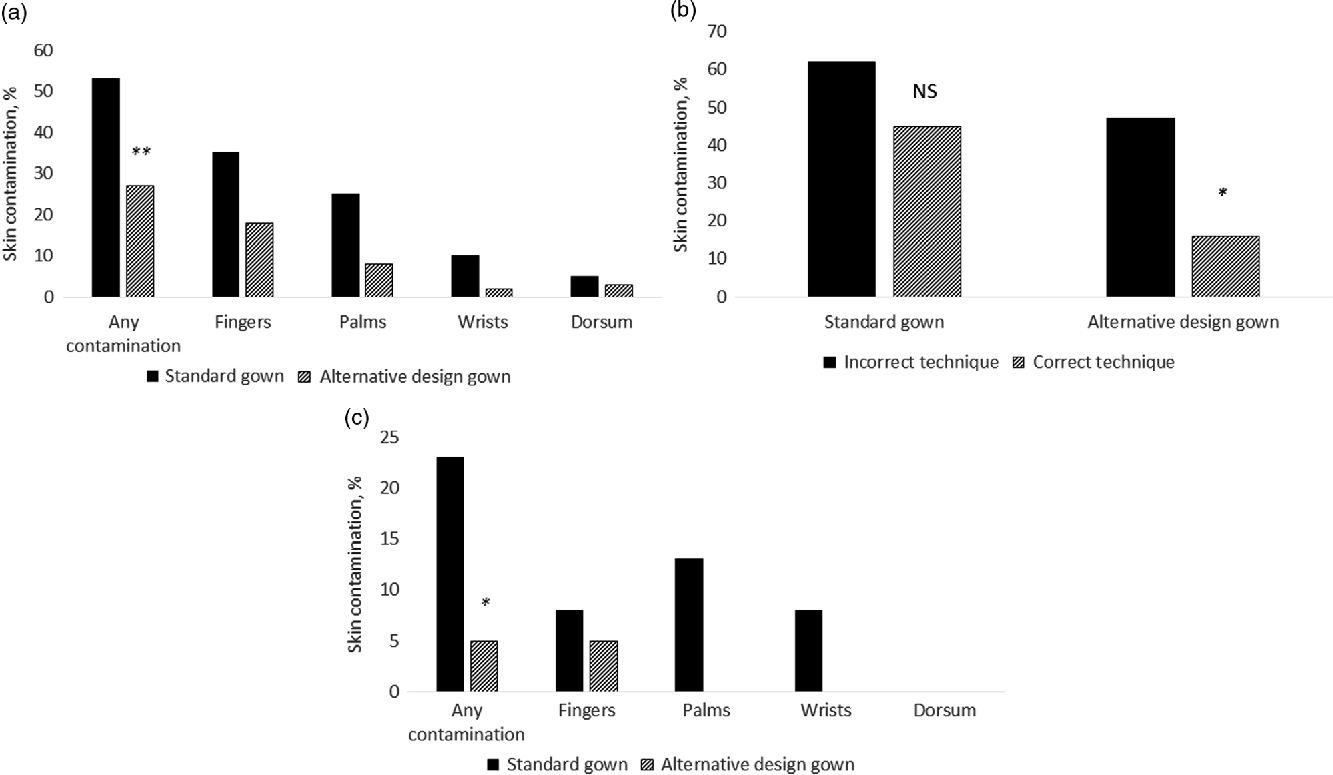
Supplemental Figure 1 (online) provides flow diagrams for the 2 trials. In total, 6 participants were excluded from the analysis because they did not complete the second assessment because they were unavailable or unable to be located after the initial assessment. In the initial trial without education, contamination of the hands and/or wrists was significantly lower for the alternative gown in comparison to the standard gown (16 of 60 [27%] versus 32 of 60 [53%]; P < .01) (Fig. 2A). Contamination occurred most frequently on the fingers and palms. PPE donning and/or doffing technique was deemed incorrect in 48 of 120 simulations (40%), with similar percentages of incorrect technique for the standard and alternative gowns (26 of 60 [43%] and 22 of 60 [37%], respectively; P = .58). For both gowns, contamination occurred less frequently when correct versus incorrect technique was used (Fig. 2B).
Frequency of hand and wrist contamination with fluorescent solution during simulations of contaminated personal protective equipment removal with the standard versus alternative design gown with (A) no education (N = 60 participants completing study), (B) no education group, stratified by incorrect versus correct technique, or (C) education (N=40 participants completing study).

In the second trial including education, contamination was significantly lower for the alternative gown in comparison to the standard gown (2 of 40 [5%] vs 9 of 40 [23%]; P = .048) (Fig. 2C). For the alternative gown, contamination was only detected on the fingers. For both gowns, contamination occurred significantly less often for the education cohort in comparison to the noneducation cohort (P < .05).
Discussion
Personal protective equipment that is designed to minimize the risk for contamination of personnel is needed to protect patients and personnel. Contamination of the hands and/or wrists of personnel occurred frequently during simulations with the standard gown used in our facility, even when no lapses in technique were observed and even after education on correct technique. A gown designed to increase coverage of the skin of the hands and wrists significantly reduced contamination of personnel during contaminated PPE removal in the absence of education. A further reduction was achieved when education was provided on proper donning and doffing technique.
Our findings add to the growing body of evidence that simple modifications of current PPE may reduce the risk for contamination of personnel.Reference Mana, Tomas, Cadnum, Jencson, Piedrahita and Donskey5 , Reference Tomas, Cadnum, Mana, Jencson and Donskey7 – Reference Gleser, Schwab, Solbach and Vonberg9 As noted previously, a commercial gown designed to allow easy removal at the neck and to provide increased skin coverage and snugness of fit at the wrist reduced contamination of personnel during simulations of contaminated PPE removal.Reference Mana, Tomas, Cadnum, Jencson, Piedrahita and Donskey5 Gleser et alReference Gleser, Schwab, Solbach and Vonberg9 also reported that a simple modification of current glove design reduced contamination in simulations; the modification provides a flap above the thumb that can be gripped to assist in doffing.
Our study has several limitations. We studied only 2 gown designs. A fluorescent solution was used rather than a live virus. However, contamination with the fluorescent solution correlates well with contamination with bacteriophage MS-2.Reference Tomas, Kundrapu and Thota1 , Reference Alhmidi, Gonzalez-Orta and Cadnum4 , Reference Mana, Tomas, Cadnum, Jencson, Piedrahita and Donskey5 Finally, it was not possible to conduct the study in a blinded fashion because the gowns were visibly different and the fluorescent marker was assessed visually by research personnel.
In summary, a gown designed to increase skin coverage at the hands and wrists significantly reduced contamination of personnel during simulations of contaminated PPE removal. The frequency of contamination was further reduced by education. Studies are needed to determine whether such modifications of PPE design can reduce contamination in clinical settings.
Acknowledgments
We thank personnel at the Cleveland VA Medical Center for their participation in the study.
Financial support
This study was supported by a Merit Review grant from the Department of Veterans’ Affairs (grant no. 1 I01 BX002944-01A1 to C.J.D). AMD Ritmed provided the modified version of the Assure WearTM VersaGowns with FlexneckTM technology for testing but had no role in study design, analysis, or interpretation of the data or in the writing of the manuscript.
Conflicts of interest
C.J.D has received research grants from Clorox, GOJO, Pfizer, PDI, and Boehringer Laboratories. All other authors report no conflicts of interest related to this article.
Supplementary material
To view supplementary material for this article, please visit https://doi.org/10.1017/ice.2019.211