I. INTRODUCTION
As a class of amorphous materials, the metallic glasses (MGs) have been attracting increasing interest in recent years because they possess scientific and engineering significance due to their unique properties.Reference Inoue1, Reference Wang, Dong and Shek2 Unfortunately, these MGs have encountered a challenge to be widely used in engineering because of their limited casting size, unsolved problem about the glass-forming mechanism, expensive cost, and so on.Reference Inoue1 However, it is found that the precipitation of nanocrystals in the amorphous alloys can improve their properties,Reference Greer3 such as the good soft magnetic propertyReference Yoshizawa, Ogurna and Yamauchi4 and high strength,Reference Inoue, Horio, Kim and Masumoto5 which may extend their application as engineering materials. Therefore, vast efforts have been devoted to searching for the relationship between the amorphous/nanocrystal structure and their unique properties.Reference Inoue, Kawase, Tsai, Zhang and Masumoto6–Reference Saida, Matsushita, Li and Inoue10 So far, amorphous/nanocrystal composite materials can be prepared via the thermal synthesis,Reference Lu11 the mechanical processing,Reference Chen, He, Shiflet and Poon12 and the electron irradiationReference Nagase, Nakamura and Umakoshi13 upon MGs. In particular, as a thermal synthesis method, annealing treatment was largely used to prepare these materials, which also is available for probing the phase transformation kinetics and mechanism of the nanocrystallization in amorphous alloys.Reference Saida, Setyawan and Matsubara14–Reference He, Bian and Chen16 Whereas, the structural evolution of amorphous-to-nanocrystallization change is far from being clarified, especially whether and how structural evolution occurs in the glasses during annealing prior to the precipitation of nanocrystals is a long-standing issue.Reference Wang, Almer, Liu, Wang, Zhao, Stoica, Haeffner and Wang17 In this work, a series of state-of-the-art synchrotron radiation-based experiments coupled with simulations were performed to address this issue, by investigating the structural evolution of the Zr48Cu45Al7 amorphous alloy,Reference Wang, Tan and Li18 which is a representative bulk MG with unique engineering and structural significance.
II. EXPERIMENTS AND SIMULATIONS
The Zr48Cu45Al7 alloy ingot was prepared by arc-melting the mixtures of Cu (99.9 wt%), Zr (99.9 wt%), and Al (99.9 wt%) elements in Ti-gettered high-purity argon atmosphere, which was melted at least five times to ensure its compositional homogeneity. The corresponding amorphous ribbons with a cross section of 0.04 × 2 mm2 were obtained from the master alloys by single-roller melt spinning at a wheel surface velocity of 40 m/s in purified Ar atmosphere. Then, the annealing treatment was carried out in an oven with a vacuum of 10−4 Pa at 598 K for 3 min. This temperature is much lower than its glass transition temperature (708 K).Reference Wang, Tan and Li18 Subsequently, the synchrotron radiation-based high-energy (about 100 keV) x-ray diffraction measurements were performed upon the as-prepared and annealed ZrCuAl samples at the beam line, BW5, at HASYLAB (Hamburg, Germany). The two-dimensional diffraction data were recorded using a Mar345 image plate. In addition, using the transmission mode, their Zr and Cu K-edge extended x-ray absorption fine structure (EXAFS) spectra also were measured at the beam line, BL14W1, in the Shanghai Synchrotron Radiation Facility of China. EXAFS did not allow to measure the Al-centered local structure because of the rather low and experimentally inaccessible energy value of the Al K-edge (1.560 keV). Both of the diffraction patterns and EXAFS spectra were normalized via a standard data reduced procedure,Reference Yang, Jiang, Liu, Hu and Uruga19 employing the softwares PDFgetX and VIPER, respectively. To ensure the reliability of the deduced atomic structural information, both of the normalized diffraction and EXAFS data were simulated simultaneously under the framework of reverse Monte Carlo (RMC).Reference Luo, Sheng, Alamgir, Bai, He and Ma20, Reference Yang, Yin, Wang, Cao, Jiang, Saksl and Franz21 Two cubic boxes containing 40,000 atoms were built to simulate these two sample sets, matching the selected Zr48Cu45Al7 composition. Finally, both of the simulated atomic structural models were further analyzed by the Voronoi tessellation method.Reference Finney22, Reference Stepanyuk, Szasz, Katsnelson, Trushin, Müller and Kirchmayr23
III. RESULTS AND DISCUSSION
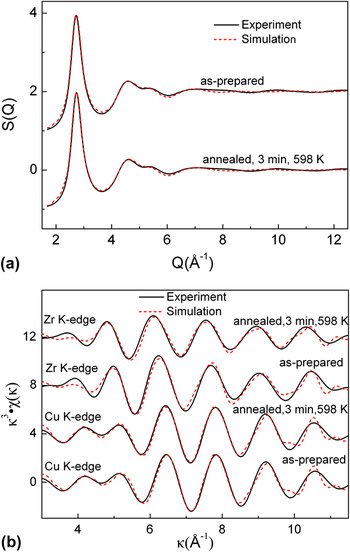
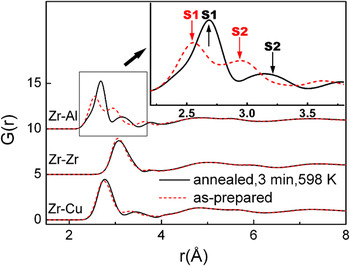
Figures 1(a) and 1(b) show the experimental structural factor S(Q) obtained from the diffraction measurement, Zr and Cu K-edge EXAFS data of the as-prepared and annealed Zr48Cu45Al7, along with their corresponding simulated curves. Except for the first strong peak, the smooth experimental S(Q) curves exhibit the gentle oscillations, and with no sharp peaks, which indicate the full amorphous nature in both samples. The plots of their experimental S(Q) and Cu EXAFS curves are almost the same. However, a slight k-shift and intensity difference of the oscillations between the experimental Zr EXAFS data of both samples are observed, which suggest that the local structure around the Zr atoms changes when the annealing treatment is performed on the ZrCuAl MG. To get more direct structural information, the partial pair distribution function G(r)s are deduced and plotted in Fig. 2 (Cu–Cu, Cu–Al, and Al–Al G(r)s are not shown here). It is found that there is no obvious difference in the Zr–Zr, Zr–Cu, Cu–Cu, Cu–Al, and Al–Al G(r)s for both samples. However, an evident discrepancy ranged from 2.2 to 3.5 Å is observed in the first-shell distribution (FSD) of the Zr–Al pair, which is highlighted in the inset. The FSD is split into two subpeaks (S1 and S2) in the as-prepared ZrCuAl, which possess the peak values at 2.55 and 3.00 Å, respectively. However, in the annealed sample, the FSD is mainly attributed to the relatively strong S1 peak, whose peak value shifts to a higher value (2.70 Å), and the intensity of the S2 subpeak is much lower. It indicates that compared with those of the as-prepared ZrCuAl, most of the Zr–Al pairs possess the similar and longer bond length (2.70 Å) in the annealed sample, leading to the change of the short-range ordering. In addition, because the concentration of Zr around Al is much higher than that of Al around Zr, it is suggested that the change of the Al-centered local ordering is more obvious than that of the Zr-centered counterpart.
(a) Structure factor S(Q) and (b) Zr and Cu K-edge extended x-ray absorption fine structure spectra in the as-prepared and annealed Zr48Cu45Al7 metallic glasses. The solid and dotted lines denote the experimental and simulation data, respectively.

Partial pair distribution function G(r)s. Zr–Al, Zr–Zr, and Zr–Cu pairs are plotted here. The dotted and solid lines stand for the as-prepared and annealed samples, respectively.

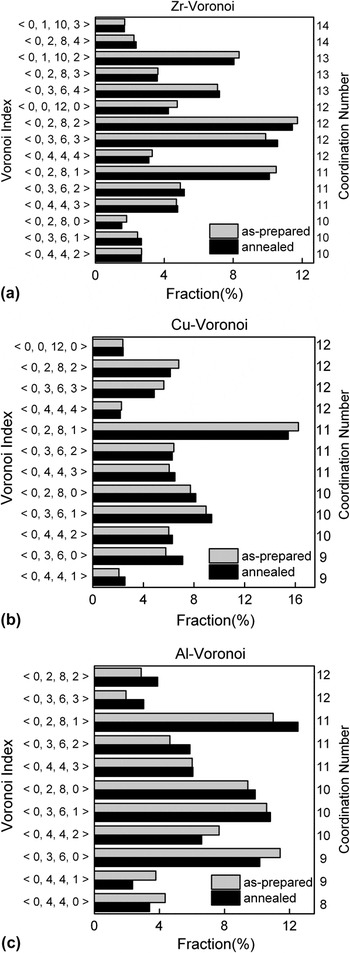
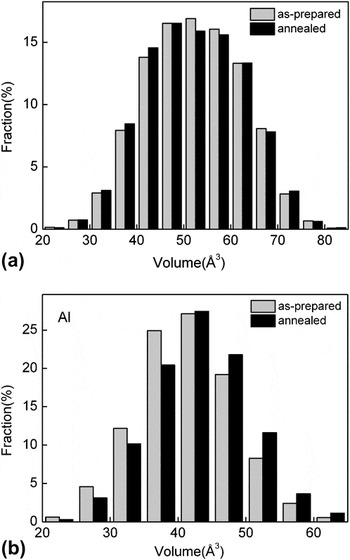
To further address this issue, the RMC-simulated atomic structural model is further analyzed at the cluster scale. Figures 3(a)–3(c) show the Zr-, Cu-, and Al-centered major Voronoi tessellation clusters, which have the broad distributions with the coordination numbers ranged from 8 to 14. A slight tendency is observed compared with those in the as-prepared ZrCuAl, the large Al-centered clusters (such as <0,2,8,2>, <0,2,8,1>) possess the relatively high weights in the annealed sample, and the small Al-centered ones (such as <0,3,6,0> and <0,4,4,1>) have the lower fractions. Such a tendency is not obvious in the distributions of Zr- or Cu-centered clusters. It also indicates that the structural evolution mainly starts around the Al atoms when the glassy alloy is under annealing. Moreover, the volumes of the random atom-centered clusters are calculated for both samples, whose distributions are plotted in Fig. 4(a). It is shown that there is no statistical change in the volume distributions, which means that on average, the present annealing leads no obvious change in the local structural ordering. Nevertheless, the random atom-centered clusters cannot be regarded as the backbones of glassy structure, while the solute-centered clusters are recognized as the basic building blocks to enable the formation of the short-to-medium range ordering.Reference Miracle24, Reference Sheng, Luo, Alamgir, Bai and Ma25 The Al atoms should be the solutes considering its relatively low concentration in both samples, thus, the volumes of the Al-centered clusters also are calculated and plotted in Fig. 4(b). It is worth noting that the large clusters (with a volume larger than 50 Å3) have the relatively high weights in the annealed sample, which indicates that the annealing treatment leads to the expansion of the Al-centered clusters. We have revealed that the average Zr–Al bond length is longer in the annealed ZrCuAl MG than that of the as-prepared sample, which should be the origin of the volume expansion in the Al-centered clusters.
Distribution of the major Voronoi clusters centered with (a) Zr, (b) Cu, and (c) Al atoms.

Distribution of the volumes of the Voronoi clusters centered with (a) a random atom and (b) an Al atom.

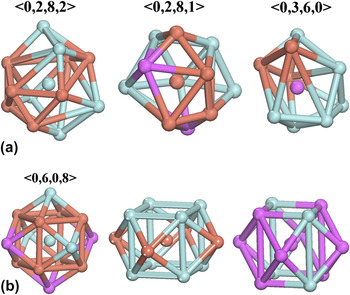
In addition, we compared the representative clusters in the annealed sample with those deduced from the possible precipitated nanocrystalline phases after annealing,Reference Zhang, Ichitsubo, Yokoyama, Yamamoto, Matsubara and Inoue26, Reference Yamamoto, Yokoyama, Ichitsubo, Kimura, Matsubara and Inoue27 as plotted in Figs. 5(a) and 5(b). The method to extract clusters in crystal phases refers to our previous work.Reference Yang, Xia, Wang, Dong, Chen, Ou, Liu, Jiang, Klementiev, Saksl, Franz, Schneider and Gerward28 It is shown that the Voronoi tessellation clusters in Fig. 5(a) are closed convex polyhedra formed by a set of Delaunay tetrahedra with the common vertex at their center atoms, and their surfaces should be only made up of triangle faces.Reference Medvedev and Naberukhin29 These clusters have abundant 5-fold-rotation symmetry features, which are favored in the glass state.Reference Yang and Guo30 However, most of the clusters extracted from the crystals cannot be indexed using the Voronoi tessellation method because their surfaces are made up of the quadrangles beside the triangles. Although the others have the Voronoi tessellation indexes, they are rarely found in the glasses, such as the <0,6,8,0> cluster illustrated in Fig. 5(b). It indicates that the clusters in the annealed glass are different with those in the crystal alloys, i.e., the transition of the glass-favored clusters to those favored in corresponding crystals is absent.
Configurations of some representative clusters from (a) the annealed sample and (b) the possible precipitated nanocrystalline phases after annealing. The blue, red, and purple spheres represent the Zr, Cu, and Al atoms, respectively. In particular, in (b), the left, the center, and the right are the clusters extracted from the AlCu2Zr, the CuZr2, and the Al3Zr crystal phases, respectively. Not all the clusters extracted from the glass alloy and the crystal phases are shown here.

In our previous work,Reference Yang, Guo, Chen, Wei, Jiang and Wang31 it has been suggested that in the as-prepared ZrCuAl MG, the relatively short Zr–Al bond attributing from their strong atomic interaction leads to formation of the relatively small and compact Al-centered clusters in the as-prepared ZrCuAl MG. These Al atoms can be regarded as the glue atoms, which occupy the interstices around the Zr- and Cu-centered large clusters to connect and fix them. Accordingly, it strengthens the glassy structure to bypass the crystallization during quenching. It is the structural origin of the enhanced glass-forming ability in the ZrCu alloys with the Al microalloying element. In the present work, it is revealed that compared with that of the as-prepared sample, the Zr–Al pair of the annealed ZrCuAl has a longer bond length, which indicates that the Al–Zr atomic interaction is relatively weakened, and, accordingly, the neighbor atoms are relatively loosely packed around the Al centers to form clusters with the larger volumes. Although in the present annealed sample, the direct transition of the glass-favored clusters to those favored in corresponding crystals is absent, the expansion of the Al-centered clusters leads to the enhanced motility of Al atoms and their neighbor atoms. The role of Al atoms as the glue atoms to connect and fix the Zr- and Cu-centered large clusters is accordingly weakened, i.e., it decreases the stability of the cluster favored in the glass state. We suppose that once more energy is provided during annealing, the clusters are more unstable and prone to collapse or transform into the crystal-favored clusters, leading to the precipitation of nanocrystal in the amorphous alloys.
IV. CONCLUSIONS
In summary, the atomic structural evolution of the as-prepared and annealed ZrCuAl MGs is investigated. It is revealed that the Zr–Al pair has a longer bond length in the annealed ZrCuAl sample, which is attributed from their relatively weakened atomic interaction. It leads to expansion of the Al-centered clusters. Thus, the motility of the Al atoms and their neighbor atoms are increased, which decreases the connection and stability of their neighbor Zr- and Cu-centered clusters. Thus, it may ease the rearrangement of clusters and atoms in the glass state. The present work not only addresses the issue that how the microstructure changes in MGs during annealing but also has implication for understanding on the mechanism of the precipitation of nanocrystals in glassy alloys.
ACKNOWLEDGMENTS
The authors thank the HASYLAB in Germany and the Shanghai Synchrotron Radiation Facility in China for the use of the advanced synchrotron radiation facilities. Financial supports from the National Natural Science Foundation of China (Grant No. 10805027), the Natural Science Foundation of Jiangsu Province (Grant No. BK2011071), and the NUAA Research Funding (Grant No. NS2010168) are gratefully acknowledged.