1. Introduction
In the First Analogy of Experience in his Critique of Pure Reason, Kant argues that everything in the world is, or is a, (permanent) substance or a determination thereof.Footnote 1 There are various interpretations of the First Analogy. I endorse, and, in this paper, I develop, what I call a representational reading of the text. In what follows, I articulate two important objections that Kant’s argument faces, for which satisfactory solutions remain wanting, and explain on Kant’s behalf how a representational reading can address them.
Kant’s primary argument in the First Analogy seeks the preconditions of our representation of the persistence (Beharrlichkeit) of time, one of time’s three ‘modi’ (A177/B219). Time ‘lasts and does not change’ (B224-5). This is somehow ground for finding something permanent (etwas Beharrliches) in appearances that ‘gives general expression to time’ (A183/B226), viz., (permanent) substance. This argument strategy raises the following two questions. First, is the representation of time for which Kant seeks preconditions our pure intuition of time? Second – and this yields the first difficulty that I want to address – if this representation of time is not our pure intuition of time, how can there be any basis to argue that we must represent (permanent) substance in experience? For the nature of pure intuition is such that it would seem to explain how time appears to last and not change. Through pure intuition, we represent ‘[d]ifferent times … only [as] parts of one and the same time’ (A31/B47).
A second important and more commonly discussed objection to Kant’s argument – setting to one side the previous concern – is that he can establish at best the existence of (permanent) substance and not the further thesis that everything else is a determination of substance. Perhaps we must grant that something permanent exists among appearances, but why must, say, this table be a mode of it?
The structure of my paper is as follows. In section 2, I nail down what I have in mind by a ‘representational reading’ of the First Analogy and distinguish it from other kinds of interpretation. In section 3, I present Kant’s First Analogy argument, so understood, highlighting the representational readings of Henry Allison and Andrew Ward, both of whom emphasise – rightly, in my view – that Kant seeks to explain our representation of time’s ‘unity’. In section 4, I provide an elaboration of and resolution to the first difficulty. In fact, the representation of time the conditions for which Kant seeks in the First Analogy is not our pure intuition of time. Inspired by work, not on the First Analogy, by Paul Guyer, I argue that there are important limitations on our pure intuition of time that make it unable to represent time – or, thereby, the permanence of time – in the sense at issue in the First Analogy. In section 5, I respond to the second difficulty. In fact, Kant fails to establish the existence of substance as an all-encompassing substratum in the text that he gives us. But it is also my view that he had the resources to do it. In section 6, I conclude.
2. Readings of Kant’s argument
As I construe it, a representational reading of one of Kant’s arguments has Kant contending that representing the world thus-and-so in experience requires experientially representing the world in other ways. As applied to the First Analogy, my proposal will be (with qualification to come in section 5) that it is Kant’s goal to establish that any experience requires the representation of any object of that experience either as (permanent) substance or as a determination of substance.Footnote 2 From this result, Kant infers, about the phenomenal world, that everything is (permanent) substance or a determination thereof.
A few words about how I am articulating things. First, the point of adding ‘experientially’ to ‘representing’ is to make clear that the representation is constitutive of the relevant experience. Thus, it is not a plausible representational reading of Kant’s Analogies that having such-and-such experience requires having a belief that is not itself part of the experience.Footnote 3 Second, I include ‘permanent’ in parentheses because Kant seems to take it to be analytic, at least in the First Analogy, that substance is permanent. The parenthetical is redundant but worth bearing in mind.Footnote 4 Third, Kant sometimes treats ‘substance’ as a mass noun, sometimes as a count noun. Rather than hedging between these uses, I will typically just treat ‘substance’ as a mass noun. But I mean to remain agnostic about whether substance is better understood as stuff or as a thing.
One more word on representational readings. I take it that on any reading of Kant’s First Analogy, Kant is ultimately trying to establish a metaphysical claim about the world: it contains (permanent) substance, of which everything else is a determination. One might think that a representational reading cannot, in principle, bridge the gap between conclusions about how we must represent the world and how the world is. But on my view, this is where Kant puts his transcendental idealism to work. We must represent the world spatially and temporally, Kant argues back in the Transcendental Aesthetic, and this suffices for it to be the case that appearances are spatial and temporal. Space and time are transcendentally ideal but ‘empirically real’.Footnote 5 Representational conditions on our being able to experience the world are just conditions on appearances. As he also famously puts it: ‘The conditions of the possibility of experience in general are at the same time conditions of the possibility of the objects of experience …’ (A158/B197).Footnote 6
Representational readings of the First Analogy are not the only game in town. We might call another an epistemological reading. Essential to such readings is that they concern the conditions both on a representational state that is not itself constitutive of the relevant experience (it might be a belief or a judgement) and on that state’s accuracy or justification. Thus, perhaps Kant’s view is that to measure accurately a time interval (Melnick Reference Melnick1973: 58-77), or for me to be justified in believing that a change has occurred (Guyer Reference Guyer1987: 224-30), there must be, or I must be justified in believing that there is, (permanent) substance of which everything else is a determination.
Finally, on a metaphysical reading, Kant argues for the existence of (permanent) substance of which everything else is a determination by way of arguing that it is necessary for the existence of something else that is not in dispute: say, change (Van Cleve Reference Van Cleve1979; Reference Van Cleve1999: Ch. 8) or perhaps time itself. On such readings, the conditions of possible experience play no role in Kant’s argument.Footnote 7 There is no inference to make, as there is on a representational reading, from how we must represent the world in experience to how the world is.
But I mention these other readings only to clarify the style of interpretation that I want to defend.
3. Kant’s argument and two objections
Commentators on the First Analogy have found different argument strategies within its pages, but the passages on which I focus appear at the beginning of the A-edition text (A182-4/B225-7), as well as in the paragraph inserted at the beginning of the B-edition (B224-5). Kant observes that the experience of ‘both simultaneity as well as succession’ (B224; see also A182-3/B225-6), and indeed ‘[a]ll appearances’ (B224), ‘can alone be represented’ (B224) in time. But time itself ‘lasts and does not change’ (B224-5; see also A144/B183). And as Kant claims in each of the Analogies, we cannot perceive time ‘by [or in] itself’ (B225). Presumably, it is the lastingness of time that is the salient feature, for Kant infers that something equally ‘lasting and persisting [Beharrliches]’, not itself time, must be found among appearances. Moreover, ‘everything [else] that belongs to existence can be thought only as [its] determination’ (B225, my interpolations; see also A183/B226-7). With the appeal to transcendental idealism – not explicit in the First Analogy – Kant can infer, about appearances only!, that everything either is substance or a determination thereof.Footnote 8
There are many questions and concerns that one might have about this argument. Edward Caird is frequently cited for questioning the meaningfulness of the premise that time lasts and does not change.Footnote 9 Things in time last or change; to claim that time itself lasts or changes seems like a category mistake. I think that Allison’s response here is right. ‘The essential point is that the constant flux occurs in a single time’.Footnote 10 But we should add that, for Kant, permanence is ‘existence at all times’ (A242/B300; see also MSI, 2: 417), so since time exists at any of its moments, it follows that time itself is permanent, or ‘lasts’, or ‘does not change’.
A more significant issue is the inference to the representation of (permanent) substance. Part of the rationale is our inability to perceive time by itself. I will have more to say about this thesis below (§4.3). For Allison, this is the claim that we cannot ‘determine the temporal order of appearances by referring them to time itself as a quasi-object’ (Reference Allison2004: 238). It is then supposed to be ‘necessary to presuppose some perceptually accessible model for time itself as a condition of the possibility of determining the temporal relations of appearances. … [I]f everything were in constant flux, then we could not even be aware of succession as such, not to mention simultaneity’ (p. 239). But this is not yet to establish either that this thing is permanent or that it functions as the bearer of all modes. It is the former point on which I want to focus for now. According to Allison, Kant later argues that the ‘model for time’ must itself be permanent. Otherwise, Allison’s analysis seems to imply, there would be ‘a rupture in the unity of time, and therefore in the unity of experience’ (p. 243).
Similar considerations animate Ward’s presentation of Kant’s argument. We experience, he claims, a ‘temporal continuum’ in which objects appear to us (Reference Ward2001: 394). But fleeting perceptions offer up nothing that would provide for the appearance of continuity for such a continuum, and there is no appearance of an enduring self that could do this, either. ‘The solution Kant offers is that this consciousness [of a temporal continuum] can only arise if we are able to join together the contents of the manifold so as to perceive them as the coexisting or changing states of one or more spatial object, whose substance remains the same …’ (ibid.). Ward thinks that Kant is licensed to infer the permanence of this substance because, should there be no permanence (e.g., if at some point nothing exists), we would be forced to acknowledge a ‘hiatus in experience and, thereby, destroy the consciousness of a single temporal continuum’ (p. 397).
I think that these presentations of Kant’s argument, as far as they go, are fundamentally correct. But they need to go further.
Both Allison and Ward think that substance is a phenomenological proxy for time, providing the appearance of unity in a sea of flux. But neither explains why the experience of substance is necessary in light of one’s pure intuition of time. It is important to recall that it is a ground of Kant’s argument that our original representation of time is an intuition and not a concept or conception that ‘[d]ifferent times are [represented as] only parts of one and the same time’ (A31-2/B47). There is unity baked into our pure intuition. Does the experience of substance make our pure intuition of time possible?Footnote 11 If not, why is representing substance necessary? It would seem that pure intuition represents the temporal unity that Kant is concerned about.
There is also the other issue that I have promised to address. How does Kant establish not only the existence of substance as a permanent ‘backdrop’Footnote 12 but also its role as the substratum of everything else? Allison confronts this difficulty head-on. His response works like this. (1) If I am to experience a change, AB, in the world, then it must be the case that B replaces A in an enduring object. ‘The crucial point … is that the assignment of the successively represented states of affairs to an enduring substratum (as its successive states) functions as the rule through which we think such change’ (Reference Allison2004: 241-2). Allison later attempts (2) to extend the point in order to justify permanent substratum. There could be no merely temporarily persisting ultimate substratum because this would require, for example, that it end.Footnote 13 Let this ending event be AB, where the ultimate substratum goes from existing (A) to not (B). This would be a case of a change without a substratum enduring through and bearing the change, which is, by (1), impossible (pp. 242-3). But the issue here is (1). Why can I not experience something that is a determination of nothing else simply disappearing from existence? Call this an ‘absolute perishing’. Here, it may pay to have an example at hand, such as Jonathan Bennett’s disappearing porcelain pig (Reference Bennett1966: 188-9). Why could the pig not be a determination of nothing and be able simply to vanish?
Allison attempts to reconstruct an argument for (1) on the basis of text at A188/B231. He highlights the difference between experiencing a change – say, wooden-ness disappears and ashen-ness arises – and experiencing ‘coexisting states of affairs’ (Reference Allison2004: 241). What is the difference? In the former case, I experience some enduring thing changing states; not so in the case of co-existing states. The point is supposed to generalise to the experience of all change.
But the point does not generalise. First, why would I not be credited as experiencing an event or change if it turned out that what I was experiencing was the molecule-by-molecule swapping of a piece of wood with ash? Perhaps, as I now look at the pile of ash, the original piece of wood exists somewhere in a physicist’s lab? Of course, if this is what actually happened, then I did not experience the event that I thought I did, that is, the burning of some wood. All the same, I experienced a change. And we need not invoke science fiction. It seems that changes can happen at places without supposing substrata bearing the change: for example, the broken traffic sign gets replaced. There may be an insight here that the place must endure through change if I am to experience it, but this insight does not support the inference to an enduring object bearing the change.Footnote 14 Second, it is hard to tell a convincing story with these materials about why Bennett’s example (understood as an absolute perishing) is impossible. Presumably Allison, and Kant, must hold that if we really did encounter a vanishing porcelain pig, then we must accept that the pig was but a determination of something more fundamental. But Allison’s point must also be – given his invocation of experiencing co-existing states – that if we did experientially represent the pig as a determination of nothing else, it would be undetermined whether we were rather experiencing a porcelain pig followed by some different pig-free region of the world: an experience not of change but of co-existence. But why should this follow? Presumably, I will experience the pig disappearing against a detailed backdrop: I am in my office, replete with familiar furnishings, etc. Incredibly, the pig vanishes before my eyes! But I am still in my office, and everything else looks the same. It seems unmotivated to suppose that if I represent the pig’s disappearance as an absolute perishing I now no longer represent the same place that I did before.Footnote 15
Plausibly, Ward holds that the representation of a temporal continuum requires ‘join[ing] together the contents of the manifold’. But this is far from specifically experiencing these contents as ‘states of an object or objects whose substance persists throughout all of their changes’ (Reference Ward2001: 394), which he quickly infers.Footnote 16 He later asks us to consider (1) the experience of a change from liquid to solid that is not supported by an underlying substratum. (2) ‘This means that we must in principle be able to experience a period of time, however minute, when nothing existed, i.e. the period between the liquid absolutely ceasing to exist and the solid absolutely coming into existence’.Footnote 17 (3) We cannot in principle experience such a gap. Therefore, (4) we cannot represent the change from liquid to solid as unsupported by an underlying substratum. But it is unclear why we ought to accept (2). Why suppose that there would have to be, or that there would have to be able to be, a period of empty time between the two states? Ward seems to think that this is the only way we could conceive of the states not being joined by an underlying substance (the break would interrupt the persistence (pp. 397-8)). But if this is Ward’s analysis – which, to be sure, mirrors Kant’s text at A188/B231 – it just takes for granted that experiencing the continuity of time requires experiencing appearances as determinations of an underlying substratum.Footnote 18
4. Making possible the experience of time’s permanence
4.1 But not making possible pure intuition
I have asked these questions about the representation of time at issue in the First Analogy: Is it our pure intuition of time? If not, why does our pure intuition not explain the represented lastingness and changelessness of time? My answer to the first question is ‘no’, which means that there is work to do answering the second.
But I should linger on the first question. There is a respected school of thought according to which it might seem to merit a ‘yes’ answer. In the Transcendental Deduction, Kant seems to hold that a category-involving synthesis of the understanding is required so much as to have representations of space or time (B136n, B144-5, B160-1, B160-61n). According to those whom Colin McLear calls ‘intellectualist’ interpreters, Kant is indeed arguing that our pure intuitions of space and time require this synthesis (or at least a synthesis).Footnote 19 Despite, they continue, what earlier in the Critique seems a clear division of labour between the sensibility and the understanding, only the forms of the former making possible human intuition, it is part of the project of the Transcendental Deduction to establish that there are also intellectual conditions on pure intuition. Intellectualists tend to restrict their claims to Kant’s argument in the Deduction. But one can see how they might sympathise with the suggestion that the First Analogy spells out in greater detail how a synthesis guided by the category of substance helps make possible our pure intuition of time.Footnote 20
Others have argued that intellectualism is wrong, and that case stands as one serious reason to deny that the First Analogy articulates a condition on the pure intuition of time. McLear contends that Kant’s arguments in the Aesthetic require that our pure intuitions of time and space be prior to any synthesis. We originally represent time and space as wholes; representing parts is a focusing on what is already there. But synthesis operates only part-to-whole, generating representation of the whole from the parts (Reference McLear2015: 86-93). James Messina argues that our pure intuition of space (and by extension, of time) is of something infinite, and ‘we cannot complete an infinite successive synthesis’.Footnote 21 Against a general intellectualism about intuition, Robert Hanna and Lucy Allais emphasise §13 of the Transcendental Deduction where Kant is explicit that even without use of the categories ‘[a]ppearances would nonetheless offer objects to intuition, for intuition by no means requires the functions of thinking’.Footnote 22
A second reason to deny that the representation of time the preconditions for which Kant seeks in the First Analogy is pure intuition is that, in the Aesthetic, Kant does not seem to think that our representation of time depends on something among appearances. In the Aesthetic, Kant claims that our pure intuition of time makes possible our representation of everything in time. This surely includes permanent stuff or things. But the dependence is asymmetric. Appearances ‘could all disappear, but time itself (as the universal condition of their possibility) cannot be removed’ (A31/B46). Since it would seem that the representation of time in the First Analogy does depend on the representation of (permanent) substance in appearances, that representation cannot be pure intuition.
Finally, there are basic textual difficulties reading Kant’s First Analogy as articulating the conditions on our having a pure intuition of time. Kant had the vocabulary to claim that there is no pure intuition of time without experiencing (permanent) substance. Nowhere in the First Analogy, however, does he say this. I would not want to overemphasise some of Kant’s terminological decisions, but it seems relevant what words Kant tends to use for the representation of time at issue. ‘The time … in which all change of appearances is to be thought [gedacht], lasts and does not change’ (B224-5, my emphasis). Time ‘cannot be perceived [wahrgenommen] by itself’ (B225, my emphasis). At stake seems not the mere intuition of time but some higher-level representation. Plausibly, since the First Analogy is in the Analogies of Experience, the relevant representation of time is the experience of time.Footnote 23 This does not commit me to the claim that there is a sensation of time or an empirical intuition of time. It will, below, commit me to the view that synthesising empirical content is required to generate the pure representation at issue in experience.
4.2 Understanding the relevant representation of time
But if the First Analogy does not articulate a condition on our having a pure intuition of time, then why is our pure intuition of time not enough to explain how we represent time’s permanence?
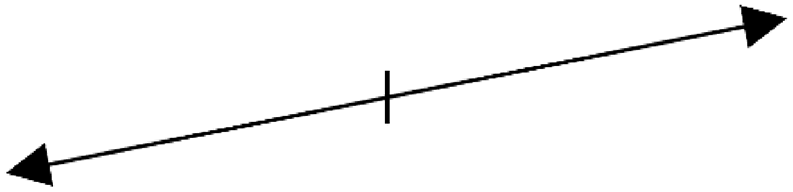
We should first consider what more precisely the content of our pure intuition of time is. Clearly in pure intuition one has a moment of time before one. But Kant also thinks that one’s pure intuition is of something ‘unlimited’ (A32/B48), and I suggest that according to Kant a pure intuition includes the representation of an endless ‘horizon’ of time both before and after (see Figure 1).Footnote 24
Time as represented through pure intuition alone.

Since permanence is existence at all moments (A242/B300) and since Kant seems to treat pure intuition as representing time containing all moments (A31/B46, A31-2/B47), it is hard to deny that in pure intuition we also represent permanence in time.
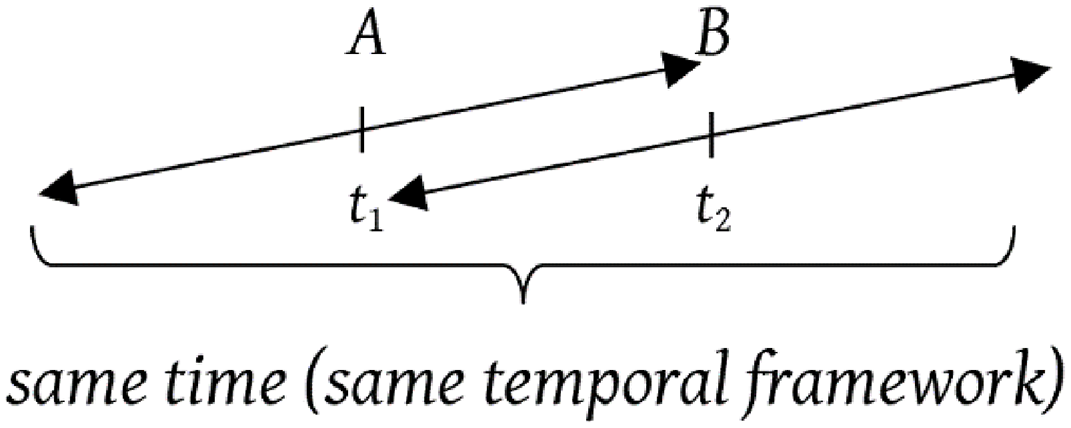
But pure intuition cannot represent that the time (temporal framework) that I intuit at one moment is the same time that I intuit at some other moment. Thus, suppose that one experiences objective succession AB or objectively simultaneous states A-B. The perceptions of A and B are (in the cases that Kant considers) successive either way. One condition on these experiences (of AB or A-B) is that one represent both A and B as in the same temporal framework (see Figure 2). (It would not be the experience of, e.g., an event if we represented A as in one timeline and B as in another, as though one were transported to an alternative universe while perceiving A.)
Time as represented over time.

Representing the time of which A occupies a moment as the same time of which B occupies a moment requires synthesis. Pure intuition alone does not suffice.Footnote 25
The point that I am making is about the kind of unity at stake in our representation of time in the First Analogy. But there is another way in which the referent of this representation differs from that of pure intuition. Compare what once confronted cartoon film illustrators. Here are the sheets of celluloid on which you will paint. Before you set to work, do these blank sheets represent the space in which the story occurs? I say: they represent a space, but each is straightforwardly undetermined, not only in the sense that the sheets are currently empty but also in the sense that there is as yet no fact of the matter about what space they depict. Perhaps these sheets will be used to depict the world of Snow White, these others the world of Bambi? I suggest that the sheets of celluloid are like our pure intuitions of time. By contrast, the representation of time at stake in the First Analogy is the time of the concrete world in which we live.
Through pure intuition alone, we always represent a moment embedded in a boundless but also undetermined past and future. In experience, we represent more. We represent this moment as part of the same time that we encounter in all of our other experiences, required for the representation of ‘both simultaneity as well as succession …’ (B224). I represent this moment as part of the same time that I experienced two years ago and the time waiting for me in the future. Indeed, I think that we must extend the point well beyond our individual experiences of simultaneity and succession, which all told are not likely to last more than 100 years. At stake for Kant is how I represent the temporal framework that I currently intuit as the same as I would represent in any possible experience of objects that are connected by way of relations of simultaneity and succession, had by even merely possible cognisers (e.g., when there are no human beings left to have experiences).Footnote 26 The next question is: How is this representing of time and its permanence accomplished?Footnote 27
4.3 Synthesising the representation of time
Here is a potential solution: we simply synthesise the content of our various pure intuitions of time (and represent, further, that times connected to these by relations of simultaneity and succession are the same).
I think that Kant holds that this cannot work. The reason, I suggest, is that we cannot perceive time in itself. But the story here must be filled out.
One possible explanation of why we cannot simply synthesise, moment to moment, our pure intuitions of time into the representation of the time of our world is that there can be no pure intuition of time at all absent this synthesis. Perhaps, indeed, to have a pure intuition of time, one needs a synthesis that specifically involves representing (permanent) substance in the world. This would be an instance of the intellectualist view that I discussed in §4.1. Helpful as it might be to me here, I will continue to pass it over. There is another way forward.
In an illuminating paper, Guyer (Reference Guyer, Nachtomy and Winegar2018) takes seriously Kant’s contention that our original representation of time is formal. Our pure intuition of time does not represent a particular thing. ‘[D]ifferent instances of pure intuition do not … present the same single object, but only the same form of objects’.Footnote 28 Here Guyer is making a point about specific objects in pure intuition (and his examples are spatial rather than temporal), which is a fine place at which to begin. One reason to endorse his claim is that it helps explain how Kant thinks mathematicians can appeal to pure intuition to yield general mathematical conclusions. If the objects of geometry – now focusing on spatial intuition – were particular, then the geometer would be able to establish claims only about the, say, particular triangle before her. But if the objects are indeterminate – i.e., not determined in various ways, such as having a specific length, specific angles, etc. – this opens the way to establishing general claims about mathematics. And Guyer extends the point to our pure intuitions of space and time themselves (pp. 191, 195). These pure intuitions are not like an intuition of a desk: It is ‘not like representing my desk before me now, at 10 AM, then representing the same desk at 11 AM when I come back from the kitchen with a fresh cup of coffee, and then again … at 1 PM when I come back from lunch’ (p. 190).
I want to take over Guyer’s insistence that our pure intuitions are formal, as well as his view that they do not represent (fully) determinate objects. He claims that ‘pure intuition does not present a single space and a single time, but a single form of space and time’ (2018: 191). I take this to mean not that there is not something singular presented in pure intuition alone but that one is not presented space or time as re-identifiable particulars.Footnote 29 This was my point above that through pure intuition alone we do not represent the time of the concrete world in which we live.
I should pause here for clarification. ‘Particular’ serves as jargon for Kant. It is a label for a form of judgement (‘Some As are B.’), from which he derives the category of plurality (A70/B95, A80/B106). It would seem to follow that items that are formal, such as points on a line in pure intuition, might be ‘particular’ despite my claim above that they are not.Footnote 30 But Kant’s is not the sense of ‘particular’ that I have in mind when I claim that in pure intuition alone we do not represent time as particular. Rather, I take myself to be using the word in P. F. Strawson’s sense (e.g., Reference Strawson1996 [1959]: Ch. 1), indicating a concrete individual.
In fact, I think that we should want to dissociate the representation of singular things and the representation of particulars independently of the task of making sense of pure intuition. Suppose, for example, that I am asked to imagine an imaginary dog. Following Berkeley (Reference Berkeley and Robinson1999 [1710]: 10-12), I am probably not imagining a dog ‘in general’. Perhaps, in this instance, what I represent looks a lot like a black labrador. On the other hand, it does not seem right that I represent a concrete particular, either. Much about this dog is undetermined: its height, its weight, the number of teeth that it has, etc. (Van Cleve Reference Van Cleve1999: 50). While my representation is clearly singular (it is just one dog), it seems wrong to insist that simply imagining a dog yields the representation of something particular – as we have in my perception of, say, my neighbour’s orange cat.
Returning to pure intuition: if we acknowledge Kant’s claim that what is given in pure intuition are ‘infinite given magnitude[s]’,Footnote 31 we now have the ingredients of a picture of our original, pure intuitions of space and time.Footnote 32 Consider specifically our pure intuition of time. I say, again, that this amounts to intuiting a moment while representing a boundless past before it and future after it. Since it is all-encompassing – one cannot intuit two times at once – it is single, as Kant insists (A31-2/B47). But it is also formal and generic. What one represents in pure intuition alone is not particular.Footnote 33
If the foregoing is correct, one can see how it would be impossible for Kant to hold that we represent time as the same temporal framework throughout our experiences just by synthesising pure intuition. If every pure intuition of time is of something formal and generic, then simply bringing together their content still leaves one with a representation of something formal and generic. A generic line, together with two more generic lines, might yield a triangle, but that triangle will also be generic.Footnote 34 The operative representation of time in the First Analogy, however, is not of something generic. It is the time of the objective world: the time in which we are born, in which we later die, in which historical events have occurred, and in which future events will transpire.
What would it be to perceive ‘time by itself’? I propose that it would be to cognise time – i.e., objective time – independently of cognising anything else in the world.Footnote 35 , Footnote 36 The story that I have told above is the story that this cannot be done. Thus, we cannot perceive time ‘by itself’. To cognise objective time independently of cognizing anything else would be to cognise it merely through pure intuition (with whatever concepts one would like to add to the mix). But this would not yield a cognition of something particular, as objective time is. It could at best yield something formal, generic.
We can now justify why Kant thinks that experiencing objective time requires experiencing something permanent in appearances.Footnote 37 There must be something particular among the objects of our experiences so that the form of time can ‘in-form’ it, be the form of it, yielding an experiential representation of time that is objective and particular.Footnote 38 Compare: I have the concept of redness. With it, alone, I represent nothing particular. Now here is a red fire truck. In experience, I can represent this particular thing, and also I represent some particular redness, the redness of this fire truck. So, too, when I experience substance, I experience time made particular by dint of in-forming this thing. And this thing must be permanent, not merely persisting for some finite period of time. We must represent objective time now as the same objective time that we will experience two hours hence and that will exist eons before and after our lifetimes. It is not just that we represent (some) time to extend forever into a past and future. That much is the content of our original representation of time. It is rather that we represent this time as identical to something encounterable in all other possible experiences of objects connected by way of relations of simultaneity and succession.
5. Substratum
Thus far, I hope to have provided an improved rationale for Kant’s conclusion that the world of appearances must contain (permanent) substance. Once Kant establishes that we must experientially represent substance, his transcendental idealism implies that substance must exist – among appearances.
Of course, this is not yet the conclusion that Kant is ultimately after – that, additionally, everything not substance is a determination thereof. Kant must establish that substance serves as the one and only fundamental substratum. And many have held that Kant cannot get this further conclusion.Footnote 39 Arguably, all Kant needs in order to account for the permanence of time is to show that we must experience something permanent among appearances – a backdrop – not that we must represent appearances as determinations of this permanent thing.
I think that this objection is a genuine problem for the argument that Kant offers in the First Analogy. But I also think that a response was available to him.
My plan in the rest of this section is as follows. First, I will explain how the argument that Kant actually offers in the First Analogy fails to address the objection. Second, I will explain how Kant nevertheless had the resources to provide a compelling response. Finally, I will defend a lemma that this reformulated argument requires.
5.1 The limitation of Kant’s argument
Recall the argument strategy that I have attributed to Kant. On a representational reading, Kant is attempting to establish that
-
(1) We must experientially represent everything as (permanent) substance or as a determination thereof.
From (1), he can infer, by invoking transcendental idealism, that
-
(2) Everything is (permanent) substance or a determination thereof.
The objection that I am currently considering really applies to (1). Perhaps I must represent (permanent) substance in the world. Thus (by transcendental idealism), there must be (permanent) substance. But why must I represent everything else as a determination of it? I do not think that Kant does, and I do not think that Kant plausibly can, answer this question.
He can go some way toward an answer, and this will matter below. He should hold that what is particular in experience will be distinct empirical objects. So for us to experientially represent particular substance – the requirement that I advanced in section 4 – particular objects of experience must have an intimate connection to substance: say, be its determinations, so that to experience one of these objects is to experience that substance. Thus, we cannot experientially represent substance as a mere backdrop, floating free of everything else that we experience.
Still, this argument falls short of what Kant needs. Kant’s view is that we must always experience substance, and this can be so as long as we are always experiencing determinations of substance. But this is compatible with representing some things as neither substance nor determinations thereof. As I look at my houseplant, for example, perhaps I represent the pot as a determination of substance but not the plant.
Remarks that Kant makes at A188-9/B231-2 might encourage the following response. He entertains the possibility that ‘substances’ (he should instead call them ‘things that are not determinations of anything’) arise or perish. But this ‘would itself remove the sole condition of the empirical unity of time, and the appearances would then be related to two different times, in which existence flowed side by side, which is absurd’. I read Kant as saying that if something arose that was not a determination of substance – an absolute arising – it could not be in the same temporal framework as everything else. But since it must be in time, it would be in its own framework, which is absurd. (Other things that are determinations of substance are in that temporal framework straightforwardly just by dint of being determinations of the substance whose form is objective time.)
As I will explain below, I think that this passage is very important for understanding how Kant should address the substance-as-mere-backdrop objection. As it stands, however, it does not provide grounds for (1). (1) is a thesis about how we must represent the world. Kant’s remarks at A188-9/B231-2 do not address how we must represent the world. They address how the world must be, appealing to the as-yet undefended metaphysical principle that for x to be part of objective time, x must be substance or a determination of substance.
5.2 Modifying Kant’s argument
The way forward, I propose, is to amend the argument strategy that I have attributed to Kant. Instead of arguing from (1) to (2), Kant should argue from the more modest
-
(1′) We must experientially represent (permanent) substance in the world and at least some things as determinations of it.
As I argued in §5.1, Kant is entitled to (1′). From (1′), by invoking transcendental idealism, he can legitimately infer
-
(2′) There is (permanent) substance, and at least some things are determinations of it.
(2′) in hand, we have a metaphysical, not a representational, question to address. Can anything that is not substance fail to be a determination of substance? Now it is appropriate to appeal to Kant’s points at A188-9/B231-2. If my table were not a determination of substance, it could not be in objective time. For objective time is the form of substance, and something disconnected from substance would be disconnected from objective time. (It would be in its own time, which is absurd.)
5.3 Defending inherence-in-substance
I must still address a lacuna in this argument. The undefended principle that I mentioned in §5.1 – for x to be part of objective time, x must be substance or a determination thereof – still requires defence. The difficulty is that there seem to be other candidate relations for the job: asymmetric causal relations or two-way causal interaction. Accordingly, something might not be a determination of substance but nevertheless exist in objective time by way of being causally connected to things that are.
But Kant could marshal a plausible response. Let me begin by distinguishing permutations of the case that we are asked to consider. The thing that is not a determination of substance – call it R – might be (i) something that arises in time or (ii) something that perishes in time. (If (iii) it is around forever, then it is substance, or a substance, and not in conflict with the principle at issue.)
Consider (i). Kant can claim that it is impossible. R must first exist to bear causal relations to substance, which means that those causal relations cannot explain R’s arising in objective time.
The trouble, then, is with (ii), at least if we specify that R has up to some moment always been around (i.e., it has not arisen in objective time, as in (i)). Still, I think that there is a difficulty that (ii) encounters. Causal relations of the sort that might be appealed to here – i.e., phenomenal causal relations – presuppose a temporal framework. Since they and their relata must already be in a temporal framework, the relations cannot explain how those relata exist in a temporal framework. This is the nub of my response to the objection that causal relations might explain belonging to objective time.
But I should elaborate. One might point out Kant’s position that causal relations ground relations of succession and simultaneity, as he argues in the Second and Third Analogies. Thus, causal relations do, for Kant, explain temporal relations. We must attend here, however, to what precisely grounds what. I claim that objective time – not temporal relations within time – makes possible causal relations. This is compatible with causal relations grounding relations of succession and simultaneity.
Matters are admittedly more complicated than this reply suggests. For as I touched on in §4.3, I take relations of succession and simultaneity to be essential to objective time, which implies (by the foregoing) that causal relations are, too. Causal relations and objective time are thus mutually conditioning: no causal relations outside of a temporal framework, but no temporal framework without those causal relations. And if objective time requires causal relations, then it seems that causal relations help explain objective time itself. Why can they not explain how something belongs to objective time?
But the answer is that these are different explananda, and the proposals under consideration are importantly different. On the account that I attribute to Kant, causal relations are in time because their relata are in time; and the relata are in time because they are modes of substance. To be sure, modes will not be in time without those causal relations – there would be no time without them – but that is not why those modes are in time. On the proposal of Kant’s opponent, R is in time because it is causally connected to a determination of substance. But to be causally connected to a determination of substance, R would already need to be in time – to explain how the causal connection is so much as possible.
I should stress that my response to Kant’s opponent is not that she misses the more fundamental question of how R is in time at all. The foregoing causal proposal is an attempt to explain R’s being in time. A slightly different version of Kant’s opponent might contend that by explaining R’s temporal relationship (before/after, simultaneity) with a determination of substance, this also explains how R is in time. My reply would be that it matters how Kant thinks this explanation must go. Temporal relationships are, Kant holds, grounded on phenomenal causal relationships. And phenomenal causal relationships and thus their relata, I am suggesting, can exist only in a unified time. Causal relationships cannot explain R’s existence in objective time, and thus neither can relations of succession or simultaneity.
6. Conclusion
I have presented a representational reading of Kant’s First Analogy, highlighting how it responds to two difficulties that Kant’s argument faces. First, in light of the fact that the First Analogy is not articulating conditions on our pure intuition of time, we need an account of why pure intuition is not enough to explain how time appears to last and not change. I have argued that our original representation of time is of something formal, not particular. Thus, we must represent something permanent in the world (more specifically, although I have not argued the point, in spaceFootnote 40 ) that bears the form of time so as to yield a representation of the (objective) time of our world. This still leaves a significant objection to Kant’s argument: that he can establish only the need for a permanent ‘backdrop’ among appearances, not that the permanent functions as a substratum for all appearances. Properly understanding the way his representational argument can work, however, helps us see the resources that Kant has to address this objection, too.
Acknowledgements
My thanks to Dai Heide and David Landy for their helpful comments to this paper, as well as audience members at the 2024 Pacific Meeting of the American Philosophical Association for their thoughtful questions and comments. I am grateful also to two anonymous referees for their thorough and insightful suggestions for improvement.