Introduction
Ecosystem engineers, also known as habitat modifiers, are species that influence the physical environment through their actions or mere presence (Jones et al., Reference Jones, Lawton and Shachak1994; Largaespada et al., Reference Largaespada, Guichard and Archambault2012). Engineering effects are provided by the creation of new habitats for other organisms, such as biological reefs, invertebrate galleries and tubes, or the modification of already existing habitats through their body architecture, metabolism, activities, or behaviours (Jones et al., Reference Jones, Lawton and Shachak1994; Sanders and Frago, Reference Sanders and Frago2024). In soft-bottom habitats, tubiculous polychaetes play an especially important ecological role by providing structures that increase the physical complexity and biodiversity of habitats (Dauer et al., Reference Dauer, Tourtelotte and Ewing1982; Dubois et al., Reference Dubois, Retière and Olivier2002; Thomsen et al., Reference Thomsen, Muth and McGlathery2011). Furthermore, polychaete tubes can modify the physical, chemical and biological characteristics of sediments (Bolam and Fernandes, Reference Bolam and Fernandes2003).
Onuphid polychaetes from the Diopatra genus are key ecosystem engineers in the intertidal and shallow subtidal waters of all the major oceans, but are more diverse in warmer waters (Arias and Paxton, Reference Arias and Paxton2015; Berke, Reference Berke2022). Diopatra tubes are capable of enhancing sediment stability, altering flow dynamics, and increasing habitat complexity and diversity of benthic invertebrates (Myers, Reference Myers1972; Bailey-Brock, Reference Bailey-Brock1984; Berke, Reference Berke2022). The tubes provide shelter from hydrodynamic forces and predators and facilitate the attachment of fouling species, which cannot survive on soft bottoms without these structures (Thomsen and McGlathery, Reference Thomsen and McGlathery2005; Santos and Aviz, Reference Santos and Aviz2018; Berke, Reference Berke2022). In addition, some species have indirect economic value since they are used as bait in artisanal and recreational fishing (Cunha et al., Reference Cunha, Hall and Queiroga2005; Aleixo et al., Reference Aleixo, Queiroga, Xenarios and Lillebø2014).
Diopatra cuprea (Bosc, Reference Bosc1802) is one of the best-documented species of the genus in intertidal and shallow intertidal environments from Cape Cod to the Caribbean (Berke, Reference Berke2022). However, recent taxonomic revisions have shown that D. cuprea represents a cryptic species complex (Ziegler et al., Reference Ziegler, Bell, Berke, Strand and Sotka2025), and several populations previously identified as D. cuprea along the Brazilian coast were reassigned to four newly described species (Seixas et al., Reference Seixas, Steiner, Solé-Cava, Amaral and Paiva2021). Consequently, without molecular confirmation, specimens should be conservatively referred to as Diopatra sp. Members of this complex typically construct deep vertical tubes that emerge 2–5 cm above the sediment surface, often with a hook-shaped cap onto which the worm actively attaches shell fragments, plant debris, algae (Berke and Woodin, Reference Berke and Woodin2008; Berke, Reference Berke2022), and occasionally even plastic items (Rosa, Reference Rosa2023). On the Brazilian Amazon coast, Diopatra tubes are widespread on protected beaches and intertidal estuaries, and although studies remain scarce, available evidence indicates that their presence can markedly alter environmental conditions and enhance the density and richness of associated benthic fauna (Santos and Aviz, Reference Santos and Aviz2018, Reference Santos and Aviz2021).
The Amazon coastal region is dominated by muddy tidal flat systems that extend for almost 480 km (Kjerfve and Lacerda, Reference Kjerfve, Lacerda and Lacerda1993). These systems are highly dynamic, influenced by a macrotidal regime (>4 m), high rainfall, and river discharge (Dittmar and Lara, Reference Dittmar and Lara2001; Souza-Filho et al., Reference Souza-Filho, Lessa, Cohen, Costa and Lara2009; Pereira et al., Reference Pereira, Sozinho da Silva, Costa, Asp, da Costa and Vila-Concejo2012; Santos et al., Reference Santos, Almeida, Aviz and Rosa-Filho2021a). Under such conditions, stable biogenic structures offer rare habitats for the establishment of benthic organisms and promote diversity of their communities in the region (Santos and Aviz, Reference Santos and Aviz2021). These structures include polychaete tubes, such as Sabellaria (Ataide et al., Reference Ataide, Venekey, Rosa-Filho and Dos Santos2014; Aviz et al., Reference Aviz, da Silva and Rosa-Filho2019, Reference Aviz, Rosa-Filho, Santos and Santos2022, Reference Aviz, Barros, Silva, Faria and Rosa-Filho2025), and Diopatra (Santos and Aviz, Reference Santos and Aviz2018, Reference Santos and Aviz2021). The available information on Diopatra tubes is for associated macrofauna (Santos and Aviz, Reference Santos and Aviz2021), and there are no complementary data on the assemblages of meiofauna associated with this habitat.
The meiofauna or meiobenthos are ecological communities of tiny organisms operationally defined by the mesh sizes used for their extraction (ranging from 45 to 500 μm), including free-living animals and protists living in aquatic sediments, on plants, algae, biogenic structures, and occasionally on other animals (Giere, Reference Giere2009). Meiofauna often aggregate spatially in the sediments, either vertically or horizontally, resulting in patchiness (Giere, Reference Giere2009). In general, this distribution is caused by variations in granulometry, oxygen saturation, salinity, food availability, and water chemical components (Giere, Reference Giere2009). The presence of biogenic structures is also responsible for spatial distribution, although these approaches have been underexplored in the field of meiofauna ecology (Giere, Reference Giere2009, Reference Giere2023).
Increases in the abundance and/or taxon richness of meiofauna are often linked to the presence of biogenic structures, such as burrowing macrofauna (Dittmann, Reference Dittmann1996; Cruz Rosa and Bemvenuti, Reference Cruz Rosa and Bemvenuti2005), coral reefs (Netto et al., Reference Netto, Attrill and Warwick1999a, Reference Netto, Warwick and Attrill1999b; Semprucci et al., Reference Semprucci, Colantoni, Baldelli, Rocchi and Balsamo2010), seagrass (Fonseca et al., Reference Fonseca, Hutchings and Gallucci2011; Daudi et al., Reference Daudi, Uku and De Troch2013; Ataide et al., Reference Ataide, Venekey, Rosa-Filho and Dos Santos2014), or polychaete tubes (Tita et al., Reference Tita, Desrosiers, Vincx and Nozais2000; Guilherme et al., Reference Guilherme, Silva, El-Deir and Santos2011). Studies on the association between meiofauna and Diopatra tubes are even scarcer (Bell and Coen, Reference Bell and Coen1982a, Reference Bell and Coen1982b; Bell, Reference Bell1985; Guilherme et al., Reference Guilherme, Silva, El-Deir and Santos2011). It is known that a wide variety of organisms, such as nematodes, copepods, turbellarians, foraminiferans, and juveniles of macrofaunal forms, are among the epibenthic meiofauna that can be found associated with Diopatra tubes (Bell and Coen, Reference Bell and Coen1982a, Reference Bell and Coen1982b; Bell, Reference Bell1985). Furthermore, meiofauna communities in tubes and sediments near tubes are denser than those in sediments further away (Guilherme et al., Reference Guilherme, Silva, El-Deir and Santos2011).
Thus, the presence of populations of Diopatra sp. in estuaries on the Brazilian Amazon coast is an opportunity to study the structure of meiofauna associated with its tubes. This study aimed to characterize the community and investigate the effects of Diopatra sp. tubes on the meiofauna community found on a tidal flat area. The tested hypothesis was that the presence of tubes contributes to the establishment of a meiofauna community distinct, in terms of composition and density, from that found on sediments with no tubes.
Material and methods
Study area
This study was conducted on a tidal muddy-sandy flat located in the estuary of the Piriá River (00°59′26.11′′S, 46°11′08.73′′W) (Figure 1) in the city of Viseu (northeast Pará, Brazil). The Piriá River is part of the Gurupi-Piriá Marine Extractive Reserve and covers an area of 74,081 ha distributed in mangrove ecosystems and marine area (ICMBio (Instituto Chico Mendes de Conservação da Biodiversidade) 2010). The climate is humid tropical with a mean annual temperature of 27.7 ± 1.1°C (Martorano et al., Reference Martorano, Pereira, César and Pereira1993) and annual rainfall (30-year series) ranging from 2,200 to 2,800 mm (Moraes et al., Reference Moraes, Costa, Costa and Costa2005). Rainfall rates vary considerably over the year, with a well-marked rainy season from January to July, with total precipitation of ∼1,657 mm, and a dry season from August to December, with total rainfall of 490 mm (Moraes et al., Reference Moraes, Costa, Costa and Costa2005). The region is dominated by semidiurnal macrotides, and the amplitude may reach more than 5 m (Souza-Filho et al., Reference Souza-Filho, Lessa, Cohen, Costa and Lara2009).
Map of the Piriá River estuary showing the study areas (area 1: with Diopatra sp. tubes and area 2: without tubes).

Sampling and laboratory procedures
The sampling design followed an opportunistic approach due to the spatial configuration of the Diopatra tube aggregation. During fieldwork, the Diopatra field exhibited no natural internal gaps that could serve as within-patch controls. Therefore, the control area without tubes (area 2) was selected within the same tidal flat, at the same elevation and distance from the tideline, ensuring comparable hydrodynamic exposure and sedimentary conditions. This approach allowed the inclusion of a tube-free reference area while maintaining the environmental coherence required for meaningful comparisons.
Samples were collected in February 2014 (Amazon rainy season) from two areas located ∼400 m apart on a muddy–sandy flat during spring low tide, each encompassing ∼50 m2 and positioned at the same distance from the tideline. One area was populated with Diopatra sp. tubes (area 1), whereas the other exhibited no visible tubes (area 2). Ten replicate samples were collected in each area using a cylindrical corer (3.0 cm diameter × 10 cm length). In area 1, the corer was positioned so that a single Diopatra tube was centred within the sampling unit. All samples were preserved in 4% formaldehyde solution for subsequent identification in the laboratory.
To estimate Diopatra sp. density in area 1, the number of tubes was counted in five evenly distributed square subplots (25 m2 each). To characterize tube morphology, intact tubes found within the sampling plots were measured. Tubes exhibited a mean exposed height of approximately 10 cm with an external diameter of about 0.7 cm, and built vertical tubes that emerged a few centimetres above the sediment surface (Supplementary Material 1). Tube caps consisted mainly of plant fragments bound with fine sediment particles, forming a compact structure with a vertically oriented opening (Supplementary Material 2). These measurements provide a structural description of the habitat-engineering features that potentially influence local meiofaunal assemblages.
In the laboratory, meiofauna was extracted from sediments using manual elutriation and sieved through 0.3 and 0.045 mm meshes. Organisms retained in the 0.045 mm mesh were placed on Dollfus plates and identified to major taxonomic groups following Giere (Reference Giere2009) and Danovaro (Reference Danovaro2010). The Diopatra sp. voucher specimens and tubes were deposited in the collections of the Museu Paraense Emílio Goeldi under the catalogue numbers MPEG.ANL 002684.
Statistical analysis
We calculated the meiofauna density (ind./10 cm2) and total major groups richness for each biological sample, and the variation in these parameters between the study areas (area 1: with Diopatra tubes × area 2: without Diopatra tubes) was analysed using a one-way analysis of variance (ANOVA) after verifying the normality and homogeneity of variances assumptions, using the Kolmogorov–Smirnov and Levene tests, respectively. When necessary, the data were fourth-root transformed. A Principal Coordinates Analysis (PCO) was run on a Bray–Curtis similarity matrix of the fourth root-transformed meiofauna major groups to visualize the similarity between samples across areas. To identify the meiofauna major group that characterized each area, major groups that correlated (Spearman’s coefficient) more than 60% with one of the first two axes were plotted in each PCO. Simultaneously, the same density matrices used for the PCO were analysed using a one-way permutational ANOVA (PERMANOVA) designed using the same layout as the ANOVA. The contribution of each major group to the dissimilarity found among the groups was assessed using the SIMPER (similarity percentage) routine. A 5% significance level was considered in all analyses.
Results
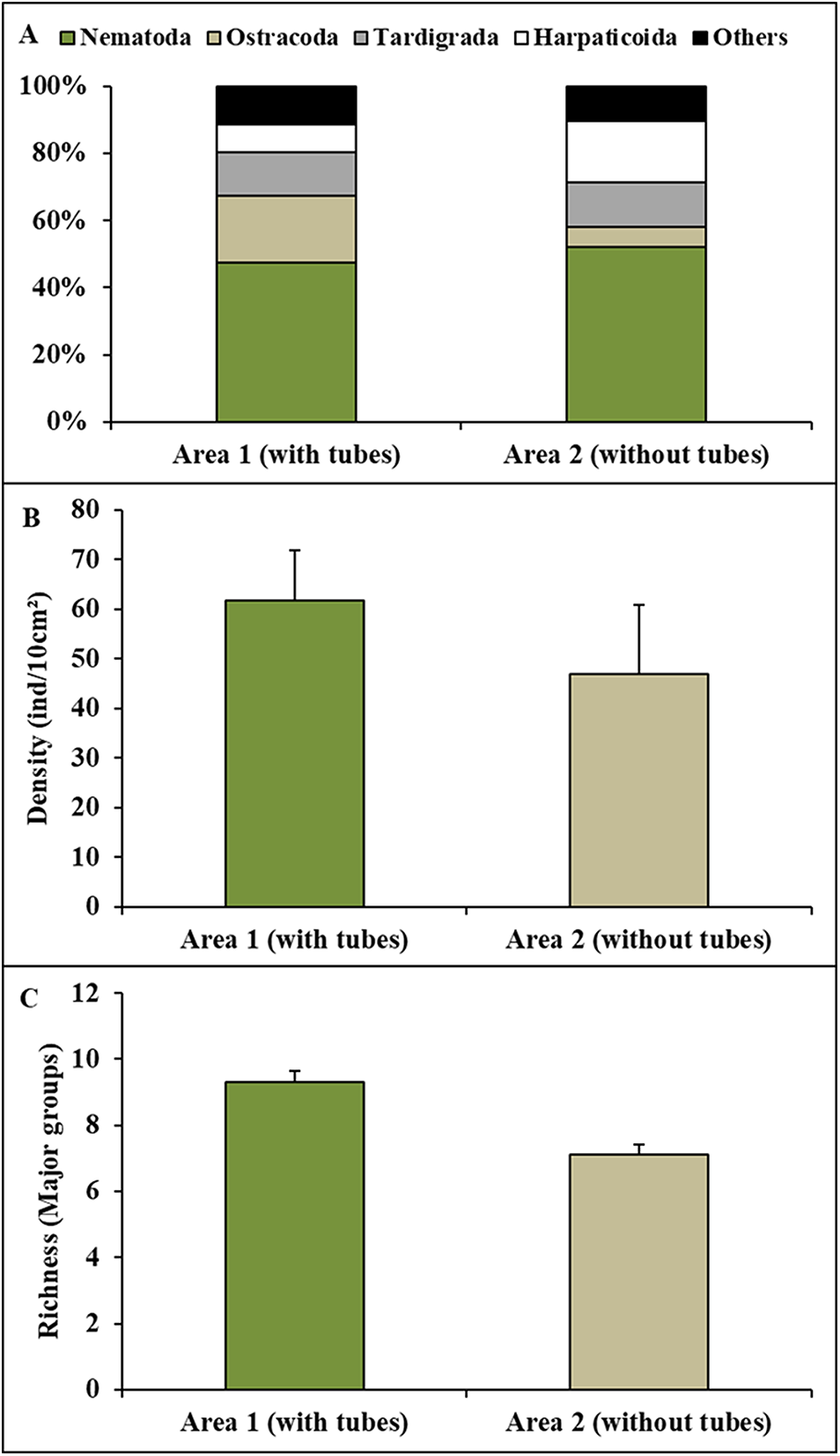
The mean density of Diopatra sp. tubes recorded at area 1 was 37.9 ± 12.1 ind./m2. Meiofauna was comprised of 13 taxonomical major groups (Table 1). Overall, Nematoda (49%), Ostracoda (14%), Tardigrada (13%), and Copepoda (12%) were the dominant groups; however, their contribution varied among areas. In area 1 (with tubes), Nematoda (47.6%), Ostracoda (19.9%) and Tardigrada (13.0%) were the dominant groups. In area 2, there was an increased contribution of Nematoda (52.1%), Tardigrada (13.13%), and Harpacticoida (18.5%), while decreased the contribution of Ostracoda (6.1%) (Figure 2A). The mean meiofauna density (F 1,18: 3.48; p < 0.01) and richness (F 1,18: 3.21; p < 0.05) vary significantly among areas. In both cases, the highest values were found in area 1 (Figure 2B and 2C).
Relative abundance (%) (A), mean density (±SE) (B), and mean richness (±SE) (C) of the major meiobenthic groups of the two sampling plots in the study areas.

Mean density (±SE) and relative abundance (R.A.) of the meiofauna major groups found in the study areas. Area 1: with Diopatra cuprea tubes; area 2: without tubes)

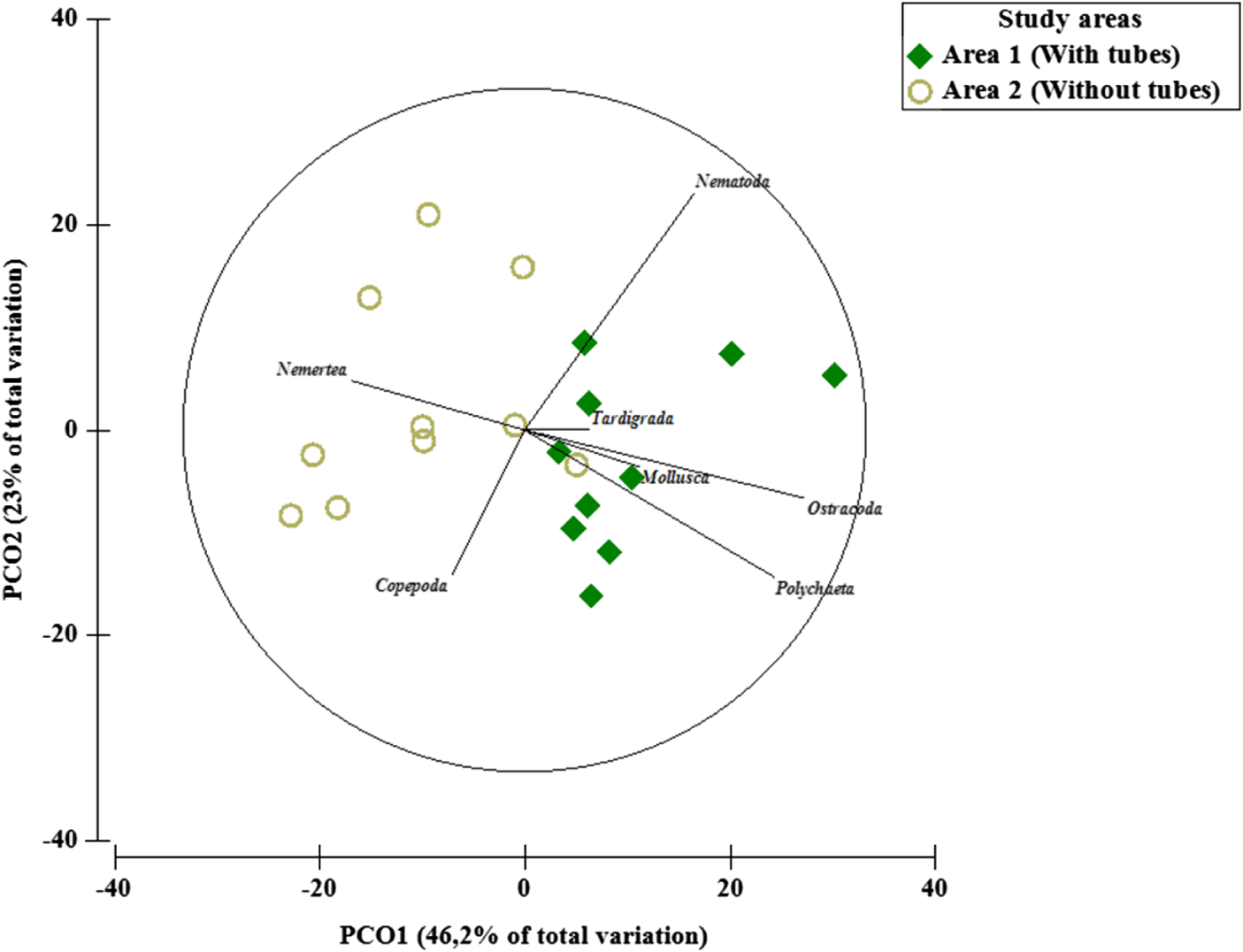
The structure of the meiofauna community varied significantly between areas (pseudo-F = 8.15; p (perm) = 0.001; p (Monte Carlo) = 0.001). The spatial configuration distinguished the meiofauna samples between the two study areas (Figure 3). Regarding major groups, axis 1 explained 46.2% of the variation in the data and was responsible for separating the two areas. The major groups most correlated with area 1 samples were Nematoda, Tardigrada, Mollusca, Ostracoda and Polychaeta, whereas Nemertea was most correlated with area 2 (Figure 3).
Principal Coordinates Analysis (PCO) of the samples of the macrobenthic fauna considering the taxonomic composition. The vectors represent species/groups correlating more than 50% (based on Spearman correlation coefficients) with one of the first two PCO axes.

The SIMPER analysis indicated a mean dissimilarity of more than 80% between the study areas (Table 2). Comparing sites, most of the species indicated by SIMPER were more abundant in area 1, in particular Ostracoda, Turbellaria, Polychaeta, Mollusca, and Nematoda (Table 2).
Average dissimilarities between the samples from the area with and without Diopatra cuprea tubes, with the contribution from taxonomical groups

Discussion
The mean density of Diopatra sp. tubes in the study area (37.9 ind. m−2) is comparable to values reported for Amazonian sandy beaches and estuarine flats, where densities typically range between 42.5 and 53.8 ind. m−2 (Rosa-Filho et al., Reference Rosa-Filho, Gomes, Almeida and Silva2011; Santos et al., Reference Santos, Almeida, Aviz and Rosa-Filho2021a; Santos and Aviz, Reference Santos and Aviz2018). These values also fall within the lower range reported for other soft-bottom habitats in the Amazon region (Santos and Aviz, Reference Santos and Aviz2021). In contrast, historical records from the southern Brazilian coast documented much higher Diopatra densities, with patches reaching up to 130 ind. m−2 during the 1970s and 1980s (Amaral, Reference Amaral1979; Corbisier, Reference Corbisier1991), although no recent data are available to evaluate long-term trends. When compared with intertidal and shallow subtidal habitats along the North Atlantic coast, areas dominated by members of the Diopatra cuprea complex, mean densities in the Amazon (37.9 ind. m−2) are lower than the values reported elsewhere (76.7–178.3 ind. m−2; Mangum et al., Reference Mangum, Santos and Rhodes1968; Peckol and Baxter, Reference Peckol and Baxter1986). Furthermore, densities of Diopatra sp. in the present study are much lower than those recorded for other congeners, such as Diopatra leuckarti Kinberg, Reference Kinberg1865, which reached 21,800 ind. m−2 on a Hawaiian beach (Bailey-Brock, Reference Bailey-Brock1984), or Diopatra marocensis Paxton, Fadlaoui, and Lechapt (Reference Paxton, Fadlaoui and Lechapt1995), which attained 90 ind. m−2 in Mersin Bay, Turkey (Çinar et al., Reference Çinar, Fauchald and Dagli2014).
In Amazonian intertidal habitats, Diopatra sp. tubes are typically scattered widely in the intertidal zone (Santos and Aviz, Reference Santos and Aviz2018, Reference Santos and Aviz2021). The low density of Diopatra sp. found on the Amazon coast is probably due to the intense hydrodynamics of the local estuaries (Santos and Aviz, Reference Santos and Aviz2018). The Amazonian estuaries and beaches are dynamic habitats generated by the interaction of waters from the Amazon River and its tributaries with waters of the Atlantic Ocean, and these discharges of water result in peculiar and intense hydrodynamic patterns (Nittrouer and DeMaster, Reference Nittrouer and DeMaster1996). It is well-known that in protected intertidal areas where organic detritus is deposited, dense aggregations of Diopatra tubes are frequently observed (Bailey-Brock, Reference Bailey-Brock1984; Dagli et al., Reference Dagli, Ergen and Çinar2005; Thomsen and McGlathery, Reference Thomsen and McGlathery2005). Overall, the population density of Diopatra sp. has a significant correlation with current velocity, and although Diopatra’s feeding mechanism might benefit from faster currents, extremely high currents might harm the tubes’ structural integrity (Mangum et al., Reference Mangum, Santos and Rhodes1968). Therefore, areas with high hydrodynamics may prevent the development of denser aggregations (Santos and Aviz, Reference Santos and Aviz2018).
The taxonomic composition of the meiofauna associated with Diopatra sp. tubes is difficult to compare to other results due to the scarcity of research in this field of study. However, the number of major groups found in the present study (12) was higher than the number obtained by Bell (Reference Bell1985), who found seven meiofauna major groups, and by Guilherme et al. (Reference Guilherme, Silva, El-Deir and Santos2011), who registered nine major groups associated with Diopatra tubes. However, the richness in our study was lower compared to the 22 major groups identified by Ataide et al. (Reference Ataide, Venekey, Rosa-Filho and Dos Santos2014) in association with the polychaete Sabellaria wilsoni Lana & Gruet, 1989 (Sabellariidae) sandy reefs on the Amazon coast.
The meiofauna in the studied areas was composed primarily of estuarine and marine taxa, with a dominance of Nematoda. This composition is similar to that found in association with D. cuprea in temperate regions (Bell and Coen, Reference Bell and Coen1982a, Reference Bell and Coen1982b) and in tropical regions (Guilherme et al., Reference Guilherme, Silva, El-Deir and Santos2011), as well as in other soft-bottom habitats on the Amazon coast (e.g. Gomes and Rosa Filho, Reference Gomes and Rosa-Filho2009; Rosa Filho et al., Reference Rosa-Filho, Gomes, Almeida and Silva2011; Baia and Venekey, Reference Baía and Venekey2019; Baia et al., Reference Baía, Rollnic and Venekey2021; Santos et al., Reference Santos, Petracco and Venekey2021b, Reference Santos, Baía and Venekey2023, Reference Santos, Petracco and Venekey2025; Melo et al., Reference Melo, Aviz, Silva, Silva, Borba, Rollnic and Venekey2024; Ferreira-Ramos et al., Reference Ferreira-Ramos, Venekey and Santos2026). The dominance of nematodes in meiofaunal communities has been extensively documented in the literature (see Giere, Reference Giere2009, for a review). This dominance of nematodes is associated with three main factors: i) their body shape (long, thin, and fusiform), which facilitates burrowing activities; ii) their high tolerance to environmental stress; and iii) their diversity of feeding habits, allowing them to utilize all available food resources (Bouwman Reference Bouwman1983; Giere Reference Giere2009; Santos and Venekey Reference Santos and Venekey2017; Santos et al Reference Santos, Nascimento and Venekey2024).
Engaging directly with Bell’s research, our results reinforce several of her mechanistic interpretations. In her experimental work, Bell (Reference Bell1985; Bell and Coen, Reference Bell and Coen1982a, Reference Bell and Coen1982b) demonstrated that Diopatra cuprea tube caps, particularly those that are elevated, heavily ornamented, and vertically oriented, create microhabitats with greater structural complexity. This complexity, in turn, was shown to be crucial for altering near-bottom flow, which promoted the retention of organic material and fine sediments. Consequently, this enhanced microhabitat complexity resulted in a notable increase in meiofaunal densities, especially of nematodes, even where tube spatial density was low.
Our results align with these findings: despite the relatively simple but typical decoration of the Amazonian tubes, higher meiofauna density and richness were found in the area with Diopatra tubes. Similar results were obtained in studies on macrobenthic fauna, where even scattered Diopatra tubes influenced the community structure (Callaway, Reference Callaway2006; Thomsen et al., Reference Thomsen, Muth and McGlathery2011; Santos & Aviz, Reference Santos and Aviz2018, Reference Santos and Aviz2021). In general, the presence of tubes increases the complexity and heterogeneity of habitats, thus promoting the establishment of more diverse and abundant benthic communities (Bell, Reference Bell1985; Rabaut et al., Reference Rabaut, Guilini, Van Hoey, Vincx and Degraer2007; Toupoint et al., Reference Toupoint, Godet, Fournier, Retière and Olivier2008), although on a much smaller spatial scale than large aggregations (Santos and Aviz, Reference Santos and Aviz2018, Reference Santos and Aviz2021). In general, there are two different kinds of Diopatra tubes: (i) those made entirely of sand and mucus particles and (ii) those reinforced with debris that rises above the sediment surface (Berke, Reference Berke2022). The incorporation of items reflects the diversity of the available substrates and surface debris (Bell and Coen, Reference Bell and Coen1982a). Although the tubes found in the study area (see Supplementary Material 1) are decorated primarily with small fragments of plants, they represent a more complex habitat than the adjacent muddy sediment, which allows the establishment of a more abundant and diverse meiofauna.
Ostracods reached higher densities in the area with Diopatra tubes, with a mean value more than four times higher than in the area without tubes. Increased ostracod abundance has been linked to high habitat complexity due to the presence of vegetable structures, such as macrophytes and seagrass (Szlauer-Łukaszewska., Reference Szlauer-Łukaszewska2015). In estuaries, higher ostracod and nematode densities have also been associated with finer grain size and greater availability of organic matter in the sediment, given their detritivorous feeding (Alves et al., Reference Alves, Adão, Patrício, Neto, Costa and Marques2013; Rosa, Reference Rosa2005). Although the sedimentary composition of the sediment could not be evaluated in this study, the presence of D. cuprea tubes has been associated with an increase in fine sediment and organic matter, due to reducing the velocity of the near-bottom flow and an increase in the deposition (Eckman et al., Reference Eckman, Nowell and Jumars1981; Friederichs et al., Reference Friederichs, Graf and Springer2000; Bolam and Fernandes, Reference Bolam and Fernandes2003; Callaway, Reference Callaway2006). In fact, a previous study in a macrotidal sandy beach of Amazonia showed that the presence of Diopatra tubes promotes a greater accumulation of organic matter (up to 18 times higher) and of fine sediments (up to 58% more) than in adjacent areas without tubes (Santos and Aviz, Reference Santos and Aviz2018).
Another important change in the sediment would be that Diopatra tubes probably maintain a higher level of relative humidity. In the Amazon region, dominated by a macrotidal (<4 m) regime, this is a crucial factor in the permanence of organisms living in the intertidal zone, which is exposed for longer periods at low tide (Cardoso et al., Reference Cardoso, Petracco, Santos, Venekey and Aviz2023; Santos and Aviz, Reference Santos and Aviz2020). Thus, apart from providing protection from predators and facilitating food, associated organisms are protected against desiccation. Similar results were observed by Ataide et al. (Reference Ataide, Venekey, Rosa-Filho and Dos Santos2014) for S. wilsoni reefs. In addition, Diopatra tubes may also stabilize sediments and provide protection by reducing wave action, which would allow the presence of less tolerant species in environments of strong energy (Berke, Reference Berke2022). In general, allogenic engineering requires the environment to be structurally changeable and additional materials, extrinsic, if necessary, to be available to the engineer (Jones et al., Reference Jones, Gutiérrez, Byers, Crooks, Lambrinos and Talley2010). In these cases, abiotic change is the result of the interaction of the structure with kinetic energy and materials within the abiotic environment (Jones et al., Reference Jones, Gutiérrez, Byers, Crooks, Lambrinos and Talley2010).
The copepods, in contrast to the ostracods, were less abundant in the area with tubes. Ólafsson et al. (Reference Ólafsson, Moore and Bett1990) also observed a lower density of copepods in areas with tubes of the polychaete Melinna palmata Grube, 1870. This result was associated with the effects of the feeding activity, presence of faecal aggregates and modifications of the sediment caused by M. palmata in the superficial layers of the sediment, where most benthic copepod populations live (Ólafsson et al., Reference Ólafsson, Moore and Bett1990; Chertoprud et al., Reference Chertoprud, Gheerardyn and Gomez2013). Furthermore, many harpacticoids have limited colonization of finer sediments and are more abundant in coarser sediments, as interstitial spaces are larger and allow for better mobility and oxygenation (De Troch et al., Reference De Troch, Houthoofd, Chepurnov and Vanreusel2006; Giere, Reference Giere2009). In fact, polychaete tubes can trap fine particles, leading to the accumulation of muddy sediment and organic matter in areas that were previously sandiest, disfavouring some benthic organisms (Dittmann, Reference Dittmann and Dittmann1999; Zühlke, Reference Zühlke2001; Callaway, Reference Callaway2006).
It is worth noting that nemerteans were found only in the area without Diopatra tubes, indicating a possible influence of the tubes on their distribution. Nemerteans are known predators in marine habitats, but little is known about their ecology, especially in relation to interstitial species (Thiel and Kruse, Reference Thiel and Kruse2001). These worms actively forage for prey and move rapidly between grains using muscle contractions (Thiel and Kruse, Reference Thiel and Kruse2001). It is possible that finer and more stable sediments, modified by the presence of Diopatra tubes, can affect nemerteans’ distribution. The presence of mud characteristically contributes to firmer substrata because the small particles impede the movement of sand grains (Crane and Merz, Reference Crane and Merz2017). Sediment mechanical properties, such as granulometry, stiffness, and resistance to penetration, are known to determine the distribution of burrowing worms (Crane and Merz, Reference Crane and Merz2017; Dorgan et al., Reference Dorgan, Arwade and Jumars2008).
Conclusion
This study was the first to evaluate the influence of Diopatra sp. tubes on the meiofauna community in the Amazon coast, and one of the few in the world. Despite the small spatial scale, the results of the present study are consistent with those of previous research, which found changes in the composition of the benthic fauna, that is, higher species richness and densities of fauna in areas inhabited by these tube-building polychaetes in comparison with areas of bare sand, even though Diopatra sp. tubes were sparsely distributed in the study area. This conclusion would be reinforced by a broader sampling, which would include a larger number of tubes and areas, larger-scale effects, as well as the sedimentary and hydrodynamic parameters. The present findings add knowledge about the presence of ecosystem engineers on the Atlantic coast.
Supplementary material
The supplementary material for this article can be found at https://doi.org/10.1017/S002531542610109X.
Acknowledgements
The first author thanks CNPq for the Institutional Training Program Grant (PCI-MPEG, grant number: 30107/2024-9). We are grateful to Roseanne Figueira for her help in the fieldwork and to Bruna Melo for her help processing the samples. We also thank the anonymous referees for the constructive suggestions that improved our manuscript.
Author contributions
T.M.T. dos Santos: conceptualization, methodology, validation, formal analysis, investigation, data curation, writing-original draft and editing; D. Aviz: conceptualization, methodology, validation, formal analysis, investigation, writing-original draft and editing.
Funding
This research did not receive any specific grant from funding agencies in the public, commercial, or not-for-profit sectors.
Conflict of interest
The authors declare that they have no known competing financial interests or personal relationships that could have appeared to influence the work reported in this paper.
Data availability statement
The data are available by requesting the authors.
Ethical standards
This article did not require any research permit.