Introduction
Perennial grain crops are emerging as promising alternatives to analogous annual cereals in sustainable agricultural systems because of their low-input requirements and suitability for growth in ecologically sensitive areas (Cox et al., Reference Cox, Glover, Van Tassel, Cox and DeHaan2006; Asbjornsen et al., Reference Asbjornsen, Hernandez-Santana, Liebman, Bayala, Chen, Helmers, Ong and Schulte2014; Ryan et al., Reference Ryan, Crews, Culman, Dehaan, Hayes, Jungers and Bakker2018). Two crops in particular, intermediate wheatgrass [IWG; Thinopyrum intermedium (Host) Barkworth & Dewey], which has been developed to produce grain marketed as Kernza® (DeHaan et al., Reference DeHaan, Christians, Crain and Poland2018; Bajgain et al., Reference Bajgain, Zhang, Jungers, DeHaan, Heim, Sheaffer, Wyse and Anderson2020), and perennial cereal rye (PCR; Secale cereale L. ‘ACE-1’) (Acharya et al., Reference Acharya, Mir and Moyer2004) are being grown for dual-use grain and forage production in North America (Ryan et al., Reference Ryan, Crews, Culman, Dehaan, Hayes, Jungers and Bakker2018). IWG reduces nitrogen leaching (Jungers et al., Reference Jungers, DeHaan, Mulla, Sheaffer and Wyse2019), grows well under surface drought conditions (Sleiderink, Reference Sleiderink2020) and has the potential to be a net carbon sink (Culman et al., Reference Culman, Snapp, Ollenburger, Basso and DeHaan2013; Sprunger et al., Reference Sprunger, Culman, Peralta, DuPont, Lennon and Snapp2019; de Oliveira et al., Reference de Oliveira, Brunsell, Crews, DeHaan and Vico2020); however, see Sprunger et al. (Reference Sprunger, Culman, Robertson and Snapp2018) for contrary evidence. These environmental benefits are in part responsible for driving increased adoption and acceptance of perennial grain crops in the USA and globally (Adebiyi et al., Reference Adebiyi, Schmitt Olabisi and Snapp2016; Marquardt et al., Reference Marquardt, Vico, Glynn, Weih, Eksvärd, Dalin and Björkman2016; Rogé et al., Reference Rogé, Diarisso, Diallo, Boiré, Goïta, Peter, Macalou, Weltzien and Snapp2017; Wayman et al., Reference Wayman, Debray, Parry, David and Ryan2019; Lanker et al., Reference Lanker, Bell and Picasso2020).
As perennial grain crops become more prevalent in the agricultural landscape, a number of management challenges are expected, including the need to control plant diseases (Cox et al., Reference Cox, Garrett and Bockus2005a). The perennial nature of IWG and PCR limits the deployment of several effective and commonly used disease management practices such as crop rotation and soil tillage. Fewer disease management options in these systems bring a risk that successfully managed pathogens found in related annual crops will become yield limiting in perennial systems. Additionally, incorporation of perennial crops with novel genetics and phenology into diverse agricultural landscapes could lead to the emergence of new and unexpected pathogens. In either case, controlling plant pathogens in these systems could require new approaches to disease management. Furthermore, the potential impact of pathogen movement between annual and perennial grains is non-trivial, posing challenges to both production systems. Pathogens from annual grain crops grown over a large acreage could threaten newly established perennial crops, whereas established fields of perennial grains could serve as a semi-permanent source of pathogen inoculum for nearby annual crops. The accumulation of pathogens on perennial crop debris within a single field may also increase disease pressure on subsequent rotation crops if they are affected by the same plant pathogens (Dill-Macky and Jones, Reference Dill-Macky and Jones2000; Bakker et al., Reference Bakker, Acharya, Moorman, Robertson and Kaspar2016), and the persistence of pathogens in perennial grain fields may need to be monitored over time.
Recognition of disease management challenges has accompanied the development of perennial cropping systems (Cox et al., Reference Cox, Garrett and Bockus2005a), and an emphasis has been placed on plant breeding. Because IWG has been a source of disease resistance genes effective at protecting plants from Fusarium head blight (FHB), stem rust and several other diseases of common wheat (Li and Wang, Reference Li and Wang2009; Turner et al., Reference Turner, De Haan, Jin and Anderson2013; Bajgain et al., Reference Bajgain, Zhang, Turner, Curland, Heim, Dill-Macky, Ishimaru and Anderson2019), domesticated lines of IWG could be expected to remain largely unaffected by plant pathogens familiar in agricultural settings. Additional studies on IWG accessions in the mid-west, including observations on Fusarium head blight, tan spot, take-all, wheat streak mosaic and barley yellow dwarf (Cox et al., Reference Cox, Garrett, Cox, Bockus and Peters2005b; Jaikumar, Reference Jaikumar2013), and in the north-west on wheat streak mosaic, Cephalosporium stripe and eyespot diseases (Cox et al., Reference Cox, Murray and Jones2002), have provided evidence of high disease resistance to regionally important plant pathogens. However, previous research in New York found susceptibility to soilborne wheat mosaic virus and wheat spindle streak mosaic virus in a number of perennial wheat and rye-breeding lines (Cadle-Davidson et al., Reference Cadle-Davidson, Bergstrom and Cox2005). Additionally, in Manitoba, Canada, PCR was found to be unfit for grain production in part because of high ergot incidence (Cattani, Reference Cattani2019). Variation in the plant pathogens examined in these previous studies reflects regional differences in climate and microbial communities, and the introduction of novel perennial grain crops into new geographic areas will require close monitoring of local plant–pathogen associations. To date, no examination of fungal pathogen presence on IWG and PCR has been conducted in the northeastern USA.
In New York, fungal pathogens of annual grains have a significant impact on crop yield and value. Accordingly, the primary objective of this study was to identify putative fungal plant pathogens associated with disease symptomatic perennial cereal crops grown in New York. Because the perennial nature of these grains is expected to support a buildup of within-field pathogen inoculum over time, fungal colonization of overwintered stem tissue was quantified. We also measured aspects of grain quality, including fungal contamination and toxin content, which can determine the suitability of grain for sale and consumption. This work was conducted primarily at experimental field sites where intercropping and nurse cropping treatments were under evaluation. We identified nine putative host–pathogen combinations, several of which have not appeared in the literature previously, and report significant effects of host species and agronomic practices on fungal pathogen communities, highlighting the importance of assaying plant disease repeatedly under varied cropping conditions.
Methods
Field sites and identification of putative pathogens
Pathogen surveillance was conducted within two ongoing field experiments at the Musgrave Research Farm in Cayuga county, NY and at four on-farm trials in Seneca, Tompkins, and Yates counties, NY. The first field experiment (intercropping perennials and annuals, IPA) was started in 2016 to compare perennial grain crops to annual grain crops commonly grown in the region. The experiment was arranged in a randomized split plot design with four replicate blocks. Each main plot measured 18 m by 6 m and was separated from other plots by 3 m alleys. Main plots were planted with PCR or IWG. Plots were split lengthwise, and the two resulting 18 m by 3 m sub-plots were assigned randomly to one of two treatments: a medium red clover (Trifolium pratense L.) intercrop planted at a rate of 22.4 kg ha−1; or a no-clover control. The second field experiment (perennial grains and peas, PGP) was started in 2017 to study the potential benefits of intercropping perennial grain crops with food-grade field pea and to determine the effects of using a winter-killed oat nurse crop to suppress weeds during perennial crop establishment. The trial was arranged in a split plot design with four replicate blocks. Main plots were 24.4 m by 9.1 m, and subplots were 12.2 m by 9.1 m. PCR and IWG were grown factorially with or without field pea (Pisum sativum L. ‘Mystique’) intercrops in the main plots, and oat (Avena sativa L. VNS) nurse crops were planted in the subplots.
The IPA and PGP field trials were both managed based on USDA National Organic Program regulations; however, neither field was certified organic. PCR seed was obtained from the breeding program at the Agriculture and Agri-Food Canada Research Center, Lethbridge, Alberta, Canada. IWG seed was obtained from a breeding population after the third cycle of selection for an increased seed yield at The Land Institute, Salina, Kansas, USA. In the IPA experiment, PCR and IWG were drilled in 19 cm rows in early September 2016, and red clover seed was broadcast into subplots in mid-March 2017 and 2018. In the PGP experiment, PCR and IWG were planted in September 2017. Seeds were drilled in 19 cm rows in monoculture plots and in 38 cm rows where intercropped with field peas, which were drilled between perennial grain rows in April 2018. This resulted in alternating 19 cm rows of perennial grain and field pea in the intercropped main plots. In both experiments, composted chicken manure (5-4-3, Kreher Family Farms, Clarence, New York, USA) was broadcast at an annual rate of 1800 kg ha−1 split equally between two applications, once in spring at greenup and again in fall after grain harvest. PCR was harvested in July and IWG was harvested in August of each production year. Crop residues were flail-chopped to 10 cm in height and stalks were removed from each field within 2 weeks of harvest. In 2017, the first production year of the experiment, the IPA experiment was examined for disease on June 20 and July 14. In 2018, the second production year for IPA and the first production year for PGP, both field experiments were examined for disease on April 28, May 28 and weekly from June 11 to July 11. Monthly rainfall was recorded in 2017 and 2018 and compared to 30-year averages (High Plains Regional Climate Center, 2020: CLIMOD2, July 28, 2021, http://climod2.nrcc.cornell.edu/) (Fig. 1).
Monthly rainfall. Rainfall was recorded at the site of field experiments in 2017 and 2018. Monthly totals are displayed here, with 30-year averages depicted by solid bars, the year 2017 by a solid line (missing data indicated by a gap), and the year 2018 by a broken line. Heavy rainfall from April to June is typically associated with fungal disease incidence, and rain during the July and August harvest periods can impact harvested grain quality and colonization by fungi.

Four on-farm trials, two with both crop species and two with only IWG, were also surveilled for disease during the 2018 growing season. Crops at each location were managed according to existing farmer practices and interests, allowing for disease occurrence to be noted across a variety of field conditions. The four on-farm trials were evaluated for the presence of disease on June 25 and July 6. Scouting for disease involved identifying the presence of disease symptoms across entire plots, photographing symptoms in situ, and when possible, collecting plant tissue samples for laboratory analysis.
Signs and symptoms of plant disease were compared to those known for annual cereal crops (Mathre, Reference Mathre1997; Bockus et al., Reference Bockus, Bowden, Hunger, Morrill, Murray, Smiley, Bockus, Bowden, Hunger, Morrill, Murray and Smiley2010). Putative fungal pathogens were isolated from symptomatic plant tissue and grown in a laboratory for morphological identification. Leaves and spikes displaying symptoms of disease were surface sterilized with 1.65% NaOCl for 60 s and rinsed in sterile distilled water. Small sections of leaf were excised from the margins of healthy and symptomatic tissue, and individual symptomatic spikelets were removed from their rachis. Both were then placed on Petri dishes containing potato dextrose agar (PDA) amended with 0.24 g L−1 streptomycin sulfate and 0.2 g L−1 neomycin sulfate to prevent bacterial growth (PDA+). Fungal colonies growing on or from plant tissue were subcultured to fresh PDA+ after 3 days of incubation at room temperature under fluorescent white lights on a 12 h cycle. Individual fungal isolates were derived from single spores and grown for 7 days under the above conditions before observation of colony morphology and spore structures. Putative pathogens were further identified by DNA sequence homology when possible. Fungal tissues collected from the field or grown in culture were homogenized by vortexing for 2 min in 2 ml microcentrifuge tubes with ~1 g of garnet beads. Genomic DNA was extracted using the QIAGEN DNEasy Plant Mini Kit (Holden, Germany), and partial fragments of ribosomal DNA were amplified in a polymerase chain reaction using primer pairs ITS4/5 (White et al., Reference White, Bruns, Lee, Taylor, Innis, Gelfand, Sninsky and White1990) or NL1/4 (O'Donnell, Reference O'Donnell1993). Amplicons were cleaned with the QIAGEN QIAQuick Kit and submitted for Sanger sequencing on an Applied Biosystems® 3730xl DNA analyzer at the Cornell University Biotechnology Resource Center (Ithaca, NY). The resulting DNA sequences (502–565 bp) were compared to known references stored in the NCBI GenBank Nucleotide database using the blastn algorithm (Altschul et al., Reference Altschul, Gish, Miller, Myers and Lipman1990), and species names were assigned when sequence identities were a 98% or greater match to known specimens.
Fungal colonization of crop residue
Overwintered crop residues were assessed for the presence of fungal pathogens. Naturally overwintered, senesced stem tissue was collected on April 28, 2018 at approximately Zadoks GS20 (Zadoks et al., Reference Zadoks, Chang and Konzak1974) from the IPA field experiment. Stem segments of IWG and PCR grown with and without the red clover intercrop were collected at five equally spaced intervals along a lengthwise transect in each field plot. On April 29, stem samples from each plot were bulked (25 total, each ~10 cm in length, always including one stem node), and ten randomly selected pieces were used to culture fungal colonies. Stems were surface sterilized with 1.65% sodium hypochlorite for 30 s followed by 95% ethanol for 30 s, rinsed in sterile distilled water and placed on 120 mm Petri plates containing PDA+. After 5 days of incubation at ambient room temperature (~22°C) under fluorescent light with a 12 h photoperiod, fungal colonies were examined. Colony morphology and spore bearing structures were used to identify fungi to the level of genus (Barnett and Hunter, Reference Barnett and Hunter1998). The fungal genera present on each individual stem were recorded.
Fungal flora of seed
Harvested perennial cereal grain was assayed for the presence of contaminant fungal species and putative pathogens. Subsamples of well-mixed harvested grain were obtained in 2017 from the IPA field experiment where both crop species were grown with and without a red clover intercrop. In 2018, samples were taken from IWG at the IPA field experiment and from both IWG and PCR at the PGP field experiment, where perennial grains were grown with or without an oat nurse crop and with or without a pea intercrop. Kernels from each replicated field plot (n = 4) were randomly selected for use in a fungal growth assay (100–120 kernels per plot and 5820 total). Grain was sterilized and incubated in the same manner as described above for crop stems, and fungal colonies were identified to the genus level using growth habit and spore morphology. The incidence of fungal contamination was recorded for each experimental plot.
Toxin content in grains
Grain samples taken from the field experiments in tandem with those used to describe fungal flora were tested for the presence of mycotoxins. Subsamples of well-mixed grains (100 g) were ground to a fine flour using an UDY Cyclone Sample Mill (Fort Collins, CO). Ground samples were subjected to a gas chromatography/mass spectrometry (GC/MS) analysis of Fusarium-produced toxins performed at the University of Minnesota in the lab of Dr Yanhong Dong (Fuentes et al., Reference Fuentes, Mickelson, Busch, Dill-Macky, Evans, Thompson, Wiersma, Xie, Dong and Anderson2005). Specifically, the trichothecenes deoxynivalenol (DON), nivalenol (NIV), and associated structural variants 3-acetylated deoxynivalenol (3ADON)and 15-acetylated deoxynivalenol (15ADON), as well as the estrogenic toxin zearalenone were quantified with a detection threshold of 0.05 ppm.
Data analysis
All data were analyzed in R version 4.0.3 (R Core Team, 2020) using RStudio version 1.4.1103 (RStudio Team, 2021). Crop residue colonization by fungal genera in the IPA experiment was analyzed with generalized linear mixed models using a binomial error distribution (‘lme4’ function glmer) (Bates et al., Reference Bates, Mächler, Bolker and Walker2015). Perennial crop, clover intercrop and a perennial crop–clover intercrop interaction were included as fixed effects, and a random effect was included for experimental block. The significance of these model terms was determined using analysis of variance (ANOVA) (‘car’ function Anova), and model fit was assessed with R 2 values (‘piecewiseSEM’ function rsquared) (Lefcheck, Reference Lefcheck2016; Kuznetsova et al., Reference Kuznetsova, Brockhoff and Christensen2017; Fox and Weisberg, Reference Fox and Weisberg2019). Estimated least squares means for fixed effects of interest were contrasted with pairwise Tukey honest significant difference (HSD) tests at α = 0.05 (‘emmeans’ function emmeans) (Hothorn et al., Reference Hothorn, Bretz and Westfall2008; Lenth, Reference Lenth2020). The Pearson correlations of individual stem colonizer abundances were tested for significance (‘corrplot’ function cor.mtest). The community composition of seed-borne fungi was analyzed with a permutational multivariate analysis of variance (PERMANOVA) using year, field experiment, perennial crop, intercrop and nurse crop as nested predictors (permutations = 999) after building a community dissimilarity matrix based on Jaccard distances (‘vegan’ functions vegdist, adonis2) (Anderson, Reference Anderson2001; McArdle and Anderson, Reference McArdle and Anderson2001; Legendre and De Cáceres, Reference Legendre and De Cáceres2013; Oksanen et al., Reference Oksanen, Blanchet, Friendly, Kindt, Legendre, McGlinn, Minchin, O'Hara, Simpson, Solymos, Stevens, Szoecs and Wagner2020). Community dispersion was assessed with ANOVA, and non-metric multidimensional scaling (nMDS) plots were used to visualize community dissimilarity (‘vegan’ function metaMDS) (Kruskal, Reference Kruskal1964; Faith et al., Reference Faith, Minchin and Belbin1987; Anderson, Reference Anderson2006). The incidence of black point causing fungi, Alternaria and Bipolaris, found on harvested grains was assessed with a linear model including fixed effects for year, field experiment, perennial crop, intercrop and nurse crop as well as a three-way perennial crop, intercrop and nurse crop interaction and a year by field experiment interaction. ANOVA was used to identify significant predictors, and least square means were compared with a Tukey HSD test within each year and field experiment. Mycotoxin content in grain was analyzed using the same model variables and a quasipoisson error distribution.
Results
Identification of putative pathogens
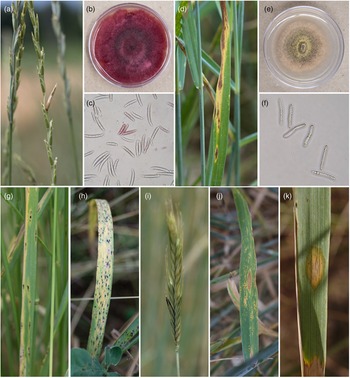
Four putative fungal pathogens were identified on IWG, and five putative fungal pathogens were identified on PCR (Table 1, Fig. 2). Ergot caused by Claviceps purpurea was identified in both perennial cereals based on the presence of sclerotia, the pathogen's reproductive and survival structures, on maturing grain spikes and through DNA sequencing. Fusarium head blight, caused by Fusarium spp., also was identified in both perennial cereals based on characteristic disease symptoms that include the premature bleaching of plant spikelets. A subsequent examination of fungal morphology and DNA sequences supported the identification of the species Fusarium graminearum sensu stricto on both hosts. Leaf blotches observed on both crops were putatively caused by Parastagonospora nodorum, the causal agent of Stagonospora leaf blotch, which was identified by isolation from symptomatic tissue and DNA sequencing. Leaf rust, caused by one of several obligate parasites in the genus Puccinia, was observed on PCR in the field, and preliminary identification was based on the presence of pustules containing urediniospores. Additionally, leaf spots observed on PCR were identified as scald caused by Rhynchosporium spp. based on disease symptoms, though attempts to isolate the pathogen were unsuccessful. Tar spot, caused by Phyllachora graminis, was reported on IWG based on symptoms, pathogen morphology and DNA sequences. The fungi identified here cause commonplace diseases in annual cereal crops in New York, with the exception of P. graminis, which is more frequently associated with non-cultivated grasses and has not been observed on small grain crops in New York.
Foliar and spike diseases and pathogens observed on perennial cereal grain crops in New York from 2017 to 2018. (A) Fusarium head blight causing typical premature bleaching of an IWG (T. intermedium) spikelet. (B, C) F. graminearum culture grown on a 60 mm dish of PDA, and asexually produced spores viewed at 400× magnification. (D) Symptoms of Stagonospora leaf blotch on IWG include oblong, brown necrotic lesions surrounded by a ring of chlorosis. (E, F) P. nodorum culture grown on a 60 mm dish of PDA, and asexually produced spores viewed at 400× magnification. (G, H) Early- and late-stage symptoms of tar spot (P. graminis) on IWG. Infection is first apparent when dark purple to black fungal tissue (spore-containing stroma) appears in isolated clumps along leaves, stems or spikes. Fungal fruiting bodies are surrounded by a green island of tissue, itself ringed by a yellow, chlorotic zone. Late-stage infection produces coalescent lesions, resulting in premature senescence. (I) Ergot sclerotia, pictured here on a spike of PCR (S. cereale ‘ACE-1’) are signs of C. purpurea infection. (J) Stagonospora leaf blotch and characteristic leaf rust pustules are shown here on PCR. (K) A suspected scald lesion (Rhynchosporium sp.) on PCR similar to those found on annual rye and barley.

Putative fungal pathogens identified on perennial cereal grain crops in New York from 2017 to 2018

IWG, intermediate wheatgrass, T. intermedium (Host) Barkworth & Dewey; PCR, perennial cereal rye, S. cereale L. ‘ACE-1’.
a Sequences of ITS or 28S ribosomal RNA deposited in NCBI GenBank, the number of accessions corresponds to the number of isolates for which sequence-based identification was performed.
b Pathogen detection at each site is denoted by a + (presence), – (absence) or NA (crop not grown).
Fungal colonization of crop residue
Fungal colonization of overwintered crop residue was measured using 160 individual stems collected from the IPA field trial in spring 2018. Eight fungal genera (Alternaria, Bipolaris, Colletotrichum, Cladosporium, Epicoccum, Fusarium, Phoma and Stagonospora) were identified morphologically. Fusarium colonization was the greatest at 97% of all stems, followed by Alternaria at 81% of stems. No other genera were found on more than 30% of stems. The colonization rates of fungal genera were not correlated with one another (P ≥ 0.411). IWG had a greater number of fungal colonizers (251 colonies) compared to PCR (176 colonies), and all stems were colonized by at least one fungus ($\overline x$ = 2.670, s = 0.969). Based on generalized linear models and ANOVA, crop host had a significant effect on the colonization probability of Alternaria, Colletotrichum, Epicoccum and Phoma (χ21 ≥ 5.401, P ≤ 0.020), and there was a significant crop by intercrop interaction effect for the colonization probability of Stagonospora (χ21 = 4.215, P = 0.040) (Fig. 3).
Fungal colonization of overwintered perennial cereal stem tissue. Fungi were recovered from naturally senesced and overwintered stem tissue at the IPA field trial in 2018, where IWG (T. intermedium (Host) Barkworth & Dewey) and PCR (S. cereale L. ‘ACE-1’) were grown with and without a medium red clover (T. pratense L.) intercrop. A total of 470 fungal colonies recovered from 160 stem segments were identified to genus, and the mean probability of individual stem colonization was contrasted across crops and intercrop treatment. Headers above each plot indicate fungal genus. Solid bars represent estimated marginal means and error bars denote standard errors. Different letters within the same plot denote significant differences between means according to pairwise Tukey HSD tests (α = 0.05).

Fungal flora of seed
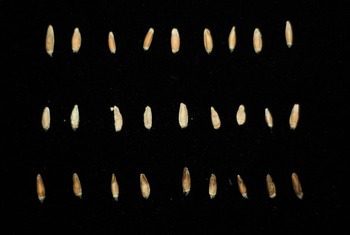
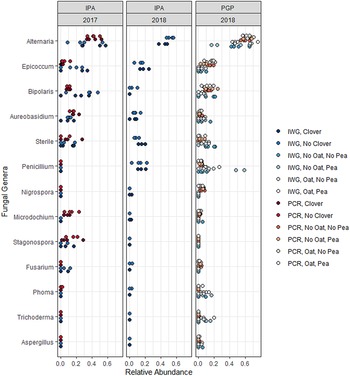
Harvested grain was assayed for the presence of individual fungal genera, composition of fungal communities and black point occurrence. Representative images of grain with high levels of fungal contamination are presented in Figure 4. In total, 2948 fungal colonies were recovered from 2560 kernels of PCR and 3260 kernels of IWG. PCR grain contained a greater number of fungal colonies (2157) compared to IWG (791). Differences in the size and structure of IWG and PCR grain could have influenced fungal colonization and recovery rates or the efficacy of surface sterilization. The fungi recovered were identified as belonging to 12 genera, with the exception of 138 colonies that did not produce reproductive structures permitting identification (Fig. 5). These 138 colonies were classified as ‘Sterile’ and retained in further analyses. Fungi associated with degraded grain quality were abundant (Alternaria, 1638; Bipolaris, 312), and genera containing pathogens of annual small grains were also present (Fusarium, 30; Microdochium, 63; Stagonospora, 56).
Grain samples from PCR representing three quality conditions. The first row is free from obvious fungal contaminants. The second row of shriveled, pale and pink tinged grain is characteristic of Fusarium head blight infection caused by mycotoxigenic Fusarium spp. The third row exhibits darkened tips associated with black point caused by fungi in the genera Alternaria and Bipolaris.

Relative abundance of fungal genera isolated from perennial cereal grain. Grain was harvested from IWG (T. intermedium (Host) Barkworth & Dewey) and PCR (S. cereale L. ‘ACE-1’) grown in two field experiments, IPA experiment and PGP. Experimental treatments consisted of a medium red clover intercrop (T. pratense L.) (IPA) or factorial use of an oat (A. sativa L. VNS) nurse crop and winter pea (P. sativum L. ‘Mystique’) intercrop (PGP). Following the 2017 and 2018 growing seasons, grain was assayed for the presence of fungal flora (5820 kernels, 2984 fungal colonies). Plots are split by experiment and year, each point represents the relative abundance of a fungal genus in 100–120 kernels from each of three to four replicate samples per treatment, and points are color coded by crop and experimental treatment with intercrops or both nurse crops and intercrops.

Seed-borne fungal communities were significantly different according to PERMANOVA and nMDS (Fig. 6). Year (R 2 = 0.109, F 1,42 = 12.556, P = 0.001), experiment (R 2 = 0.070, F 1,42 = 8.064, P = 0.001) and crop (R 2 = 0.382, F 1,42 = 21.994, P = 0.001) were significant predictors of community dissimilarity, while intercrop and nurse crop were not (R 2 ≤ 0.060, F 1,42 ≤ 1.163, P ≥ 0.233). Annual variation in weather patterns may explain the differentiation between years, and differences between the local microbial communities or microclimates at each experimental field could explain the differentiation between experiments. The factors identified as significant by PERMANOVA were further analyzed with an ANOVA of community dispersion to determine whether a change in mean values or variation in distances from the treatment medians were responsible for community differentiation. Community dispersion did not vary between year or trial, but did differ significantly between crops (F 1,53 = 4.981, P = 0.030). Fungal communities recovered from IWG grain had a greater average distance to their treatment median than those communities recovered from PCR grain (0.452 and 0.354, respectively). Differences between IWG and PCR phenology or host–microbe interactions might account for both the distance between their seed-borne fungal communities as well as the differing levels of variation within their communities. For instance, if grain development was more uniform in PCR than in IWG, this could explain the lower dispersion of fungal communities from PCR. Finally, the incidence of black point causing fungi (Alternaria and Bipolaris) was analyzed with a linear model (R 2 = 0.964). Crop by intercrop and crop by nurse crop interactions had significant effects (F 2,42 = 3.425, P = 0.042; F 1,42 = 8.161, P = 0.006) on incidence, as did a trial by year interaction (F = 8.414, P = 0.006) (Fig. 7). Generally, IWG exhibited less black point compared to PCR, and PCR grown without a nurse crop but with an intercrop had the highest incidence of black point.
nMDS plot of seed-borne fungal community dissimilarities. Fungal community composition was recorded in grain harvested from two perennial cereal grain field trials (5820 kernels, 2984 fungal colonies). Grain was harvested from IWG (T. intermedium (Host) Barkworth & Dewey) and PCR (S. cereale L. ‘ACE-1’) grown in two field experiments, IPA experiment and PGP. Experimental treatments consisted of a medium red clover intercrop (T. pratense L.) (IPA) or factorial use of an oat (A. sativa L. VNS) nurse crop and winter pea (P. sativum L. ‘Mystique’) intercrop (PGP). Each point represents an individual field plot (n = 100–120 kernels), and their spatial arrangement reflects a community dissimilarity matrix based on Jaccard distances between fungal communities. A PERMANOVA found year, trial and crop were significant predictors of community dissimilarity (P < 0.001), and an ANOVA found the dispersion of fungal communities from IWG seed was greater than observed for communities derived from PCR seed (P = 0.030). Points are color coded by crop and experimental treatment with intercrops or both nurse crops and intercrops. The associated stress value is 0.11.

Incidence of black point fungi in harvested perennial cereal grain. Fungi from the genera Alternaria and Bipolaris associated with black point of small grain cereals were recovered from grain harvested from two crop trials conducted over 2 years (5820 kernels). Grain was harvested from IWG (T. intermedium (Host) Barkworth & Dewey) and PCR (S. cereale L. ‘ACE-1’) grown in either an IPA experiment or a PGP experiment. Experimental treatments consisted of a medium red clover intercrop (T. pratense L.) (IPA) or factorial use of an oat (A. sativa L. VNS) nurse crop and winter pea (P. sativum L. ‘Mystique’) intercrop (PGP). The mean incidence of black point fungi differed between years, trials, crops and nurse crop (P ≤ 0.041), and there were significant crop by intercrop and crop by nurse crop interactions (P ≤ 0.042). Solid bars indicate mean observed values, and error bars depict 1 s.d. Plots are split by year and experiment, and bars are color coded by crop and experimental treatment with either intercrops or both nurse crops and intercrops. Different letters within the same plot denote significant differences between means according to pairwise Tukey HSD tests (α = 0.05).

Toxin content in grains
The presence and quantity of trichothecene and zearalenone mycotoxins were recorded in 48 harvested grain samples. The number of samples tested was lower than the number of experimental plots due to low crop yields in some plots. Zearalenone and nivalenol were not detected in any samples. DON was detected in 81% of samples, 3ADON in 6% of samples and 15ADON in 20% of samples. The highest total DON concentration was 8.6 ppm. Total DON (sum of DON, 3ADON and 15ADON) varied between crops, trials and years but was not significantly different between intercrop or nurse crop. DON content was higher in 2017 compared to that in 2018, and IWG contained a greater level of DON compared to PCR when levels were substantial (i.e., >2.0 ppm) (Table 2).
Total trichothecene mycotoxin content in grain harvested from perennial cereal grain crop field experiments in New York during 2017–2018

IPA, intercropping perennials and annuals; PGP, perennial grains and peas; IWG, intermediate wheatgrass, T. intermedium (Host) Barkworth & Dewey; PCR, perennial cereal rye, S. cereale L. ‘ACE-1’.
a Data were collected from replicated field plots from two experiments.
b Experimental treatments consisted of a medium red clover intercrop (T. pratense L.) (IPA) or factorial use of an oat (A. sativa L. VNS) nurse crop and winter pea (P. sativum L. ‘Mystique’) intercrop (PGP).
c Total trichothecene content is the sum of DON and acetylated derivatives (3ADON and 15ADON) measured in bulk grain samples by GC/MS on a ppm basis. Bold indicates treatments with at least one sample testing above the 2 ppm threshold informally used to assess grain quality. Minimum values below the detection threshold of 0.05 ppm are indicated by n.d. (not detected).
Discussion
This preliminary report on the plant pathogens infecting IWG and PCR in New York provides a basis for further research on the significance and management of plant diseases in perennial grain production in the northeastern USA. Several new host–pathogen associations were noted in the field, and to the authors' knowledge this was the first study to quantify pathogen overwintering in perennial grain crop residues and fungal colonization of harvested grain. The high stem colonization rate of mycotoxigenic fungi in the genus Fusarium is evidence that perennial crop debris is a potential source of disease inciting pathogen inoculum. The variability observed in seed-borne fungal communities and grain toxin content reinforces the importance of continuing to evaluate the presence of pathogen on perennial grains during their introduction to new environments. Taken together, our findings suggest (1) pathogen communities impacting annual and perennial cereal crops are substantially similar and inoculum exchange between cropping systems deserve further consideration and (2) cultural approaches to disease management likely will need to be adjusted for perennial crops.
Identification of putative pathogens
In total, nine host–pathogen combinations were observed on perennial cereal leaves and spikes over 2 years (Table 1; Fig. 2). Six of these putative pathogens were found on PCR, and all have been well-described as pathogens of annual cereal rye. The PCR observed in this study is genetically very similar to annual rye, so the identification of these common pathogens was likely. A relatively small amount of annual cereal rye is grown in New York, with an estimated 3100 ha in 2017 and 2600 ha in 2018 (USDA-NASS, 2018), but pathogen inoculum is present and could lead to disease incidence in PCR grown at or near the site of previous annual rye crops. Only four fungal pathogens were found on IWG, though there are 41 known fungal–IWG associations (Farr and Rossman, Reference Farr and Rossman2021). Thirty-six of these associations have been observed in North America, with additional reports of four from Asia and two from Europe. Based on this list, the present survey reports the first association of P. nodorum and P. graminis with IWG in North America. This suggests additional monitoring for novel host–pathogen associations will be needed as the acreage of cultivated IWG continues to expand into new geographic areas. Three of the pathogens identified were found on both perennial crops, but it is not known whether each individual isolate is capable of infecting both hosts. Although several studies have directly examined susceptibility of IWG to other fungal pathogens (Cox et al., Reference Cox, Murray and Jones2002; Cox et al., Reference Cox, Garrett, Cox, Bockus and Peters2005b; Jaikumar, Reference Jaikumar2013), additional research on disease susceptibility to these newly associated pathogens may be warranted.
The majority of putative pathogens recovered in this study were consistent with expectations based on known pathogens of annual crops in New York. Close to 56,600 ha of annual small grain cereals are grown in New York, and movement of pathogens between these hosts and perennial grain crops is expected, particularly for those fungi with broad host ranges, like F. graminearum. Cross-pathogenicity studies including annual and perennial crop hosts are needed to confirm the link between these systems, but our findings support preliminary consideration of perennial crop fields as semi-permanent reservoirs of fungal pathogen inoculum with the potential to incite disease in nearby annual cereals.
The pathogen causing tar spot on IWG, P. graminis, is notable for the lack of information available on its biology, effects on plant productivity and existing management practices. This pathogen is unusual in agricultural settings, and most often associated with non-cultivated grasses. Species in the genus Phyllachora are believed to grow and survive primarily in living host tissues, and their ability to colonize plants is thought to be highly host specific, so that only a single plant species might be infected by an individual fungal strain. The pathogen was not found on any grasses growing in the margins of the field where it was observed on IWG in New York. Symptoms of the disease appeared as early as late-May, and the pathogen might persist through the winter by systemically infecting plants or surviving through spore structures produced on crowns or debris. A similar pathogen infecting Lespedeza stipulacea caused significant reductions in both seed and hay yields (Hanson et al., Reference Hanson, Cope and Allison1956), and the importance of tar spot on IWG yield and harvest quality remains undetermined. A related and concerning pathogen has been found recently on maize in the USA (Valle-Torres et al., Reference Valle-Torres, Ross, Plewa, Avellaneda, Check, Chilvers, Cruz, Dalla Lana, Groves, Gongora-Canul, Henriquez-Dole, Jamann, Kleczewski, Lipps, Malvick, McCoy, Mueller, Paul, Puerto, Schloemer, Raid, Robertson, Roggenkamp, Smith, Telenko and Cruz2020), and research in that system may provide additional information about Phyllachora biology and ecology in an agricultural setting.
Fungal colonization of crop residue
The fungi recovered from senesced, overwintered crop stems in this study were from genera containing pathogens, saprotrophs and species able to survive both parasitically and saprotrophically. Alternaria, Bipolaris, Colletotrichum, Fusarium, Phoma and Stagonospora all include species pathogenic to annual grains and other grasses. Cladosporium and Epicoccum include several widely distributed species, which are common colonizers of cereal grains and debris (Schol-Schwarz, Reference Schol-Schwarz1959; Bensch et al., Reference Bensch, Braun, Groenewald and Crous2012). Crop residues in annuals are an important source of pathogen inoculum (Bailey, Reference Bailey1996), and the high rate of Fusarium spp. recovery in perennial grains indicates a potential risk of root or stem rots and Fusarium head blight. Because these crops are intended to remain in place for several years, the risk of pathogen buildup in inoculum might increase over time. However, the high incidence of Fusarium on stem residues of both crops, in only the second growing season suggests pathogen buildup may occur rapidly.
The variation in fungal colonization rates observed between crops and intercrops indicates that agronomic practices could play a role in promoting or reducing the persistence of pathogens in crop residues (Fig. 3). Despite the unavailability of certain practices (i.e., tillage), cultural control might be achieved through other means. For instance, the probability of Stagonospora colonization in PCR stems was significantly lower in experimental plots with a red clover intercrop compared to those only receiving nitrogen fertilizer. Intercropped species can reduce disease severity by limiting pathogen dispersal, altering microclimates and reducing host crop density (Boudreau, Reference Boudreau2013). Although intercropping as a disease management practice has not been adopted widely in conventional agricultural systems, this practice may have greater value in perennial grain fields. Practices that minimize the buildup of pathogen inoculum in fields of perennial grain may be especially important if rotations are planned that move from perennial grain into an annual crop affected by the same pathogens. For instance, Fusarium spp. cause diseases on both small grains and corn, so planting corn into a multi-year perennial grain field could lead to an increased disease risk.
Fungal flora of seed
Seed-borne fungal communities are important markers of grain quality (Christensen and Kaufmann, Reference Christensen and Kaufmann1965), can influence the accumulation of mycotoxins in storage (Chelkowski, (Reference Chelkowski and Chelkowski1991) and may be composed partially of phytopathogenic species. We recorded the relative abundances of 12 fungal genera inhabiting harvested perennial cereal grain (Fig. 5). A high-throughput sequencing study identified 21 species core to wheat seed microbiomes (Nicolaisen et al., Reference Nicolaisen, Justesen, Knorr, Wang and Pinnschmidt2014), and ten of those species were contained within the genera counted in the present study. Six of the genera we observed contain annual small grain pathogens (Alternaria, Bipolaris, Fusarium, Microdochium, Phoma and Septoria), and two additional genera are associated with toxin contamination in stored grain (Aspergillus and Penicillium). The composition of fungal communities varied between crop hosts, trials, treatments and years (Fig. 6). This is not unexpected and reflects the role of annual variation in weather and biological variation between host species during fungal colonization of grain. Fungi (Alternaria and Bipolaris) causing black point were prevalent in PCR especially, but their incidence was lower in PCR grown after an oat nurse crop (Fig. 7). Black point can influence crop grading in the USA, and the levels observed in this study exceeded the damage thresholds set for wheat grades 1 and 2 (USDA Federal Grain Inspection Service, 2016). High rates of black point can cause visual defects in added-value products made from affected flour, and the high-humidity conditions that regularly occur in New York during small grain harvesting periods contribute to its development. Rainfall near the PCR harvest in 2018 was high relative to the 30-year average and may have contributed to the incidence of black point during that year (Fig. 1). It is possible that intercrops may alter microclimates within plots to increase the risk of black point incidence or alternatively to interrupt the movement of these fungi from debris upward to the plant spikes. Depending on the intended end use for PCR, black point could represent a risk to crop value.
Toxin content in grain
Mycotoxin contamination in annual cereal crops is a major challenge for grain production in New York (Lugo-Torres, Reference Lugo-Torres2020). An informal standard limits the value of grain with >2 ppm DON content, and in 2017, levels of DON exceeded this threshold (Table 2). However, there are ways to mitigate DON contamination, including blending with low DON content grain or improving grain harvest and cleaning practices (Magyar et al., Reference Magyar, Véha, Pepó, Bartók and Gyimes2019). For example, following an improvement in the IWG grain dehulling process, grain bulked from the 2017 samples presented in this study (>4 ppm on average) was retested and found to contain only 0.24 ppm DON. In addition to dehulling practices, breeding for a hulless IWG could reduce the risk of DON contamination. Legzdina and Buerstmayr (Reference Legzdina and Buerstmayr2004) reported that hulless varieties of barley accumulated less DON than hulled varieties, though both contained similar levels of NIV. Also, despite the very high levels of Fusarium colonization observed in overwintered stems, relatively few Fusarium colonies were recovered from harvested grain in 2018. Infection by DON producing Fusarium spp. in annual crops is highly variable based on relative humidity at key points during crop development (McMullen et al., Reference McMullen, Bergstrom, De Wolf, Dill-Macky, Hershman, Shaner and Van Sanford2012). Spring rainfall was above average in 2017 and below average in 2018, which may have contributed to the different levels of DON recorded during those years. Existing FHB risk prediction models for annual wheat (e.g., https://www.wheatscab.psu.edu/; De Wolf et al., Reference De Wolf, Madden and Lipps2003) could be used to test predictions about the environmental conditions leading to IWG infection. IWG also may exhibit resistance to Fusarium head blight infections, and anecdotal observations made during this study suggest pathogen spread through the rachis may be limited since infections were typically restricted to single spikelets (Mesterházy, Reference Mesterházy1995) (Fig. 2a).
Conclusions
We report the first survey of fungi associated with disease symptomatic perennial cereal grains in New York. Putative pathogens were recorded on plants, in overwintered stems and in harvested grain. Pathogens that limit the production of annual cereal crops were identified on both PCR and IWG, and additional research on the impact these pathogens may have on yield and grain quality in perennial systems is warranted. Further incorporation of perennial grains into the agricultural landscape will require the development of novel disease management practices, providing an opportunity to design sustainable approaches to disease control that complement the environmental and ecological benefits that characterize perennial grain cultivation. Intercropping in particular may be a suitable alternative crop diversification strategy that could replace crop rotation in these systems as a disease management practice.
Data availability statement
Data and cultures of Parastagonospora nodorum and Fusarium graminearum are available on reasonable request from the authors.
Acknowledgements
The experiments reported in this article were conducted on the traditional homelands of the Gayogo̱hó꞉nǫ' (the Cayuga Nation). The Gayogo̱hó꞉nǫ' are members of the Haudenosaunee Confederacy, an alliance of six sovereign Nations with a historic and contemporary presence on this land. The Confederacy precedes the establishment of Cornell University, New York state, and the United States of America. We acknowledge the painful history of Gayogo̱hó꞉nǫ' dispossession and honor the ongoing connection of Gayogo̱hó꞉nǫ' people, past and present, to these lands and waters. The U.S. Department of Agriculture (USDA) prohibits discrimination in all its programs and activities on the basis of race, color, national origin, age, disability and where applicable, sex, marital status, familial status, parental status, religion, sexual orientation, genetic information, political beliefs, reprisal or because all or part of an individual's income is derived from any public assistance program. (Not all prohibited bases apply to all programs.) Persons with disabilities who require alternative means for communication of program information (Braille, large print, audiotape, etc.) should contact USDA's TARGET Center at (202) 720-2600 (voice and TDD). To file a complaint of discrimination, write to USDA, Director, Office of Civil Rights, 1400 Independence Avenue, S.W., Washington, D.C. 20250-9410, or call (800) 795-3272 (voice) or (202) 720-6382 (TDD). USDA is an equal opportunity provider and employer. Mention of trade names or commercial products in this report is solely for the purpose of providing specific information and does not imply recommendation or endorsement by the U.S. Department of Agriculture.
Financial support
Funding was provided by Northeast SARE grants LNE16-351 and GNE 17-156, and by the Schmittau-Novak Small Grants Program administered through the Cornell University School of Integrative Plant Science.
Conflict of interest
The authors declare none.