The origins of aggressive behavior have long captured researchers’ attentions (Quay, Reference Quay1946). One early and consistent observation in early work was that males engage in notably higher rates of physical aggression than do females, with a 2:1 to 10:1 male–female ratio beginning in the toddler years and continuing throughout the lifespan (Monuteaux et al., Reference Monuteaux, Fitzmaurice, Blacker, Buka and Biederman2004; van Lier et al., Reference van Lier, Vitaro, Barker, Koot and Tremblay2009). Moreover, these sex differences in aggression persist across numerous human societies (Ramirez et al., Reference Ramirez, Andreu and Fujihara2001; Archer, Reference Archer2004) and across most mammalian species, including humans’ nearest phylogenetic cousin, the chimpanzee (Gray, Reference Gray1971; Maccoby and Jacklin, Reference Maccoby and Jacklin1980; Manson et al., Reference Manson, Wrangham, Boone, Chapais, Dunbar, Ember and Nishida1991).
The sheer robustness of observed sex differences led to a number of hypotheses, one of which was that girls do not exhibit behavioral difficulties during childhood (i.e. ‘benign childhood’ hypothesis; Crick and Zahn-Waxler, Reference Crick and Zahn-Waxler2003). This hypothesis was directly challenged beginning in the 1990s. Crick and Grotpeter (Reference Crick and Grotpeter1995), for instance, argue that sex differences in aggression were due a failure to assess aggressive behaviors that are salient for females, and particularly those that used interpersonal relationships to harm others. They specifically proposed that different types of aggressive behaviors correspond to the different social goals of the perpetrator. Specifically, girls were hypothesized to utilize relational or social aggressionFootnote †Footnote 1 over physical aggression because it is consistent with the focus on the interpersonal relationships and social functioning that particularly characterizes female peer groups (relative to male peer groups). Second, it was argued that norms against aggression are especially salient for girls, who are socialized against physical aggression (by both adults and peers) to a greater extent than boys. It was suggested that these socialization experiences would reduce girls’ use of physical aggression and instead promote the use of more socially acceptable and covert forms of aggression (Keenan and Shaw, Reference Keenan and Shaw1997; Crick et al., Reference Crick, Ostrov, Kawabata, Flannery, Vazsonyi and Waldman2007). Third, girls’ earlier cognitive maturation was hypothesized to both buffer against engaging in physical aggression and promote the perpetration of more sophisticated and covert aggressive behaviors (Björkqvist et al., Reference Björkqvist, Lagerspetz and Kaukiainen1992; Keenan and Shaw, Reference Keenan and Shaw1997; Silverthorn and Frick, Reference Silverthorn and Frick1999). Finally, girls’ smaller physical size and lower physical strength was thought to limit their capacity to use physical aggression effectively (Björkqvist, Reference Björkqvist1994).
These early studies of social aggression led (both implicitly and explicitly) to the still-popular belief that social aggression is the ‘female-typical’ form of aggression while physical aggression is the ‘male-typical’ form of aggression. More recent empirical studies, however, have indicated that this early conclusion may have been premature. Recent meta-analytic work, for example, concluded that males also frequently engage in social aggression, and that while girls do engage in higher rates of social aggression than boys, the magnitude of these sex differences is trivial (Archer, Reference Archer2004; Card et al., Reference Card, Stucky, Sawalani and Little2008; Scheithauer et al., Reference Scheithauer, Haag, Mahlke and Ittel2008). Recent work in our own laboratory has further suggested that even these small sex differences may reflect bias rather than legitimate sex differences. We specifically explored item-level sex differences in the perpetration of socially aggressive behaviors in middle childhood and emerging adulthood and found small but generally consistent sex differences for a large number of behaviors, such that girls were more likely to give someone the silent treatment and reveal secrets when angry, while boys were more likely to blame and be rude toward others. Critically, however, follow-up analyses revealed that, although they were consistent, these observed differences were largely a function of measurement non-invariance rather than true differences in social aggression (Slawinski, Reference Slawinski2016).
Despite this clear empirical and meta-analytic evidence against large mean sex differences in social aggression, however, the belief that social aggression is simply the female version of physical aggression persists, indirectly bolstered perhaps by the dramatically higher mean rates of physical aggression in males v. females. Another way to conceptualize this same belief is via the generalist–specialist distinction, such that females are social aggression ‘specialists’ while males are aggression ‘generalists’ (i.e. they engage in both physical and social aggression). What sort of study(s) would be needed to more directly evaluate this possibility? One such study would examine sex differences in the associations between social and physical aggression, and specifically on the etiologic sources of their covariance. Namely, if males are aggression generalists while females are social aggression specialists, we would expect sex differences in (1) the magnitude of the phenotypic association between social and physical aggression (whereby the correlation is higher in males than in females), and (2) both genetic and environmental influences on physical aggression would overlap with those on social aggression significantly more in males than in females.
To be sure, some data are already available to inform these questions. Prior meta-analytic work, for example, has shown that aggressive individuals use both forms of aggression (r = 0.76; Card et al., Reference Card, Stucky, Sawalani and Little2008), and that this association is larger for males than females. Additionally, emerging research suggests that, although physical and relational aggression in children may share psychophysiological correlates, this relationship is likely moderated by sex (Murray-Close et al., Reference Murray-Close, Crick, Tseng, Lafko, Burrows, Pitula and Ralston2014). Specifically, physical aggression was associated with blunted physiological reactivity to relational stressors and heightened physiological reactivity to instrumental stressors in both boys and girls. For girls, relational aggression was also associated with blunted reactivity. For boys, however, this association was further moderated by level of peer victimization such that relational aggression was associated with blunted reactivity in boys with lower levels of victimization, but heightened reactivity in boys with higher levels of victimization. Findings such as these highlight the possibility of sex differences in shared and unique etiological processes that underlie physical and social aggression.
Genetically informed twin designs have much to add to this body of work (as suggested in Murray-Close et al., Reference Murray-Close, Nelson, Ostrov, Casas, Crick and Cicchetti2016), since they can be used to decompose and simultaneously estimate genetic and environmental influences on a given phenotype or phenotypes, and to do so separately by sex. Using this approach, the correlated factors model can be used to estimate the extent to which social and physical aggression are a function of the same genetic and environmental influences. High genetic correlations, for example, would indicate that the genes influencing social aggression do not differ (or differ only minimally) from those influencing physical aggression and that differences among them are primarily environmental in origin. Low genetic correlations, by contrast, would imply unique genetic architectures for the two forms of aggression (that may or may not co-occur with unique environmental architectures). Analyses would be conducted separately by sex, and then constrained across sex, to clarify whether the sources of covariation between physical aggression and social aggression vary across sex [i.e. there are large genetic and/or environmental correlation(s) in one sex, but not in the other].
To our knowledge, only one prior study (Brengden et al., Reference Brendgen, Dionne, Girard, Boivin, Vitaro and Pérusse2005) has examined the etiological covariance between social and physical aggression. Given sample size constraints, however (N = 234 pairs), they were unable to evaluate the moderating effects of sex (at least 1000 twin pairs are necessary to detect sex limitation with a reasonable magnitude in bivariate analyses; Verhulst, Reference Verhulst2017). Even so, their results suggested that both forms of aggression share most of their underlying genes (R G = 0.79–1.00), but few overlapping environmental influences (R E = 0.12–0.31). Additionally, Ligthart et al. (Reference Ligthart, Bartels, Hoekstra, Hudziak and Boomsma2005) investigated the etiological covariation between relational and direct aggression, but the generalizability of their findings is limited by construct validity problems of the relational aggression scale. Specifically, the items on this scale did not assess manipulative, interpersonal behaviors typical of relational aggression and instead were found to be consistent with oppositional defiant behavior and attention-deficit hyperactivity problems. There is thus a clear need for a large twin study that empirically evaluates the etiological sources of overlap between social and physical aggression, and does so separately by sex. The current study sought just to do this, applying the bivariate correlated factors model to social and physical aggression data collected from a sample of twins in middle childhood.
Methods
Participants
The 1030 families included in the current study were assessed as part of the Twin Study of Behavioral and Emotional Development in Children (TBED-C) within the Michigan State University Twin Registry (MSUTR; Klump and Burt, Reference Klump and Burt2006; Burt and Klump, Reference Burt and Klump2013). The TBED-C consists of two independent sub-samples of twins in middle childhood. The first sample consists of a population-based epidemiologic sample of 528 families (1056 twins and their parents). The second, ‘at-risk’ sample consists of 502 families (1004 twins and their parents) in the same general recruitment radius, for whom inclusion criteria also specified that they reside in modestly-to-severely disadvantaged neighborhoods. Recruitment procedures have been described previously (Burt and Klump, Reference Burt and Klump2013; Burt et al., Reference Burt, Klump, Gorman-Smith and Neiderhiser2016). Children gave informed assent, while parents gave informed consent for themselves and their children.
Participating twins were 48.7% female and ranged in age from 6 to 10 years old, although some (n = 59) had turned 11 by the time the family participated [mean age (s.d.) = 8.02 years (1.49)]. Twins’ racial and ethnic background was provided by their parents (81.7% non-Hispanic White, 9.5% African American, 1.1% Native American, 0.8% Asian, 0.7% Hispanic, 0.3% Pacific Islander, and 5.9% multiracial or other ethnic groups). Twin zygosity was determined via parent report using a standard five-item questionnaire that assesses within-pair physical similarity and is over 95% accurate (Peeters et al., Reference Peeters, Gestel, Vlietinck, Derom and Derom1998). Unclear zygosities were resolved by comparing twin sibling DNA markers. Monozygotic twins constituted 41.4% of the pairs (n = 426 pairs), same-sex dizygotic twins constituted 40.4% (n = 416 pairs), and opposite-sex dizygotic twins constituted 18.3% (n = 188 pairs).
Measure
Social and physical aggression were assessed using the Subtypes of Antisocial Behavior Questionnaire (STAB; Burt and Donnellan, Reference Burt and Donnellan2009, Reference Burt and Donnellan2010). The STAB is a 32-item measure assessing three major dimensions of antisocial behavior, two of which are social and physical aggression. The Social Aggression Scale (SA) includes 11 behaviors (e.g. gossips, gives others the silent treatment, excludes others from group activities) and the Physical Aggression Scale (PA) includes 10 behaviors (e.g. hits others, gets into physical fights, angers easily). For each, informants report on the frequency with which the child commits each behavior using a scale that ranges from 1 (never) to 5 (nearly all the time). Items were summed. Prior work (Burt and Donnellan, Reference Burt and Donnellan2009, Reference Burt and Donnellan2010) has confirmed the factor structure of the STAB in multiple samples and provided consistent support for its criterion-related validity.
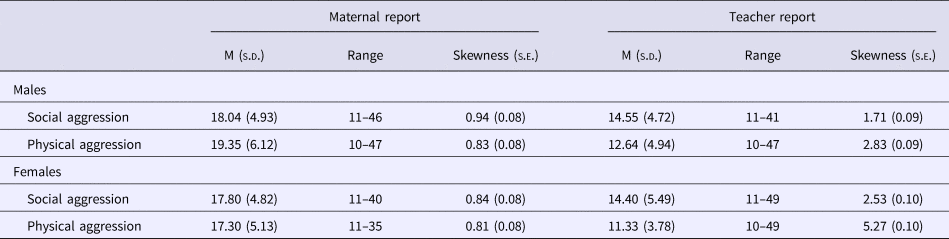
Maternal-reported STAB data were available for 96.0% of the twins (α = 0.85 for SA and 0.89 for PA) and teacher-reported STAB data were available for 80.9% of the twins (α = 0.91 for SA and 0.93 for PA). The teachers of 115 participants were not available for assessment because the children were home-schooled or parental consents to contact the teachers were completed incorrectly. To adjust for positive skew (Table 1), teacher ratings of twin social and physical aggression were log-transformed prior to analysis to better approximate normality.
Descriptive statistics

The STAB Social and Physical Aggression Scales ask informants to report on the frequency with which the child commits each behavior, ranging from 1 (never) to 5 (nearly all the time). The Social Aggression Scale contains 11 behaviors, so overall scale scores could range from 11 to 55. The Physical Aggression Scale contains 10 behaviors, so overall scale scores could range from 10 to 50.
Quantitative genetic analyses
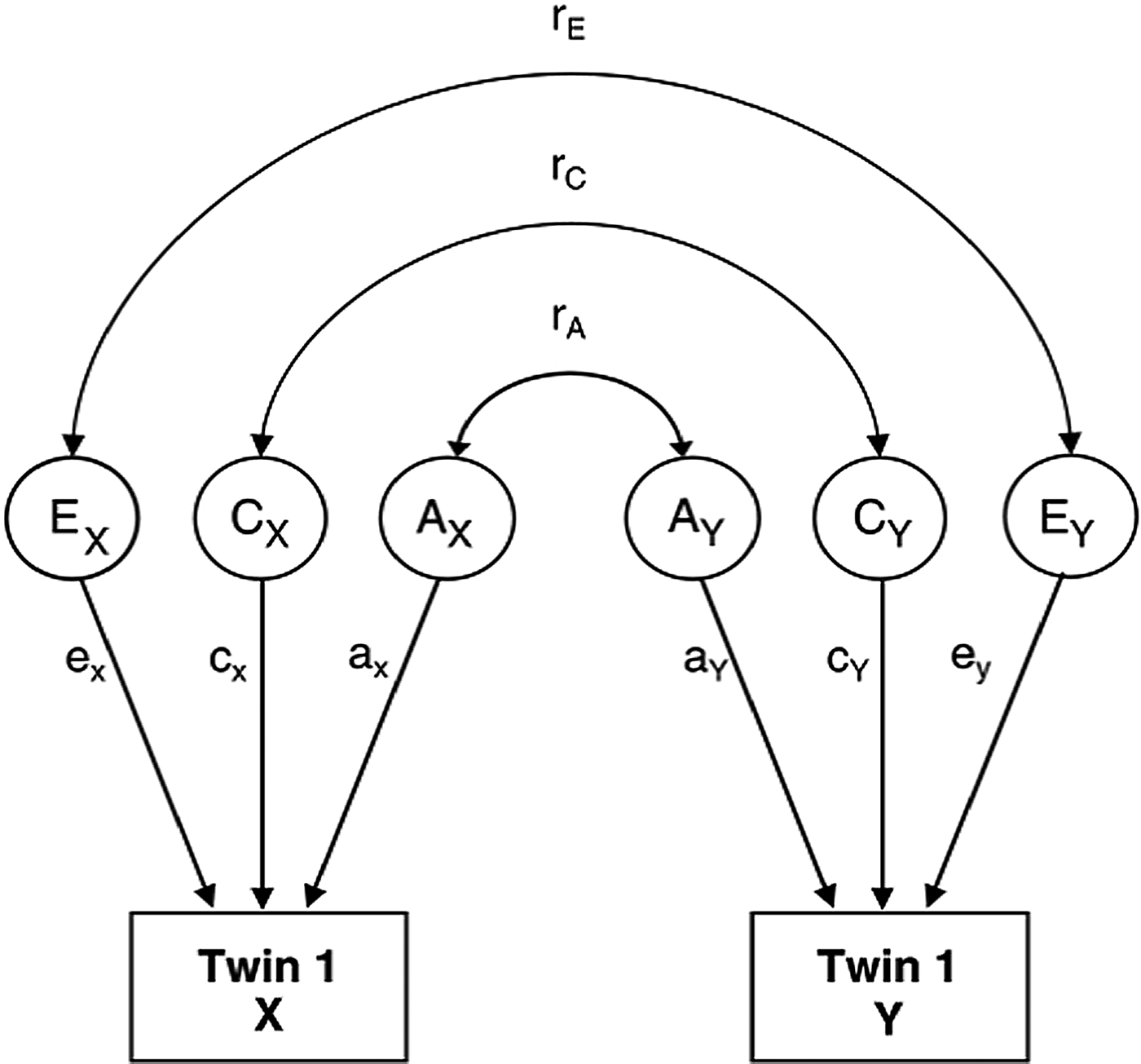
Univariate twin models were first used to estimate the proportion of genetic and environmental influences, respectively, on the variance within physical and social aggression, separately by phenotype and by informant. We then fitted bivariate correlated factor models (see Fig. 1) to decompose the phenotypic correlation between social and physical aggression into its genetic and environmental components, separately for maternal and teacher ratings. The bivariate correlated factors model decomposes shared sources of covariance into its genetic, shared, and non-shared environmental components. These genetic and environmental covariances are then standardized on their respective variances to compute genetic (R A), shared environmental (R C), and non-shared environmental (R E) correlations. These correlations reveal the extent to which genetic and environmental factors associated with one phenotype (e.g. social aggression) overlap with the genetic and environmental factors associated with the other phenotype (e.g. physical aggression). For both univariate and bivariate analyses, we tested both a sex differences model and a no-sex differences model. In the former, genetic and environmental parameter estimates are allowed to freely vary across sex. In the latter, genetic and environmental parameter estimates are constrained to be equal across sex. The relative fits of these two models were then compared to reveal whether there are sex differences in etiology.
Path diagram of a bivariate correlated factors model. Note: In a univariate model, the variance in the phenotype is parsed into that which is due to additive genetic effects (A), shared environmental effects (C), and non-shared environmental effects (E). In the bivariate correlated factors model, the shared sources of variance between two phenotypes (X and Y) are decomposed into a genetic correlation (R A), a shared environment correlation (R C), and a non-shared environment correlation (R E).

Mx, a structural-equation modeling program (Neale et al., Reference Neale, Boker, Xie and Maes2003), was used to perform the model-fitting analyses. Because of missing data, we made use of Full-Information Maximum-Likelihood (FIML) raw data techniques, which produce less biased and more efficient and consistent estimates than pairwise or listwise deletion in the face of missing data. FIML raw data analyses assume that missing data are missing at random (MAR; Allison, Reference Allison2003; Croy and Novins, Reference Croy and Novins2005), and missing maternal data did appear to be MAR.
When fitting models to raw data, variances, covariances, and means are first freely estimated to get a baseline index of fit (minus twice the log-likelihood; −2lnL). Model fit was evaluated using −2lnL and four information theoretic indices that balance overall fit with model parsimony: the Akaike's Information Criterion (AIC; Akaike, Reference Akaike1987), the Bayesian Information Criteria (BIC; Raftery, Reference Raftery1995), the sample-size adjusted Bayesian Information Criterion (SABIC; Sclove, Reference Sclove1987), and the Deviance Information Criterion (DIC; Spiegelhalter et al., Reference Spiegelhalter, Best, Carlin and Van Der Linde2002). The lowest AIC, BIC, SABIC, and DIC among a series of nested models are considered best. As fit indices do not always agree, we reasoned that the best-fitting model should yield lower or more negative values for at least three of the five fit indices.
Results
Descriptive statistics and correlations
Descriptive statistics are presented in Table 1. According to both teachers and mothers, boys were more physically aggressive than girls (Cohen's d = 0.30 and 0.36, respectively, p < 0.001 for both), but there were no sex differences in the perpetration of social aggression (p = 0.847 and 0.217, respectively). Phenotypic correlations between social and physical aggression were large (r = 0.67–0.80), but also did not differ by sex (p values were ns, ranging from 0.25 to 0.97).
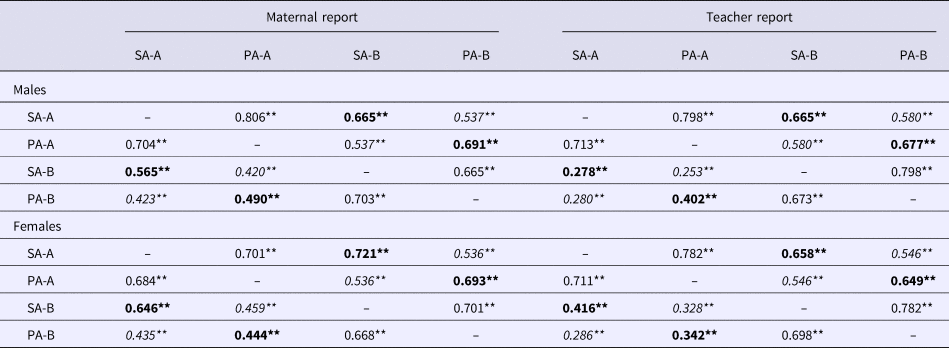
Prior to multivariate model-fitting analyses, intraclass, within-person, and cross-twin correlations were calculated across zygosity and sex (Table 2) and examined for a preliminary indication of genetic and environmental influences on a given phenotype. For both boys and girls, the MZ intraclass correlations for social and physical aggression were larger than their corresponding DZ correlations (ranging from p < 0.0001 to p = 0.03), suggesting that genetic influences may be important for the etiologies of social and physical aggression for both sexes. There was evidence of shared environmental influences, especially for social aggression, in that the DZ correlation was less than half the MZ correlation. The cross-twin, cross-trait correlations can be compared across zygosity to preliminarily indicate the etiology of covariance between social and physical aggression. For both boys and girls, MZ cross-twin cross-trait correlations were consistently larger than DZ cross-twin cross-trait correlations (p > 0.0001 to p = 0.1211), suggesting that the etiological covariation between social and physical aggression may be largely due to common genetic factors.
Intraclass, within-person, and cross-twin, cross-trait correlations for social and physical aggression for each sex–zygosity cohort

SA-A and PA-A indicate social aggression and physical aggression, respectively, for Twin A while SA-B and PA-B indicate social aggression and physical aggression, respectively, for Twin B. MZ twin correlations are above the diagonals and DZ twin correlations are below. Intraclass correlations are bolded and cross-twin, cross-trait correlations are italicized.
**p < 0.01.
Modeling results
Univariate results
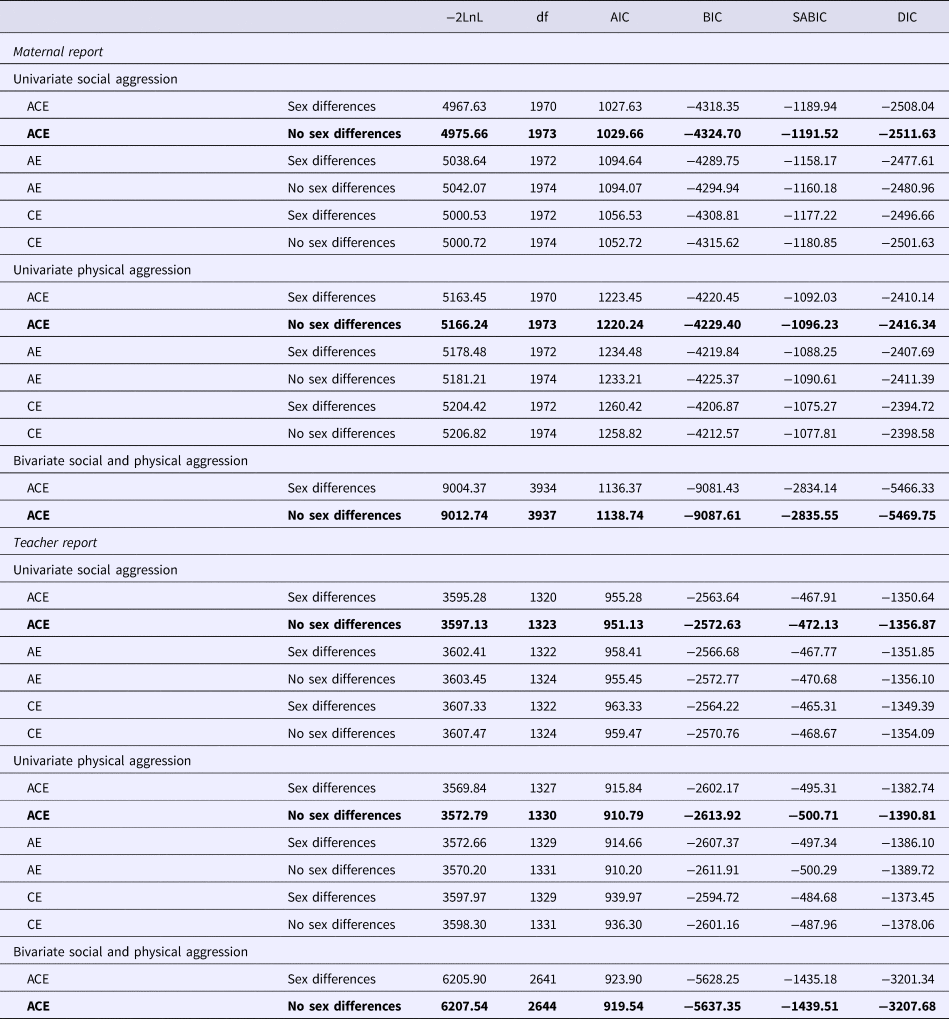
Univariate model-fitting results and parameter estimates for social and physical aggression are presented in Tables 3 and 4. The first model tested was an ACE model, which estimated the variance in a given phenotype attributable to genetic (A), shared environmental (C), and non-shared environmental (E) factors. In the second and third models, labeled AE and CE, C and A were fixed to zero, respectively. All three models were estimated twice for each informant, once allowing for sex differences in parameter estimates and once constraining the parameter estimates in both sexes to be equal. The best-fitting model across informants and phenotypes was the ACE no sex differences model, indicating that additive genetic, shared environmental, and non-shared environmental influences significantly contribute to the etiologies of social and physical aggression, and more importantly, that these magnitudes do not differ across sex. Examination of the parameter estimates revealed that physical aggression is largely additive genetic (45–54%) in origin with smaller contributions from shared (15–26%) and non-shared (29–31%) environmental influences. Social aggression is also additive genetic (28–36%) in origin with clear contributions of shared (24–49%) and non-shared environmental (24–40%) influences as well.
Quantitative genetic model-fitting results for social aggression, physical aggression, and their covariation

Additive genetic, shared environmental, and non-shared environmental influences are represented with A, C, and E, respectively. The best-fitting model for each informant (as indicated by the lowest −2LnL, AIC, BIC, SABIC, and DIC values for at least three of the five fit indices) is highlighted in bold font.
Best-fitting univariate and bivariate model parameter estimates for social aggression, physical aggression, and their covariation

Additive genetic, shared environmental, and non-shared environmental influences are represented with A, C, and E, respectively. The 95% confidence intervals are presented below the point estimate in brackets.
*p < 0.05. The ACE no sex differences model was the best-fitting model for both informants.
Bivariate results
Bivariate correlated factors model-fitting results and parameter estimates are also reported in Tables 3 and 4. As univariate analyses indicated that an ACE model best explained the variance of social and physical aggression for both maternal and teacher ratings, we fit an ACE correlated factors model. This model was also estimated twice for each informant, once allowing for sex differences in parameter estimates and once constraining the parameter estimates in both sexes to be equal. The best-fitting model across informants was the no sex differences model, indicating that the etiology did not differ significantly by sex. For both maternal and teacher informant reports, there was a strong correlation between the genetic factors (R A = 0.71–0.75) and shared environmental factors (R C = 0.86–1.00). The non-shared environmental overlap (R E = 0.53–0.62) was still strong but somewhat less pronounced. Put another way, 50–57% of the genetic factors, 74–100% of the shared environmental factors, and 28–40% of the unique environmental factors influencing social and physical aggression are the same across the two forms of aggression. Parameter estimates for the sex differences model are reported by informant in online Supplementary Table S1 and model-fitting results for alternative models are reported in online Supplementary Table S2.
Discussion
Although social and physical aggression have long been theoretically and empirically linked, their etiological overlap remained unclear. Results from the current study indicate that their covariation is due to both overlapping genes and common environmental conditions. Moreover, these shared etiological factors did not differ across sex, indicating that, at least during middle childhood, the covariation between social and physical aggression is influenced by the same etiological factors in males and females.
Our findings regarding common genetic influences are comparable to Brendgen et al.’s (Reference Brendgen, Dionne, Girard, Boivin, Vitaro and Pérusse2005) results, which indicated that the two forms of aggression share most of their underlying genes. However, our results indicate that they share a greater proportion of environmental risk factors than did Brendgen et al. (Reference Brendgen, Dionne, Girard, Boivin, Vitaro and Pérusse2005). This latter discrepancy may be due to bivariate model-fitting strategies and/or sample demographics. Brendgen et al. (Reference Brendgen, Dionne, Girard, Boivin, Vitaro and Pérusse2005) fit a correlated factors model that specified an AE model for physical aggression and an ACE model for social aggression. Because this model excluded shared environmental influences on physical aggression, the shared environmental correlation between social and physical aggression was necessarily zero. Additionally, Brendgen et al.’s (Reference Brendgen, Dionne, Girard, Boivin, Vitaro and Pérusse2005) participants were younger, less racially diverse, and more affluent than those in the current study, suggesting that the etiological covariation between social and physical aggression may change across developmental periods and/or be moderated by demographic factors.
Both studies found that social and physical aggression share a substantial proportion of their genetic influences, which is consistent with the theory that both are expressions of the same underlying tendency to engage in aggression toward others. The correlated factors method does not identify individual genes, or the number of genes, that contribute to the covariance between social and physical aggression, but it does provide support for molecular genetic studies examining these questions. While there have been no molecular genetic studies of social aggression specifically, there is a growing field of research exploring the genetics of physical aggression and antisocial behavior more broadly (Fernàndez and Cormand, Reference Fernàndez-Castillo and Cormand2016; Veroude et al., Reference Veroude, Zhang-James, Fernàndez-Castillo, Bakker, Cormand and Faraone2016). Given the evidence for common genetic architectures for both forms of aggression, future research should extend this work to social aggression.
Our results also indicate that social and physical aggression are, to a lesser degree, shaped by common environmental influences. Peers and parents are often implicated in the development and shaping of physical aggression. Affiliation with aggressive friends has been associated with increases in physical and social aggression in both children and adolescents (Patterson et al., Reference Patterson, Dishion and Yoerger2000; Werner and Crick, Reference Werner and Crick2004; Snyder et al., Reference Snyder, Schrepferman, Oeser, Patterson, Stoolmiller, Johnson and Snyder2005). Harsh discipline has been associated with both physical and social aggression and hostile/inconsistent parenting significantly predicts increases in relational aggression from early to middle childhood (Rhee and Waldman, Reference Rhee and Waldman2002; Vaillancourt et al., Reference Vaillancourt, Miller, Fagbemi, Côté and Tremblay2007). Psychological control (e.g. love withdrawal, induction of shame and guilt), however, could be particularly relevant for the development of social as opposed to physical aggression. Indeed, parental psychological control is consistently associated with levels of and increases in child social aggression (Casas et al., Reference Casas, Weigel, Crick, Ostrov, Woods, Yeh and Huddleston-Casas2006; Soensens et al., Reference Soensens, Vansteenkiste, Goossens, Duriez and Niemiec2008; Gaertner et al., Reference Gaertner, Rathert, Fite, Vitulano, Wynn and Harber2010; Nelson et al., Reference Nelson, Yang, Coyne, Olsen and Hart2013), and preliminary research suggests that this process may be unique to social aggression (Kuppens et al., Reference Kuppens, Grietens, Onghena and Michiels2009).
Most importantly, however, there was no evidence of sex differences in the phenotypic or etiologic associations between social and physical aggression. Physical and social aggression were strongly correlated in these data (r ranged from 0.67–0.80), and these associations did not differ across sex. Similarly, physical and social aggression were strongly correlated at the etiologic level as well, and none of these genetic or environmental correlations differed across sex. There is thus little evidence to support either the conceptualization of social aggression as the female-typical form of aggression, or to support the notion that males are aggression ‘generalists’, whereas girls are aggression ‘specialists’.
There are several limitations to be considered in the present study. First, the heritability estimates and etiologic associations found here are specific to middle childhood and should not be generalized to other developmental periods as etiological differences in antisocial behavior has been observed across age and development (Rhee and Waldman, Reference Rhee and Waldman2002). Second, although the examination of teacher and maternal reports was a strength of the present study, the lack of twin self-reports and/or peer-ratings of the twins limited our ability to fully investigate the etiological covariation between social and physical aggression. These informants could be especially useful since social aggression is characterized by both overt behaviors (that adults are likely to witness) and covert behaviors (of which only the child and his or her peers may be aware). Although there are concerns regarding the reliability and validity of peer- and self-reports in young children, peer ratings are more frequently used with adolescents and have been suggested to be more valid than teacher, parent, or self-ratings of social aggression (Archer and Coyne, Reference Archer and Coyne2005).
Despite these limitations, there are important implications from our findings. First, our finding that the covariation between social and physical aggression is due to both common genes and environments supports the notion of multifinality in the etiology of antisocial behavior, which suggests that individual etiological factors can result in multiple developmental outcomes (Cicchetti and Rogosch, Reference Cicchetti and Rogosch1996). Indeed, it is frequently argued that social and physical aggression are both manifestations of a broad externalizing tendency (Crick and Zahn-Waxler, Reference Crick and Zahn-Waxler2003; Tackett et al., Reference Tackett, Waldman and Lahey2009). From this perspective, similar underlying vulnerabilities or risk factors may promote both forms of aggression, with specific manifestations depending on moderating factors (Lagerspetz and Björkqvist, Reference Lagerspetz, Björkqvist and Huesmann1994; Crick and Zahn-Waxler, Reference Crick and Zahn-Waxler2003; Burt et al., Reference Burt, Donnellan and Tackett2012). Sex appears to be one such moderating factor, in that the etiologies of social and physical aggression do not vary across sex, but the prevalence of the latter certainly does.
Put another way, although our results are not consistent with the notion that social aggression is the female version of male physical aggression, it is nevertheless the case that males engage in more physical aggression than do females. How do we understand these findings in light of the absence of sex differences in etiology? Sex differences in biological and social developmental processes may be one likely explanation, as there is at least some evidence that hormonal differences, and especially those related to puberty, may contribute to sex differences in aggressive behavior. Specifically, testosterone levels predict physical aggression in children and adolescents, and this relationship may be stronger for boys than girls (Archer et al., Reference Archer, Graham-Kevan and Davies2005; Archer, Reference Archer2006; van Bokhoven et al., Reference van Bokhoven, van Goozen, van Engeland, Schaal, Arseneault, Séguin and Tremblay2006). Only one study (Sánchez-Martín et al., Reference Sánchez-Martín, Azurmendi, Pascual-Sagastizabal, Cardas, Braza, Braza, Carreras and Muñoz2011) has examined the association between testosterone levels and indirect aggression, finding that testosterone was positively associated with indirect aggression in a small sample (N = 90) of 9-year-old children, but that this relationship was not moderated by child sex. While the genomic effects of testosterone on aggression in humans remains an area for further study, animal research has shown that testosterone regulates the expression of genes (rather than the presence of genes) that promote aggression (Montoya et al., Reference Montoya, Terburg, Bos and van Honk2012) and that sex differences in testosterone-regulated gene expression predicts sexual dimorphism in aggressive behaviors (Peterson et al., Reference Peterson, Rosvall, Choi, Ziegenfus, Tang, Colbourne and Ketterson2013).
Sex differences in social development may also contribute to observed (but not etiological) sex differences in physical aggression. Physical aggression is common in young children of both sexes, likely because they are limited by their social and cognitive abilities. Moreover, advances in these social-cognitive skills, which typically occur earlier in girls, are often linked to a decrease in physical aggression and an increase in social aggression (Sutton et al., Reference Sutton, Smith and Swettenham1999). Ostrov and Godleski (Reference Ostrov and Godleski2010) proposed a gender-linked model of aggression in which gender identity and gender schemas influence aggressive behavior such that children are theorized to prefer to use gender-consistent aggressive behavior. This model suggests that girls engage in less physical aggression than boys because they are socialized against it by parents and peers.
In conclusion, our findings argue against the common assumption that social aggression is the ‘female version’ of male physical aggression, and instead suggest that it may be best conceptualized as a form of antisocial behavior used by both sexes that share developmental pathways with other manifestations of externalizing pathology. Similar underlying vulnerabilities may promote antisocial behavior more broadly, with specific manifestations depending on moderating factors such as the age or social goals of the aggressor. It remains imperative that future research continues to expand beyond the field's historical focus on cross-sectional, mean-level sex differences in social aggression, and instead use longitudinal and person-centered approaches to explore sex differences in social and biological developmental processes and how social aggression is similar to and distinct from other forms of antisocial behavior.
Supplementary material
The supplementary material for this article can be found at https://doi.org/10.1017/S0033291718003392.
Author ORCIDs
Brooke L. Slawinski, Kelly L. Klump and S. Alexandra Burt, 0000-0002-4542-3651, 0000-0003-1790-9264 and 0000-0001-5538-7431
Acknowledgements
The authors thank all participating twins and their families for making this work possible.
Financial support
This project was supported by R01-MH081813 from the National Institute of Mental Health (NIMH) and by R01-HD066040 from the Eunice Kennedy Shriver National Institute for Child Health and Human Development (NICHD). The content is solely the responsibility of the authors and does not necessarily represent the official views of the NIMH, the NICHD, or the National Institutes of Health.
Conflict of interest
None.
Ethical standards
The authors assert that all procedures contributing to this work comply with the ethical standards of the relevant national and institutional committees on human experimentation and with the Helsinki Declaration of 1975, as revised in 2008.