Introduction
Trematodes are one of the most diverse groups of parasites found among metazoans (Bray et al. Reference Bray, Gibson and Jones2009). The taxonomic history of the genus Phyllodistomum has been controversial and unstable due to the wide intraspecific variation of some species, making their correct identification a challenging task (Petkevičiūtė et al. Reference Petkevičiūtė, Stunzenas, Stanevicite and Zhokhov2014). Currently, this genus is considered one of the most diversified among trematodes because it contains more than 120 species (Pinacho-Pinacho et al. Reference Pinacho-Pinacho, Sereno-Uribe, Hernández-Orts, Gárcia-Varela and Peréz-Ponce de León2021). In this context, molecular systematic studies have proven useful to aid in species delineation and to allocate species in their proper taxonomic groupings (Pérez-Ponce de León et al. Reference Pérez-Ponce de León, Razo-Mendivil, Mendoza-Garfias, Rubio-Godoy and Choudhury2015). Phyllodistomum spp. are widely distributed in freshwater and marine environments and are found in the urinary bladder, ureters, intestine, swim bladder, and gall bladder of fishes (Campbell Reference Campbell, Bray, Gibson and Jones2008; Mendoza-Garfias & Pérez-Ponce de León Reference Mendoza-Garfias and de León G2005).
Among teleosts, characiform fishes are mainly distributed in freshwater environments across the Neotropical region (Baumgartner et al. Reference Baumgartner, Pavanelli, Baumgartner, Bifi, Debona and Frana2012) and possess a highly diverse parasite fauna. Phyllodistomum spp. have been reported to infect the urinary bladders of Hoplias malabaricus (Bloch, 1794), commonly known as ‘traíra’ (Oyakawa Reference Oyakawa, Reis, Kullander and Ferraris2003), in São Francisco and Batalha River basins, Brazil (Costa et al. Reference Costa, Monteiro and Brasil-Sato2015; Gião et al. Reference Gião, Pelegrini, Azevedo and Abdallah2020). Hoplias malabaricus are carnivorous fish with ambush behavior. They exhibit a wide geographic distribution across the Neotropical biogeographic region; they occur in several hydrographic basins in South America (Oyakawa Reference Oyakawa, Reis, Kullander and Ferraris2003) and their distribution also extends northwards to Costa Rica in Central America.
In this study, we describe a new species of Phyllodistomum from the urinary bladder of H. malabaricus in Brazil. The new species description is based on morphological characteristics and other sources of information such as molecular data obtained from the D1–D3 domains of the 28S rRNA gene, host association, and geographical distribution.
Materials and methods
In May 2018 and October 2021, a total of 60 specimens of H. malabaricus were collected from the Jacaré-Pepira River, São Paulo state, Brazil. Fish were captured with gill nets of different mesh sizes placed at different depths. After collection, they were anesthetized with eugenol and then euthanized by spinal section. For parasite collection, all organs were removed, separated in Petri dishes, and examined for trematodes under a stereoscope. Adult trematodes were removed from the urinary bladder and fixed in hot 10% buffered formalin; some specimens were stained with clorhidric carmine and cleared in eugenol. The holotype was mounted in Permount® for morphological study. Morphological analysis and measurements of adult digeneans were made using a microscope with differential interference contrast optics (Leica DMLB 5000, Leica Microsystems). Measurements are given in micrometers (μm). Drawings were made with the aid of a microscope (Leica DMLS, Leiva Microsystems, Wetzlar, Germany) equipped with a drawing tube. Type material was deposited in the Helminthological Collection of the Institute Oswaldo Cruz, Rio de Janeiro, Brazil, with the accession numbers ‘CHIOC 000000–000000’.
Some specimens were processed for scanning electron microscopy. These specimens were fixed in 70% ethanol, dehydrated in a graded alcohol series, critical-point dried with carbon dioxide, mounted on aluminum stubs using conductive double-sided tape, coated with gold-palladium, and examined with the use of a FEI Quanta 200 scanning electron microscope.
For the molecular study, some specimens were fixed in 100% ethanol. Total genomic DNA was extracted from whole worms using the Qiagen Dneasy® Blood and Tissue Kit (Qiagen, Hilden, Germany) according to the manufacturer’s protocol. Fragments of the D1–D3 domains of the 28S rRNA were amplified by polymerase chain reaction (PCR) with primers dig12 (5’-AAGCATATCACTAAGCGG-3’) (Tkach et al. Reference Tkach, Pawlowski and Mariaux2000) and reverse LSU1500R (5’-GCTATCCTGAGGGAAACTTCG-3’) (Tkach et al. Reference Tkach, DTJ, Olson, Kinsella and Swiderski2003). Amplification was performed in a Bio-Rad Mycycler (Bio-Rad Laboratories Pty Ltd., Gladesville, Australia) with initial denaturation at 94°C for 3 min, followed by 45 cycles of 94°C for 45 s, 54°C for 45 s, 72°C for 1:30 min and a final extension at 72°C for 10 min. PCR reactions were performed in 25 μl reactions containing 2 μl of extracted DNA and 1 μl of each PCR primer using PCR Ready-to-Go beads (Pure TaqTMReady-to-GoTM beads, GE Healthcare, Chicago, USA). The solution consisted of stabilizers, BSA, dATP, dCTP, dGTP, dTTP, ± 2.5 units of puReTaq DNA polymerase, and reaction buffer. Each bead was reconstituted to a final volume of 25 μl. PCR products were analyzed by electrophoresis on 1% agarose gel stained with GelRed and visualized under UV light. The products of the PCR reaction for the 28S rRNA gene were purified and then sequenced with primers dig12 (5’-AAGCATATCACTAAGCGG-3’) (Tkach et al. Reference Tkach, Pawlowski and Mariaux2000) and reverse LSU1500R (5’- 90 GCTATCCTGAGGGAAACTTCG-3’) (Tkach et al. Reference Tkach, DTJ, Olson, Kinsella and Swiderski2003) with BigDye® Terminator v3.1 Cycle Sequencing Kit (Applied) and precipitation reaction by Ethanol/EDTA/Sodium Acetate, according to the protocol suggested by the manufacturer. Automatic sequencing by capillary electrophoresis was performed on the ABI3730xl DNA Analyzer (Applied Biosystems). PCR results were purified with the Qiagen purification kit before sequencing. The obtained partial sequences were assembled and edited using Sequencher 4.8 software (Gene Codes Corporation) to obtain consensus sequences. The consensus sequences were aligned with partial sequences of 28 genetically similar species obtained from GenBank using the ClustalW algorithm (Larkin et al. Reference Larkin, Blackshields, Brown, Chenna, Mcgettigan, McWilliam, Valentin, Wallace, Wilm, Lopez, Thompson, Gibson and Higgins2007) and standard settings in Geneious 7.1.3 software (Kearse et al. Reference Kearse, Moir, Wilson, Stone-Havas, Cheung, Sturrock, Buxton, Cppér, Markowitz, Duran, Thierer, Ashton, Meintjes and Drummond2012).
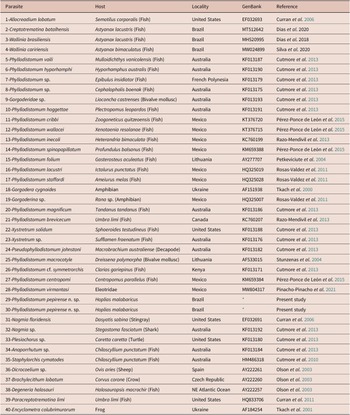
The phylogenetic analysis of the 28S rRNA gene included the newly sequenced individuals plus 36 sequences downloaded from Genbank (Table 1). We used sequences of four species of allocreadiids (i.e., Allocreadium lobatum Wallin, 1909; Creptotrematina batalhensis Dias and Abdallah, 2020; Wallinia brasiliensis Dias and Abdallah, 2018; and W. caririensis Silva and Yamada, 2020) as outgroups. Species of this family were used because they are the sister taxon of gorgoderids (Choudhury et al. Reference Choudhury, García-Varela and Pérez-Ponce de León2017). Sequences were aligned using the MUSCLE software (Edgar Reference Edgar2004) implemented in the Geneious Server Database (version 7.1.3), using default settings (Kearse et al. Reference Kearse, Moir, Wilson, Stone-Havas, Cheung, Sturrock, Buxton, Cppér, Markowitz, Duran, Thierer, Ashton, Meintjes and Drummond2012). The alignment was trimmed to the shortest sequence, and the homologous regions were aligned. The substitution saturation index was estimated using DAMBE5 (Xia Reference Xia2013), and the number of base substitutions per site between sequences was calculated. Phylogenetic analyses were done using maximum likelihood in RaxML version 8 (Stamatakis Reference Stamatakis2014) using the Kimura 2-parameter model of substitution. Standard error estimates were obtained using the bootstrap procedure (1,000 replicates). The model parameter and bootstrap value (1,000 repetitions) were also estimated using the RaxML program, which was performed through an online computer site CIPRES (Miller et al. Reference Miller, Pfeiffer and Schwartz2010). Figtree ver 1.1.2 was used to visualize phylogenetic trees.
Sequences used in phylogenetic analyses of 28S rDNA gene: Parasite species, hosts, locality, GenBank accession number, and references

* GenBank Access number will be added after acceptance of the manuscript.
Results
Family Gorgoderidae Looss, 1901
Genus Phyllodistomum Braun, 1899
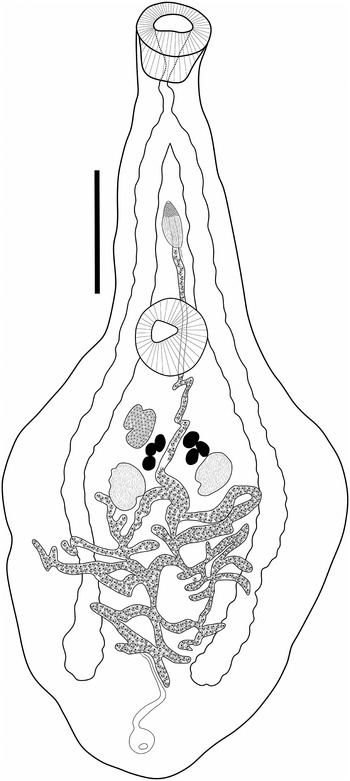
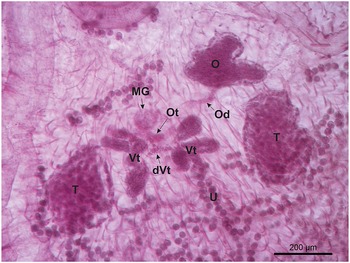
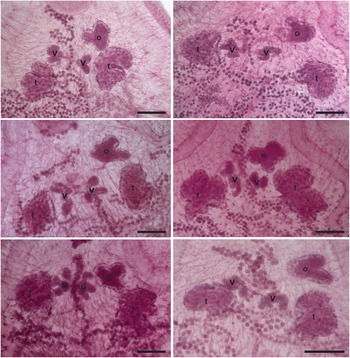
Phyllodistomum pepirense Dias, Pérez-Ponce de León, Silva and Abdallah n. sp. (Figures 1–4)
Phyllodistomum pepirense n. sp. holotype: Whole mount specimen collected from the urinary bladder of Hoplias malabaricus from Jacaré-Pepira River, municipality of Ibitinga, São Paulo state, Brazil. Ventral view. Scale bar 500 μm.

Detail of the post-acetabular region of the holotype of Phyllodistomum pepirense n. sp. highlighting the ovary (O), oviduct (Od), Mehlis’ gland (MG), Ootype (Ot), Vitelline follicles (Vt), Vitelline ducts (dVt), Uterus (U), and Testes (T). Carmine staining, dorsal view.

Detail of the post-acetabular region of some paratypes of Phyllodistomum pepirense n. sp. highlighting the ovary (o), Vitelline follicles (v), and Testes (t). Carmine staining, dorsal view. Scale bar 200 μm.

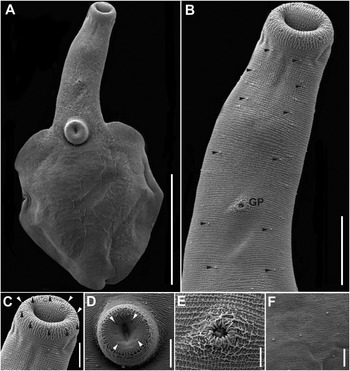
Description (based on eight whole-mounted adult specimens): Body spatulate, 902–3363 (4235 ± 449) long, distinctly divided in forebody and hindbody. Tegument wrinkled. Forebody elongated, neck-like, 1673–2110 (1862 ± 167) long, 657–1180 (838 ± 162) wide, 40–52% (44%) of total body length, possessing ventrally six pairs of dome-like papillae (Figure 4B). Hindbody foliate, widest at testes level, 1607–2942 (2372 ± 383) long, 2211–3076 (2532 ± 274) wide, with numerous randomly distributed tegumental papillae. Oral sucker terminal, 438–602 (502 ± 62) long, 414–577 (491 ± 64) wide, with five pairs of papillae on outer border and one pair on inner anterior border (Figure 4C). Mouth opening subventrally. Ventral sucker pre-equatorial, smaller than oral sucker, 302–379 (343 ± 27) long, 340–398 (357 ± 21) wide, with four papillae on the inner surface (Figure 4D). Oral sucker/ventral sucker length/width ratios 1:0.55–1:0.82 (1:0.69), 1:0.61–1:0.84 (1:0.74), respectively. Prepharynx and pharynx absent. Esophagus 226–307 (264 ± 32) long. Caeca long, wide, extending laterally to almost reach posterior, slightly diverticulated, 488–662 (588 ± 74) from posterior end of body.
Scanning electron micrographs of Phyllodistomum pepirense n. sp. A) Total view, scale 1 mm; B) detail of the forebody with six pairs of dome-like papillae (black head arrows), scale 250 μm; see the genital pore (GP); C) detail of the oral sucker, highlighting the presence of 10 papillae on the outer surface (white and black head arrows) and two on the inner surface (black circle), scale 100 μm; D) detail of the ventral sucker, highlighting the presence of four papillae on the inner surface (white head arrows), scale 100 μm; E) detail of the genital pore, scale 25 μm; and F) detail of some papillae of the hindbody, scale bar 50 μm.

Testes two, ellipsoid, in middle region of body, slightly lobed, post-ovarian, intercaecal, and slightly oblique (Figures 1–3). Right testis, 253–488 (328 ± 73) long, 202–326 (248 ± 47) wide; left testis, 277–498 (341 ± 74) long, 175–291 (240 ± 35) wide. Seminal vesicle sac-like, 189–256 (210 ± 21) long, 9–124 (101 ± 11) wide. Genital pore median, intercaecal, between intestinal bifurcation and ventral sucker, 819–1353 (1068 ± 170) from the anterior extremity.
Ovary lobed, pre-testicular, dextral, 159–290 (206 ± 44) long, 19–283 (214 ± 50) wide. Mehlis’ gland median, weakly developed, slightly anterior to vitelline follicles. Laurer’s canal not observed. Uterus with few loops; loops exceptionally extracecal. Metraterm weakly muscular, dorsal to seminal vesicle, opening into genital pore. Vitelline glands composed of two opposing masses containing three to five follicles, located between ovary and testes; right mass 137–308 (205 ± 63) long, 87–171 (113 ± 27) wide; left mass 103–285 (167 ± 57) long, 65–183 (124 ± 39) wide. Eggs ovoid, 25–35 (29 ± 2) long, 18–25 (23 ± 1.5) wide. Excretory vesicle I-shaped; excretory pore subterminal.
Taxonomic summary
Type-host: Hoplias malabaricus (Bloch, 1794) (Osteichthyes, Erythrinidae)
Type-locality: Jacaré-Pepira River, municipality of Ibitinga (21°53’30.5"S; 48°48’33.0"W)
Infection site: Urinary bladder
Prevalence: 35%
Mean abundance: 0.42 digeneans per examined host
Etymology: The specific epithet pepirense refers to the name of the river (Jacaré-Pepira River) where the parasite was discovered.
Remarks
Phyllodistomum pepirense n. sp. possesses the characteristic morphological features that place it in its genus (Campbell Reference Campbell, Bray, Gibson and Jones2008; Bray Reference Bray, Gibson and Jones2009). Five species of Phyllodistomum have been reported from Brazil, but only two currently valid species were described from freshwater fishes – namely, P. rhamdiae Amato & Amato, Reference Amato and Amato1993, a parasite of Rhamdia quelen (Quoy & Gaimard, 1824), and P. spatula Odhner, 1902 from Colossoma macropomum (Cuvier, 1818); Pimelodella laticeps Eigenmann, 1917; and Rhamdia sapo (Valenciennes, 1836) in Argentina (see Kohn et al. Reference Kohn, Fernandes and Cohen2007). The new species differs from P. rhamdiae by having slightly lobed testes, a hindbody with irregular margins, and the uterus intercaecal and extracaecal, occupying most of the hindbody. The species P. spatula was first recorded in Brazil by Fernandes (Reference Fernandes1984) in the Ceará state from C. macropomum and differs morphologically from the new species in body size, caeca width, shape of vitelline masses, and the distribution of the uterus occupying most of the hindbody. The record of Phyllodistomum sp. from H. malabaricus in the Jacaré-Pepira River in São Paulo state, Brazil, by Leite et al. (Reference Leite, Pedreira Filho, Azevedo and Abdallah2021) most likely corresponds with the new species we describe herein.
Several species of Phyllodistomum have also been described further north in the Neotropical region. One of them, P. centropomid, was described from the urinary bladder of Centropomus paralellus Poey, 1860 in Veracruz, Mexico (Mendoza-Garfias & Pérez-Ponce de León Reference Mendoza-Garfias and de León G2005). The new species is distinguished morphologically from P. centropomi because the body length of Phyllodistomum pepirense n. sp. is larger [3360 to 4900 (4230) vs 1796 to 2610 (2200)] in P. centropomi. The new species lacks the three or four slight undulations on the lateral surface of the hindbody, which possesses muscular indentations. The vitellarium in the new species is composed of two groups of three to five follicles; in P. centropomi, vitellarium comprises two compact oval masses. At last, the uterus in P. pepirense n. sp. possesses few loops, mostly intercaecal and partially caecal, and in P. centropomid, the uterus occupies most of the hindbody and extends into the extra- and inter-caecal area.
More recently, Pinacho-Pinacho et al. (Reference Pinacho-Pinacho, Sereno-Uribe, Hernández-Orts, Gárcia-Varela and Peréz-Ponce de León2021) described five additional new species from Mexico and Central America through an integrative taxonomy approach: P virmantasi, Pinacho-Pinacho, Sereno-Uribe, Hernández-Orts, García-Varela & Pérez-Ponce de León, Reference Pinacho-Pinacho, Sereno-Uribe, Hernández-Orts, Gárcia-Varela and Peréz-Ponce de León2021; P. romualdae Pinacho-Pinacho, Sereno-Uribe, Hernández-Orts, García-Varela & Pérez-Ponce de León, Reference Pinacho-Pinacho, Sereno-Uribe, Hernández-Orts, Gárcia-Varela and Peréz-Ponce de León2021; P. isabelae Pinacho-Pinacho, Sereno-Uribe, Hernández-Orts, García-Varela & Pérez-Ponce de León, Reference Pinacho-Pinacho, Sereno-Uribe, Hernández-Orts, Gárcia-Varela and Peréz-Ponce de León2021; P. scotti Pinacho-Pinacho, Sereno-Uribe, Hernández-Orts, García-Varela & Pérez-Ponce de León, Reference Pinacho-Pinacho, Sereno-Uribe, Hernández-Orts, Gárcia-Varela and Peréz-Ponce de León2021; and P. simonae Pinacho-Pinacho, Sereno-Uribe, Hernández-Orts, García-Varela & Pérez-Ponce de León, Reference Pinacho-Pinacho, Sereno-Uribe, Hernández-Orts, Gárcia-Varela and Peréz-Ponce de León2021. Phyllodistomum virmantasi was described from the urinary bladders of Gobiomorus dormitor Lacepède, 1800 and Eleotris sp. (Eleotridae). Our specimens more closely resemble one of them, P. virmantasi; however, the new species can be differentiated by having a larger body size [3362–4902 (4234) vs 1898–3497 (2480)]. Furthermore, P. pepirense n. sp. possesses a larger oral sucker bearing ten papillae on the outer surface and two papillae on the inner surface, whereas P. virmantasi possesses 12 papillae on the outer surface and four on the inner surface. In addition, Phyllodistomum pepirense n. sp. differs in size, form, and position of the ovary (i.e., lobed, slightly dextral, and located a short distance from the ventral sucker, whereas in P. virmantasi, the ovary is subspherical, smooth, and almost contiguous with the ventral sucker). The vitellarium in the new species is composed of two groups of three to five follicles, whereas in P. virmantasi, the vitellarium consists of two masses that are spherical to slightly elongate. Finally, P. virmantasi has an extensively coiled uterus that is inter- and extracaecal and occupies most of the hindbody, whereas in P. pepirense n. sp., the uterus possesses few loops, which are mostly intercaecal.
An additional record of Phyllodistomum sp. was reported by Choudhury et al. (Reference Choudhury, García-Varela and Pérez-Ponce de León2017) from a closely related species of host, Hoplias microlepis (Günther, 1864), in Panama. However, the single specimen reported by these authors was not characterized morphologically or molecularly, hindering a comparison with the new species we describe herein. Considering the host and geographical location of this species of Phyllodistomum, we hypothesize that it represents the same species; however, this needs to be corroborated by sampling more specimens from Panama and characterizing the species morphologically and molecularly.
Phylogenetic analysis
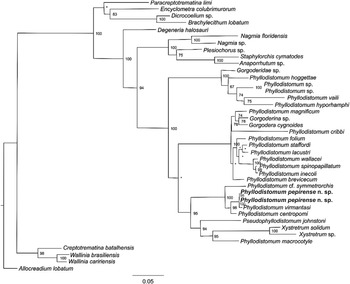
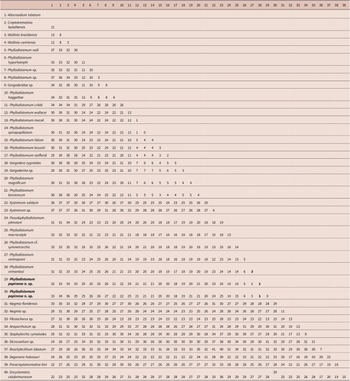
Two adult specimens of Phyllodistomum pepirense n. sp. were successfully sequenced. The alignment of 28S rDNA sequences included 34 gorgoderid species, and four allocreadids were used as outgroup. The final alignment was 841 bp long. Maximum likelihood phylogenetic trees yielded Phyllodistyomum pepirense n. sp. as the sister taxon of P. virmantasi and these two, together, as the sister group of P. centropomid. Both species distributed farther north in the Neotropical region parasitizing distantly related species of hosts (Figure 5). These relationships are well-supported by high bootstrap values. The genetic divergence between the species-pair Phyllodistomum pepirense n. sp. and P. virmantasi was 1%, whereas the divergence between these two species and P. centropomi varied from 2% to 3% (Table 2).
Phylogenetic tree based on Maximum Likelihood analysis of partial sequences of the 28S nuclear rDNA gene. Bootstrap support values with an asterisk representing values not supported by the analyses (<70%). GenBank accession numbers are provided in Table 1. Branch length scale bar indicates the number of substitutions per site. Allocreadim lobatum, Creptotrematina batalhensis, Wallinia caririensis, and Wallinia brasiliensis were used as outgroup.

Percentage (%) of Kimura-2-Parameters genetic divergence of 28S rRNA among Gorgoderidae species downloaded from Genbank and Phyllodistomum n. sp. Species of Allocreadiidae (1–4) were used as outgroup.

Discussion
The genus Phyllodistomum is one of the genera with the largest species richness of Trematoda, parasitizing both freshwater and marine fishes, and also amphibians, and being recorded in different regions of the world (Cribb et al. Reference Cribb, Chisholm and Bray2002). In North America, there are approximately 43 species described (Pérez-Ponce de León et al. Reference Pérez-Ponce de León, García Prieto and Mendoza-Garfías2007; Pinacho et al. Reference Pinacho-Pinacho, Sereno-Uribe, Hernández-Orts, Gárcia-Varela and Peréz-Ponce de León2021). Conversely, in South America, the genus is species-poor, with only five species reported (Kohn et al. Reference Kohn, Fernandes and Cohen2007). Of these, three species of Phyllodistomum were described in Brazil. The first described species of the genus was P. mugilis from M. platanus in the Baia de Guanabara, Rio de Janeiro state (Knoff & Amato Reference Knoff and Amato1992), and later, the species P. rhamdiae was described from R. quelen in the Guandu River, Rio de Janeiro state (Amato & Amato Reference Amato and Amato1993). This latter species has also been recorded in H. malabaricus in the Batalha River, São Paulo state (Gião et al. Reference Gião, Pelegrini, Azevedo and Abdallah2020), although considering host association, it is more likely that the report may correspond with the new species we describe in this study. One species, P. spatula, seems to be widely distributed in Brazilian fishes and was first recorded in Ceará, Brazil, by Fernandes (Reference Fernandes1984) from C. macropomum (Cuvier, 1818). Later, it was reported infecting H. malabaricus and H. intermedius from the São Francisco River from Minas Gerais state (Costa et al. Reference Costa, Monteiro and Brasil-Sato2015) and Acestrorhynchus falcirostris Cuvier, 1819 from the municipality of Manus, Amazonas state (Fernandes et al. Reference Fernandes, Justo, Anjos, Malta and Dumbo2017). We also believe that at least the records by Costa et al. (Reference Costa, Monteiro and Brasil-Sato2015) may correspond to the species described here. Still, this requires further verification by analysing the morphology of the specimens in more detail and, preferentially, by obtaining sequence data from specimens sampled in the same locality. Our study increased the diversity of species within the genus Phyllodistomum in South America, although the current concept of the genus is controversial, and several studies have demonstrated that the genus needs revision because it seems to be paraphyletic (Cutmore et al. Reference Cutmore, Miller, Curran, Bennett and Cribb2013; Petkevičiūtė et al. Reference Petkevičiūtė, Zhokhov, Stunžėnas, Poddubnaya and Stanevičiūte2020; Pinacho-Pinacho et al. Reference Pinacho-Pinacho, Sereno-Uribe, Hernández-Orts, Gárcia-Varela and Peréz-Ponce de León2021).
Molecular tools have proven very useful for species delimitation within Phyllodistomum in combination with the use of other characteristics such as morphology (including scanning electron microscopy to describe the type, number, and arrangements of papillae), geographical distribution, and host association. In some cases, preparation and fixation of the parasite have led to controversial species identification because of the influence of this procedure on the morphological traits of individuals (Bakke Reference Bakke1988). Also, there seems to be a pattern of host specificity among species of Phyllodistomum, although many species are not yet sequenced, and reports of some species infecting certain groups of hosts require further verification, in addition to the potential to find cryptic species complexes as in the case of P. lacustri in catfishes of North America (Rosas-Valdez et al. Reference Rosas-Valdez, Choudhury and Pérez-Ponce de León2011). The finding of the new species as a parasite of the erythrinid H. malabaricus in South America raises an interesting hypothesis about the distribution of this gorgoderid along with its hosts. Phyllodistomum sp. was reported from another erythrinid, Hoplias microlepis, from the Rio Chagres in the Soberania National Park, Panama (Choudhury et al. Reference Choudhury, García-Varela and Pérez-Ponce de León2017). This erythrinid, along with H. malabaricus, reaches its northernmost distribution range in Costa Rica, Central America. It seems plausible to postulate that the specimens from Panama will more likely represent the new species.
Finally, the number of Phyllodistomum spp. is still increasing as authors approach the description of new congeneric species worldwide through an integrative taxonomy approach (Petkevičiūtė et al. Reference Petkevičiūtė, Zhokhov, Stunžėnas, Poddubnaya and Stanevičiūte2020; Pinacho-Pinacho et al. Reference Pinacho-Pinacho, Sereno-Uribe, Hernández-Orts, Gárcia-Varela and Peréz-Ponce de León2021). Once a taxonomic review of the genus is conducted as more species of the genus are sequenced, the classification scheme for the group will be modified to determine monophyletic groupings corresponding with the generic rank, and then the diversity of all the genera of gorgoderids will be known.
Ethical standard
The fish collection was authorized through the Sistema de Autorização e Informação da Biodiversidade (SISBIO) under #40998-2. All animal procedures were performed in full compliance with the Ethics Committee for Animal Experimentation (CEUA #3353050417) of the Universidade Estadual Paulista (São Paulo State University - UNESP).
Financial support
K.G. Alves Dias was supported by the Brazilian Association for the Improvement of Higher Education Personnel (CAPES). R.J. da Silva was supported by the Brazilian National Research Council (CNPq) (grant ID 301635/2021-0) and by the São Paulo Research Foundation (FAPESP) (grant ID 2019/25223-9; 2020/05412-9). L.A.R. Leite was supported by the São Paulo Research Foundation (FAPESP) (grant ID 2017/00566-5). V.D. Abdallah was supported by the Brazilian National Research Council (CNPq) (grant ID 306987/2018-0).
Author contribution
K.G. Alves Dias was involved in the study conceptualization, project administration, data curation, and writing, reviewing, and editing the manuscript. G. Pérez-Ponce de León was involved in data interpretation, parasite identification and taxonomic characterization, and writing, reviewing, and editing the manuscript. R.J. da Silva was involved in data interpretation, parasite identification and taxonomic characterization, and writing, reviewing, and editing the manuscript. D.H.M.D. Vieira was involved in the molecular and phylogenetic analysis, and writing, reviewing, and editing the manuscript. L.A.R. Leite was involved in data collection, writing, reviewing, and editing the manuscript. R. Kozlowiski de Azevedo was involved in project administration and writing, reviewing, and editing the manuscript. V.D. Abdallah was involved in the study conceptualization, project administration, data interpretation, and writing, reviewing, and editing the manuscript.
Competing interest
No potential conflict of interest was reported by the authors.