American courts are generally regarded as influential political institutions, capable of affecting a wide range of social and policy outcomes (Hume Reference Hume2009, Reference Hume2013; Keck Reference Keck2009; Howard and Steigerwalt Reference Howard2011). Given their integral role in trying and sentencing criminal defendants, judges may be particularly successful at influencing the criminal justice system (Hall Reference Hall2011). Nonetheless, the ability of US high courts to affect social change is subject to substantial limitations (Horowitz Reference Horowitz1977; Sweet Reference Sweet2010), and even criminal justice rulings occasionally fall flat (Wasby Reference Wasby1976; Rosenberg Reference Rosenberg2008). Judges almost certainly influence some criminal justice outcomes, but the extent, timing, and nature of judicial impact remain largely unknown.
In this study, we evaluate judicial impact in the criminal justice system, as well as the political and institutional factors that condition impact. To do so, we analyze the dynamic influence of state courts of last resort (SCOLRs) and the Supreme Court of the United States (SCOTUS) on state incarceration rates. Our approach offers several important advantages. First, rather than examine the effects of particular rulings, we test the aggregate effects of judicial preferences on a broad policy outcome of central importance to the judiciary: the admission of new prisoners to state correctional facilities. Second, our analyses focus on the American states, which are uniquely suited for the comparative study of judicial impact. SCOLRs perform similar functions in every state, yet states vary widely in political climate and institutional structure. Third, our multilevel error correction approach facilitates an analysis of judicial impact by capturing the dynamic influence of judicial preferences across states and over time. In sum, our study is the first to test the political and institutional factors that moderate the long-term aggregate influence of judicial preferences on policy outcomes.
We find that high courts wield significant influence over state incarceration rates, but that influence is conditioned by a state’s political climate and the institutional structure of the state’s judicial system. Specifically, the influence of judicial preferences on incarceration is (1) stronger in states with divided partisan control of the government and (2) faster in states that lack intermediate appellate courts. Our findings suggest that divided government (i.e., the propensity for gridlock associated with divided government) and institutional thickness (i.e., the number of hierarchical layers in a judicial system) substantially constrain judicial impact.
Judicial Influence on Incarceration
The United States incarcerates a greater proportion of its population than any other nation in the world—almost one out of every 160 adults as of 2012 (Walmsley Reference Walmsley2006; Carson and Golinelli Reference Carson2013). This mass incarceration has disrupted family life (Western Reference Western2006), displaced public resources (Mauer Reference Mauer2006), reinforced cycles of poverty and crime (Pager Reference Pager2007), disenfranchised a significant portion of African American citizens (Mauer Reference Mauer2006), and inspired negative orientations toward government (Weaver and Lerman Reference Weaver2010). Accordingly, understanding the causal factors behind this remarkable phenomenon is of critical importance for understanding American social and political life.
Numerous factors may have contributed to the rise of mass incarceration in the United States, such as economic inequality (Garland Reference Garland1990; Gordon Reference Gordon1994), the legacy of racial cleavages (Smith Reference Smith2004; Alexander Reference Alexander2011), and a proliferation of out-of-wedlock births (Jacobs and Helms Reference Jacobs1996). Social movements (Gottschalk Reference Gottschalk2006) and public opinion (Nicholson-Crotty, Peterson, and Ramirez Reference Nicholson-Crotty2009; Enns Reference Enns2014) also may have played important roles. Increased incarceration may be a strategy employed by “tough-on-crime” politicians to curry electoral favor (Jacobs and Helms Reference Jacobs1996; Davey Reference Davey1998; Yates and Fording Reference Yates2005). Previous research has found that elected officials, including presidents (Jacobs and Helms Reference Jacobs1996), governors (Davey Reference Davey1998), and state legislators (Smith Reference Smith2004), influence the incarceration rate, and even elected state judges tend to become more punitive as reelection contests approach (Huber and Gordon Reference Huber2004). Many studies find that increased Republican Party power or conservative ideology is associated with increased incarceration (Jacobs and Helms Reference Jacobs1996; Smith Reference Smith2004; Yates and Fording Reference Yates2005). Others cite specific policy agendas, such as the “war on drugs,” limitations on parole, and the establishment of sentencing guidelines and mandatory minimums, as potential causal factors (Nicholson-Crotty and Meier Reference Nicholson-Crotty2003; Mauer Reference Mauer2006).
Several studies suggest that courts also influence incarceration rates (Yates and Fording Reference Yates2005; Simon Reference Simon2007, Reference Simon2013). US courts ultimately resolve a wide range of questions related to criminal justice, including the interpretation of common law principles, statutes, and constitutional rights. By expanding or contracting the protections afforded to criminal suspects and defendants, courts may significantly alter the rate at which Americans are put behind bars. For example, the Warren Court is frequently credited with initiating a “revolution in the constitutional law of criminal procedure” (Keck Reference Keck2004, 72) that “remade the entire American system of criminal justice” (Powe Reference Powe2000, 412). Similarly, some claim that the Burger and Rehnquist Courts instituted a “counterrevolution” by restricting defendant rights and advancing conservative criminal justice policies (Clayton and Pickerill Reference Clayton2006; see Keck Reference Keck2004, 177–79). Moreover, courts often exercise considerable influence over policy outcomes (Hume Reference Hume2009, Reference Hume2013; Keck Reference Keck2009; Howard and Steigerwalt Reference Howard2011), and SCOTUS is particularly successful at implementing criminal justice rulings, even when those decisions are unpopular (Hall Reference Hall2011). A systematic analysis of new admissions to federal prison from 1950 to 2008 indicates that SCOTUS decisions are strongly associated with long-term shifts in incarceration (Hall Reference Hall2015).
SCOLRs may play an even larger role in the criminal justice process. “The great preponderance of trials, both civil and criminal, take place in the state courts” (Galanter Reference Galanter2004, 506), and SCOLRs devote a substantial and increasing portion of their docket to criminal cases (Kritzer et al. Reference Kritzer2007). Even more important, the vast majority of prisoners in the United States reside in state penitentiaries (Carson and Golinelli Reference Carson2013). Accordingly, Yates and Fording (Reference Yates2005) find that shifts in SCOLR ideology are associated with changes in state incarceration rates.
High-court judges probably influence incarceration rates by altering the behavior of other actors in the criminal justice system. First, high courts influence decision making by lower-court judges, who generally adhere to the judicial hierarchy (Gruhl Reference Gruhl1980; Songer and Sheehan Reference Songer1990; Songer, Segal, and Cameron Reference Songer1994; Brent Reference Brent1999). Although lower-court compliance is not perfect (Baum Reference Baum1978; Scott Reference Scott2006), defying precedent tends to be the exception rather than the rule (Westerland et al. Reference Westerland2010). Because these judges oversee the process of trying and sentencing criminal defendants, their decisions directly affect who goes to jail and who does not. In fact, some scholars have used the influence of trial court judges on incarceration in order to study recidivism rates (Berube and Green Reference Berube2007; Green and Winik Reference Green2010).
Second, the changing behavior of lower-court judges likely affects the behavior of prosecutors. These actors strategically anticipate the probability of success when deciding whether to prosecute a case, appeal a decision, or plea bargain (Albonetti Reference Albonetti1987; Lederman Reference Lederman1999; Taha Reference Taha2010; Wedeking Reference Wedeking2010). Accordingly, as high courts expand or contract criminal rights and lower courts comply, prosecutors alter their behavior. For example, SCOTUS’s influence on incarceration is mediated by the behavior of lower-court judges and prosecutors (Hall Reference Hall2014a). Specifically, SCOTUS’s criminal justice policy is associated with case filing rates, plea bargaining rates, and conviction rates in federal district courts. The behavior of these judges and prosecutors is associated with subsequent shifts in the federal incarceration rate.
Finally, as the behavior of lower-court judges and prosecutors changes, law enforcement officials, defendants, and defense attorneys should adjust their behavior in response to the new legal landscape. For example, SCOTUS’s decision in Mapp v. Ohio (367 U.S. 643 [1961]) prompted changes in the frequency of motions to suppress, guilty pleas, and the issuing of search warrants (Hall Reference Hall2011, 51–56). That decision may have also influenced arrest and crime rates, as police officers struggled to comply with the new rules (Nagel Reference Nagel1965; Canon Reference Canon1974a). Similarly, the Court’s ruling in Miranda v. Arizona (384 U.S. 436 [1966]) altered police and arrestee behavior (Hall Reference Hall2011, 62–70) and may have reduced the ability of law enforcement officials to solve crimes (Cassell and Fowles Reference Cassell1998a, Reference Cassell1998b; Donohue Reference Donohue1998).
In short, we argue that high courts influence the behavior of judges, prosecutors, and law enforcement officials, which subsequently affects how many people go to prison. Of course, the behavior of these actors is also likely influenced by their own and each others’ preferences; however, in the aggregate, judicial preferences should substantially shape incarceration rates (Yates and Fording Reference Yates2005; Hall Reference Hall2015).
We expect the causal chain between judicial preferences and new prison admissions to unfold rather slowly as justices influence the behavior of lower-court judges, prosecutors, and law enforcement officials. Considering the complexity and delays inherent in the American legal process, an immediate effect of high-court preferences on policy outcomes would seem implausible. If high-court preferences affect incarceration, they most likely do so by producing only long-term shifts in new prison admissions. Standard conceptions of judicial ideology define decisions that are supportive of criminal suspects and criminal defendants as liberal decisions.Footnote 1 Accordingly, the extant literature suggests our first hypothesis:
Hypothesis 1: High-court liberalism is negatively associated with long-term shifts in state incarceration rates.
The Limits of Judicial Influence
Previous research suggests that high courts influence the criminal justice system in general (e.g., Powe Reference Powe2000; Keck Reference Keck2004) and incarceration in particular (e.g., Yates and Fording Reference Yates2005; Hall Reference Hall2015), yet many scholars emphasize the limits of judicial impact. US high courts are traditionally viewed as severely constrained in their ability to influence policy outcomes (e.g., Horowitz Reference Horowitz1977; McCloskey Reference McCloskey2010), even those related to criminal justice. For example, Wasby finds that, for many law enforcement officials, SCOTUS’s most prominent rulings simply “did not matter much” (Reference Wasby1976, 8), and Rosenberg claims the criminal rights revolution “failed” because judges ultimately depend on other actors to implement their rulings (Reference Rosenberg2008, 335).
To be sure, most scholars agree that courts influence social change (e.g., Rosenberg Reference Rosenberg2014); however, even the most expansive views of judicial power concede that courts are constrained by various contextual factors (e.g., Hall Reference Hall2011). Accordingly, the critical task for understanding judicial impact is to identify these constraining factors. As described above, high courts probably affect incarceration rates by altering the behavior of street-level bureaucrats, such as trial court judges, prosecutors, and law enforcement officials. Therefore, judicial impact is likely moderated by factors that inhibit high-court control over these bureaucrats. Specifically, we argue that two factors condition judicial impact on incarceration: political climates and institutional structures.
Political Climates
Judicial influence is likely constrained by the political “environment,” including “widely shared societal values” and “the specific political context” (Murphy 1964, 33). The political climate is especially important for judicial impact because street-level bureaucrats probably respond to the preferences and actions of legislative and executive officials, as well as high courts. These lawmakers can potentially undermine judicial impact in at least two ways.
First, lawmakers can interfere with the exercise of judicial power by overriding judicial decisions (Rosenberg Reference Rosenberg2008, chap. 13), sanctioning courts (e.g., impeachment, jurisdiction stripping; Rosenberg Reference Rosenberg1992), or failing to implement judicial rulings (Sweet Reference Sweet2010). Lawmakers can even blunt judicial influence without resorting to these tactics. When judges face strong opposition, they may refrain from issuing unpopular rulings due to a fear of override (Ferejohn and Shipan Reference Ferejohn1990; Gely and Spiller Reference Gely1990; Epstein, Knight, and Martin Reference Epstein2001), sanctions (Segal, Westerland, and Lindquist Reference Segal2011), or nonimplementation (McGuire and Stimson Reference McGuire2004; Casillas, Enns, and Wohlfarth Reference Casillas2011; Hall Reference Hall2014b). If high courts refrain from issuing their preferred rulings, then their preferences will obviously have little impact on the behavior of street-level bureaucrats.
Second, lawmakers possess a variety of tools with which they can directly influence the behavior of street-level bureaucrats and, in doing so, alter the incarceration rate. For example, lawmakers can alter the content of criminal statutes and funding for law enforcement or the public defender system, all of which could influence the behavior of trial court judges, prosecutors, and law enforcement officials. Therefore, lawmakers can often dull the effects of judicial rulings—even those they cannot override—by directly influencing these bureaucrats.
However, both of these strategies usually require the passage of new legislation (e.g., court-curbing legislation, new criminal statutes). Consequently, lawmakers’ ability to thwart judicial influence should be significantly diminished when they are gridlocked by disagreement among themselves.Footnote 2 Gridlocked legislators are less able to override the decisions of other policy makers or sanction them for disfavored decisions (Howell 2003). They are also less capable of enacting new legislation in order to independently influence policy outcomes.
As a result of these dynamics, courts should tend to enjoy greater influence over incarceration during periods of divided partisan government.Footnote 3 Under unified government, lawmakers can more easily override judicial rulings and sanction courts; therefore, judges tend to be more constrained and less free to pursue their own policy preferences (Bergara, Richman, and Spiller Reference Bergara2003; Harvey and Friedman Reference Harvey2006, Reference Harvey2009). Additionally, under unified government, lawmakers can more readily enact legislation, appropriate funds, and control street-level bureaucrats in pursuit of their policy goals; therefore, judges should enjoy less influence as lawmakers exercise independent control.
When the partisan control of government is divided, judges should have greater influence over incarceration for several reasons. First, judges should have less reason to fear override or sanctions, because the lawmakers are gridlocked. Second, lawmakers should have more difficulty controlling policy outcomes due to disagreement over new legislation. As a result, street-level bureaucrats should be less responsive to lawmaker preferences because they are less concerned about legislative action. However, regardless of divided government, these bureaucrats should still respond to judicial preferences for all of the reasons discussed above. Accordingly, we expect the presence of divided government to inhibit lawmakers and, therefore, facilitate judicial impact.
Hypothesis 2: The negative relationship between judicial liberalism and state incarceration rates is stronger in states with divided government.
Institutional Structures
Judicial influence may also depend on the institutional structure of the judiciary. For example, SCOTUS’s integration into the system of federal policy making better enabled the justices to satisfy their objectives (McGuire 2004), and SCOTUS’s implementation power depends on the institutional, as well as the political, context of its rulings; specifically, the Court’s impact is enhanced when its rulings can be implemented by lower courts (Hall 2011). However, many institutional constraints on judicial influence are not unique to the judiciary. In a review of SCOTUS impact, Lawrence Baum emphasizes this point: “for the most part, the Court’s difficulties reflect universal imperfections in organizational hierarchy and inherent limitations in government capacity” (2003, 177). Accordingly, any evaluation of judicial influence must consider factors that universally limit policy impact.
Perhaps the most commonly recognized constraint on policy implementation is institutional thickness (i.e., the number of layers in an institutional hierarchy). Numerous studies on bureaucracy, public policy, and implementation confirm that the presence of more institutional layers hampers the ability of policy makers at the top of a hierarchy to influence outcomes. Thick institutions can disrupt hierarchical control in a variety of ways, such as distorting information, stalling administrative inertia, and reducing accountability (Light Reference Light1995, 64). As Pressman and Wildavsky explain, “the longer the chains of causality, the more numerous the reciprocal relationships among the links and the more complex implementation becomes” (Reference Pressman1973, xxiv). Accordingly, institutional thickness has been found to limit the influence of presidents (Skowronek Reference Skowronek1997; Krause Reference Krause2004, Reference Krause2009), parliaments (Strøm Reference Strøm2000), and bureaucratic administrators (Light Reference Light1995, Reference Light1997; Hupe Reference Hupe2011).
Scholars of judicial impact have also noted the importance of institutional thickness. For example, Baum argues that “messages which travel downward in a hierarchy frequently suffer distortion in the process of communication, both because of intentional alterations by intermediate officials and because of unintentional errors in transmission”; in particular, “there may exist the problem of message distortion where the court issuing a decision is several steps removed in the hierarchy from the courts to which the decision is relevant” (1976, 94–95; see also Downs 1967).
As Baum points out, thickness can disrupt hierarchical control in two different ways: deliberate distortion and unintentional complications. In theory, intermediate courts should consistently follow high-court rulings, and empirical evidence suggests that they generally do (Gruhl Reference Gruhl1980; Songer and Sheehan Reference Songer1990; Westerland et al. Reference Westerland2010); nonetheless, intermediate-court judges sometimes find opportunities to “shirk” and pursue their own policy goals (Brent Reference Brent1999; Canon Reference Canon1974b; Songer et al. Reference Songer1994; Benesh Reference Benesh2002). This shirking may limit or delay high-court influence on incarceration rates as intermediate-court judges send conflicting signals to trial court judges. Additionally, many of the problems inherent to thick institutions, such as information distortion and administrative delays, do not involve willful shirking by subordinates. Therefore, even if intermediate-court compliance is perfect, the presence of these courts may nonetheless frustrate and delay the effectiveness of high-court decisions. The added layer of judicial bureaucracy could interfere with the communication of rules and multiply the possibilities for ambiguity and misunderstanding. Accordingly, we posit that thick judicial hierarchies (i.e., judicial systems with intermediate appellate courts) will also tend to inhibit judicial impact.
Hypothesis 3: The negative relationship between judicial liberalism and state incarceration rates is stronger in states that lack intermediate appellate courts.
Analysis
Our goal is to identify factors that constrain high-court influence; accordingly, we are interested in assessing judicial power. In his seminal work on the topic, Jack Nagel defines power as follows: “a power relation, actual or potential, is an actual or potential causal relation between the preferences of an actor regarding an outcome and the outcome itself” (1975, 29). Accordingly, we assess high-court influence by measuring the association between high-court ideology and incarceration. We test two factors (one climatic and one institutional) that might constrain judicial influence. Specifically, we test whether divided government and institutional thickness moderate the relationship between high-court ideology and incarceration.
Our methodological approach offers several advantages. First, rather than examine the effects of individual rulings on specific behaviors (e.g., the effect of Mapp v. Ohio on the exclusion of evidence), we evaluate judicial impact by testing the aggregate influence of judicial ideology on a broad policy outcome: the rate of new admissions to state prisons. This aggregate approach accounts for the possibility that broad policy outputs may be gradually influenced by numerous judicial decisions over time or the anticipation of judicial decisions. Second, we employ a multilevel error correction model, which captures the dynamic effects of judicial preferences across states and over time. Most importantly, the error correction framework allows us to distinguish between short- and long-term effects and assess the speed with which judicial preferences affect policy outcomes. Third, our analysis exploits the political and institutional variation across the American states to test the factors that condition judicial impact. Accordingly, our study offers the first systematic assessment of factors that condition the aggregate influence of judicial preferences on policy outcomes over time and across political and institutional contexts.
Data
Our dependent variable is the rate of new admissions to state prisons per 100,000 people in every state from 1978 to 2004.Footnote 4 Analyzing new admissions is appropriate because changes in judicial policy should primarily affect new conviction and sentencing practices rather than the existing prison population as a whole.Footnote 5 Additionally, increases in incarceration rates over the last few decades have been primarily driven by new admissions rather than increases in average sentences (Wacquant 2010).
In order to measure SCOLR liberalism we employ party-adjusted judge ideology (PAJID) scores, which have been shown to be valid and reliable measures of preferences in SCOLRs (Brace, Langer, and Hall 2000). PAJID scores are based on the partisan affiliation of the judge and the elite or citizen ideology of the state at the time of the judge’s ascension, depending on the state’s judicial selection method. Most importantly for our purposes, PAJID scores provide comparable measures of judicial preferences across states and over time. Higher PAJID scores indicate more liberal preferences. We employ judicial common space (JCS) scores to measure SCOTUS liberalism (Epstein, Knight, and Martin 2007). We reverse the sign of these scores so that higher values also indicate increased liberalism. For both SCOLRs and SCOTUS, we use the score of the median judge on the respective court to measure the court’s liberalism.Footnote 6 PAJID scores cannot yet be bridged to common space; therefore, it is impossible to directly compare PAJID scores to the JCS scores. Fortunately, our goal is not to compare the relative influence of SCOLRs and SCOTUS. Instead, our goal is to compare high-court impact across different political and institutional contexts, and ideology scores do not need to be placed in a common space to test both of their effects in a linear model.
Both PAJID scores and JCS scores are designed to measure judicial ideology on a standard liberal-conservative dimension across issue areas; accordingly, these scores are imperfect proxies for the justices’ preferences specifically with regard to criminal justice policy. In the supporting information, we assess the validity of these measures by testing their relationship with judicial decision making in incarceration-related cases. We find that both SCOLR and SCOTUS liberalism are significantly associated with decision making in these cases. Accordingly, we conclude that these scores are valid measures of judicial preferences with respect to criminal justice policy.
We do not include measures for the ideology of the regional US courts of appeals because doing so would not comport with our theory of judicial impact. We expect SCOLR and SCOTUS preferences to influence incarceration because their decisions are officially binding on state trial courts that actually convict and sentence criminal defendants to state penitentiaries; however, US courts of appeals decisions are not binding on any state courts. Therefore, we do not expect these courts to influence state incarceration rates.
We also include a variety of controls to account for the possibility that judicial ideology is correlated with other influences on incarceration.Footnote 7 We include the Berry et al. (1998) measure of elite liberalism to capture the influence of the state legislatures and governors on incarceration.Footnote 8 We include the Enns and Koch (2013) measure of the percentage of respondents in each state identifying themselves as conservatives to test the influence of public preferences.Footnote 9
Some argue that incarceration is a form of social control, and public demand for this social control increases as inequality increases (Rusche and Kirchheimer 1939; Garland 1990; Gordon 1994). To account for this possibility, we include a Gini coefficient of household post-redistribution income as an annual indicator of economic inequality. We rely on household income data collected by the US Census Bureau in the Annual Social and Economic Supplement (ASES). Our income measure includes all sources of income available in the ASES data set including both government transfer payments and private transfers.
Finally, we include an index of the violent and property crime rate based on the annual rate of murder, forcible rape, robbery, aggravated assault, burglary, and motor vehicle theft.Footnote 10 Previous research has shown that these variables share a great deal of variation over time, and a principal components analysis shows that the six crime rates load onto a single factor.Footnote 11
Model Estimation
We use the error correction model (ECM) framework to estimate our models. ECMs represent a general class of regression models appropriate for both stationary and nonstationary data (De Boef and Keele 2008).Footnote 12 This approach is particularly appropriate in this context because it distinguishes between immediate and long-term effects. One way to express a single-equation ECM is as follows (excluding a constant term for simplicity):

The critical feature of an ECM is that for each independent variable X we include up to two parameter estimates:
 for the differenced variable and
 for the lagged level of the variable. If either of these coefficient estimates indicates a statistically significant relationship, then it is appropriate to conclude that the explanatory variable is associated with the dependent variable. In this simple bivariate example,
 provides an estimate of the initial change in the dependent variable produced by a shock to the independent variable. This is called the “short-term” effect, not meaning that the effect is impermanent but rather that the effect occurs wholly at a specific point in time. The error correction rate (
 ) and
 provide the information needed to estimate the slightly more complicated “long-term” effect (the long-run multiplier). The long-term effect is the portion of the connection between X and Y that does not occur at one particular point in time but is distributed temporally such that a portion of the impact is distributed over a period of time.
A multilevel (or hierarchical) modeling framework is particularly well suited for analyzing time-series–cross-sectional data such as ours. Hierarchical data structures contain more than one level of analysis, where units from one level are nested within units from a higher level. This approach facilitates the analysis of observations that are likely to be correlated within levels of analysis (Gelman and Hill 2006). Therefore, we estimate a multilevel ECM employing a two-level hierarchical structure: state-years (level 1 units) nested within states (level 2 units).Footnote 13 In order to facilitate intuitive and comparable interpretation, we standardize all independent variables. State-level variables were standardized on the basis of the average within-state variation of each variable.
Judicial Influence on Incarceration
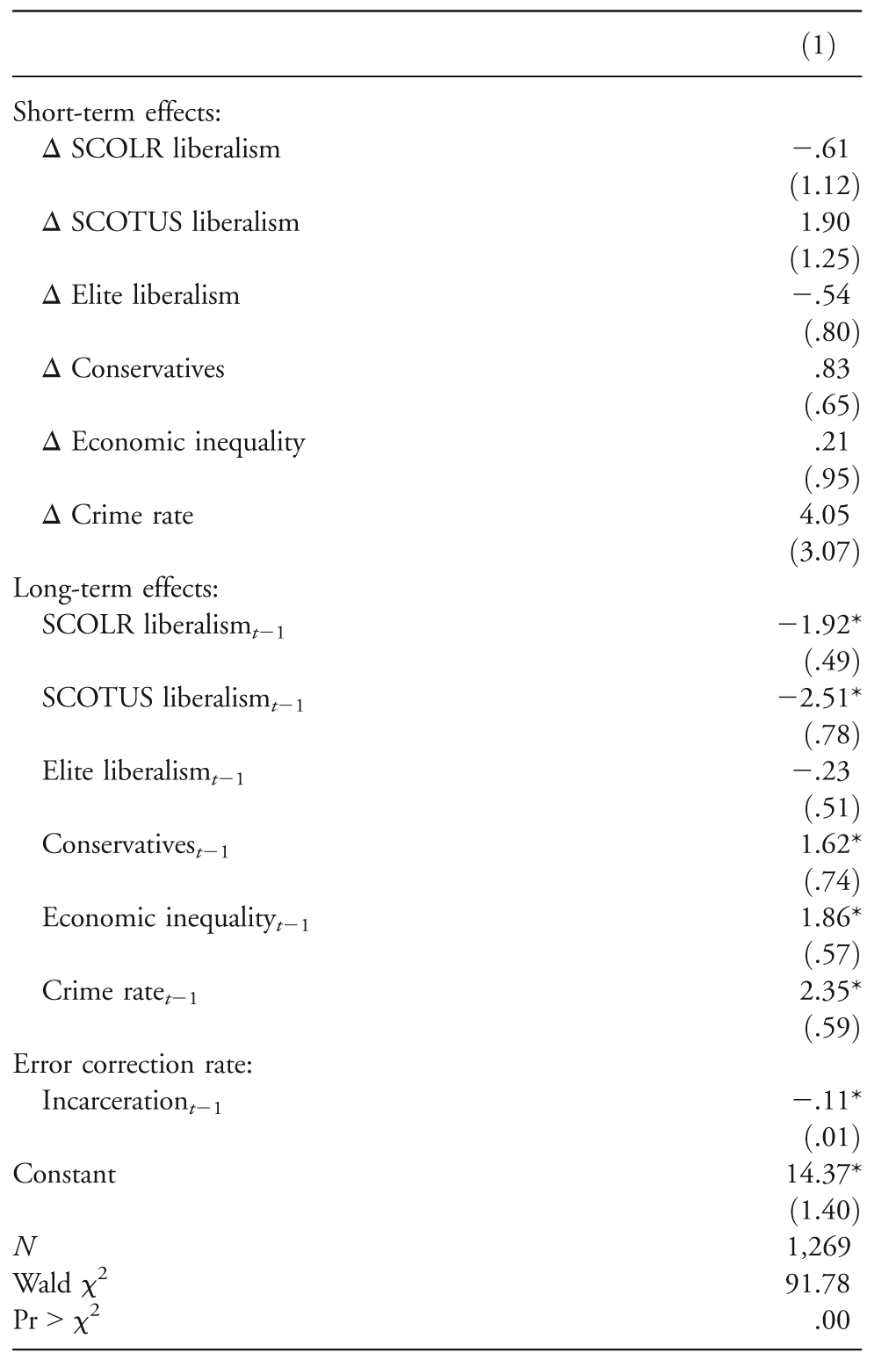
We begin with an analysis of whether high-court ideology is associated with changes in incarceration rates across all states. If high courts influence this important policy output, we expect incarceration rates to be negatively associated with judicial liberalism. The results of the multilevel ECMs are reported in table 1. In this model, both SCOLR and SCOTUS liberalism are associated with long-term decreases in a state’s incarceration rate. In other words, liberal judicial preferences are associated with long-term decreases in state incarceration rates. Most of the control variables perform as expected. Higher levels of conservatives, economic inequality, and the crime rate are associated with long-term increases in incarceration. The coefficients for elite liberalism are signed in the expected direction, but neither reaches conventional levels of statistical significance. Consistent with our expectations, none of the variables are significantly associated with immediate changes in incarceration. These results support our first hypothesis: judicial preferences appear to influence new admissions to state prisons over the long term.Footnote 14
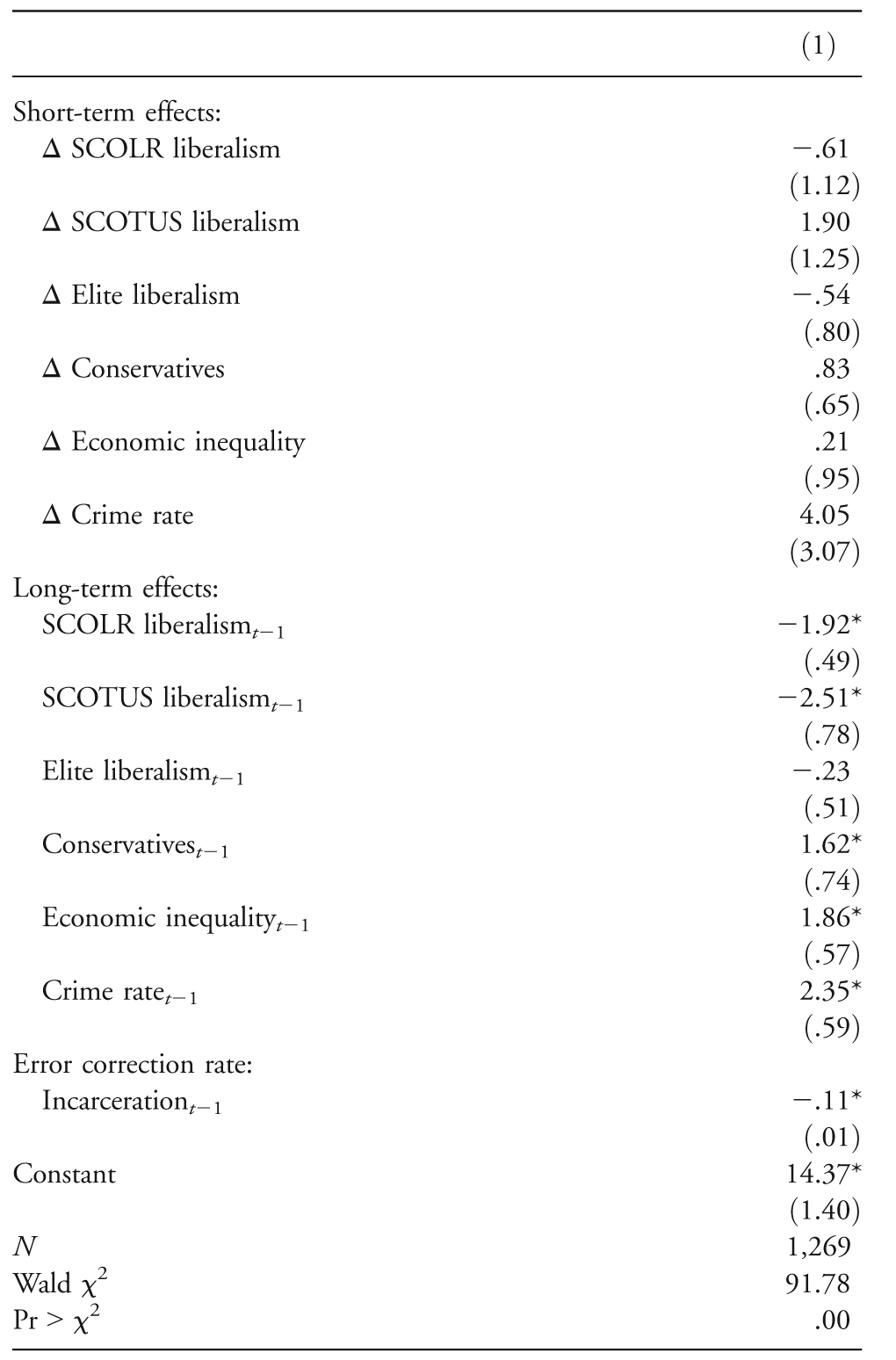
Note.—Multilevel error correction model of changes in new state incarcerations; standard errors in parentheses.
* p < .05 (two-tailed test).
In order to understand the total long-term effects of our explanatory variables, we estimate the long-run multipliers (LRMs) for SCOLR and SCOTUS liberalism on the basis of the model in table 1.Footnote 15 The LRM estimates the total effect of a change in an independent variable in 1 year as it continues to influence incarceration at a decaying rate in future years. Because PAJID scores and JCS scores are not bridged to a common metric, we cannot directly compare the influence of these courts; however, we can estimate the effects of a typical shift in each court’s ideology (recall that SCOLR liberalism is standardized on the basis of within-state variation). A 1 standard deviation (SD) increase in SCOLR liberalism is associated with a total long-term decrease of 17.1 in the incarceration rate. A 1 SD increase in SCOTUS liberalism is associated with a total long-term decrease of 22.4 in the incarceration rate.
To put those figures in context, consider the state of Georgia, which had an incarceration rate of 131.0 in 2004.Footnote 16 In other words, of the 8,769,252 people living in Georgia in 2004, 11,489 of them were sentenced to prison that year. On the basis of the results in table 1, if the liberalism of the median justice on the Supreme Court of Georgia were to increase 1 SD, we would expect the incarceration rate to decrease 17.1 in the long term. Stated another way, a 1 SD increase in the court’s liberalism in that year would be associated with 1,500 fewer people being sentenced to prison over time. A 1 SD increase in SCOTUS liberalism would be associated with 1,964 fewer incarcerations over time.
Consistent with our expectations, the effects of judicial preferences on incarceration appear to unfold rather slowly. The error correction rate indicates the speed at which the long-term effects take place. For example, the error correction rate of −0.11 in table 1 indicates that out of the total long-term effect of SCOLR liberalism (−17.1 or 17.1 fewer admissions per 100,000 people), 11% of this effect takes place at time t + 1 (−1.9), an additional 11% of the remaining effect takes place at time t + 2 (−1.7), and so on, until the total long-term effect has been distributed. Accordingly, it takes more than a decade for 75% of the total long-run impact of judicial preferences to be realized in the incarceration rate. Recall that the SCOLR ideology scores are not dynamic (meaning that each judge gets the same score for his or her entire career). Therefore, a shift in SCOLR liberalism indicates that a new judge has been elected or appointed to the court, shifting the court’s median ideology. Accordingly, the long-term effects are consistent with the idea that a judge’s arrival on the court has gradual effects as the new court hears cases over time, those cases filter through the judicial system, and those rulings affect the behavior of street-level bureaucrats.
Divided Government and Institutional Thickness
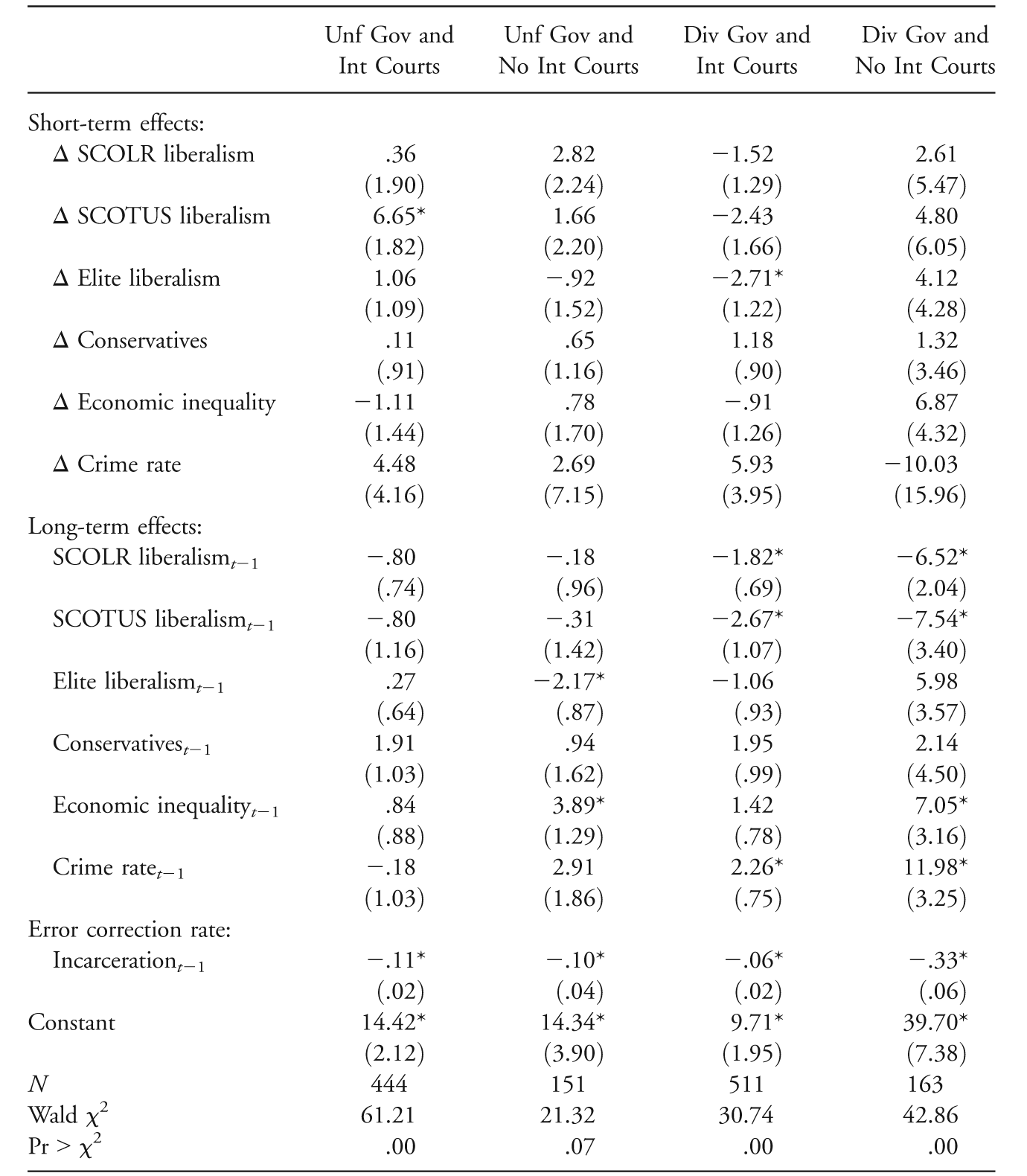
We now turn to an analysis of factors that condition high-court influence on incarceration. We hypothesized that courts would enjoy greater influence in states with divided government and thin judicial hierarchies. To test these hypotheses, we segregate the data into four groups on the basis of whether the partisan control of the state government was divided and whether the state judicial system had intermediate appellate courts.Footnote 17 We then run the multilevel ECM from table 1 on each of these four subsets of data. The results of the models are presented in table 2.
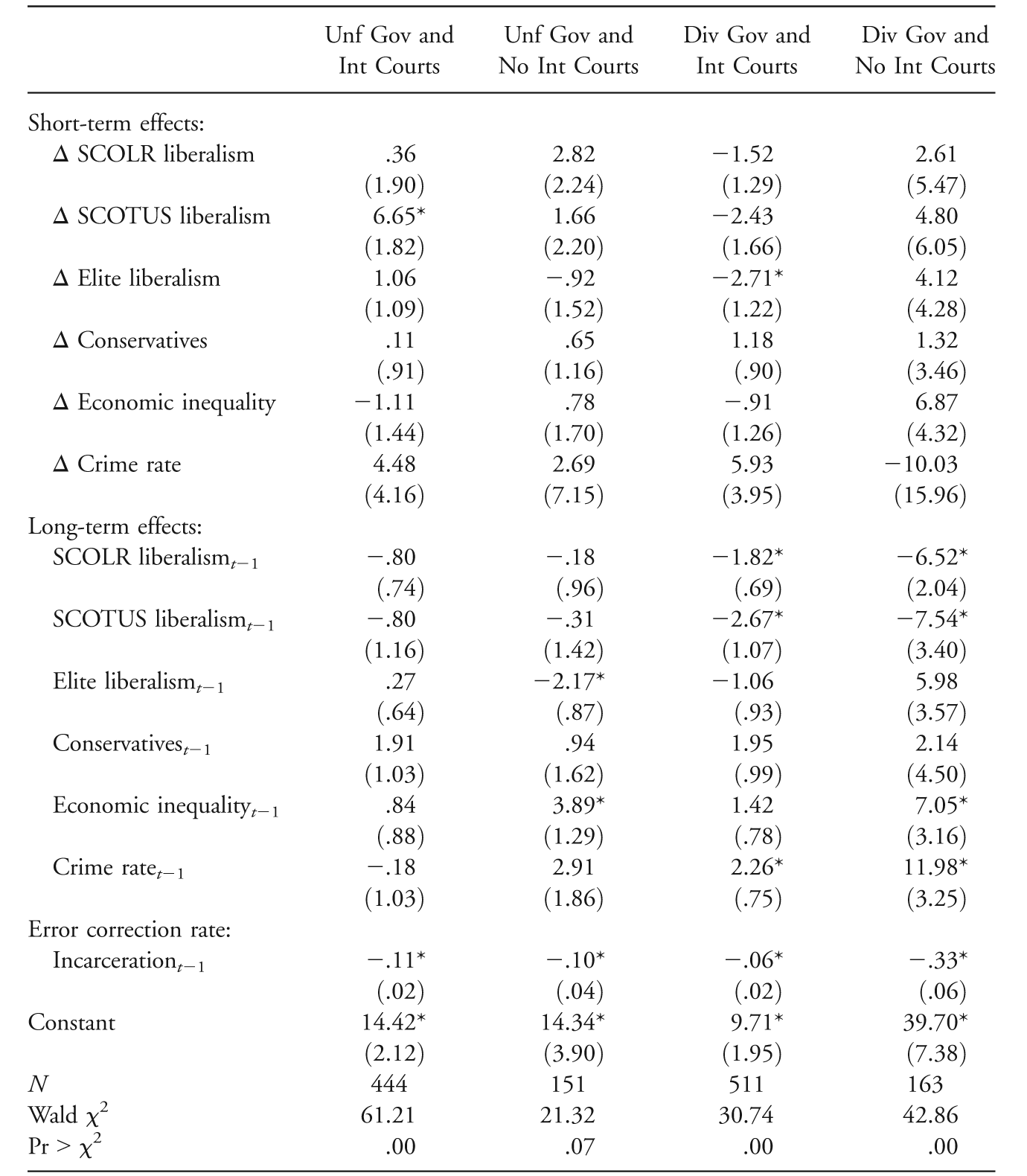
Note.—Multilevel error correction models of changes in new state incarcerations for states with unified (Unf Gov) versus divided (Div Gov) government and states that have intermediate courts (Int Courts) versus those that do not (No Int Courts); standard errors in parentheses.
* p < .05 (two-tailed test).
The first model in table 2 includes states with unified government and intermediate courts. Consistent with our expectations, SCOLR liberalism is not significantly associated with decreases in the incarceration rate in this model.Footnote 18 The second model in table 2 includes states with unified government and no intermediate courts. Once again, judicial ideology has no effect on incarceration in these states; however, in this model, elite ideology is associated with long-term shifts in incarceration. The third and fourth models in table 2 examine states with divided government. The third model includes states with intermediate courts, and the fourth model includes states that lack these courts. In these models, both SCOLR and SCOTUS liberalism are negatively associated with long-term changes in incarceration, suggesting that high courts influence new admissions in these states. The coefficients for judicial ideology in these models are not only statistically significant but also substantially larger than in the models for states with unified government. This finding supports our second hypothesis: the negative relationship between judicial liberalism and state incarceration rates is stronger in states with divided government.
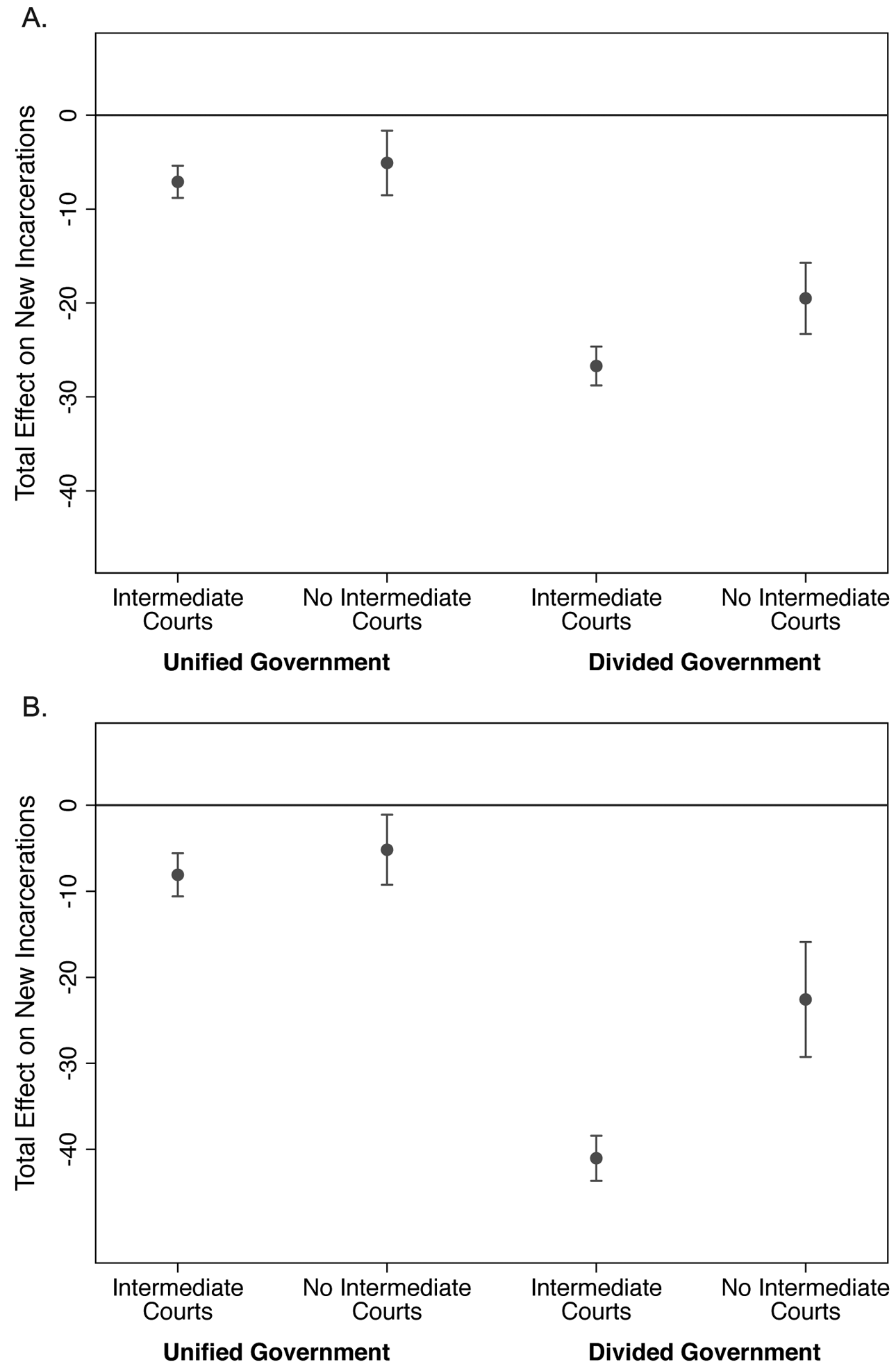
We estimate the substantive impact of judicial preferences on incarceration by calculating the LRMs on the basis of the third and fourth models in table 2. Figure 1 illustrates the total long-term effect of a 1 SD increase in SCOLR liberalism (fig. 1A ) and SCOTUS liberalism (fig. 1B ) on changes in state incarceration rates.Footnote 19 As shown in figure 1, the long-term effects of judicial ideology are significantly larger in states with divided government than in states with unified government.
Total long-term effects on incarceration: A, effects of 1 SD increase in SCOLR liberalism; B, effects of 1 SD increase in SCOTUS liberalism.
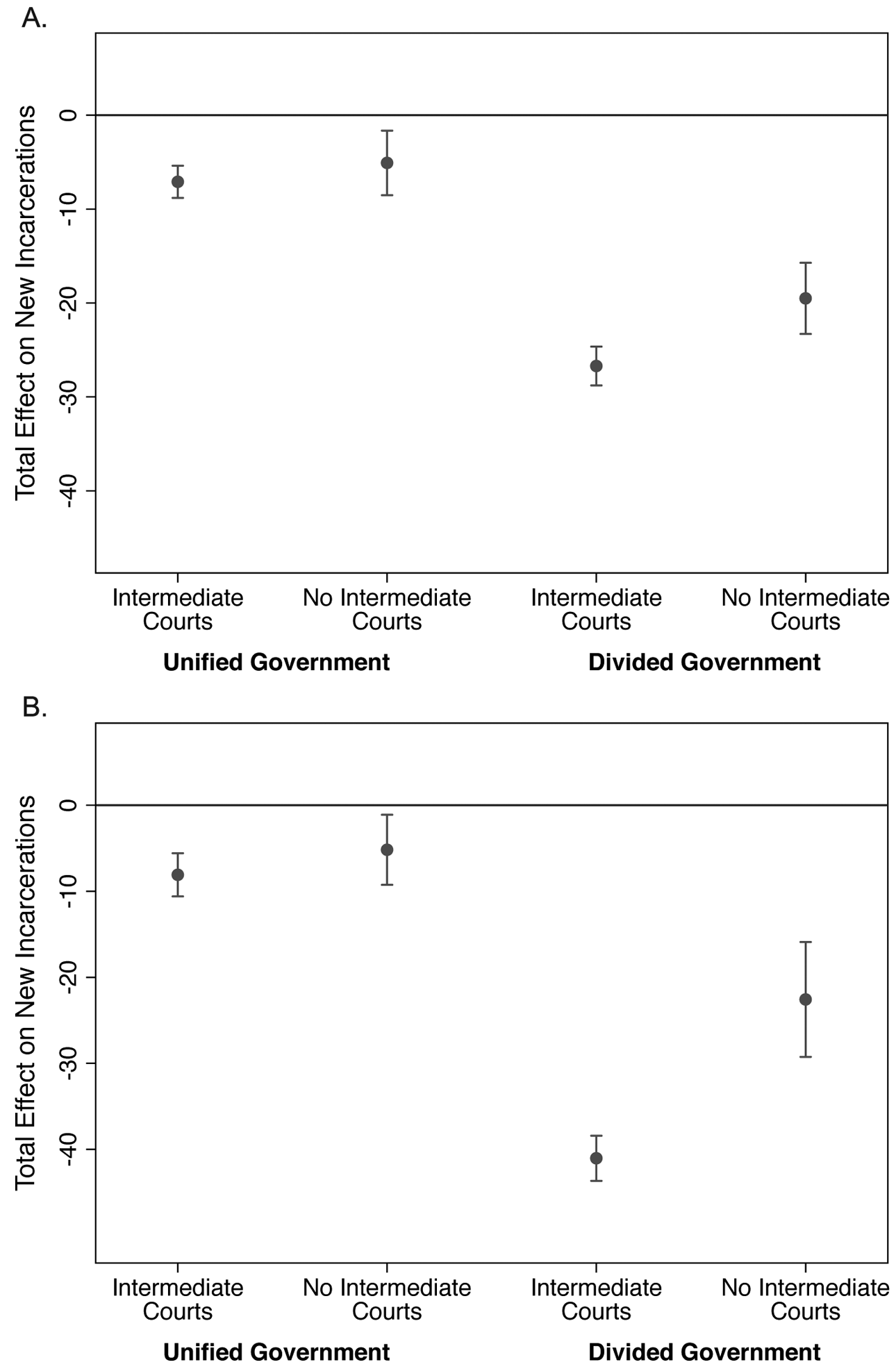
Contrary to our third hypothesis, the total long-term effect of judicial preferences is not larger in states that lack intermediate courts; if anything, the long-term effects appear to be smaller in these states. However, a closer look at the data reveals a more complicated picture. The difference between these two groups is not simply the magnitude of the effects but also the speed at which these effects manifest themselves. The error correction rate in states with divided government and intermediate courts is only −.06, compared to −.33 in states with divided government and no intermediate courts. This means that it takes more than 2 decades for 75% of that effect to be realized in states with divided government and intermediate courts. In states with divided government and no intermediate courts, 75% of judicial impact is realized in just 4 years.
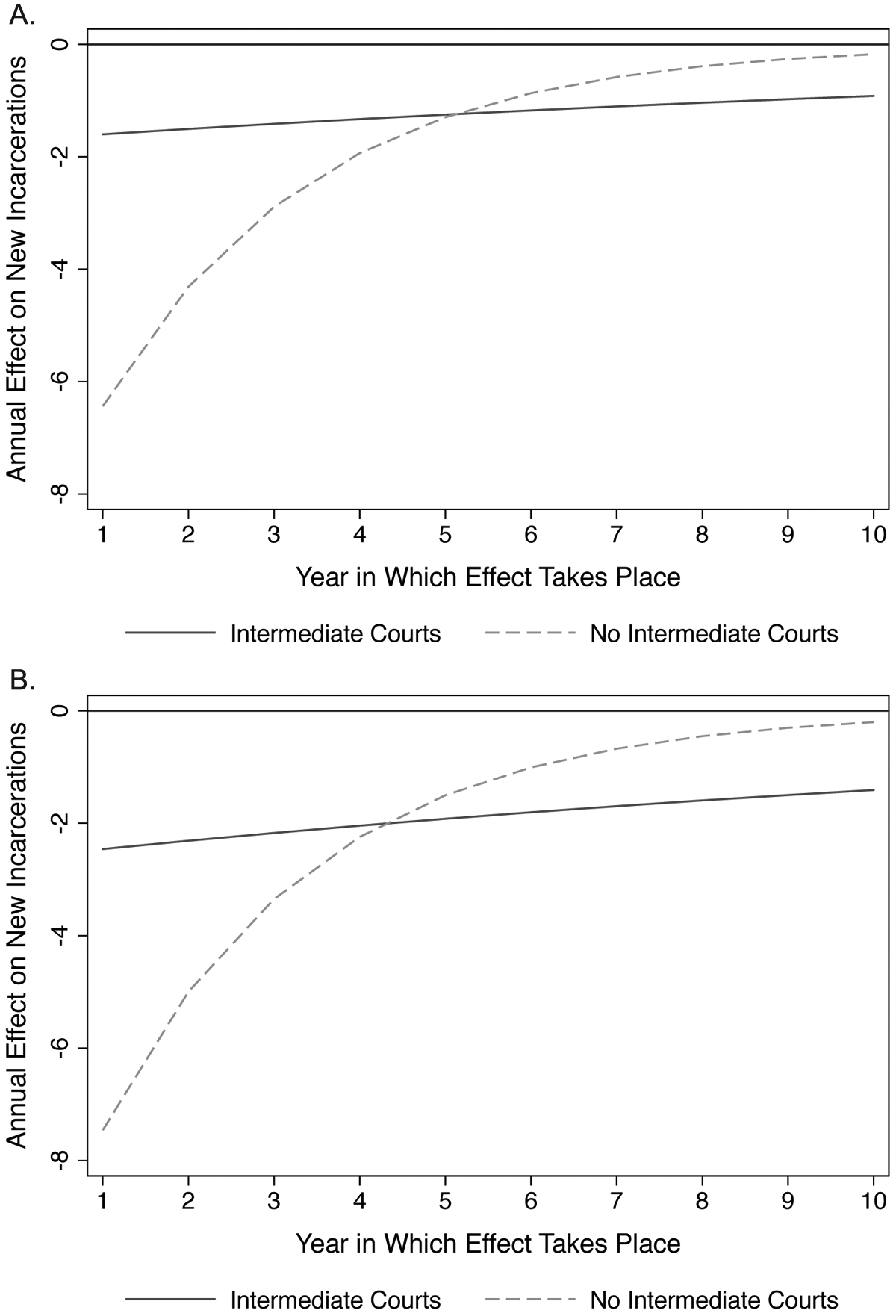
In figure 2, we plot the annual impact of the long-term effects in states with divided government to show how vastly different these processes are. The figure presents the effect of a 1 SD increase in SCOLR liberalism (fig. 2A ) and SCOTUS liberalism (fig. 2B ) in 1 year on new prison admissions in subsequent years. As the figure indicates, the long-term effects of judicial liberalism in states with intermediate courts is a drastically slower process than it is in states with thin judicial hierarchies. The initial effects of judicial ideology are actually much stronger in states that lack intermediate courts, but those effects dissipate within a few years. Therefore, we find only partial support for our third hypothesis.
Annual decay of long-term effects on incarceration in states with divided government: A, effects of 1 SD increase in SCOLAR liberalism; B, effects of 1 SD increase in SCOTUS liberalism.
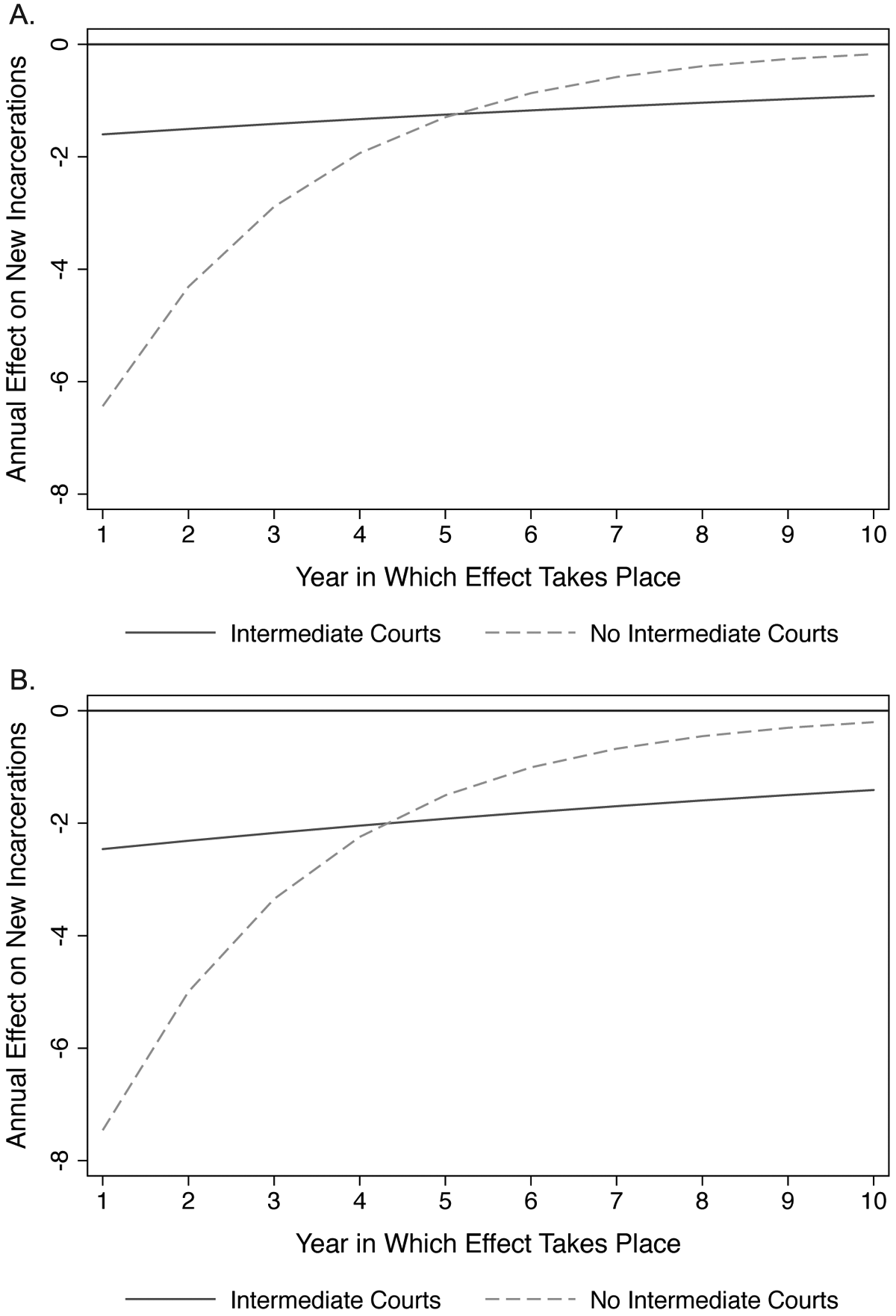
In sum, high-court judges appear to exert substantially greater influence on incarceration rates when state governments are divided, and they exert influence more quickly when they sit at the top of thin judicial hierarchies.
Conclusion
Understanding the process of judicial impact is central to the study of law, courts, and American politics. Unfortunately, identifying the factors that shape impact is a complicated empirical task. In this article, we have striven to overcome the inherent challenges of studying impact, by examining the influence of judicial institutions on the rate of new admissions to state prisons. The American states offer an ideal venue for studying impact because state political institutions are comparable across states yet vary significantly in their political climate and institutional structure. Our study provides the first systematic examination of factors that limit judicial influence on a broad and important policy outcome. Additionally, our multilevel error correction approach facilitates the analysis of dynamic, aggregate effects across contexts and over time.
Our analysis suggests that US high courts influence incarceration; however, the influence of judicial preferences varies significantly across contexts. Judicial influence is stronger when the partisan control of the state government is divided and faster when the state’s judicial hierarchy lacks intermediate courts. This finding suggests that high-court judges are more influential when other policy makers have less opportunity to affect the policy-making process. Divided government may inhibit other policy makers from overriding court decisions, sanctioning judges, and independently influencing outcomes. In thick judicial hierarchies, intermediate courts may delay the high courts’ influence by subtly altering or unintentionally misapplying high-court rulings; the more complicated hierarchical structure itself may also slow down the policy process as cases work their way through the system and different courts resolve inconsistencies and ambiguities.
Our results are consistent with recent studies of judicial impact finding that judges affect social outcomes (Keck 2009; Howard and Steigerwalt 2011; Hume 2013), judicial impact is conditional (Rosenberg 2008; Hume 2009; Hall 2011), and courts are particularly influential in the domain of criminal justice policy (Hall 2015). Accordingly, scholars interested in incarceration should consider the role of increasingly conservative judicial institutions as a driving force behind the dramatic increase in prison admissions over the last few decades. Our results are also broadly consistent with the depiction of judges as political actors that must strategically consider their political and institutional context as they attempt to alter social outcomes (e.g., Epstein and Knight 1998; Casillas et al. 2011; Segal et al. 2011).
Our findings also have important implications for understanding the nature of policy impact more broadly. When read in conjunction with other studies, our results suggest that certain factors—such as political climates and institutional structures—tend to shape impact across institutional contexts. We interpret our findings as evidence that judicial impact may share many characteristics with legislative and executive impact; indeed, it may be possible to identify characteristics of the policy impact process that transcend particular institutions. More specifically, we find that (1) divided government enhances the influence of nonlegislative policy makers, and (2) institutional thickness tends to delay the influence of actors at the top of policy-making hierarchies. Our hope is that future research will explore these basic dynamics of policy impact in other contexts.
Appendix
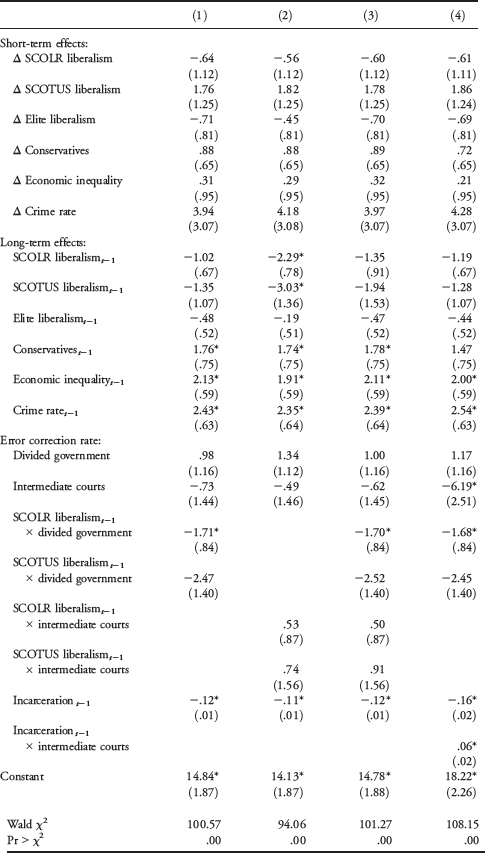
In the manuscript, we test conditional effects by disaggregating the data into four groups on the basis of the presence of divided government and intermediate courts. Here, we present models testing conditional effects with interaction terms. These models have the advantage of parsimony, but they also include restrictions on the potential relationships by assuming that most of the variables have the same effects across different types of states. In table A1 we present models with interaction terms between divided government, intermediate courts, lagged SCOLR liberalism, and lagged SCOTUS liberalism to test our hypotheses.
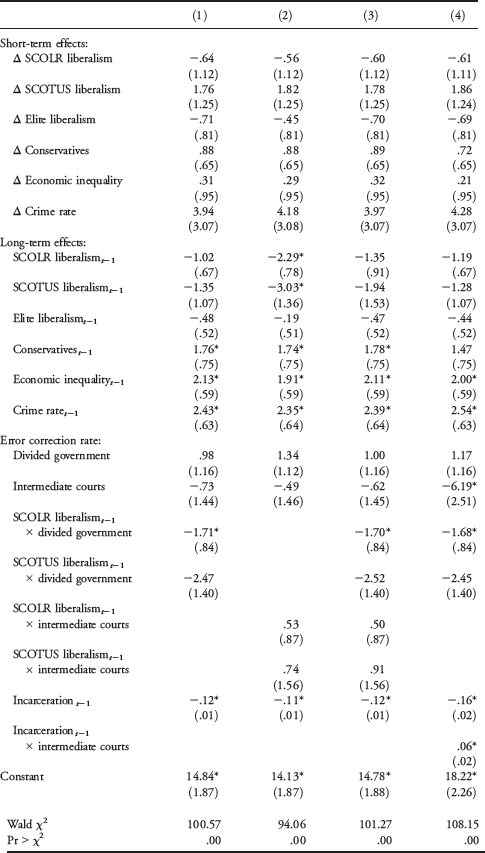
Note.—Multilevel error correction models of changes in new state incarcerations; standard errors in parentheses. N = 1,269.
* p < .05 (two-tailed test).
As shown in the table, the interaction terms confirm that judicial influence is stronger under divided government: the negative relationship between judicial liberalism and incarceration tends to be stronger in states with divided government. This effect is statistically significant for SCOLRs and nears statistical significance for SCOTUS. None of the interaction terms between judicial ideology and intermediate courts are statistically significant.
We also include a model with an interaction term between the lagged incarceration rate and intermediate courts to test our finding that the effect of judicial influence occurs more rapidly in states with thinner judicial hierarchies. The results also confirm this finding: the error correction rates tend to be larger in states that lack intermediate courts.