Introduction
Acquiring a language involves learning language-specific patterns not only in speech but also in gesture, resulting in a tightly integrated gesture-speech system in adult speakers (McNeill, Reference McNeill1992). Adult native speakers of structurally different languages differ systematically in their expression of events, particularly events involving spatial motion; and they follow language-specific patterns both in speech and in co-speech gesture (e.g., Kita & Özyürek, Reference Kita and Özyürek2003; Özçalışkan & Slobin, Reference Özçalışkan, Slobin, Greenhill, Littlefield and Tano1999), showing an effect of language on nonverbal representation of events in gesture when speaking (i.e., thinking for speaking, Slobin, Reference Slobin, Gumperz and Levinson1996). Importantly, however, speakers do not follow the language-specific patterns that they show in speech and co-speech gesture, when asked to describe events without any accompanying speech, namely in silent gesture. They instead produce silent gestures that show close cross-linguistic similarities between different languages (Özçalışkan, Lucero & Goldin-Meadow, Reference Özçalışkan, Lucero and Goldin-Meadow2015), thereby suggesting no effect of language on nonverbal representation of events in gesture beyond online production of speech.
In this study, we ask whether language has a similar effect on co-speech and silent gesturing in bilingual adult speakers who speak structurally different languages. More specifically, we focus on the gestures produced by bilingual Turkish–English speakers, namely advanced second language (L2) learners of English with Turkish as first language (L1), as they described motion scenes in speech with gesture (co-speech gesture) and only in gesture without speech (silent gesture) – a domain characterized by systematic cross-linguistic variation in its expression both in speech and in gesture. We first ask whether bilinguals show L2 patterns in co-speech gesture around the same time they show L2 patterns in speech. If acquisition of native-like gesture patterns is a by-product of acquisition of native-like speech patterns, then we would predict that bilinguals would produce co-speech gestures in L2 that resemble the co-speech gestures of English monolinguals. If, on the other hand, acquisition of native-like gesture patterns takes longer than the acquisition of native-like speech patterns, then we would predict that bilingual speakers would follow L1 co-speech gesture patterns even when speaking L2. We next ask whether the bilinguals show language-specific patterns in gesture only when gesture is accompanied by speech (i.e., co-speech gesture) or also show evidence of this pattern even when it is not accompanied by speech (i.e., silent gesture). If language has a longer lasting effect on nonverbal representation of events in gesture beyond online production of speech, then we would predict that bilinguals would show evidence of language-specific differences unique to L1 or L2 even in their silent gestures. If, on the other hand, gesture takes on language-specific patterns when only accompanied by speech, then we would predict that the silent gestures bilinguals produce would show similarities to the silent gestures produced by monolinguals speaking either English or Turkish.
Spatial motion which shows strong crosslinguistic variation but also patterned regularities in its expression in speech (Talmy, Reference Talmy and Shopen1985, Reference Talmy2000) offers a highly relevant realm within which L1 vs. L2 effects on gesture can be examined. For example, in expressing a motion event, such as a boy crawling into a house, most languages provide lexical options to refer to the figure (boy) in relation to the ground (house), to identify its path (in, out), or to describe the manner with which the figure moves (crawling, running). At the same time, languages also differ systematically in terms of the way they arrange these elements. Speakers of English – a satellite-framed language – prefer to use a conflated strategy in speech; they typically express manner and path components in a compact description with manner in the verb and path in a satellite to the verb, both expressed in a single clause (e.g., “The boy crawled into the house”). In contrast speakers of Turkish – a verb-framed language, prefer to use a separated strategy in speech with a path verb in the main clause and optional expression of manner outside the verb in another subordinate clause; e.g., “Oglan eve girdi (koşarak): The boy entered house (by running)”. Importantly, because of the additional processing load incurred by such subordinate clauses, Turkish speakers typically leave out manner, expressing only path of motion in their separated verbal descriptions (Özçalışkan & Slobin, Reference Özçalışkan, Slobin, Greenhill, Littlefield and Tano1999; Slobin, Reference Slobin, Strömqvist and Verhoeven2004, Özçalışkan, Reference Özçalışkan2005, Reference Özçalışkan, Guo, Lieven, Ervin-Tripp, Budwig, Nakamura and Özçalışkan2009).
Speakers use not only words but also gestures when describing motion; these gestures in turn show crosslinguistic differences. As shown in previous work (Kita & Özyürek, Reference Kita and Özyürek2003), in describing motion scenes English speakers typically synthesize manner and path components into a single gesture (e.g., circling hands while moving them forward as if rolling forward), while Turkish speakers produce separate gestures for manner and path – replicating the patterns found in their speech. More recent work also comparing English to Turkish (Özçalışkan et al., Reference Özçalışkan, Lucero and Goldin-Meadow2015) further suggests that the crosslinguistic differences in gesture only become evident when the gestures are accompanied by speech (i.e., co-speech gesture). That is, gestures that are produced without speech (i.e., silent gesture) do not show the language-specific patterns observed in speech and co-speech gesture, but instead show similarities across speakers of English and Turkish. Thus, monolingual English and Turkish speakers differ not only in their speech about motion, but also in the co-speech gestures that they produce while describing motion – a pattern that does not extend to gestures that are produced without speech. In this study we ask whether L2 speakers of English display the same co-speech and silent gesture patterns as their native counterparts when describing motion. Unlike speech, which is a codified system, gesture can draw upon distinctions not found in speech in both English and Turkish, offering a unique window onto speakers’ conceptualization of motion events in both L1 and L2. Here we examine the effect of language-specific differences observed in L1 vs. L2 speech on nonverbal representation of events in gesture, asking whether the effect of language-specific patterns in speech is limited to co-speech gesture, when gestures are produced online along with speech in L1 and L2, or perhaps have effects beyond online production, namely in silent gesture, when gestures are produced without speech.
Although there are now several cross-linguistic descriptions of gesture and speech production in monolingual speakers, relatively little is known about the gestures of L2 speakers. Most of the earlier work (e.g., Gullberg, Reference Gullberg1998, Hadar, Dar & Teitelman, Reference Hadar, Dar and Teitelman2001, Nicoladis, Pika, Yin & Marentette, Reference Nicoladis, Pika, Yin and Marentette2007, Sherman & Nicoladis, Reference Sherman and Nicoladis2004) focused on the amount of gesture production, asking whether bilinguals used more gestures when speaking their stronger (L1) vs. weaker language (L2) and found evidence for both possibilities (see Nicoladis, Reference Nicoladis2007 for a review). Some relatively more recent work examined patterns of gesture use during L2 production, particularly in describing events that show strong crosslinguistic variability in L1 and L2 speech (i.e., motion). Some of this work showed that L2 learners’ co-speech gestures continued to show L1 patterns even when speaking L2 (Choi & Lantolf, Reference Choi and Lantolf2008; Stam, Reference Stam2006); while other studies highlighted the importance of greater proficiency in L2 as an important factor in shifting bilingual speakers toward a more L2-like gesture pattern (Özyürek, Reference Özyürek and Skarabella2002) or even provided evidence for bidirectional influences between L1 and L2 in co-speech gesture (Brown & Gullberg, Reference Brown and Gullberg2008). There is no work that examined the silent gesture patterns in bilingual speakers.
In this study, we focus on the co-speech and silent gestures produced by Turkish–English bilinguals, comparing them to the gestures produced by monolingual English and monolingual Turkish speakers. We ask whether bilingual speakers’ co-speech gestures in L2 resemble the gestures produced by monolingual English speakers, or alternatively, continue to show L1 patterns; we also ask whether the silent gestures produced by bilinguals show no effect of language, displaying similar patterns as silent gestures produced by English and Turkish monolingual speakers.
Methods
Sample
The participants included 10 bilingual adult Turkish speakers with English as second language (Mage = 29; range = 22–44, 5 females), along with 10 monolingual English speakers (Mage = 21; range = 22–39, 5 females) and 10 monolingual Turkish speakers (Mage = 32; range = 18–43, 5 females). The sample size was based on a similar study with monolinguals (Özçalışkan, Reference Özçalışkan, Guo, Lieven, Ervin-Tripp, Budwig, Nakamura and Özçalışkan2009), which indicated that 10 subjects per group would provide a minimum of 84% power to detect reliable effects at p<.05 (η2 = 0.08; N = 10/group). The data from monolingual English speakers and bilingual Turkish–English speakers were collected in Atlanta, USA; the data from monolingual Turkish speakers were collected in Istanbul, Turkey. The bilinguals included advanced L2 learners of English, who have been educated in both English and Turkish from middle school through college; they also have been residing in the United States for four years or more, using English as their primary language. The mean age of L2 acquisition was M = 11;8 [SD = 0.84], range = 10–13. Majority of the bilingual participants (90%) rated their written and spoken English proficiency as ‘very well’ and 10% rated it as ‘quite well’ using a 5-point likert scale from ‘not at all well’ to ‘very well’. We also used a word generation task (Lezak, Reference Lezak1995; Spreen & Strauss, Reference Spreen and Strauss1998) to assess the relative levels of fluency bilinguals have in their two languages, where the speakers were asked to generate lists of words for particular categories (i.e., animal, fruit) and letters (i.e., words starting with F, A, and S) in each language, using one minute per list. The bilinguals produced significantly fewer words in L2 than in L1 in both the category-based (ML2 = 15.65 [3.45] vs. ML1 = 19.30 [2.72], Wilcoxon Z = 2.35, p = .02, r = 0.53) and letter-based word generation tasks (ML2 = 12.0 [3.25] vs. ML1 = 15.60 [2.64], Z = 2.65, p = .01, r = 0.59), thus showing greater fluency in L1 than in L2.
Procedure for data collection
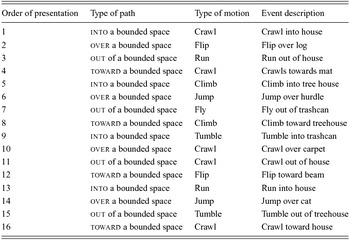
Each participant was interviewed individually. The interviews with monolingual speakers were conducted in one session by a native speaker of each language. Bilingual speakers were interviewed in two sessions: once in English by a native English speaker and once in Turkish by a native Turkish speaker. We counterbalanced the order of the two languages for the bilingual participants, with half of the participants completing the interview in English first and the other half completing the interview in Turkish first to control for the possible effect of one language on the other. At the beginning of the interview, each participant was introduced to a cartoon character named Adam, who was the moving figure in all the animations. Each participant was then presented with 16 animated motion clips with various manners and paths, one at a time, and asked to describe them in two different ways (see Fig. 1 for a sample motion event and Table 1 for a listing of all 16 motion events). In the first condition, they were asked to describe the animations using words without any explicit instruction to gesture (co-speech gesture condition; “Tell me what is happening in this clip”). In the second condition, they were asked to describe the animations using their hands without any speech (silent gesture condition; “Tell me what is happening in this clip only with your hands, without speaking”). Participants described all animations first in the co-speech gesture condition and then in the silent gesture condition to avoid influencing naturalness of participants’ co-speech gestures; the silent gesture condition was administered only once to each monolingual and bilingual speaker. That is, 5 of the bilingual participants who completed the tasks first in English and then in Turkish did the silent gesture task after the elicitation in Turkish and the remaining 5 bilingual participants who completed the tasks first in Turkish and then in English did the silent gesture task after the elicitation in English to control for possible effect of order of instruction on silent gesture patterns. There was minimal verbal instruction in the silent gesture condition except for the initial instruction (“Tell me what is happening in this clip only with your hands, without speaking”). We kept the presentation order of the animations the same across participants and conditions to prevent possible confounding effect of order of presentation on participants’ responses.
List of motion event types in order of presentation

Snapshot of a sample motion animation: crawling into a house

Procedure for data coding and analysis
All speech produced in the co-speech gesture condition was transcribed and segmented into sentence-units. Each sentence-unit contained at least one motion verb and associated arguments (e.g., “He crawls into the house”, “Eve girdi (sürünerek): He entered the house by (crawling)”, “He is crawling”).Footnote 1 We also coded all gestures that accompanied each sentence unit in the co-speech gesture condition and that were produced on their own in the silent gesture condition. Gesture was defined as a communicative hand movement that had an identifiable beginning and an end. In this study, we focused only on iconic gestures, which convey meaning by their “iconic” resemblance to the different aspects of the motion they depict (McNeill, Reference McNeill1992; e.g., circling hands next to body as if running, wiggling fingers left to right to convey ‘running towards’); iconic gestures also constituted the predominant gesture type produced by the participants.Footnote 2 We further coded each sentence-unit and each gesture for the type of motion element: conflated (manner and path were both conveyed within a single spoken clause or within a single gesture) or separated (manner and path were conveyed in separate spoken clauses or in separate gestures). A sentence-unit was classified as separated if it contained manner-only (e.g., “he is crawling”), path-only (e.g., “he is entering the house”), or manner and path, each conveyed in a separate clause (e.g., “he enters the house by crawling”). A gesture was classified as separated if it contained manner-only (e.g., wiggling fingers in place as if crawling) or path-only (e.g., moving index finger left to right to convey left to right motion trajectory). A sentence-unit or gesture was classified conflated if it synthesized manner and path into a single clause (e.g., “he crawled into the house”) or a single gesture (e.g., wiggling fingers left to right to convey crawling left to right).
We computed the total number of separated vs. conflated motion expressions each speaker produced in speech, co-speech gesture and silent gesture in each language. We analyzed differences between the two monolingual groups (monolingual English vs. monolingual Turkish) and each monolingual group and the bilingual group (monolingual English or monolingual Turkish vs. bilingual using L1 or bilingual using L2) separately in speech, co-speech gesture and silent gesture with Kruskal-Wallis (χ2) tests, with group as a between-subjects factor. We analyzed differences within the bilingual group (elicitations in L1, elicitations in L2) separately in speech, co-speech gesture and silent gesture with Wilcoxon signed rank tests (Z), with elicitation language as a within-subject factor. We examined differences in patterns of speech and gesture production using non-parametric tests due to the violation of the normality assumption in the distribution of the data. Reliability for gesture was assessed with trained coders: one coder, blind to the hypotheses of the study, coded the entire corpus and a second coder independently coded a subset of the data; agreement between coders was 88% for identifying gestures and 95% for coding motion elements in gesture.
Results
Frequency of speech and gesture production
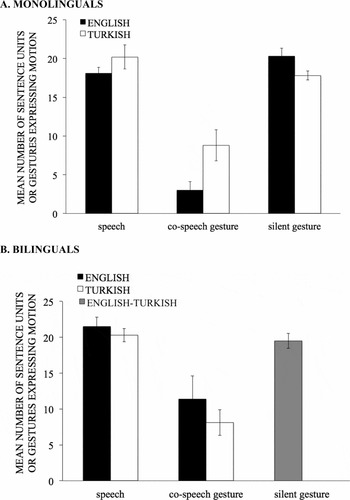
We first examined overall frequency of speech and gesture production in monolingual English, monolingual Turkish and bilingual speakers describing the scenes in English and Turkish. Beginning with monolinguals, we found no difference between English and Turkish in the number of sentence-units conveying motion (χ2(1) = 1.72, p = .19), but a reliable difference in the number of co-speech gestures (χ2(1) = 4.86, p = .03, r = 0.49) and a marginal difference in the number of silent gestures (χ2(1) = 4.0, p = .05, r = 0.45) conveying motion (see Fig. 2A). Turning next to bilinguals, we also found no difference in the number of sentence-units produced in English and in Turkish (Z(1) = −1.55, p = .12) and no difference in the number of co-speech gestures produced in English and in Turkish (Z(1) = −1.07, p = .28; see Figure 2B).
Mean number of sentences and gestures conveying motion produced by monolingual speakers of English and Turkish (panel A) and by bilingual speakers in English and in Turkish (panel B). Error bars represent standard error; bilinguals produced silent gesture condition only once after they completed the co-speech gesture condition in both languages

Turning last to the amount of gesture and speech production in bilinguals compared to monolinguals, we found that bilinguals produced significantly more sentence-units (χ2(1) = 4.05, p = .04, r = 0.45) and more co-speech gestures (χ2(1) = 5.55, p = .02, r = 0.53) conveying motion than English monolinguals when they described the scenes in English, but were comparable to Turkish monolinguals in both speech (χ2(1) = .53 p = .47) and co-speech gesture (χ2(1) = .12, p = .73) production when they described the scenes in Turkish. The bilinguals did not differ from the monolinguals of either language in their silent gesture production (χ2(2) = 3.58, p = .167; see Figure 2A vs. 2B).
Speaking about motion
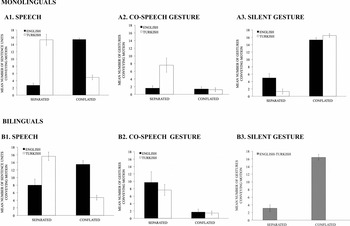
We first looked at the arrangement of motion elements expressed in speech, and found cross-linguistic differences. Beginning with monolinguals, we found that English monolinguals produced significantly more conflated motion descriptions than Turkish monolinguals (χ2(1) = 14.53, p<.001, r = 0.85). Conversely, Turkish monolinguals produced more separated motion descriptions than English monolinguals (χ2(1) = 14.95, p<.001, r = 0.86; see Fig. 3: A1). The cross-linguistic patterns also characterized individual speakers: all 10 English monolinguals produced more conflated than separated descriptions and all 10 Turkish monolinguals produced more separated than conflated descriptions.
Turning next to bilinguals, we found similar language-specific patterns. Bilingual speakers produced significantly more conflated motion descriptions when they described the scenes in English than when they did so in Turkish (Wilcoxon Z = −2.81, p = .005, r = 0.63). The opposite was true for separated motion descriptions: bilinguals produced significantly more separated motion descriptions when they described the scenes in Turkish than when they did so in English (Z = −2.81, p = .005, r = 0.63; see Fig. 3: B1). The individual speakers showed the same pattern: when describing the scenes in English, greater number of bilinguals (8/10) produced more conflated than separated speech; conversely, when describing the scenes in Turkish greater number of bilinguals produced more separated than conflated speech (9/10).
Turning last to the patterns of speech in bilinguals compared to monolinguals, we also found evidence of language-specific differences. In describing the scenes in English, bilinguals produced significantly more conflated descriptions than Turkish monolinguals (χ2(1) = 12.77, p<.001, r = 0.80), but not English monolinguals (χ2(1) = 2.54, p = .11). Bilinguals also produced significantly fewer separated descriptions in English compared to Turkish monolinguals (χ2(1) = 6.48, p = .01, r = 0.57; see Figures 3A1 vs. 3B1). Conversely, in describing the scenes in Turkish, bilinguals differed from English monolingual speakers, producing significantly fewer conflated (χ2 (1) = 14.62, p<.001, r = 0.85) but more separated descriptions (χ2(1) = 14.95, p<.001, r = 0.86) than English monolinguals. They did not differ from Turkish monolinguals however, producing comparable amounts of separated (χ2(1) = .47, p = .49) and conflated descriptions (χ2(1) = .72, p = .40) in speech.
Mean number of sentences and gestures using separated or conflated strategies in speech (A1,B1), co-speech gesture (A2,B2) and silent gesture (A3,B3) produced by monolingual speakers of English and Turkish (A1-A3) and bilingual speakers in English and in Turkish (B1-B3). Error bars represent standard error; bilinguals produced silent gesture condition only once after they completed the co-speech gesture condition in both languages.

In summary, monolinguals differed in their speech about motion – with English monolinguals producing more conflated and Turkish monolinguals producing more separated descriptions. Bilinguals followed the same speech pattern as monolinguals, using more conflated descriptions in English and more separated descriptions in Turkish.
Gesturing about motion when speaking
We next looked at the arrangement of motion elements expressed in co-speech gesture, and found cross-linguistic differences between English and Turkish monolinguals, but not between bilingual speakers when they described the scenes in English versus in Turkish. Beginning with monolinguals, we found that English monolinguals produced significantly fewer separated co-speech gestures than Turkish monolinguals (χ2(1) = 7.61, p = .006, r = 0.62), even though the groups did not differ in their use of conflated co-speech gestures (χ2(1) = 0.10, p = .75; see Fig. 3: A2). The patterns remained the same for individual speakers: 8 of the 10 Turkish monolinguals produced more separated than conflated co-speech gestures; in contrast, 4 English monolinguals produced comparable numbers of separated and conflated co-speech gestures, 4 did not produce gestures conveying motion, and of the two remaining English monolinguals, one produced more conflated and the other produced more separated co-speech gestures.
Turning next to bilinguals, we found lack of a cross-linguistic difference in co-speech gesture. Bilinguals did not differ in their production of either conflated (Z = −.11, p = .91) or separated co-speech gestures (Z = −.97, p = .33) when describing the scenes in each of the two languages; Fig. 3: B2). The cross-linguistic patterns also characterized individual speakers: greater number of bilinguals produced more separated than conflated co-speech gestures when describing the scenes in English (10/10) or in Turkish (9/10).
Turning last to the patterns of co-speech gesture in bilinguals compared to monolinguals, we did not find any evidence of language-specific differences. Bilinguals describing the scene in English produced comparable amounts of conflated gestures as English monolinguals (χ2 (1) = 0.08, p = .78) and as Turkish monolinguals (χ2(1) = 0.007, p = .93). The bilinguals differed however from monolinguals in their use of separated gestures: overall bilingual speakers describing scenes in English produced significantly more separated gestures than English monolinguals (χ2(1) = 7.17, p = .007, r = 0.60), but bilingual speakers describing scenes in Turkish were comparable to Turkish monolinguals in their production of separated gestures (χ2(1) = 0.05, p = .82; see Figures 3A2 vs. 3B2).
In summary, monolingual speakers showed differences in co-speech gesture – with Turkish monolinguals producing more separated gestures than English monolinguals. In contrast, bilinguals did not follow the patterns of the accompanying language in their co-speech gestures; instead they showed L1 pattern (i.e., used more separated gestures) in their co-speech gestures when describing the scenes in English or in Turkish.
Gesturing about motion when not speaking
We last looked at the arrangement of motion elements expressed in silent gesture, and found evidence of cross-linguistic similarities in the monolinguals’ and the bilinguals’ expression of motion scenes in gesture. Beginning with monolinguals, we found that both English and Turkish monolinguals produced predominantly conflated silent gestures and at comparable frequencies (χ2(1) = 1.61 p = .21). The two groups differed slightly in their production of separated gestures (M = 5 vs. M = 1.3; χ2(1) = 5.5, p = .02, r = 0.53; Fig. 3: A3).
Next turning to bilinguals Footnote 3 and comparing them to monolinguals of each language, we found similar patterns in silent gesture across the three groups: bilinguals produced predominantly conflated silent gestures, also at comparable amounts as monolingual speakers of English (χ2(1) = 0.72, p = .40) and Turkish (χ2(1) = 0.18, p = .67). Bilinguals were also comparable to both English monolinguals (χ2(1) = 1.2, p = .28) and Turkish monolinguals (χ2(1) = 3.54, p = .06; Fig. 3: B3) in their production of separated gestures. The cross-linguistic patterns also characterized individual speakers: all speakers, including 10 English monolinguals, 10 Turkish monolinguals, and 10 Turkish–English bilinguals produced more conflated than separated gestures in the silent gesture condition.
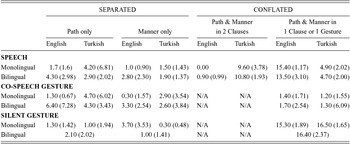
In summary, both monolinguals and bilinguals produced predominantly conflated silent gestures, showing no effect of language. Even though English monolinguals also produced significantly more separated gestures in the silent gesture condition than Turkish monolinguals, this was not a language-specific pattern observed in their speech about motion, further suggesting that silent gesture patterns are largely independent of the language one speaks (see Table 2 in Appendix for a distribution of types of separated responses in speech, co-speech gesture and silent gesture).
Conclusions
Gestures constitute part of what learners acquire in a new language and show variability across different languages. But when does gesture show the patterns of the language one speaks in second language learning contexts? We explored this question by studying the speech and gestures produced by 10 adult advanced second language learners of English (Turkish as L1) in comparison to 10 adult monolingual English and 10 adult monolingual Turkish speakers as they described motion scenes first in speech with gesture (co-speech gesture) and then in gesture without speech (silent gesture). We found strong crosslinguistic differences in monolingual and bilingual speakers’ speech and co-speech gesture, but close crosslinguistic similarities in their silent gestures. We also found that bilingual speakers continued to show L1 patterns in co-speech gesture both in amount and arrangement (i.e., more separated gestures), while describing the motion scenes in L2 – even if they showed strong L2 patterns in speech (i.e., more conflated speech). Overall, our findings suggest that acquisition of native-like gesture patterns is not a by product of acquisition of native-like speech patterns in second language learning contexts, and gestures follow language-specific patterns only when accompanied by speech.
Why do speakers show language-specific patterns in co-speech gesture but not in silent gesture? The thinking-for-speaking hypothesis (Slobin, Reference Slobin, Gumperz and Levinson1996) postulates that language influences nonverbal representation of a domain only when speaking – a possible explanation for the patterns of co-speech gesture we observed in monolinguals. Importantly, the bilingual speakers in our study deviated from this pattern in L2; they used L1 co-speech gesture patterns in describing events not only in Turkish but also in English. This might suggest that language-specific representations for L1 might have longer lasting effects on nonverbal representation of events than postulated by the thinking-for-speaking hypothesis, revealing itself in gesture even when one is speaking another language. Previous research also suggests an early preference for separated co-speech gestures in first language acquisition contexts for children learning English or Turkish (Özyürek, Kita, Allen, Brown, Furman & Ishizuka, Reference Özyürek, Kita, Allen, Brown, Furman and Ishizuka2008, but see Özçalışkan, Gentner & Goldin-Meadow, Reference Özçalışkan, Gentner and Goldin-Meadow2014 for an alternative view) – a preference that might also be true for the acquisition of co-speech gestures in second language-learning contexts, as shown in our study. All our bilingual participants were late learners of English and were more fluent in Turkish than in English. As such, their use of L1 gesture patterns in L2 production might be reflective of this early preference towards more separated co-speech gestures in language learning.
Our results also showed that all speakers – monolingual and bilingual – did not rely on the language-specific patterns when asked to describe events without speaking, in silent gesture, providing additional evidence for the thinking-for-speaking hypothesis. Instead, they used predominantly conflated gestures, further suggesting the possibility of a natural semantic arrangement speakers – both bilingual and monolingual – impose on motion events that cuts across structurally different languages when conveying events nonverbally in gesture without speech.
Appendix
Mean number separated and conflated descriptions produced in speech and in gesture by each group. Standard deviations are indicated in parentheses; bilinguals produced silent gesture condition only once at the end of the study