The rescinding of the monopoly held by the East India Company (EIC) on trade between Britain and India in 1813 opened new prospects for British trading firms. Subsequently, the value of the Anglo-Indian trade grew extensively and the range of products imported and exported became progressively more varied, enabling increased opportunities for specialization and integration. In the years after 1840, tea gradually became one of the leading Indian export products. Firms undertaking the production and marketing of tea used a range of ownership and organizational forms, including the partnership, joint-stock, and hybrid models. The selection of ownership form became a major choice for entrepreneurs in the mid-nineteenth century after significant changes in company legislation lowered the costs of incorporation.Footnote 1 Entrepreneurs had to weigh the pros and cons of the partnership and joint-stock forms.
The most notable trend regarding the choice of ownership in this period was the widespread adoption of a hybrid form known as managing agents. Organized as partnerships, through a range of governance mechanisms, the managing agents controlled a portfolio of joint-stock firms. This allowed small numbers of partners to channel investment into a range of industries through the joint-stock firms, reducing their risk and exposure to capital-intensive investments, but retaining close control over the firms. Through this model, the managing agents came to dominate the ownership and organization of Indian industry toward the end of the nineteenth century.Footnote 2 The question of why the managing agents succeeded and the joint-stock form as a stand-alone entity failed in India has been widely debated.
Various hypotheses have been advanced to explain the emergence and proliferation of the form. Lokanathan pointed to their capacity to provide managerial expertise, as well as capital and credit, to other firms—resources that remained scarce in nineteenth-century India. Many of the early managing agents were British-owned trading firms that could access such resources and channel them effectively through their networks of trading partners and financiers in Britain and Europe.Footnote 3 This enabled various undercapitalized industries, such as tea and jute, to become established.
Chapman claimed that the firms “in reality ... were not agents at all but private partnerships that contrived to control public companies.”Footnote 4 He called the firms “investment groups,” and termed this arrangement a “legal fiction of agency” through which no real agency activity was undertaken, with the managing agent contract a device to control investments. The model proved so successful that by the end of the nineteenth century the managing agents retained the partnership form, ensuring that control over decision making and profits was limited to a restricted, often family-related, group of partners.Footnote 5 Rungta believed that this process inhibited the growth of the joint-stock corporation in India and, rather than enabling a manufacturing sector to grow, the firms did nothing more than invest the smallest amounts they could to generate excess profits for the British partners.Footnote 6 Chapman agreed, noting that control of the networks in Britain and India allowed the managing agents to manipulate the flow of key resources, constraining access for new entrants. In particular, he found that this restricted the development of joint-stock firms in the tea sector.Footnote 7
This rather negative perception of the managing agents has been challenged by Jones and Wale.Footnote 8 They contend that because of the partnership form and certain organizational structures, the managing agents were well equipped to succeed in volatile colonial markets, as their flexible network structure, described as a “business group,” reduced transaction costs.Footnote 9 This flexibility allowed the firms to take advantage of the widening opportunities throughout Asia brought about by the revolution in transportation and communication, caused by the opening of the Suez Canal and telegraph between London and Calcutta in 1870, accounting for their persistence into the twentieth century.
The importance of the partnership form and network structure used by the managing agents offers an interesting perspective by which to re-examine the rationale for the increasing adoption of the form. This article focuses on the use of the different forms of ownership in the Indian tea industry, from its emergence in the 1840s and through the period of rapid expansion in the late 1850s and 1860s. The benefits of capital formation and longevity of investment in the joint-stock form is contrasted with the increasing agency costs brought on by the physical and metaphysical separation of owners and managers, to propose an alternative reading for the emergence of the managing agent firms and the relative underutilization of the joint-stock form.Footnote 10
These findings contribute to a post-Chandlerian discourse that has sought to highlight the importance of different business forms in enabling economic development in a range of conditions. Authors including Guinnane, Hannah, and Hilt have shown the historical limitation of the joint-stock form in certain industries, while showing how business forms such as cooperatives and partnerships resolved problems more effectively than the joint-stock form.Footnote 11 This literature calls for a more nuanced approach to understanding the trade-offs between organizational and ownership forms, rejecting the view that business forms other than large integrated firms organized as corporations were poor substitutes either waiting to be replaced or retardants of economic growth.
This article considers the question posed by Lamoreaux et al., who asked: Why, when the joint-stock form was easily available, did entrepreneurs make a terrible mistake in choosing another form?12 The question is approached by identifying the ownership forms adopted by entrepreneurs in the Anglo-Indian tea trade and evaluating these decisions in relation to changes in the economic environment, to reveal how their decisions were shaped by developments in both the scale and the structure of the trade. The choices made by the entrepreneur are analyzed through the problems they attempted to solve by means of an evolving choice of ownership and organizational forms.
The first part of the article identifies the broad trends in the Anglo-Indian trade environment between 1840 and 1870, highlighting changes in the scale of the trade and the growth of the tea industry. These trends are related to an analysis of the number and types of firms involved in trade activities in this period. This is drawn from new data taken from a sample of nineteenth-century commercial registers in Calcutta and Bengal. The commercial registers were published every year and listed all the firms active in Bengal. The registers became more comprehensive over time, adding details such as the names of partners and assistants for the trading firms, and share issues and nominal capital for the joint-stock firms.Footnote 13 Fifteen benchmark years, starting in 1813 and ending in 1868, were selected. These data show the extent and timing of the adoption of the different forms of ownership.
The second part of the article investigates the rationale for these choices, by examining the decisions of entrepreneurs in the emerging tea sector in India, using detailed case studies of the Assam Company and Gillanders, Arbuthnot and Co. The cases are selected as representative cases of joint-stock and managing agent firms, but it is important to note that Gillanders, Arbuthnot and Co. did not act as an agent for the Assam Company.Footnote 14 The usual caveats about representativeness apply to both cases; in particular, there are issues of survivor bias, as both firms were large and successful relative to the rest of the firm population and survived well into the twentieth century. The Assam Company had the largest paid-up capital of all Indian tea firms during this period, although it was supplanted later in the century. Gillanders, Arbuthnot and Co. was agent to numerous firms, including two of the largest British tea firms in the late nineteenth century. However, both firms conducted activities and were organized in a similar fashion to others of their type. The discrete setting of the tea sector and economy of Bengal constrain the generalizability of these findings.
The article concludes that the entrepreneurs adapted and adopted ownership and organizational forms to overcome a variety of problems, both external and internal to the firm. This analysis reinterprets the role of the managing agents in the tea trade, proposing that rather than being a legal fiction, the managing agents did provide services to lower the inherently larger agency costs incurred by joint-stock firms. In turn, the article reconsiders the role of managing agents in the wider development of the Anglo-Indian trade and other colonial markets, particularly in the period prior to 1870. These findings question the traditional dichotomy of choice for entrepreneurs between the joint-stock and partnership forms. They show that a richer ecology of firm types evolved in the mid-nineteenth century, one in which boundaries of ownership were adapted by innovative owners, enabling them to leverage the capabilities of both forms. This improves our understanding of the rationale by which entrepreneurs choose, and the mechanisms through which change in ownership and organizational structures occurred.
The Growth of the Anglo-Indian Trade Between 1840 and 1870
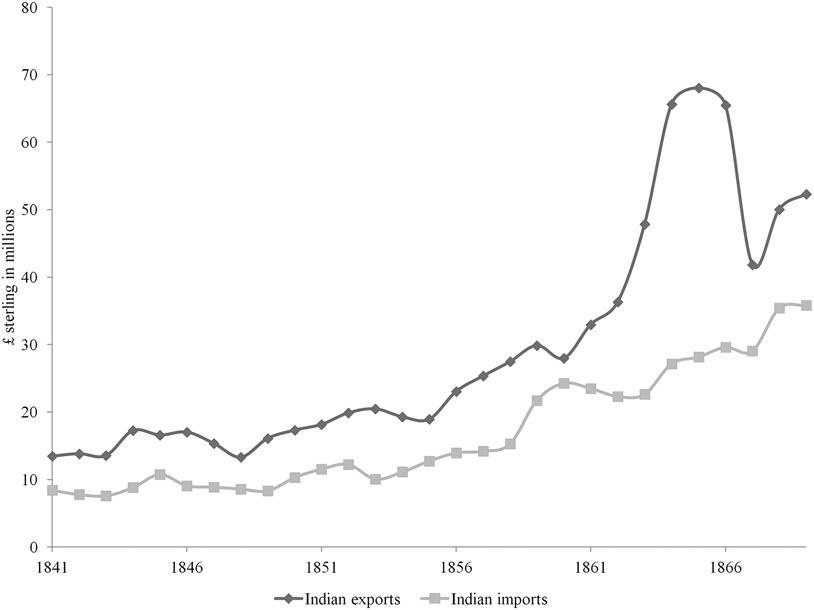
The Anglo-Indian trade underwent a number of significant changes in both scale and composition in the mid-nineteenth century. The general trend was one of growth in both the volume and value of imports and exports. Figure 1 shows that the value of imports had tripled between 1840 and 1870, whereas exports nearly quadrupled. The growth was not unrestricted, and periods of volatility were common.Footnote 15 The market for products such as indigo was highly volatile, experiencing dramatic booms and busts.Footnote 16
Value of Indian exports and imports from 1841 to 1869.
Sources: Digital South Asia Library (DSAL) statistics section, Nos. 27 and 31 (1840–1865) and No. 18 and 24 (1860–1869).

The general upward trend in the level of trade saw Anglo-Indian imports and exports become an increasingly large proportion of Britain’s total trade balance. Between 1825 and 1860 Asia and the Near East rose from 11.6 percent to 25.7 percent of all British exports. Asia similarly accounted for 23.2 percent of British imports in 1860.Footnote 17 The composition of both the imports and exports changed somewhat in this period. British exports of textiles, piece goods, and manufactured goods grew, and exports of metals expanded steadily after 1840.Footnote 18 In the case of Indian exports to Britain, the major products in terms of value included raw cotton, indigo, sugar, and silk.
After 1813, indigo had been the main export crop, as increasing European demand and opportunities for profit made it a staple trade product for nearly all the trading houses. However, by the 1850s, the demand for indigo flattened, leading to thinner profit margins. Other products, including raw cotton, jute, and tea, emerged in the 1840s and 1850s as highly profitable opportunities. Tea was first cultivated in India for mass production in 1840. The level of production and value of the trade was slow to increase, but by 1869, the value of exported tea was worth nearly £1 million and approached 2 percent of the total value of Indian exports.Footnote 19 This was the beginning of a remarkable period of growth in the Indian tea industry that would see it rise to become the world’s biggest exporter of tea by the end of the nineteenth century. Just as indigo had been one of the staple exports for trading houses in the first half of the nineteenth century, so became tea in the second half.
Anglo-Indian Trading Firms
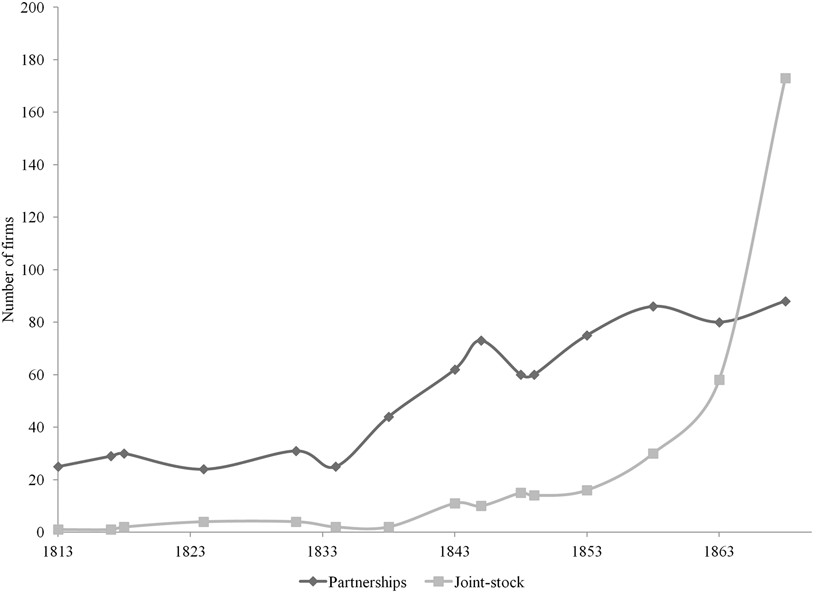
The firms conducting this trade also underwent a number of significant changes. The period from 1813 to 1840, as shown in Figure 2, was dominated by partnerships. In the years leading up to 1813, a number of agency houses were established in Calcutta.Footnote 20 They combined a wide range of banking and commercial interests: taking deposits and advancing credit, providing insurance, and trading on commission.Footnote 21 Trade was predominantly in Indian export products, such as indigo, purchased through auctions in Calcutta. All the agency houses were organized as partnerships.
The number of trading firms and joint-stock firms in Calcutta, 1813–1868.
Sources: Fifteen benchmark years of the merchant and company lists in Calcutta and Bengal commercial registers published between 1813 and 1868 in the British Library (BL).
Through their role in advancing credit, many of the trading firms in Calcutta began to integrate more fully into manufacturing. The failure to repay debts resulted in the trading houses seizing factories used as collateral on the loans, and subsequently managing them directly.Footnote 22 Some of the firms went further with this integration. Gisborne and Co, a trading firm established in Calcutta in 1830, founded a private company, the Tirhoot Company, with multiple shareholders, to set up and run indigo factories.Footnote 23 This process was not confined to indigo; growth in the markets for cotton and jute also encouraged investment and integration in production. The role of many trading firms in Calcutta expanded well beyond the normally ascribed commission trade activities.Footnote 24 However, as the capital requirements for investment in production facilities increased, investors—often within or linked to the trading firms—began to look at forms of ownership beyond the traditional partnership form to undertake these activities.
As shown in Figure 2, before 1840 the use of the joint-stock form was virtually nonexistent, with only a handful of local joint-stock banks established by charter from the EIC government. Subsequently, a number of firms incorporated in transport, infrastructure, and manufacturing. After various legislative changes in Britain and India significantly lowered the costs of incorporation between 1844 and 1857, the number of Calcutta registered joint-stock firms rose rapidly, from 30 in 1858 to 173 in 1868.Footnote 25
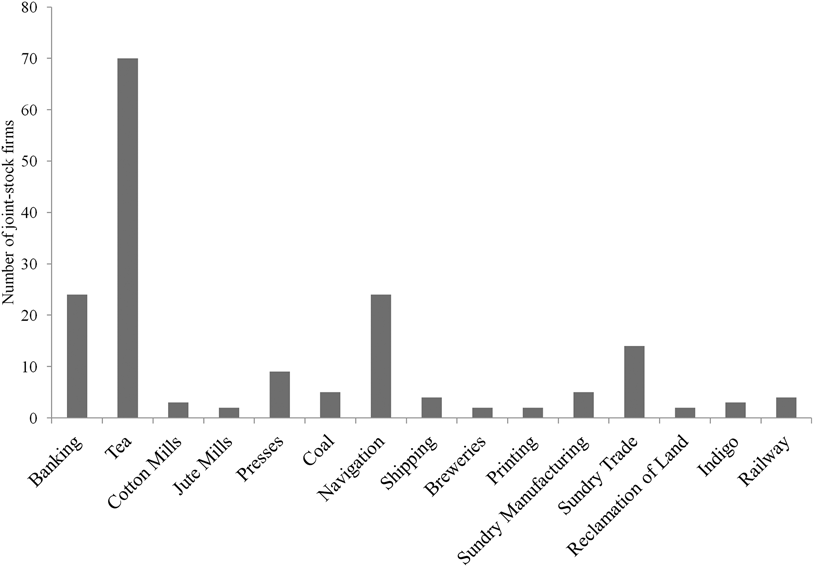
Incorporated firms proliferated in four sectors, as shown in Figure 3. In 1868, these were banking, tea, navigation, and presses.Footnote 26 Mechanized presses were used in the manufacture of cotton and jute and, in conjunction with the mills, represented an emerging light-industrial manufacturing sector. Navigation accounted for firms involved in both international and regional shipping and transportation, as well as infrastructure related to these activities, such as docks and warehouses. The banks included both the government-supported Banks of Bengal and Bombay alongside an increasing number of private banks. The form proliferated most rapidly in the expanding tea sector, which accounted for 40 percent of all the joint-stock firms in 1868. These joint-stock firms incorporated in both London and Calcutta.Footnote 27
The number of joint-stock firms in Calcutta by sector in 1868.
Sources: Thackers Commercial Directory for Bengal, 1868 (BL).
The activities in these four sectors had been undertaken predominantly by the trading firms organized as partnerships in the earlier period. However, the expansion in the scale of trade, opportunities for investment in profitable new sectors such as tea, and increasing capital requirements to finance operations had encouraged entrepreneurs to expand on experiments such as the Tirhoot Indigo Company and launch joint-stock ventures.
As the number of joint-stock firms increased in the late 1860s, a major change to the organization and ownership of many of these firms occurred, as an increasing number of joint-stock firms contracted managing agencies to manage their operations. The managing agency firms in this period emerged from trading firms or partners linked to them, which had developed expertise in certain sectors. Nearly all, certainly prior to 1870, were organized as partnerships.Footnote 28 They performed two main functions: providing management capabilities to other firms, and promoting joint-stock enterprises in both Britain and India.
The relationship between the agents and the represented firm was defined by a contract that laid out the activities undertaken by the agents, enabled by the granting of powers of attorney. These arrangements were often signed for a minimum of ten years, which allowed the agents to exert extensive control over the day-to-day and strategic management of the firm. The agent received an annual fee, and often a variety of commission payments on different outputs.Footnote 29 The agents that promoted ventures to attract British or Indian capital would also take a small minority share holding, but would exert control predominantly through the contract.
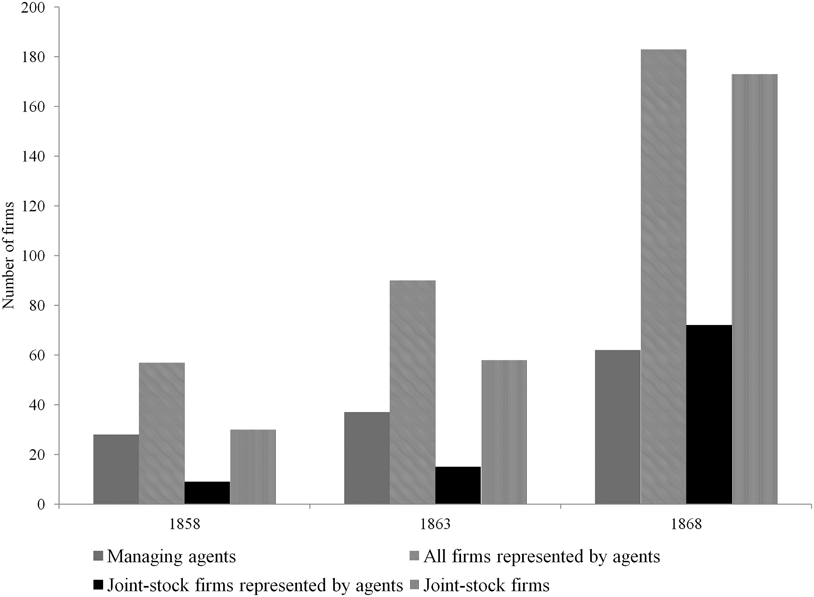
The number of firms providing these agency services, shown in Figure 4, increased in the decade from 1858 to 1868. The number of firms using agency services also rose dramatically, trebling in this period. The managing agencies were particularly prominent in insurance, shipping and transportation, manufacturing, and tea. It was noticeable that by 1868, 42 percent of registered joint-stock firms had appointed agents; indeed, forty-six of the seventy tea firms were listed as having a managing agent.
The number of managing agencies and the firms they represented, 1858–1868.
Sources: The New Calcutta Directory, 1858, 1863, and Thackers Directory, 1868 (BL).

The distinction between joint-stock tea firms that incorporated and turned to agents for services and those that were originated and promoted by the managing agents is difficult to specify precisely. Many of the joint-stock tea firms incorporated in the late 1850s and 1860s, such as the Assam Company and Jorehaut Company, appointed agents after incorporation. However, an increasing number were first listed in the registers alongside an agent.Footnote 30 This suggests that the structure of the relationship between the firms evolved. Certainly by the end of the nineteenth century all the leading joint-stock tea companies operating in India but listed in Britain had managing agents.Footnote 31 Why, despite having adopted a supposedly superior form of organization, did the owners of so many joint-stock firms give up extensive levels of control and decision-making capacity, and actually pay for this arrangement?
The Growth of the Tea Industry in India
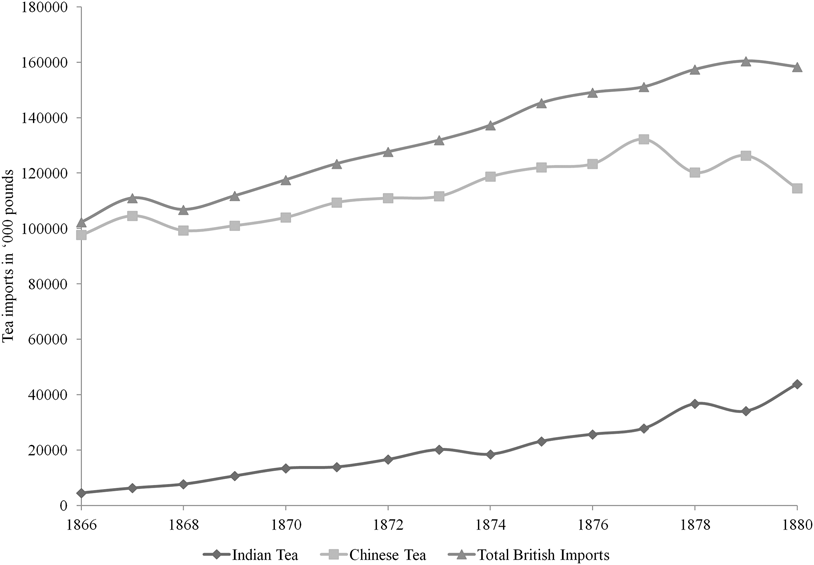
The use of managing agents in Bengal was most pronounced in the tea sector, which had expanded rapidly in the 1850s and 1860s, attracting significant investment. The demand for tea in Britain had grown rapidly over the nineteenth century. Per-capita tea consumption had risen from 1.36 pounds in 1813 to 3.76 pounds in 1870. In comparison, in the same period, demand for coffee grew from 0.70 pounds to 0.87 pounds per capita.Footnote 32 This made Britain the world’s largest consumer of tea, although demand was increasing throughout Europe, the United States, and other world markets.Footnote 33 The tea sector in India was actively promoted by the British and colonial Indian governments in an effort to break the monopoly held by China on commercial tea production. Figure 5 shows the total UK imports of tea in the late nineteenth century, and the amounts supplied by China and India. China had fulfilled almost all of this demand until the 1860s, when tea produced in India became a larger component of British imports. Indeed, from 1866 to 1883, India went from supplying less than 5 percent of the UK’s total imports of tea to 34 percent.Footnote 34
Total British imports of tea with Chinese and Indian shares, 1866–1880.
Source: Griffiths, The History of the Indian Tea Industry, 125.

The tea industry in India had been slow to take off. The first tea exported from Calcutta to London was in 1838, but from 1849 to 1859 the value of exports had increased only from £27,263 to £60,533 annually.Footnote 35 The slow growth in output between 1840 and 1853 gave way to solid expansion from 1854 to 1865 and a dramatic takeoff in the years after 1866. In 1866, more than 6 million pounds were produced, but in only nine more years this had grown to more than 20 million pounds.Footnote 36 The increasing level of demand meant that virtually all the increase in production could be absorbed by the expanding British market, while prices remained on a slow upward trend.Footnote 37
This opportunity attracted capital from British and Indian investors; between 1851 and 1865, fifty-three joint-stock tea firms were incorporated.Footnote 38 Several legislative changes also encouraged the rapid expansion in investment. First, the settlement of 1858 and the formal transference of ruling powers from the EIC to the crown provided greater stability for investors. Second, legislation specific to Assam was also amended in 1854, as the laws governing access to land were amended, with leases offered on highly favorable terms.Footnote 39 These rules encouraged speculative behavior because of the low rent burden and long length of leases. Many speculators sought to obtain land and simply resell it as potential areas for tea production. Indeed, during the early 1860s, a tea boom was recorded in Bengal, with new public and private firms flooding into the market.Footnote 40 Although a crash in 1865 saw numerous failures and consolidation, the Bengal registry for 1868 listed seventy joint-stock tea firms.Footnote 41
The Structure of the Tea Industry in India
The EIC had experimented with the cultivation of tea in the late 1830s in a number of locations in India, but owing to the preponderance of naturally growing tea trees in Assam, tea gardens were established there. These gardens were developed with the avowed intent of passing them on to private ownership, if tea cultivation on a commercial scale appeared viable. The Assam Company was formed to take advantage of this policy and obtained the majority of these gardens from the EIC in 1839.Footnote 42 The articles of association specified that the company would “manufacture and dispose of the tea, the growth thereof … manufacturing or preparing the same for sale and exportation.”Footnote 43 The integration of production and sales activities marked a distinct change from the use of trading firms as intermediaries.
The mountainous jungle environment in Assam meant that little infrastructure had been developed before 1840. The main route into the region was the river Brahmaputra, which was the vital lifeline for shipping supplies and labor in and the tea out. The distance from Calcutta to the Assam Company’s main station at Nazira was around 1000 km. In 1840, infrequent government services sailed up the Brahmaputra, and it took roughly two months to make the journey in one direction. As there were very few roads in the region, much of the transport took place cross-country by elephant. Attempts by both public and private organizations were made to improve these conditions, including the use of steam-powered boats to provide a quicker and more regular year-round service on the river.Footnote 44 There were also protracted efforts to build roads to link the tea gardens to one another and to the river.
When new sites for cultivation were found, the area needed to be cleared of jungle so existing tea trees could be cultivated and new trees planted. Once planted, the trees were weeded and pruned at various stages to ensure that they produced the “flush” of leaves to be harvested. In practice, there was a three-year period from the planting of a new tree until it could begin to be harvested. Production would begin with the plucking of the trees in the “season,” which, in Assam, began in April and lasted until November. Once the tea was plucked, it underwent a number of processes to dry and prepare the leaves. Throughout the period of this study experimentation was undertaken, and a variety of attempts were made to mechanize or control the processes, such as improved systems for drying the leaves.Footnote 45 The manufacturing processes needed investment in buildings and machinery; in particular, building space was required for the different production processes and subsequently for packing and storage of the finished leaves. At the end of the production process, the leaves were sorted, graded, bulked together, and packed into chests for shipment.
The ability to produce high-quality tea in an adequate quantity was a difficult balancing act. Quality was determined by a number of factors; the situation of the gardens, particularly the altitude height and soil, affected the basic growing conditions, which, in turn, determined the underlying taste of the tea from a particular region or even a particular garden. The picking and timing of the harvest and care of the leaves in the manufacturing process, particularly ensuring that the leaves were not broken or torn, also affected the taste and, subsequently, the quality of the tea.Footnote 46 Quality was a key determinant of price. In 1856, the Assam Company achieved prices of S.d 1.8 per pound for low-grade Souchong, S.d 2.1 for Pekoe, and S.d 3.8 for high-grade Flowery Pekoe.Footnote 47 Although there was an incentive to produce high-grade tea, this required investment in specialist workers and managers to improve the harvesting and production processes. Roberts, director of the rival Jorehaut Tea Company, claimed that the general quality of Assam tea was so bad in 1866 that it adversely affected the perception of the whole industry in Britain, leading to a downturn in Assam tea prices, which compromised the profitability of even the best-run tea gardens.Footnote 48
The majority of tea produced in India in this period was exported.Footnote 49 The tea was shipped to Calcutta, where a proportion was auctioned to the trading firms; many of the joint-stock firms, however, shipped the tea directly to the UK, where it entered a well-defined auction system. On arrival the tea was stored in warehouses, where each package was tasted and its quality determined by a broker. The lots and prices were then published in a catalog and distributed to interested buyers.Footnote 50 Buyers would then also sample the tea, also using brokers to undertake these tasks. After the wholesale buyers had purchased at the London auction, they would then distribute the tea to a network of retailers.Footnote 51
Labor and Management
Large numbers of laborers were needed to undertake the clearing, cultivation, and picking. Much effort was initially expended on trying to build a local workforce and use a subcontraction system such as those used in indigo and other plantation crops. Indigo factory owners paid peasants to produce and harvest indigo leaves and deliver them to the factory. This meant that the factory owner did not have to invest in the land or equipment needed for cultivation, which could be funded through an annual credit advanced to the peasants. This system failed to achieve widespread adoption in the tea sector, as Assam, certainly when compared to Bengal, had a small indigenous population from which labor could be hired. There was simply not enough local labor to undertake the required levels of production. In response, the tea firms had to directly fund and manage the cultivation of the tea trees. Coolie labor was subsequently directly hired by the tea firms and imported from elsewhere in India, particularly Bengal and Bihar. Recruiting out of the region incurred significant costs, as the laborers had to be transported into Assam and subsequently housed and fed, while poor conditions and high mortality rates resulted in a constant need for new workers.Footnote 52
The gardens were managed by senior European managers known as superintendents and junior assistants. They undertook a range of functions, including the management of cultivation and production, bookkeeping, and surveying. Although a steady supply of men in Britain was available, those with relevant experience either in tea cultivation or colonial plantation management were few in number. Edward Money wrote a scathing critique of these planters in the 1860s: “Tea planters in those days were a strange medley of retired or cashiered army and navy officers, medical men, engineers, vetenary [sic] surgeons, steamer captains, chemists, shop keepers of all kinds, stable keepers, used up policeman, clerks, and goodness knows who besides.”Footnote 53 A high premium was paid for experienced and knowledgeable managers who had the ability to control costs, increase quality, and do all this in a harsh environment.
Ownership and Finance in the Tea Industry
The nascent tea industry required large fixed-cost investments in infrastructure, particularly transportation and land clearances, and in facilities and machinery. The early subscribers to the Assam Company saw that this opportunity “may be advantageously prosecuted on a scale beyond the resources and enterprise of individual capitalists.” To access this capital, they incorporated with a nominal capital of £500,000 to be raised from 10,000 shares. The majority of the shareholders and capital came from Britain.Footnote 54
The company was the largest joint-stock tea firm in India, with a paid-up capital of £200,000 and more than 300 shareholders in 1866. Joint-stock tea firms varied greatly in terms of capital and number of shareholders, however. Rungta identified thirty tea firms incorporated in the UK between 1845 and 1866; of these firms, seventeen had paid-up capital. The smallest had paid-up capital of £10,626, whereas the mean was £41,736. In terms of shareholders, the smallest number was 21, with a mean of 111. Seven of the firms had more than 100 shareholders.Footnote 55 Much of the capital, for both the Assam Company and other tea firms, was raised in London from British-based investors.Footnote 56 There were investors in India, and some of the firms, including the Assam Company, held dual share registers in London and Calcutta, allowing investors to transfer shares between them. Although contemporary partnerships in India could generate levels of capital in excess of those raised by the joint-stock firms, it was difficult for them to lock it in for long-term fixed investments, as partners left and withdrew their capital shares.Footnote 57
In 1840, the total expenditure of the Assam Company was around £50,000. This amounted to nearly half of its paid-up capital to that date. Of this expenditure, 35 percent can be classified as fixed capital investments in large equipment, including a steamboat and a sawmill, among other equipment; the development of both the land and infrastructure in Assam; and costs of maintaining the operations in Calcutta. Circulating capital, such as the annual outlay on cultivation and harvesting and the management of operations, accounted for 45 percent of the budget. The other 22 percent was spent on coolie labor.Footnote 58 The size of fixed investments required in the tea sector was significantly greater than in other comparable sectors, such as indigo. Indeed, Ray calculated that there were no fixed capital investments made in the indigo sector after 1829. Between 1825 and 1829, only £67,000 was invested in the whole sector.Footnote 59
The expansion of the scale of the tea sector, along with efforts to improve cultivation techniques in the 1850s and 1860s, also offered possibilities for firms to achieve some economies of scale. Firms looked to expand their holdings, with the Assam Company increasing its acreage of planted tea in most years, rising from 1356 acres in 1840 to 5145 acres in 1870.Footnote 60 Efforts were made to improve productivity and quality of tea per acre, while changes in the cultivation and harvesting techniques were improved by use of new technology and processes, which also helped to lower the cost per pound.Footnote 61 Firms that expanded their operations needed to make annual fixed-capital investments, particularly in the land clearances and infrastructure improvements.
The Joint-Stock Company: A Rational Response
The structure of the tea industry, particularly the need to invest in land and infrastructure and hire a large labor pool, favored firms capable of undertaking large fixed-capital investments. This was due, in part, to the need to develop a fully integrated production process rather than using a subcontracting system. Capital continued to be important in enabling firms to invest in growth through the expansion of the size of their holdings, and achieve scale efficiencies by adopting better techniques. As competition in the sector increased in the early 1860s, there was a need to achieve levels of scale and efficiency in production.
The vertical integration of production and trading activities also reduced the transaction costs of using the markets and auctions in Calcutta. Trading companies had predominantly purchased products such as indigo either directly from manufacturers or through public auction. Repetitive purchasing in both channels was costly, as brokerage fees and contracting and enforcement costs had to be paid each time a contract was made.Footnote 62 The prices paid through the auction system were also volatile, with coordination of supply in India and demand in Britain communicated by written correspondence that could take from thirty-five to fifty-nine days to travel between London and Calcutta.Footnote 63 This led to spikes and crashes in price as news filtered into the market, making it difficult for trading firms to obtain supplies of products at predictable prices. The vertical integration into production gave the Assam Company direct control of the supply of a core trade product and enabled it to manage the costs of production. It was also better able to improve the quality of the tea and, through control of costs and quality, attain better and more consistent prices.
The fixed costs and lag in time before the gardens could become productive and generate revenues required firms with the capacity for long-term investments. The volatility in the trade environment also encouraged firms to deepen their reserves to enable them to overcome the inevitable downturns. Although some of the larger partnership firms were able to generate significant capital reserves, these capabilities were most readily found in the joint-stock form of ownership; these benefits were clearly recognized by the founders and investors of the Assam Company.
Organization and Governance of the Assam Company
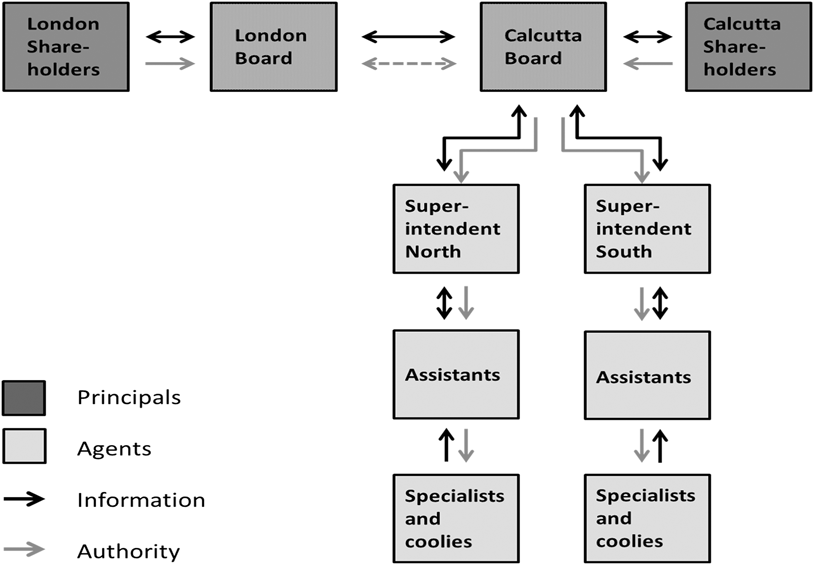
To undertake these operations, the Assam Company was organised with two boards, one in London and one in Calcutta. The board members were elected at an annual general meeting from among the shareholders and given overarching decision-making control of the company. In India, a hierarchical structure was implemented, with the directors of the Calcutta board at the top, beneath them the superintendents who each oversaw a region, then the assistants, and finally the Indian specialized workers and the coolie laborers. In 1863, there were approximately twenty-five European managers, and potentially thousands of coolie laborers.Footnote 64
This dual board and hierarchical structure, shown in Figure 6, attempted to resolve the problems of control and decision making at distance. The separation of the owners in Britain from their agents in India, and subsequently between the owners in Calcutta and the agents in Assam, increased the costs of reporting and monitoring significantly. To this end, the local board in Calcutta was given oversight of all decisions made in India, while regularly reporting their actions to the board in London. The scope of the local board was rather uneasily defined; the local management and direction were to be “left entirely with the committee who will govern the proceedings here (Calcutta),”Footnote 65 but decisions had to be undertaken, “provided always that they shall in all respects conform to these presents and any rules or regulations … given by the general (London) directory of the company.”Footnote 66 The managerial hierarchy in India coordinated activities between Assam and Calcutta, vesting much day-to-day power with the Superintendents in their respective regions. They were charged with decision making in Assam, while reporting to the board in Calcutta.
The Assam Company’s organizational structure in 1840.
Sources: Drawn from LMA MA08796, the Assam Company Original Act of incorporation XIX.
This structure, though, was beset with a number of problems. A high level of information asymmetry existed between the boards, exacerbated by the slow speed of communication. This left the London board often feeling that that it was not properly informed of events in India and unable to adequately set strategy. This was particularly acute in the 1840s, when the performance of the firm was abject and many shareholders demanded that the directors of the London board take action. In one letter to shareholders, the London board claimed “that the data furnished by the Calcutta direction are of so imperfect and contradictory a nature, and the details of accounts so unsatisfactory they are unable to come to such a conclusion upon the questions referred to them.”Footnote 67 High information asymmetry was coupled with a lack of clarity in decision rights. In a further circular to the shareholders, the London directors opined, “Your directors must remind you that whilst it is their province and duty to superintend and control the general business of the company, it is on the local board in Calcutta that your main dependence must be placed—to them is committed by our constitution the care and direction of those details of management, which distance from the scene of our operations renders it impossible for the general directory to perform.”Footnote 68 Despite various attempts by the London directors to dictate decisions to the Calcutta board, they were forced to defend to angry shareholders their inability to enact them, pointing to the rather nebulous definition of their role.
The information asymmetry and indistinct roles and responsibilities of the boards resulted in a lack of alignment and accountability. This generated two major conflicts of interest that paved the way for malfeasant behavior. The first conflict was between the two boards when it became apparent that various directors in Calcutta held appointments with other tea firms, or had interests in their own tea gardens. One director in Calcutta noted, “I can safely say there is not a Director on the Calcutta board who is not interested in Tea plantations other than those of the Assam Company.”Footnote 69 This division of interests saw directors misuse company resources for personal gain. In one case it was reported that two directors “took advantage of our position as two of the directors of the Assam Company to obtain, and apply to our own use, for clearing and planting our estate, seed and labour, rightly belonging to the Assam Company; at a time when that seed and labour were required for the company.”Footnote 70
The problem of divergent interests was also prevalent among managers in Assam. A shareholder in Calcutta blamed declining performance of the firm in the 1860s on the failure to ensure that managers’ efforts were focused on the company’s work. He claimed, “I have endeavoured to ascertain if Mr Smith’s (superintendent) time and attentions are given exclusively to the service of the company … and I learnt that he has several gardens of his own in different places, contiguous to our gardens … his own personal interests are in direct opposition to the interests of the company.”Footnote 71
Efforts were made reduce the malfeasant behavior of both directors and managers. Employment contracts were widely used from the 1860s, with clauses specifically aimed at restricting the activities of managers. Managers were instructed that they “shall not take up lands, open out gardens, or directly or indirectly be engaged in any other service, business, or speculation whatever,” and “shall not, under any pretence whatever, take employment from any other person or company in India during the aforesaid period of five years.”Footnote 72
Salaries were increased and gradated based on length and type of service, and incentives were introduced, such as bonus payments based on annual profits. In 1840, a superintendent’s pay was £300 per annum, an assistant’s between £100 and £150 per annum.Footnote 73 By 1863, a superintendent was offered £500, with a progression to £750 in three years, and an assistant was offered in the region of £250.Footnote 74 This package compared increasingly favorably with comparatively skilled managerial positions. For example, a clerk of the EIC in London with between eleven and fifteen years’ experience earned around £400 in 1850.Footnote 75
The hierarchy and reporting structures in India were also reformed. Greater decision-making powers were invested in the superintendents. The primacy of the Calcutta board over the superintendents in Assam was rejected by the London board. Kemshead, the chairman in London, wrote, “If there be one thing more certain than another, it is that for executive administration the instrumentality of an individual is far superior to that of a Board of Committee.”Footnote 76 He was adamant that the main decision makers should be in Assam, not Calcutta, and the superintendent should liaise directly with London.
The reporting structure was subsequently developed to better monitor both managers and directors in India. The level, content, and distribution of reports changed significantly in the early 1860s. The letters between the agents in Assam and the owners in Calcutta and London were now bound and printed for distribution to a wider readership, as well as to be stored for reference.Footnote 77 This was done to ensure that all correspondence was viewed and cleared by key board members and noted in the minute book. This was to prevent private correspondence between managers and directors that had enabled the previous frauds.Footnote 78
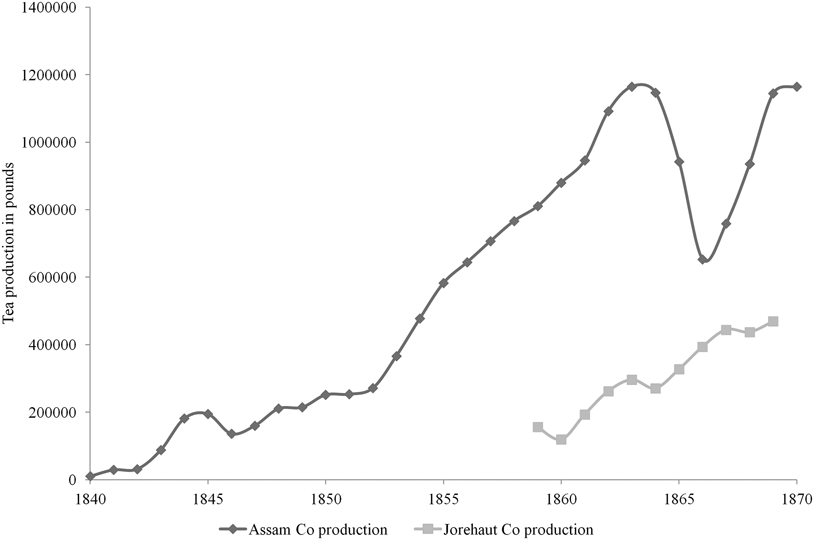
Despite these reforms, the company’s performance declined significantly. Production slumped, falling by 50 percent between 1864 and 1866; profits also plunged, with the firm losing money between 1865 and 1867.Footnote 79 The firm’s directors attributed the source of these problems to organizational and managerial faults. Although there was volatility in the tea sector in 1865 and 1866, the slump in production, shown in Figure 7, is telling of deep-seated problems. The Jorehaut Company, the next largest tea company in Assam, continued to increase its production while facing the same environmental and market conditions, indicating that the Assam Company’s problems were predominantly internal.
Comparison of the Assam and Jorehaut Companies’ annual production, 1840–1870.
Source: Antrobus, the Assam Company, 407–409; Antrobus, the Jorehaut Company, 47–48.
One director, upon his resignation from the board in 1864, moaned, “I am unable to see any way out of the difficulty unless it be in a dissolution and reorganisation of the company, but it would be of little purpose to resort to this radical expedient unless there can be a reasonable certainty of the administration devolving upon a body of men combining the standard of ability and practical experience in the affairs and business of the company.”Footnote 80
The London board sought to improve performance by abolishing the Calcutta board and appointing a managing agency in its place. In May 1867, Schoene, Kilburn and Co. were contracted with an annual fee of £2,000, and a commission on every chest of tea that was received and shipped and on the sale of bills. The agency initially managed the flow of goods, funds, and resources between Assam, Calcutta, and London. The London board retained ultimate authority, but decision making in India was increasingly vested in the managing agent’s hands. This arrangement proved successful, and in 1868 the firm returned to profit.Footnote 81
The importance of reducing the costs of agency became a major problem for the owners of the Assam Company to address. The costs of aligning the interests of principals and agents, and subsequently monitoring performance and enforcing contracts, were high. Enabled by the distance and information asymmetries between the parties and the weakness of the incentives, the managers and directors in India were able to pursue their own interests vigorously. The weakness of monitoring and enforcement may also have created a “market for lemons” in recruiting managers, with poor-quality individuals gravitating to the company.Footnote 82 The owners had used various structures and governance mechanisms to try to reduce these costs and improve the quality of the agents working for them, but the results were ineffective. The failure to do so was a major cost to the company, as the performance of the company suffered dramatically. The final solution was to appoint a managing agent to effectively reduce these costs. However, why were the managing agents able to reduce these costs so effectively and, if they were so successful at resolving these agency costs, why did all tea companies simply not adopt the partnership form to undertake these activities?
The Managing Agents
In 1866, around the time the owners of the Assam Company turned their attentions to finding a managing agent, the partners at Gillanders, Arbuthnot and Co. (Gillanders) took on their first agency contracts in the tea sector. The company was well established in India, having been founded in 1825 by Thomas Ogilvy and F. M. Gillanders in Calcutta, although both partners had learned their trade in Liverpool.Footnote 83 Ogilvy returned to Liverpool and opened Ogilvy, Gillanders and Co., with the two firms linked by a partnership agreement. The firm expanded and partnership agreements were made to set up firms interlinked through shared partners in Bombay in 1834 (Arbuthnot, Ewart and Co.) and in Manchester in 1851 (Gladstone, Latham and Co.); a branch was opened in Rangoon in 1852. In the years from 1825 to the 1860s, the partners focused predominantly on commission trade in British exports and shipping agency work.Footnote 84
The firm acted as general agents for British firms such as Bass and Co., simply promoting and selling their products—in this case, beer—in the Indian market on commission. More involved agency activities began in 1844, when the firm concluded an agreement with Barlow Brothers and Co. to support its indigo seed company. Gillanders provided £5,000 as annual credit to Barlow Brothers and made other advances when necessary. They made 10 percent on the loan and a further 2.5 percent on the cash advances.Footnote 85 However, they had no responsibilities toward the actual management of the indigo concern. The rationale for this investment was not only the prospect of profit on the advance, but also the chance to understand the workings of the indigo industry better. Advances were subsequently made to various other indigo factories, including the Otter factory. In 1847, the owner of the factory absconded from the country, owing Gillanders £12,000, whereas the assets of the factory were worth only £6,000.Footnote 86 Rather than accept the loss, the firm took over the factory to run it directly. This was its first experience in the direct management of a production operation.
Gillanders significantly expanded the breadth of its agency activities in the 1860s and 1870s.Footnote 87 In 1862, the firm became the financial agent of the Indian Branch Railway Co. In 1870, it purchased the Burmah Company (a French timber concern in Rangoon) and, in 1877, it became managing agent for the Balliaghatta Co. Jute Mill. Further agency activities developed in each of these areas. As part of this expansion, Gillanders also became agent for the Golaghat Tea Estate and the Teelwaree Tea Co. in 1866. Further expansion in the tea sector resulted in the firm managing more than forty tea estates.Footnote 88
Structure of Gillanders, Arbuthnot and Co. in Calcutta
To enable it to undertake these activities, Gillanders’ Calcutta office was organized into a number of business and administrative departments. Each major agency activity had a department that was overseen by at least one Indian writer (senior clerk) and a European assistant (junior manager). The more senior Indian writers were employed in the key administrative departments such as correspondence and accounting. In 1870, there were twenty-two Indian writers and about 100 other Indian workers employed by the company.Footnote 89 The most senior Indians employed by the firm were the Banian and his assistant, who managed various key functions in the firm. They acted as salesmen with the local community, both buying produce for export and selling imported British goods in the bazaar.
The European assistants managed the day-to-day affairs of the departments and oversaw the work of the writers. In 1870, the firm employed seven assistants in Calcutta, most of whom were employed on five-year contracts. The firm also hired specific experts to undertake key agency functions, such as an agent to inspect the tea gardens. Two senior partners provided overall decision making in Calcutta. There were usually five partners in the firm, although this could fluctuate in years when senior partners retired and new ones were appointed. The partners rotated on a regular basis between the office in Calcutta and those in Britain. Some of the partners made multiple trips to India and built up extensive experience in the country before finally retiring back to the UK.
Contracting to Manage a Tea Estate
The role of the managing agent could differ between industries and between firms. The scope of their involvement was negotiated and contracted. No records survive for these early forays, but in 1875 Gillanders began to work with Thomas Kingsley, a tea planter, who founded a number of firms in Assam, the Jaboka Tea Co. and the Kisna Tea Co., for which Gillanders acted as agent. In 1895, this relationship was deepened when Kingsley amalgamated his existing firms with the Dooars Tea Company Ltd. to form the Siglo Tea Company Ltd. The contract and negotiations surrounding Gillanders’ role as agent in the new company provide an interesting insight into the structure of the managing agent’s operations.Footnote 90
The prospectus of the Siglo Tea Co. records that it was looking to raise £300,000 capital through 17,000 ordinary and 13,000 preferential shares at £10 each. Of the five directors, three were existing directors of the Dooars Company, and the other two were H. N. Gladstone and J. F. Ogilvy, partners in Gillanders.Footnote 91 The prospectus clearly highlights the role of Gillanders, and their representative partners, as a core component of the management of the company. Gillanders’ reputation was used to help present the company as a viable concern, and it is likely that the partners would also have worked to place shares with their network of clients and contacts.Footnote 92
Specifically, the partners from Gillanders were appointed to be “attorneys and attorney jointly and each of them severally and the agents in Calcutta of the company.” With these powers, the partners were instructed to “carry out and complete the purchase of other estates to the company and to carry on conduct and manage all the business and affairs of the company connected with the plantation and cultivation of the said tea estates.” The key managerial tasks they were contracted to do included “to dispose of the produce thereof and to maintain and develop the said estates and property … and to supply all such stores implements and labour and all other necessaries for the purposes aforesaid … and to employ and dismiss all such managers, assistants, servants, coolies, labourers and others as may be necessary for the due cultivation management and carrying on of the said several tea estates and property.”Footnote 93 Gillanders managed this process though regular visits to the gardens, using an inspector with knowledge of tea estates, to report on their condition and outlook and oversee the operations. This enabled the partners in Calcutta to build up information on the performance of the gardens and more effectively control the flow of resources to and from Assam.
The partners were also empowered to “make, sign, draw, accept, endorse, discount and negotiate bills of exchange, bills of lading, policies of insurance, drafts, orders, cheques, hoondies, promisory notes or other negotiable instruments or securities whatsoever necessary for the due and proper management.”Footnote 94 The firm’s structure and expertise in conducting the trade of a wide range of produce meant that it was well placed to efficiently undertake the purchasing and sales of the estates’ supplies and produce, and thus the empowerment to manage much of the estates finances. This gave Gillanders almost total control over the activities in India. By controlling the supply of all critical resources, it oversaw both the day-to-day operations and the more long-term strategic decisions relating to the management of the tea gardens.
In return for these services, Gillanders was paid “a commission of two and half per cent on the gross proceeds of all tea, tea seeds and other produce sold or shipped by them on behalf of the company … two and half per cent on the purchase of all stores and machinery and tea seed other than purchased and shipped by the company from Europe and two rupees eight annas for each statute adult coolie recruited by them and they shall in addition be entitled to charge interest on all advances at the rate of seven per cent per annum from the date of advance to date of payment.”Footnote 95 The contract was agreed to for fifteen years, after which it could be canceled by either party with twelve months’ notice.
The Partnership’s Effect on Incentives and Alignment
Gillanders’ success as a managing agent was due to its capacity to provide the critical managerial functions of reporting, monitoring, and enforcement of decisions between Assam and Calcutta. But why was it more effective in providing these managerial capabilities than the systems developed internally by the joint-stock tea firms? The answer to this question lies in the use of the partnership form, which enabled Gillanders to better align the interests within the firm and to attract and retain better-qualified individuals.
Entering the partnership required investment and, in return, offered a remuneration package that included a percentage of profits made by the firm. On joining, the partners invested between £10,000 and £20,000, often through a lump sum and the remainder over a period of twelve to eighteen months.Footnote 96 Some joined as salaried partners, whereby they invested no capital at the beginning, but used their annual profits to build a capital stake in the firm.Footnote 97 It became increasingly common for the firm to take on a potential partner as an assistant on a five-year contract, with the possibility of a partnership on the successful completion of the contract.Footnote 98
The assistants normally joined the firm on a five-year contract, which included a gradated increase in wages from around £200 to £400 per annum over the course of the contract. Some were hired for specific roles, such as bookkeeping; others were taken on for more general positions in the trading and agency departments. The terms of the contracts and remuneration were very similar to those of the assistants at the Assam Company. The opportunity for progression, though, appeared much stronger in the partnership. Numerous assistants progressed to become partners either at Gillanders or other similar firms. In one case, for example, George Mewburn joined the firm as an apprentice in 1857 for £10 per annum and worked his way up to become a full partner in 1871.Footnote 99
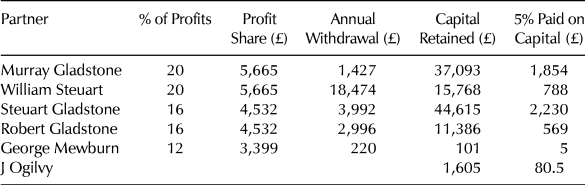
The future rewards of becoming a partner far outstripped the possible incentives available in the tea companies. A superintendent in the Assam Company could expect a wage of £750 to £1000 per annum, with a small bonus from profits. The potential returns for the partners were far greater. Dependent on the amount of capital invested, and length of service, each partner was contracted to a proportion of profits or losses incurred by the firm annually. In the 1872 financial report a total profit of £28,326 was recorded and the senior partners made £5,665 each on their profit share. Each partner was also allowed 5 percent interest on his retained capital in the firm. An annual withdrawal was allowed from the profits to cover a partner’s living expenses; the rest was credited against the partner’s retained capital. The senior partner in 1872, Murray Gladstone, made £5,665 in profits, £1,854 on his retained capital and withdrew £1,427 that year, leaving him a personal profit of £6,092 in the year. This was added to his capital of £37,093 as shown in Table 1.
Gillanders, Arbuthnot and Co. partners’ profit share and retained capital in 1872
Sources: Ogilvy, Gillanders and Co. consolidated profit and loss accounts for 1872/73 (GG 2552).
The improved incentives and alignment mechanisms were not restricted to the European staff. The Banians were contracted to the firm and a Del Credere account was opened to manage the bazaar sales of British import goods. The Del Credere account meant that the Banians stood surety on the sales in case of default, which acted as a strong incentive to ensure that they managed the sales carefully. In return, they were offered 98 percent of the net balance of the account at the end of the year, after certain salary costs had been subtracted.Footnote 100
These mechanisms tied the partners, assistants, and Indian agents to the long-term interests of the firm. The invested capital certainly ensured that each partner had plenty of “skin in the game” and a commitment to devote their efforts to the improvements of the firm. The assistants also had long-term commitments to the firm through the possibility of becoming partners through hard work and success. The high earning potential from the profit share was a significant incentive for the partners to diligently improve the firm’s performance in both the short and long term.
The alignment of interests significantly lowered the risks of malfeasant behavior among the partners and the workforce. Greater trust was engendered as a result of shared interests and risks, which, in turn, lowered the threat of asymmetric information being used to enable malfeasant and opportunistic behavior when the partners or their agents worked at distance. Mechanisms such as the rotation of the partners also helped to improve the monitoring and reporting within the firm. Information and knowledge between Britain and India was shared, and monitoring of activities in both India and Britain was improved. By lowering the overall risks of asymmetric information and improving the flow of information in the firm, reporting and monitoring became more effective and efficient.
The incentives also attracted high-quality individuals to firms such as Gillanders. The use of the five-year assistant contracts enabled the firm to select the best-performing individuals to continue in the firm and retain their talent. This increased the capacity of both assistants and partners to develop deep knowledge and expertise of industries, firms, and markets, and was a further factor in improving the effectiveness of the reporting and managerial processes. This was a major advantage, particularly over newly founded ventures with British owners unversed in business in India.
A Coda to the Benefits of the Partnership
If the partnership form was able to mitigate and lower agency costs so effectively, it is worth questioning why most firms did not adopt or revert back to it in the 1870s. It was a cheap and easy contracting form that enabled great flexibility in shaping a firm’s governance and structure. An obvious riposte would be that there was a need for deep capital reserves to undertake the fixed investments, and this was best found via joint-stock arrangements. However, although it is true that increased fixed capital was required in the tea industry, larger partnerships such as Gillanders could feasibly generate levels of capital to undertake these activities.Footnote 101 A further problem with the partnership, though, was noticeable in the case of Gillanders, which pointed to a real weakness in the form regarding the management of fixed assets in the long term.
In 1863 a salaried partner, Daniel Mackinlay, returned from India after a successful spell, in which he had been promised a full partnership. He had, however, fallen out irrevocably with another of the partners, and on his return offered an ultimatum that he would resign if the other partner remained in the company. This was not forthcoming, so Mackinlay resigned and the firm sought to arrange his exit from the partnership. Because he had not become a senior partner, no new partnership agreement had been drawn up, and Mackinlay rejected the claim that he was bound by the firm’s previous partnership agreement. Having co-signed deeds for both the firm’s new offices in Calcutta and an indigo factory, he refused to re-convey his claim on the assets back to the firm unless his asking price was met. The remaining partners felt that this was too high and Mackinlay proposed to maintain his claim on the buildings as an investment. The partners were forced to go through arbitration and ultimately to the Chancery Court in London, with the case finally being settled in 1873 to enforce the re-conveyance at a set price. However, in the intervening period, the firm was unable to sell the assets without Mackinlay’s assent. The threat and costs of untimely dissolution of the partnership increased. The need to hold the ownership of high, fixed-cost assets in a form that enabled them to be managed over the long term certainly encouraged owners to once again look at the joint-stock form.
Conclusion
The increased use of the joint-stock form in the Indian tea industry can be seen as a response to growing capital requirements in setting up and expanding a nascent industry, while integrating activities to lower transaction costs. This process was supported by changes in legislation that increased security of investments and incentivized speculation. The partnership form was underpowered in enabling capital formation on this scale, and managing the transfer of fixed assets in the long term. The governance structure of the joint-stock form, however, significantly increased agency costs. The tea firms thus needed to solve two distinct problems: obtaining capital for fixed investments and reducing the costs of doing business at distance in an environment with highly asymmetric information.
Neither form of ownership could adequately address both problems. For this reason, owners were incentivized to modify the joint-stock form, so a hybrid solution was adopted through the appointment of a managing agency. This enabled the capital formation and threats of untimely dissolution to be reduced, while mitigating the “negligence and profusion” of the joint-stock form. This recasts the role of the managing agents during the period of their proliferation in India during the late 1850s and 1860s. Alongside their capacity to access scarce resources, success was founded on the ability to lower the agency costs of doing business in distant markets. Chapman’s dismissal of the “legal fiction of agency” does not adequately capture their operations in the tea trade. The role of agent was a key aspect of their business certainly prior to 1870, after which the evolution toward the investment and business group model gathered pace. Entrepreneurs like Kingsley become increasingly aware of the limitations of the joint-stock form and looked to the managing agents as an integral part of doing business in India.
The entrepreneurs in the Anglo-Indian tea trade did not see the choice of ownership as a dichotomy, with one form replacing the other. Instead, a symbiosis emerged between the forms, with the strengths of each adapted to mitigate the combined problems faced by the firms in the tea sector. The evolution of the trading partnerships into managing agents, and subsequently the use of agents by the joint-stock firms show the entrepreneurs in the mid-nineteenth century as both innovative and successful in their use of a range of ownership and organizational forms. Their approach to ownership suggests that far from being anachronistic rent seekers retaining the partnership as a vehicle for family firms to extract profits, they were innovative and flexible entrepreneurs, capable of developing firm structures to meet the demands of the expanding and internationalizing Indian tea industry.
Although the explanatory scope of the article is limited because of the discrete location of the cases, it raises interesting questions about the choice of business organization employed in other colonial markets. The managing agents have tended to be viewed as a British model of business organization for managing overseas investments. If this was a distinctly British model, the explanation for their emergence and existence would most probably lie in cultural traits of British entrepreneurship and the financial and legal frameworks that bound London to the British Empire in Asia.
If, however, the intuition of this article is correct, and the organization evolved to reduce costs of agency while allowing capital formation, then it could be expected that entrepreneurs of different nationalities would adopt similar forms of business organization to address the challenges of long-distance trade and foreign direct investment. Jonker and Sluyterman describe similar conditions in the Dutch East Indies during the 1860s, where thin credit markets, increasing need for investments and advances on plantation crops such as tobacco, and the problems of distance drove trading firms to innovative forms of ownership and organization.Footnote 102 They note the adoption of the joint-stock form registered by trading firms in Amsterdam to undertake both trade and production in the colonial markets, perhaps indicative of a similar process at work. Further comparative analysis between firms of different national origin, similar to the Free-Standing Company research agenda, may illustrate different trajectories of internationalization, but also identify common factors related to choice of ownership and organization.
These findings support the assertion of Lamoreaux et al. and others that the integrated corporate firm should be seen as only one among many forms of business organization that could compete and successfully grow global industries such as tea. A wider ecology of firm types was active and successful, even as the joint-stock form became readily available and more widely employed. The boundaries of the firm were pushed by entrepreneurs in this period to identify forms that allowed them to achieve the benefits of scale and align the interests of owners, investors, and managers. Inherent weaknesses of the joint-stock form meant that as a stand-alone entity, it was rapidly discarded. These findings indicate that further work at the level of the entrepreneur and firm, in different industries and sectors, would contribute to a richer understanding of factors that shaped choices regarding ownership and organization. By focusing the analysis on the identification of the sets of problems faced by entrepreneurs and firms, and how they used a variety of mechanisms to solve them, the rationale of historical actors may be revealed as a response to more complex set of circumstances previously accounted for.