Introduction
Seed dispersal is a key process for plant population dynamics and for community-level processes in natural and man-made environments (Jordano, Reference Jordano and Fenner2000). The benefits of frugivory and seed dispersal to plants include seed transport away from the parent plant, pulp removal (seed cleaning), seed deposition at sites that may affect the germination and establishment of new individuals, and fertilization effects (Traveset et al., Reference Traveset, Roberstson, Rodríguez-Pérez, Dennis, Schupp, Green and Westcott2007; Schupp et al., Reference Schupp, Jordano and Gómez2010). According to Traveset et al. (Reference Traveset, Roberstson, Rodríguez-Pérez, Dennis, Schupp, Green and Westcott2007), the effect of the seed passage through the digestive tract of vertebrates in seed germination can be positive, negative or null. Besides, gut-passage effects can vary with both disperser and plant traits (Traveset et al., Reference Traveset, Riera and Mas2001a), habitat (Baskin and Baskin, Reference Baskin and Baskin1998), population (Traveset, Reference Traveset1998) and seed size (Verdú and Traveset, Reference Verdú and Traveset2004), but the mechanisms modulating gut-passage effects are poorly known.
Melastomataceae is a pantropical family that comprises nearly 4600 species and attains higher diversity in the Neotropics (Renner et al., Reference Renner, Clausing and Meyer2001). The fleshy fruits of the members of this family are an important food resource for frugivores in tropical environments, since species of the family produce fruits with small seeds that are consumed by taxonomic-wide communities of birds, especially when food is scarce (Silveira et al., Reference Silveira, Fernandes and Lemos-Filho2013). For Melastomataceae, the effects of the passage through the digestive tract of birds are quite complex, and can be negative (Alves et al., Reference Alves, Ritter, Antonini and Almeida2008), null (Gomes et al., Reference Gomes, Correia, Lima and Alves2008; Silveira et al., Reference Silveira, Mafia, Lemos-Filho and Fernandes2012) or positive (Ellison et al., Reference Ellison, Denslow, Loiselle and Brenes1993; Silveira et al., Reference Silveira, Mafia, Lemos-Filho and Fernandes2012). However, the causes for interspecific variation in seed responses to gut passage are unclear. Possible underlying causes are seed traits (e.g. seed size, pulp composition, seed coat thickness, texture and permeability) (Pollux et al., Reference Pollux, Santamaria and Ouborg2005; Tewksbury et al., Reference Tewksbury, Levey, Huizinga, Haak and Traveset2008; Traveset et al., Reference Traveset, Rodríguez and Pías2008), bird morphological (e.g. size and presence of gizzard; Traveset et al., Reference Traveset, Riera and Mas2001b; Santamaría et al., Reference Santamaría, Charalambidou, Figuerola and Green2002) and physiological traits (e.g. digestive fluids varying according to pH and water, amount of plant material ingested; Traveset et al., Reference Traveset, Riera and Mas2001b), and duration of gut passage (Murray et al., Reference Murray, Russell, Picone, Winnett-Murray, Sherwood and Kuhlmann1994; Traveset et al., Reference Traveset, Riera and Mas2001b; Charalambidou et al., Reference Charalambidou, Santamaría, Jansen and Nolet2005; Tewksbury et al., Reference Tewksbury, Levey, Huizinga, Haak and Traveset2008).
Small seeds are more slowly separated from the pulp than larger seeds, and longer transit times inside the frugivore guts may lead to deleterious effects resulting from excessive scarification (Murray et al., Reference Murray, Russell, Picone, Winnett-Murray, Sherwood and Kuhlmann1994). The time of seed retention in bird guts depends largely on the length of their digestive tracts. Birds with a specialized fruit diet have shorter digestive tracts (Karasov and Levey, Reference Karasov and Levey1990) and, potentially, the low retention time may promote more positive effects on seeds compared with less-specialized frugivorous birds. In this work, we aimed to investigate whether the seed coat structure modulates gut-passage effects on three species of Miconieae (Melastomataceae). Given these assumptions, our goals were to test the following hypotheses: (1) germination responses after the passage through the digestive tract are related to structural changes in the seed coat; and (2) there is a positive correlation between the degree of frugivory and the effect on germination after the passage through the digestive tract.
Materials and methods
Study site and species
Berries of three species of Miconieae (Melastomataceae) were collected at Serra do Cipó (19°10′–19°20′S and 43°30′–43°40′W), south-eastern Brazil. The main vegetation at Serra do Cipó is called campo rupestre, a fire-prone seasonal grassland in which sclerophyllous, ericoid-like plants establish on quartzite-derived, nutrient-poor, acidic and shallow soils (Silveira et al., Reference Silveira, Negreiros, Barbosa, Buisson, Carmo, Carstensen, Conceicao, Cornelissen, Echternacht, Fernandes, Garcia, Guerra, Jacobi, Lemos-Filho, Le Stradic, Morellato, Neves, Oliveira, Schaefer, Viana and Lambers2016). In the campo rupestre vegetation, Melastomataceae comprises the most diverse animal-dispersed family (Silveira et al., Reference Silveira, Negreiros, Barbosa, Buisson, Carmo, Carstensen, Conceicao, Cornelissen, Echternacht, Fernandes, Garcia, Guerra, Jacobi, Lemos-Filho, Le Stradic, Morellato, Neves, Oliveira, Schaefer, Viana and Lambers2016). The altitude of the study site ranges from 850 to 1800 m (Madeira and Fernandes, Reference Madeira and Fernandes1999) and the climate is mesothermic, with dry winters lasting 4–5 months and rainy summers of 7–8 months; the average annual precipitation is 1500 mm (Madeira and Fernandes, Reference Madeira and Fernandes1999).
Berries of Miconieae are variable in seed number and dispersal phenology, and are consumed by a wide variety of frugivores in the Neotropics (Silveira et al., Reference Silveira, Fernandes and Lemos-Filho2013). Three species of Miconieae were selected – Clidemia urceolata DC., Leandra aurea (Cham.) Cogn. and Miconia rubiginosa (Bonpl.) DC. – all of which are widespread species in South America (Goldenberg et al., Reference Goldenberg, Almeda, Caddah, Martins, Meirelles, Michelangeli and Weiss2013) and co-occur with many bird species. The plants are dominant shrubs at the study site and produce small, purple or black berries. Ripe berries from 20 individuals of each species were collected and taken immediately to the laboratory for the experiments. The number of seeds per fruit was estimated in five replicates of three fruits.
For this study, we selected the birds Tangara sayaca L. and Schistoclamys ruficapillus Vieillot (Thraupidae) because both species eat melastome fruits but differ in their diets (Silveira et al., Reference Silveira, Mafia, Lemos-Filho and Fernandes2012). T. sayaca is an omnivorous bird that feeds predominantly on insects, whereas S. ruficapillus is also an omnivore, but its diet consists mainly of fruits (Sick, Reference Sick1997).
Gut-passage effects on germination
To determine the effects of seed passage through the bird digestive tract, a factorial combination of three plant species (C. urceolata, L. aurea and M. rubiginosa) with two seed treatments (hand extracted and gut passage) and two bird species (S. ruficapillus and T. sayaca) were performed. In treatment I, manually extracted seeds were washed for 5 min in running water and dried for 24 h at room temperature (control treatment). In treatment II, 25 fruits were offered to two or three individuals of T. sayaca provided by the Centro de Triagem de Animais Silvestres (CETAS) in Belo Horizonte, Minas Gerais State, Brazil. In treatment III, the same procedure was done for S. ruficapillus. CETAS is a governmental centre for wildlife rehabilitation where birds are kept in good health conditions before being released into their natural habitats. Fruits of a single species of Miconieae were offered to the birds early in the morning each day (Silveira et al., Reference Silveira, Mafia, Lemos-Filho and Fernandes2012). Seed retention time (the time interval between the first fruit ingestion and the release of the seed in faeces) was registered for each bird species. To ensure independent samples, this experiment was conducted for 2 d for each plant species.
Since all the species studied produce minute seeds (0.07 × 0.05 cm, 0.11 × 0.06 cm and 0.13 × 0.11 cm for C. urceolata, L. aurea and M. rubiginosa, respectively) we could not carry out the germination experiments under field conditions. Six replicates of 25 seeds of each species from all treatments were set in Petri dishes containing natural soil (37 g) from the area where the species occur (Traveset et al., Reference Traveset, Roberstson, Rodríguez-Pérez, Dennis, Schupp, Green and Westcott2007) to simulate the natural conditions. The Petri dishes were incubated in germination chambers under a 12/12 h photoperiod with alternated temperatures of 15 and 25°C, which are considered suitable for the germination of Melastomataceae seeds (Silveira et al., Reference Silveira, Fernandes and Lemos-Filho2013). The substrate was irrigated with a 2% Nistatin™ solution to prevent fungal growth, and watered whenever needed to keep the moisture constant. Germination was monitored at daily intervals for 50 d.
Germination inhibitors in the fruits
Previous studies have shown that melastome seeds do not germinate within intact fruits (Silveira et al., Reference Silveira, Fernandes and Lemos-Filho2013). To evaluate the possible occurrence of germination inhibitors in fruit pulp of the studied species, seeds were set to germinate in three fruit extract concentrations (100%, 50% and 5%) and in a control group. After manually removing the seeds from the fruits, we prepared the 100% extract by macerating 100 fruits of each species in 40 ml of distilled water and filtering the solution. Dilutions from that 100% solution were made for the 50% and 5% extracts. Seeds in the control group were moistened with distilled water. The samples were incubated in germination chambers at 25°C and a 12/12 h photoperiod. Six replicates of 25 seeds were set for each treatment. Germination was monitored at daily intervals for 50 d.
Statistical analysis
Data in percentages were converted into arcsin of the square root to meet the assumptions of the parametric analysis. Mean germination time (MGT) was calculated following the formula (Ranal and Santana, Reference Ranal and Santana2006):
 $${\rm MGT} = \sum\limits_{i = 1}^k {niti/} \,\sum\limits_{i = 1}^k {ni}$$
where ni is the number of seeds germinated in the time i, ti is the time from the start of the experiment to the ith observation, and k is the time of last germination. Statistical differences between the treatments were determined by analysis of variance (ANOVA) followed by Tukey's test (α = 0.05).
Anatomical and micromorphological studies
The manually extracted and gut-passed seeds were fixed in formaldehyde–acetic acid–50% ethanol (Johansen, Reference Johansen1940) for 48 h and exposed to a vacuum. A sample of seeds was processed for light microscopy according to Ribeiro and Oliveira (Reference Ribeiro and Oliveira2014), embedded in (2-hydroxyethyl)-methacrylate (Leica™, Heidelberg, Germany) and processed in a freezer to delay polymerization, as indicated by Paiva et al. (Reference Paiva, Pinho, Oliveira, Chiarini-Garcia and Melo2011). Eight-micrometre-thick transverse and longitudinal sections were obtained in a rotary microtome (Zeiss Hyrax M40, Microm GmbH, Walldorf, Germany). The sections were stained with 0.05% toluidine blue in acetate buffer at pH 4.7 (modified from O'Brien et al., Reference O'Brien, Feder and McCully1964) and mounted with Entellan™. According to Briggs et al. (Reference Briggs, Morris and Ashford2005), we used the toluidine blue staining to recognize phenolic compounds, which were also determined by histochemical tests. We used 10% aqueous ferric chloride plus sodium carbonate to detect non-specific phenolic compounds (Johansen, Reference Johansen1940) in cell walls or vacuoles, and phloroglucinol in HCl specifically for lignin (Jensen, Reference Jensen1962) in cell walls. The sections were analysed using a Zeiss light microscope (Zeiss, Oberkochen, Germany) and the anatomical terminology follows Corner (Reference Corner1976) and Werker (Reference Werker1997).
To analyse the micromorphology of the seed surface, gut-passed seeds were fixed in Karnovsky solution (Karnovsky, Reference Karnovsky1965) for 24 h and exposed to a vacuum. The material was dehydrated in increasing ethanol series, critical point dried with Balzers CPD 030 equipment (BAL-TEC GmbH, Schalksmühle, Germany), glued to stubs and gold-coated in Balzers SCD 050 equipment (BAL-TEC GmbH). Non-ingested seeds were dried in an incubator at 60°C, glued to stubs and gold-coated as described previously. Samples were analysed and described using a scanning electron microscope (SEM) Quanta 200 (Fei Company, Hillsboro, Oregon, USA), producing digital images. The terminology followed Ocampo and Almeda (Reference Ocampo and Almeda2013). Seed coat thickness was measured in the median longitudinal section of the anti-raphal region of five seeds per species, using AxioVision Zeiss software.
Results
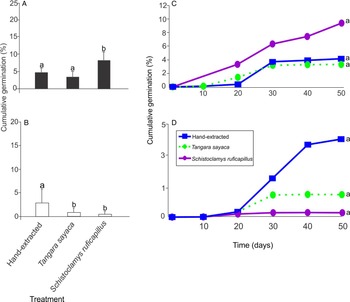
The germinability of hand-extracted seeds was <5% in C. urceolata and L. aurea. Seeds of M. rubiginosa did not germinate (Fig. 1A, B). For C. urceolata, the increase in germinability of gut-passed seeds compared to hand-extracted seeds depended on the bird species. The germinability of seeds passed in the gut of S. ruficapillus was significantly higher than hand-extracted seeds of C. urceolata (Fig. 1A), but seeds passed in the gut of T. sayaca did not germinate more compared to control seeds (Fig. 1A). In contrast, the germinability of hand-extracted seeds in L. aurea was larger than that of gut-passed seeds for both bird species (Fig. 1B). For C. urceolata and L. aurea, gut passage did not change MGT (Fig. 1C, D). In the gut-passed experiments, average seed retention time was 20 min in both bird species for all plant species.
Germination of fresh seeds of the Miconieae species. (A, B) Average germinability (%, bars) of Clidemia urceolata (A) and Leandra aurea (B) in different treatments. (C, D) Cumulative germinability (%) of seeds of C. urceolata (C) and L. aurea (D). Means (± SE) followed by the same letter do not differ statistically.

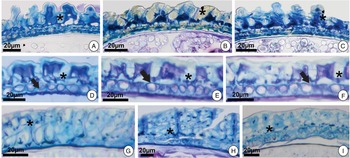
Gut passage did not change seed coat structure in C. urceolata (Fig. 2A–I) or M. rubiginosa (Fig. 2S–AA). For L. aurea (Fig. 2J–R), there were small projections of the cells of the seed coat after ingestion by S. ruficapillus (compare Fig. 2L and 2O with 2R). However, there were no significant differences in the seed coat thickness when comparing gut-passed and control seeds (Fig. 3A–I) in all species (C. urceolata: F = 0.844, P = 0.454; L. aurea: F = 0.408, P = 0.674; and M. rubiginosa: F = 1.313, P = 0.305). The epidermis in the seed coat was unistratified in all species (Fig. 3A–I). In C. urceolata and L. aurea, the seed coat had straight cells (Fig. 3A–F), but there were oblique cells in M. rubiginosa seed coats (Fig. 3G–I). In mature seeds, the epidermis in the seed coat is composed by dead cells with regular, thick walls (Fig. 3A–I). Phenolic compounds were observed in cell walls in all seed coats (Fig. 3A–I). There were no anatomical changes in the seed coat of the three species when comparing control seeds (Fig. 3A, D, G) with seeds passed through the digestive tract of T. sayaca (Fig. 3B, E, H) and S. ruficapillus (Fig. 3C, F, I).
Mature seeds of Clidemia urceolata (A–I), Leandra aurea (J–R) and Miconia rubiginosa (S–AA) observed by scanning electron microscopy. For each species, seeds are shown in lateral view, radicular lobe and seed coat detail of manually extracted seeds (A–C, J–L, S–U), after passing through the digestive tract of Tangara sayaca (D–F, M–O, V–Y) and Schistoclamys ruficapillus (G–I, P–R, X–AA). Arrows, radicular lobes.

Mature seeds of Clidemia urceolata (A–C), Leandra aurea (D–F) and Miconia rubiginosa (G–I) in longitudinal section of the anti-raphal region, observed by light microscopy. For each species, sections of the seed coat in manually extracted seeds (A, D, G), and after passing through the digestive tract of Tangara sayaca (B, E, H) and Schistoclamys ruficapillus (C, F, I) are presented. Arrows, crystals of calcium oxalate; asterisks, secondary walls with phenolic compounds.

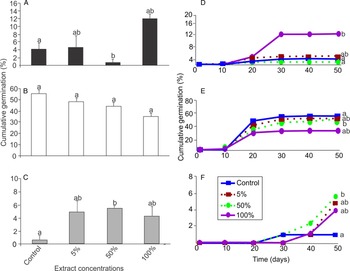
In the experiment using fruit extracts, seed germinability was low in C. urceolata (<12%; Fig. 4A) and in M. rubiginosa (<10%; Fig. 4C). For both species, the effect of the extract of concentration 50% was significantly different from the effect of other concentrations and the control group (Fig. 4A, C). In C. urceolata (Fig. 4A, D), the extract of concentration 50% decreased germination, but the other concentrations did not. For M. rubiginosa (Fig. 4C, F), the opposite effect was found: the extract of concentration 50% increased germinability compared to the control. For L. aurea, germinability was >30% in all treatments, with no significant differences among treatments (Fig. 4B). In all species the MGT differed significantly among treatments (Fig. 4D–F). The extract of concentration 100% significantly increased MGT in C. urceolata (Fig. 4D). However, comparatively, the extract of concentration 50% had more effect on MGT than that of 100% in L. aurea (Fig. 4E) and M. rubiginosa (Fig. 4F).
Germination of fresh seeds of the Miconieae species using different fruit extract concentrations. (A–B) Average germinability (%, bars) of Clidemia urceolata (A), Leandra aurea (B) and Miconia rubiginosa (C). (D–F) Cumulative germinability (%) of seeds of C. urceolata (D), L. aurea (E) and M. rubiginosa (F) in fruit extracts of different concentrations. Means (± SE) followed by the same letter do not differ statistically.

Discussion
Understanding the complexity of factors that determine the outcome of vertebrate gut passage on seed germination is a challenging issue in seed dispersal ecology. To date, there is no consensus regarding which specific mechanism is responsible for changes in germination percentage and time following gut passage (Traveset et al., Reference Traveset, Rodríguez and Pías2008). Here, we show that birds with a higher degree of frugivory had a higher quality of treatment in the mouth (sensu Schupp et al., Reference Schupp, Jordano and Gómez2010) compared to a more generalist (omnivorous) bird, which suggests that the degree of frugivory plays an important role in determining gut passage outcomes. We have also shown that slight changes in seed coat structure after gut passage may have affected germination responses of gut-passed seeds negatively, at least for L. aurea, indicating that plant traits are also determinants of gut-passage effects.
Species of Melastomataceae have evolved generalist seed dispersal systems (sensu McKey, Reference McKey, Gilbert and Raven1975), indicating that their fruits are consumed by a wide range of vertebrates, ranging from strict frugivores to generalist species (Silveira et al., Reference Silveira, Fernandes and Lemos-Filho2013 and references therein). It has been shown recently that gut-passage effects on melastomes range from negative to positive (Silveira et al., Reference Silveira, Mafia, Lemos-Filho and Fernandes2012, Reference Silveira, Fernandes and Lemos-Filho2013). In our study, S. ruficapillus, the bird with a higher degree of frugivory, provided C. urceolata with a better quality of treatment in the mouth than T. sayaca, the more omnivorous bird. Relative shorter gut lengths in birds with a high degree of frugivory result in shorter retention times within guts, and therefore seeds are less likely to experience excessive abrasion that is harmful to embryos (Karasov and Levey, Reference Karasov and Levey1990; Levey and Martínez del Rio, Reference Levey and Martínez del Rio2001). However, the same pattern was not observed in L. aurea. This result indicates that a multitude of factors is involved in the complex eco-evolutionary dynamics of generalist fruit–frugivore interactions (Stiles and Rosselli, Reference Stiles and Rosselli1993).
Both bird species had a negative effect on seed germination of L. aurea. Gut-passed seeds of L. aurea had changes on the superficial cells of the seed coat that may have decreased germination compared to hand-extracted seeds. Similar results were observed by Bravo et al. (Reference Bravo, Velilla, Bautista and Peco2014) in seeds of Solanum nigrum, wherein the gut-passed seeds showed changes on superficial cells of the seed coat and had lower germination success than non-ingested seeds. This result indicates that changes in seed coat structure and physiology modulate the outcome of gut-passage effects in Melastomataceae, as shown by Traveset et al. (Reference Traveset, Rodríguez and Pías2008). Nevertheless, changes in germination were not related to changes in seed coat thickness between unpassed and gut-passed seeds. The fact that this result was not observed for C. urceolata reinforces the idea of species-specific effects of gut passage (Traveset et al., Reference Traveset, Riera and Mas2001a) for species with generalist dispersal systems (Silveira et al., Reference Silveira, Mafia, Lemos-Filho and Fernandes2012).
Our data also show that seed cleaning is an important service delivered by both bird species. Seed cleaning is a key process because it reduces the inhibition effect of high osmotic pressure, light-blocking pigmentation and secondary metabolites in seed germination, improving dispersal quality (Samuels and Levey, Reference Samuels and Levey2005). Melastome seeds do not germinate within intact fruits but the reasons for lack of germination remain controversial (Silveira et al., Reference Silveira, Fernandes and Lemos-Filho2013). Here, we show that fruit extracts can inhibit seed germination in L. aurea, as shown in other Melastomataceae species (Amaral and Paulilo, Reference Amaral and Paulilo1992; Carreira and Zaidan, Reference Carreira and Zaidan2007; Silveira et al., Reference Silveira, Fernandes and Lemos-Filho2013). The mechanisms accounting for increased germination of C. urceolata and in M. rubiginosa seeds treated with fruit extracts are currently unknown and deserve further investigation.
Our results suggest that seed germination in melastomes from campo rupestre is dependent on the consumption of their fruits by birds. Overall, gut passage exerts a null or minor effect on seed germination, but seed cleaning is necessary to remove germination inhibitors present in the fruit pulp of L. aurea. In addition, our study also supports the idea that more specialized frugivores provide high-quality dispersal for the plants. Finally, our data suggest that the small changes observed in the seed coats affect germination of seeds of L. aurea, supporting the idea that biochemical, physical and physiological changes in seed coats during seed passage modulate the outcome of the complex fruit–frugivore interactions. Given that the outcome of gut passage can be affected by experimental conditions, further experimentation to improve our understanding of fruit–frugivore interactions in the Neotropics should be addressed under field conditions.
Acknowledgements
We thank the Centro de Microscopia Eletrônica of the Universidade Federal de Minas Gerais, Brazil, for providing equipment and technical support for SEM, and Daniel Vilela, who allowed access to CETAS in Belo Horizonte, Minas Gerais State, Brazil.
Financial support
Financial support was provided by the Brazilian Conselho Nacional de Desenvolvimento Científico e Tecnológico (CNPq, process 482720/12), the Fundação de Amparo à Pesquisa de Minas Gerais (FAPEMIG, process APQ-02231/12) and the Pró-Reitoria de Pesquisa da Universidade Federal de Minas Gerais. This study was in partial fulfilment of the requirements for a PhD in Plant Biology by R.C.R., who received a scholarship from the Brazilian Coordenação de Aperfeiçoamento de Pessoal de Nível Superior (CAPES) and CNPq. D.M.T.O. and F.A.O.S. receive research grants from the CNPq (process 308117/2014-0 and 301883/2014-9, respectively).
Conflicts of interest
None.