NORTH OF THE ANTONINE WALL
PERTH & KINROSS
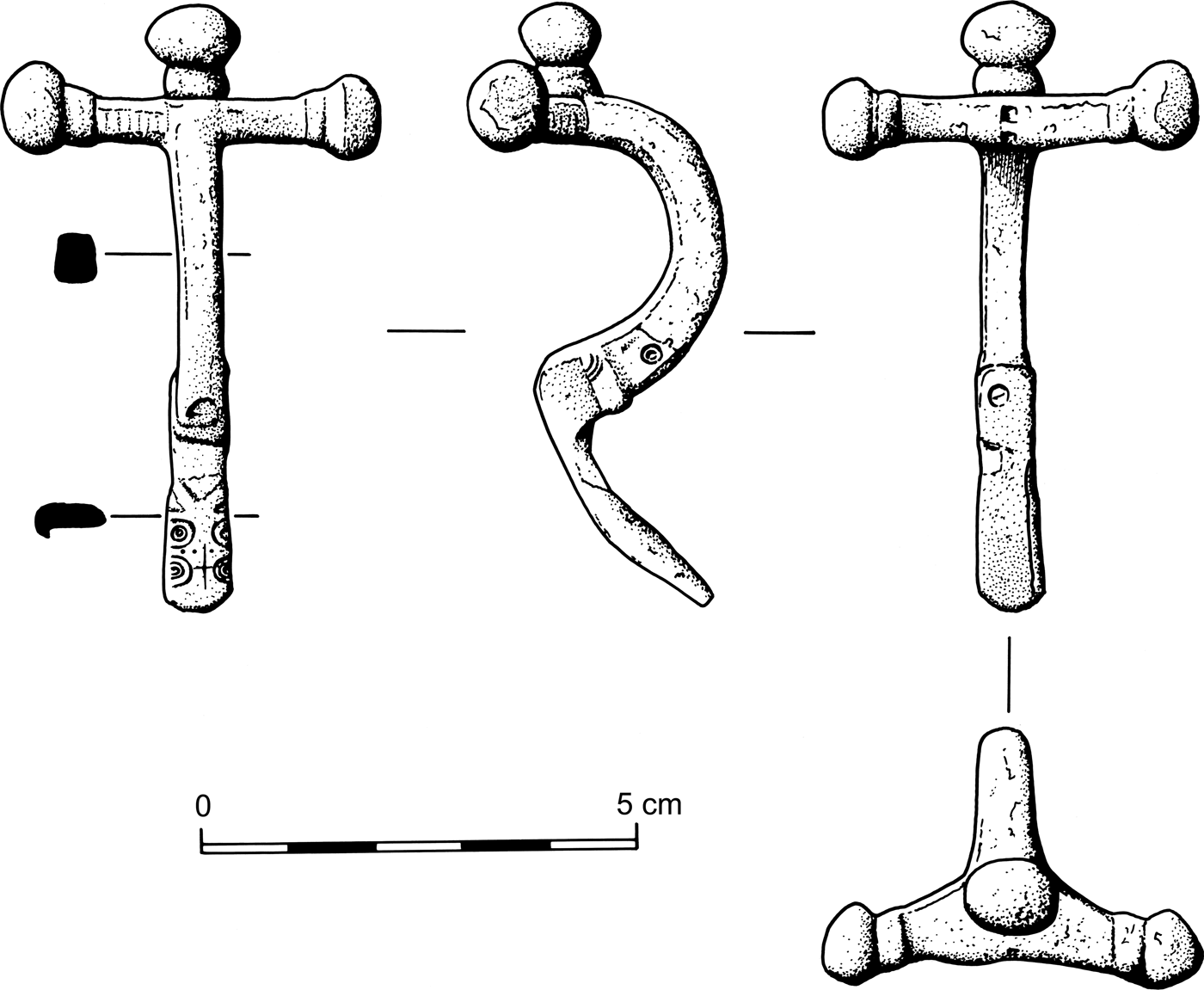
(1) Easter Balgedie (NO 17 04): a copper-alloy crossbow brooch, intact bar the pin, was found by metal-detecting close to the former margins of Loch Leven (fig. 2) and may represent a deliberate deposit.Footnote 11 Such brooches are rare in Scotland.
Crossbow brooch, Easter Balgedie, Perth and Kinross. (Drawn by Alan Braby)

THE ANTONINE WALL
EAST DUNBARTONSHIRE
(1) Bearsden, Boclair Road (NS 553 720): small-scale excavationsFootnote 12 revealed a length of kerbed stone-built wall base perpendicular to the rear of the Wall. Two pottery sherds suggest a Roman date; it may represent a fortlet.Footnote 13
FALKIRK
(1) Mumrills: (a) 34 Polmont Road, Laurieston (NS 9161 7939): excavationFootnote 14 revealed the ditch of the Phase I Antonine fort on its anticipated line.Footnote 15 It was deliberately backfilled and the area occupied with cobble platforms for large buildings and a road when the Phase II annexe was constructed. (b) Birchwood, Laurieston (NS 9163 7942): landscaping had caused significant damage to this area of the annexe, but excavationFootnote 16 revealed surviving building remains associated with quantities of Roman pottery.
SOUTH OF THE ANTONINE WALL
SCOTTISH BORDERS
(1) Newstead (Trimontium) (NT 570 344): a new magnetometer surveyFootnote 17 conducted over the fort and its environs revealed fresh details of the interior and south annexe.
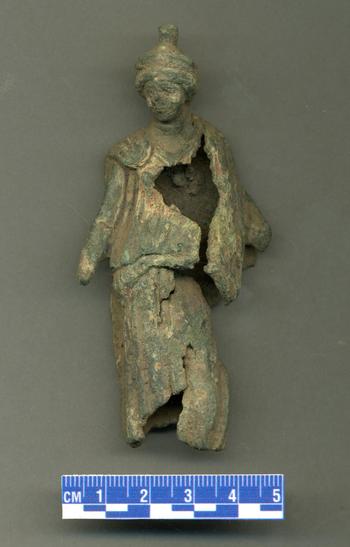
(2) Berryhill (NT 72 35): a hollow-cast copper-alloy statuette of Minerva (in helmet and peplos)Footnote 18 was found by metal-detecting in an area of no known Roman activity (fig. 3).
Statuette of Minerva from Berryhill, Scottish Borders. (By courtesy of the Crown Office)

DUMFRIES & GALLOWAY
(1) Broomholm (NY 3786 8145): geophysical survey over much of this fort siteFootnote 19 confirmed its complexity and revealed considerable internal details (fig. 4). The area normally interpreted as an annexeFootnote 20 has a regular layout of buildings, suggesting it became part of the fort.Footnote 21
Magnetometer survey of Broomholm, overlaid on the fort plan. (By courtesy of Richard Jones)

(2) Dalswinton (NX 94 84): metal-detecting in the vicinity of the fort complex revealed four copper-alloy coins (an as of Vespasian, the others not identified) and nine denarii with a notably early bias: three of the late Republic, one of Marc Antony, three of Tiberius, one of Domitian, and one fragment.Footnote 22 A trumpet brooch was also found.
(3) Carzield (NX 9687 8180): geophysical surveyFootnote 23 to north and east of the fort indicated an area of intense magnetic anomalies beyond the fort and annexe. Some strip-buildings seemingly overlie a sinuous enclosure line which contained most of the anomalies. The location of the bath-house to the north-east of the fort was suggested by surface finds of masonry and tile and supported in the geophysical results.
SUPPLEMENTARY MATERIAL
For Supplementary Material for this article please visit https://doi.org/10.1017/S0068113X19000369