Introduction
Since December 2019, the coronavirus disease 2019 (COVID-19) pandemic has put the health systems in trouble world-wide. Hospitals’ intensive care units (ICUs) and emergency services are particularly at risk due to the COVID-19 outbreak. Reference Katayama, Kiyohara, Kitamura, Hayashida and Shimazu1 Since March 11, 2020, when the first case was seen in Turkey, the emergency services and the Emergency Medical Service (EMS) system have been at the forefront in the fight against the pandemic. In emergency services, optimal care continues to be given simultaneously to COVID-19 and non-COVID-19 critical patients. Since the early days of the pandemic, patients with suspected or confirmed COVID-19 are transferred to the hospital and back home by the EMS system due to dyspnea or to prevent the use of public transportation. 2
During the COVID-19 pandemic, a decrease of 42.0% Reference Hartnett, Kite-Powell and DeVies3 in emergency service admissions and up to 19.7% Reference Weiner, Cash and Hendricks4 in ambulance calls has been reported in the literature. Studies subjecting to the effects of the COVID-19 pandemic on the EMS system have often subjected the numerical changes in ambulance calls Reference Katayama, Kiyohara, Kitamura, Hayashida and Shimazu1,Reference Weiner, Cash and Hendricks4–Reference Lerner, Newgard and Mann6 or the demand for transportation by ambulance of certain patient groups (eg, opiate intake). Reference Slavova, Rock, Bush, Quesinberry and Walsh7 There are insufficient data on the changes in the diagnosis of the patients, the requirements for ambulance transport to the emergency services, and the outcome of the patients. This study aimed to examine the reasons for the ambulance calls of patients brought to the emergency department (ED) of a tertiary hospital by ambulance, the necessity of transportation to the ED by ambulance, and the outcome of these cases with the admissions during the COVID-19 pandemic period, as well as the same period in 2019. This study will help to determine the efficiency of use of the EMS system in the early period of the COVID-19 pandemic when there was a decrease in hospital admissions and the necessary precautions in case of another possible disaster (ie, war, flood, earthquake, or pandemic) occurs.
Materials and Methods
Study Design and Setting
This study is a retrospective descriptive study. The first COVID-19 case in Turkey was seen on March 11, 2020. In order to determine the effect of the pandemic on the use of EMS, the cases during the early period of the COVID-19 pandemic were evaluated. Patients over the age of 18 years who were brought to the ED by ambulance from April 1-30, 2019 (pre-COVID-19 period) and from April 1-30, 2020 (COVID-19 period) were included in the study. Patients whose file information could not be fully accessed were excluded from the study (Figure 1). The study was conducted with the approval of the Republic of Turkey Ministry of Health (Ankara, Turkey; approval number: 2020-04-29T15_32_01) and the approval of the local ethics committee (Date of Approval: May 6, 2020; Meeting Number: 56; Decision Number: 837).
Flow Chart of the Patients Included in the Study.Abbreviations: ED, emergency department; EMS, Emergency Medical Services.aComplete Data: Patients whose file information could be fully accessed were included in the study.

EMS System and Hospitals in Adana City, Turkey
The study was conducted in the ED of a tertiary hospital in Adana, Turkey’s sixth largest city, with a population of 2.5 million and an area of 13,844 km 2 . This hospital has the property of being the second hospital where the most patients were taken by ambulance in 2017. While an average of 296,389 patients are examined in the ED annually, 27,256 of them were admitted via ambulance. 8 There are 1,550 beds in the hospital, of which 274 are intensive care beds. The ED consists of three separate sections: adult emergency, gynecological-obstetric emergency, and pediatric emergency. Apart from this hospital, there are two university hospitals, 12 state hospitals, and 16 private practice hospitals in Adana. In addition, there are 66 ambulance stations in the city, and there are 115 ambulances.
In Turkey, emergency services and the EMS system are offered completely free of charge as a public service. Emergency number 1-1-2 is called to activate the emergency call system. The EMS personnel at the Command and Control Center (CCC) assign the closest and most appropriate team to the scene. The team consists of one paramedic, one emergency medical technician, and one driver. The team transports the patient to the nearest appropriate medical institution according to the medical urgency. Before the patient transfer, EMS staff does not receive confirmation from the hospital where the patient will be transported, but only informs CCC about the clinical status of the case. If the patient has a life-threatening injury or a critical illness, CCC gives information about the case to the hospital where the patient will be transported. 9
Data Collection
Data were accessed through EMS system records, hospital information operating system records, and patient files and were recorded on a uniform data collection form. In addition to the demographic characteristics of the patients, the time of admission to the emergency room, where the patients were brought from (home, hospital, scene of accident), the reason they were transported (medical emergency, trauma), the diagnoses they received in the emergency room, the necessity of moving by ambulance, and their outcome (discharge, ward admission, intensive care admission, dead, referred to another hospital) were recorded. Whether or not the patients were indicated for transfer to the hospital by ambulance was determined according to the presence of conditions such as bodily injury and serious illness, which are included in the scope of the 32 International Medical Emergencies (Table 1) determined by the World Health Organization (WHO; Geneva, Switzerland).
32 International Medical Emergencies Determined by World Health Organization

Sample Size
The sample size was estimated with G*Power for Mac OS X (version 3.1.9.2; Universität Dusseldorf, Germany). Accordingly, with a Type-1 error of 5%, a Type-2 error of 5% (power 95%), and a two-sided analysis, the sample size was determined as 2,564 patients. Considering a possible protocol bias, adding 10% patients to each arm was planned; hence, 2,820 were determined as the minimum number of volunteers to be included.
Outcome
The primary outcomes were the changes in the number and diagnoses of patients who were transferred to the ED by ambulance during the COVID-19 period. The secondary outcome was the need for patients to be transferred to the hospital by ambulance.
Statistical Analysis
SPSS 22 package program (SPSS Inc.; Chicago, Illinois USA) was used for the statistical evaluation of the data obtained in the study. The variables were divided into two categories as categorical and continuous. Comparison of categorical variables was made using the chi-square test. Continuous variables were shown through mean and standard deviation (SD). Categorical data were shown as numbers and percentages. Whether continuous variables were distributed normally or not was calculated by the Kolmogrov-Smirnov test. When the variables were normally distributed, the student’s t-test was used in the comparisons of the two groups, and the Mann Whitney U test was used when the variables were not normally distributed. A value of P <.05 was considered as the statistical significance level.
Results
A total of 24,860 patients were admitted to the ED in April 2019, while 14,516 patients were admitted in April 2020. A 41.6% decrease was found in all ED admissions. While the number of patients transported to the ED by ambulance was 2,683 in April 2019, it was 1,837 patients in April 2020. A 31.5% decrease was detected in the number of patients transported by ambulance during the COVID-19 period.
A total of 4,466 patients (n = 2,647 for 2019 and n = 1,819 for 2020) who were transported to the ED by ambulance, and all data could be accessed, were included in the study.
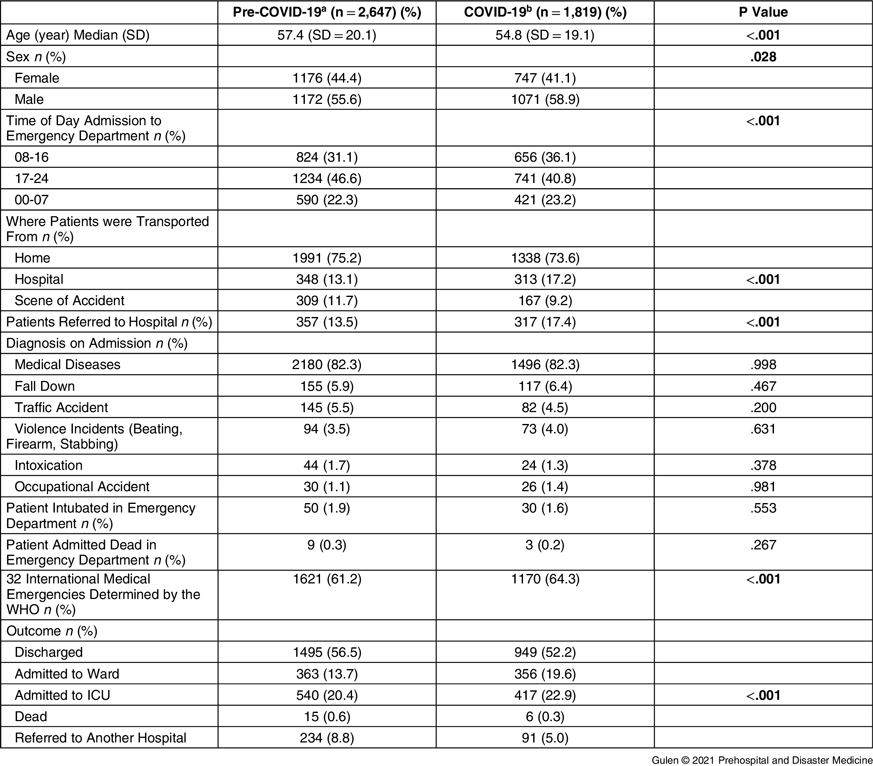
Demographic characteristics and admission details of the patients are shown in Table 2. When the diagnosis types were evaluated, no statistically significant difference was observed between medical emergencies (P = .998), traffic accidents (P = .200), occupational accidents (P = .981), violence incidents (beating, firearm, stabbing; P = .631), falls (P = .467), and intoxication (P = .378) admissions in both periods. The 32 International Medical Emergencies determined by the WHO were evaluated in order to determine the indication for patients to be brought to the hospital by ambulance (Table 1). Accordingly, 61.2% (n = 1,621) of the cases in 2019 and 64.3% (n = 1,170) in 2020 were found to be within the scope of bodily injury and serious illness, and there was a statistically significant difference between them (P <.001).
Characteristics of Patients and Admission Details

Note: Significant differences of April 2020 compared to April 2019 (Chi-Square sig. <.05) is marked by bold font.
Abbreviation: COVID-19, coronavirus disease 2019; ICU, intensive care unit; WHO, World Health Organization.
a April of 2019.
b April of 2020.
When the outcome of the patients in the ED was evaluated, 56.5% of the patients in 2019 and 52.2% in 2020 were discharged from the emergency service, and it was observed that 34.1% of the patients (13.7% ward admission, 20.4% intensive care admission) were hospitalized in 2019 and 42.5% (19.6% ward admission, 22.9% intensive care admission) in 2020. There was a statistically significant difference between the outcomes of the patients according to the years (P <.001). It was observed that referrals to other hospitals due to lack of intensive care beds decreased significantly in 2020 (P <.001).
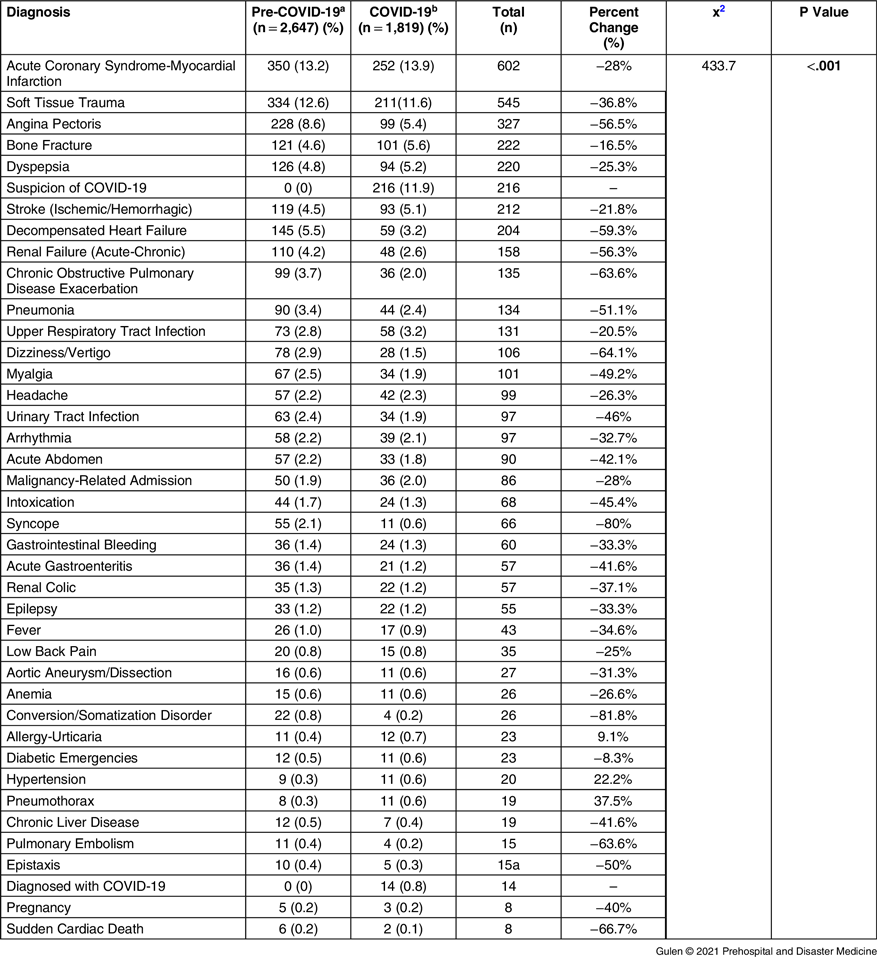
Table 3 shows the diagnoses of all patients transported by ambulance and the percent changes in the number of patients before and after COVID-19. A total of 18.1% (n = 330) of the patients transported in 2020 were transferred by the ambulance team with the suspicion of COVID-19; 0.8% (n = 14) of them were transferred due to COVID-19 real-time polymerase chain reaction/RT-PCR (+) contact isolation precautions. As a result, 65.4% (n = 216) of the patients brought in due to suspicion of COVID-19 were evaluated as suspected of COVID-19. While 22.9% (n = 79) of the 344 patients with known or suspected COVID-19 were discharged, 42.7% (n = 147) were admitted to the ward, 26.5% (n = 91) were admitted to the ICU, 0.9% (n = 3) died in the ED, and 7% (n = 24) were referred to another health institution since there was no empty ICU beds.
Diagnosis of Patients and Percentage Changes in the Number of Patients Before and After COVID-19 Pandemic

Note: Significant differences of April 2020 compared to April 2019 (Chi-Square sig. <.05) is marked by bold font.
Abbreviation: COVID-19, coronavirus disease 2019.
a April of 2019.
b April of 2020.
Table 4 shows life-threatening diagnoses and the percent changes in the number of patients before and after COVID-19. Excluding the transport of 18.9% (n = 344) patients related to COVID-19, the number of transports of other life-threatening emergencies during the pandemic period was 44.9% lower than in the previous year. It was found that the frequency of transporting patients by ambulance was significantly lower in 2020 due to acute exacerbations and complications of life-threatening chronic diseases such as decompensated heart failure (P <.001), chronic obstructive pulmonary disease (COPD) exacerbation (P = .001), and renal failure (acute-chronic; P = .008). Also, it was found that the frequency of transportation by ambulance due to angina pectoris (P <.001) and syncope (P <.001), which are symptoms with high mortality and morbidity, was significantly lower in 2020.
Life-Threatening Diagnoses and Percentage Changes in the Number of Patients Before and After COVID-19

Note: Significant differences of April 2020 compared to April 2019 (Chi-Square sig. <.05) is marked by bold font.
Abbreviation: COVID-19, coronavirus disease 2019.
a April of 2019.
b April of 2020.
Discussion
In April 2020, when this study was conducted, there was a 41.6% decrease in ED visits and a 31.5% decrease in ambulance calls compared to April 2019. The number of critically ill patients transported by ambulance with diagnoses such as decompensated heart failure, COPD exacerbation, renal failure, angina pectoris, and syncope decreased statistically significantly in 2020. Considering the WHO’s 32 International Medical Emergencies for the necessity of transporting patients by ambulance, the proportion of patients increased statistically significantly from 61.2% to 64.3% compared to the previous year. However, 52.2% of the patients transported by ambulance in 2020 consisted of patients who did not require special treatment or were discharged home without hospitalization. This study is the first study in the literature in which the diagnoses of all patients transported by ambulance in the first period of the COVID-19 pandemic and the necessity of transporting by ambulance were examined in detail.
At the beginning of the COVID-19 pandemic in March 2020, hospital’s emergency room admissions where the study was conducted and EMS calls had decreased significantly. By the Republic of Turkey Ministry of Health, numerous measures have been implemented to control the spread of the disease, including social distancing, travel and movement restrictions, closure of schools, and cancellation of events such as cinemas, concerts, theaters, and mass gatherings. Reference Ebrahim, Ahmed, Gozzer, Schlagenhauf and Memish10 Social distancing and restriction of movement are among the most widely accepted non-pharmaceutical measures to prevent human-to-human transmission in the absence of specific antiviral therapy and vaccines. Reference Aledort, Lurie, Wasserman and Bozzette11 In the COVID-19 pandemic, as in previous pandemics, numerous factors such as nosophobia and reluctance to visit hospitals due to increased disease anxiety contributed to the significant reduction in ED visits and ambulance calls. Reference Lau, Griffiths and Choi12 Besides, some patients may not want to use an ambulance since COVID-19 suspected patients with symptoms such as fever and cough were transported in ambulances, and it was thought that COVID-19 was transmitted through aerosolized droplets. Reference Katayama, Kiyohara, Kitamura, Hayashida and Shimazu1 Similar to this study, while there was a decrease in ambulance calls in Japan Reference Katayama, Kiyohara, Kitamura, Hayashida and Shimazu1 and the United States Reference Lerner, Newgard and Mann6 (26.1% decrease), there was an increase in Saudi Arabia Reference Al-Wathinani, Hertelendy and Alhurishi13 (22.1%-27.3% increase). It is thought that this increase was due to the strict lockdown, especially in areas with low population, and patients preferred to be transferred to the hospital via ambulance instead of using their own vehicles. Reference Al-Wathinani, Hertelendy and Alhurishi13
Prehospital emergency services were established to provide rapid transport of critically injured or ill patients to the ED. In the present day, patients’ frequent use of ambulances for non-emergency complaints and injuries strains the capacity of prehospital emergency health services. Reference Knapp, Kerns, Riley and Powers14 Improper ambulance use is a global problem. Reference Silibolatlaz, Gulen, Avci and Satar15–Reference Brown and Sindelar17 In study, despite the decrease in ambulance calls during the COVID-19 period, the calls of patients who did not require special treatment and were discharged from the ED continued to represent a large proportion of ambulance calls. In another study conducted in same hospital in 2018, the patients transported via ambulance were evaluated according to the 32 International Medical Emergencies determined by the WHO. It was seen that 53.7% of the cases were not life-threatening, unnecessary to be transported by ambulance, could admit to the ED on an outpatient basis, or should have been evaluated in outpatient conditions. Reference Silibolatlaz, Gulen, Avci and Satar15 This rate increased significantly at the time of study, from 61.2% in 2019 to 64.3% in 2020. However, 52.2% of the patients in 2020 transferred to the hospital were patients with mild diseases who were discharged from the ED. In the literature, abuse or excessive use of ambulances is associated with the advanced age of the users, their socioeconomic characteristics, the type of social security, and whether they have private cars. Reference Kawakami, Ohshige, Kubota and Tochikubo18,Reference Billittier, Moscati, Janicke, Lerner, Seymour and Olsson19
During the COVID-19 period, when the study was conducted, unnecessary ambulance calls continued, while on the other hand, the decreased in critical diseases applications drew attention. Excluding the transport of 18.9% of patients related to COVID-19, the amount of transport of other life-threatening emergencies during the pandemic period was 44.9% lower than in the previous year. It was observed that the frequency of admission of critically ill patients with high morbidity and mortality, especially decompensated heart failure, COPD attack, renal failure, syncope, and angina pectoris, decreased. The literature has documented a decline in the number of patients admitted to hospitals for acute coronary syndrome in the first months of the pandemic in the United States, Spain, and Austria. Reference Garcia, Albaghdadi and Meraj20–Reference Rodrıguez-Leor, Cid-Alvarez and Ojeda22 More than one-third of patients with myocardial infarction who delayed their admission to the ED stated that the reason for the delay was fear of COVID-19 or unwillingness to be a burden to the hospital. Reference Lerner, Newgard and Mann6,Reference Hammad, Parikh and Tashtish23 There were also reports of reductions in emergency life-saving procedures such as primary percutaneous coronary interventions during this period. Reference Rosenbaum24 The number of visits for conditions such as non-specific chest pain and acute myocardial infarction was reduced, suggesting that some people may delay receiving care for severe conditions that, if left untreated, could result in additional death. Reference Hartnett, Kite-Powell and DeVies3 In study, the decrease in the frequency of admission due to the acute decompensation of chronic diseases suggests that the threshold for calling an ambulance increases due to the fear of contamination, and patients try to find a solution by continuing their current treatment at home and trying to take their medications more regularly. The complete recovery of patients after syncope or the absence of persistent and uncomfortable chest pain may reduce the need for further medical care and the need to call an ambulance due to the fear of contamination in the hospital. However, both syncope and angina pectoris are findings that should be fully examined and may be early indicators of critical situations.
Limitations
There are some limitations to this study. First and foremost, an early and limited period of the pandemic was discussed. The purpose was to determine how much the current restrictions and other emergencies, along with COVID-19 patients, affect the EMS system. Another limitation was that the study was a single-center, retrospective study. Also, due to the design of emergency service, the data of gynecological-obstetric emergency and pediatric emergency patients could not be accessed and evaluated.
Conclusion
In the COVID-19 pandemic, a 31.5% decrease was found in the number of patients transported by ambulance, and a 44.9% decrease in the number of life-threatening emergencies, compared to the same period of the previous year. A statistically significant decrease was found in the number of critically ill patients transported by ambulance, especially with diagnoses such as decompensated heart failure, COPD attack, kidney failure, angina pectoris, and syncope. Understanding how the COVID-19 pandemic is affecting EMS use is important for evaluating the current state of emergency health care and planning to manage possible future outbreaks.
Conflicts of interest/funding
This research did not receive any specific grant from funding agencies in the public, commercial, or not-for-profit sectors. The authors have no conflicts of interests to declare.
Author Contributors
All authors attest to meeting the four ICMJE authorship criteria: (1) Substantial contributions to the conception or design of the work; or the acquisition, analysis, or interpretation of data for the work; AND (2) Drafting the work or revising it critically for important intellectual content; AND (3) Final approval of the version to be published; AND (4) Agreement to be accountable for all aspects of the work in ensuring that questions related to the accuracy or integrity of any part of the work are appropriately investigated and resolved.