

1. Introduction
The structural budget balance (SB) measures the budgetary position of public finances, when the effects of economic cycles and one-off expense and income items are eliminated. It has received a central role in the EU's fiscal policy legislation framework. In the corrective arm of the Stability and Growth Pact, SB will help steer the removal of excessive deficit. In the preventive arm of the Stability and Growth Pact, it specifies the government's general medium-term budgetary objective. In principle, the use of SB clarifies the execution of fiscal policy and its control. Public finances should react to shocks of a cyclical nature with automatic stability measures and, in principle, such measures should be allowed to work in spite of the short-term costs inflicted on public finances. However, if the SB worsens, the related change in fiscal policy can be interpreted as independent of economic cycles, and should be corrected at least in cases where the sustainability of the public finances is in danger. Without steering produced by fiscal policy indicators such as SB, uncertainty about the nature of shocks can easily lead to contradictory policy recommendations, which could, in the worst case, paralyse fiscal policy.Footnote 1
Despite its conceptual clarity, it is challenging to measure SB in practice. This is especially true of the so called output gap-based methods of measuring SB. The methods require assessments on several quantities that are difficult to measure (see for example Reference Mourre, Isbasoiu, Paternoster and SaltoMourre et al., 2013; Reference Havik, Mc Morrow, Orlandi, Planas, Raciborski, Roeger, Rossi, Thum-Thysen and VandermeulenHavik et al., 2014). First, the output gap must be defined, i.e. the difference between actual economic activity and potential economic activity must be estimated. The structural budgetary balance is calculated next, taking account of the historical sensitivity of tax revenue and public expenditure to fluctuations in the output gap. The resulting assessments of the effects of fiscal cycles on the budgetary position of public finances in different countries have been criticised as inadequate during the recent financial and debt crisis. If this is the case, fiscal policy reliant on such indicators is in danger of becoming procyclical.Footnote 2
In this article I assess the challenges in the European Commission's method of calculating SB and consider methodological alternatives to the output gap method. The perspective adopted is that of recent Finnish economic developments between the years 1984–2014. The time period provides rapid swings in Finland's business cycles, from fiscal overheating in the late 1980s through deep crisis in the early 1990s to recovery and growth since the mid-1990s, the IT bubble in the early 2000s, and finally the Great Recession in the late 2000s. The well-documented time period makes it possible to examine in great detail both the functioning of the European Commission's method of calculating SB, as well as alternative indicators that might serve as inputs for tuning fiscal policy.
With regard to the output gap method, I calculate historical estimates for two key components of the output gap (structural unemployment and the potential level of total factor productivity) in 1984–2014. I also examine the plausibility of the Commission's current estimates by comparing them to observations in earlier literature. In addition, I evaluate the method at various points in real time – that is without information on the future development of the economy that would be available later.
The results reinforce the impression of the limited capacity of the output gap method to predict cyclical changes in real time. Therefore, its use for steering fiscal policy – in the EU's fiscal framework for instance – tends to lead to a procyclical fiscal policy (stimulus in upturns and austerity in downturns). For example, fiscal policy guided by an output gap-based SB does not react in a contractionary manner during the economic upswing in the 1980s and early 2000s. On the contrary, the indicator permits fiscal policy to be more expansive than the actual policy, if it had been calculated with real time data. Besides, an output gap-based SB indicator ignores the fairly strong contractionary measures in fiscal policy implemented in the crisis of the early 1990s, thereby leading to even more contractionary policy.
Based on the results, it appears that the method currently used by the Commission may also be hypersensitive to changes in economic trends due to methodological reasons. In particular, estimates about structural unemployment in the recession of the 1990s, that have increased to a fairly high level, indicate that the indicator could overreact to economic cycles. One explanation for this behaviour is provided by the statistically problematic constraints on the parameter estimates that are imposed when applying the estimation.
As methodological alternatives to the output gap method, I will review other fiscal policy evaluation methods used in the EU's legislation framework: the expenditure benchmark in the preventive part, and a bottom-up assessment method in the corrective part of the Stability and Growth Pact. It is important to review alternative methods, since they measure the budgetary position using rather different criteria. Unlike the SB, both the expenditure rule and the bottom-up assessment evaluate potential production in the medium term. Cyclical expenditure items are subtracted from public expenditure more directly than in assessments based on an output gap and standard cyclical elasticity, and the revenue trend is measured based on the observed decisions on a revenue basis and assessments of their effects.
In practice, alternative indicators already form part of the EU's control of fiscal policy. An understanding of the practicality of the various methods is also necessary due to the fact that the EU rules on fiscal policy leave much room for selecting the indicator used to guide fiscal policy (although the output gap method still plays a fairly central role within the rules). In the preventive arm of the Stability and Growth Pact, the actualisation of the medium-term budgetary objective is assessed not only by output gap-based SB, but also by the expenditure rule. According to the expenditure rule, public expenditure may only grow at the same rate as the potential medium-term GDP used as the reference. In the excessive deficit procedure of the corrective arm, the effectiveness of corrective measures is assessed not only via the SB, but also in terms of the number of discretionary measures in question. In practice, such an assessment is based on a method that resembles the expenditure rule very closely. Using this method, cyclical items are eliminated from the expenditure trend, which is then compared to the medium-term growth of potential production, taking account of changes in the revenue basis (bottom-up assessment).
For the analysis of alternative methods, I have collected a new historical time series on the effects of the changes on the revenue basis of the entire public economy (the state, local administration and social funds). Using the data, I analyse how the alternative methods would have worked over the past three decades.
The results are encouraging. Using either the expenditure rule or the bottom-up assessment to guide fiscal policy results in a more countercyclical policy than the output gap-based SB. Fiscal policy based on the expenditure rule is contractionary, especially during the lead-up to the 1990s crisis, and could have helped to alleviate the crisis and increase the margin for recovery measures while it was taking place. On the other hand, based on a discretionary bottom-up assessment, the contractionary fiscal policy practised from 1992 onwards is sufficient and, unlike the output gap-based SB, the method does not generate additional contractionary pressures. It is also noteworthy that in spite of their different assumptions, the methods provide a fairly uniform view of the magnitude of discretionary measures.
In section 2 below, I present the methods used. In section 3, the applied data is introduced, while in section 4 the results of the analysis are reported. Section 5 concludes.
2. Methodology
In this section, I briefly present the output gap-based structural balance and its discretionary alternatives within the EU's fiscal policy legislation framework.
2.1 Structural balance with the Commission's output gap method
In the European Commission's calculation method the structural balance (SB) is calculated on the basis of estimates about the historical sensitivity of tax revenue and public expenditure to fluctuations in the output gap. This is assessed as the difference between the actual fiscal position and the cyclic effects as relative to GDP:

where Rt is public sector revenue, Gt is public sector expenditure and Yt is nominal GDP at year t. The cyclic correction is the product of the output gap (OGt) and the elasticity between the output gap and budgetary balance ε. In the method used by the Commission, the output gap is determined in proportion to the production potential of the entire national economy, and semi-elasticity ε is assumed to be a constant. In addition, the budgetary balance is adjusted in proportion to GDP by using the effect of certain one-off revenue and expenditure items (OOt). Reference Mourre, Isbasoiu, Paternoster and SaltoMourre et al. (2013) review the semi-elasticity ε calculation method in more detail.
Currently, most international institutions (OECD, IMF, European Commission) calculate potential output using the production function method, which enables the efficient utilisation of the available research information on production technology and the behaviour of various factors of production during the assessment of the cyclic phase of the economy. The idea is to aggregate a comprehensive view of the production capacity of the economy (potential production function), based on an economic theory and observations of the state of the various components.
In the method applied by the European Commission (see Reference Havik, Mc Morrow, Orlandi, Planas, Raciborski, Roeger, Rossi, Thum-Thysen and VandermeulenHavik et al., 2014), the production function is assumed to follow the Cobb-Douglas form and it can be presented as

where Yt is total production, Lt total labour input, and Kt physical capital stock. The use of each production factor is controlled by their utilisation rate (ULt, UKt) and the efficiency of use (ELt, EKt). The parameter α measures the expenditure share of labour input of all inputs. Labour input is measured as the total number of work hours, and capital is measured as the amount of capital services, divided into buildings and equipment. The Cobb-Douglas production function allows total factor productivity to be examined separately as the weighted product of efficiency and the utilisation rate.

The output gap can be divided into different components. When the potential magnitude of the components of the production function is known, the percentual deviation from potential can be approximately estimated as the difference between the logarithms of the components

It is worth noting that, in the output gap calculation, the capital stock is not adjusted separately in line with the phase of the economic cycle. Moreover, the quantity of the potential workforce is divided further into several components. This corresponds to the potential workforce adjusted based on the level of structural unemployment, NAWRUt. The potential workforce is the product of the size of the population of working age people  , the average level of participation
 and working hours per employee
 .

The cyclical adjustment of participation and working hours is based on a statistical HP filter. Thus, the assessment of trends does not include a separate economic theory. The population of working age is measured based on the actual number of people of working age.
Here, the focus is particularly on the methods of estimating structural unemployment and total factor productivity.Footnote 3 With regard to distinguishing the cyclical and structural components of unemployment, the Commission uses a general labour market framework whose features are ultimately estimated based on the data and correspond to the predictions of various labour market theories (see Reference Havik, Mc Morrow, Orlandi, Planas, Raciborski, Roeger, Rossi, Thum-Thysen and VandermeulenHavik et al. 2014). Outside the long-term equilibrium, the short-term state of the labour market can be assessed using the Phillips curve. This curve describes the inverse relationship between inflation and cyclical unemployment. Key factors affecting the curve include assumptions about the creation of expectations. The total factor productivity term is also broken down into a cyclical and structural component, but unlike for unemployment, no precisely described theoretical model can be invoked to justify the breakdown. Instead, it is assumed that the cyclical term depends on the underutilisation of economic resources, which is measured using the capacity utilisation rate series and by making assumptions about the duration of the effects of the underlying shocks.Footnote 4
2.2 Critique of the structural budget balance
The measurement of the output gap-based structural balance has been studied quite extensively in the literature, and an increasing number of reservations have been raised concerning its use. The estimation of the output gap is highly sensitive to changes in estimates over time, both due to genuine uncertainty and to the difficulty of selecting the right model (e.g. Reference Orphanides and van NordenOrphanides and van Norden, 2002; Reference RünstlerRünstler, 2002; Reference Planas and RossiPlanas and Rossi, 2004; Reference GolinelliGolinelli, 2008; Reference Marcellino and MussoMarcellino and Musso, 2010; Reference Bouis, Cournède and ChristensenBouis et al., 2012).
The uncertainty relates to various components of the output gap.Footnote 5 First, it concerns the form of the production function. For example, in the Finnish case Reference Jalava, Pohjola, Ripatti and VilmunenJalava et al. (2006) state that the Cobb-Douglas production function (whereby the nominal shares of the factors remain constant) may be statistically applicable in the long term, but not completely adequate for describing Finland's production since World War II. Reference Luoma and LuotoLuoma and Luoto (2010) are of the opinion that a more suitable production function would be the CES (Constant Elasticity of Substitution) production function, whereby the nominal proportions of production inputs may vary as their relative prices change.Footnote 6 Nevertheless, when applied during a crisis, the Cobb Douglas production function can be argued to provide a good estimate of the CES production function, even if the predictions generated by the Cobb Douglas production function would not work in the long term (Reference Havik, Mc Morrow, Orlandi, Planas, Raciborski, Roeger, Rossi, Thum-Thysen and VandermeulenHavik et al., 2014). In any case, in the short run it is very difficult to assess technological development supporting various production factors and the change in respective input proportions. The effect of trends that are often weak but that affect the production function in the long term is dominated by the effect of a crisis on the profitability, efficiency and product demand of companies.
The estimation of the individual components of the output gap also involves uncertainties. For example, with respect to the measurement of cyclical unemployment, recent literature suggests that the behaviour of inflation does not necessarily correspond to the New-Keynesian Phillips curve during major crises, even if it includes backward-looking elements, such as a lagged inflation term. For example, Reference Stock and WatsonStock and Watson (2010) are of the opinion that, in the US, an increase in unemployment does decrease inflation, but this effect wears off when a higher level of unemployment has lasted for eleven quarters. One of the underlying causes of this could be anchored inflation expectations, whose effects during the euro crisis are a topic of discussion, see for example Reference KrugmanKrugman (2013). Wage frictions (for example, pressure not to reduce nominal wages) can affect the relation between inflation and unemployment in such a way that it does not correspond to the New-Keynesian Phillips curve (Reference Daly and HobijnDaly and Hobijn, 2013). In the Finnish case, there is clear evidence of fairly substantial wage inelasticity in the crisis of the early 1990s (Reference Gorodnichenko, Mendoza and TesarGorodnichenko et al., 2012).
Another key challenge is the estimation of the total-factor productivity (TFP) gap. The interpretation and forecasting of TFP growth can be problematic as it is measured as a residual growth of output after the influence of production factor growth is accounted for. Thus, TFP growth may result from a multitude of factors, such as capacity utilisation, increasing returns to scale, mark-ups due to imperfect competition, or gains from sectoral reallocations, as well as measurement errors of the inputs.Footnote 7 Furthermore, TFP is subjected to major trend volatility that makes it difficult to assess its potential level. In this respect, Finland provides an illustrative example. In each major economic crisis of the past 30 years, the Finnish economy has suffered from surprise structural shocks that have persistently affected productivity (the Soviet trade collapse in the early 1990s and the recent collapse of Nokia in the late 2000s). The shocks have been largely unanticipated and their aggregate productivity impacts have been hard to predict. The recent crisis shows that the uncertainty regarding long-term productivity growth is not unique to Finland.Footnote 8
All in all, a look at the Commission's method in the present crisis confirms that revisions of the output gap have been large. For example, Reference VirkolaVirkola (2014) reviews the revisions made to the European Commission's output gap methods, and reports that the changes to output gap estimates in 2000–2013 amounted to 1.5 percentage points on average during the crisis.
Challenges associated with the calculation of the output gap-based SB are not, however, limited to the difficulty of measuring the output gap, but also relate to the difficulty of modelling the reactions of the public economy to cyclic shocks. Firstly, a cycle-independent budget should not contain individual expenditure and revenue items that have no clear connection to the long-term balance. Although it is easy to eliminate one-off items from the budget in principle, problems occur when trying to define which items are temporary or large enough (European Commission, 2006). Secondly, the budget balance of the public finances can depend on fluctuations in asset and commodity prices that correlate only weakly with economic cycles (see for example Reference Eschenbach and SchuknechtEschenbach and Schuknecht, 2002; Reference Price and DangPrice and Dang, 2011). In addition, economic crises and their aftermaths are associated with structural and legal reforms that do not treat every sector and public finance revenue base equally. Taking them into account requires an alternative approach to SB calculation, since calculations based on an aggregated output gap assume that economic upswings and downswings are symmetrical and thus neutral towards sources of tax revenue (Reference Kremer, Rodrigues Braz, Brosens, Langenus, Momigliano and SpolanderKremer et al., 2006; Reference MorrisMorris, 2007; Reference WolswijkWolswijk, 2007; Reference Barrios and FargnoliBarrios and Fargnoli, 2010).
2.3 The alternative indicators
I evaluate alternative indicators that have recently been presented as solutions to the problems presented above within the EU's fiscal policy legislation framework. These comprise the expenditure rule within the preventive arm of the SGP, which is defined in the Commission's vade mecum guidelines (2013a, 2016). The purpose of the expenditure rule is to ensure that the countries remain committed to their medium-term objectives (MTO) or a path of adjustments leading to it. On the other hand, the excessive deficit procedure in the SGP's corrective arm assesses the outcomes of actions that seek to correct the budgetary position by means of a bottom-up assessment. It resembles very closely the expenditure rule in the preventive arm in methodological terms. The latter indicator is discussed by the European Commission (2013b) and Reference Carnot and de CastroCarnot and de Castro (2015), amongst others.
The starting point in both alternative indicators is the direct analysis of detected policy changes instead of indirect assessments based on the output gap method. In principle, it is easy to monitor changes in economic policy on the revenue side: economic policy is essentially neutral if no new decisions are made. The combined effects of new decisions can be interpreted as a change in fiscal policy.
On the other hand, there is no corresponding distinct neutral reference point on the expenditure side, as changes in the expenditures involve more automatic responses to economic conditions, but the growth in expenditure must somehow be quantified in reference to other developments in the aggregate economy. Changes in fiscal policy are measured based on the growth rate of aggregated expenditures, with various cyclical items being eliminated, as relative to the potential medium-term growth in GDP.Footnote 9 A fiscal policy can be interpreted as neutral if it will not change the expenditure proportion of GDP according to the adjusted expenditure in the medium term. On the other hand, if the adjusted expenditure growth rate exceeds the potential growth of GDP in the medium term, the fiscal policy must be interpreted to have changed, particularly if the difference will not be compensated with discretionary measures on the revenue side.
In the following, I will examine alternative indicators in more detail. In the case of the expenditure rule, revenue base changes and various cyclical items are subtracted from public expenditure

where in year t, Gt is total public expenditure, INTt interest expenses, EUt the country's share of EU structural fund projects, It public investment expenditure, average public investment expenditure in the current and three previous years, and UCt cycle-related variation in unemployment expenditure. Unemployment expenditures due to economic cycles are assessed based on an estimate of the magnitude of cyclical unemployment (derived from the magnitude of structural unemployment) and average unemployment expenses per unemployed person.
The change in adjusted aggregated expenditures is calculated further, taking account of the discretionary change in revenue  (and certain expenses funded by earmarked revenue) in such a way that the proportional change in expenses is

The growth rate of expenses is deflated using the price change in GDP. Using the method of calculating the expense rule, inflation is measured as the average of the Commission's previous year's spring and autumn inflation forecasts for the current year. Let us express the real change as  .
The estimate of growth potential is based on the potential change in the level of production by the aggregate economy in the medium term. When the growth rate of expenditure equals the potential growth rate of production, the economy does not include a tendency to increase or decrease public demand in proportion to GDP in the medium term. Based on the Commission's suggestion, the potential growth rate is defined as the average based on observations of the growth rate of potential GDP during the last five years and forecasts of the growth rate for four years into the future:

where  is potential (real) production at a particular point of time t.
When the adjusted expenditure aggregate has been calculated, its real growth  can be compared to the growth potential of the aggregate economy
 . A useful result is that the growth of expenditure aggregate must undershoot the reference growth rate by
 , to have the corresponding proportion of expenditure to GDP fall by × per cent, where Et/Yt is the nominal GDP proportion of the expenditure variable used.
In a bottom-up estimate, the definition of the adjusted expenditure aggregate is slightly different from the expenditure benchmark. The expenditure aggregate is defined by first subtracting the non-discretionary unemployment expenditure (Gt) interest expenses of public bodies ( ) and one-off expenditure items (It) from the total expenditure of public bodies (OOt):

The change rate of expenditure is estimated as above

The discretionary fiscal effort (DFEt) resulting from the nominal difference between the expenditure variable and reference growth indicates their impact on the change in the proportion of expenses in GDP between years t and t–1. I define DFE in the same way as the European Commission (2013b) and Reference Carnot and de CastroCarnot and de Castro (2015), as the difference between growth rates divided by the GDP ratio of the expenditure aggregate, as follows:

where the reference growth of potential production is now defined as nominal  In the last breakdown, the indicator is further divided into the impact of revenue based changes (
 ) and the change in expenditure related to potential (
 ).
Subject to reservations due to the differences in the methods, both the DFE indicator and SB can measure the same cycle-independent change in the budgetary position. If the DFE indicator is positive by 1 percentage point, the growth rate of expenditure (with an adjusted expense aggregate and taking the revenue side into account) is estimated to be so slow that the budgetary position is strengthened on a discretionary basis by 1 percentage point.
The theoretical connection between the output gap-based SB and the DFE indicator defined by aggregated expenditures used in a bottom-up assessment has been reviewed by the European Commission (2013b, box III.2.1) and Reference Carnot and de CastroCarnot and de Castro (2015, Appendix 1). In principle, the indicators are equivalent: during long-term growth equilibrium, where the elasticity of revenue and expenditure items is close to the averages estimated using the fixed elasticity method and economic growth remains stable, very similar results should be yielded by the different methods. However, differences may appear in the case of a large shock. Based on the breakdowns of the two indicators, it becomes apparent that the differences on the revenue side are explained by changes in expenditure elasticity in cycles (such as windfall revenue), deviations in income class proportions from their fixed shares according to the fixed elasticity method, and changes generated by potential output in the long-term ratio of revenue and GDP. Of the above, changes in cyclical elasticities associated with windfall revenue are by far the most significant explanatory factor according to Reference Carnot and de CastroCarnot and de Castro (2015). On the expenditure side, the differences are mainly explained by unemployment expenditure that cannot be directly attributed to cycles, differences in methods of measuring potential output, or interest expenses.
3. Data
3.1 Data used in the evaluations of the output-gap method
I mainly use the data from the European Commission's autumn 2014 forecast as material. This comprises a time series on unemployment ranging from 1963 to 2016. The data between 2014 and 2016 comprise forecasts. The inflation variable used in the Phillips curve is the change in unit labour costs. The unit labour cost is equal to wage inflation less the labour productivity growth rate and the change in consumer prices. The material extends up to 2014, while the data for 2014 are the forecasts by the Commission.Footnote 10
In addition, the data consist of the total-factor productivity series which the Commission calculates using real GDP, capital and labour series, as well as their expenditure shares of the inputs in production. The figures for 2014–16 are based on the Commission's forecasts.
It also includes a capacity utilisation rate series, which is a collection of business cycle indicators describing economic activity (Reference Havik, Mc Morrow, Orlandi, Planas, Raciborski, Roeger, Rossi, Thum-Thysen and VandermeulenHavik et al., 2014). The series' components consist of the industrial capacity utilisation rate as well as service sector and construction sector confidence indicators. The indicators are weighted with the shares of total output of the economy attributable to different sectors, and their standard deviations are normalised in such a way that the deviations correspond to the standard deviation of the value added for the sector. Business cycle indicators are published quarterly, and the data for 2014 is based on the average of the first three quarters.
When analysing the data used by the Commission, a point worth noting is that the capacity utilisation rate series only extends to 1996. The worst crisis years of the 1990s recession, for example, are therefore missing from the data. Therefore I also make use of another indicator series: estimates by industrial enterprises regarding their order books in relation to the norm, which I compiled by chaining indicator series BTEOLRSL and BTEOLL:B8S of the Confederation of Finnish Industries (EK). The data have been available since 1976; they thus include data on the 1990s crisis. Further analysis provided by Reference KuusiKuusi (2015) suggests that the use of the alternative indicators yields very similar results.
Finally, the government budget balance series is taken from the AMECO database in the spring of 2015.
3.2 Data used in the evaluations of the alternative measures
For a historical assessment of alternative indicators, I need information on revenue-related policy changes implemented in public finances (including central government, municipalities and social funds). With respect to central government finances, the data I have collected for this paper contain information on the estimated effects of changes in tax policy as provided by the Financial Status Reports 1977–2002. After the year 2002, the reports are no longer available in the same form. Therefore, I have evaluated the changes in the tax policy against the government's budget proposals for 2003–8. With respect to the period 2009–14, I received the necessary information from the Ministry of Finance. The Ministry's data also include information on various types of deductions concerning the whole public sector. In addition to state taxation, I will examine the effects of policy changes made in general government finances. With respect to the period 2009–14, I will use the evaluations of the Ministry of Finance. As for the preceding years, 1977–2008, I could not find direct estimates of the effects of changes made to the criteria for charges on revenues, so I used the observed changes in charge percentages as the basis for the effect estimates of the decisions.
I will evaluate local government finances' revenue estimates on the basis of changes in the weighted average local income tax rate and the real estate tax rate. I will calculate the euro-denominated effect of the change by multiplying the change in the tax base with the tax basis of the previous year, which in the case of local income tax means private income and in the case of real estate tax the taxable value of real estate. As for social insurance funds, I will evaluate the changes on the basis of the average social insurance contributions (employer's child benefit, accident, health, national pension, unemployment and TEL contributions and employee's unemployment and TEL contributions), expressed as percentages of the payroll. I will multiply the change in these with the previous year's total payroll.
The number of discretionary measures on the revenue side in my calculations corresponds fairly well to previous assessments (for more details, see Reference KuusiKuusi 2015). Reference PerottiPerotti (2011) assessed discretionary total changes on the revenue side with regard to Finland during the crisis of the 1990s. The calculations that have now been completed reinforce the impression presented in the article that the revenue basis had a major impact on the overall balance of public finances during the crisis. However, the results differ from the earlier evaluations by the IMF (see Reference PerottiPerotti, 2011), according to which public finances were not adjusted by increasing revenues but by cutting expenditure. In addition, the Commission's figures for 2010–14 from the AMECO database (UDMGCR variable) are also parallel with the estimates used in this work.
In addition to the evaluation of changes in the revenue basis, I have collected other variables needed for the calculation of alternative discretionary measures. Potential output growth estimates for 2011–14 are based on reference values provided by the Commission to the individual member states. Potential output growth estimates for 2002–10 are based on the estimates made by the Commission in the autumn of the same year, by applying the production function method. Potential output growth estimates for 1989–2001 are based on the estimates made by the OECD at the end of the same year on average growth for the following two years and the preceding five years. With respect to the 1980s, I have estimated potential output growth on the basis of the average five-year growth forecast made by ETLA (the Research Institute of the Finnish Economy) in the same year.
With respect to the expenditure benchmark, I will use the GDP inflation projections as inflation series. For the years 2001–14, these are the European Commission's forecast averages from the previous year's spring and autumn. For the years prior to that, I will use the previous year's average inflation forecasts made by the Ministry of Finance. With respect to bottom-up evaluation, I will use the actual change in the GDP price.
For the other variables, I have followed the principle of trying to find the longest time series possible in order to enable a historical assessment. As expenditure series, G, I have selected a time series, published by the IMF, for general government total expenditure because this covers the longest period from the early 1980s onwards. In addition, I have used the Ministry of Social Affairs and Health's information on unemployment expenditure, which I will eliminate from the expenditure aggregate related to the bottom-up evaluation and, with respect to the expenditure benchmark, from the expenditure aggregate related to cyclical unemployment expenditure.
As interest expenditure, I will use the time series given for property expenditure. The amount of public investment is based on the figures obtained from the National Accounts.Footnote 11
The data on Finland's shares of EU structural funds are based on the data for 2010–14 obtained from the audit memorandum prepared by the National Audit Office of Finland regarding compliance with the Stability and Growth Pact. Due to lack of preceding observations, I will set these to zero prior to the year 2010. Likewise, I will not assess the amount of non-recurring items since the related evaluations are not available for the entire period in question. In any case, since they have also been eliminated from the output gap-based structural balance indicator presented by the Commission, they are not essential for comparison purposes.
4. Results
4.1 Evaluations of structural unemployment and total factor productivity
In the following, I will first examine the method for calculating structural unemployment. The short-term state of the labour market can be assessed with the help of the New-Keynesian Phillips curve, which describes the inverse relationship between (wage) inflation and unemployment. In principle, the connection to structural unemployment is clear. If inflation reacts to an increase in cyclical unemployment, the detected connection can be reversed, and the increase in cyclical unemployment can be specified efficiently with the help of inflation. Thereafter, structural unemployment can be achieved by removing the cyclical part from detected unemployment. In practice, however, price stickiness in major economic crises due to anchored inflation expectations or pressures not to lower wages have turned out to be problematic with regard to the assessment of cyclical unemployment (IFAC, 2013; Reference Wren-LewisWren-Lewis, 2013; Reference KrugmanKrugman, 2013). If they are not sufficiently taken into account in the models – or if the models do not identify them correctly – the result may be oversized assessments regarding the development of structural unemployment. Based on changes in inflation, an increase in unemployment can be considered structural, although it would in fact be cyclical. The output gap will be underestimated, as the increase in structural unemployment does not increase the output gap.
Explaining unemployment with the inflation indicatorFootnote 12 used by the Commission is also problematic in Finland's case. There was no clear unambiguous connection between the variables, in particular during the crisis of the early 1990s (see the left panel in figure 1). During the years of highest unemployment, strong inflation would have been required in order for such a connection to have been observed. This could not, however, be discerned on the basis of the data. The highest unemployment estimates were specifically for these years, based on the Commission's method (see the right panel in figure 1).
Evaluations of structural unemployment

In addition, special attention should be paid to the fact that the Commission imposes inequality constraints on the parameter estimates when applying the estimation. In the Finnish case, the constraint restricts the maximum size of the cyclical change in unemployment forecasted by the model, insofar as the New-Keynesian Phillips curve does not directly explain it. Using the restrictions could lead us to underestimate the amount of cyclical unemployment (see Appendix A for further details). I recommend that the parameterisation of the method used for calculating structural unemployment be changed to correspond better to a plausible model based on the literature and observations outside the model. When the constraint used in the parameter estimation is removed, structural unemployment increases more moderately during the crisis of the early 1990s (see the right panel in figure 1).Footnote 13
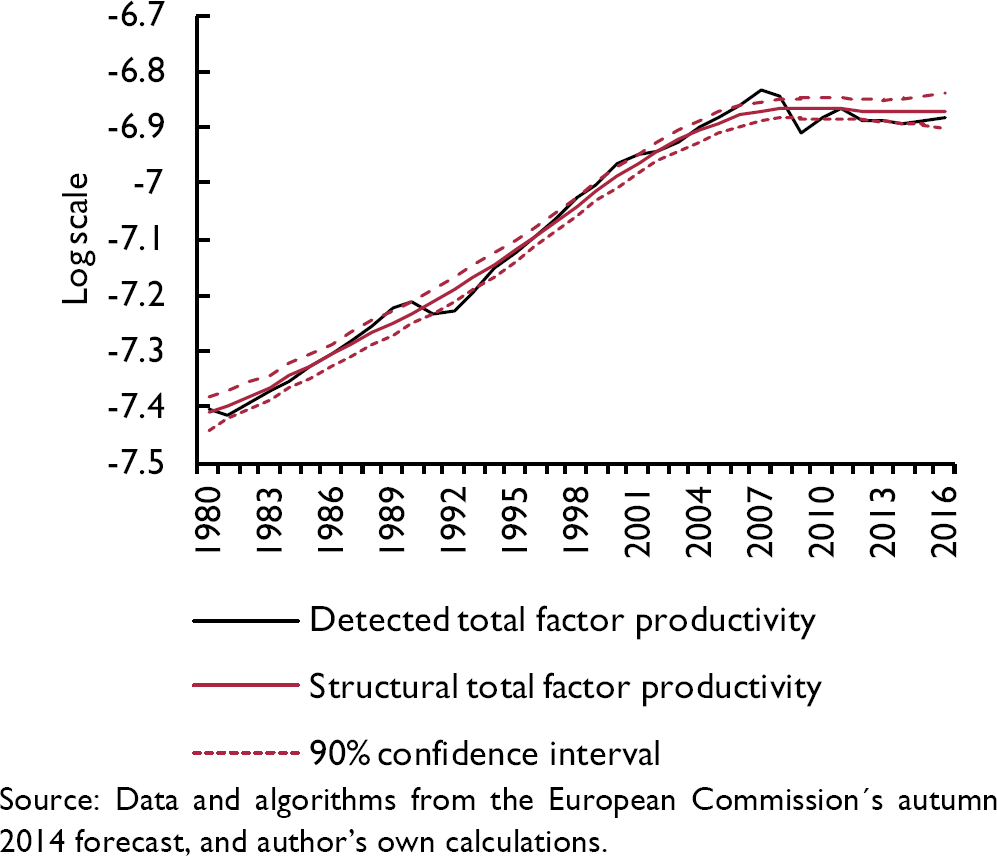
I have also examined the European Commission's assessments of structural total factor productivity. Figure 2 shows the natural logarithm of structural total productivity and an assessment of potential total factor productivity with the Commission's calculation method for 1980–2016. The dominant feature in the figure is the strong slowing of the total factor productivity growth rate after 2007. During the present crisis, the development of total factor productivity has been the main factor affecting potential output. For example, compared to the recession in the 1990s, the halt in total factor productivity growth has lasted significantly longer. Total productivity reached 1989 levels only a couple of years after the start of the crisis, whereas, during the current crisis, total factor productivity was still far from the 2007 level in 2014.
Evaluations of total factor productivity

While similar patterns are also seen elsewhere, reasons for the weak development of Finland's total factor productivity during the economic crisis have been searched for, particularly in the industry-level shocks that have hit the economy. It has been argued that the fall in total factor productivity is due to problems in the Nokia-driven ICT cluster and in the paper and mechanical engineering industries. On the basis of productivity growth from sector to sector, and when Finland is compared to Sweden and the United States, it appears that the rather gloomy assessments about the development of total factor productivity that have been calculated using the Commission's method are fair. When the development of total factor productivity is examined over various periods of time in Finland, Sweden and the United States, for example, it becomes evident that its growth rate has been on average very similar in those countries in 1995–2014. Following the crisis, the strong growth effect of ICT prior to the economic crisis is stabilising in the Nordic countries to the same level as in the United States.
4.2 Evaluations of the structural balance
When the gap estimates for different components have been calculated, they can be aggregated as an output gap in the economy. Measuring the structural budget balance used by the Commission is fairly straightforward. The estimated output gap is multiplied by cyclical elasticity (e) and income is subtracted from the headline balance. I use the estimate of 0.57 provided by the Ministry of Finance in the spring of 2015 as the cyclical elasticity.
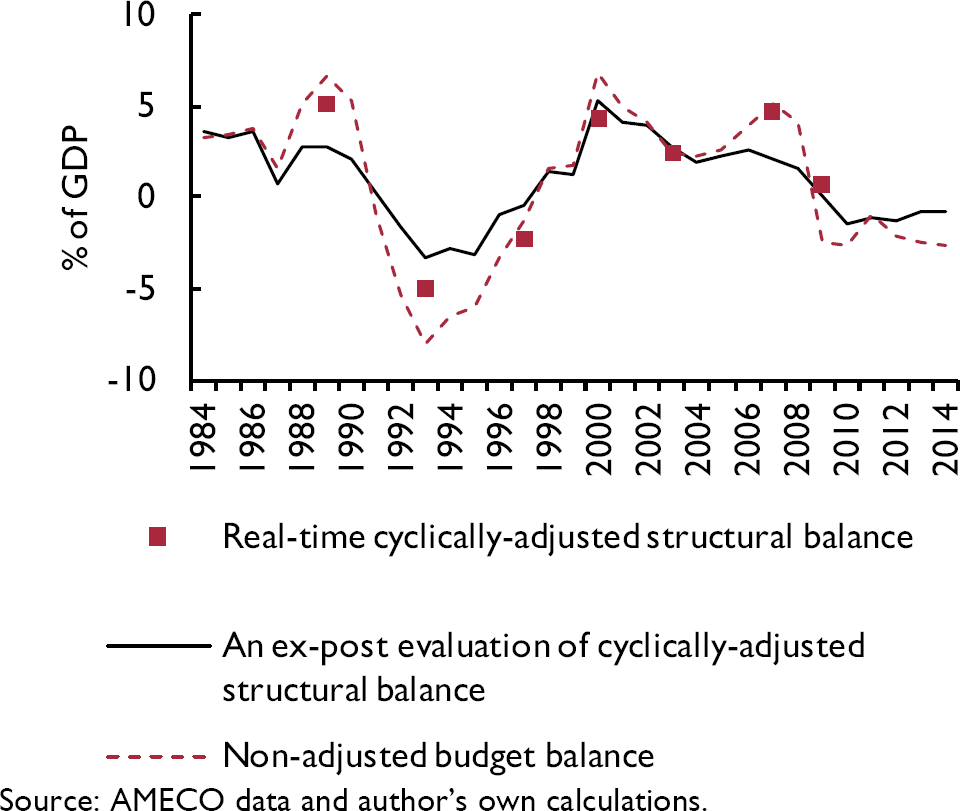
Figure 3 shows alternative structural balance estimates as well as a series of non-adjusted balance retrieved from the AMECO database. I have first calculated an ex post evaluation of a cyclical correction (an ex post evaluation of cyclically-adjusted structural balance) using the method recommended in the report by Reference KuusiKuusi (2015); that is, I based structural unemployment on an assessment in which the above-mentioned parameter constraint has not been used.Footnote 14 In addition, I evaluated the operation of the indicator in (quasi) real time, without information on future development of the variables that are used in the estimation. I calculate the estimate after constraining the data being used at different points in time.Footnote 15 I adjust the output gap estimate that I recommended, which does not contain parameter constraints, for key turning years in the economic cycle (1989, 1993, 1997, 2001, 2003, 2007 and 2009) by changing the ex post estimate of total productivity and structural unemployment to real-time estimates (real-time cyclically-adjusted balance). I will make the adjustment by removing the difference between the ex post estimate and real-time estimate of both components from the output gap. At the same time, I do not comment on the real-time cyclical adjustment of other output gap components, such as the participation rate. The GDP and nominal deficit estimates are also ex post.
Evaluations of the ex post and real time structural balance

Real time has a considerable effect on the indicator's functioning. When estimates of total factor productivity and structural unemployment are based on data which take no account of the trend for future years, the structural balance proves to be considerably more procyclical.Footnote 16 In real time, the structural balance has deviated materially from the ex post estimate in two of the three expansions in recent decades (1989, 2000, 2007). The structural balance is overestimated by approximately 1.3 percentage points with respect to three business cycle peaks, on average. In addition, the real-time structural balance underestimated the deficit component due to the economic crisis when the downturn of the early 1990s had already begun. For example, the 1993 ex post estimate of the structural contribution to the total deficit is approximately 35 per cent, while the real-time estimate would have been approximately 60 per cent.
The results suggest that the output gap method has limited capacity to predict cyclical changes in real time and, therefore, its use for steering fiscal policy could lead to a procyclical fiscal policy. On the basis of the figure, it seems that fiscal policy guided by an output gap-based SB does not react in a contractionary manner during the economic upswing in the 1980s and early 2000s. On the contrary, the indicator permits a fiscal policy that is more expansive than the actual fiscal policy, if it is calculated without the future development of the economy that would be available later. Besides, an output gap-based SB indicator ignores the fairly strong contractionary measures in fiscal policy implemented in the crisis in the early 1990s.
It should be noted that the real-time results presented are not without problems. Firstly, the real-time estimate of the present output gap may underestimate the accuracy of the Commission's estimate, as the Commission uses forecasts of the trend for future years to support the estimate. If the forecasts are informative regarding cyclical change, they can improve the model's accuracy. On the other hand, revisions may have taken place in the data used which are not taken into account by ex post cutting of the data. It should also be noted that the assessment of the real-time gap does not take into account the effect of changes in other output gap components (such as participation). Likewise, I will not assess the amount of one-off items since the related evaluations are not available for the entire period in question.
However, earlier literature would seem to indicate that there are no major differences between realised forecasts and quasi real-time assessments such as the one presented here. Reference KuusiKuusi (2014) compared quasi real-time output gaps with the Commission's genuine real-time estimates, and the results achieved with the method did not significantly deviate from each other. The average difference in the output gap estimates was about ½ a percentage point in 2006–12, which corresponds to about a ¼ percentage point effect on the structural deficit. Reference VirkolaVirkola (2013) also examined the Commission's revisions in respect of 2007 and observed that real ex post revisions to the output gap in Finland were on the same scale as the estimates currently shown, i.e. approximately 5 percentage points. Since the one-off measures are eliminated from both the output-gap based structural balance and the discretionary fiscal policy measures, they are not essential for comparison purposes.Footnote 17
4.3 The bottom-up alternatives
In figure 4, I present assessments on the amount of discretionary fiscal efforts based on the bottom-up method and the DFE indicator specified above. By applying this method, an increase of 1 percentage point in the DFE indicator improves the structural balance by 1 percentage point. The cumulative change, on the other hand, indicates the total change in the budgetary position within a certain time period.
Evaluations of the policy stance using the top-down and bottom-up methods

I will focus here on assessments according to the bottom-up method, as they do not use ex post data on the development of the economy. In that way, the presented method offers a real-time baseline for the SB. For comparison, the figure contains the real-time cyclically-adjusted balance and the non-adjusted balance presented in the previous subsection. As discussed above, both indicators are estimated without the information on the one-off measures. Figure 4 also shows the DFE indicator based on the expenditure aggregate, which is calculated based on the expenditure rule. The adjustment items for different types of expenditure have a relatively minor effect on the resulting interpretation of fiscal policy developments. On the other hand, the differences between the assessments are almost fully attributable to the inflation variables used.Footnote 18
On the basis of figure 4, a fiscal policy steered by discretionary measures could have become more countercyclical than a policy steered by SB. During the economic upswings in the 1980s and the 2000s, fiscal policy is stimulative when measured using a discretionary assessment.Footnote 19 This observation enables (1) the fiscal policy guided by the method to be tighter during the upswings, (2) the control of the overheating of the economy and (3) creation of a margin for recovery measures during the crisis. In comparison, before the outbreak of each of the two major crises, the real-time structural balance based on the output gap method was exceptionally strong, which could have enabled the continuation of a stimulative fiscal policy during the upturns.
On the other hand, the tightening of the fiscal policy after the outbreak of the crisis in the 1990s is clearly visible on the basis of the discretionary indicator. In particular, the significant tightening on the revenue side of social insurance contributions explains the strong increase in the discretionary indicator. After the outbreak of the crisis, the measured fiscal policy was tightened rapidly from 1992 onwards and continued throughout the 1990s. The observation could have enabled the use of a more stimulative fiscal policy. When comparing the results to the development of the output gap-based structural balance (see figure 3), we can see that, on the basis of the latter, the tightening of fiscal policy did not begin until after the mid-1990s even as an ex post evaluation.
Measured by both indicators, fiscal policy was stimulative at the initial stage of the present crisis, but from 2011 onwards, the indicators diverge again as the discretionary fiscal effort indicator suggests a 2–3 percentage point tightening of fiscal policy in 2010–14, whereas the ex post structural balance indicator (in figure 3) shows hardly any signs of improved public finances.
In order further to illustrate the difference between the indicators in terms of cyclical behaviour, I have compared the ex post changes in the output gap to the change in various fiscal policy indicators in 1984–9, 1989–93, 1993–7, 1997–2000, 2000–3, 2003–7 and 2007–9.Footnote 20 Based on a cross-tabulation, a 1 percentage-point growth in the (ex post) output gap would have weakened the real-time structural balance by approximately 0.65 percentage points. Meanwhile, the bottom-up assessment method does not indicate a clear connection between the cyclical change and indicator developments.
What explains the differences between the methods? First, similarly to the European Commission (2013b) and Reference Carnot and de CastroCarnot and de Castro (2015), I compare the developments in the structural balance net of interest expenses with the bottom-up method. After netting interest expenses, the differences between the indicators are more clearly attributable to methodological factors, such as different cyclical adjustments of revenue and expenditure items and a different method of calculating the potential output growth rate. The comparison between the real-time cyclically-adjusted structural balance and the structural primary balance suggests that the interest expenses explain around 15 per cent of the cyclical changes in the real-time structural balance, while the rest is explained by methodological differences.
Second, by means of changes in the revenue basis, the cyclical development of revenue items can be directly examined in different years, instead of using the output gap and fixed cyclical elasticity. I will do this by first eliminating the discretionary changes related to the various income types presented above (for methodological details see Reference KuusiKuusi, 2015, appendix 4; Reference Carnot and de CastroCarnot and De Castro, 2015). In principle, the remaining element of income development can be evaluated as a (cyclical) change independent of fiscal policy, while naturally taking account of any errors in the effects of the related decisions. The results of the analysis suggest that changes in cyclical income in relation to cyclical income evaluated using fixed elasticities may explain various percentage points of the differences in the changes in the structural balance according to the different indicators. In particular, the analysis of the late 1980s and early 2000s suggests that the income growth experienced during the economic upturn exceeded the estimates produced using the output gap method. In downturns, on the other hand, it appears that the differences are attributable to different cyclical adjustments to unemployment expenditure and the different method of calculating the potential output growth rate.
4.4 Indicator differences from the viewpoint of EU regulations
I have also evaluated how the indicators would have steered financial policy in practice if the EU's fiscal policy rules had been followed over this period. I collect the observations from the previous analysis, and examine the regulatory requirements that the country would have faced in different time periods. The rules are based on a summary of the criteria applied regarding deviations from the rules of the preventive and corrective arms of the SGP (European Commission 2013a, 2016):
Deviation in the preventive arm:
The deviation from the medium-term objective (MTO),Footnote 21 was more than 0.25 per cent of GDP in the previous year (ex post assessment) and
the nominal deficit does not exceed 3 per cent, i.e. the country is not subject to the corrective arm of the SGPFootnote 22and
on the path towards the MTO, the structural balance improves by less than 0.5 percentage points and
the structural deviation from the path (ex post) is significant, i.e. at least 0.5 per cent of GDP and
the deviation is significant from the viewpoint of both the structural balance and the expenditure benchmark while taking account of the cyclical state in accordance with the guidelines of the European Commission (2015, appendix 2).
Deviation in the corrective arm:
The nominal deficit exceeds 3 per cent and
the measures are not effective, i.e. the country is unable to adjust its structural budgetary position by at least 0.5 percentage points (structural balance adjustment path) and
the structural deviation from the path (ex post) is significant, i.e. at least 0.5 percentage points per year and
the deviation is significant in terms of both the structural balance and the bottom-up assessment.
The analysis shows that in many years during economic upturns (1985–8, 2004–5, and 2007–9) Finland would have achieved the MTO based on the real-time structural balance, but at the same time would not have achieved the expenditure growth rate required by the expenditure benchmark, or would have been close to exceeding it. The major strengthening in the structural balance that preceded the crisis of the early 1990s and the current crisis could have allowed an expansion in the public finances. During both periods, the structural balance was rather strong, as measured on the basis of both ex post and real time output gap estimates. At the same time, the expenditure benchmark might have imposed stricter limits on fiscal policy during these years.
Between the years 1993–6, during which the legislation related to the corrective arm of the SGP could have been applied on the basis of the deficit criterion, Finland would not have reached the 0.5 percentage point adjustment requirement in the crisis years 1993 and 1995. Thus, Finland would have been unable sufficiently to adjust its structural deficit, and further measures might have been required. However, following careful consideration based on the bottom-up indicator, it can be seen that a sufficient adjustment of the general government balance was implemented in those years. Footnote 23
4.5 Discussion of the results
All in all, the empirical analysis of the rules reinforces the impression of the limited capacity of the output gap method to predict cyclical changes in real time. On the other hand, the discretionary indicators can provide better guidance and steer fiscal policy more countercyclically. In particular, it seems that fiscal policy based on the expenditure rule would have been contractionary during the lead-up to the 1990s crisis, which might have helped both to alleviate it and to increase the margin for recovery measures after it started. On the other hand, based on a discretionary bottom-up assessment, the contractionary fiscal policy practised from 1992 onwards would have been sufficient and, unlike the output gap-based SB, the method would not have generated additional contractionary pressures. Footnote 24
The historical analysis raises several concerns regarding the use of the current output-gap methodology. It seems fair to say that explaining unemployment on the basis of inflation may be problematic, especially in the case of major economic crises, like the Finnish Great Depression of the 1990s. In particular, the findings are consistent with the recent literature suggesting that the behaviour of inflation does not necessarily correspond to the New-Keynesian Phillips curve during major crises, even though it includes a delayed inflation term. Moreover, the output-gap revisions are not just due to methodological issues, but they reflect genuine real-time uncertainty regarding the measurement of potential output. The measured revisions during the Finnish Great Depression are large just as they have been large during the current crisis.
While they seem to work better, the expenditure benchmark and bottom-up assessment are not fully immune to measurement problems either. They should also be buttressed by an understanding of the medium-term output potential of the economy. Although the moving average for past trends and forecasts over the business cycle is less sensitive to cyclical changes, short-term positions may also be reflected in longer-term assessments. Currently, this is a particularly important problem, as many countries are facing uncertainty regarding their long-term productivity prospects. Furthermore, independent economic analysis of the effects of various changes in policy is needed to back up the expenditure benchmark and the bottom-up approach. For example, any appraisals of the magnitude of the multiplier effect of fiscal policy – both during and outside crises – remain fairly contradictory. In terms of finding the neutral policy stance, the inflation variable of the expenditure benchmark and the bottom-up approach should be replaced with longer-term equilibrium inflation, in order to avoid changes in inflation or its forecasts having the effect of enhancing cyclicality. Both indicators allow for strong growth in expenditure during periods of high inflation, while during crises and periods of low inflation the need may arise to make additional cuts in public expenditure.
Finally, based on the functioning of the historical behaviour of the SB, it is problematic that the expenditure benchmark plays no clear role – independent of the structural balance and its calculation methods – in the EU's fiscal rules. In determining the medium-term growth reference rate of potential output in accordance with the expenditure benchmark, the preventive arm of the SGP still relies on the fulfilment of the MTO. In fiscal policy legislation, if the MTO has been achieved in a certain year, the reference growth rate of expenditure is the long-term GDP growth. On the other hand, if the MTO has not been achieved, expenditure growth measured using indicators must be slower so that the deficit decreases by at least 0.5 percentage points per year.Footnote 25 This link is necessary, because the discretionary measures as such do not involve monitoring the objective level of fiscal policy, but only changes in fiscal policy. An alternative solution could involve tying the expenditure benchmark more closely to the debt level and to forecasts of its future trends based on sustainability calculations. Reference Hughes Hallett and JensenHughes Hallett and Jensen (2012), for example, propose a given limit for the indebtedness level below a GDP ratio of 60 per cent, where exceeding such a limit would trigger preventive measures. Although the debt ratio is also sensitive to cyclical changes, it is not as prone to fluctuation as the (structural) deficit. On the other hand, we already have experience of cyclical adjustments of debt under the present rules.
5. Conclusions
The structural balance has played a central role in the EU's new fiscal policy legislation. In this study, I examine estimates of the structural balance from a historical perspective, using the European Commission's analysis method and comparing it to alternative fiscal policy indicators. The perspective adopted is that of recent Finnish economic developments between the years 1984–2014; a time period that includes the Finnish Great Depression of the 1990s.
The results of the study corroborate the view presented in earlier literature, according to which a structural balance is difficult to estimate using the output gap approach. Although the European Commission uses the latest statistical methods to assess the cyclical state of the economy, measuring the output gap in real time proves to be a difficult task in practice. The capacity of the output gap method to filter out cyclical fluctuations and measure cyclical phase effects on the budgetary position is limited, which may result in an under- or overestimate of the structural budgetary position. Particularly in the overheating phase of the Finnish economy in the 1980s and also in the deep economic crisis of the early 1990s, using the structural balance to steer fiscal policy results in a very procyclical policy.
The results also indicate that discretionary indicators (expenditure benchmark and bottom-up assessment) form a useful part of the EU's control of fiscal policy. On the basis of the analysis, fiscal policy based on the discretionary measures is more countercyclical compared to the policy that is guided by the output gap-based SB. Having said that, established ways of analysing the slackness in the economy with the help of inflation in particular should not be ignored, although methodological challenges have been encountered in applying them in practice. Long-term growth estimates calculated based on discretionary methods do not offer a clear reference point for assessing the cyclical position of the national economy. However, it is necessary to develop the output gap method in this respect in order to improve its reliability.
Appendix A. Parameter restrictions used when estimating structural unemployment
With respect to the application of the model (that is specified more closely below), I paid particular attention to the parameter constraints used when determining the model. When considering the details of the model's solution, it is seen that the parameter constraints concern the variance of cyclical variation (Vc), which is restricted, bound by an assumption, to a value of 0.5. Likewise, the shock variance (Vp) directly affecting the trend is restricted, in accordance with an assumption, to zero. Although the latter assumption is a natural variance positivity requirement, there are no clear statistical or theoretical grounds for the first assumption.
The constrained parameter concerns the size of the variance of the cyclical component of unemployment in so far as the New Keynesian Phillips curve does not directly explain it. The smaller the parameter, the more the estimate on the size of cyclical unemployment is based on inflation changes. Hence, the effects of parameter constraint depend on the function of the Phillips curve. If wage inflation clearly reacts to growth in unemployment, the observed connection can be turned around, and unemployment growth can, for its part, be effectively determined based on inflation. The analysis suggests that the impact of the constraint is large. Furthermore, Reference KuusiKuusi (2015) shows that there are differences between countries in terms of the constraint's size.Footnote 26
Specification of the model
The functional forms and assumptions are the same as the assumptions concerning Finland in the forecast for autumn 2014. The first equation of the model is a regression model with structural time series error terms

where z1 t are exogenous variables. The error term xt is a sum of the trend component pt and cyclic component ct so that

The cyclical component is defined as the AR(1) model:

where act is a cyclical shock term with a variance of Vc.
With regard to Finland, a trend shock is modelled in the reviewed Commission's method as a second order random walk defined by the following equations

The equations apt contain a shock that affects trends directly and has a white noise distribution. Its variance is Vp. The second shock aµt affects the slope of the trend and is also white noise. Its variance is marked as Vµ.
Another equation used in the method is the New-Keynesian Phillips curve that can be expressed concisely as:

where RULCt is the rate of change of real unit labour costs, ct is the cyclical component of unemployment and α is a term that includes various long-term relations (such as the average rate of the increase in productivity). et is a noise term.
The difference compared to the traditional method of estimating a Phillips curve lies in the assumption that the cyclical component ct cannot be perceived. Instead, the problem with a statistical method of calculation is the assessment of unperceivable variables pt and ct using the maximum likelihood method and the so-called Kalman filter. A more detailed description of the method is presented by Reference Planas and RossiPlanas and Rossi (2004), and Reference Planas and RossiPlanas and Rossi (2014). These papers contain descriptions of the closed form solution for an estimator and of deriving the confidence intervals for forecast errors.