Introduction
Bacterial blight (BB) of rice caused by Xanthomonas oryzae pv. oryzae Ishiyama Dye (Xoo) is a widespread disease in tropical Asia and can cause yield losses of up to 50% (Adhikari et al., Reference Adhikari, Mew and Teng1994). The disease has been contained so far through the deployment of race-specific resistance genes (Khush, Reference Khush2005). More than 25 resistance genes have been identified, and are designated Xa1 to Xa29(t) (Lee et al., Reference Lee, Rasabandith, Angeles and Khush2003; Gu et al., Reference Gu, Tian, Yang, Wu, Sreekala, Wang, Wang and Yin2004; Tan et al., Reference Tan, Ren, Weng, Shi, Zhu and He2004). Most of these genes have been deployed in modern cultivars but Xa4 is predominant (Mundt et al., Reference Mundt, Nieva and Vera Cruz2002; Vikal et al., Reference Vikal, Goel, Singh and Singh2004). Compatible Xoo strains have emerged due to deployment of race-specific BB resistance genes (Leach and White, Reference Leach and White1996). The disease appears regularly in north-western India and assumes epidemic proportions in isolated pockets. The pathogen in this region is highly variable and none of the known Xa genes are effective individually against all prevalent pathotypes (Yashitola et al., Reference Yashitola, Krishnavani, Reddy and Sonti1997; Goel et al., Reference Goel, Saini and Kaur1998). In order to contain the disease in future, two options are available to breeders: stacking of existing Xa genes through the use of marker-assisted selection (Leung et al., Reference Leung, Wu, Liu, Bustaman, Sridhar, Singh, Redona, Quang, Zheng, Bernardo, Wang, Leach, Choi and Vera Cruz2004) or the discovery of new, wider-spectrum resistance genes from cultivated and wild species germplasm. Wild Oryza species germplasm has potential as a source of such genes (Brar and Khush, Reference Brar, Khush, Nanda and Sharma2003).
Experimental
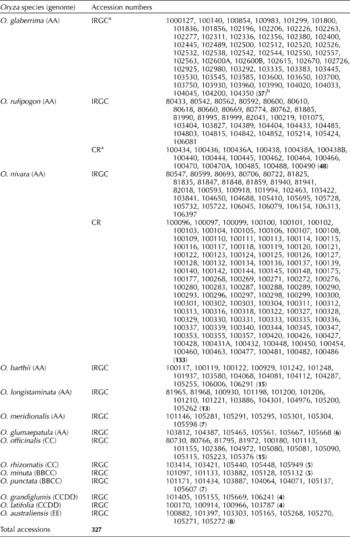
A set of 327 accessions belonging to 14 Oryza species (Appendix Table A1) were obtained from the International Rice Research Institute (IRRI), Manila, Philippines and the Central Rice Research Institute (CRRI), Cuttack, India. All the accessions were field grown and screened for reaction to infection with six pathotypes over 2 years (2001 and 2002). Resistant accessions were evaluated for a further 3 years (2003–2005) against a newly evolved, highly virulent pathotype. The seven Xoo pathotypes had a defined virulence spectrum (Appendix Table A2). Two plants from each accession were inoculated with each pathotype by clipping 5–10 fully expanded leaves, with scissors dipped in inoculum (Kauffman et al., Reference Kauffman, Reddy, Hsieh and Merca1973). Lesion length was recorded 14 days after inoculation on five fully expanded and randomly chosen leaves from each pathotype–accession combination. Accessions with mean lesion lengths 0–5.0 cm were scored as resistant (R), 5.1–10.0 cm as moderately resistant (MR) and >10 cm as susceptible (S).
Discussion
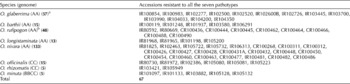
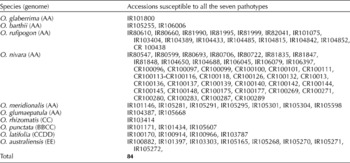
In all, 67 accessions were resistant or moderately resistant to all seven pathotypes (Table 1) and 84 were susceptible to all pathotypes (Appendix Table A3). The former comprised 13 accessions of O. glaberrima, five of O. barthii, 10 of O. rufipogon, 4 of O. longistaminata, 22 of O. nivara, 6 of O. officinalis, 2 of O. rhizomatis and 5 of O. minuta. The O. rufipogon accessions had moderate levels of resistance to two pathotypes and complete resistance to five. Six O. officinalis and two O. rhizomatis accessions (both CC genome) and all five O. minuta (EE) accessions were resistant to all pathotypes. A total of 84 accessions were susceptible to all the seven pathotypes. In all, 41 O. nivara, 15 O. rufipogon, 8 O. australiensis, 7 O. meridionalis, 4 O. latifolia, 3 O. punctata, 2 O. barthii, 2 O. glumaepatula and one each of O. glaberrima and O. rhizomatis accessions were susceptible to all seven pathotypes (Appendix Table A3). Accessions resistant to all the pathotypes can be used directly in breeding programmes, while others that show resistance against particular pathotype(s) may be useful either in cross combinations with material carrying other genes, or in areas where the avirulent pathotypes are prevalent. Resistance in O. glaberrima, O. barthii, and most of the O. nivara accessions is recessive, as F1 offspring between these accessions and cultivated rice were susceptible. Only one accession of O. nivara (IRGC81825) carries a dominant gene for resistance (Kaur et al., Reference Kaur, Grewal, Das, Vikal, Singh, Bharaj, Sidhu and Singh2005).
Accessions showing resistance to all the seven pathotypes of Xanthomonas oryzae pv. oryzae in Punjab (India)

a Numbers in parentheses are the total number of accessions evaluated.
b These accessions showed complete resistance to five pathotypes and moderate resistance to two pathotypes.
Of the 29 Xa genes designated so far, only four [Xa21, Xa23, Xa27(t) and Xa29(t)] have been derived from wild species (Khush et al., Reference Khush, Bacalangco and Ogawa1990; Zhang et al., Reference Zhang, Lin, Zhao, Wang, Yang, Zhou, Li, Chen and Zhu1998; Gu et al., Reference Gu, Tian, Yang, Wu, Sreekala, Wang, Wang and Yin2004; Tan et al., Reference Tan, Ren, Weng, Shi, Zhu and He2004), and only Xa21 has been exploited commercially, remaining effective in most rice-growing regions (Khush, Reference Khush2005). The newly identified sources of BB resistance should be suitable for broadening the genetic base of resistance to BB. Of particular note is O. nivara, the progenitor of O. sativa ssp. indica (Yamanaka et al., Reference Yamanaka, Nakamura, Nakai and Sato2003) which grows sympatrically with, and is easily crossable with, O. sativa. O. nivara has evolved with Xoo (Yashitola et al., Reference Yashitola, Reddy and Sonti2000) but so far no BB resistance gene has been designated from this species. Similarly, introgressions from O. glaberrima to O. sativa are limited, probably due to the large number of sterility genes present in O. glaberrima (Heuer and Miezan, Reference Heuer and Miezan2003), and fully fertile progenies are derived only after 3–4 backcrosses (unpublished results, Heuer et al., Reference Heuer, Miezan, Sie and Gaye2003). Inheritance studies, molecular mapping and the transfer of some of these genes into O. sativa ssp. indica are in progress. The accessions being used include IRGC102600B of O. glaberrima, IRGC100119 of O. barthii, and IRGC81825 and CR100428 of O. nivara. We aim to provide a resource for the development of cultivars with a broad spectrum of BB resistance in Punjab and adjoining north-western regions of India.
Acknowledgements
Financial support provided by the Department of Biotechnology, Government of India and the Rockefeller Foundation, USA is gratefully acknowledged.
Appendix
Oryza species accessions screened against seven pathotypes of Xanthomonas oryzae pv. oryzae in Punjab (India)

a Accessions designated as IRGC were procured from the International Rice Research Institute (IRRI), Philippines, whereas those designated as CR were procured from the Central Rice Research Institute (CRRI), Cuttack.
b Figures in parentheses are the total accessions evaluated for BB resistance
Avirulence/virulence (effective/ineffective resistance genes) of different pathotypes of Xanthomonas oryzae pv. oryzae in Punjab (India)

Accessions showing susceptibility to all the seven pathotypes of Xanthomonas oryzae pv. oryzae in Punjab (India)