A significant percentage of Americans may believe in conspiracies at given times (Oliver and Wood Reference Oliver and Wood2014; Stempel, Hargrove, and Stempel Reference Stempel, Hargrove and Stempel2007) and for different psychological and ideological reasons (Miller, Saunders, and Farhart Reference Miller, Saunders and Farhart2016). One overlooked question, however, is how the public responds when the government, rather than discouraging conspiratorial talk (Bird and Bogart Reference Bird and Bogart2005; Fenster Reference Fenster2008), actually corroborates a conspiratorial explanation. Traditionally, portions of the public might expect that “the government” was involved in the conspiracy, refused to acknowledge that a conspiracy existed, and covered it up (Fenster Reference Fenster2008; Stempel, Hargrove, and Stempel Reference Stempel, Hargrove and Stempel2007). However, what I term a “government-corroborated conspiracy” may be decidedly different in effect.
How audiences perceive (and respond to) events in which the government publicly agrees with the notion of conspiratorial action has both practical and theoretical import. This is no better reflected than in the continued need for fact-checking political information (Allcott and Gentzkow Reference Allcott and Gentzkow2017) and in the difficulty in correcting misinformation (Nyhan and Reifler Reference Nyhan and Reifler2010). Theoretically, public perceptions of government legitimacy, although variable (see Useem and Useem Reference Useem and Useem1979), suggest that government-corroborated conspiracy claims motivate increased public attention to available information about the event—and perhaps belief in the conspiracy itself.
JFK AND THE FINDING OF A CONSPIRACY
To test this possibility, I leveraged two randomized experiments that variably introduced media information about the US government’s official findings on President John F. Kennedy’s assassination on November 22, 1963. The 1964 Warren Commission report named Lee Harvey Oswald as Kennedy’s lone assassin. Perhaps as a result, conspiracy theories focusing on Kennedy’s physical reaction to the gunshots as captured on the “Zapruder film” (Fetzer Reference Fetzer2003), alleged inconsistencies in Kennedy’s autopsy (Groden Reference Groden1993), hints of Mafia and CIA involvement (Douglass Reference Douglass2010; North Reference North2011), and participation by anti-Castro Cubans who blamed Kennedy for the botched Bay of Pigs invasion (Summers Reference Summers1980) gained popularity in public discussion of Kennedy’s death.
Critically, however, the government did conclude that a conspiracy existed involving more than Oswald. In 1979, the House Select Committee on Assassinations found Kennedy’s death to be the result of a probable conspiracy (although the committee could not name additional conspirators).
Critically, however, the government did conclude that a conspiracy existed involving more than Oswald. In 1979, the House Select Committee on Assassinations found Kennedy’s death to be the result of a probable conspiracy (although the committee could not name additional conspirators).
This 1979 report is a rare example of government corroborating the notion of conspiracy, which makes it a useful test case for public reaction.
RESEARCH DESIGN
Understanding the effects of exposure to the 1979 report findings might be problematic in that those alive during Kennedy’s assassination may have heavily formed perceptions of the event and its causes. Other factors being equal, traditional college-age students have a relatively good chance of lacking event familiarity. Therefore, I used two subject pools: traditional college-age students (conducted in a university computer lab in November 2013) and a sample of the general public (conducted in April 2019). Subjects in both pools were randomly assigned exposure to news about the 1979 House Select Committee report to assess (1) opinion on whether the assassination was a conspiracy; (2) the impact that knowledge of the 1979 House Select Committee finding had on self-reported anger—a reaction that Butler, Koopman, and Zimbardo (Reference Butler, Koopman and Zimbardo1995) found in those exposed to JFK assassination-conspiracy information; and (3) the extent to which subjects are inclined to peruse media information about the assassination using a mock Google News search exercise. The latter outcome may shed light on audience information engagement for fact-checking and related behaviors in reaction to contemporary political controversies.
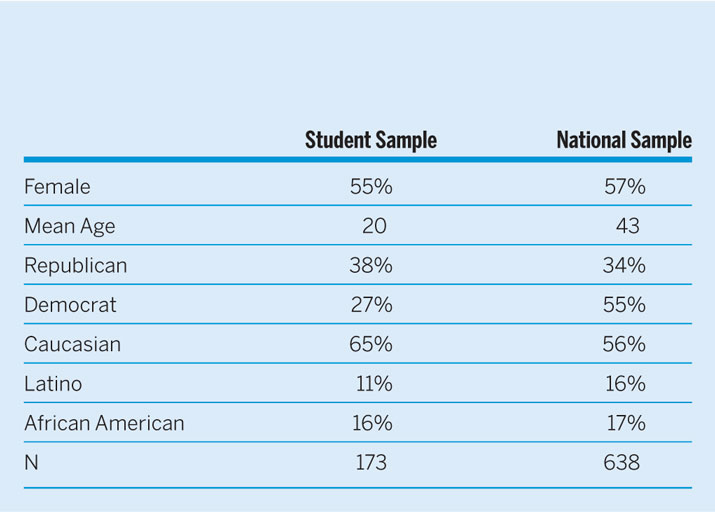
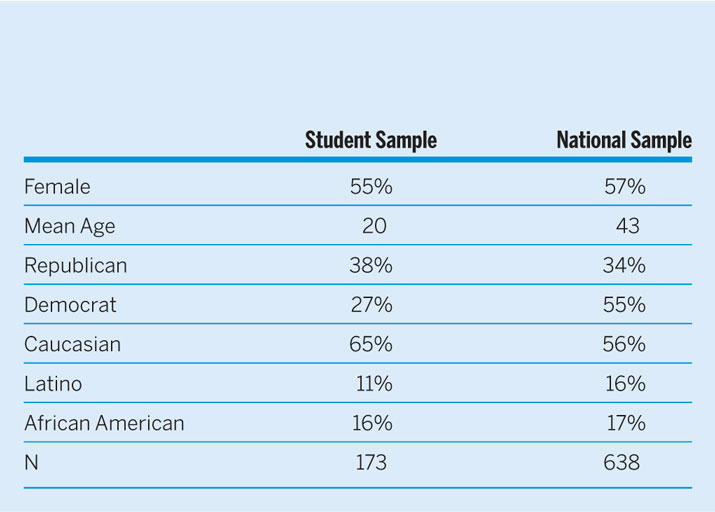
Concerns about generalizing a 173-person college-student sample to the larger population, as well as the lower statistical power associated with a small study, necessitated the replication study to be conducted on a national sample of 638 adults using the sampling firm Lucid. The replication experiment, like the student version, was housed in Qualtrics. Statistical tests show that treatment assignment was not predicted by subject gender, race, age, or partisanship in either experiment. Table 1 summarizes demographic characteristics for the two samples.
Subject Demographics
TRACKING NEWS USE OBTRUSIVELY
Based on Green, Calfano, and Aronow’s (Reference Green, Calfano and Aronow2014) design approach utilizing unobtrusive media measures, I used JAVA coding to present subjects with one of two mock Google News search pages referencing the “Kennedy assassination”: 87 and 85 student subjects and 293 and 346 national-sample subjects were assigned to the control page and to the treatment, respectively.
The control condition, part of which is depicted in figure 1 in the online appendix, contained 10 news-search items featuring actual stories about the assassination. The randomly ordered story mix included retrospectives of the 1963 events, perspective pieces about Kennedy, and the “traditional” conspiratorial material usually referenced with the assassination. The treatment condition also included a random assortment of 10 stories, eight of which were the same as for the control screen. However, two of the stories made clear mention of the finding of the 1979 House Select Committee report of a probable conspiracy in its headlines and opening sentences (both of which were visible to all treated subjects without having to click on the story link). Figure 2 in the online appendix shows a portion of the treatment-condition screen. For consistency, all news items in the control and treatment versions were sourced to either MSNBC or Fox News. For the treatment, one of the 1979 House Select Committee stories was sourced to MSNBC and the other to Fox News.
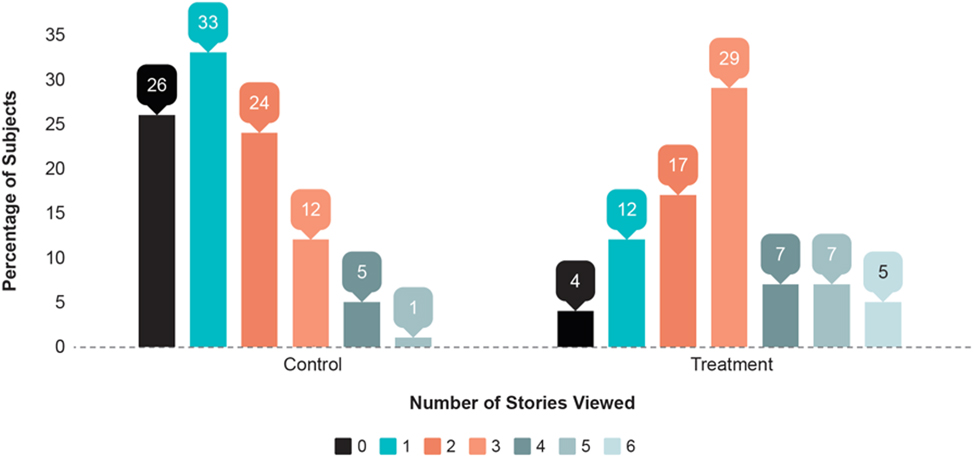
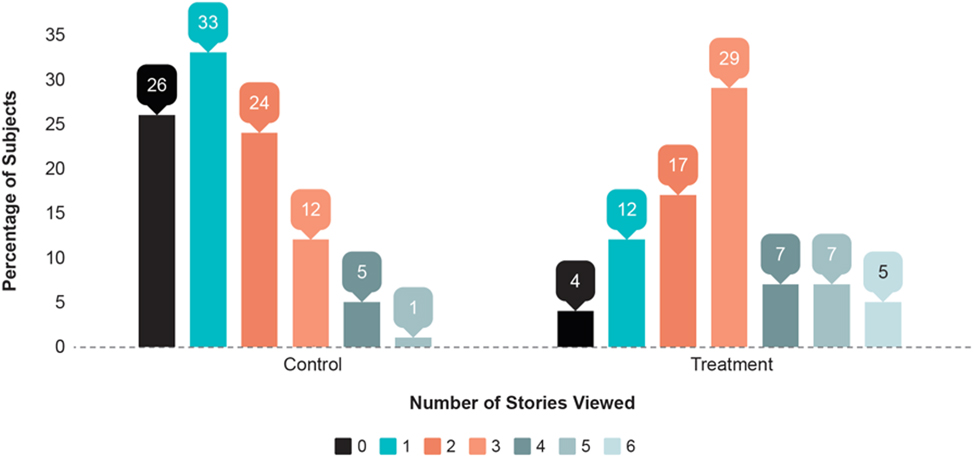
Number of Stories Viewed as Percentage of Subjects
(Student Sample, N=173).
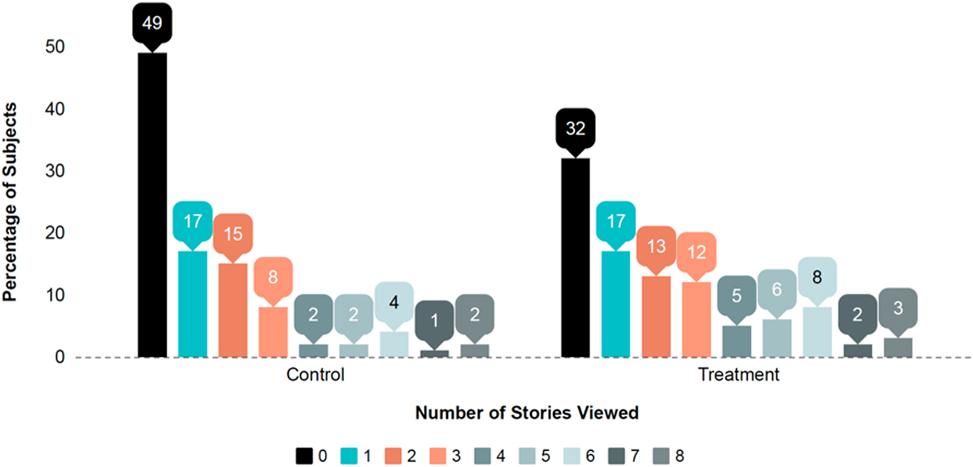
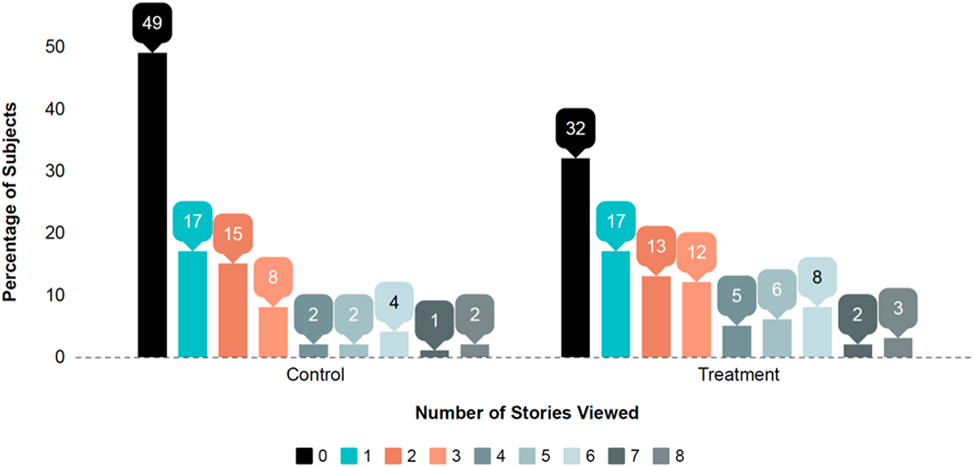
Number of Stories Viewed as Percentage of Subjects
(National Sample, N=638).
Subjects were allowed to scroll down the page and interact with the news items as they saw fit. The internet software program unobtrusively recorded the number of story-link clicks and the order in which the clicks were made (i.e., without subjects’ knowledge). An “end news search” button was programmed to appear on a 30-second time delay at the bottom of the news page. Moving off the assigned Google News page required subjects to scroll past the 10 news items to click the button. Following exposure to their assigned search page, subjects were taken to a short series of questions about their emotions, including the extent to which they felt anger based on the news-search-page items. This was followed by a question about whether they consider the Kennedy assassination to be the result of a conspiracy.
I first report the results from treatment-only models for each outcome variable. These are followed by a second round of models containing binary covariates for subject party identity as either Republican or Democrat; gender (coded “1” for female); political interest as measured on a 1-to-3 scale; and political knowledge. This latter variable is a count-based score of the number of correct identifications of relevant 2013 political figures: Joe Biden, Angela Merkel, John Roberts, David Cameron, Nancy Pelosi, Eric Holder, and the party in control of the US House and the US Senate.Footnote 1 Given the larger number of subjects, the national-sample models also included a five-category ordinal age and binary controls for African Americans and Latinos. I report findings for both subject samples in the following analysis. All other variables in addition to those highlighted were held at their means in calculating predicted probabilities and other magnitude effects. Given the nonparametric nature of both subject pools, I report bootstrap standard errors using 10,000 replications with replacement.
ANGER AND ASSASSINATION
Following the Google News page across the two assigned groups, 52% of the student sample and 57% of the national sample felt no anger in response to the information, whereas 17% of the student sample and 24% of the national sample felt “quite a bit” of anger, and 19% of both the student and the national samples felt “extremely” angry or upset. Because the ordinal-response item violates the proportional-odds assumption, I collapsed responses into a binary measure (i.e., ordinal-response categories “3” and “4” are coded as “1”).
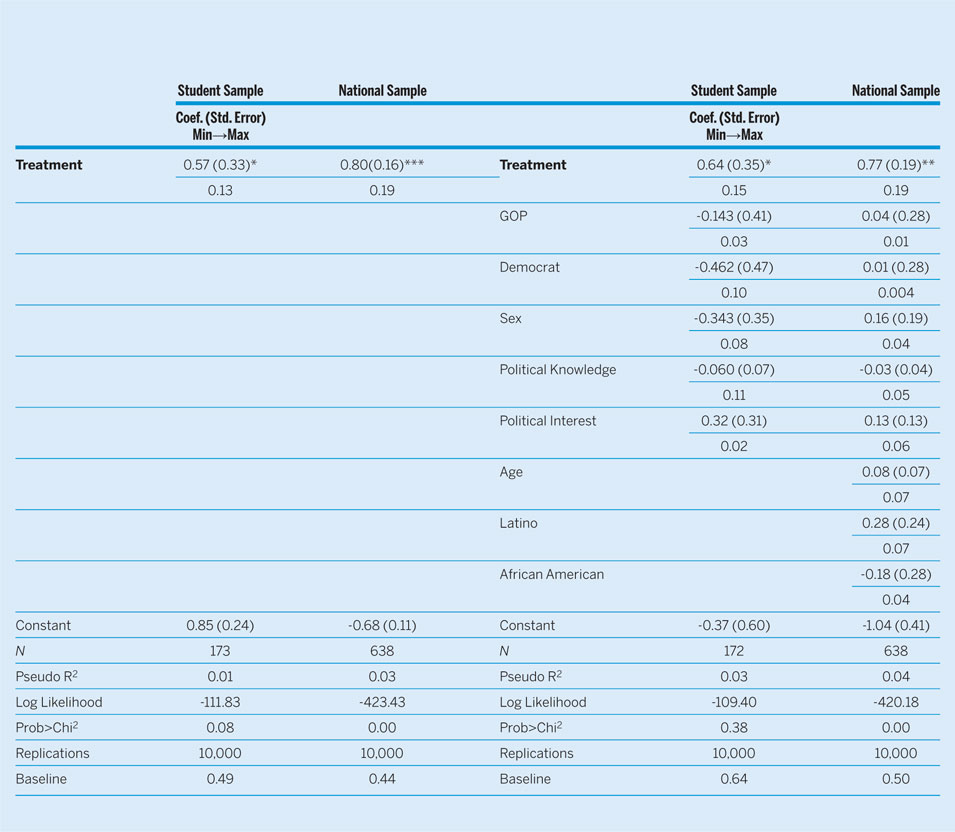
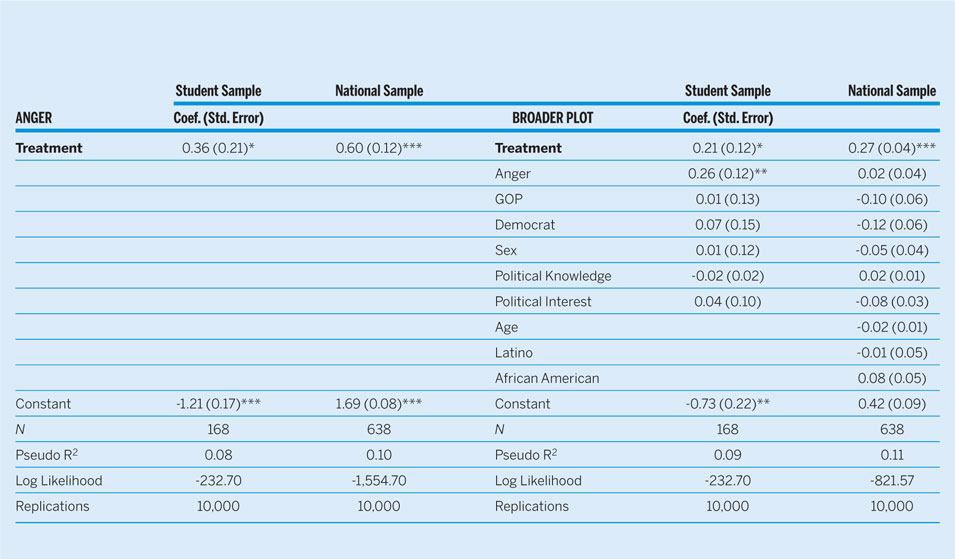
As shown in table 2, random exposure to the treatment news about the 1979 House Select Committee report in the Google News search increases the probability of those in the student sample reporting anger by 0.13 and those in the national sample by 0.19. The treatment effects in the covariate model were essentially the same, with no covariates statistically significant for either sample.
Reported Anger Following Google Search (Logit)
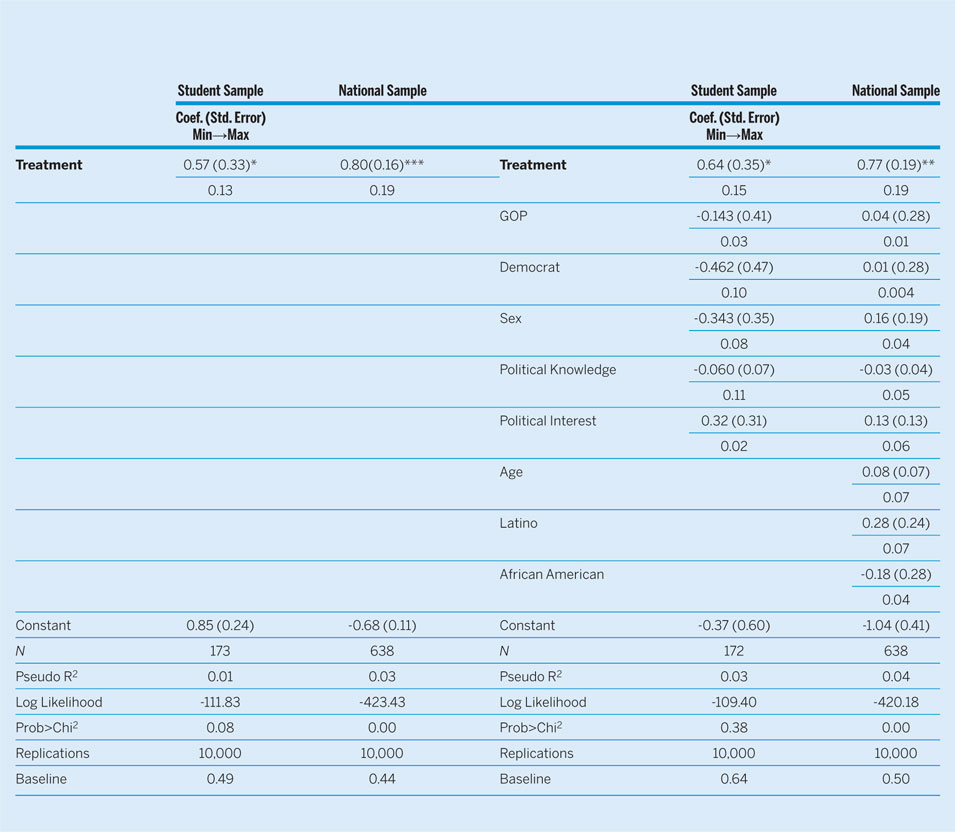
Notes: *=p<0.05, **=p<0.01, ***=p<0.001 (one-tailed tests).
CONSIDERING A “BROADER PLOT”
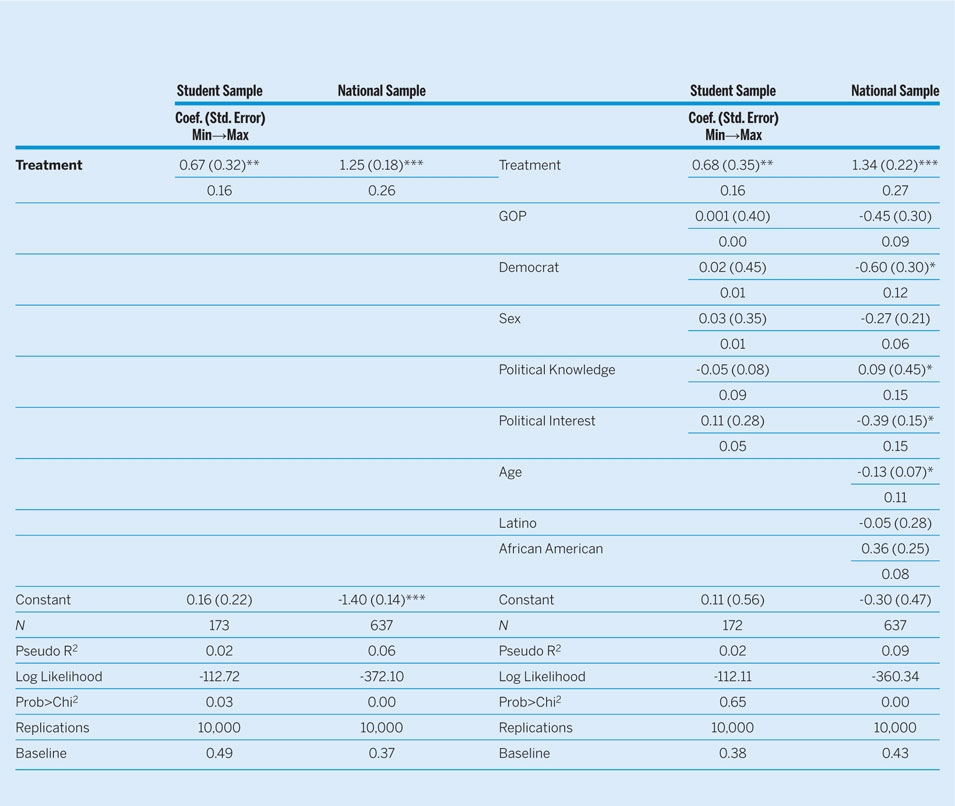
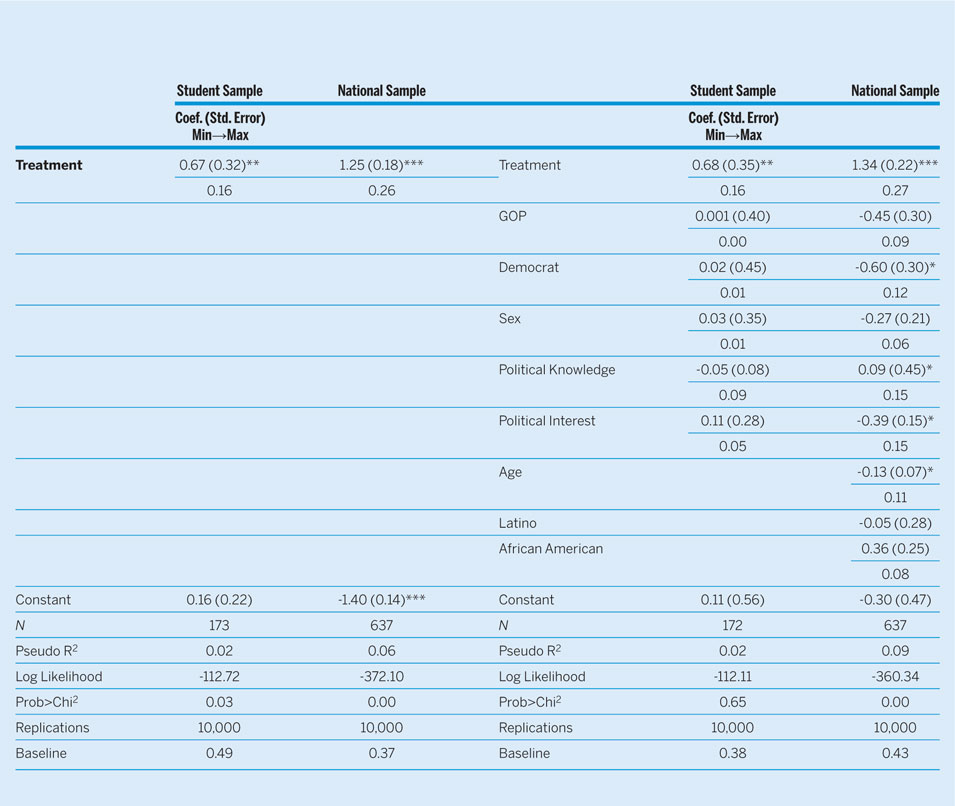
Moving to the conspiracy question, subjects were asked: “Do you feel the assassination was the work of one man or was the work of a broader plot?” “Broader plot” responses were coded “1” and the rest “0”; 62% of the student sample and a much lower 32% of the national sample selected the broader plot (i.e., a conspiracy). Table 3 presents the two models focusing on the broader-plot response.
Belief That JFK Assassination Was a Broader Plot (Logit)
Notes: *=p<0.05, **=p<0.01, ***=p<0.001 (one-tailed tests).
The treatment-only model shows that student subjects exposed to the treatment version of the Google News search had an increase in probability of 0.16 of believing the assassination to be “the work of a broader plot,” whereas the probability increase was 0.26 among the national sample. The effect is virtually identical in the covariate model.
Although none of the covariates show a statistically significant impact among the students, it is interesting that national-sample Democrats are 0.30 less likely to consider the assassination as part of a broader plot, whereas those with higher levels of political interest were 0.15 less likely, and older national-sample subjects were 0.11 less likely to accept the broader-plot explanation. The only positive covariate was among those with higher political-knowledge scores. Those subjects showed a 0.15 increase in claiming the broader-plot explanation among the national sample.
CORROBORATION TREATMENT AND INFORMATION SEARCH
Moving to subject interaction with the Google News search stories, the count distributions in figures 1 and 2 show that both assigned groups in the student sample clicked on between zero and six unique stories, whereas the national-sample subject pool members clicked on between zero and eight stories. The distribution of story clicks is generally the same between the two samples, with a significant percentage of subjects in both samples’ treatment and control groups entirely ignoring the information-search exercise.
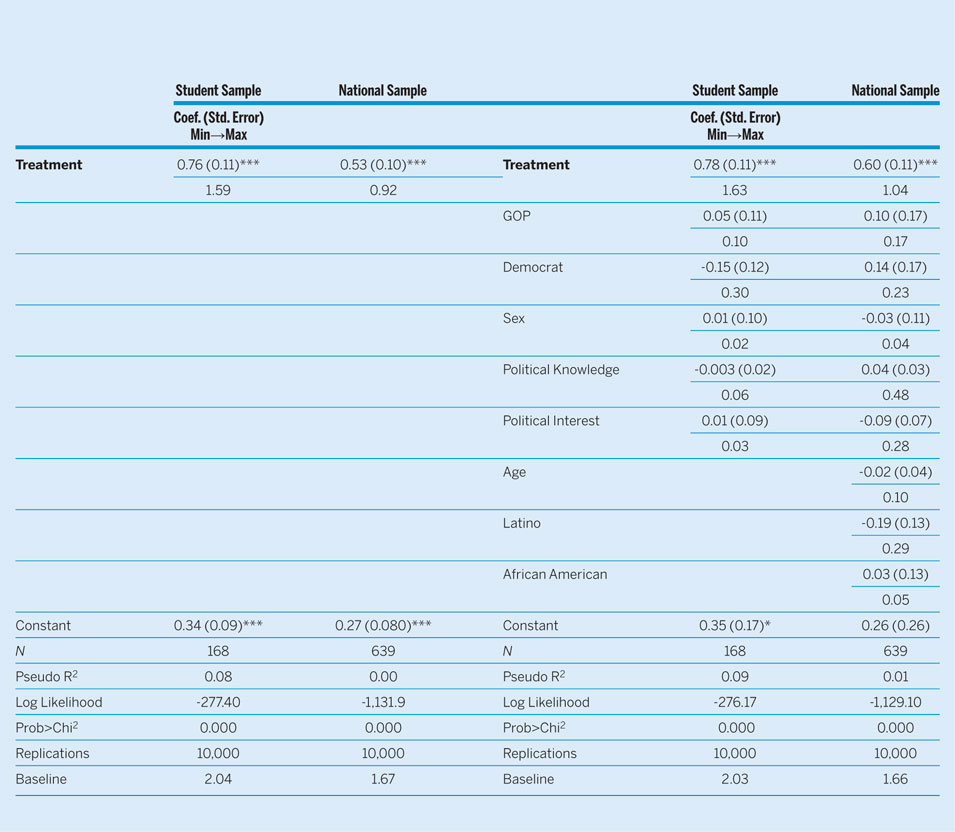
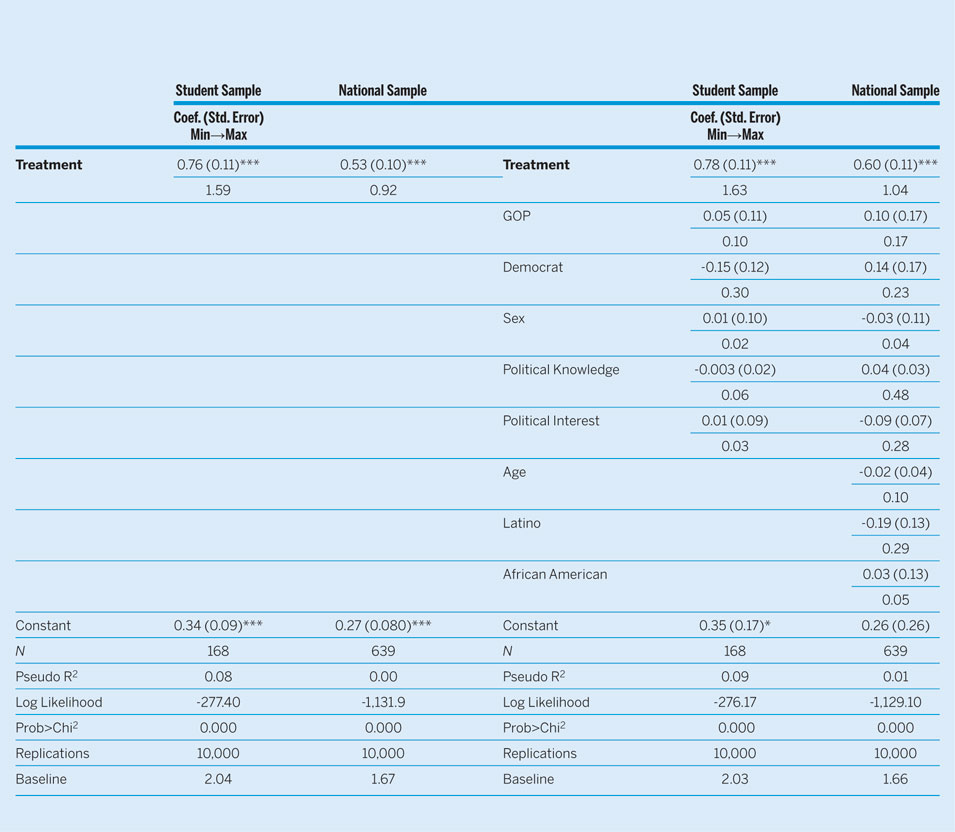
Table 4 includes the treatment and covariate Poisson and negative-binomial regression models for this story-count outcome (i.e., the national-sample story count was over-dispersed). Even with the unobtrusive nature of its visual treatment display, news about the House Special Committee finding had a robust effect on subjects across both samples. Specifically, exposure to the treatment version of the news-search items increases the number of stories clicked by 1.59 among the student sample and 0.92 among the national sample, with close to the same magnitude of effect for the treatment variables in the covariate model (no other covariates were statistically significant).
Number of Google News Stories Viewed Poisson Neg. Binomial
Notes: *=p<0.05, **=p<0.01, ***=p<0.001 (one-tailed tests).
AN ANGRY MEDIATOR
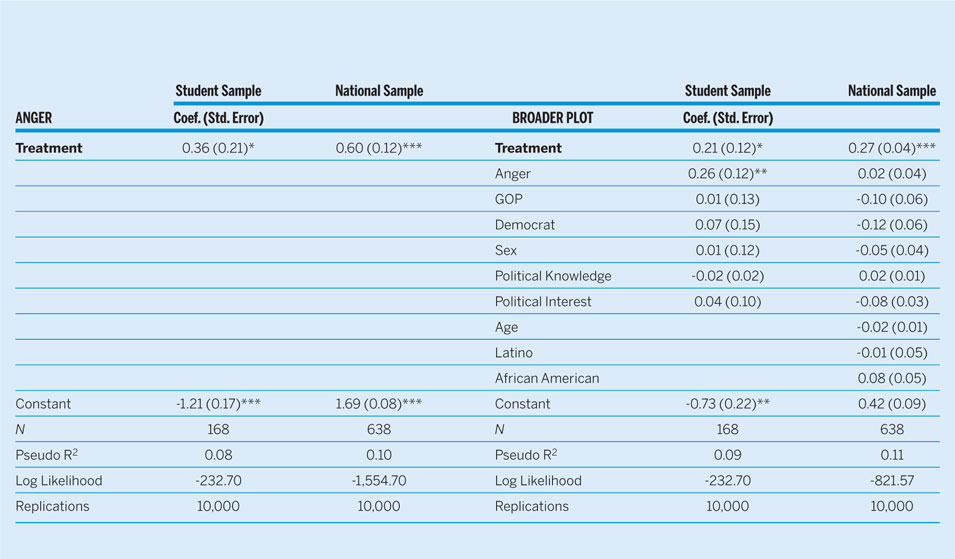
The final models explore the possible mediated effect of reported anger on subjects considering the assassination to be a broader plot. Because the “plot” question was asked after the anger items following exposure to the Google News screen, it is possible that a respondent’s relative anger level might impact views of the assassination as a broader plot beyond the direct treatment-story effects. I explored a similar mediation effect for subject anger and the count-based outcomes and found no significant relationship. Using a generalized structural-equation model, I estimated the direct and mediated effects of subject anger, while also modeling direct and mediated effects for the Google News treatment and direct-covariate effects.
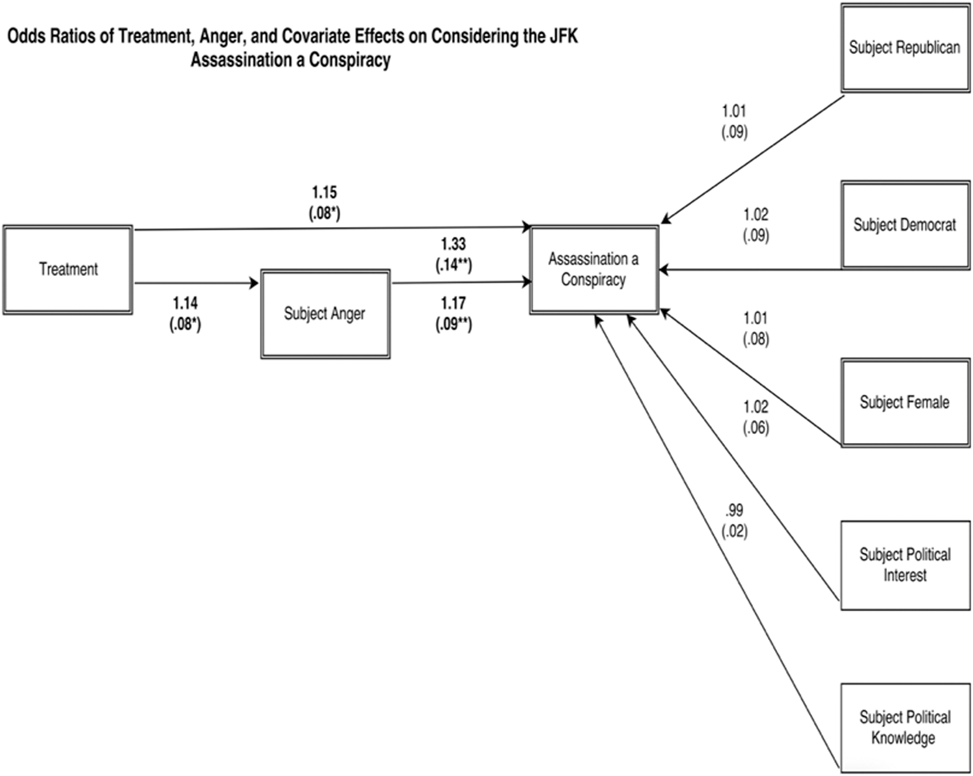
Table 5 lists the general model information for both the treatment-only and covariate-model versions across the two samples. The key results are shown in figure 3, which represent individual and linear combinations of exponentiated odds ratios. The mediated effect is significant only for the student sample, suggesting perhaps a more pervasive effect from this emotion in determining views of Kennedy’s assassination—as the relatively large percentage difference between students and the general public in accepting the “plot” outcome also might suggest.
Mediated Anger Effects on Believing Plot (Generalized Structural Equations)
Notes: *=p<0.05, **=p< 0.01, ***=p<0.001 (one-tailed tests).
Odds Ratios of Treatment, Anger, and Covariate Effects on Considering the JFK Assassination a Conspiracy

The Google News treatment increases the odds of expressing anger in reaction to the stories by 1.14, whereas the anger mediator’s effect on subjects considering the assassination part of a broader plot increases the odds of considering Kennedy’s death a conspiracy by 1.17. The combined effect of the treatment and anger mediator increases the odds of subjects believing in a plot by 1.33. This is slightly higher than the direct-treatment effect, which increases the odds of considering the assassination as part of a broader plot by 1.15. None of the covariates were statistically significant.
BEYOND CONSPIRACY
There are scant examples of governments issuing official follow-on and contradictory reports about consequential political events. However, the implications of these experimental findings may surpass government reports on conspiracies. The treatment effects from both samples show that people are willing to respond to results of official government reports as legitimate information—even while belief in a conspiratorial plot regarding Kennedy’s assassination varies widely between the student and general-public samples. The treatment effects show that people will act on reported findings by digging into available news about the subject and forming opinions. Furthermore, prior knowledge of the event generally does not alter effects of the revealed information—although it might make emotional reactions a mediating force among younger adults. Overall, this is good news for those concerned that the public does not engage enough in fact-checking and related deliberation about political information.
Yet, although government-corroborated conspiracies are rare, government-sanctioned investigative findings are not. The largely partisan sorting in response to Special Counsel Robert Mueller’s investigation of collusion with Russia and obstruction of justice may be a more common public reaction. To harness the effect of the 1979 House Special Committee report, a separate government investigation publicly contradicting (or even supporting) Mueller’s findings would be needed as well as the passage of time.
Missing from reaction to the 1979 report is any immediate partisan stake in the outcome. Kennedy enjoys largely bipartisan support as an historical figure. By contrast, reaction to Donald Trump–and any conspiratorial or malfeasant charges leveled at his administration—likely will be viewed from an acutely partisan lens long after he leaves the White House.Missing from reaction to the 1979 report is any immediate partisan stake in the outcome. Kennedy enjoys largely bipartisan support as an historical figure. By contrast, reaction to Donald Trump–and any conspiratorial or malfeasant charges leveled at his administration—likely will be viewed from an acutely partisan lens long after he leaves the White House.
Moreover, to the extent that segments of the public tend to distrust government (for partisan or other reasons), the more we should expect a mediated and reduced impact of official government findings on any issue among those who find reason to be skeptical.
Indeed, because we now know that samples of Americans with both low (i.e., the students) and at least moderate (i.e., the general public) familiarity with a subject such as the Kennedy assassination generally react the same to government reports about distant historical events, the question for researchers will be whether follow-on official government findings about any number of political and policy issues coming from Washington (or another center of government power) in this hyper-partisan age are as readily accepted as the 1979 House Special Committee report. The revealed answer likely will not be as flashy as a government-corroborated conspiracy, but its consequences might be as important.
SUPPLEMENTARY MATERIAL
To view supplementary material for this article, please visit https://doi.org/10.1017/S1049096519001252