INTRODUCTION
On January 27, 2017, one week after his inauguration, President Trump signed the “Protecting the Nation from Foreign Terrorist Entry into the United States” executive order which indefinitely suspends the resettlement of Syrian refugees, temporarily bans people from seven majority-Muslim countries from entering the United States and pauses the refugee resettlement program. As a result of the initial travel ban and its following iterations, 2018 saw the lowest number of refugees admitted in the United States since the refugee resettlement program began in 1980. Moreover, according to the Pew Research Center, the share of Muslim refugee admissions has decreased more than any other group (Krogstad and Radford Reference Krogstad and Radford2017). Further plans have been made to cap the number of refugees in 2019 to 30,000. These restrictions come at a time when global refugee numbers are at a historic high. The Trump administration has justified these policies by arguing that they will allow for more security screening measures meant to vet refugees from “high-risk” countries. During the second iteration of the travel ban, then Secretary of Homeland Security Kirstjen Nielsen argued that “These additional security measures will make it harder for bad actors to exploit our refugee program, and they will ensure we take a more risk-based approach to protecting the homeland.” Similarly, then Attorney General Jeff Sessions justified these decisions by saying that “Many people seeking to support or commit terrorist acts will try to enter through our refugee program.” These statements echo numerous others made by the President and members of his administration where security concerns are cited as reasons for restrictions on refugee resettlement.Footnote 1
In terms of public opinion, the role of the United States in resettling refugees, especially from Syria, was a point of contention during the 2016 election with Americans divided along party lines. Gallup reported in 2015 that 60% of Americans oppose “the United States taking in refugees from Syria” (Jones Reference Jones2015). Similarly, a survey conducted by the Pew Research Center in 2016 showed that 54% of voters said that “the United States does not have a responsibility to accept Syrian refugees” (Hartig Reference Hartig2018).
This paper aims to assess whether this reluctance to accept Syrian refugees in the United States is due to white Americans worrying about their safety, as is often emphasized by elites, or if views on refugee resettlement mirror attitudes toward immigrants in general and are primarily driven by prejudice. This study first provides a validation of previous findings on attitudes toward immigration in general and extends this research to attitudes toward refugee resettlement, using Syrians as a case study. I focus on White Americans as an example of attitudes toward immigration among the economically and numerically dominant racial group.
The literature on public opinion toward immigration policies distinguishes between realistic threat and prejudice as the main predictors of attitudes. The realistic threat approach argues that attitudes toward immigration are driven by concerns over physical and material security (e.g. Burns and Gimpel Reference Burns and Gimpel2000; Facchini, Mayda, and Mishra Reference Facchini, Mayda and Mishra2011; Mayda Reference Mayda2006; Schweitzer et al. Reference Schweitzer, Perkoulidis, Krome, Ludlow and Ryan2005) whereas the prejudice perspective posits that negative affect, attitudes, and beliefs about different ethnic groups are behind anti-immigrant attitudes (Citrin, Reingold, and Green Reference Citrin, Reingold and Green1990; Kinder and Sears Reference Kinder and Sears1981; Sides and Citrin Reference Sides and Citrin2007). Much of this work has looked at the effects of prejudice and realistic threat on attitudes toward immigrants of different racial, ethnic, or occupational backgrounds (e.g. Dustmann and Preston Reference Dustmann and Preston2007; Hainmueller and Hopkins Reference Hainmueller and Hopkins2015). Rarely has the literature on immigration distinguished between the effects of realistic threat and prejudice on attitudes toward refugees (e.g. Murray and Marx Reference Murray and Marx2013). Given that refugees differ from other immigrants in terms of the reasons behind their immigration, their legal status and the rhetoric pertaining to them, this paper seeks to assess whether attitudes toward refugees are shaped by similar factors as those toward immigration in general. I use the Syrian case to test whether realistic threat or prejudice play a role in determining attitudes toward refugee resettlement in the United States.
Using survey data from two nationally representative studies (the 2016 ANES and the 2016 Chicago Council Survey), I examine the extent to which prejudice and realistic threat measures determine whites’ attitudes toward accepting Syrian refugees and immigrants in general in the United States. I use the case of Syrian refugees for a number of reasons. First, Syrians constitute the largest refugee population today with over 6 million refugees worldwide. Second, while the largest numbers of refugees in the United States tend to come from Africa and South Asia, discourse regarding the current refugee crisis and the threat to Americans’ security that might result from refugee resettlement has centered around Middle Eastern and especially Syrian refugees. Much of the discourse by Republican elites, for instance, has emphasized the idea that Syrian refugees might be infiltrated by terrorists (e.g. Dearden Reference Dearden2016; Healy and Bosman Reference Healy and Bosman2015). If security threat is a primary factor influencing attitudes toward refugee resettlement, it should influence attitudes toward Syrian refugees the most given that associations between Syrian refugees and terrorism threat are often made salient by Republican elites. If, on the other hand, reluctance toward resettling refugees is mostly driven by prejudice rather than realistic threat, using the Syrian case provides a conservative estimate of the impact of prejudice.
This paper finds that attitudes toward Syrian refugee resettlement mirror those toward immigration levels in general. The results show that prejudice, rather than realistic threat, is the best predictor of support for reducing immigration levels and opposition to Syrian refugee resettlement.
DIFFERENCES BETWEEN REFUGEES AND IMMIGRANTS IN GENERAL
The literature on immigration distinguishes between different factors behind attitudes toward immigration policies. On one hand, the realistic threat approach argues that attitudes toward immigration are driven by concerns over the material and physical security (e.g. Burns and Gimpel Reference Burns and Gimpel2000, Facchini, Mayda, and Mishra Reference Facchini, Mayda and Mishra2011; Mayda Reference Mayda2006; Schweitzer et al. Reference Schweitzer, Perkoulidis, Krome, Ludlow and Ryan2005). Another perspective focuses on prejudice, which Allport (Reference Allport1954) defines as a “feeling, favorable or unfavorable, toward a person or thing, prior to, or not based on, actual experience” (p. 6), as the main driver of attitudes toward immigration.
Refugees tend to differ from immigrants in general in a number of respects that can impact how these factors influence attitudes toward them. First, while legally constituting a subgroup of authorized immigrants, refugees are distinct because they are not voluntary immigrants. According to Article 1 of the 1951 UN Convention, as modified by the 1967 Protocol, a refugee is defined as a person who, “owing to well-founded fear of being persecuted for reasons of race, religion, nationality, membership of a particular social group or political opinion, is outside the country of his nationality and is unable or, owing to such fear, is unwilling to avail himself of the protection of that country.” Second, because refugees are not voluntary immigrants but rather people who are escaping violence and persecution, attitudes toward them might be influenced by humanitarian concerns (e.g. Adida, Lo and Platas Reference Adida, Lo and Platas2017). Third, refugees differ from immigrants in general in terms of population size which may affect attitudes toward them (e.g. Quillian Reference Quillian1995). In 2018, a total of 22,491 refugees were admitted to the United States, a sharp decrease compared to 84,989 in 2016.Footnote 2 In comparison, the total number of legal immigrants accepted in the United States (including those who underwent a change in status) was around 1 million in 2018.Footnote 3
In sum, Middle Eastern refugees are not voluntary immigrants, are not a sizeable population in the United States, and can engender empathy because of the conditions surrounding their immigration. Given these factors, we might expect attitudes toward them to be less likely to be driven by threat compared to immigrants in general. On the other hand, discourse pertaining to recent refugees, especially Muslim and Middle Eastern ones, has centered around security threat which may make it a primary factor in influencing attitudes (e.g. Esses, Medianu, and Lawson Reference Esses, Medianu and Lawson2013).
Realistic Threat
The realistic threat approach centers around concerns relating to the very existence of the ingroup, its political and economic power, and the material and physical security of its members (Stephan, Ybarra, and Bachman Reference Stephan, Ybarra and Bachman1999). According to this theory, competition over scare material resources and threat to one's welfare or safety can spur people to view outgroups not as individuals but as group members. From this perspective, perceived material or physical threats, regardless of whether such threats are real, can result in heightened ingroup favoritism, prejudice toward the outgroup, and intergroup conflict (Bobo Reference Bobo, Katz and Taylor1988; Brewer Reference Brewer, Ashmore, Jussim and Wilder2001; Esses, Jackson, and Armstrong Reference Esses, Jackson and Armstrong1998; Esses et al. Reference Esses, Dovidio, Jackson and Armstrong2001; LeVine and Campbell Reference LeVine and Campbell1972; Sherif Reference Sherif1966; Stephan, Ybarra, and Bachman Reference Stephan, Ybarra and Bachman1999; Tajfel and Turner Reference Tajfel, Turner, Worchel and Austin1986). In the immigration literature, the realistic threat approach has been primarily discussed in terms of economic and security threat.
Economic Threat
The literature on economic threat has shown that competition over jobs and fear of incurring financial losses tend to be associated with increased support for anti-immigration policies especially among economically disadvantaged natives (Citrin et al. Reference Citrin, Green, Muste and Wong1997; Clark and Legge Reference Clark and Legge1997; Daniels and Von Der Ruhr Reference Daniels and Von Der Ruhr2003; Pettigrew, Wagner, and Christ Reference Pettigrew, Wagner and Christ2007; Scheve and Slaughter Reference Scheve and Slaughter2001). Studies that have tested this theory have shown mixed support for the relationship between economic conditions and anti-immigrant sentiment (Citrin, Reingold, and Green Reference Citrin, Reingold and Green1990; Espenshade and Calhoun Reference Espenshade and Calhoun1993; Hoskin Reference Hoskin1991).
Others have argued that the fiscal burden imposed by immigrants can result in anti-immigrant attitudes (e.g. Hainmueller and Hiscox Reference Hainmueller and Hiscox2010). Refugees are brought into a country at government expense and are entitled to receive some public benefits whereas immigrants in general are not. Attitudes toward refugee resettlement might thus be impacted by individuals’ views on having some of their taxpayer money be spent on public benefits aimed at aiding this population.
Negative perceptions of the economy might also influence attitudes toward both refugees and immigrants. Studies have shown that negative perceptions of the economy, regardless of one's current financial status, lead to higher support for restrictionist immigration policies (Burns and Gimpel Reference Burns and Gimpel2000; Chandler and Tsai Reference Chandler and Tsai2001; Filindra and Pearson-Merkowitz Reference Filindra and Pearson-Merkowitz2013; King and Ahmad Reference King and Ahmad2010; Sides and Citrin Reference Sides and Citrin2007). Several studies show that it is these sociotropic concerns more so than personal economic vulnerability that are most likely to influence attitudes toward immigration policies (Citrin et al. Reference Citrin, Green, Muste and Wong1997; Sides and Citrin Reference Sides and Citrin2007).
H1: Economic threat is expected to reduce support for Syrian refugee resettlement.
Given the small size of the Middle Eastern refugee population (e.g. Quillian Reference Quillian1995) and the fact that other concerns (e.g. security threat) are more salient, the relative magnitude of the effect of economic threat is not expected to be as large as other factors in predicting opposition toward refugee resettlement.Footnote 4
Security Threat
Another difference between refugees and immigrants, in general, centers around the rhetoric pertaining to them. Because contact between Americans and refugees is fairly rare, the “picture in our heads” regarding refugees is more likely to be drawn from indirect sources such as media and political elites (McCombs Reference McCombs2018). While research on media coverage of refugees is limited, studies find evidence of a negative bias in discourse (Greenberg Reference Greenberg2000; Klocker and Dunn Reference Klocker and Dunn2003). In recent years, the rhetoric on refugees, especially Muslim ones, has emphasized the risk of terrorism threat (e.g. Esses, Medianu, and Lawson Reference Esses, Medianu and Lawson2013; Lawlor and Tolley Reference Lawlor and Tolley2017). The Trump administration has justified its travel ban for instance, by arguing that the measures taken will reduce the risk of terrorism. This type of argument, focusing on the idea that refugees are not properly vetted and therefore might be prone to committing terrorist attacks, has been emphasized by conservative media and political elites.
Studies find that individuals who rely on media for information about Muslims tend to be more likely to harbor anti-Muslim sentiment and be in favor of restricting their civil liberties (e.g. Nisbet, Ostman, and Shanahan Reference Nisbet, Ostman, Shanahan and Sinno Abdulkader2009; Saleem, Yang, and Ramasubramanian Reference Saleem, Yang and Ramasubramanian2016). These findings are not surprising given the negative depiction of Arabs and Muslims in the media. For instance, in a study of 900 films, Shaheen (Reference Shaheen2003) finds that 95% of film roles depicted Arabs and Muslims as uncivilized, violent, or religious fanatics who hate Christians and Jews. In addition, studies show that individuals who think that terrorist attacks are likely to occur in the future tend to stereotype Arabs more negatively, support restrictive immigration policies toward Arabs including toughening restrictions on visas, and increasing surveillance policies directed at Arabs and Arab-Americans (Huddy et al. Reference Huddy, Feldman, Taber and Lahav2005). Using qualitative interviews of Muslim Americans, Garner and Selod (Reference Garner and Selod2015) find that when participants were identified as Muslims, they tended to be treated as a threat to national security and American values. Others have shown that the effect of security threat tends to be much stronger in influencing attitudes toward immigration policies compared to economic threat (e.g. Lahav and Courtemanche Reference Lahav and Courtemanche2012).
Given that 70% of the Syrian population is Muslim and that many Americans tend to believe that all Arabs are Muslims and all Muslims are Arabs (Shaheen Reference Shaheen2003), it is likely that views of Arabs and Muslims will be reflected on Syrians in general. Based on the rhetoric surrounding refugees and the tendency to link Arabs and Muslims with terrorism, a realistic threat approach would expect security threat, and specifically terrorism threat, to be associated with less support for Syrian refugee resettlement.
H2: Security threat is expected to reduce support for Syrian refugee resettlement.
Prejudice
While some argue that attitudes toward immigration and refugee policy are primarily driven by realistic threat concerns, an alternative hypothesis is that prejudice is at the heart of this debate. According to this line of research, individuals tend to oppose immigration because they see foreigners as a threat to their traditional way of life and their national identity (Brader, Valentino, and Suhay Reference Brader, Valentino and Suhay2008; Citrin, Reingold, and Green Reference Citrin, Reingold and Green1990; Fetzer Reference Fetzer2000; Hainmueller and Hiscox Reference Hainmueller and Hiscox2007; McLaren and Johnson Reference McLaren and Johnson2007). From this perspective, natives’ feelings toward individuals from different ethnic, racial, and religious backgrounds influence their attitudes toward accepting newcomers.
In the United States, Muslims tend to be viewed less favorably by Americans than most other minority groups (Panagopoulos Reference Panagopoulos2006; Schafer and Shaw Reference Schafer and Shaw2009). According to a survey conducted by Pew Research Center in 2017, the mean thermometer ratings for Muslims was 48, the lowest compared to other religious groups. Polls conducted by the Public Religion Research Institute during the 2015 presidential campaign showed that 76% of Republicans, 52% of Democrats, and 57% of Independents agreed that “The values of Islam are at odds with American values and way of life.” Similarly, a survey conducted by Reuters showed that 63% of Republicans, 37% of Democrats, and 47% of Independents viewed Muslims living in America as “less willing to assimilate into American society than other immigrant groups.” Research focusing on Muslims in Europe and the United States finds that anti-Muslim prejudice is a central determinant of immigration attitudes (Helbling Reference Helbling2014; Hellwig and Sinno Reference Hellwig and Sinno2017; Sniderman and Theriault Reference Sniderman, Theriault, Sniderman and Saris2004; Velasco González et al. Reference Velasco González, Verkuyten, Weesie and Poppe2008). Studies have shown that objections to the building of mosques tend to be driven by intolerance for Muslims as a group (e.g. Kalkan, Layman, and Uslaner Reference Kalkan, Layman and Uslaner2009; Schaffner Reference Schaffner2013). Other studies, most of which rely on experimental data, show that people with Arabic or Muslim-sounding names and veiled women tend to face substantial discrimination (Adida, Laitin, and Valfort Reference Adida, Laitin and Valfort2010; Dana et al. Reference Dana, Lajevardi, Oskooii and Walkerin press; Ghumman and Jackson Reference Ghumman and Jackson2010). More recent research finds that anti-Muslim sentiment in the United States is an important predictor of support for Trump (Lajevardi and Abrajano Reference Lajevardi and Abrajano2019).
This line of research would expect attitudes toward refuge resettlement to be driven by prejudice.
H3: Prejudice toward Muslims and Middle Easterners is expected to reduce support for Syrian refugee resettlement.
H4: Prejudice is expected to have the largest substantive effect on attitudes toward Syrian refugee resettlement and general immigration levels.
It is important to note here that using the case of Syrian refugees to compare the effects of realistic threat and prejudice on attitudes toward refugees, in general, gives a conservative estimate of the effects of prejudice compared to those of security threat. Given that Republican elites have often emphasized the link between Syrian refugees and terrorism, terrorism threat is likely to be salient when individuals are thinking about Syrian refugee resettlement. If security threat is not found to be a primary driver in influencing attitudes toward Syrian refugees, it is also unlikely for it to be an important factor behind attitudes toward other refugees.
DATA AND METHODS
The 2016 American National Election Study
Using the 2016 American National Election Study, I look at the effect of realistic threat and prejudice on attitudes toward the admission of Syrian refugees and immigration levels in general. In order to focus on the attitudes of the majority group, only non-Hispanic white respondents who are native-born and non-Muslim are included in the analysis (N = 2,906).
The dependent variable measuring attitudes toward Syrian refugee resettlement asks “Do you favor, oppose, or neither favor nor oppose allowing Syrian refugees to come to the United States?” Responses to this question ranged from oppose a little, oppose a moderate amount, oppose a great deal, favor a little, favor a moderate amount, and favor a great deal. Responses were coded on a seven-point ordinal scale ranging from 0 to 1 where higher values indicate more support for refugee resettlement.Footnote 5
The dependent variable for general immigration levels asks “Do you think the number of immigrants from foreign countries who are permitted to come to the United States to live should be decreased a little, decreased a lot, left the same, increased a little, or increased a lot?” and is coded on a five-point scale ranging from 0 to 1.Footnote 6
Realistic threat is measured using four variables asking about economic and security threat. Economic threat is measured using three questions relating broadly to the state of the economy. The first one asks “Thinking about the economy in the country as a whole, would you say that over the past year the nation's economy has gotten better, stayed about the same, or gotten worse?” The second one focuses on the respondents’ own financial situation asking “Would you say that [you/you and your family living here] are [much better off financially, somewhat better off, about the same, somewhat worse off, or much worse off/much worse off financially, somewhat worse off, about the same, somewhat better off, or much better off] than you were a year ago?” The final question asks “Now looking ahead, do you think that a year from now [you/you and your family living here] will be [much better off financially, somewhat better off, about the same, somewhat worse off, or much worse off/much worse off financially, somewhat worse off, about the same, somewhat better off, or much better off] than now?” This set of variables has often been used to measure economic threat without specifically asking about a certain group being economically threatening (e.g. Espenshade and Hempstead Reference Espenshade and Hempstead1996; Feldman and Stenner Reference Feldman and Stenner1997; Hood and Morris Reference Hood and Morris1997). Security threat is measured using a question that asks “During the next 12 months, how likely is it that there will be a terrorist attack in the United States?” with potential answers ranging from not at all likely to extremely likely on a five-point scale.Footnote 7
Following Allport (Reference Allport1954)'s definition, I measure prejudice using thermometer scores that ask how favorable or warm individuals feel toward a certain group. Thermometer scores have been commonly used in the literature to measure prejudice toward outgroups (e.g. Cuddy, Fiske, and Glick Reference Cuddy, Fiske and Glick2008; Esses, Haddock, and Zanna Reference Esses, Haddock, Zanna and Hamilton1993; Gawronski et al. Reference Gawronski, Peters, Brochu and Strack2008; Hugenberg and Bodenhausen Reference Hugenberg and Bodenhausen2004; Kawakami, Dion, and Dovidio Reference Kawakami, Dion and Dovidio1998). Depending on the dependent variable, I use thermometer scores for Muslims (Syrian refugees) and Hispanics (immigration levels) as measures of prejudice. Prejudice toward Hispanics is used as a proxy for attitudes toward immigrants because the largest share of the foreign-born population residing in the United States as of 2017 (about 50%) was born in Mexico and other Latin American countries (Pew Research Center).Footnote 8
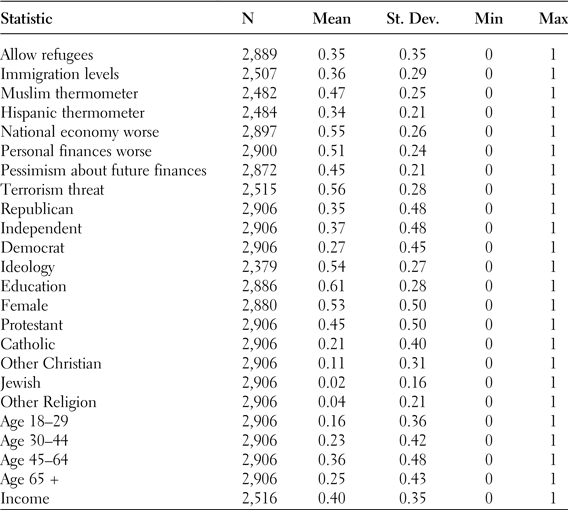
I control for party identification, ideology, income, age, sex, religion, and education. All of the variables were coded on a scale of 0–1 to ensure that coefficients can be directly compared. Descriptive statistics are reported in Table 1 in the Appendix.
The 2016 Chicago Council Survey
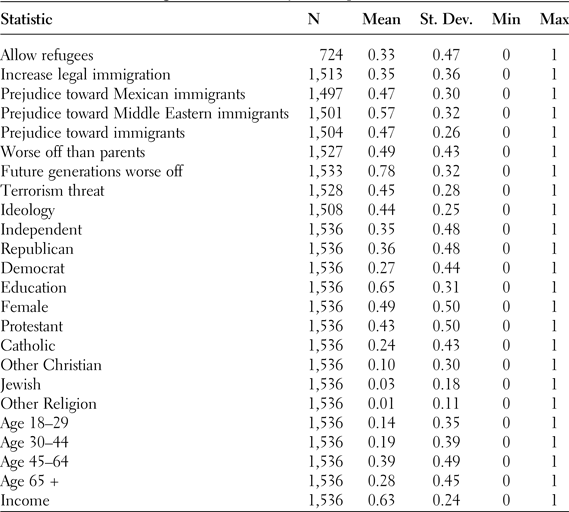
I conduct the same analyses using data from the 2016 Chicago Council Survey. This survey was conducted between June 10 and 27, 2016, among a representative national sample of 2,061 adults. The median survey length was 20 min. The survey was conducted by GfK Custom Research using a randomly selected sample of GfK's large-scale nationwide research panel, KnowledgePanel (KP). The survey was fielded online to a total of 3,580 panel members. The completion rate was 63%. Panel members were selected using Address Based Sampling (ABS) methodology. Those who agreed to participate in the panel were provided with free Internet hardware and access (if necessary) so that participation in the study was not limited to individuals who already had Internet access. About 76% of the total number of participants were non-Hispanic Whites compared to 9% African Americans and 8% Hispanics. Foreign-born individuals were not included in the survey. Descriptive statistics are presented in Table 2 in the Appendix.
The dependent variable relating to immigration levels asks whether legal immigration should be decreased, kept at its present level, or increased.Footnote 9 The dependent variable relating to attitudes toward refugees asks “Do you support or oppose the United States taking each of the following actions with respect to Syria?—Accepting Syrian refugees into the United States” and takes a value of 0 if respondents oppose accepting Syrian refugees and 1 if they support it. Contrary to the questions about immigration in general, only half the sample was asked about accepting Syrian refugees to the United States (N = 749).
Prejudice toward immigrants is measured using the question “Do you have a very favorable, somewhat favorable, somewhat unfavorable or very unfavorable view of the following people,” with the categories being: Chinese immigrants in the United States, Middle Eastern immigrants in the United States, Korean immigrants in the United States, and Mexican immigrants in the United States. I create a composite measure of prejudice toward immigrants by averaging respondents’ answers to this question for the four separate groups (Cronbach's α = .895). I use feelings toward Middle Eastern immigrants as a proxy for prejudice toward Syrian refugees.
Economic threat is measured using two questions: (1) “Thinking about the next generation of Americans who are children today, the way things are going, do you think economically they will be better off, worse off, or about the same as the generation of adults who are working today?” and (2) “And thinking now about your parents when they were your age, do you think that economically they were better off, worse off, or about the same as you are today?” These two questions aim at measuring optimism about the state of the economy which has been shown to relate to restrictive attitudes toward immigration (e.g. Burns and Gimpel Reference Burns and Gimpel2000).
Security threat is measured using a question that asks whether the person is worried that they or someone they know will be the target of a terrorist attack. Responses range from “not at all worried” to “extremely worried” coded on a four-point scale from 0 to 1.
An additional measure of realistic threat asking whether “large numbers of immigrants and refugees are a threat to the vital interests of the United States in the next 10 years” is used in some models (see Appendix).Footnote 10
I control for party, ideology, age, race, ethnicity, gender, education, and religion. All the variables in the model are coded on a 0–1 scale to facilitate direct comparison. Using standardized variables produces comparable results.Footnote 11
RESULTS
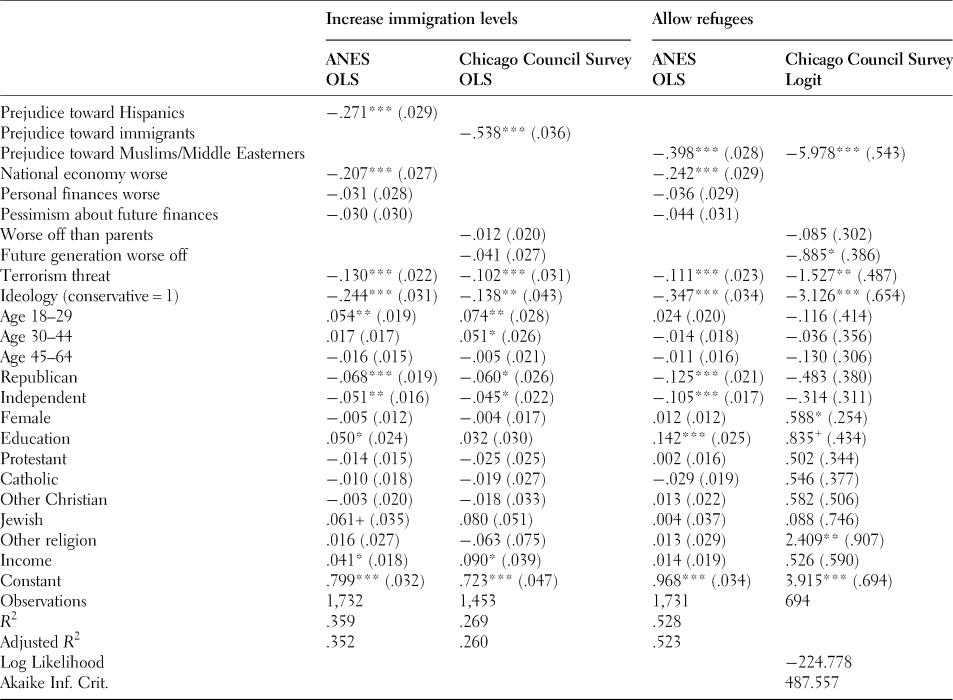
I first discuss the results for attitudes toward immigration levels as a validation of previous studies. I then extend these findings to attitudes toward refugee resettlement using Syrians as a case study. Table 1 shows the results for the regressions for Whites’ attitudes towards immigration levels and Syrian refugee resettlement using both datasets.
Whites’ Attitudes toward Immigration levels and Syrian Refugee Resettlement

Note: +p < .1; *p < .05; **p < .01; ***p < .001.
Consistent with previous studies on attitudes toward immigration, prejudice is found to significantly predict anti-immigration policies (e.g. Brader, Valentino, and Suhay Reference Brader, Valentino and Suhay2008; Fetzer Reference Fetzer2000; Hainmueller and Hiscox Reference Hainmueller and Hiscox2007). As columns 1 and 2 in Table 1 show, prejudice toward Hispanics (ANES) and immigrants in general (Chicago Council Survey) is associated with opposition toward increases in immigration levels. In terms of realistic threat measures, concern about one's personal economic situation is not found to have a significant impact on attitudes toward immigration levels. Concerns about the national economy are however found to be associated with anti-immigration attitudes. These findings are consistent with previous research that shows that sociotropic concerns are more important than pocketbook concerns in shaping attitudes toward immigration policies (e.g. Citrin et al. Reference Citrin, Green, Muste and Wong1997; Hainmueller and Hopkins Reference Hainmueller and Hopkins2014). Finally, security threat is found to reduce support for increases in immigration levels.
As noted previously, all the variables were re-coded on a scale of 0–1 so that the OLS coefficients can be read as relative maximum effects. Maximum effects are the estimated change in the probability that a respondent would answer “increase immigration levels” or “support Syrian refugee resettlement” due to a change in the relevant predictor from its minimum value to its maximum value while holding all other variables constant at their means. This allows us to compare the relative substantive importance of the different predictors.
In the ANES dataset, attitudes toward immigration levels are almost equally predicted by prejudice toward Hispanics and perceptions of the national economy. As column 1 shows, going from the minimum to the maximum value on prejudice toward Hispanics is associated with a 27 percentage point reduction in support for increases in immigration levels. This is only slightly larger than the effect of perceptions of the national economy which is associated with a 21 percentage point maximum reduction in support for immigration level increases. These results can be due to the use of prejudice toward Hispanics as a proxy for prejudice toward immigrants in general and are addressed in the Chicago Council Survey data. As column 2 shows, when prejudice toward immigrants in general is used, it is found to have the largest substantive effect on attitudes toward immigration levels. Going from the minimum to the maximum value of prejudice toward immigrants is found to reduce support for increases in immigration levels by 53 percentage points. This is consistent with previous research on immigration attitudes which finds that prejudice is the main driver of anti-immigration attitudes (e.g. Brader, Valentino, and Suhay Reference Brader, Valentino and Suhay2008; Citrin, Reingold, and Green Reference Citrin, Reingold and Green1990; Hainmueller and Hiscox Reference Hainmueller and Hiscox2007).
Other measures of economic threat are not found to be associated with attitudes toward immigration levels in either dataset. The second measure of realistic threat, terrorism threat, is found to reduce support for increases in immigration levels by a maximum of 13 and 10 percentage points in the ANES and Chicago Council Survey models, respectively. These results show that while realistic concerns are significantly associated with anti-immigration attitudes, their effect in three out of the four models is dwarfed by that of prejudice.
Columns 3 and 4 present the linear and logistic regression results for attitudes toward Syrian refugee resettlement. Prejudice toward Muslims and toward Middle Easterners is found to be associated with opposition to Syrian refugee resettlement. Concern about the state of the national economy, perceptions of future generations as economically worse off, and terrorism threat are also found to be associated with decreases in support for Syrian refugee resettlement. Consistent with the results regarding general immigration attitudes, pocketbook concerns are not significantly associated with attitudes toward the resettlement of Syrian refugees.
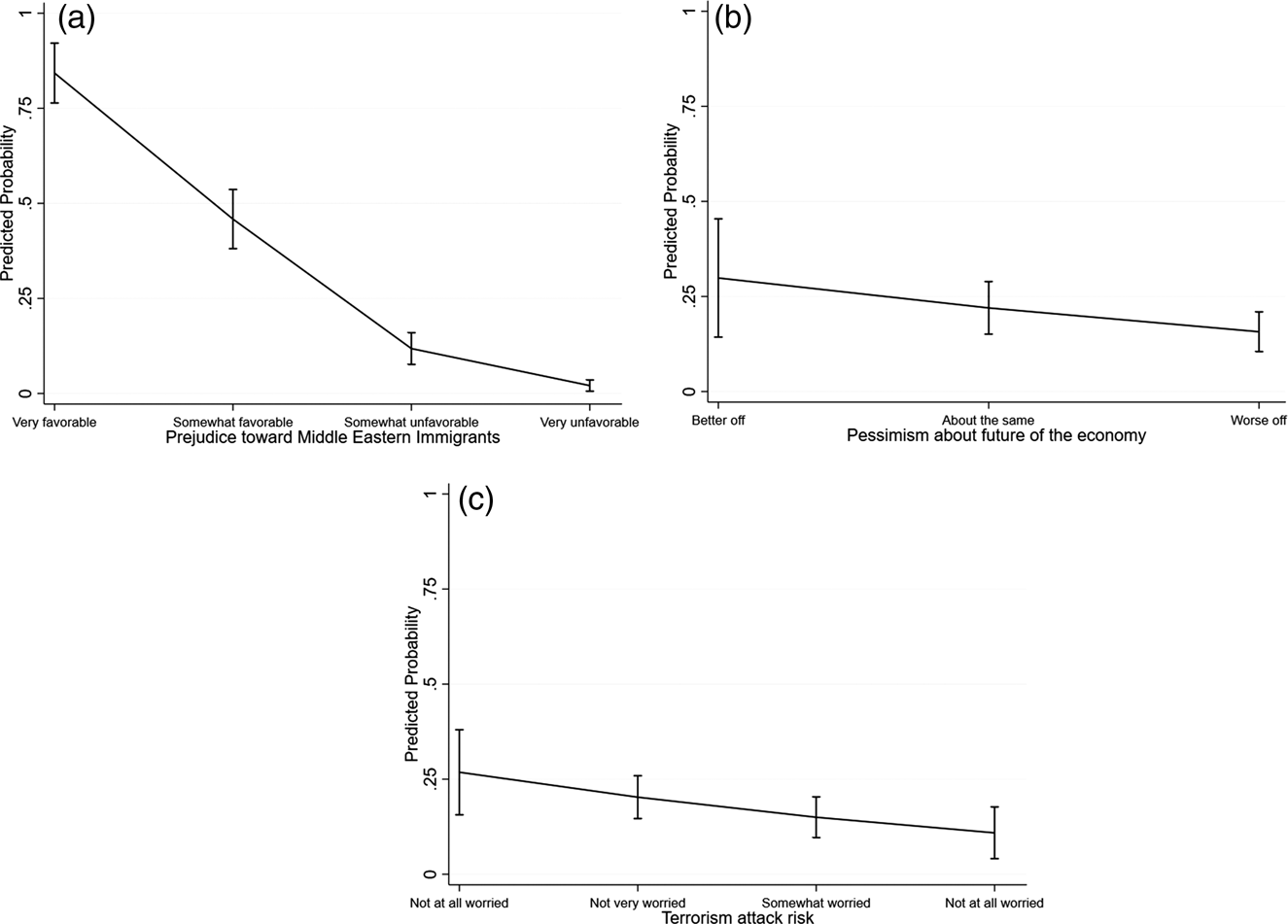
In terms of the size of these effects, prejudice is again found to have the largest effect on attitudes. Column 3 in Table 1 shows the results for the ANES dataset. Going from the minimum to the maximum value on prejudice is associated with a 40 percentage point decrease in support for refugee resettlement. In comparison, going from the minimum to the maximum value on the sociotropic measure of economic threat (perceptions of the national economy) is associated with a decrease in support for Syrian refugee resettlement of 24 points. The results from the Chicago Council Survey, reported in column 4, show similar patterns. Figure 1 shows the predicted probability plots for the relevant coefficients. Going from the minimum to the maximum value in prejudice toward Middle Eastern immigrants is found to be associated with an 82 percentage point drop in support for Syrian refugee resettlement. In comparison, going from the minimum to the maximum value on terrorism threat and pessimism about future generations’ economic prospects, the two significant measures of realistic threat, decreases support for Syrian refugee resettlement by 16 and 15 percentage points (see Figure 1). These results are consistent with the findings from the ANES and are in line with those relating to general levels of immigration.
Logit Predicted Probabilities for Attitudes toward Accepting Syrian Refugees

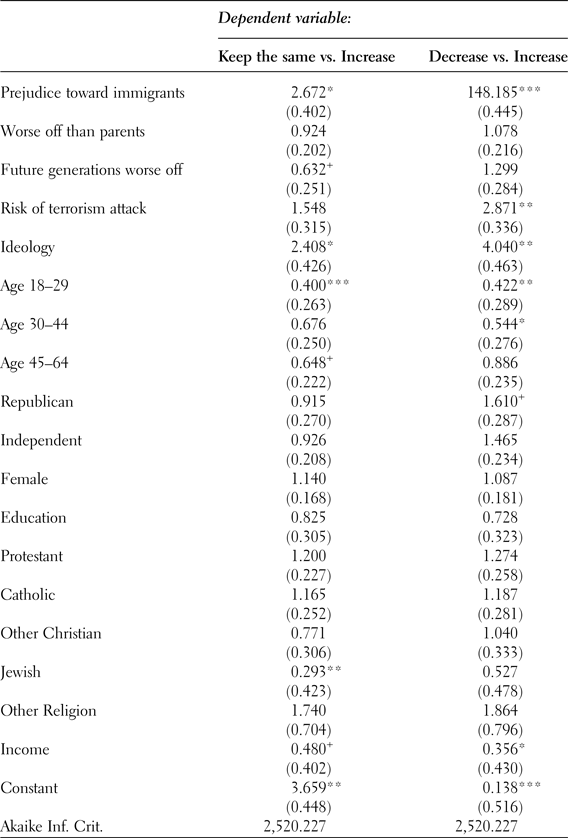
Ideology and party identification are also substantively important predictors of support of attitudes toward both immigration levels and refugee resettlement. The results are comparable when using standardized variables.Footnote 12 As a robustness check, multinomial logit models for attitudes toward immigration levels using the Chicago Council Survey data are provided in Table 3 in the Appendix. Based on the Brant test, I find that the ordered logit regressions are not consistent with the parallel regression assumption. Multinomial logit models are thus more appropriate than ordered logit regressions to assess the effects of the different predictors on the dependent variable. The findings are however robust to different model specifications (ordered logit, multinomial logit, and multinomial probit models).
In sum, the findings from all four models highlight the importance of prejudice on attitudes toward immigration and refugee policy. Realistic threat, while having a significant impact on attitudes, is found to have a smaller substantive impact compared to prejudice.
LIMITATIONS
Results from both datasets suggest that prejudice toward Muslims, rather than realistic threat, is a dominant factor in determining attitudes toward Syrian refugee resettlement. The results for general immigration levels are more mixed, with the data from the 2016 ANES suggesting that both prejudice and economic threat have a similar impact on attitudes. However, these findings might be due to differences in how prejudice is measured. When attitudes toward immigrants in general rather than toward Hispanics are used as measures of prejudice, attitudes toward immigration levels are found to be primarily driven by prejudice.
This study focuses on White Americans to assess immigration attitudes among the economically and numerically dominant group. Additional studies should incorporate racial minorities’ views given that previous research has shown that non-Whites tend to display different immigration preferences. Research on Latinos for instance shows that they do not have homogeneous attitudes on immigration (Sanchez Reference Sanchez2006; Sanchez and Vargas Reference Sanchez and Vargas2016; Vega and Ortiz Reference Vega and Ortiz2017). Studies on African Americans’ attitudes toward immigration show that they tend to be primarily driven by economic threat rather than prejudice (Gay Reference Gay2006). This line of research shows that it is important to look beyond the White population when studying attitudes toward immigration policy in general and refugee policy in particular.
CONCLUSION
This study contributes to the literature on immigration in two ways. First, it is among the first to examine the determinants of attitudes toward Syrian refugees in the United States. I show that even though Syrian refugees differ from immigrants in general in terms of their ethnic and religious background, the reasons for their immigration, and the rhetoric surrounding their admission, prejudice toward Muslims and Middle Eastern immigrants remains the dominant factor in explaining Whites’ attitudes toward them. More importantly, I show that even though the main argument against Syrian refugee resettlement centers around security, concerns over crime or terrorism are not primary drivers of attitudes toward refugee resettlement. These findings suggest that arguments citing terrorism threat as a reason for restricting refugee admissions, rather than being drivers of attitudes toward refugees, may be socially acceptable ways of expressing prejudice toward individuals of Muslim and Middle Eastern backgrounds.
Given that prejudice is the main driver of attitudes toward refugee resettlement and immigration levels, future research should look at its contextual drivers. Such research could look at how perceptions of the state of the economy, one's own economic vulnerabilities, the state of national security, and the media environment can all activate the effect of prejudice on attitudes toward different non-citizen groups.
Understanding whether prejudice or realistic threat is at the heart of attitudes toward different non-citizen groups can serve to promote better group relations between white Americans and immigrants. Given that prejudice is found to be the main driver of anti-immigrant attitudes, positive intergroup contact between white Americans and Muslims or Hispanics can serve to improve perceptions of these outgroups (e.g. Pettigrew and Tropp Reference Pettigrew and Tropp2008; Pettigrew et al. Reference Pettigrew, Tropp, Wagner and Christ2011) and, in turn, attitudes toward the resettlement of these populations in the United States.
SUPPLEMENTARY MATERIAL
The supplementary material for this article can be found at https://doi.org/10.1017/rep.2019.37
Acknowledgments
The author would like to thank Bernard Fraga, Edward Carmines, Beyza Büyüker, Alexandra Filindra, and the anonymous reviewers for their invaluable feedback, comments, and suggestions at different stages of the project.
APPENDIX
2016 ANES Descriptive statistics

2016 Chicago Council Survey Descriptive statistics

Multinomial logit regressions: Whites’ Attitudes toward Immigration Levels