Introduction
Geomyidae, a family of rodents commonly known as gophers, is native to North America and Central America, although some members have been reported from northwestern Colombia (MacDonald, Reference MacDonald2006; Vaughan et al., Reference Vaughan, Ryan and Czaplewski2015). This family includes two subfamilies, Geomyinae and Entoptychinae (Flynn et al., Reference Flynn, Lindsay, Martin, Janis, Gunnell and Uhen2008).
The greatest diversity of gophers is in Geomyinae, including the extant members that belong to the genera Cratogeomys, Thomomys, Orthogeomys, Geomys, Pappogeomys, and Zygogeomys (Villa and Cervantes, Reference Villa and Cervantes2003; Flynn et al., Reference Flynn, Lindsay, Martin, Janis, Gunnell and Uhen2008; Fernández et al., Reference Fernández, Hafner, Hafner and Cervantes2014). This subfamily originated in the middle Miocene (ca. 14 Ma) and was represented by eight genera during the Neogene, among which Pliosaccomys, Reynoldsomys, Parapliosaccomys, and Pliogeomys became extinct (Flynn et al., Reference Flynn, Lindsay, Martin, Janis, Gunnell and Uhen2008).
Entoptychinae includes an extinct group of gophers that exhibited a temporal range from the early Oligocene (Arikareean 1) to the middle Miocene (Barstovian 2). It is represented by the genera Gregorymys, Pleurolicus, Entoptychus, and Ziamys (Flynn et al., Reference Flynn, Lindsay, Martin, Janis, Gunnell and Uhen2008). Particularly, Gregorymys had a long temporal range and includes eight species, with records from many localities in the Pacific Northwest (Oregon), the Great Plains (Montana, Wyoming, South Dakota, Nebraska, Colorado), the Great Basin (Texas), and southern Mexico (Oaxaca) (Flynn et al., Reference Flynn, Lindsay, Martin, Janis, Gunnell and Uhen2008; Jiménez-Hidalgo et al., Reference Jiménez-Hidalgo, Smith, Guerrero-Arenas and Alvarado-Ortega2015, Reference Jiménez-Hidalgo, Guerrero-Arenas and Smith2018a).
In recent years, Gregorymys veloxikua Jiménez-Hidalgo, Guerrero-Arenas, and Smith, Reference Jiménez-Hidalgo, Guerrero-Arenas and Smith2018a was described from the Santiago Yolomécatl area, in northwestern Oaxaca, southern Mexico. This species is part of the Iniyoo Local Fauna that was previously considered as late Eocene in age (Chadronian) (Jiménez-Hidalgo et al., Reference Jiménez-Hidalgo, Smith, Guerrero-Arenas and Alvarado-Ortega2015, Reference Jiménez-Hidalgo, Guerrero-Arenas and Smith2018a); however, a maximum depositional U-Pb age and the recent identification of typical mammalian index taxa revealed that the age of this assemblage is early Oligocene, corresponding to the Arikareean 1 (Ar1) in the North American mammalian biochronology (Guerrero-Arenas et al., Reference Guerrero-Arenas, Jiménez-Hidalgo and Genise2020).
The record from Oaxaca is the southernmost occurrence of Gregorymys in North America (Jiménez-Hidalgo et al., Reference Jiménez-Hidalgo, Guerrero-Arenas and Smith2018a). Besides G. veloxikua, another closely related gopher is present in the Iniyoo Local Fauna. Cranial and dental material that represents a new species of Gregorymys from Santiago Yolomécatl is formally described here. Furthermore, comments on its phylogenetic position and the paleobiological implications of this new record are provided.
Geological setting
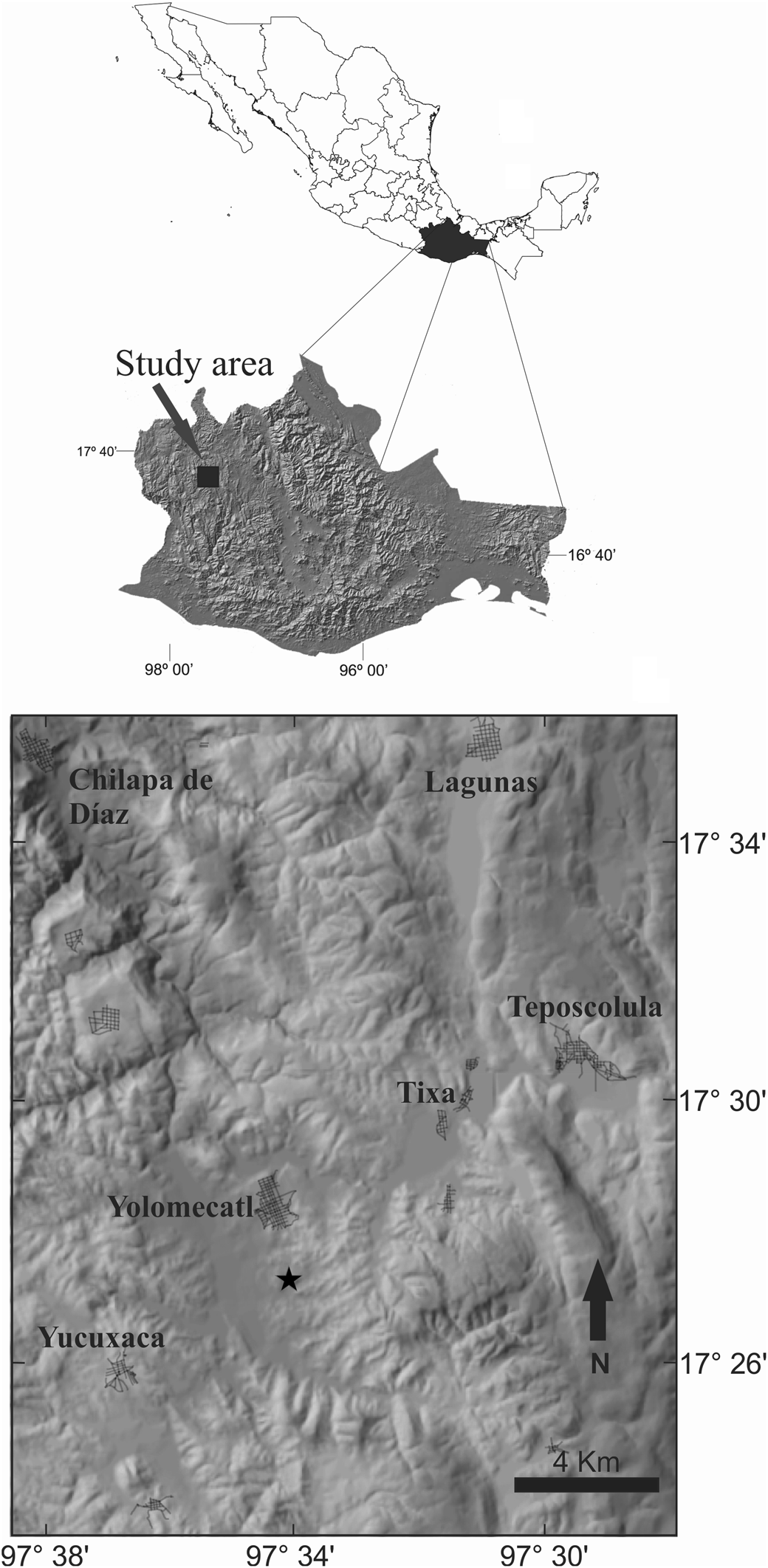
The Yolomécatl area is in the southeastern part of the Tlaxiaco basin, in northwestern Oaxaca, southern Mexico (Fig. 1), within the Sierra Madre del Sur physiographic province and the Mixteca Alta sub-province (INEGI, 2008).
Geographic location of Santiago Yolomécatl, Oaxaca, México. Fossil locality is indicated by a black star.

Stratigraphic information
The studied specimens were collected from silty-clayey sediments with occasional lithics and pedogenesis of the lower Oligocene Chilapa Formation (Santamaría-Díaz et al., Reference Santamaría-Díaz, Alaníz-Álvarez and Nieto-Samaniego2008), which crop out at 17°27'28"N, 97°34'35"W. In the Yolomécatl area, the Chilapa Formation consists of a stratigraphic sequence that, in its lower part, comprises alternating layers of red mudstone with some volcanic lithic fragments, greenish to gray volcanic sandstone, and volcarenitic matrix-supported conglomerate, greenish and whitish siltstone, and medium- to thickly bedded, partially silicified limestone beds. That sequence changes upward into one comprising layers of thinly to thickly bedded, reddish mudstone with several interbedded paleosols and layers of silicified calcrete and volcanic conglomerate (Jiménez-Hidalgo et al., Reference Jiménez-Hidalgo, Israde-Alcántara, Rodríguez-Caballero and Guerrero-Arenas2019; Rodríguez-Caballero, Reference Rodríguez-Caballero2019).
The fossiliferous sediments and associated fauna (Iniyoo Local Fauna) were initially regarded as late Eocene (Jiménez-Hidalgo et al., Reference Jiménez-Hidalgo, Smith, Guerrero-Arenas and Alvarado-Ortega2015) or middle Eocene (Ferrusquía-Villafranca et al., Reference Ferrusquía-Villafranca, Ruiz-González, Torres-Hernández, Anderson, Urrutia-Fucugauchi, Martínez-Hernández and García-Villegas2016) in age. A new U-Pb zircon maximum depositional age of 30.6 ± 0.77 Ma for a sandstone bed that is within the fossiliferous beds, as well as some of the associated mammals (Cormocyon, Mammacyon, Oreodontoides, Archaeolagus, among others), indicate an Arikareean 1 North American Land Mammal Age (NALMA) (Guerrero-Arenas et al., Reference Guerrero-Arenas, Jiménez-Hidalgo and Genise2020). An absolute age of 28–29 Ma for the Iniyoo Local Fauna is constrained by the First Appearance Datum of the amphicyonid Mammacyon and the Last Appearance Datums for the tayassuid Perchoerus probus and Subhyracodon (Jiménez-Hidalgo et al., Reference Jiménez-Hidalgo, Lander and Guerrero-Arenas2018b).
The Chilapa Formation in the study area is capped by volcanic rocks with an age of 27.7 ± 0.7 Ma (Ferrusquía-Villafranca et al., Reference Ferrusquía-Villafranca, Ruiz-González, Torres-Hernández, Anderson, Urrutia-Fucugauchi, Martínez-Hernández and García-Villegas2016) and is underlain by volcanic breccia.
Materials and methods
The dental nomenclature and measurements follow Wood (Reference Wood1936), Munthe (Reference Munthe1977), and Korth and Branciforte (Reference Korth and Branciforte2007), whereas the cranial nomenclature and measurements are adopted from Wahlert and Souza (Reference Wahlert and Souza1988) and Korth (Reference Korth1993). The measurements were taken with a digital caliper, with a resolution of 0.01 mm and a precision of 0.003 mm. All measurements are in mm.
Phylogenetic analysis
To explore the phylogenetic relationship of the new Gregorymys species to the already erected species of this genus, the observed character states of the studied specimens were added to the character matrix of Jiménez-Hidalgo et al. (Reference Jiménez-Hidalgo, Guerrero-Arenas and Smith2018a; Appendix 1), which contains a data set of 48 characters. Twelve characters are biometric indices and were treated as continuous, and six discrete characters are additive. The number of anterostylids on the p4 were added to this matrix and this character was treated as additive ([0] no anterostylids, [1] one anterostylid, [2] two anterostylids, [3] three or more anterostylids) (see Appendix 1).
The ingroup consists of 10 taxa that include the eight previously known species of Gregorymys (G. formosus [Matthew, Reference Matthew1907], G. curtus [Matthew, Reference Matthew1907], G. riggsi Wood, Reference Wood1936, G. riograndensis Stevens, Reference Stevens1977, G. kayi Wood, Reference Wood1950, G. larsoni Munthe, Reference Munthe1977, G. douglassi Wood, Reference Wood1936, and G. veloxikua Jimenez-Hidalgo, Guerrero-Arenas, and Smith, Reference Jiménez-Hidalgo, Guerrero-Arenas and Smith2018a) and the new species described here. The character states of Geomyinae were derived from the extant genera Thomomys and Cratogeomys, in order to recover the largest part of the morphological and metric variation observed within the members of this subfamily. The families Florentiamyidae and Heteromyidae, as well as the genus Tenudomys, were considered as outgroups (see Appendix 1).
Evaluation of new specimens of Gregorymys veloxikua revealed the presence of a very weak anterolabial cingulid on the lower molars, which disappears with minimal wear. Accordingly, character 16 was coded as present (1) in this taxon, in contrast to Jiménez-Hidalgo et al. (Reference Jiménez-Hidalgo, Guerrero-Arenas and Smith2018a).
The phylogenetic analysis was performed in TNT v. 1.5 (Goloboff and Catalano, Reference Goloboff and Catalano2016), with implicit enumeration. Bremer support was implemented to measure the number of extra steps required before a clade is lost from the tree (Kitching et al., Reference Kitching, Forey, Humphries and Williams1998).
Anatomical abbreviations
I, upper incisor; i, lower incisor; P, upper premolar; p, lower premolar; M, upper molar; m, lower molar.
Repositories and institutional abbreviations
The specimens described in this study are housed in the Colección Científica del Laboratorio de Paleobiología, campus Puerto Escondido, Universidad del Mar (UMPE), Oaxaca, Mexico. The studied sample was compared with selected specimens belonging to Gregorymys formosus, G. curtus, G. douglassi, and G. riggsi, housed at the American Museum of Natural History, New York (AMNH). In addition, comparisons with previously published specimens of G. riograndensis, G. kayi, and G. larsoni were also performed (Wood, Reference Wood1936; Munthe, Reference Munthe1977).
Systematic paleontology
Order Rodentia Bowdich, Reference Bowdich1821
Superfamily Geomyoidea Bonaparte, Reference Bonaparte1845
Family Geomyidae Bonaparte, Reference Bonaparte1845
Subfamily Entoptychinae Miller and Gidley, Reference Miller and Gidley1918
Genus Gregorymys Wood, Reference Wood1936
Type species
Gregorymys formosus (Matthew, Reference Matthew1907) from the Oligocene (Arikareean) of South Dakota.
Gregorymys mixtecorum new species
Figures 2, 3
- Reference Jiménez-Hidalgo, Guerrero-Arenas and Smith2018a
Gregorymys veloxikua Jiménez-Hidalgo et al., p. 429 (in part).
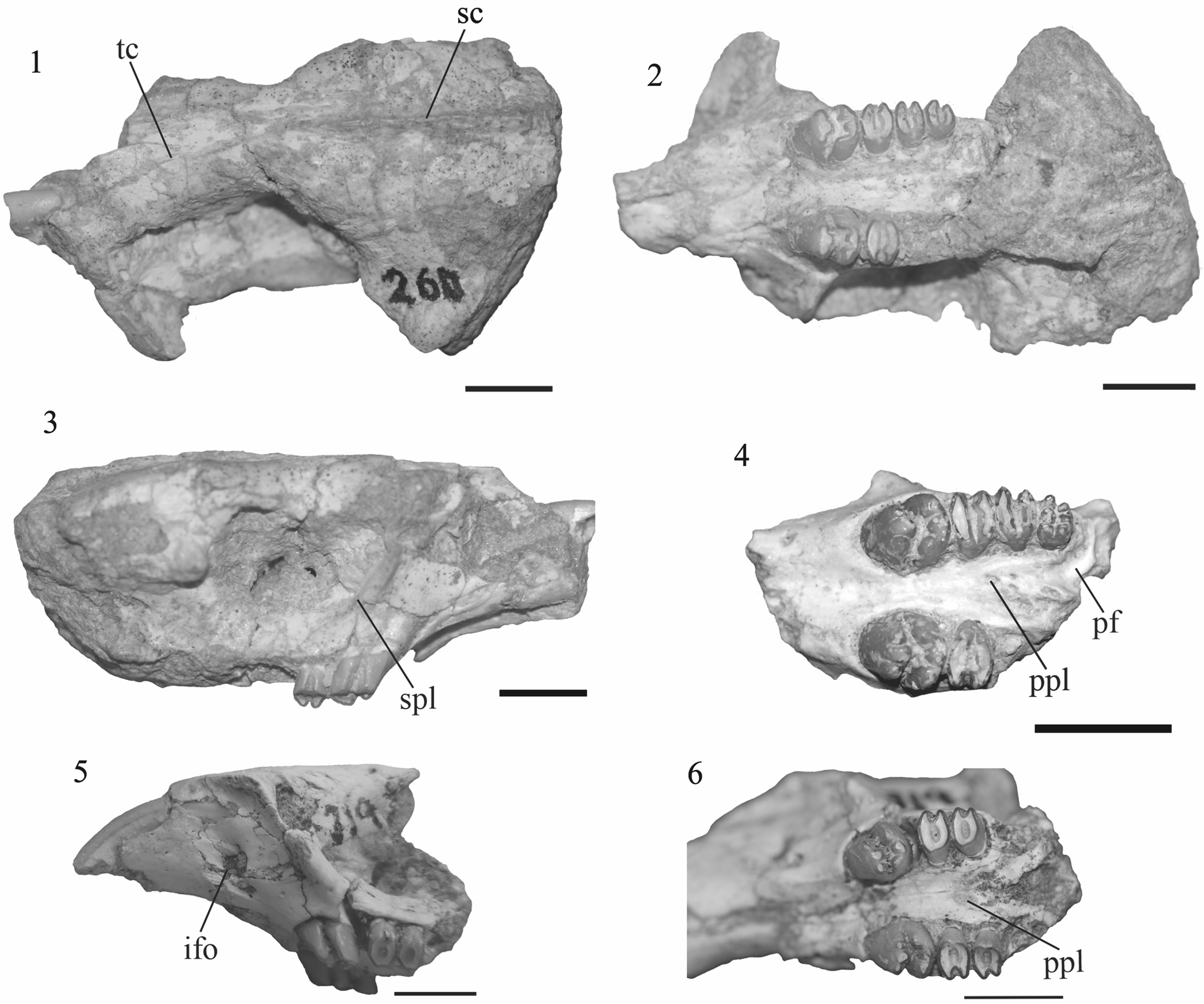
Gregorymys mixtecorum n. sp. from the early Oligocene of Santiago Yolomécatl, Oaxaca. (1–3) Holotype UMPE 260, partial skull in (1) dorsal view, (2) ventral view, and (3) lateral view; (4) UMPE 671, maxillaries with right P4–M1 and left P4–M3; (5, 6) UMPE 319, partial skull in (5) lateral and (6) ventral view. Abbreviations: ifo= infraorbital foramen; pf, parapterygoid fossa; ppl, posterior palatine foramen; sc, sagittal crest; spl; sphenopalatine foramen; tc, temporal/supraorbital crest. Scale bars = 5 mm.

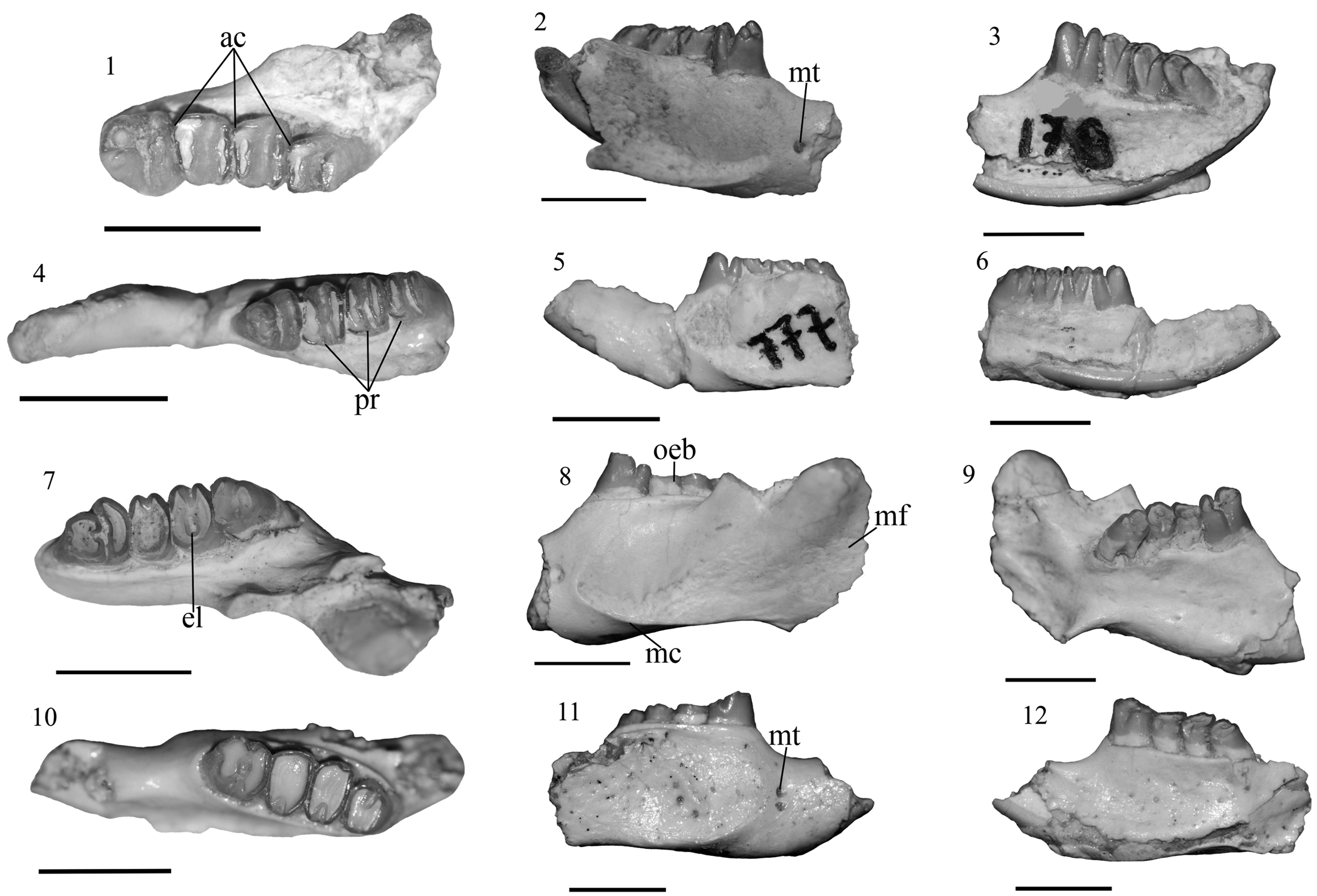
Lower jaws of Gregorymys mixtecorum n. sp. (1–3) UMPE 178 in (1) occlusal, (2) labial, and (3) lingual views; (4–6) paratype UMPE 777 in (4) occlusal, (5) labial, and (6) lingual views; (7–9) UMPE 710 in (7) occlusal, (8) labial, and (9) lingual views; (10–12) UMPE 716 in (10) occlusal, (11) labial, and (12) lingual views. Abbreviations: ac= anterolabial cingulid; el= enamel lake; mc= masseteric crest; mf= masseteric fossa; mt= mental foramen; oeb= undulating enamel base; pr= protostylid. Scale bars = 5 mm.

Holotype
UMPE 260, partial skull with left P4–M3 and right P4–M1, without nasals, premaxillaries, and basicranium.
Paratypes
UMPE 267, partial skull with right and left P4–M3, without rostral part of nasals, premaxillaries and the caudal part of skull; UMPE 314, partial right lower jaw with p4–m3; UMPE 438, partial right lower jaw with i, p4–m3; UMPE 777, partial left lower jaw with p4–m3. Type series was collected from silty-clayey sediments of the lower Oligocene Chilapa Formation (Arikareean 1 NALMA), which crop out at 17°27'28"N, 97°34'35"W.
Diagnosis
Differs from other species of Gregorymys in commonly having one or rarely two anterostylid(s) on p4; larger than all other species, except G. veloxikua; P4 shorter than in G. veloxikua, slightly longer than in G. formosus and longer than all other species; P4 wider than G. formosus, G. riograndensis, and G. douglassi, narrower than in G. curtus, G. riggsi, and G. veloxikua. Lower tooth row longer than in all other species, except G. veloxikua; p4 longer than in G. larsoni and G. riograndensis; slightly shorter than in G. curtus, similar to G. riggsi and shorter than in all other species; mandible shallower than in G. veloxikua, G. formosus, and G. curtus, deeper than in all other species.
Occurrence
Early Oligocene (Arikareean 1 North American Land Mammal Age), Chilapa Formation, Santiago Yolomécatl, northwestern Oaxaca, southern Mexico.
Comparative description
Skull
The supraorbital crests are prominent (Fig. 2.1), as in Gregorymys veloxikua and G. formosus, whereas G. curtus and G. riggsi differ in having low supraorbital crests (Wood, Reference Wood1936; Whalert and Souza, Reference Wahlert and Souza1988; Jiménez-Hidalgo et al., Reference Jiménez-Hidalgo, Guerrero-Arenas and Smith2018a). The supraorbital crests join posteriorly as the sagittal crest, which is strong, as in G. veloxikua and G. formosus, although it is low in G. curtus (Wood, Reference Wood1936; Whalert and Souza, Reference Wahlert and Souza1988; Jiménez-Hidalgo et al., Reference Jiménez-Hidalgo, Guerrero-Arenas and Smith2018a). The interparietal width is broad, which is a typical condition of the species of Gregorymys (Whalert and Souza, Reference Wahlert and Souza1988).
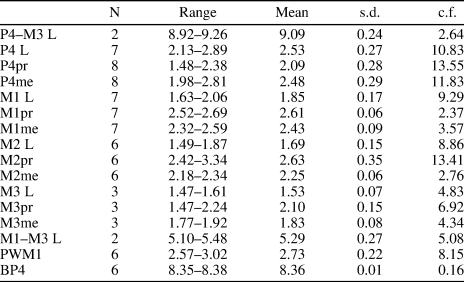
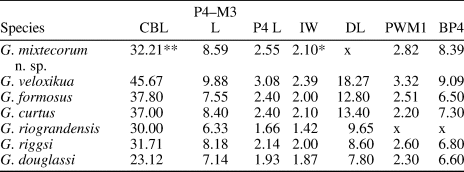
The infraorbital foramen is low in the rostrum and depressed into the rostral wall, similar to that of Gregorymys curtus and G. formosus (Whalert and Souza, Reference Wahlert and Souza1988). The diastema is dorsally concave and curved toward the incisors (Fig. 2.2, 2.5), as in the other species of Gregorymys and other members of Entoptychinae (Whalert and Souza, Reference Wahlert and Souza1988; Jiménez-Hidalgo et al., Reference Jiménez-Hidalgo, Guerrero-Arenas and Smith2018a). The palate is anteroposteriorly expanded, as in other entoptychines and geomyines (Whalert and Souza, Reference Wahlert and Souza1988). Palate width between the alveoli of M1 is smaller than that of G. veloxikua and is more similar to that of G. riggsi than to other species of the genus, in which it is narrower (Tables 1, 2). The maximum maxillary breadth at the level of P4 is relatively smaller than that of G. veloxikua, although it is larger than in the other species of the genus (Table 2).
Skull and upper teeth measurements (in mm) of Gregorymys mixtecorum n. sp. from the early Oligocene (Arikareean 1 NALMA) of Oaxaca, southern Mexico. Abbreviations: N = sample number, s.d. = standard deviation, c.f. = coefficient of variation, P4–M3 L = alveolar length of P4–M3 series, P4 L = length of P4, P4pr = width of P4 protoloph, P4me = width of P4 metaloph, M1 L = length of M1, M1pr = width of M1 protoloph, M1me = width of M1 metaloph, M2 L = length of M2, M2pr = width of M2 protoloph, M2me = width of M2 metaloph, M3 L = length of M3, M3pr = width of M3 protoloph, M3me = width of M3 metaloph, IW = width of I, M1-M3 L = length of M1-M3, PWM1 = palatal width between alveoli of M1, BP4 = maximum maxillaries breadth at P4 level.

Skull and upper teeth measurements (in mm) of Gregorymys species. CBL = condylobasilar length, P4–M3 L = alveolar length of P4–M3 series, P4 L = length of P4, IW = width of I, DL = diastema length, PWM1 = palatal width between alveoli of M1, BP4 = maximum maxillaries breadth at P4 level, x = missing value, *= measured in a single specimen, **broken specimen.

The sphenopalatine foramina are dorsal to P4, as in G. veloxikua (Jiménez-Hidalgo et al., Reference Jiménez-Hidalgo, Guerrero-Arenas and Smith2018a), whereas in G. formosus and G. curtus they are dorsal to the anterior part of M1 and dorsal to the P4–M1 junction in G. riggsi (Whalert and Souza, Reference Wahlert and Souza1988). In G. mixtecorum n. sp., the optic foramen is dorsal to M2, as in G. curtus, whereas in G. riggsi it is dorsal to the junction of M1–M2 and in G. formosus is dorsal to M3 (Whalert and Souza, Reference Wahlert and Souza1988). The dorsal palatine foramina are dorsal to M1, as in G. veloxikua, whereas in G. formosus they are dorsal to the junction of M2–M3 (Wahlert and Souza, Reference Wahlert and Souza1988). The posterior palatine foramina are on the maxillary-palatine suture, parallel to the metaloph of M2 (Fig. 2.4), as in G. veloxikua. In other species of Gregorymys, these foramina are located between M1 and M2 (Whalert and Souza, Reference Wahlert and Souza1988). The parapterygoid fossae are deep, as in G. formosus, G. veloxikua, and G. riggsi (Jiménez-Hidalgo et al., Reference Jiménez-Hidalgo, Guerrero-Arenas and Smith2018a). The sphenopterygoid canal is located immediately posterior to the parapterygoid fossae, as in G. formosus and G. riggsi (Whalert and Souza, Reference Wahlert and Souza1988).
Upper dentition
The mean length of P4–M3 is somewhat smaller than that of Gregorymys veloxikua (Tables 1, 2), although it is larger than that observed in the other species of the genus. The molars decrease in size from M1 to M3. The molars are wider than long and compressed anteroposteriorly (Fig. 2.2, 2.4, 2.6). These conditions are observed in the upper molars of G. curtus and G. douglassi (Wood, Reference Wood1936).
Incisors are ungrooved as in G. veloxikua and G. curtus, whereas G. formosus, G. riggsi, G. riograndensis, G. larsoni, G. kayi, and G. douglassi have incisors with a poorly developed groove (Whalert and Souza, Reference Wahlert and Souza1988; Flynn et al., Reference Flynn, Lindsay, Martin, Janis, Gunnell and Uhen2008; Jiménez-Hidalgo et al., Reference Jiménez-Hidalgo, Guerrero-Arenas and Smith2018a). The width of the incisor of the specimen UMPE 260 is similar to that of G. formosus, G. curtus, and G. riggsi, although it is somewhat smaller than that of G. veloxikua (Table 1).
The protoloph of P4 has three cusps, as in G. veloxikua and G. riggsi, whereas G. formosus has a single cusp in the protoloph (Wood, Reference Wood1936; Whalert and Souza, Reference Wahlert and Souza1988; Jiménez-Hidalgo et al., Reference Jiménez-Hidalgo, Guerrero-Arenas and Smith2018a). The protocone is the largest cusp on the protoloph, as in G. veloxikua. The metaloph has three to four cusps of similar size, but the hypostyle is the smallest. The P4 is larger (~25%) than the M1, as in other species of Gregorymys (Wood, Reference Wood1936).
In the molars, the protoloph has three cusps and the metaloph four cusps, as in G. veloxikua (Jiménez-Hidalgo et al., Reference Jiménez-Hidalgo, Guerrero-Arenas and Smith2018a). The cusps on the protoloph and metaloph disappear at late wear stages. The protoloph and metaloph are fused forming an enamel lake; this fusion begins in the lingual side as in the other species of Gregorymys (Wood, Reference Wood1936; Flynn et al., Reference Flynn, Lindsay, Martin, Janis, Gunnell and Uhen2008).
Mandible
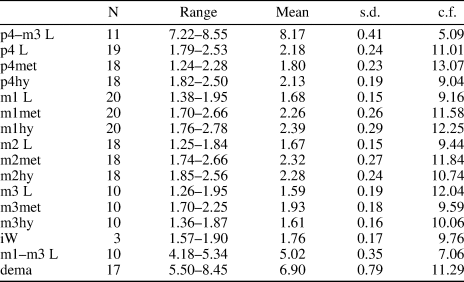
The mandible is relatively stout, as in G. veloxikua, G. formosus, and G. curtus (Fig. 3). The mean mandible depth at the level of m1 is similar to that of G. curtus and somewhat smaller than that of G. veloxikua (Tables 3, 4). In most of the specimens, part of the coronoid process is observed; it begins at the m1–m2 junction.
Mandibular and lower teeth measurements (in mm) of G. mixtecorum n. sp. N = sample number, s.d. = standard deviation, c.f. = coefficient of variation, p4–m3 L = alveolar length of p4–m3, p4L = length of p4, p4met = width of p4 metalophid, p4hy = width of p4 hypolophid, m1 L = length of m1, m1met = width of m1 metalophid, m1hy = width of m1 hypolophid, m2 L = length of m2, m2met = width of m2 metalophid, m2hy = width of m2 hypolophid, m3 L = length of m3, m3met = width of m3 metalophid, m3hy = width of m3 hypolophid, iW = width of i, m1–m3 L = length of m1-m3, dema = depth of mandible at m1 level.

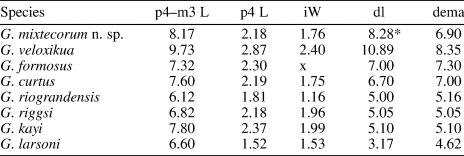
Mandibular and lower teeth measurements (in mm) of Gregorymys species. p4–m3 L = alveolar length of p4–m3, p4 L = length of p4, iW = width of i, dl = diastemal length, dema = depth of mandible at m1 level, x = missing value, *= measured in a single specimen.

The ventral masseteric crest is well developed (Fig. 3.2, 3.5, 3.8, 3.11), as in G. veloxikua and G. formosus (Whalert and Souza, Reference Wahlert and Souza1988; Jiménez-Hidalgo et al., Reference Jiménez-Hidalgo, Guerrero-Arenas and Smith2018a), whereas the masseteric fossa is deep, as in G. riggsi (Wood, Reference Wood1936). The mental foramen is anterior to the p4 and ventral to the diastema, as in G. veloxikua and G. larsoni (Munthe, Reference Munthe1977; Jiménez-Hidalgo et al., Reference Jiménez-Hidalgo, Guerrero-Arenas and Smith2018a).
Lower dentition
The mean width of the incisors is similar to that of G. curtus and smaller to that of G. veloxikua (Tables 3, 4). Diastemal length of specimen UMPE 692 is somewhat smaller than that of G. veloxikua, although it is larger than that of the other species of the genus (Table 4).
The mean length of the p4–m3 is smaller than that of G. veloxikua and larger than that of the other species in the genus (Table 4). As in the upper teeth, the lower molars decrease in size from m1 to m3, being wider than they are long, which is a common condition of the species of Gregorymys (Wood, Reference Wood1936).
The p4 is the largest of the cheek teeth; it is ~30% larger than the m1. This tooth has three cuspids on the metalophid (Fig. 3.1, 3.4); the metaconid is the largest cuspid and the protoconid and the protostylid are subequal in size. In nine slightly worn p4s, the number of anterostylids could be observed; eight have only one anterostylid and one p4 has two anterostylids. In G. veloxikua, the number of anterostylids varies from two to four; in G. curtus, there are three large anterostylids and two small ones; in G. riggsi and G. larsoni, there are three anterostylids (Wood, Reference Wood1936; Jiménez-Hidalgo et al., Reference Jiménez-Hidalgo, Guerrero-Arenas and Smith2018a). The hypolophid has three cuspids, with the entoconid and the hypoconid subequal in size; both are larger than the hypostylid.
In the molars, the metalophid and the hypolophid have three cusps each; the molars have a well-developed anterolabial cingulid located between the protoconid and the protostylid that is connected to these cusps as the dental wear progresses (Fig. 3.1, 3.4, 3.7, 3.10). The protostylid is more distally situated in G. mixtecorum n. sp. than it is in G. curtus, and the anterolabial cingulid is more prominent than in G. curtus, G. veloxikua, or G. larsoni.
Upper and lower molars have mesodont crowns and undulating enamel bases, as in all other species of Gregorymys (Flynn et al., Reference Flynn, Lindsay, Martin, Janis, Gunnell and Uhen2008).
Etymology
Species name is dedicated to the inhabitants of the Mixteca Region of Oaxaca.
Materials
UMPE 319, partial skull with right and left P4–M2, without nasals and the caudal part of skull; UMPE 671, maxillaries with right P4–M1 and left P4–M3; UMPE 693, left premaxilla with I and maxillary with P4; UMPE 712A, right maxilla with P4–M2; UMPE 712B, left maxilla with M2–M3; UMPE 178, partial right lower jaw with p4–m3; UMPE 278D, partial left lower jaw with p4–m3; UMPE 305A, right edentulous partial lower jaw; UMPE 346, left partial lower jaw with p4–m2; UMPE 365, right partial lower jaw with p4–m1; UMPE 403, left partial lower jaw with i, p4–m3; UMPE 636, partial right lower jaw with p3–m3; UMPE 680, partial lower jaw with p4–m1; UMPE 686, partial lower jaw with p4–m3; UMPE 692, left partial lower jaw with i, p4–m1; UMPE 710, left partial lower jaw with p4–m3; UMPE 711B, left partial lower jaw with p4–m2; UMPE 712C, partial lower jaw with m1–m3; UMPE 715, right partial lower jaw with m1; UMPE 716, right partial lower jaw with p4–m1; UMPE 717A, right partial lower jaw with p4–m2; UMPE 717B, left partial lower jaw with p4–m3; UMPE 778, left partial lower jaw with p4–m3; UMPE 779, partial right lower jaw with m1; UMPE 937, partial left lower jaw with p4–m3; UMPE 938, partial lower jaw with p4–m1.
Remarks
Gregorymys mixtecorum n. sp., from the Arikareean 1 (early Oligocene) of Oaxaca, southern Mexico, has a unique combination of character states (see diagnosis and comparative description) that differs from any known species of Gregorymys. This allowed us to erect a new species within the genus. As expected, this new species is phylogenetically close to G. veloxikua, the other early Oligocene Gregorymys species recorded from southern Mexico (see phylogenetic analysis).
The specimen UMPE 278D was originally referred to G. veloxikua, but its size and proportions indicate that it belongs to G. mixtecorum n. sp.
Results
Phylogenetic analysis
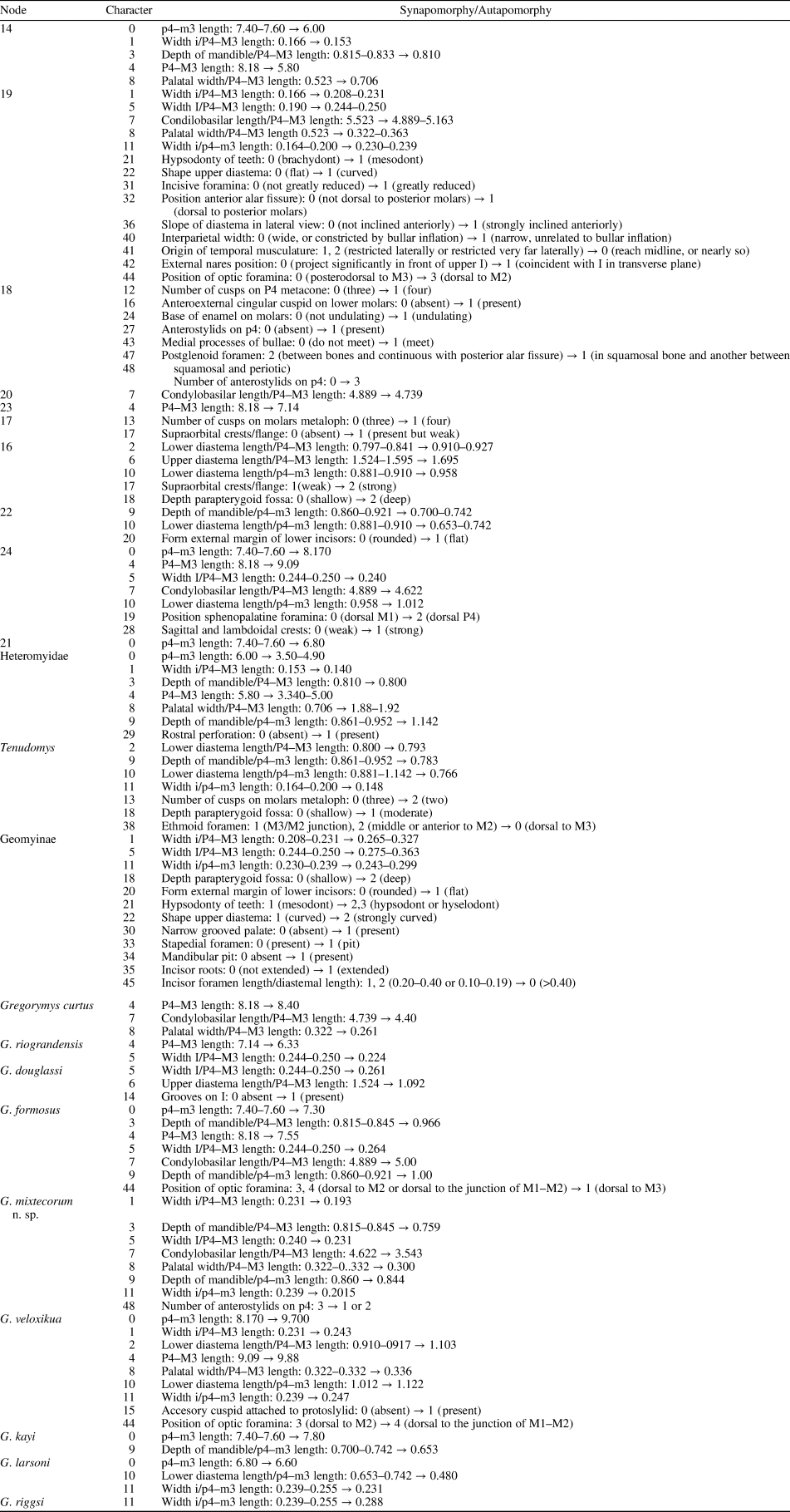
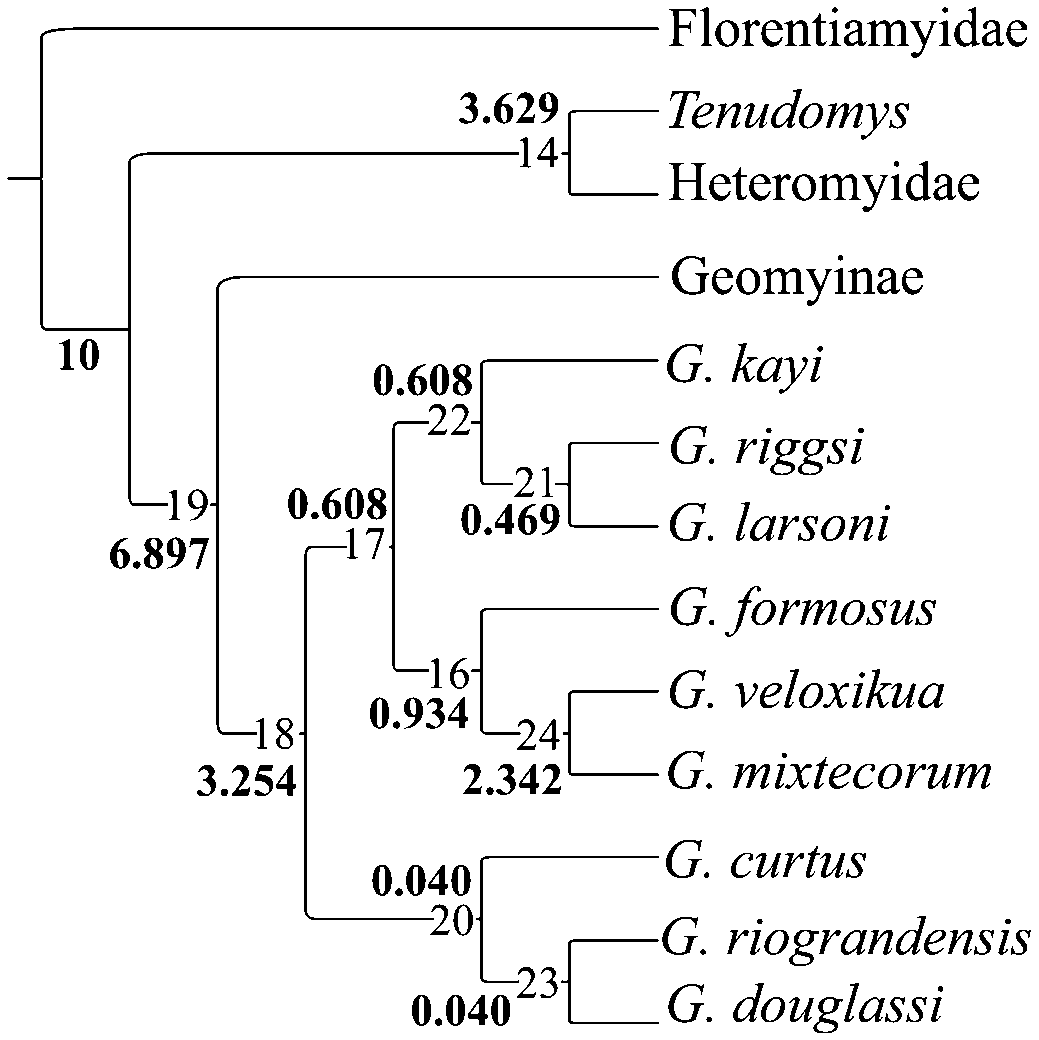
The phylogenetic analysis resulted in one most parsimonious tree of 94.784 steps with a consistency index (CI) of 0.751, and retention index (RI) of 0.722. Synapomorphies and autapomorphies of each node and taxa are listed in Table 5, and the phylogenetic tree is shown in Figure 5.
Number of nodes and characters with synapomorphies/autapomorphies of the phylogenetic tree of Gregorymys species.

Geomyidae is supported by 14 synapomorphies related to cranial and mandibular features (node 19). The family splits into two clades: one is the subfamily Geomyinae, which has 12 autapomorphies, and the other is a monophyletic group comprising all the species of Gregorymys (node 18), which have seven synapomorphies related to dental and cranial characters (Table 5).
Within the Gregorymys clade there are three groups. The first contains G. curtus, G. riograndensis, and G. douglassi, and is supported by one synapomorphy (Table 5, node 20). The second includes G. formosus, G. mixtecorum n. sp., and G. veloxikua, supported by five synapomorphies (Table 5, node 16) related to the proportions of upper and lower diastemal length, proportions of upper and lower dental series length, and cranial features. The third is formed by G. kayi, G. larsoni, and G. riggsi, which is defined by three synapomorphies (Table 5, node 22), all of them related to features of the mandible and lower incisors.
Gregorymys mixtecorum n. sp. is the sister species of G. veloxikua (Table 5, node 24), supported by seven synapomorphies, variously related to the lower and upper teeth row length, to the ratios of the upper incisors width, condylobasal length, and lower diastema length, as well as the position of the sphenopalatine foramina and sagittal and lambdoidal crests. There are seven autapomorphies that diagnose G. mixtecorum n. sp., which are related to the proportions of the incisors, the depth of the mandible, the size of skull, and the number of anterostylids on the p4 (Table 5, Fig. 4).
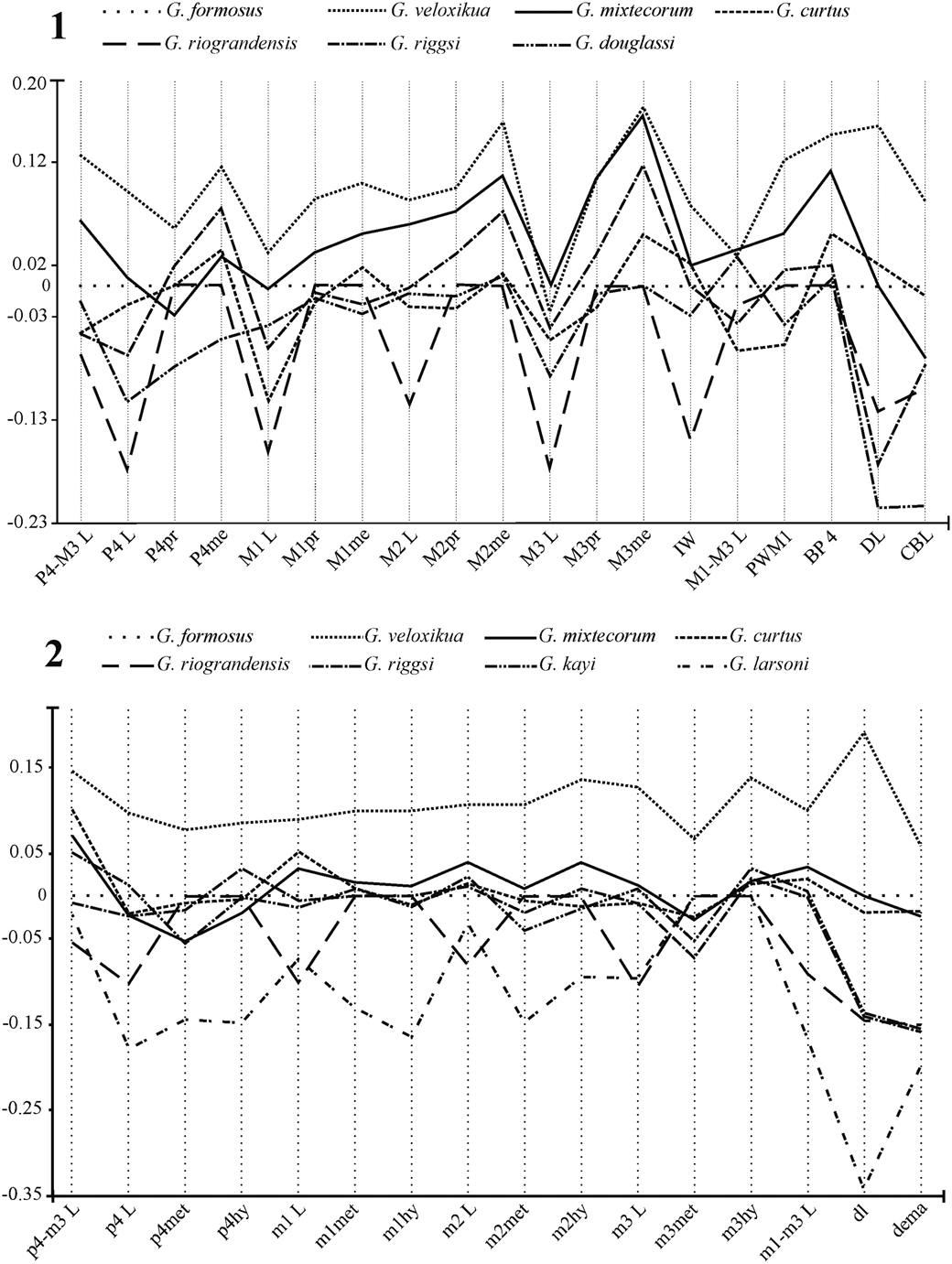
Simpson's Log-ratio diagrams of the species of Gregorymys. The reference species is G. formosus: (1) skull measurements, P4–M3 L = alveolar length of P4–M3 series, P4L = length of P4, P4pr = width of P4 protoloph, P4me = width of P4 metaloph, M1 L = length of M1, M1pr = width of M1 protoloph, M1me = width of M1 metaloph, M2 L = length of M2, M2pr = width of M2 protoloph, M2me = width of M2 metaloph, M3 L = length of M3, M3pr = width of M3 protoloph, M3me = width of M3 metaloph, IW = width of I, M1–M3 L = occlusal length of M1–M3 series, PWM1 = palatal width between alveoli of M1, BP4 = maximum maxillaries breadth at P4 level, DL = diastema length, CBL = condylobasilar length. (2) Mandibular measurements, p4–m3 L = alveolar length of p4–m3 series, p4 L = length of p4, p4met = width of p4 metalophid, p4hy = width of p4 hypolophid, m1 L = length of m1, m1met= width of m1 metalophid, m1hy = width of m1 hypolophid, m2 L = length of m2, m2met = width of m2 metalophid, m2hy = width of m2 hypolophid, m3 L = length of m3, m3met = width of m3 metalophid, m3hy = width of m3 hypolophid, m1–m3 L = length of m1-m3 series, dl = diastemal length, dema = depth of mandible at m1 level.

Bremer support indicates that the best-supported nodes in our phylogenetic hypothesis are those of the close relationship between Tenudomys and Heteromyidae, the monophyly of Geomyidae and the monophyly of Gregorymys, and the sister relationship of G. velokikua and G. mixtecorum n. sp. (Fig. 5).
Most parsimonious phylogenetic tree of selected geomyoid taxa and the Gregorymys species (90.784 steps, CI = 0.751, and RI = 0.702). The plain numbers are node's number. Numbers in bold are Bremer supports.

Discussion
Gregorymys mixtecorum n. sp. can be confidently included in the genus Gregorymys based on its mesodont teeth and undulating base of enamel, its P4 larger than M1, with multicusped protoloph, its p4 larger than m1, with an anterior cingulid and an hypolophid with three cusps, the transverse lophs of lower cheek teeth that join initially on the labial side, the transverse lophs of upper cheek teeth joining initially on the lingual sides, and the formation of central enamel lakes in the upper and lower molars after wear (Wood, Reference Wood1936; Flynn et al., Reference Flynn, Lindsay, Martin, Janis, Gunnell and Uhen2008).
Unlike G. mixtecorum n. sp., Ziamys is smaller in size, has a short and broad rostrum, a short diastema, lower-crowned cheek teeth, has cusps that merge late in wear, upper incisors with a medial groove or central and medial grooves, a p4 with an anteroposteriorly elongated protostylid, has lophs of lower molars lacking marginal connections, transverse lophs of molars that join centrally in late wear, and P4 with unicuspid protolophs (Gawne, Reference Gawne1975; Korth, et al., Reference Korth, Bailey and Hunt1990). Gregorymys mixtecorum n. sp., also differs from Pleurolicus because this genus has weak longitudinal grooves in the upper and lower incisors, a relatively short p4 without an anterior cingulum, a P4 with a transversely narrower protoloph than metaloph, and with transverse lophs that join late in wear, as well as upper molars with weak anterior cingula (Rensberger, Reference Rensberger1973; Korth et al., Reference Korth, Bailey and Hunt1990; Flynn et al., Reference Flynn, Lindsay, Martin, Janis, Gunnell and Uhen2008). Gregorymys mixtecorum n. sp. also differs from Entoptychus, which has a very elongate rostrum, high-crowned teeth, upper incisor with a medial groove, well-developed dentine tracts (which are not present in earliest Entoptychus species), and p4 with a weak anterior cingulum (Rensberger, Reference Rensberger1971; Korth, Reference Korth1992; Flynn et al., Reference Flynn, Lindsay, Martin, Janis, Gunnell and Uhen2008).
The identification of a new Gregorymys species in the early Oligocene of southern Mexico indicates that at least two gopher species (G. mixtecorum n. sp. and G. veloxikua) inhabited northwestern Oaxaca during the Arikareean 1. A similar pattern is observed in the Great Plains, where Gregorymys formosus and G. curtus were recorded from the Arikareean 2 to the Arikareean 4 in the Rosebud Formation (South Dakota) and, during Arikareean 4, G. riggsi is also recorded in the same formation (Flynn et al., Reference Flynn, Lindsay, Martin, Janis, Gunnell and Uhen2008). Thus, it is not uncommon to find two or three gopher taxa cohabiting in the same geographic area.
The observed differences in size and anatomical proportions (Fig. 4) between sympatric gopher species from southern Mexico and those from the Great Plains would allow for reduced competition for resources: these species were probably exploiting different microhabitats.
Gregorymys mixtecorum n. sp. and G. veloxikua represent the oldest species of Gregorymys in North America; both were collected from sediments with a maximum depositional age of 30.6 ± 0.77 Ma that were biochronologically dated between 28–29 Ma, and which also are overlain by volcanic rocks dated 27.77 ± 0.7 Ma (see geologic setting). In the Great Plains, Gregorymys formosus from the upper part of the Rosebud Formation (Wounded Knee/Monroe Creek fauna) in South Dakota was the oldest record of Gregorymys in North America (Flynn et al., Reference Flynn, Lindsay, Martin, Janis, Gunnell and Uhen2008), with an estimated age of 27.9 Ma (Carrasco et al., Reference Carrasco, Kraatz, Davis and Barnosky2005). These three oldest species within the genus are closely related in our phylogenetic hypothesis (Fig. 5). This indicates that cladogenesis within the Gregorymys lineage took place first in tropical North America (southern Mexico) and later in temperate North America (Great Plains) during the early Arikareean (early Oligocene). This diversification pattern suggests that some entoptychine gophers evolved first in Mexico or Central America.
The records of Gregorymys mixtecorum n. sp. and G. veloxikua extend the geographic distribution of Gregorymys southward by more than 1,400 km, from the Castolon Local Fauna of Texas to Santiago Yolomécatl in Oaxaca, southern Mexico.
Acknowledgments
We thank the municipal authorities and landowners of Santiago Yolomécatl for the permits to prospect their lands. We acknowledge the academic and administrative authorities of Universidad del Mar for logistic support. Thanks to the students and colleagues that helped during the field seasons. We appreciate the thoughtful reviews of W.W. Korth and the Associate Editor, which helped to improve this paper. We thank the Editor, H.-D. Sues, for the suggested final corrections. This research was funded by CONACYT, Ciencia Básica 2015-01 project No. 255883, “Asociaciones faunísticas y ambientes de depósito de las localidades fosilíferas continentales del Eoceno tardío de la Mixteca alta oaxaqueña” and Universidad del Mar project “La microfauna del Oligoceno temprano de Santiago Yolomecatl, Oaxaca.” Last but not least, we appreciate the kind support of N.M. Morales-García (Bristol University, UK) for the linguistic review.
Appendix 1. Character matrix used in the phylogenetic analysis of the Gregorymys species.
Continuous characters

Discrete characters