INTRODUCTION
A number of polychaete species are able to build reefs on stabilized hard substrata. These reefs are considered local hotspots of biodiversity; they are nursery grounds for juvenile fish and provide refuge and substrate to an array of organisms including invertebrates and fishes. Surveys have recorded a higher species number of decapods and stomatopods (Gore et al., Reference Gore, Scotto and Becker1978), isopods and amphipods (Nelson & Demetriades, Reference Nelson and Demetriades1992), and fish (Gilmore, Reference Gilmore1977; Lindeman & Snyder, Reference Lindeman and Snyder1999) within or adjacent to worm reefs compared to other habitats (Kirtley, Reference Kirtley1968; Gore et al., Reference Gore, Scotto and Becker1978; Zale & Merrifield, Reference Zale and Merrifield1989; Lindeman & Snyder, Reference Lindeman and Snyder1999).
The Sabellariidae Johnston, 1865, placed within the Sabellida (Rouse & Fauchald, Reference Rouse and Fauchald1997), comprises non-colonial or colonial tube-dwelling and filter-feeding marine polychaetes, which occur from shallow to deep waters (Uebelacker, Reference Uebelacker, Uebelacker and Johnson1984). Colonies are formed by mass settlement (Eckelbarger, Reference Eckelbarger1977) and aggregates of tubes are capable of colonizing wide areas along the coast (Pawlick, 1988). Sabellariids build tubes made of sand and mucous secretions, which attach to a variety of substrata, including rocks, seaweeds or invertebrates (Uebelacker, Reference Uebelacker, Uebelacker and Johnson1984; Hutchings, Reference Hutchings, Beesley, Ross and Glasby2000; Morgado & Tanaka, Reference Morgado and Tanaka2001; Pérez et al., Reference Pérez, Vila-Nova and Santos2005); their occurrence in coralline beds was recently reported in Brazilian subtidal waters (Santos et al., Reference Santos, Riul, Brasil and Christofferesen2010). Six species of Sabellaria Savigny, 1818 have been found in the south-western Atlantic Ocean: S. bella Grube, 1870; S. bellis Hansen, 1882; S. corallinea Santos et al., Reference Santos, Riul, Brasil and Christofferesen2010; S. nanella Chamberlin, 1919; S. pectinata Fauvel, 1928; and S. wilsoni Lana & Gruet, 1989. All of them were recorded in Brazil (Espírito Santo, Rio de Janeiro, Santa Catarina and Paraná States, 20–32°S, and Paraíba State, 7°S). Three species were collected in southern latitudes: S. bellis (Uruguay, 34–35°S), S. nanella (Argentina, 39°S) and S. wilsoni (Argentina, 38–39°S) (Bremec & Lana, Reference Bremec and Lana1994; Lana & Bremec, Reference Lana, Bremec, Dauvin, Laubier and Reish1994; Bremec & Giberto, Reference Bremec and Giberto2004; Chiaradia et al. Reference Chiaradia, Marchesi, Azzone, San Martin, Giberto, Bremec and Elías2007; Santos et al., Reference Santos, Riul, Brasil and Christofferesen2010).
Sabellaria nanella was already known as a solitary species from subtidal hard bottoms (10 m) located in the present study area. In this study, we report the first intertidal worm reefs of S. nanella discovered at 39°S in Monte Hermoso, Argentina and we give features (granulometry, organic matter content, dimensions and shape) that describe the reefs. We study the population size-structure of worms and the invertebrate fauna associated with the reefs.
Study area
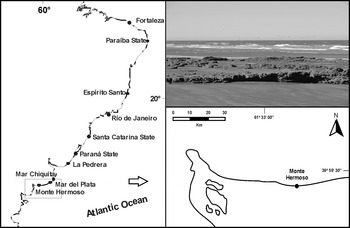
The study area is located at 38°59′S–61°15′W (Monte Hermoso, Argentina) (Figure 1). This is a continuous dissipative sandy beach, ~32 km long, backed by a fringe of dunes, with gentle slope (0.5° to 2°), medium to fine sand (grain size: 0.21 to 0.32 mm), strong wave action (height: 0 to 2 m) and high salinity (36.1). It is a mesotidal beach, with mean and maximum tide amplitudes 2.45 m and 3.61 m respectively. The mean annual seawater temperature fluctuates between 6°C (winter) and 19°C (summer) (Fiori, Reference Fiori2002). The wide intertidal fringe, more than 100 m, is interrupted by ledge of rocks in the west. Sabellaria nanella reefs develop on the stony rock.
Localities on the south-west Atlantic coast where species of sabellariids were recorded and sampling site in Buenos Aires province, Argentina.

MATERIALS AND METHODS
Samplings were made in May 2009 and in April 2010, during low tide, in a rocky outcrop located in the intertidal of Monte Hermoso (38°59′S 61°20′W). Length, width and height of the reefs located on this site were measured. The rocky outcrop area was measured with GPS in both years to assess fluctuations in the availability of settlement substrate.
Two reef samples and two sand samples (collected close to the stony rock) were taken in 2010 to develop sediment analyses. Samples were taken with a core of 5.5 cm of diameter. Reef samples were disaggregated and all specimens were removed. The sediments of reef and sand samples were dried in a stove (60°C). Mechanical sieving was made with a series of ten Standard Tyler sieves with decreasing mesh size to obtain the proportion of the main sand fractions in the Wentworth scale (very coarse, coarse, medium, fine and very fine sand, mud). Mean grain size was calculated following the method of Folk & Ward (Reference Folk and Ward1957). Sand samples and reef samples were compared to analyse if worms select grain size to build tubes (Chi square (χ 2) test). The organic matter (OM) contents of all the samples were determined by the wet oxidation method (Walkley & Black, Reference Walkley, Black and Black1965) to assess if the reef structure retains more OM than the surrounding areas (organic enrichment).
Biological samples (five replicate cores of 5.5 cm diameter and 15 cm long) were taken in 2009 and 2010 in one of the reefs at the 1 km site. The samples were fixed in a 4% formaldehyde solution with seawater. At the laboratory, the samples were disaggregated under seawater and the material was sieved through a 500 µm mesh; retained worms and associated fauna were sorted, identified and counted under binocular microscope and preserved in alcohol 70°.
Population size-structure of worms was studied from the biological samples taken in 2009. Total length, including caudal region was measured (N = 333) using an ocular micrometer attached to a stereoscopic microscope, and divided into 21 size-classes. The size-classes ranged from 0.5 mm to 21 mm, 0.5 mm interval each class. Size–frequency distribution histogram was analysed to recognize dominant size-groups using the Bhattacharya method (FISAT II software).
RESULTS
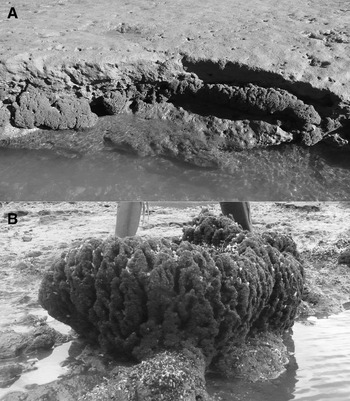
The exposed area of the rocky outcrops in the study site was 1293 m2 in 2009 and 717 m2 in 2010. Eleven reefs conformed by straight sandy tubes were located in different pools at the intermediate and low rocky intertidal zone selected in this study. The reefs showed two typical morphologies: elongated and circular. Elongated reefs developed on the lateral walls of the stony rock, reached 300 cm length, 40 cm width and 10 cm height. Circular reefs developed in concentric shape on the horizontal surface of the outcrops and reached 60 cm diameter and 30 cm height (Figure 2).
Reefs of Sabellaria nanella located at Monte Hermoso, Argentina: (A) elongated shape; (B) circular shape. Photographs: Sandra Fiori.

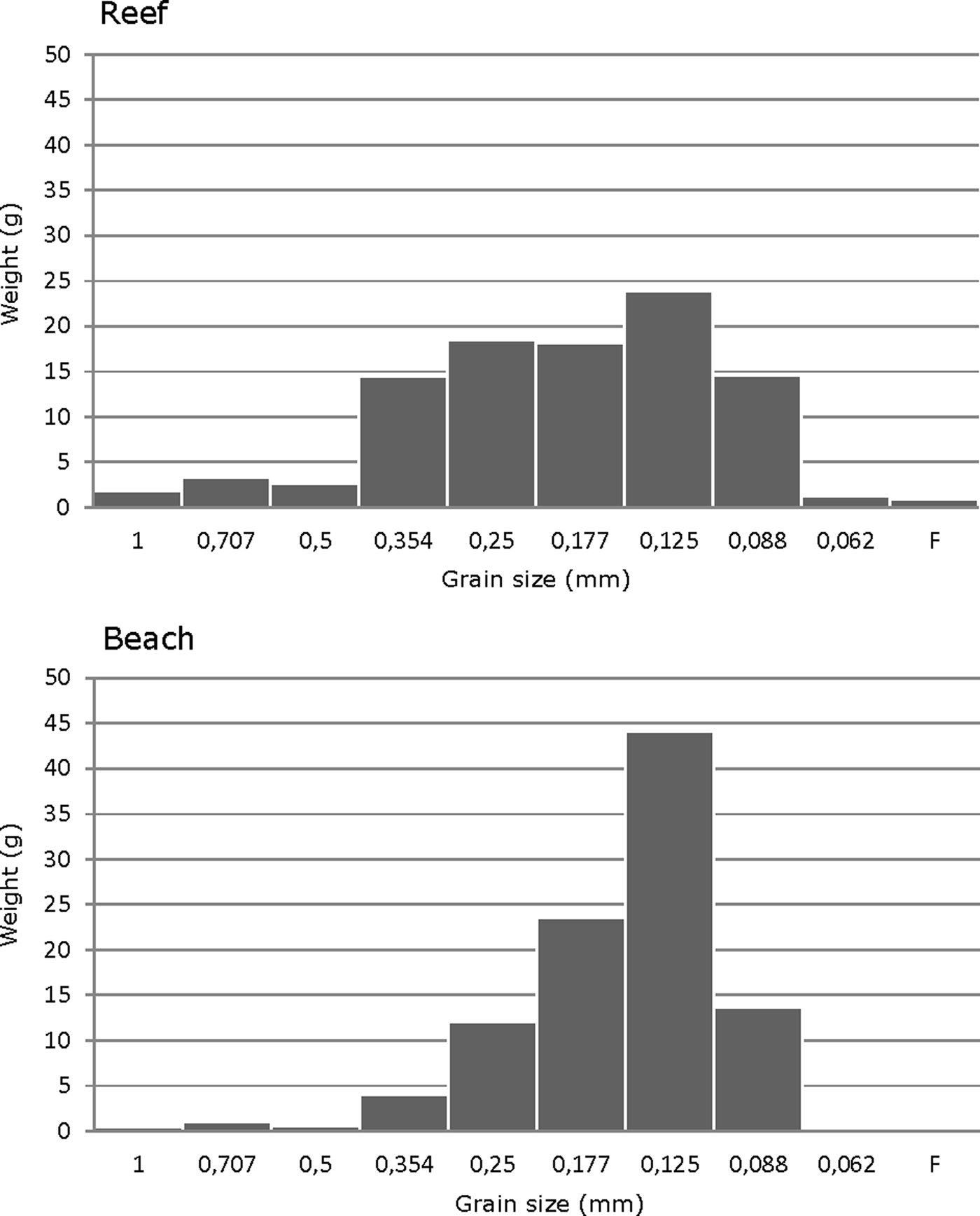
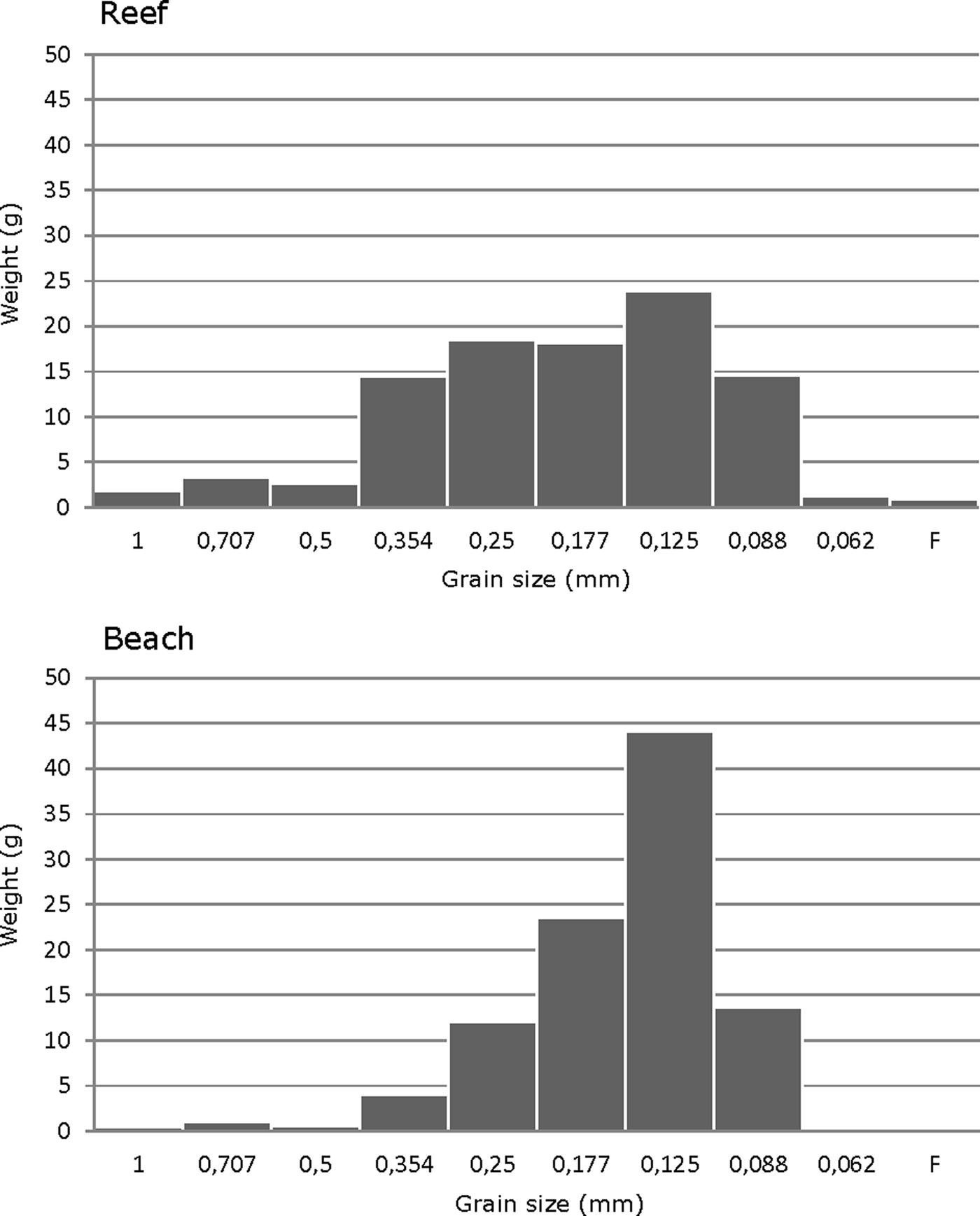
The results of the sedimentary analysis indicate significant differences between the sand in the tubes and the sand on the beach (χ 2 = 18.97; P = 0.02). The tubes contain a higher percentage of medium grain size (35.54%) than the beach (16.67%) (Figure 3). OM contents were higher (7%) in the tubes than in the surrounding sand (3%).
Histograms of sand samples taken from the beach and from Sabellaria nanella reef, showing weight (g) of each fraction of sediment.
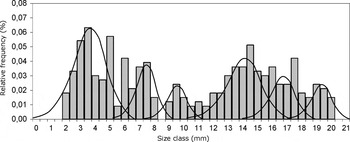
Total length of worms ranged between 1.66 and 21.42 mm. The size distribution of worms reveals multiple size cohorts (~6 cohorts) that included recent recruits and mature adults (Figure 4).
Size–frequency distribution of the population of Sabellaria nanella sampled in May 2009 at Monte Hermoso, Argentina.

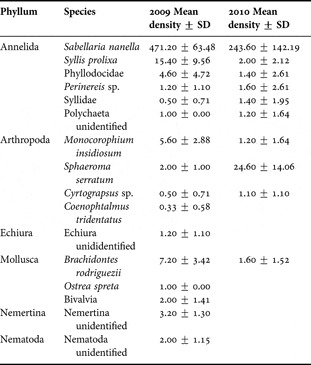
The associated fauna included annelids, arthropods, molluscs, nemerteans and nematodes (Table 1). Polychaeta were most abundant, followed by crustaceans and bivalves. Based on numerical abundance, S. nanella contributed with more than 85% to the total number of individuals in both years. Mean density of this species was estimated in 19.84 ± 2.67 individuals per cm2 in 2009 and 10.26 ± 5.99 individuals per cm2 in 2010.
List of invertebrate taxa associated with Sabellaria nanella intertidal reefs at Monte Hermoso, Argentina.

SD, standard deviation.
DISCUSSION
This study reports the presence of S. nanella in dense aggregates covering intertidal rocky outcrops located at nearly 39°S, Argentina. All previous records of the species in Argentina correspond to solitary specimens collected from shallow depths, 10 m, in rocky bottoms of Monte Hermoso (Bremec & Lana, Reference Bremec and Lana1994). It was never recorded in shelf areas intensively sampled in the Argentine Biogeographical Province (Bremec & Giberto, Reference Bremec and Giberto2004, Reference Bremec and Giberto2006). Previous records of this species in other south-west Atlantic areas correspond to the intertidal of Fortaleza, Brazil (27°S) and La Pedrera, Uruguay (34°S) (Kirtley, Reference Kirtley1994) and Espírito Santo, Rio de Janeiro (Lana & Bremec, Reference Lana, Bremec, Dauvin, Laubier and Reish1994) and Paraiba States, Brazil (Santos et al., Reference Santos, Riul, Brasil and Christofferesen2010). Lana & Bremec (Reference Lana, Bremec, Dauvin, Laubier and Reish1994) suggested that the disjunct distribution of the South American sabellariid fauna is in fact an actual zoogeographical pattern. This fact was analysed from another point of view that considers S. nanella is an invasive polychaete. The scattered records of the species in subtidal and intertidal habitats (USA, Ecuador, Uruguay, Brazil and Argentina) suggested the possibility of dispersal by means of attachment of colonies to hulls of ships (Kirtley, Reference Kirtley1994).
Reefs presented two morphologies in the study site, elongated and circular, and some of them reached 3 m length; other prospections indicate that they are largely extended all along 20 km of sandy beaches with stony rock in neighbouring areas (S. Fiori, personal observation). Sabellariidae are highly competitive fast colonizers, characterized by a long lifespan and high fecundity and dispersal capability (Giangrande, Reference Giangrande1997). The presence and reef-building capacity of the species, not registered previously in the intertidal zone, strongly influenced by tides and storms (Caló et al., Reference Caló, Fernández, Marcos, Aldacour and Varela2000, Reference Caló, Fernández, Marcos and Aldacour2005), indicates its adaptation to environments with different physical conditions (subtidal and intertidal zones). It is interesting to point out that although both S. wilsoni and S. nanella were collected in the subtidal of the study location (Lana & Bremec, Reference Lana, Bremec, Dauvin, Laubier and Reish1994), only the latter settled in the intertidal and developed reefs.
It is well known that gregarious species colonize wide areas along the coast and dominate in abundance (Pawlick, 1988). The development of S. nanella seems to be very successful on Monte Hermoso beach; the species properly selected suitable building sand for the production of tubes and reefs, which generate a matrix of organic matter favourable for the development of a variety of associated invertebrates. Previous studies show that the colonies constitute valuable habitats for other organisms, favouring species richness or providing feeding grounds (Wilson, Reference Wilson1971; Kirtley, Reference Kirtley1994). We sorted a total of 15 taxa; the 6 most abundant taxa were collected in both sampling periods. Eleven of the associated species were previously registered in the intertidal mytilid Brachidontes rodriguezii (d'Orbigny, 1846) community in the study area (dos Santos et al., 2009) and in other localities of the Buenos Aires province, i.e. Necochea (Adami et al., Reference Adami, Tablado and López-Gappa2004) and Mar del Plata (Vallarino, Reference Vallarino2002). The number of species collected in other reefs worldwide was higher than those collected in the present samplings, reaching more than 70 taxa in many cases, and included a variety of crustaceans, molluscs, polychaetes, bryozoans, anthozoans and fishes (Gilmore, Reference Gilmore1977; Gore et al., Reference Gore, Scotto and Becker1978; Posey et al., Reference Posey, Pregnall and Graham1984; Caline et al., Reference Caline, Gruet, Legendre, Le Rhun, L'Homer, Mathieu and Zbinden1992; La Porta & Nicoletti, Reference La Porta and Nicoletti2009).
The presence of polychaete reefs on the Buenos Aires seashore has been unexpectedly registered during recent years. Sabellaria wilsoni aggregations, between 20 and 30 cm height and nearly 100 cm in diameter, were found in pools at the upper rocky intertidal of Mar del Plata (38°S) in 2006 (Chiaradia et al., Reference Chiaradia, Marchesi, Azzone, San Martin, Giberto, Bremec and Elías2007) and a solitary specimen of the same species was found in the Mar Chiquita coastal lagoon (37°40′S) in 2001, associated with the most austral reefs of F. enigmaticus (Obenat, Reference Obenat2002; Bremec & Giberto, Reference Bremec and Giberto2004). In both cases, the colonized habitats are strongly influenced by tides and historical information does not report the presence of the species in littoral zones (Olivier et al., Reference Olivier, Escofet, Orensanz, Pezzani, Turró and Turró1966; Elías & Bremec, Reference Elías, Bremec, Boschi and Cousseau2004). Other recent observations in the region (Mar del Plata, 38°S) report large biogenic reefs of Boccardia proboscidea (Hartman, 1940) and the presence and stability of the reefs was related to increased organic contamination as a structuring factor (Jaubet et al., Reference Jaubet, Sánchez, Rivero, Garaffo, Vallarino and Elías2011).
Larval settlement seems to be induced by the presence of conspecific reefs in gregarious species; larvae of a reef-forming sabellariid responded first to proper flow conditions and then to chemical cues that induced metamorphosis under experimental small spatial scales (Pawlik, Reference Pawlik1988; Pawlik et al., Reference Pawlik, Butman and Starczak1991). The desperate larvae hypothesis (Toonen & Pawlik, Reference Toonen and Pawlik1994) suggests that all larvae of a gregarious species should initially delay metamorphosis while searching for a suitable habitat, but could eventually colonize a new substratum if unsuccessful in locating conspecifics. This hypothesis is supported from studies of sessile and filter feeding polychaetes; presence of adults may indicate suitable abiotic (e.g. tidal height) and biotic (e.g. absence of predators) conditions but, in principle, any hard substratum offers such species an attachment site and the opportunity to feed. A juvenile isolated on a bare rock can filter-feed in the absence of conspecifics, and if it survives long enough for other larvae to settle on it or nearby, it may obtain access to mates (Botello & Krug, Reference Botello and Krug2006). Results from models of habitat choice suggest that a combination of the length of time available to search and the frequency and relative payoff of optimal habitat in the environment exert the greatest influence on individual settlement of competent larvae. In absence of strong habitat specialization, once encounter rates for the optimal habitat have decreased to the point that some larvae complete the planktonic period without ever encountering the optimal habitat, the model predicts that selection should result in larvae having variable settlement preferences (Toonen & Tyre, Reference Toonen and Tyre2007). For feeding larvae, local food availability in the plankton should strongly affect the benefits of delaying metamorphosis in the absence of settlement cues, and habitat choice for most organisms is clearly a dynamic process leading to an adaptive strategy to avoid direct and deferred costs (larval energy use) (Elkin & Marshall, Reference Elkin and Marshall2007).
In the case of S. nanella reefs at 39°S along the coast of Buenos Aires, the findings show that trophic availability, together with local nearshore patterns of circulation and larval transport, permitted the species to colonize new coastal areas. Sabellaria nanella intertidal reefs were discovered in 1995 at Monte Hermoso and in 2000 at Pehuen Có, becoming conspicuously extensive during recent years (G. Perillo, personal communication; S. Fiori, personal observation). The increment of stony rock areas on the beach is a phenomenon produced by marine erosion that is affecting the coastline in the littoral of Buenos Aires. The settlement of S. nanella in the intertidal fringe is favoured by this erosive process, which is particularly intensive on Monte Hermoso beach (Vaquero et al., Reference Vaquero, Pascale and Ercolani2004). Both hydrodynamic and sedimentological regimes play a role in promoting, or restricting, the distribution of sabellariid reefs into intertidal zone (see Kirtley, Reference Kirtley1994). Once settled on intertidal, S. nanella should adapt not only to desiccation periods and physical impact of waves, but also to anoxia or hypoxia when they remain buried during the periods of accumulation of sand. One of these periods was recorded in the sampling of 2010 when both a smaller exposed stony rock area and a lower density of individuals than the year before were estimated. These results could indicate that the sedimentary dynamics is a structuring factor to the community.
Recent studies of other reef-building polychaetes conclude that the main biological factor that may positively or negatively affect their structural development is the reproduction and recruitment mechanism of the pelagic larvae, still dominated and oriented by physical factors associated with hydrodynamics (Gruet, Reference Gruet1986; La Porta & Nicoletti, Reference La Porta and Nicoletti2009; Culloty et al., Reference Culloty, Favier, Riada, Ramsay and O'Riordan2010). The S. alveolata reef's development in European littoral was summarized in different periods: primary settlement phase; growth phase; stagnation phase; and destruction phase (Gruet, Reference Gruet1986). Some of the biological features observed in the present study are characteristic of the growth phase: parallel tube orientation; numerical abundance of S. nanella; size structure with multiple size cohorts (presence of recruits and mature adults); and, although reduced and covered by sand, the general morphology of the reefs did not show signs of destruction or changes of colour. The phase is a result of a constantly disturbed and precarious balance between biological and physical factors, hence it is controversial to assign any period of development to the reefs studied at Monte Hermoso beach, where dense aggregations conforming to well-developed reefs on stony rocks were found.
ACKNOWLEDGEMENTS
This research is dedicated to our friend Dim. This work was supported by Agencia Nacional de Promoción Científica y Tecnológica (M.C.P. PICT 1202- and C.B. Pict 2007-02200) and Secretaria de Ciencia y Técnica de la Universidad Nacional del Sur (S.M.F. PGI 24/ZB40). This is INIDEP Contribution No. 1730.